Immigration Documents Checklist for Florida
Navigating immigration processes in Florida requires a comprehensive checklist of documents. This guide helps you gather all necessary paperwork to ensure a successful application. Consult Florida Immigration Lawyers for personalized assistance.

- Identification is essential
- Financial records are required
- USCIS forms must be complete
- Check for local requirements in Homestead, FL
- Consult an attorney for personalized guidance
Immigrating to Florida, particularly in areas like Homestead, can be a complex process filled with extensive documentation requirements. Ensuring you have the correct immigration documents is crucial to avoid delays or denials in your application. This guide provides a detailed checklist to help you gather all necessary paperwork.
If you're feeling overwhelmed, Florida Immigration Lawyers can assist you. Call 1-844-967-3536 for a free consultation.
What Are the Essential Immigration Documents Needed in Florida?
As of 2026, the essential immigration documents required in Florida include personal identification, proof of financial stability, and completed USCIS forms. Each immigrant's situation may demand additional paperwork, depending on their specific case.
Make sure to have your passport, birth certificate, and any previous immigration documents readily available. Financial documents, such as bank statements and tax returns, are also vital. Remember, all forms required by USCIS must be filled out accurately to avoid processing delays.
Beyond these foundational items, specific categories of documents are universally critical. For personal identification, this includes valid passports from your country of origin, national identity cards, driver's licenses (if applicable), and any previous U.S. visa stamps or I-94 arrival/departure records. For financial stability, you will need comprehensive proof, such as recent bank statements (covering several months), federal tax returns (Form 1040) for the past three years, W-2 forms, pay stubs, and letters of employment verifying your position, salary, and duration of employment. If you have a sponsor, their financial documents will be equally important, often requiring a completed Form I-864, Affidavit of Support.
USCIS forms are the backbone of any immigration application. Common forms include Form I-130 (Petition for Alien Relative), Form I-485 (Application to Register Permanent Residence or Adjust Status), Form I-765 (Application for Employment Authorization), Form I-131 (Application for Travel Document), and Form N-400 (Application for Naturalization). It is absolutely critical that every section of these forms is completed accurately and truthfully. Any discrepancies or omissions, even minor ones, can lead to Requests for Evidence (RFEs), delays, or even outright denial. Always refer to the latest version of the forms available on the USCIS website, as they are updated periodically. Florida Immigration Lawyers can help you ensure all forms are correctly filled out and submitted with the necessary supporting documentation.
Furthermore, don't overlook the importance of civil documents such as marriage certificates, birth certificates for all family members involved, divorce decrees, and death certificates, if applicable. These documents prove key relationships and life events that are fundamental to many immigration pathways. For any documents not in English, certified translations are mandatory. A certified translation must include a statement from the translator affirming that the translation is complete and accurate, and that they are competent to translate from the foreign language into English. Keeping multiple copies of all submitted documents, both physical and digital, is a practical tip that can save immense stress down the line.
How to Prepare Your Immigration Documents Checklist for Homestead, Florida?
Preparing your checklist involves organizing and verifying key documents. Begin by gathering personal identification and financial records. Confirm all information matches across documents to prevent issues during your application process.
It's advisable to consult with a legal expert familiar with Homestead's specific requirements. They can provide invaluable guidance on additional documents you might need, such as local affidavits or specific USCIS forms not commonly required in other areas.
To effectively prepare your checklist for Homestead, Florida, start by creating a master list that categorizes documents by type: personal identification, financial, civil, and USCIS forms. As you gather each document, tick it off your list. A practical tip is to create a physical binder with clearly labeled sections for each category, and a corresponding digital folder on your computer or cloud storage. This dual approach ensures both accessibility and backup. For example, if you are applying for adjustment of status based on marriage, you’ll need your marriage certificate, but also proof of cohabitation in Homestead, such as joint utility bills, lease agreements, or property deeds in both names, demonstrating your shared life in the area.
While federal immigration law applies nationwide, local factors can subtly influence your application process. In Homestead, for instance, understanding local government services or community resources might be beneficial for obtaining certain supporting documents or information. Although specific "local USCIS forms" are rare, an attorney familiar with the Homestead area might know of common local practices or expectations that could streamline your application. For example, knowing the nearest USCIS field office or Application Support Center (ASC) and understanding their typical appointment scheduling can save time and reduce anxiety. Florida Immigration Lawyers possess this local insight, helping you navigate these nuances effectively.
A crucial step in preparation is to meticulously review every document for accuracy. Check names, dates, and places against your official identification. A common scenario involves a slight discrepancy in a birth date or a misspelled name between a passport and a birth certificate, which can trigger an RFE. Ensure all documents are current and not expired. For example, if your passport is nearing its expiration date, renew it before submitting your application. Double-checking these details can prevent significant delays. Consider having a trusted friend or family member, or better yet, your attorney, review your completed checklist and documents before submission. This extra layer of scrutiny can catch errors you might have overlooked.
What Documents Are Required for a Family-Based Immigration Application?
Family-based immigration applications typically require documents proving family relationships, such as marriage certificates or birth certificates, along with financial support documents.
In Homestead, Florida, make sure to include any local affidavits that support your family ties. Additionally, completed sponsorship forms and evidence of your ability to financially support the family member are mandatory.
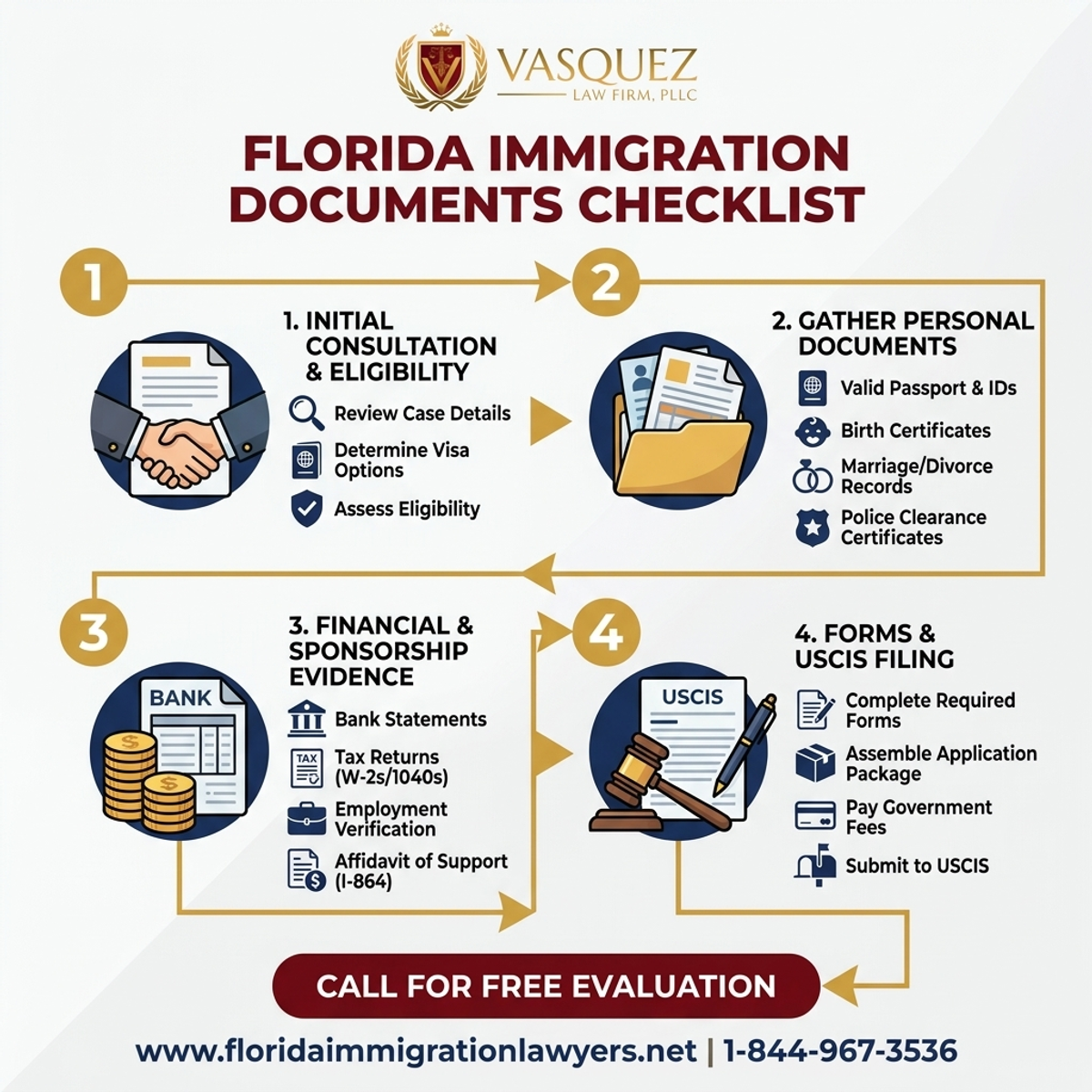
Step-by-Step Process — Immigration Documents Checklist for Florida
For family-based petitions, the core requirement is irrefutable proof of the qualifying relationship. This means providing original or certified copies of civil documents. For spouses, a marriage certificate is paramount, accompanied by evidence of a bona fide marriage, such as joint bank accounts, property deeds, shared insurance policies, photos together, and affidavits from friends and family. For parents sponsoring children, or vice versa, birth certificates are essential to establish the parent-child relationship. If there have been previous marriages, divorce decrees or death certificates for former spouses are necessary to prove the termination of those marriages and the legality of the current one. Adoption decrees are required for adopted children.
Financial sponsorship is another critical component, ensuring the immigrant will not become a public charge. The U.S. citizen or lawful permanent resident petitioner must submit Form I-864, Affidavit of Support, demonstrating income at or above 125% of the federal poverty guidelines for their household size. Supporting documents for the I-864 include federal income tax returns (Form 1040 and all schedules) for the most recent three years, W-2s, 1099s, and recent pay stubs. If the petitioner's income is insufficient, a joint sponsor may be required, who must also submit their own I-864 and financial documentation. Florida Immigration Lawyers can guide you through the complex financial requirements and help prepare a robust affidavit of support.
Beyond the standard federal requirements, specific circumstances in Florida, or even Homestead, might necessitate additional supporting evidence. For example, if a relationship has been questioned or if there's a significant age difference, providing more extensive evidence of a genuine relationship, such as detailed timelines of your relationship, communication records, and travel itineraries, can strengthen your case. Affidavits from community members or religious leaders in Homestead who can attest to the legitimacy of your family ties can also be beneficial. A common pitfall is underestimating the amount of evidence USCIS expects for a bona fide marriage. Always err on the side of providing more evidence rather than less, ensuring a comprehensive package that leaves no room for doubt about your family connection or financial stability. Our team at Florida Immigration Lawyers is adept at identifying and compiling all necessary documentation for a successful family-based application.
How to Organize Your Immigration Paperwork Effectively?
Effective organization is key to a successful immigration application. Use folders or binders to separate different categories of documents. Label each section clearly and keep an index for easy reference.
Consider creating digital copies of all documents and store them securely. This will not only help in quick access but also ensure you have backups in case of loss or damage to original papers.
To truly master your immigration paperwork, a systematic approach is essential. Start by creating a master checklist that mirrors the order of documents required by USCIS for your specific application. For physical organization, invest in sturdy binders with tabbed dividers. Dedicate a section to each major category, such as "Petitioner's Documents," "Beneficiary's Documents," "Financial Support," "Civil Documents," and "USCIS Forms." Within each section, arrange documents chronologically or by relevance. For example, all birth certificates together, all marriage certificates together, and all tax returns in descending order by year. This meticulous arrangement makes it easier for you and USCIS officers to locate specific information quickly.
Digital organization is equally important. Scan every document, ideally in high-resolution PDF format. Create a dedicated folder on your computer, and within it, subfolders mirroring your physical binder's structure. Name files clearly and consistently (e.g., "John_Doe_Passport_BioPage.pdf," "Jane_Smith_Marriage_Certificate.pdf," "Form_I-485_Signed.pdf"). Utilize cloud storage services (like Google Drive, Dropbox, or OneDrive) with strong security features for off-site backups, protecting against loss due to fire, theft, or hard drive failure. Ensure these digital copies are easily accessible, as you may need to refer to them during interviews or if USCIS requests additional information. Keeping a secure, encrypted flash drive with all documents is also a good practice for travel or quick access.
A practical tip for managing your paperwork is to maintain a detailed log of all correspondence with USCIS. This includes dates of submission, tracking numbers, forms submitted, and copies of any receipts or notices received. When sending documents to USCIS, always use a method that provides tracking and delivery confirmation. Never send original civil documents unless specifically requested; certified copies are almost always sufficient. Keep your original documents in a separate, secure location, such as a fireproof safe or a bank safe deposit box. This level of organization not only helps prevent errors and missed deadlines but also provides peace of mind throughout the often lengthy immigration process. Florida Immigration Lawyers emphasize the importance of this meticulous organization and can assist clients in setting up efficient systems for their documentation.
Timeline and Processing Expectations for Immigration Applications
| Stage | Typical Timeframe | Notes |
|---|---|---|
| Document Gathering | 1-3 months | Varies based on personal situation |
| USCIS Filing | 2-12 months | Depends on service center workload |
| Interview Scheduling | 4-8 months | Delays possible due to high demand |
Do not navigate this process alone. Contact Florida Immigration Lawyers today.
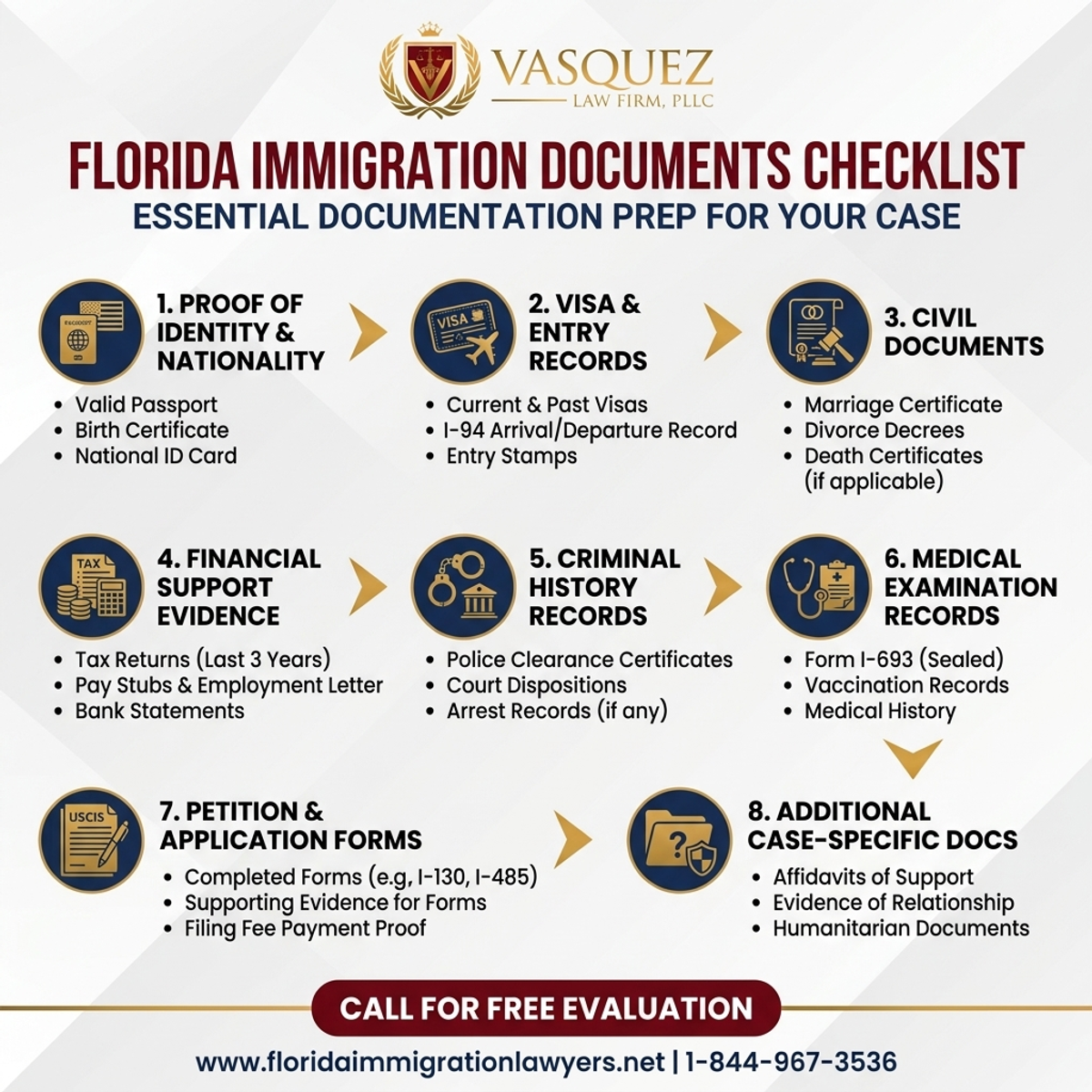
Key Statistics — Immigration Documents Checklist for Florida
Common Mistakes to Avoid in Immigration Paperwork
Navigating the immigration process requires precision and attention to detail. Even seemingly minor errors can lead to significant delays, requests for additional evidence, or even outright denial of your application. Being aware of these common pitfalls can help you avoid them and ensure a smoother journey.
- Incomplete Forms: Missing information can lead to application rejection. Every field on every form must be addressed. If a question does not apply, write "N/A" (not applicable) rather than leaving it blank. USCIS often rejects applications that are not fully completed, even for minor omissions.
- Incorrect Fees: Filing the wrong amount can delay processing. USCIS fees change periodically, so always check the latest fee schedule on the official USCIS website before submitting your application. Sending an incorrect payment amount, whether too much or too little, will result in your application being returned.
- Expired Documentation: Ensure all documents are current. Submitting an expired passport, visa, or even a driver's license as primary identification can cause issues. Always verify that all identification and supporting documents are valid and unexpired at the time of submission.
- Missing Translations: Non-English documents need certified translations. Any document submitted to USCIS that is not in English must be accompanied by a complete and accurate English translation, certified by a competent translator. Failure to provide this will result in an RFE or rejection.
- Overlooking Local Requirements: Check specific requirements for Florida. While federal law governs immigration, local jurisdictions or specific USCIS field offices may have unique preferences or requirements for certain supporting documents, especially for interviews. An attorney familiar with Florida's immigration landscape, like Florida Immigration Lawyers, can provide crucial insights.
- Neglecting to Update USCIS: Always update any changes in personal information. If your address, marital status, or employment changes while your application is pending, you must inform USCIS promptly. Failure to do so can lead to missed notices, interviews, or even application abandonment.
- Ignoring Deadlines: Late submissions can result in denial. USCIS provides specific deadlines for responding to RFEs or other notices. Missing these deadlines can lead to the denial of your application without further review. Always keep track of all deadlines and submit responses well in advance.
- Failure to Consult an Attorney: Professional guidance can prevent costly errors. Attempting to navigate complex immigration laws without legal expertise significantly increases the risk of mistakes. An experienced immigration lawyer can review your application, identify potential issues, and ensure compliance with all regulations.
By being proactive and diligent in avoiding these common mistakes, you can significantly improve the chances of a smooth and successful immigration process. When in doubt, always seek professional legal advice to safeguard your application.
When to Call a Lawyer for Your Immigration Needs
Consider contacting a lawyer if you're facing complex situations such as deportation defense or if you've been denied previously. Warning signs include receiving a Notice to Appear or confusing communication from USCIS.
At Florida Immigration Lawyers, we provide comprehensive services to assist you through every step of your immigration process. Call us at 1-844-967-3536 for support.
The decision to consult an immigration lawyer can be pivotal, particularly when your case involves intricacies beyond standard procedures. For instance, if you have a criminal record, even a minor one, it could affect your admissibility to the U.S. or your eligibility for certain immigration benefits. Navigating the waivers required for such situations is highly complex and almost impossible without legal expertise. Similarly, if you've had a previous visa overstay, unlawful presence, or multiple entries and exits, an attorney can assess the potential impact on your current application and strategize the best approach.
Beyond defensive immigration scenarios like deportation, legal counsel is invaluable for proactive applications that present unique challenges. This includes asylum claims, where detailed narratives and substantial evidence are required, or specific employment-based visas that demand intricate business plans and compliance with various labor laws. A lawyer can help you understand the nuances of these applications, identify all necessary supporting documents, and prepare you for interviews. For example, a case involving an investor visa (EB-5) requires not only significant capital but also meticulous documentation of the source of funds and the creation of U.S. jobs, areas where legal guidance is indispensable.
Confusing communication from USCIS is a clear indicator that professional help is needed. This might include receiving a Request for Evidence (RFE) that seems overly broad or difficult to address, a Notice of Intent to Deny (NOID), or an interview notice highlighting specific concerns about your eligibility. These notices often come with strict deadlines and require precise responses. Attempting to decipher and respond to these complex legal documents without an attorney can inadvertently harm your case. Florida Immigration Lawyers are experienced in interpreting USCIS communications and crafting effective responses, ensuring your rights are protected and your application remains on track. Don't hesitate to call 1-844-967-3536 for a free consultation if you encounter any of these warning signs.
About Florida Immigration Lawyers
Florida Immigration Lawyers is committed to assisting immigrants throughout Florida. Our expertise in various immigration services, including family immigration, asylum, and deportation defense, sets us apart. We offer free consultations and are available 24/7 to help you navigate the complexities of the immigration system.
Phone: 1-844-967-3536 | Website
Our firm prides itself on a deep understanding of both federal immigration law and the specific needs of communities across Florida, including Homestead, Miami, Orlando, and Tampa. We understand that each client's journey is unique, which is why we offer personalized legal strategies tailored to your individual circumstances. Whether you are seeking to unite with family members, pursue U.S. citizenship, or defend against removal proceedings, our dedicated team provides compassionate and effective representation. We stay abreast of the latest changes in immigration policy and procedure to ensure our advice is always current and accurate.
At Florida Immigration Lawyers, we believe everyone deserves access to quality legal representation. Our commitment extends beyond just legal advice; we strive to be a reliable partner throughout your entire immigration process. From the initial document gathering and form preparation to
Sources and References
- U.S. Citizenship and Immigration Services (USCIS)
- Executive Office for Immigration Review (EOIR)
- U.S. Department of State - Bureau of Consular Affairs
- Immigration and Nationality Act (INA), 8 U.S.C. Chapter 12
Do Not Navigate This Process Alone
Our experienced immigration attorneys are ready to fight for you. Get a free, confidential consultation today.
Se Habla Español
Frequently Asked Questions
Harold Estrada-Rodriguez
Florida Immigration Attorney · FL Bar No. 1041171
Florida Bar attorney handling Florida-jurisdiction immigration matters. Bilingual representation, free consultations.
Available 24/7 - Free Evaluations
Related Legal Services
Our Florida immigration attorneys can help you with asylum protection, deportation defense and citizenship and naturalization. Call today at 1-844-967-3536 for a free consultation.
Related Links
Related Topics
Free Legal Consultation
Discuss your case with our experienced attorneys. We're available 24/7.
Se Habla Español - Estamos aquí para ayudarle.
Related Articles
Immigration Attorney West Palm Beach Guide | VLF Florida
Navigate the complexities of immigration in West Palm Beach with a trusted attorney. Learn what to expect, common pitfalls, and how to choose the right legal help.
Dual Citizenship in Florida: What You Need to Know
Explore dual citizenship in Florida, understand the process, and learn how to apply. Discover the benefits and complexities involved with having two passports and navigating immigration laws. Call Florida Immigration Lawyers for expert guidance.
Understanding the Child Status Protection Act in Florida
Worried about your child aging out of their immigration status in Florida? Discover how the Child Status Protection Act (CSPA) can help safeguard their future. Call Florida Immigration Lawyers at 1-844-967-3536 for expert guidance.
Protect Yourself from Immigration Scams in Florida
Immigration scams are a serious issue in Florida, particularly in areas like Hollywood. Learn how to identify and avoid scams such as notario fraud. Stay informed and seek legal help when necessary. Call Florida Immigration Lawyers for a free consultation.