Florida Asylum Application Process: Your 2026 Guide to I-589
For individuals seeking safety and protection, understanding the asylum application process in Florida is crucial. This comprehensive guide from Florida Immigration Lawyers details the steps, requirements, and common pitfalls for Form I-589 in 2026. From initial filing to interviews and potential court proceedings, we cover what you need to know to pursue asylum. Learn about eligibility, required documents, timelines, and how our experienced attorneys can support your journey. Your path to safety starts with informed action and expert legal guidance.

The asylum application process in Florida involves filing Form I-589 with USCIS, attending a biometrics appointment, and undergoing an asylum interview. Eligibility is based on a well-founded fear of persecution due to race, religion, nationality, political opinion, or particular social group. The process can be lengthy and complex, often requiring strong evidence and legal assistance.
- Apply for asylum within one year of arrival, unless an exception applies.
- Gather compelling evidence of past persecution or fear of future persecution.
- Attend all scheduled appointments, including biometrics and interviews.
- Seek experienced legal counsel from Florida Immigration Lawyers.
- Understand the distinction between affirmative and defensive asylum processes.
Florida Asylum Application Process: Your 2026 Guide to I-589
Seeking safety and a new beginning in the United States is a profound decision. For many individuals and families in Florida, the journey begins with an asylum application Florida process. This pathway offers protection to those who fear persecution in their home country.
Navigating the complex U.S. immigration system, especially when dealing with the intricacies of Form I-589, can feel overwhelming. You are not alone in this challenge. Our firm, Florida Immigration Lawyers, is dedicated to guiding individuals through every step of this critical process.
This comprehensive guide will walk you through the asylum application process in Florida for 2026. We will cover eligibility, required documents, timelines, and crucial advice to help you build a strong case. For personalized guidance on your specific situation, Call Florida Immigration Lawyers at 1-844-967-3536 for a free consultation.
Understanding Asylum and the Florida Context
Asylum is a form of protection granted to individuals who are already in the United States or at a port of entry and are unable or unwilling to return to their country of origin. This inability stems from a well-founded fear of persecution. The persecution must be on account of one of five protected grounds: race, religion, nationality, membership in a particular social group, or political opinion. This legal framework is primarily outlined in Section 208 of the Immigration and Nationality Act (INA).
Who Qualifies for Asylum in the United States?
To qualify for asylum, you must demonstrate a "well-founded fear" of persecution. This means you must show that there is a reasonable possibility you would be persecuted if you returned to your home country. This fear must be directly linked to one of the five protected grounds mentioned above. For example, if you face threats or violence due to your religious beliefs, you may be eligible for asylum.
The fear can be based on past persecution you have already suffered, or on a credible threat of future persecution. It is important to present clear and convincing evidence to support your claim. The U.S. government does not grant asylum to individuals who have committed serious crimes, participated in persecution, or pose a danger to U.S. security.
Affirmative vs. Defensive Asylum in Florida
There are generally two paths to an asylum application Florida process: affirmative and defensive. Understanding the difference is crucial for your strategy. Each path has distinct filing procedures and involves different government agencies.
- Affirmative Asylum: This path is for individuals who are not currently in removal (deportation) proceedings. You proactively apply for asylum with U.S. Citizenship and Immigration Services (USCIS) by filing Form I-589, Application for Asylum and for Withholding of Removal. This process typically involves an interview at a USCIS Asylum Office, such as the Orlando Asylum Office.
- Defensive Asylum: If you are already in removal proceedings before an Immigration Judge, you may apply for asylum defensively. This means you present your asylum claim as a defense against deportation. Your case will be heard by an Immigration Judge at an Executive Office for Immigration Review (EOIR) court, such as the Miami Immigration Court or Orlando Immigration Court.
Why Florida? Asylum Seekers in the Sunshine State
Florida is a vibrant and diverse state, home to a significant immigrant population. Cities like Kissimmee, Orlando, and Miami have become major hubs for individuals seeking refuge and new opportunities. The state's geographical location also means it is often a first point of arrival for many. Consequently, Florida's immigration courts and USCIS asylum offices handle a substantial volume of asylum cases.
The unique demographics and circumstances in Florida mean that local knowledge and experience are invaluable. Our attorneys at Florida Immigration Lawyers understand the specific challenges and nuances faced by asylum seekers in this region. We are committed to providing culturally sensitive and effective legal representation to our clients throughout Florida.
The Asylum Application Florida Process: A Step-by-Step Guide
Navigating the USCIS asylum application journey requires careful attention to detail and adherence to strict deadlines. Here is a general overview of the steps involved in the affirmative asylum process in Florida:
-
Step 1: Arriving in the U.S. and the One-Year Filing Deadline
Generally, you must file your Form I-589, Application for Asylum and for Withholding of Removal, within one year of your most recent arrival in the United States. This is a critical deadline. Failing to meet it without an exception can lead to your application being barred. There are limited exceptions to this one-year rule, such as changed circumstances that materially affect your eligibility for asylum or extraordinary circumstances relating to the delay in filing. Proving an exception requires strong evidence and often legal assistance.
-
Step 2: Filing Form I-589, Application for Asylum and for Withholding of Removal
This is the cornerstone of your asylum claim. Form I-589 is a detailed document where you provide personal information, explain your fear of persecution, and describe the events that led you to seek asylum. You must complete this form accurately and thoroughly, providing all necessary details about the basis of your claim. Any inconsistencies or omissions can negatively impact your case. You should include all dependents you wish to include in your application. Remember, there is no filing fee for Form I-589 itself. You can find the form and instructions on the official USCIS website.
-
Step 3: Biometrics Appointment
After filing your Form I-589, USCIS will send you a notice for a biometrics appointment at an Application Support Center (ASC). At this appointment, your fingerprints, photograph, and signature will be collected. These biometrics are used for background and security checks. It is crucial to attend this appointment. Failure to do so can lead to delays or even denial of your application.
-
Step 4: Asylum Interview at the Orlando Asylum Office
Once your background checks are complete, USCIS will schedule you for an asylum interview. For applicants in Central Florida, including Kissimmee, this interview typically takes place at the Orlando Asylum Office. The interview is a crucial part of the process where an Asylum Officer will ask you questions about your application, your fear of persecution, and your personal history. You have the right to have an attorney present with you during this interview. An attorney can help you prepare and ensure your rights are protected.
-
Step 5: Decision on Your Asylum Claim
Following your interview, the Asylum Officer will review your testimony and evidence. They will then make a decision. If your case is approved, you will be granted asylum. This means you can remain in the U.S., apply for work authorization, and eventually apply for lawful permanent residency (a green card) after one year. If your case is not approved by USCIS, and you are not in legal immigration status, your case will typically be referred to an Immigration Judge for defensive asylum proceedings. If you are already in legal status, your case will be closed.
-
Step 6: Potential Referral to Immigration Court (Defensive Asylum)
If your affirmative asylum claim is not granted by USCIS, and you are not in lawful status, your case will be referred to an Immigration Judge. This initiates the defensive asylum process. You will then have the opportunity to present your asylum claim again before an Immigration Judge, often at a court like the Miami Immigration Court or Orlando Immigration Court. This judicial process can be more formal and complex, requiring multiple hearings. Legal representation is highly recommended to navigate these court proceedings effectively.
Essential Documents for Your Asylum Application in Florida
A strong asylum case relies heavily on compelling and well-organized documentation. Gathering these materials is a critical step in your asylum application Florida process. Here is a checklist of documents you should prepare:
- Form I-589, Application for Asylum and for Withholding of Removal: The completed and signed form, along with any necessary supplements.
- Identity Documents: Copies of your passport, birth certificate, national identity card, and any U.S. entry documents (e.g., I-94 arrival/departure record).
- Evidence of Persecution: This is perhaps the most important category. It includes:
- Personal declarations or affidavits detailing your experiences of persecution.
- Letters, threats, or official documents from persecutors.
- Police reports, medical records, or psychological evaluations documenting harm.
- Newspaper articles, human rights reports, or other country conditions reports from reputable sources (e.g., U.S. Department of State, Amnesty International, Human Rights Watch) that corroborate your claim and describe the general situation in your home country.
- Photographs or videos related to your persecution.
- Witness Affidavits: Sworn statements from individuals who witnessed your persecution or can corroborate your fear.
- Proof of Membership: Documents proving your membership in the protected group (e.g., religious affiliation certificates, political party membership cards, evidence of nationality).
- Marriage Certificates and Birth Certificates: For yourself and any family members included in your application.
- Travel Documents: Any documents related to your travel to the U.S.
- Translations: All documents not in English must be accompanied by a certified English translation.
The more credible and consistent your evidence, the stronger your asylum eligibility claim will be. Our attorneys can help you identify and gather the necessary documentation.
Asylum Application Florida Process: Timelines and Expectations
The processing time for an asylum application Florida process can vary significantly. It is important to manage your expectations and understand that delays are common. Several factors influence how long your case may take.
Average Processing Times
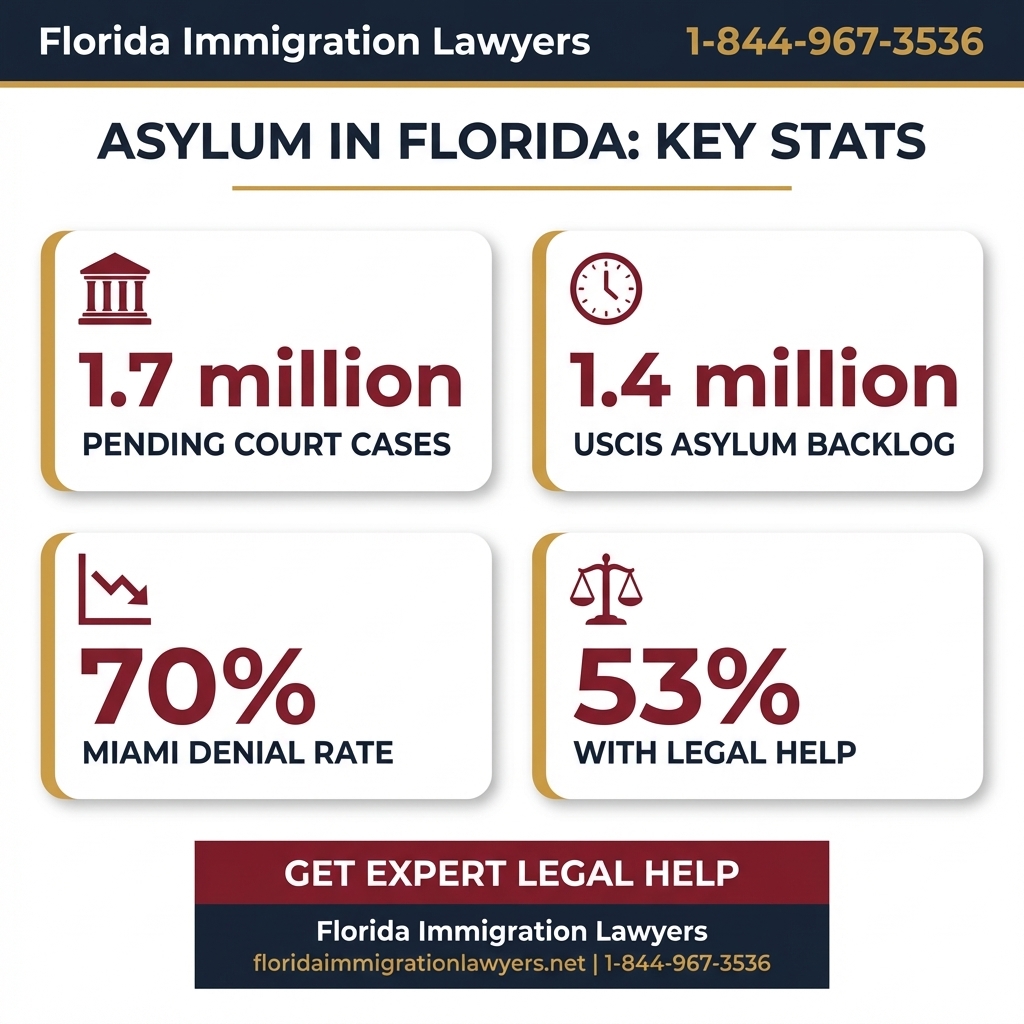
USCIS aims to prioritize recently filed affirmative asylum applications, but significant backlogs still exist. While some cases may be decided within a few months, others can take several years. Defensive asylum cases in immigration court can also extend for years due to court schedules and legal complexities. There are no guarantees on specific timelines, and it is crucial to remain patient while your case is pending.
Work Authorization (EAD)
After your asylum application has been pending for 150 days (and not denied by an Asylum Officer or Immigration Judge), you may be eligible to apply for an Employment Authorization Document (EAD), also known as a work permit. You file Form I-765, Application for Employment Authorization, with USCIS. This allows you to legally work in the U.S. while your asylum case is being processed. There is typically a fee associated with filing Form I-765.
Expedited Processing
In very limited circumstances, USCIS may expedite an asylum application. This is usually reserved for cases involving severe medical conditions, urgent humanitarian reasons, or national interest. Requesting expedited processing requires strong justification and does not guarantee a faster outcome.
Cost Factors and Fee Breakdown for Asylum Seekers
While the Form I-589 itself has no filing fee, there are other costs associated with the USCIS asylum application process. Understanding these financial aspects is important for planning.
- USCIS Filing Fees:
- Form I-589: No filing fee.
- Form I-765 (Employment Authorization Document): There is a fee for this application, which allows you to work legally while your asylum case is pending. Fee amounts are subject to change, so always check the latest USCIS fee schedule.
- Legal Fees: Retaining an experienced immigration attorney is one of the most significant costs, but it is often a worthwhile investment. Legal fees cover:
- Comprehensive case assessment and strategy development.
- Assistance with preparing and filing Form I-589 and supporting documents.
- Preparation for the asylum interview or court hearings.
- Representation during interviews or court proceedings.
- Appeals, if necessary.
- Translation Costs: If any of your supporting documents are not in English, you will need to pay for certified translations.
- Medical and Psychological Evaluations: In some cases, expert evaluations are crucial to support your claim of persecution. These can incur additional costs.
- Travel Expenses: Costs associated with traveling to biometrics appointments, asylum interviews in Orlando, or court hearings in Miami or Orlando.
Do not navigate this process alone. The complexities of the asylum application and the high stakes involved make legal representation invaluable. Contact Florida Immigration Lawyers today to discuss your case and understand how we can help you achieve protection.
Common Mistakes to Avoid in Your Asylum Application
The asylum application process is unforgiving of errors. Avoiding common mistakes can significantly improve your chances of success. Be aware of these pitfalls:
-
Missing the One-Year Filing Deadline: This is arguably the most common and critical error. If you do not file Form I-589 within one year of your last arrival in the U.S. and cannot prove an exception, your application will likely be denied.
Consequence: Barred from applying for asylum unless you meet a narrow exception.
-
Incomplete or Inaccurate Form I-589: Failing to fill out every section, providing inconsistent information, or omitting crucial details can raise red flags and lead to delays or denials.
Consequence: Delays, requests for evidence, or potential denial due to lack of credibility.
-
Lack of Sufficient Corroborating Evidence: A strong personal testimony needs to be backed by objective evidence. Relying solely on your verbal account without supporting documents weakens your claim significantly.
Consequence: Difficulty in proving a "well-founded fear" of persecution.
-
Inconsistent Testimony: Providing different details about your story at various stages (e.g., initial credible fear interview, Form I-589, asylum interview) can severely damage your credibility.
Consequence: Asylum officer or judge may find your testimony not credible, leading to denial.
-
Failing to Disclose All Prior Immigration History or Arrests: Attempting to hide any part of your past, even minor infractions or previous entries, will be uncovered during background checks and can lead to a finding of lack of candor.
Consequence: Credibility issues, potential criminal charges, or asylum denial.
-
Attempting to Lie or Exaggerate Details: Any fabrication or exaggeration, no matter how small, can destroy your entire asylum claim. Immigration officials are trained to detect inconsistencies.
Consequence: Immediate denial and a permanent bar from future immigration benefits.
-
Not Updating Your Address with USCIS and EOIR: If you move, you must notify USCIS and, if applicable, the immigration court, within 10 days. Missing important notices can have severe consequences.
Consequence: Missing biometrics appointments, interview notices, or court hearings, potentially leading to a "failure to appear" order and removal in absentia.
-
Traveling Internationally While Your Asylum Case is Pending: Leaving the U.S. without proper authorization (advance parole) can be seen as an abandonment of your asylum claim, especially if you travel to the country you claimed to fear.
Consequence: Abandonment of your asylum application and potential inadmissibility upon return.
-
Not Preparing Adequately for the Asylum Interview: Many applicants underestimate the intensity and detail required during the interview. Not being ready to articulate your story clearly and consistently is a major disadvantage.
Consequence: Failure to convince the asylum officer of your claim's merits.
-
Not Understanding the Legal Grounds for Asylum: Your fear of persecution must fall within one of the five protected grounds. Simply fearing general violence or economic hardship is not enough.
Consequence: Inability to meet the legal requirements for asylum.
-
Not Seeking Legal Counsel: While not mandatory, navigating the complex asylum application Florida process without an attorney significantly increases the risk of making critical errors.
Consequence: Higher likelihood of denial due to procedural errors or insufficient legal arguments.
When to Call a Florida Immigration Lawyer for Asylum Help
The decision to seek asylum is deeply personal and often involves traumatic experiences. While you can file an asylum application on your own, the process is incredibly complex and high-stakes. Partnering with an experienced Florida immigration lawyer significantly enhances your chances of success. Here are specific scenarios where legal assistance is highly recommended:
- Complex Persecution Claims: If your persecution claim involves nuanced legal arguments, multiple forms of harm, or persecution from non-state actors, an attorney can help articulate your case effectively.
- Past Immigration Issues: If you have previous deportations, criminal convictions, or other immigration violations, an attorney can assess how these might impact your asylum eligibility and strategize defenses.
- One-Year Filing Deadline Exceptions: Proving an exception to the one-year filing deadline is legally challenging. A lawyer can help gather evidence and construct a compelling argument.
- Defensive Asylum Cases: If you are in removal proceedings, an attorney is essential to represent you in immigration court. They can navigate court procedures, present evidence, and cross-examine witnesses.
- Fear of Interview or Language Barriers: An attorney can prepare you thoroughly for your asylum interview, explain the process, and ensure an interpreter is provided if needed.
- Seeking Work Authorization: We can assist you in applying for an Employment Authorization Document (EAD) once you are eligible.
Florida Immigration Lawyers has extensive experience with asylum cases throughout Florida, including Kissimmee, Orlando, and Miami. We are here to provide the compassionate and skilled representation you deserve. Our team understands the unique challenges faced by asylum seekers and is committed to protecting your rights.
About Florida Immigration Lawyers
Florida Immigration Lawyers is a leading immigration law firm dedicated to serving individuals and families across the entire state of Florida. Our mission is to provide expert, compassionate, and effective legal representation in all areas of immigration law. We understand the profound impact immigration matters have on your life and are committed to achieving the best possible outcomes for our clients.
Our Services: We offer a comprehensive range of immigration legal services, including but not limited to:
- Asylum applications and refugee claims
- Deportation defense
- Family-based immigration
- Citizenship and naturalization
- Visa applications and adjustments of status
- Business immigration
Why Choose Us:
- Expertise: Our attorneys possess deep knowledge of U.S. immigration law and stay updated on policy changes.
- Compassion: We approach every case with empathy, understanding the personal struggles our clients face.
- Accessibility: We are available 24/7 to answer your urgent questions and provide support.
- Free Consultations: We offer free initial consultations to discuss your case without obligation.
- Bilingual Services: Our team is fluent in English and Spanish, ensuring clear communication.
- Statewide Reach: We serve clients in all Florida cities, from Kissimmee to Jacksonville, Tampa, and Miami.
For dedicated and experienced legal assistance with your immigration needs, contact us today. Your future in Florida is our priority.
Phone: 1-844-967-3536
Website: https://www.floridaimmigrationlawyers.net
Frequently Asked Questions (FAQs) About Asylum in Florida
Here are answers to common questions regarding the asylum application Florida process:
How to apply for asylum in Florida?
You apply for asylum in Florida by filing Form I-589, Application for Asylum and for Withholding of Removal, with USCIS. This typically initiates the affirmative asylum process, involving a biometrics appointment and an interview at the Orlando Asylum Office. If you are in removal proceedings, you apply defensively with an Immigration Judge.
How long does it take for my asylum case to be approved?
Asylum processing times vary widely and can range from several months to several years. Factors include the volume of applications, the complexity of your case, and whether it is an affirmative or defensive claim. USCIS aims to prioritize newer affirmative cases, but backlogs can still cause significant delays. There is no guaranteed timeline for approval.
Who has to pay $100 for an asylum application?
The Form I-589, Application for Asylum and for Withholding of Removal, itself has no filing fee. There is no $100 fee for filing an asylum application. However, if you apply for an Employment Authorization Document (EAD) using Form I-765 after your asylum application has been pending for 150 days, there is typically a filing fee for the EAD application. Fee amounts are subject to change, so always consult the latest USCIS fee schedule.
What are the 5 grounds for asylum?
To be granted asylum, you must demonstrate a well-founded fear of persecution based on one of five protected grounds: race, religion, nationality, membership in a particular social group, or political opinion. Your fear must be directly linked to one of these categories, not simply a general fear of violence or economic hardship.
Sources and References
- U.S. Citizenship and Immigration Services (USCIS) - Asylum
- U.S. Citizenship and Immigration Services (USCIS) - Form I-589
- Executive Office for Immigration Review (EOIR) - Immigration Court Locations
- 8 U.S.C. § 1158 - Asylum (Immigration and Nationality Act Section 208)
- 8 CFR Part 208 - Asylum and Withholding of Removal
- USCIS Policy Manual - Asylum and Withholding of Removal
This article provides general legal information and is not intended as legal advice. Every case is unique, and outcomes depend on specific facts and circumstances. Contact an attorney for advice about your particular situation.
Your journey to safety and stability in Florida is important. Do not face the complexities of the asylum application Florida process without expert legal guidance. Our dedicated team at Florida Immigration Lawyers is ready to assist you with a free, confidential consultation.
Call us today at 1-844-967-3536 to discuss your asylum case. Se Habla Español - Estamos aquí para ayudarle.
Do Not Navigate This Process Alone
Our experienced immigration attorneys are ready to fight for you. Get a free, confidential consultation today.
Se Habla Español
Or leave your details and we’ll call you:
Free Evaluation in 24 Hours
Or talk to us right now

AI voice assistant — available 24/7
FreeFrequently Asked Questions

William J. Vásquez
Founding Attorney · Vasquez Law Firm
U.S. Air Force veteran and immigration attorney with years of hands-on U.S. immigration experience. J.D., NCCU School of Law. AILA member. Admitted to the 4th, 5th, and 11th Circuit Courts.
Available 24/7 - Free Evaluations
Reviewed for legal accuracy by William J. Vásquez
Licensed in North Carolina; U.S. immigration is federal practice.
Related Legal Services
Our Florida immigration attorneys can help you with free immigration consultation, experienced immigration attorneys and business immigration. Call today at 1-844-967-3536 for a free consultation.
Related Links
Related Topics
Free Legal Consultation
Discuss your case with our experienced attorneys. We're available 24/7.
Se Habla Español - Estamos aquí para ayudarle.
Related Articles
Immigration Lawyer Orlando Free Consultation Today
Explore immigration services in Orlando with a focus on recent changes affecting DACA and legal immigration categories. Learn what documents are necessary, timeline expectations, and common mistakes to avoid. Get a free consultation today.
Orlando Immigration Fraud Attorney: I-601 Waivers
Facing allegations of immigration fraud or misrepresentation in Florida can be a frightening experience, potentially leading to inadmissibility and separation from loved ones. The I-601 Waiver of Grounds of Inadmissibility offers a critical pathway to overcome these challenges by demonstrating extreme hardship to a qualifying U.S. citizen or lawful permanent resident relative. This comprehensive guide details the eligibility criteria, the intricate step-by-step application process, essential documentation, and realistic processing timelines for I-601 waivers as of 2026, with a special focus on the Orlando and wider Florida context. We highlight common mistakes to avoid and emphasize the invaluable role of an experienced Orlando immigration fraud attorney. Florida Immigration Lawyers stands ready to provide expert legal counsel, ensuring your application is meticulously prepared and persuasively presented, guiding you through every complex stage.
CSPA Aging Out: Protecting Child Immigrants in Florida 2026
The Child Status Protection Act (CSPA) is a critical U.S. immigration law safeguarding children from 'aging out' of eligibility for permanent residency due to processing delays. This guide from Florida Immigration Lawyers explains CSPA eligibility, the precise age calculation, and the step-by-step process for families in Florida. We cover vital requirements, common mistakes like missing the 'sought to acquire' deadline, and provide a comprehensive document checklist. Understanding CSPA is essential for derivative beneficiaries in family-based petitions, especially with fluctuating visa bulletins and potential category conversions. Learn how to protect your child's immigration future and when to seek expert legal assistance from our firm, serving Jacksonville and all of Florida.
Immigration Lawyer Fort Lauderdale Florida
For individuals and families in Orlando, Fort Lauderdale, Homestead, and throughout Florida, understanding U.S. immigration law is paramount. This comprehensive guide from Florida Immigration Lawyers details the complexities of green card applications, citizenship, and deportation defense. We explore why an experienced immigration lawyer is essential, provide step-by-step processes for common applications, outline necessary documents, and discuss typical timelines and costs. Learn to avoid common mistakes and discover when immediate legal counsel is critical. With a focus on Florida-specific challenges and up-to-date information for 2026, our firm offers personalized assistance. Schedule a free consultation to protect your rights and achieve your immigration goals.