Derived Citizenship: Guide for Children in Florida
For families in Florida, derived citizenship offers a vital pathway for children born abroad to become U.S. citizens through their naturalized parents. This comprehensive guide from Florida Immigration Lawyers details the eligibility requirements, including the child being under 18, a lawful permanent resident, and in the legal and physical custody of a U.S. citizen parent. We provide a step-by-step process for filing Form N-600, a crucial document checklist, and an overview of processing timelines and associated costs. Avoid common mistakes that can delay or jeopardize your application. Learn when it’s essential to consult with an experienced immigration attorney to navigate complex scenarios, such as custody issues, criminal histories, or previous denials. Our firm serves all of Florida, offering free consultations and dedicated support to ensure your child's future is secure. Contact us today for legal assistance.
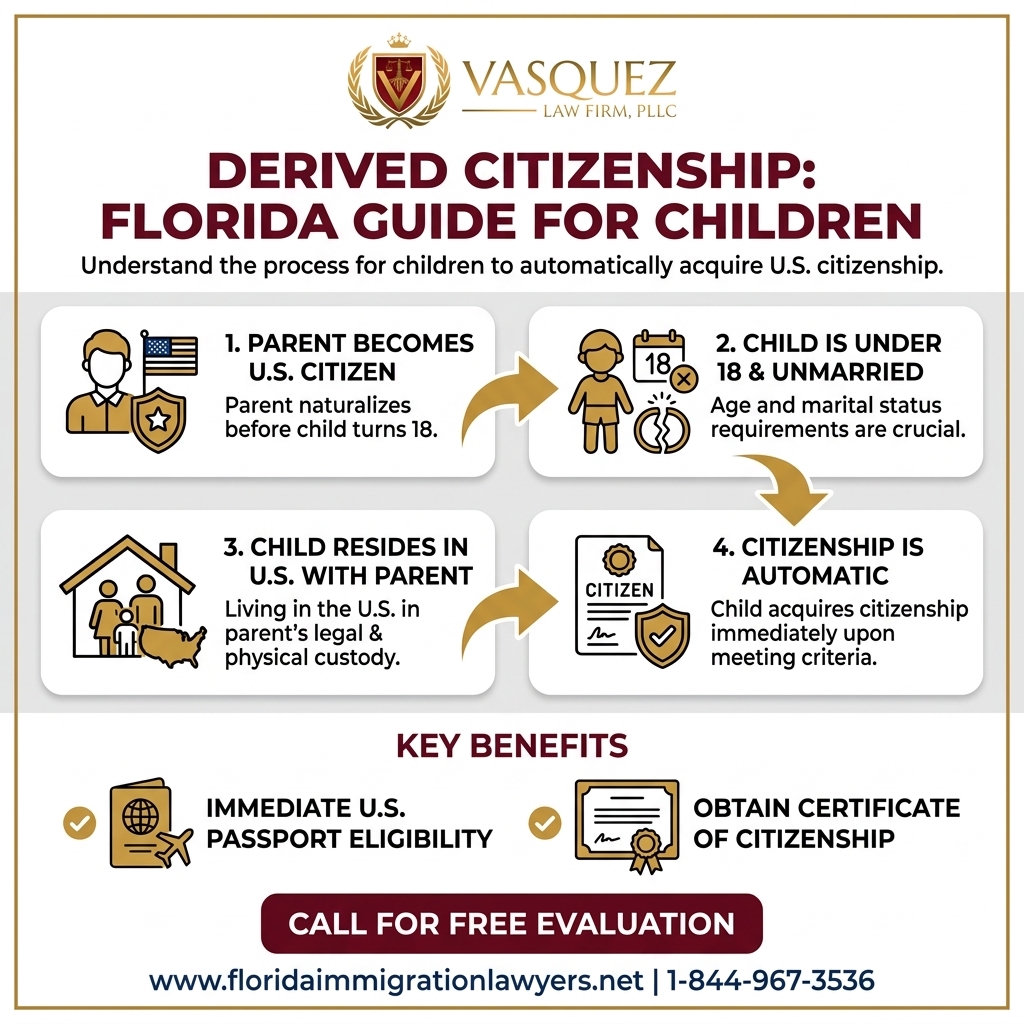
Derived citizenship refers to the process where a child automatically becomes a U.S. citizen when one or both parents naturalize, provided certain conditions are met. This typically applies to children under 18 who are lawful permanent residents and reside in the U.S. in the legal and physical custody of the naturalizing parent. It is a critical pathway for many families in Florida to secure their child's future. While automatic, proving derived citizenship often requires filing Form N-600, Application for Certificate of Citizenship, to obtain official documentation.
- Child must be under 18 years old.
- Child must be a lawful permanent resident (Green Card holder).
- At least one parent must be a U.S. citizen (by birth or naturalization).
- Child must be residing in the U.S. in the legal and physical custody of the U.S. citizen parent.
- The child's status as a lawful permanent resident must have been acquired before their 18th birthday.
For many families across Florida, ensuring a child's secure future is a top priority. If your child was born outside the United States but now lives here, you may wonder about their path to U.S. citizenship. One significant pathway is derived citizenship, a process where a child automatically becomes a citizen through their parents. This can be a life-changing event, offering stability and opportunity, but understanding the specific requirements and procedures is crucial, especially within Florida's diverse communities.
This comprehensive guide from Florida Immigration Lawyers will walk you through the intricacies of derived citizenship, focusing on the specific conditions and processes relevant to families in Florida. We will cover eligibility criteria, the application process, essential documents, common pitfalls, and when professional legal guidance becomes indispensable. Navigating immigration law can be complex, and securing your child's citizenship is a monumental step. For personalized assistance and to ensure a smooth process, call Florida Immigration Lawyers at 1-844-YO-PELEO for a free consultation today.
Understanding Derived Citizenship for Children in Florida
Derived citizenship, often confused with acquired citizenship, is a distinct legal concept that grants U.S. citizenship to children through the naturalization of their parent(s). Unlike acquired citizenship, which generally applies to children born abroad to U.S. citizen parents, derived citizenship specifically addresses children who become citizens automatically when their parent(s) naturalize. This means the child does not need to file their own naturalization application (Form N-400); their status changes based on their parent's actions and their own residency status. This automatic conferral is primarily governed by Section 320 of the Immigration and Nationality Act (INA), specifically 8 U.S.C. § 1431.
To qualify for derived citizenship in Florida, several stringent conditions must be met concurrently. First, at least one parent must be a U.S. citizen, either by birth or through naturalization. Second, the child must be a lawful permanent resident (LPR), holding a Green Card. This LPR status must have been obtained before the child's 18th birthday. Third, the child must be residing in the United States in the legal and physical custody of the U.S. citizen parent. This means the child must live with the parent who is a U.S. citizen, and that parent must have legal authority over the child's care and upbringing. These conditions must all be true on or after the date the parent becomes a U.S. citizen.
For families in Florida, understanding these nuances is vital. Whether you are in Tampa, Miami, Orlando, or anywhere else in the state, the federal laws governing derived citizenship apply uniformly. However, local USCIS field offices, such as the one in Tampa, will process the applications for official documentation. The process hinges on demonstrating that all statutory requirements were met on the critical date of the parent's naturalization or the child's admission as an LPR, whichever came last. It is not enough for the parent to simply naturalize; the child's specific circumstances must align perfectly with the legal framework for the citizenship to automatically derive.
Step-by-Step Guide to Proving Derived Citizenship
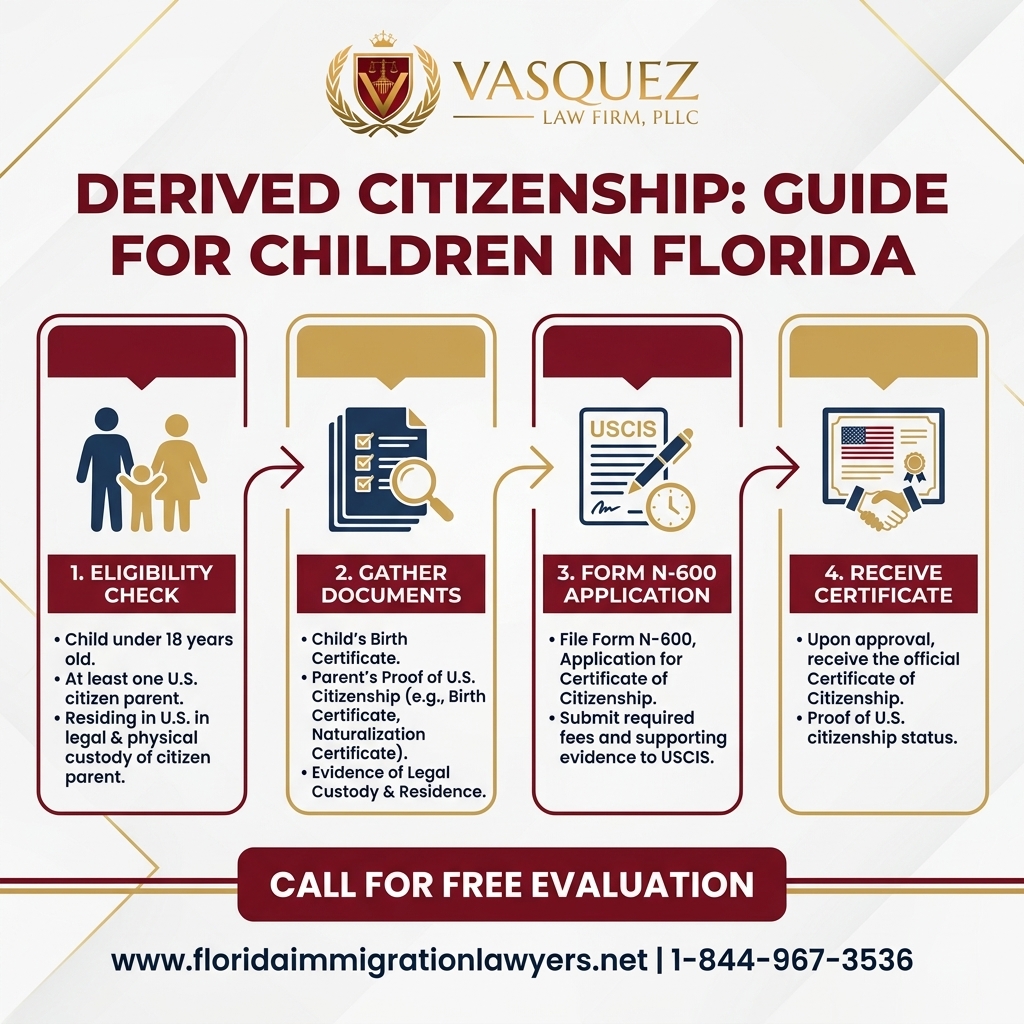
While derived citizenship is automatic once all conditions are met, obtaining official documentation is highly recommended and often necessary for travel, employment, and other benefits. This usually involves filing Form N-600, Application for Certificate of Citizenship. Here is a step-by-step guide for families in Florida:
- Confirm Eligibility: Before beginning any application, meticulously review all eligibility criteria for derived citizenship. Ensure the child was under 18, held lawful permanent resident status, and was in the legal and physical custody of a U.S. citizen parent when the parent naturalized. If the parent naturalized before the child obtained LPR status, ensure the child obtained LPR status before their 18th birthday while still in the legal and physical custody of the U.S. citizen parent. Any ambiguity here can lead to delays or denial.
- Gather Required Documents: Collect all necessary supporting documentation. This includes proof of the child's identity, LPR status, the parent's U.S. citizenship, and evidence of the parent-child relationship and custody. Refer to the detailed document checklist provided below. Ensure all foreign-language documents are accompanied by certified English translations.
- Complete Form N-600: Accurately fill out Form N-600, Application for Certificate of Citizenship. Provide precise information, ensuring consistency with all supporting documents. Any discrepancies can raise red flags with USCIS. The form can be downloaded from the USCIS website.
- Pay the Filing Fee (or Request a Waiver): Submit the correct filing fee with your application. USCIS fees are subject to change, so always check the most current fee schedule on their website. If you believe you qualify for a fee waiver due to financial hardship, you may submit Form I-912, Request for Fee Waiver, along with supporting evidence.
- Mail the Application: Send your completed Form N-600, supporting documents, and fee (or fee waiver request) to the appropriate USCIS Lockbox facility. The mailing address depends on where you reside in Florida and which service center has jurisdiction. Always verify the correct filing address on the USCIS website to avoid processing delays.
- Attend Biometrics Appointment: After USCIS receives your application, they will send a receipt notice (Form I-797C) and then a notice for a biometrics appointment. This appointment, usually held at a local Application Support Center (ASC) in Florida (e.g., in Orlando, Miami, or West Palm Beach), is for fingerprinting, photographs, and signature collection. It is mandatory for identity verification and background checks.
- Interview (If Required): While many N-600 applications do not require an interview, USCIS may schedule one if they need additional information or clarification. The interview would typically take place at a USCIS field office, such as the one in Tampa. Both the U.S. citizen parent and the child may need to attend. Be prepared to answer questions about your family history and the child's eligibility.
- Receive Decision: USCIS will issue a decision after reviewing your application and any interview results. If approved, the child will receive a Certificate of Citizenship, which is official proof of their U.S. citizenship. If denied, the notice will explain the reasons, and you may have options to appeal or refile.
Essential Document Checklist for Derived Citizenship Applications
A thorough and accurate submission of documents is paramount for a successful derived citizenship application. Missing or incorrect documents are among the leading causes of delays and denials. This comprehensive checklist will help Florida families prepare their Form N-600 application:
- Child's Documents:
- Child's birth certificate (original or certified copy).
- Child's Green Card (Form I-551, Permanent Resident Card).
- Child's passport and visa used for entry into the U.S. (if applicable).
- Two passport-style photographs of the child.
- Any previous Certificates of Citizenship or Naturalization Certificates issued to the child (if applicable).
- U.S. Citizen Parent's Documents:
- Parent's birth certificate (if U.S. citizen at birth).
- Parent's Certificate of Naturalization (Form N-550 or N-570) or Certificate of Citizenship (Form N-560 or N-561) (if naturalized or derived).
- Parent's current U.S. passport.
- If the U.S. citizen parent is deceased, a certified copy of their death certificate.
- Proof of Relationship:
- Parent's marriage certificate (if applicable).
- Divorce decrees or death certificates for any prior marriages of either parent (if applicable).
- Adoption decree (if the child was adopted).
- Evidence of legal and physical custody (court orders, school records, medical records, utility bills, lease agreements, etc., showing the child resides with the U.S. citizen parent).
- Additional Documents:
- Certified English translations for all foreign-language documents.
- Proof of name change (if any party has legally changed their name).
- Any other documents requested by USCIS during the process.
It is always advisable to keep copies of everything you submit to USCIS for your records. For complex family situations, such as those involving divorce, adoption, or non-traditional custody arrangements common in Florida, providing comprehensive documentation is even more critical. Consulting with an attorney from Florida Immigration Lawyers can help ensure you have all the necessary evidence.
Do not navigate this process alone. Understanding the nuances of derived citizenship and ensuring a complete, accurate application is essential for your child's future. Contact Florida Immigration Lawyers today to schedule a consultation and protect your family's interests.
Timelines and Processing Expectations for Derived Citizenship in Florida
Understanding the potential timeline for a derived citizenship application through Form N-600 is important for managing expectations. While USCIS strives for efficient processing, various factors can influence how long it takes for a child in Florida to receive their Certificate of Citizenship. The processing times are not fixed and can fluctuate based on the volume of applications, the specific USCIS service center handling the case, the complexity of the application, and whether an interview is required.
Generally, after filing Form N-600, applicants typically receive a receipt notice within 2-4 weeks. A biometrics appointment notice usually follows within 4-8 weeks. The biometrics appointment itself is quick, but the processing of background checks can take several weeks. If an interview is deemed necessary, it can add several months to the overall timeline, depending on the caseload at your local USCIS field office, such as the one in Tampa. The total processing time from filing to receiving a decision can range from 6 months to over a year, and sometimes even longer in complex cases. You can check the current processing times for Form N-600 on the USCIS website by selecting Form N-600 and your specific service center.
Several factors can lead to delays. An incomplete application or missing documentation will almost certainly result in a Request for Evidence (RFE), which adds significant time to the process. Responding to an RFE promptly and thoroughly is critical. Similarly, if there are any discrepancies in the information provided or if USCIS requires further clarification regarding the parent-child relationship, custody, or the parent's naturalization, an interview will be scheduled, extending the timeline. Ensuring all information is accurate and consistent from the outset can help mitigate these delays. For Florida residents, staying informed about your case status through the USCIS online tool is recommended, but direct communication with a legal professional can provide more specific insights and advocacy.
Cost Factors and Fee Breakdown for Form N-600
When applying for a Certificate of Citizenship via Form N-600, families in Florida should be prepared for various costs. The most significant direct cost is the USCIS filing fee for Form N-600 itself. It is crucial to note that USCIS fees are subject to change, so always verify the current fee amount on the official USCIS website before submitting your application. Submitting an incorrect fee will result in the rejection of your application and significant delays.
Beyond the primary filing fee, other potential costs include fees for obtaining necessary supporting documents. This might involve charges for certified copies of birth certificates, marriage certificates, divorce decrees, or adoption papers from government agencies. If any of your documents are in a foreign language, you will incur costs for certified English translations. These translation services typically charge per page or per word, and ensuring they are certified according to USCIS standards is essential. For some families in Florida, the cumulative cost of document retrieval and translation can be substantial.
Another significant cost factor is legal representation. While it is possible to file Form N-600 independently, the complexities of immigration law often make legal assistance invaluable. An experienced immigration attorney, like those at Florida Immigration Lawyers, can help confirm eligibility, ensure all documents are correctly prepared and submitted, represent you at interviews, and respond to RFEs. Attorney fees vary based on the complexity of the case and the services provided. However, investing in legal counsel can often prevent costly mistakes, delays, or even denials that might arise from navigating the process alone. For those facing financial hardship, USCIS offers a fee waiver option (Form I-912), which can waive the N-600 filing fee if you meet specific income or public assistance criteria. This can be a vital resource for eligible families in Florida.
Common Mistakes to Avoid in Derived Citizenship Applications
Navigating the derived citizenship process can be fraught with potential pitfalls that can lead to significant delays or even denial. Being aware of these common mistakes can help Florida families prepare a stronger application:
- Misunderstanding Eligibility Criteria: Many applicants mistakenly believe their child qualifies when they do not meet all the specific requirements, such as the child being under 18, a lawful permanent resident, and in the legal and physical custody of the U.S. citizen parent at the time of the parent's naturalization. Incorrectly assuming eligibility can lead to wasted time and resources.
- Incomplete Documentation: Failing to submit all required supporting documents, such as birth certificates, marriage certificates, naturalization certificates, or proof of legal custody, is a frequent error. USCIS requires comprehensive evidence to confirm eligibility, and missing pieces will result in a Request for Evidence (RFE).
- Incorrect Filing Fees: Submitting an incorrect or outdated filing fee for Form N-600 will cause the application to be rejected and returned. USCIS fees change periodically, so always check the most current fee schedule on their official website before mailing your application.
- Failure to Provide Certified Translations: Any document not in English must be accompanied by a complete and certified English translation. Failing to provide a proper translation, or providing one that is not certified, will lead to an RFE and delay the process.
- Errors or Inconsistencies on Forms: Simple mistakes, typos, or inconsistencies between the information provided on Form N-600 and the supporting documents can raise red flags for USCIS and prompt further scrutiny, interviews, or RFEs. Accuracy is paramount.
- Not Responding to RFEs or Interview Notices: Ignoring or failing to respond promptly and thoroughly to a Request for Evidence (RFE) or an interview notice can lead to the denial of the application. It is crucial to address all USCIS requests within the specified timeframe.
- Lack of Proof of Legal and Physical Custody: For children of divorced or separated parents, demonstrating that the U.S. citizen parent has sole or joint legal and physical custody of the child can be challenging. Insufficient evidence of custody is a common reason for application delays or denials.
- Assuming Citizenship Without Documentation: While derived citizenship is automatic, relying solely on this without obtaining a Certificate of Citizenship (Form N-560) can create issues later, particularly for international travel or proving citizenship for employment and benefits. Official documentation is crucial.
- Filing for an Ineligible Child: Some parents mistakenly file for children who acquired LPR status after turning 18, or who were not in the legal and physical custody of the naturalizing parent. This fundamental error will always result in a denial.
- Not Updating Address with USCIS: If you move after filing, failing to update your address with USCIS can result in missed notices, RFEs, or interview appointments, leading to significant delays or even abandonment of the application. Always use the AR-11 form to update your address.
- Criminal History Issues: While derived citizenship is automatic, if the child or parent has a significant criminal history, it can complicate the process, particularly if it impacts the child's LPR status or the parent's eligibility for naturalization (if the parent's naturalization is still pending).
- Waiting Too Long: Although there is no deadline for filing Form N-600 for derived citizenship, delaying can lead to difficulties in retrieving old documents or changes in family circumstances that might complicate the case. It is best to apply once eligible.
When to Call a Lawyer for Derived Citizenship in Florida
While the concept of derived citizenship might seem straightforward, the application process, especially for Form N-600, can be complex and filled with potential pitfalls. Knowing when to seek professional legal assistance can save families in Florida significant time, stress, and potential heartbreak. Florida Immigration Lawyers are here to provide guidance and support.
You should strongly consider contacting an immigration lawyer if your family's situation involves any complexities. For example, if there are questions about whether your child truly meets all the eligibility criteria, particularly regarding legal and physical custody, an attorney can provide clarity. This is especially true in cases of divorce, separation, adoption, or if the U.S. citizen parent is deceased. An attorney can help interpret court orders and gather sufficient evidence to satisfy USCIS requirements.
Furthermore, if your child or the naturalizing parent has any criminal history, even minor offenses, it could impact eligibility or lead to additional scrutiny. An attorney can assess the implications of such records and advise on the best course of action. If you have previously filed for derived citizenship and were denied, understanding the reasons for denial and strategizing a new approach requires legal expertise. If you receive a Request for Evidence (RFE) or an interview notice, an attorney can help you prepare a comprehensive response or represent you at the interview, ensuring your rights are protected and all information is presented effectively. Florida Immigration Lawyers have extensive experience assisting families in Tampa and across Florida with these precise challenges, offering peace of mind and skilled advocacy.
About Florida Immigration Lawyers
Florida Immigration Lawyers is an immigration law firm dedicated to serving individuals and families throughout Florida. With a deep understanding of U.S. immigration laws, our experienced attorneys provide comprehensive legal services, from family-based visas and naturalization to complex deportation defense and asylum cases. We are committed to offering compassionate, client-focused representation, ensuring that every client receives personalized attention and strategic advice tailored to their unique circumstances. Our goal is to make the immigration process as smooth and successful as possible for you and your loved ones. We pride ourselves on being accessible and responsive to our clients' needs, offering support at every stage of their immigration journey in Florida.
We understand the profound impact immigration matters have on families, and we are here to provide unwavering support. Our firm offers free consultations and is available 24/7 to address your urgent questions and concerns. From our Orlando office, serving clients across Florida, we are your trusted partners in navigating the complexities of immigration law. Visit our website at floridaimmigrationlawyers.net or call us directly at 1-844-YO-PELEO to learn how we can assist you. Our team is ready to help you achieve your immigration goals.
Sources and References
- U.S. Citizenship and Immigration Services (USCIS)
- U.S. Department of State
- Executive Office for Immigration Review (EOIR)
- 8 U.S.C. § 1431 - Children born outside U.S. of citizen parent
- 8 U.S.C. Chapter 12 - Immigration and Nationality Act
- 8 CFR Part 320 - Regulations for Automatic Citizenship (Children of Citizens)
Related services: naturalization process, citizenship test preparation, dual citizenship guidance, citizenship test resources.
This article provides general legal information and is not intended as legal advice. Every case is unique, and outcomes depend on specific facts and circumstances. Contact an attorney for advice about your particular situation.
Securing your child's U.S. citizenship through derivation is a profound step towards their future stability and opportunities in Florida. Do not let the complexities of the immigration system overwhelm you. The experienced legal team at Florida Immigration Lawyers is dedicated to guiding families like yours through every stage of this crucial process. We are committed to providing clear, effective legal strategies tailored to your specific needs.
Take the first step towards securing your child's citizenship today. Call Florida Immigration Lawyers at 1-844-YO-PELEO for a free, confidential consultation. Se Habla Español - Estamos aquí para ayudarle.
Do Not Navigate This Process Alone
Our experienced immigration attorneys are ready to fight for you. Get a free, confidential case review today.
Se Habla Español
Or leave your details and we’ll call you:
Free Evaluation in 24 Hours
Or talk to us right now

AI voice assistant — available 24/7
FreeFrequently Asked Questions

William J. Vásquez
Founding Attorney · Vasquez Law Firm
U.S. Air Force veteran and immigration attorney with years of hands-on U.S. immigration experience. J.D., NCCU School of Law. AILA member. Admitted to the 4th, 5th, and 11th Circuit Courts.
Available 24/7 - Free Evaluations
Reviewed for legal accuracy by William J. Vásquez
Licensed in North Carolina; U.S. immigration is federal practice.
Related Legal Services
Our Florida immigration attorneys can help you with immigration lawyer cost in Florida, experienced immigration attorneys and asylum protection. Call today at 1-844-YO-PELEO for a free case review.
Related Links
Related Topics
Free Legal Case Review
Discuss your case with our experienced attorneys. We're available 24/7.
Se Habla Español - Estamos aquí para ayudarle.
Related Articles
Immigration Lawyer Orlando Free Consultation in Florida
For individuals and families in Orlando, Florida, navigating the complexities of U.S. immigration law requires expert guidance. An immigration lawyer in Orlando offers crucial support for everything from visa applications and green card processes to naturalization and deportation defense. This comprehensive guide details what a free consultation covers, providing a step-by-step overview of immigration pathways, essential document checklists, and expected timelines in 2026. We also highlight common mistakes to avoid, discuss the critical role of legal counsel in deportation and asylum cases, and explain why choosing a local Orlando immigration attorney is beneficial. Florida Immigration Lawyers is dedicated to serving the diverse community of Orlando with compassionate, effective legal solutions, ensuring you receive personalized advice and robust representation for a successful immigration journey.
EAD Advance Parole Combo Card in Florida 2026
For individuals with a pending Form I-485, Application to Register Permanent Residence or Adjust Status, the EAD Advance Parole Combo Card is an essential document. This single card combines the authorization to work legally in the U.S. (Employment Authorization Document - EAD) with permission to travel internationally and re-enter without abandoning your green card application (Advance Parole). This guide from Florida Immigration Lawyers provides a comprehensive overview for applicants in Florida in 2026, covering eligibility, the step-by-step application process, required documents, expected processing times, and associated costs. We also highlight common mistakes to avoid and when to seek legal counsel to ensure a smooth and successful immigration journey. Understanding this vital card is key to maintaining stability while awaiting your permanent residency approval.
EAD Advance Parole Combo Card in Florida: What You Need
An EAD advance parole combo card allows individuals with pending adjustment applications to both work and travel abroad without jeopardizing their green card application. Learn how to apply in Florida, what documents you need, and common mistakes to avoid.
Dual Citizenship Lawyer in Florida: What You Need to Know
For Florida residents, the concept of dual citizenship, or holding two passports, offers a compelling blend of opportunities and challenges. While the U.S. generally permits dual nationality, the path to achieving this status requires a meticulous understanding of both U.S. immigration laws and the citizenship policies of your country of origin. This guide explores the definition of dual citizenship, the detailed step-by-step process for U.S. naturalization, and the significant benefits and potential pitfalls involved. We cover essential documentation, typical timelines, and cost considerations for 2026, providing crucial insights for anyone in Orlando, Miami, or across Florida considering this important legal step. Learn about common mistakes to avoid and understand when to seek professional legal counsel to navigate this complex process successfully. Florida Immigration Lawyers is here to provide expert, bilingual support for your dual citizenship journey.