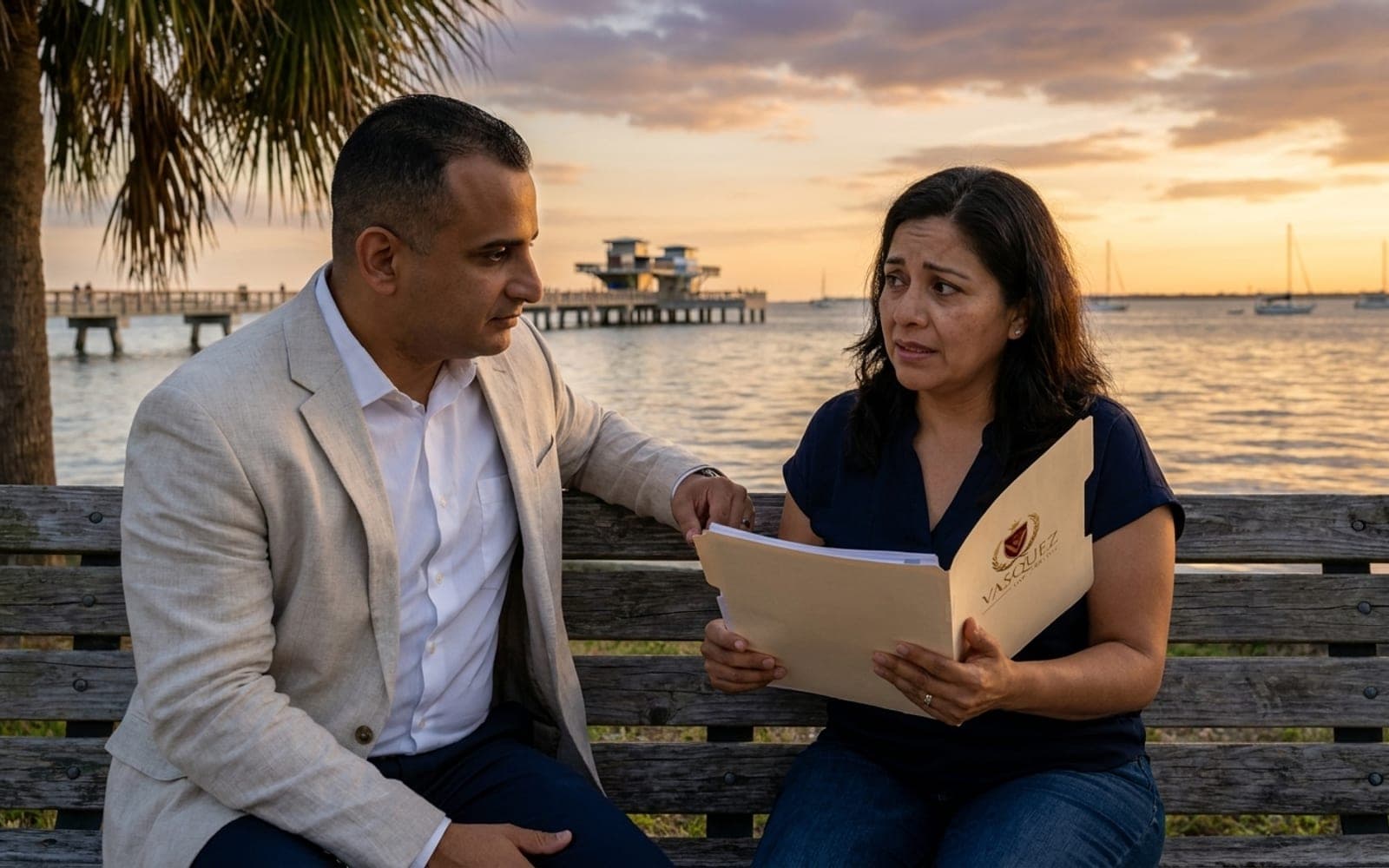
If you or a relative received a Notice to Appear or was detained by ICE, a lawyer should review the papers before the first hearing. A removal case is a civil proceeding in immigration court where the government tries to show a person is removable and the person can contest the charges or seek relief. A lawyer reads the Notice to Appear, checks the allegations, appears at master calendar hearings and identifies relief such as asylum or withholding of removal. Waiting until the hearing week leaves fewer choices. We serve Tampa-area families from Orlando.
- Call a lawyer as soon as a Notice to Appear arrives.
- A removal case is a civil proceeding where you can contest charges or seek relief.
- Lawyers check the notice, attend hearings and identify possible relief.
- Bond hearings and criminal-immigration issues are also discussed.
Introduction
If you or a family member received a Notice to Appear or was detained by ICE in the Tampa Bay area, a deportation attorney in Tampa who can be reached quickly should review the papers before the first hearing. This guide is for families in Tampa, Riverview, Brandon, and the rest of Hillsborough County who need to understand how removal cases work, what bond hearings involve, and what to gather before calling a lawyer. To discuss a specific situation, call 1-844-YO-PELEO or contact us.
Removal cases move on court deadlines, and what you file early often shapes what defenses stay available later. Families who wait until the week of a hearing have fewer choices than families who call as soon as the notice arrives, even when the underlying facts are the same.
Vasquez Law Firm practices immigration law only. We serve clients in Tampa, Riverview, Brandon, and the rest of Hillsborough County from our office at 1111 E Amelia Street in Orlando, by phone and secure video, in English and Spanish. This article is general information, not legal advice, and every case turns on its own facts and on the rules in force at the time.
What a Tampa Deportation Lawyer Does in a Removal Case
A removal case is a civil proceeding in immigration court, where the government tries to show that a person is removable and the person can contest the charges or ask for relief. A deportation defense lawyer handles the legal work around that process, including the following.
- Reading the Notice to Appear and checking whether the factual allegations and charges are correct.
- Appearing with you at master calendar hearings and stating your position on the charges.
- Identifying relief you may qualify for, such as asylum, withholding of removal, protection under the Convention Against Torture, cancellation of removal, adjustment of status, or voluntary departure.
- Preparing applications, evidence, witness statements, and legal briefs for the individual (merits) hearing.
- Filing motions, appeals to the Board of Immigration Appeals, or motions to reopen when the law allows.
Not every person qualifies for every form of relief. Eligibility depends on immigration history, family ties, how long the person has been in the United States, and any criminal record, so a lawyer reviews the full file before recommending a strategy. Our deportation defense page describes these categories in more detail.
Tampa Immigration Court and the People It Serves
Hillsborough County residents with removal cases appear before the immigration court named on the Notice to Appear or the hearing notice. Florida has only a few immigration courts, so the assigned court may not be in Tampa, and detained cases and transferred cases can be heard elsewhere. A lawyer should confirm which court has the case, the judge assigned, and the next hearing date, using the official EOIR case information system and the hearing notice itself.
Missing a hearing can lead to an order of removal in your absence, which is very hard to undo. If you moved, you must update your address with the court. If you never received a notice, tell your lawyer right away, because there are limited ways to ask the court to reopen a case.
Help for Families in Riverview and Brandon
Many of the calls we receive come from the suburbs east and south of Tampa. A family looking for a deportation lawyer in Riverview often has a relative who was stopped on the road or picked up at home and now has a pending case. A family looking for a deportation lawyer in Brandon is often worried about a loved one in detention and about the children left at home.
In both situations the first steps are the same: find out where the person is held or which court has the case, gather identity and immigration documents, and schedule a consultation so a lawyer can explain the options. Distance from Orlando does not slow this down. We meet most Hillsborough County clients by video and see them in person in Orlando when a meeting there helps. We have no office in Tampa, Riverview, or Brandon.
How the Removal Process Works in Florida
The order of events is similar in most cases, though timing varies with the court and with whether the person is detained.
- The government serves a Notice to Appear, which lists the allegations and the charges, and files it with the immigration court.
- The person receives a hearing notice and appears at a master calendar hearing, where the judge asks whether the allegations are admitted or denied.
- The person tells the judge which relief, if any, will be requested, and the judge sets deadlines for applications and evidence.
- The lawyer files applications, evidence, and any legal briefs by the court's deadlines.
- At the individual hearing, the person testifies, the government may cross-examine, and the judge decides.
- Either side may appeal to the Board of Immigration Appeals within a strict deadline.
Detention and Tampa Bond Hearing Lawyer Services
When ICE detains someone, the family's first question is usually whether that person can be released. Bond is decided first by ICE and then, for many people, by an immigration judge at a bond hearing. Some people are subject to mandatory detention because of certain criminal convictions or because of how they entered the country, and the rules on who can receive a bond hearing have been the subject of recent litigation and policy changes. A lawyer checks current law against the person's specific history.
At a bond hearing, the judge generally looks at whether the person is a danger to the community and whether he or she is likely to return to court. Evidence that often helps includes the following.
- Proof of a stable address and long residence in the Tampa Bay area.
- Letters from family, employers, churches, and community members.
- Records showing U.S. citizen or permanent resident family members who depend on the person.
- Official court records showing how any criminal case ended.
- Evidence of a possible defense or relief in the removal case.
Our immigration bond page explains the process in more detail, and our article on immigration bond attorneys in Florida covers the subject further.
Criminal Immigration Questions for Tampa Residents
An arrest or conviction can trigger removal, block a green card, or make someone ineligible for bond. People often search for a criminal immigration lawyer when they face both a criminal charge and immigration risk. Others look for one lawyer who can handle both cases at once. Our firm is immigration-only: we do not defend criminal charges in state or federal court. What we do is analyze the immigration consequences of the charge, a proposed plea, or a past conviction, and we work alongside the client's criminal defense lawyer so both lawyers understand how a plea or sentence may affect immigration status.
This coordination matters most before a plea is entered. After a conviction, options are narrower, but a lawyer can still review the record, explain whether a conviction is likely to be treated as a removable offense, and consider whether any relief remains available.
Document Checklist for a Removal Defense Consultation
- The Notice to Appear, hearing notices, and any orders from the immigration judge.
- Passport, visas, I-94 record, green card, or work permit, if you have them.
- Any prior applications filed with USCIS, and the receipts or decisions.
- Final court dispositions for every arrest, even if the charges were dropped.
- Birth and marriage certificates for family members, especially U.S. citizens and permanent residents.
- Proof of residence, work, and taxes over the years.
- For a detained person: full name, date of birth, country of birth, and A-number, if known.
If you do not have every paper, bring what you have. A lawyer can often explain how to request the rest while the case moves forward.
Keep in mind that relief often depends on facts that take time to document, such as years of residence, family hardship, or the circumstances of an arrest. Starting to gather proof early, even before a lawyer has chosen a defense, gives the case more room. Photographs, school and medical records, tax filings, and letters from people who know the family all become useful at different stages.
Timeline and Processing Expectations
Removal cases do not follow a standard schedule. Detained cases are usually handled on a different track from cases of people who are not in custody, and the pace depends on the court's calendar, the judge, and the relief sought. The immigration courts and USCIS publish current information, which changes often, so we do not predict how long a case will take, and families should be skeptical of anyone who does.
What matters is deadlines: dates for hearings, applications, evidence, and appeals are set by the court or by rule, and late filings may not be considered. The table below outlines the stages.
| Stage | What happens | Who acts |
|---|
| Notice to Appear | Government states allegations and charges | DHS, immigration court |
| Master calendar hearing | Charges are answered; relief is identified; deadlines set | Judge, DHS attorney, respondent, lawyer |
| Preparation of relief | Applications, evidence, and witness statements are filed | Lawyer, respondent |
| Individual (merits) hearing | Testimony and evidence; the judge decides | Judge, DHS attorney, respondent |
| Appeal or motion | Board of Immigration Appeals review, or a motion to reopen | Lawyer, Board, immigration court |
How to Choose a Tampa Removal Defense Attorney
When comparing a removal defense attorney with others you are considering, ask direct questions. Who will appear at the hearing? How will the firm communicate with you before each court date? What relief does the lawyer see in your case, and what are the risks? A deportation defense lawyer should explain the process plainly and should not promise a result, because no lawyer can know in advance how a judge will rule. Be cautious about any lawyer who guarantees an outcome.
Ask whether the lawyer is licensed and in good standing, and whether consultations are available in your language. Families sometimes call several offices and feel pressured to decide on the spot. Take the time you need to understand the plan, but do not wait until the week of the hearing. Deadlines for filing applications and evidence are set by the court, and late evidence may not be considered.
Cost Factors and Fee Breakdown
The cost of a removal defense case depends on how many hearings it takes, which relief is requested, and whether the person is detained.
| Item | Amount | Notes |
|---|
| Attorney fees for case review and hearing representation | Varies by case | Depends on the number of hearings and the complexity of the relief |
| Immigration court application fees | Check the court or agency for current fees | Depend on the application or motion filed |
| USCIS filing fees, if an application goes to USCIS | Check USCIS for the current fee | Fees differ by form and change over time |
| Bond | Check the court or agency for current fees | Set by ICE or the immigration judge, with conditions |
| Records, translations, and evidence gathering | Varies by case | Foreign-language records usually need translation |
Ask for a written fee agreement that describes the stages covered, such as the master calendar hearings, the individual hearing, and any appeal, and which government fees are paid separately.
Government fees and fee waiver rules change, so read the current instructions before filing. A clear agreement at the start prevents misunderstandings later.
Common Mistakes to Avoid
- Missing a hearing, or failing to update your address with the immigration court.
- Waiting until the week of the hearing to look for a lawyer.
- Admitting allegations in the Notice to Appear without a lawyer reviewing them.
- Entering a criminal plea without asking about the immigration consequences.
- Giving different versions of your story in different places.
- Paying a notario or an unlicensed person who promises to fix the case.
- Delaying a bond request after a relative is detained.
When to Call a Lawyer
Call as soon as a Notice to Appear arrives, an ICE officer contacts you, or a family member is detained. Call before you plead in any criminal case if you are not a U.S. citizen, and call if you missed a court date or learned of an order in your absence. If you need a lawyer for deportation defense in Tampa, an early review will tell you which deadlines are running and which options may still be open.
How We Work With Tampa Bay Clients From Orlando
We serve the whole Tampa Bay area from our one office in Orlando. Most consultations happen by secure video or phone, and documents can be shared electronically. Clients who prefer to meet face to face can see us in Orlando. To schedule a consultation in English or Spanish, contact our office.
About Vasquez Law Firm
Vasquez Law Firm practices immigration law only. Our only office is at 1111 E Amelia Street in Orlando. We serve clients across Florida by phone and secure video, and we meet in person at the Orlando office. William J. Vásquez is the founding attorney, and consultations are available in English and Spanish. To talk about your situation, call 1-844-YO-PELEO or contact us.
Sources and References
Related services: deportation defense, immigration lawyers in Florida
Other ways people search for this
People look for this help under different names. Related searches include immigration law firm tampa; best immigration lawyers in tampa fl; deportation lawyer riverview; immigration court lawyer tampa; tampa deportation defense attorney; tampa deportation defense lawyer; deportation lawyer brandon; criminal immigration lawyer tampa; immigration and criminal lawyer tampa.
This article is general information, not legal advice. Every case is different; speak with an immigration lawyer about your situation.