Immigration Bond Hearing in Florida: Your 2026 Guide
An immigration bond hearing in Florida is a pivotal moment for individuals detained by ICE, determining their eligibility for release while their immigration case proceeds. This comprehensive guide for 2026 breaks down the entire process, from understanding what a bond hearing entails to navigating the complex court system in Florida, including key factors immigration judges consider. We delve into the typical timelines and associated costs, providing detailed tables for clarity. Furthermore, the article highlights crucial rights during ICE detention and outlines common mistakes to avoid that could jeopardize a favorable outcome. For anyone facing detention or seeking to help a loved one, this resource offers essential information and emphasizes the indispensable role of experienced legal counsel. Florida Immigration Lawyers stands ready to assist with expert representation across Florida, offering free case reviews.
An immigration bond hearing in Florida is a crucial legal proceeding where an immigration judge determines if a detained non-citizen can be released from U.S. Immigration and Customs Enforcement (ICE) custody by posting a bond. As of 2026, these hearings are vital for individuals seeking temporary freedom while their immigration case proceeds. The judge assesses factors like flight risk and danger to the community, aiming to ensure the individual will appear for future court dates. Securing legal representation from experienced Florida immigration lawyers is paramount to presenting a compelling case for release.
- Immigration bond hearings determine release from ICE custody.
- Judges evaluate flight risk and public safety concerns.
- Evidence of community ties and good conduct is essential.
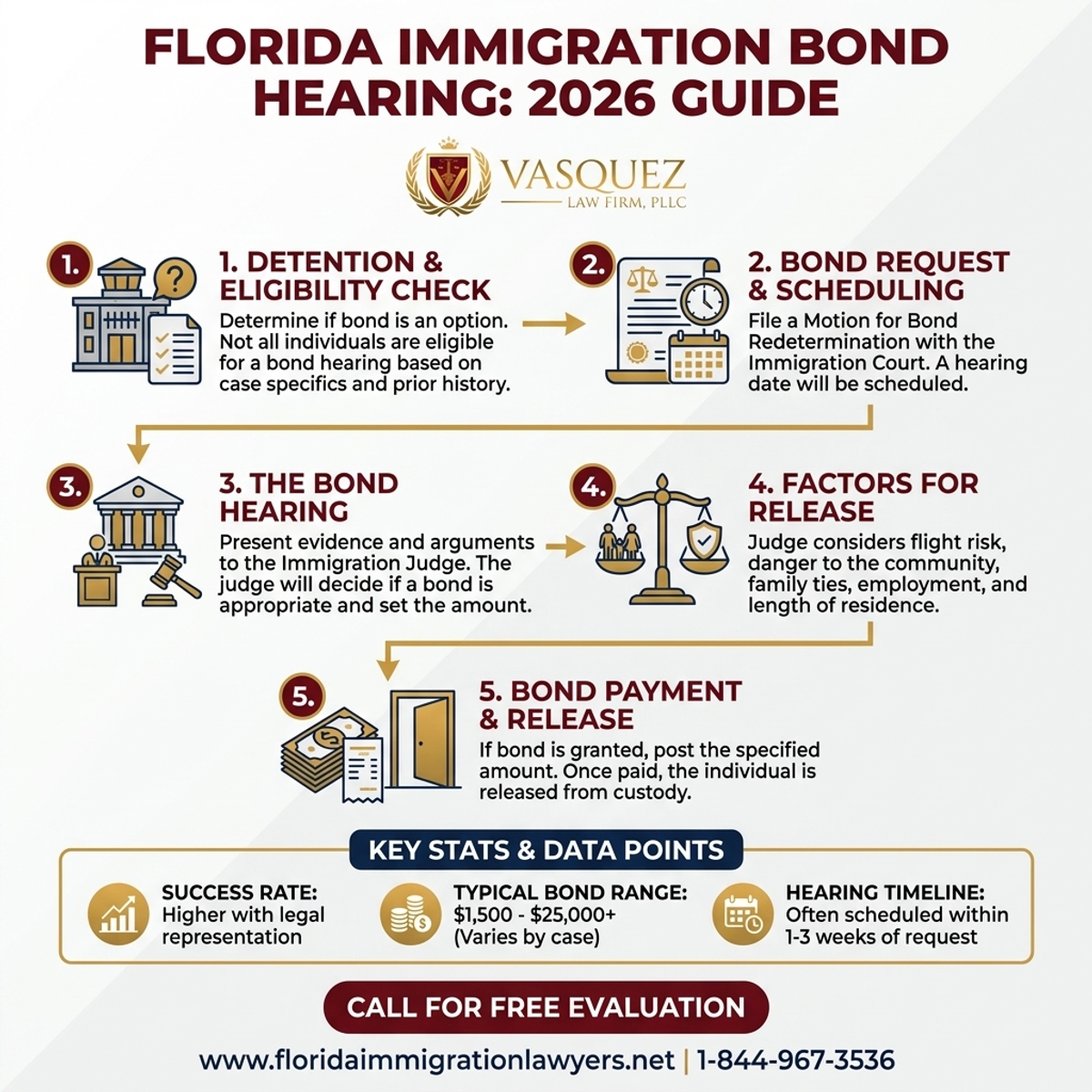
- Bonds are typically set between $1,500 and $25,000 or higher.
- Legal counsel significantly improves the chances of a favorable outcome.
Facing detention by U.S. Immigration and Customs Enforcement (ICE) can be an incredibly frightening and disorienting experience, not just for the individual detained but also for their family members in Florida and across the nation. The uncertainty surrounding an immigration bond hearing can add immense stress, leaving many to wonder about the process, their rights, and the possibility of release. Understanding the intricacies of an immigration bond hearing in Florida is the first step toward navigating this challenging situation effectively and securing the best possible outcome for yourself or a loved one.
This comprehensive guide, updated for 2026, aims to demystify the immigration bond hearing process, providing clear, actionable information for individuals and families in Florida. We will cover everything from how an immigration bond is determined to what to expect during the hearing, common mistakes to avoid, and when to seek professional legal assistance. Our goal is to empower you with the knowledge needed to make informed decisions during a critical time. Don't face this complex legal challenge alone. Call Florida Immigration Lawyers at 1-844-YO-PELEO for a free case review and let our dedicated team advocate for your freedom.
What is an Immigration Bond Hearing and Why is it Important in Florida?
An immigration bond hearing is a formal proceeding before an immigration judge to determine if a non-citizen detained by ICE can be released from custody by paying a sum of money, known as a bond. This hearing is critical because it offers a pathway to temporary freedom for individuals while their underlying immigration case, such as asylum claims or deportation defense, is being adjudicated. Without a bond, individuals might remain in detention for months or even years, profoundly impacting their families, employment, and ability to prepare their legal defense effectively.
In Florida, where immigration communities are diverse and extensive, the need for clear understanding of bond hearings is particularly acute. Detention centers like the Glades County Detention Center and Krome Service Processing Center often house individuals awaiting these crucial hearings. The purpose of a bond is not punitive; rather, it serves as an assurance that the detained individual will appear for all future immigration court proceedings. Under the Immigration and Nationality Act (INA), specifically 8 U.S.C. § 1226 (INA 236), the government has the authority to detain non-citizens, but also provides for the possibility of release on bond under certain circumstances. An immigration judge, rather than ICE, has the final authority to set or deny a bond in many cases, making the hearing a fundamental safeguard for due process.
The importance of these hearings cannot be overstated. A favorable bond decision allows a person to reunite with their family, return to work, and work closely with their attorney to build a robust defense. For families in Central Florida, including Orlando, securing a bond can mean the difference between prolonged separation and the opportunity to fight their case from home. Our firm, Florida Immigration Lawyers, understands the profound impact detention has on individuals and families and is committed to fighting for the freedom of our clients.
How Do Immigration Bond Hearings Work in Florida Courts?
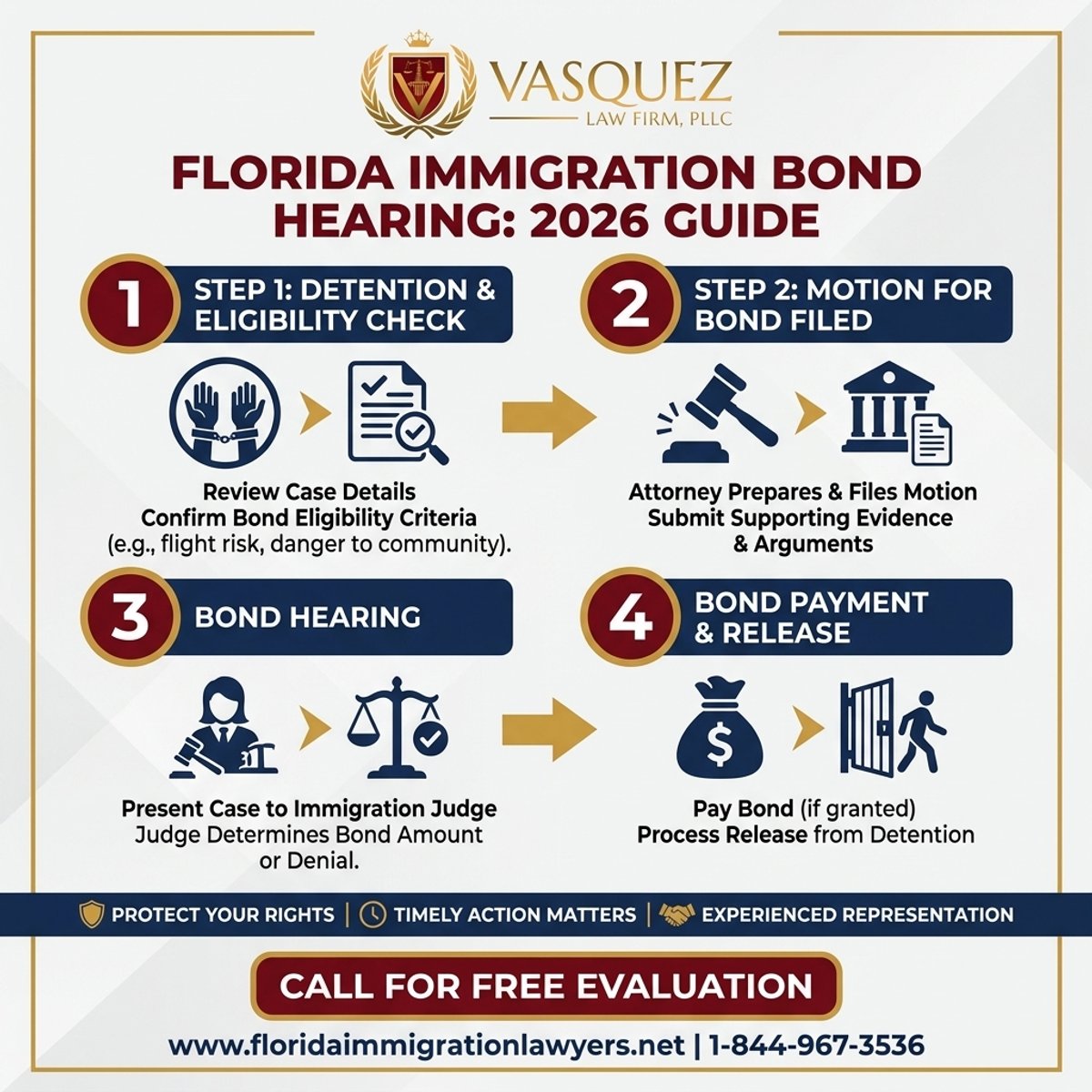
Immigration bond hearings in Florida typically begin after an individual has been detained by ICE and has received a Notice to Appear (NTA), which initiates removal proceedings. The process involves several key steps, focusing on demonstrating to an immigration judge that the detained individual is not a flight risk or a danger to the community.
The journey to an immigration bond hearing often starts with an individual's arrest and subsequent detention by ICE, which can occur for various reasons, including visa overstays, border encounters, or alleged violations of immigration law. Once detained, ICE may initially set a bond amount or determine that the individual is not eligible for bond. If ICE denies bond or sets an unreasonably high amount, the detained individual, often through their legal counsel, can request a bond hearing before an immigration judge. This request is typically made to the Executive Office for Immigration Review (EOIR) immigration court with jurisdiction over the detention facility. For many held in Florida, this could mean the Orlando Immigration Court or the Miami Immigration Court. Preparing for the hearing involves gathering compelling evidence, such as proof of strong community ties, employment history, family responsibilities, and a clean criminal record. During the hearing, the judge will hear arguments from both the detained individual's attorney and the ICE attorney. The judge then weighs all presented evidence and arguments to decide whether to grant a bond, and if so, at what amount. A favorable decision allows for release upon payment of the bond, enabling the individual to continue their immigration case outside of detention. For more information on defending against removal, visit our page on deportation defense.
- Arrest and Detention by ICE: An individual is taken into custody by ICE. This is the initial stage where the person is processed and placed in a detention facility, often in Florida, such as the Glades or Krome centers.
- Issuance of Notice to Appear (NTA): ICE serves the detained individual with an NTA, which formally begins removal proceedings and provides the basis for their detention. The NTA will specify the charges and the date of their first court appearance.
- ICE Custody Review and Bond Determination: ICE officials conduct an initial custody review. They may decide to release the individual on their own recognizance, set an administrative bond, or determine that the individual is not eligible for bond.
- Requesting an Immigration Bond Hearing: If ICE denies bond or sets an amount deemed too high, the detained individual or their attorney can file a motion with the immigration court to request a bond hearing before an immigration judge. This motion typically includes a request for a review of the custody determination.
- Preparation for the Hearing: This crucial stage involves collecting all relevant documentation and evidence to support the argument for release. This includes proof of ties to the U.S. community, financial stability, good moral character, and a lack of criminal history.
- The Bond Hearing Itself: The hearing takes place before an immigration judge. Both the individual's attorney and the ICE attorney present arguments and evidence. The judge listens to testimony, reviews documents, and asks questions to assess flight risk and danger to the community. In some instances, an immigration judge like Judge Karen Nazaire in Miami might preside over such a hearing, evaluating the specific circumstances of each case.
- Judge's Decision: After considering all factors, the immigration judge makes a decision. They may grant bond and set an amount, deny bond, or release the individual on their own recognizance without a bond.
- Posting the Bond and Release: If a bond is granted, the specified amount must be paid to ICE. Once paid, the individual is typically released from detention within 24-72 hours, with the understanding that they must attend all future court dates.
What Factors Influence an Immigration Judge's Bond Decision?
An immigration judge's decision regarding an immigration bond is not arbitrary; it is based on a careful assessment of several factors outlined in legal precedents and immigration regulations. The primary considerations revolve around whether the detained individual poses a flight risk or a danger to the community. The burden of proof typically lies with the non-citizen to demonstrate that they are not a flight risk or a danger, especially if they have certain criminal convictions or prior immigration violations. This is a critical aspect of the hearing, requiring comprehensive and persuasive evidence.
As of 2026, judges consider a wide array of evidence to make an informed decision. Key factors include the individual's ties to the U.S., such as family relationships, particularly U.S. citizen or lawful permanent resident relatives, employment history, property ownership, and community involvement. A strong showing of these ties indicates a lower flight risk. The judge will also scrutinize any criminal history, the nature of the immigration violation, and the individual's demeanor in court. For instance, a long-term resident with strong family roots in Orlando, a stable job, and no criminal record will generally have a stronger case for bond than someone with recent criminal convictions or a history of failing to appear for court. Legal precedents like Matter of Guerra and Matter of P-H- guide judges in evaluating these factors, emphasizing the importance of presenting a holistic picture of the individual's character and intentions. Our firm often leverages evidence of deep community integration and strong family immigration ties to advocate for our clients' release.
Key Factors Considered by Immigration Judges:
- Family Ties in the U.S.: Presence of U.S. citizen or lawful permanent resident spouses, children, or parents, especially if they are dependent on the detained individual.
- Length of Residence in the U.S.: How long the individual has lived in the United States. Longer periods generally suggest stronger ties.
- Employment History and Financial Stability: Stable employment, income, and financial responsibilities indicate a commitment to remaining in the community.
- Community Involvement: Participation in religious organizations, schools, volunteer work, or other community groups.
- Criminal History: The nature and severity of any past criminal convictions. Certain serious crimes can significantly impair bond eligibility.
- Prior Immigration Violations: History of overstays, unauthorized entries, or prior deportation orders.
- Manner of Entry into the U.S.: Whether entry was legal or illegal.
- Eligibility for Immigration Relief: The likelihood of success in their underlying immigration case, as this can influence the motivation to appear for future hearings.
- Good Moral Character: General reputation and conduct, supported by character letters and testimony.
Step-by-Step Process — Immigration Bond Hearing in Florida: Your 2026 Guide
Document Checklist for a Strong Bond Case:
- Birth certificates and marriage certificates of U.S. citizen/LPR family members.
- Proof of address (utility bills, lease agreements).
- Employment verification letters, pay stubs, tax returns.
- Letters of support from family, friends, employers, community leaders.
- Bank statements and other financial records.
- Property deeds or lease agreements.
- Medical records, especially if there are health concerns.
- School records for children.
- Evidence of community involvement (e.g., church membership, volunteer certificates).
- Any documents related to the underlying immigration case (e.g., I-130 petition).
- Proof of absence of criminal record (e.g., FBI background check results).
How Long Do Immigration Bond Hearings Take and What Are the Associated Costs in 2026?
The timeline for an immigration bond hearing in Florida can vary significantly depending on factors such as the specific immigration court's caseload, the complexity of the case, and the availability of the judge and attorneys. As of 2026, individuals can generally expect a bond hearing to be scheduled within a few weeks to a couple of months after the request is filed. However, in busy courts like Miami or Orlando, this timeframe can sometimes be longer. Once a bond is granted, the actual release process typically takes 1-3 business days after the bond amount has been paid to ICE.
The costs associated with an immigration bond hearing primarily include attorney fees and the bond amount itself. There are no direct filing fees for requesting a bond hearing from the immigration court. Attorney fees can vary widely based on the lawyer's experience, the complexity of the case, and the amount of preparation required. The bond amount, set by the immigration judge, is perhaps the most significant financial aspect. These amounts can range from a minimum of $1,500 to $25,000 or even higher in more serious cases. The bond must be paid in full to ICE, either by the detained individual's family or friends, or through a bond agent who charges a non-refundable fee. It is crucial to understand that if the individual attends all their future court dates, the full bond amount (if paid directly to ICE) will be returned. However, if a bond agent is used, their fee is retained. Consulting with a qualified immigration attorney is essential to understand both the potential timeline and financial obligations.
Timeline and Processing Expectations (as of 2026):
| Stage | Typical Timeframe | Notes |
|---|---|---|
| Detention to NTA Issuance | 1-5 days | Varies by ICE processing capacity. |
| NTA Issuance to Bond Hearing Request Filing | Immediately upon attorney retention | Can be filed quickly once counsel is secured. |
| Bond Hearing Request to Hearing Date | 2-8 weeks | Depends on court docket, location (e.g., Orlando Immigration Court). |
| Bond Hearing to Decision | Same day or within a few days | Judge usually issues a verbal decision, followed by a written order. |
| Bond Payment to Release from Custody | 1-3 business days | Requires full payment to ICE; can be delayed by administrative processes. |
| Overall Process (if bond granted) | Typically 1-3 months | Can be expedited with proactive legal representation and strong evidence. |
Cost Factors and Fee Breakdown:
| Item | Typical Fee | Notes |
|---|---|---|
| Attorney Fees for Bond Hearing | $3,000 - $7,000+ | Varies based on case complexity, attorney experience, and location in Florida. |
| Immigration Bond Amount | $1,500 - $25,000+ | Set by the immigration judge; must be paid in full to ICE. Returned if all court dates are met. |
| Bond Agent Fees (if used) | 10-20% of bond amount (non-refundable) | A non-refundable percentage paid to a third-party agency to post the bond on your behalf. |
| Filing Fees for Bond Hearing | None | There is no direct fee to file a motion for a bond hearing with EOIR. |
| Miscellaneous Costs | Variable | Includes costs for obtaining documents, translation services, travel for witnesses. |
For official information on immigration courts and procedures, you can visit the Executive Office for Immigration Review (EOIR) website.
What Happens After an Immigration Bond Hearing in Florida?
The outcome of an immigration bond hearing dictates the immediate next steps for the detained individual and their family in Florida. If the immigration judge grants a bond, the focus immediately shifts to securing the individual's release. This involves paying the full bond amount to ICE. The payment process can be handled by family members or friends at an ICE ERO field office, often located in major hubs like Miami or Orlando. Once the bond is paid and processed, ICE typically releases the individual from detention within one to three business days. Upon release, it is absolutely critical for the individual to understand and adhere to all conditions of their bond, which usually include appearing for all future immigration court dates and complying with any reporting requirements.
Conversely, if the immigration judge denies the bond, the individual will remain in ICE custody. While this is a disheartening outcome, it is not necessarily the end of all options. The decision to deny bond can sometimes be appealed to the Board of Immigration Appeals (BIA). However, appealing a bond decision is a complex legal process with strict deadlines, typically requiring the expertise of an experienced immigration attorney. During this time, the individual's primary immigration case continues, and their attorney will work to explore other avenues for release or to prepare for the next stages of their immigration proceedings. Regardless of the bond hearing outcome, continued legal representation is vital to navigating the complexities of the U.S. immigration system and fighting for a positive resolution. Our Florida Immigration Lawyers team stands ready to assist at every stage, offering guidance and robust advocacy.
Key Statistics — Immigration Bond Hearing in Florida: Your 2026 Guide
Understanding Your Rights During ICE Detention in Florida
Being detained by ICE can be an overwhelming experience, and it's essential to understand that even in detention, you have fundamental rights. Knowing these rights can help you protect yourself and ensure you receive fair treatment throughout the immigration process. These rights are protected under U.S. law and should be exercised carefully, ideally with the assistance of legal counsel. It is important to remember that these rights apply to all individuals within U.S. borders, regardless of their immigration status, though the scope of these rights may differ for non-citizens.
As of 2026, key rights include the right to remain silent, the right to speak with an attorney, and the right to contact your consulate. You have the right to refuse to answer questions about your immigration status or country of origin, except when requested by an immigration judge during a formal hearing. You should clearly state that you wish to remain silent and request to speak with an attorney. ICE officers are required to provide you with a list of free legal service providers if you request one, though these services are often overwhelmed. It is also crucial to avoid signing any documents you do not understand, especially those related to voluntary departure or waiving your rights, as this could have severe, irreversible consequences for your case. If you have immediate family members in Florida, you have the right to inform them of your detention. Seeking legal counsel quickly is the most effective way to ensure these rights are protected, as an attorney can advocate on your behalf and guide you through the complex legal landscape. The U.S. Citizenship and Immigration Services (USCIS) website provides information on various immigration processes and rights.
Do not navigate this process alone. Contact Florida Immigration Lawyers today for a free case review.
Common Mistakes to Avoid in Immigration Bond Hearings
Navigating an immigration bond hearing without proper guidance can lead to critical errors that jeopardize your chances of release. Avoiding these common mistakes is as important as presenting strong evidence.
- Not Requesting a Bond Hearing: Some individuals or their families might not realize they have the right to request a bond hearing if ICE denies bond or sets a high amount. Failing to request one means remaining in detention unnecessarily.
- Attending the Hearing Without Legal Representation: Representing yourself in immigration court, especially for a bond hearing, is highly risky. Immigration law is complex, and an attorney can effectively argue your case, present evidence, and navigate legal procedures.
- Failing to Gather Sufficient Evidence: A successful bond case relies on compelling evidence of community ties, financial stability, and good moral character. Not preparing and presenting a comprehensive document package significantly weakens your case.
- Providing Inconsistent or False Information: Any inconsistencies or false statements made to ICE or the immigration judge can severely damage your credibility and lead to bond denial or even criminal charges. Honesty and accuracy are paramount.
- Missing Future Court Dates After Release: If released on bond, failing to appear for any subsequent immigration court hearings will result in the forfeiture of the bond amount and likely a new order of detention and deportation. This is outlined in 8 CFR 1236.1(c).
- Not Understanding Bond Conditions: Individuals released on bond must fully understand and comply with all conditions set by the judge, such as reporting requirements or travel restrictions. Non-compliance can lead to re-detention.
- Delaying Bond Payment: Once a bond is granted, delaying payment means prolonged detention. Prompt payment is essential for timely release.
- Appealing an ICE Bond Decision Incorrectly: If ICE sets a bond, but you believe it's too high, you must correctly file a motion for a bond redetermination with the immigration court, not appeal to a higher ICE authority.
- Having Unrealistic Expectations: While a bond hearing offers hope, it's not a guarantee of release. Understanding the strengths and weaknesses of your case with an attorney can help manage expectations.
- Ignoring Criminal History Issues: Any criminal record, even minor offenses, must be addressed transparently with your attorney. Attempting to conceal or downplay it can have severe negative consequences for your bond eligibility and overall case.
- Lack of Florida-Specific Context: Failing to tailor arguments and evidence to the specific immigration court in Florida (e.g., Orlando or Miami) and understanding local precedents can be a disadvantage.
When to Call a Florida Immigration Lawyer for a Bond Hearing
The decision to seek legal counsel is one of the most critical steps you can take when facing an immigration bond hearing in Florida. While it might be tempting to navigate the process alone to save costs, the complexities of immigration law and the high stakes involved make professional legal representation invaluable. You should call a Florida immigration lawyer immediately if you or a loved one has been detained by ICE and is facing removal proceedings.
Specific scenarios that absolutely warrant legal intervention include receiving a Notice to Appear (NTA), being denied bond by ICE, or having an immigration judge set an unreasonably high bond amount. If the detained individual has any criminal history, prior deportation orders, or a complicated immigration record, an attorney's expertise is essential to mitigate negative impacts. Our experienced attorneys at Florida Immigration Lawyers are adept at preparing compelling arguments, gathering crucial evidence, and representing clients effectively in immigration courts across Florida, including the Orlando Immigration Court. We understand the nuances of the legal system and can advocate forcefully for your release. Don't wait until it's too late; a timely intervention can significantly improve the outcome. We offer free case reviews to assess your situation and outline your best course of action. You can learn more about our services by visiting our immigration practice areas.
About Florida Immigration Lawyers
Florida Immigration Lawyers is a leading immigration law firm dedicated to serving individuals and families across the entire state of Florida. With a deep understanding of U.S. immigration laws and the unique challenges faced by immigrant communities in Central Florida and beyond, our experienced attorneys provide compassionate and effective legal representation. We specialize in a wide range of immigration matters, including deportation defense, asylum, family-based immigration, business immigration, and citizenship applications. Our commitment is to protect your rights, keep families together, and help you achieve your immigration goals.
We pride ourselves on offering personalized legal strategies tailored to each client's unique circumstances. Our firm is available 24/7, recognizing that immigration issues often arise unexpectedly and require immediate attention. We offer free case reviews to help you understand your options without financial obligation. Our team is fluent in both English and Spanish, ensuring that language is never a barrier to quality legal assistance. When you choose Florida Immigration Lawyers, you gain a dedicated advocate who will fight tirelessly on your behalf. To discuss your case with our experienced attorneys, call us today at 1-844-YO-PELEO.
Sources and References
- U.S. Citizenship and Immigration Services (USCIS)
- Executive Office for Immigration Review (EOIR)
- U.S. Department of State
- 8 U.S.C. Chapter 12 - Immigration and Nationality Act (INA) Section 236
- 8 Code of Federal Regulations (CFR) § 1236.1 - Custody and bond
- Matter of Guerra, 24 I&N Dec. 37 (BIA 2006)
- Matter of P-H-, 12 I&N Dec. 101 (BIA 1967)
Related services: immigration waivers, humanitarian protection programs, DACA renewal and applications, temporary protected status (TPS).
This article provides general legal information and is not intended as legal advice. Every case is unique, and outcomes depend on specific facts and circumstances. Contact an attorney for advice about your particular situation.
Do not face the complexities of an immigration bond hearing alone. Your freedom and future are too important. Contact Florida Immigration Lawyers today for a confidential, free case review. We are here to provide the expert legal guidance and tenacious representation you need. Call us now at 1-844-YO-PELEO. Se Habla Espanol - Estamos aqui para ayudarle.
Do Not Navigate This Process Alone
Our experienced immigration attorneys are ready to fight for you. Get a free, confidential case review today.
Se Habla Español
Or leave your details and we’ll call you:
Free Evaluation in 24 Hours
Or talk to us right now

AI voice assistant — available 24/7
FreeFrequently Asked Questions

William J. Vásquez
Founding Attorney · Vasquez Law Firm
U.S. Air Force veteran and immigration attorney with years of hands-on U.S. immigration experience. J.D., NCCU School of Law. AILA member. Admitted to the 4th, 5th, and 11th Circuit Courts.
Available 24/7 - Free Evaluations
Reviewed for legal accuracy by William J. Vásquez
Licensed in North Carolina; U.S. immigration is federal practice.
Related Legal Services
Our Florida immigration attorneys can help you with family immigration services, immigration lawyer cost in Florida and experienced immigration attorneys. Call today at 1-844-YO-PELEO for a free case review.
Related Links
Related Topics
Free Legal Case Review
Discuss your case with our experienced attorneys. We're available 24/7.
Se Habla Español - Estamos aquí para ayudarle.
Related Articles
Immigration Lawyer Orlando Free Consultation in Florida
For individuals and families in Orlando, Florida, navigating the complexities of U.S. immigration law requires expert guidance. An immigration lawyer in Orlando offers crucial support for everything from visa applications and green card processes to naturalization and deportation defense. This comprehensive guide details what a free consultation covers, providing a step-by-step overview of immigration pathways, essential document checklists, and expected timelines in 2026. We also highlight common mistakes to avoid, discuss the critical role of legal counsel in deportation and asylum cases, and explain why choosing a local Orlando immigration attorney is beneficial. Florida Immigration Lawyers is dedicated to serving the diverse community of Orlando with compassionate, effective legal solutions, ensuring you receive personalized advice and robust representation for a successful immigration journey.
EAD Advance Parole Combo Card in Florida 2026
For individuals with a pending Form I-485, Application to Register Permanent Residence or Adjust Status, the EAD Advance Parole Combo Card is an essential document. This single card combines the authorization to work legally in the U.S. (Employment Authorization Document - EAD) with permission to travel internationally and re-enter without abandoning your green card application (Advance Parole). This guide from Florida Immigration Lawyers provides a comprehensive overview for applicants in Florida in 2026, covering eligibility, the step-by-step application process, required documents, expected processing times, and associated costs. We also highlight common mistakes to avoid and when to seek legal counsel to ensure a smooth and successful immigration journey. Understanding this vital card is key to maintaining stability while awaiting your permanent residency approval.
Spanish Speaking Criminal Lawyer Near Me: Florida Waivers
Navigating the process of obtaining a criminal waiver in Florida is complex, especially for those with criminal convictions seeking immigration relief. This comprehensive guide explores the I-601 waiver process, common pitfalls, and when to seek legal help. Our expert team at Florida Immigration Lawyers is ready to assist you.
Immigration Court Proceedings in Florida: A 2026 Guide
Facing immigration court proceedings in Florida can be daunting. This guide covers everything from the role of immigration judges to the impact of recent policy changes. Whether you're facing removal proceedings or seeking to understand the EOIR's role, this article provides crucial insights.