Immigration Court Proceedings in Florida: A 2026 Guide
Facing immigration court proceedings in Florida can be daunting. This guide covers everything from the role of immigration judges to the impact of recent policy changes. Whether you're facing removal proceedings or seeking to understand the EOIR's role, this article provides crucial insights.
Immigration court proceedings in Florida involve several steps, including hearings before an immigration judge. The process can be lengthy and complex, often requiring legal representation to navigate effectively. Understanding the roles of the EOIR and the impact of recent policy changes is crucial.
- Immigration court handles removal proceedings.
- EOIR oversees the court system.
- Legal representation is highly recommended.
- Recent policy changes can affect outcomes.
Introduction
Facing immigration court proceedings in Florida can be daunting. With potential outcomes such as deportation, understanding the process is essential. This guide covers everything from the role of immigration judges to the impact of recent policy changes. Whether you're facing removal proceedings or seeking to understand the EOIR's role, this article provides crucial insights. Call Florida Immigration Lawyers at 1-844-YO-PELEO for a free case review.
What Is the Role of Immigration Court in Florida?
Immigration courts in Florida are responsible for determining the admissibility and deportation of non-citizens. These courts are part of the Executive Office for Immigration Review (EOIR) and conduct hearings before immigration judges.
As of 2026, immigration courts play a pivotal role in handling removal proceedings. An immigration judge assesses the case, determining whether the individual can remain in the U.S. or must be deported. The EOIR oversees these courts, ensuring due process and legal compliance. The Orlando Immigration Court is one of the key locations in Central Florida, serving a diverse immigrant population.
The proceedings typically involve multiple hearings, where the judge reviews evidence, listens to testimonies, and makes rulings based on immigration law. Legal representation can significantly affect the outcome, as attorneys are experienced in navigating the complex legal landscape.
Beyond removal proceedings, immigration judges in Florida also hear cases related to various forms of relief from deportation, such as asylum, withholding of removal, protection under the Convention Against Torture, cancellation of removal for certain non-permanent residents and lawful permanent residents, and adjustment of status applications. Each of these forms of relief has strict eligibility requirements and requires a thorough understanding of U.S. immigration law. The judge acts as an impartial arbiter, ensuring that all parties adhere to legal procedures and that decisions are made in accordance with the Immigration and Nationality Act (INA).
Florida hosts several key immigration courts, including those in Orlando, Miami, and Pompano Beach, each handling a high volume of cases. These courts serve diverse populations, from individuals seeking refuge to those facing deportation due to minor infractions or expired visas. The decisions made by these judges have profound, life-altering consequences, affecting not only the individuals directly involved but also their families and communities. Therefore, understanding the specific jurisdiction and operational nuances of the Florida immigration court system is paramount for anyone involved in these proceedings.
Engaging with an experienced legal team, like Florida Immigration Lawyers, can provide invaluable support in understanding the specific court procedures and the judge's expectations. Their expertise can help you prepare compelling arguments and present evidence effectively, significantly increasing your chances of a favorable outcome. Don't underestimate the complexity; expert guidance is a critical asset.
How Do Removal Proceedings Work in 2026?
Removal proceedings involve several stages, including initial hearings and final rulings. The process begins when the Department of Homeland Security issues a Notice to Appear (NTA) in court.
Typically, the first step is the Master Calendar Hearing, where procedural aspects are addressed. Following this, an individual merits hearing may be scheduled, allowing for detailed presentations of the case. A judge will then issue a decision, which can be appealed if necessary. This process can take months or even years, depending on case complexity and court backlog.
Recent policy changes, such as those impacting public charge rules, may influence proceedings. It's crucial to stay informed about these developments, as they may affect your eligibility for relief from removal.
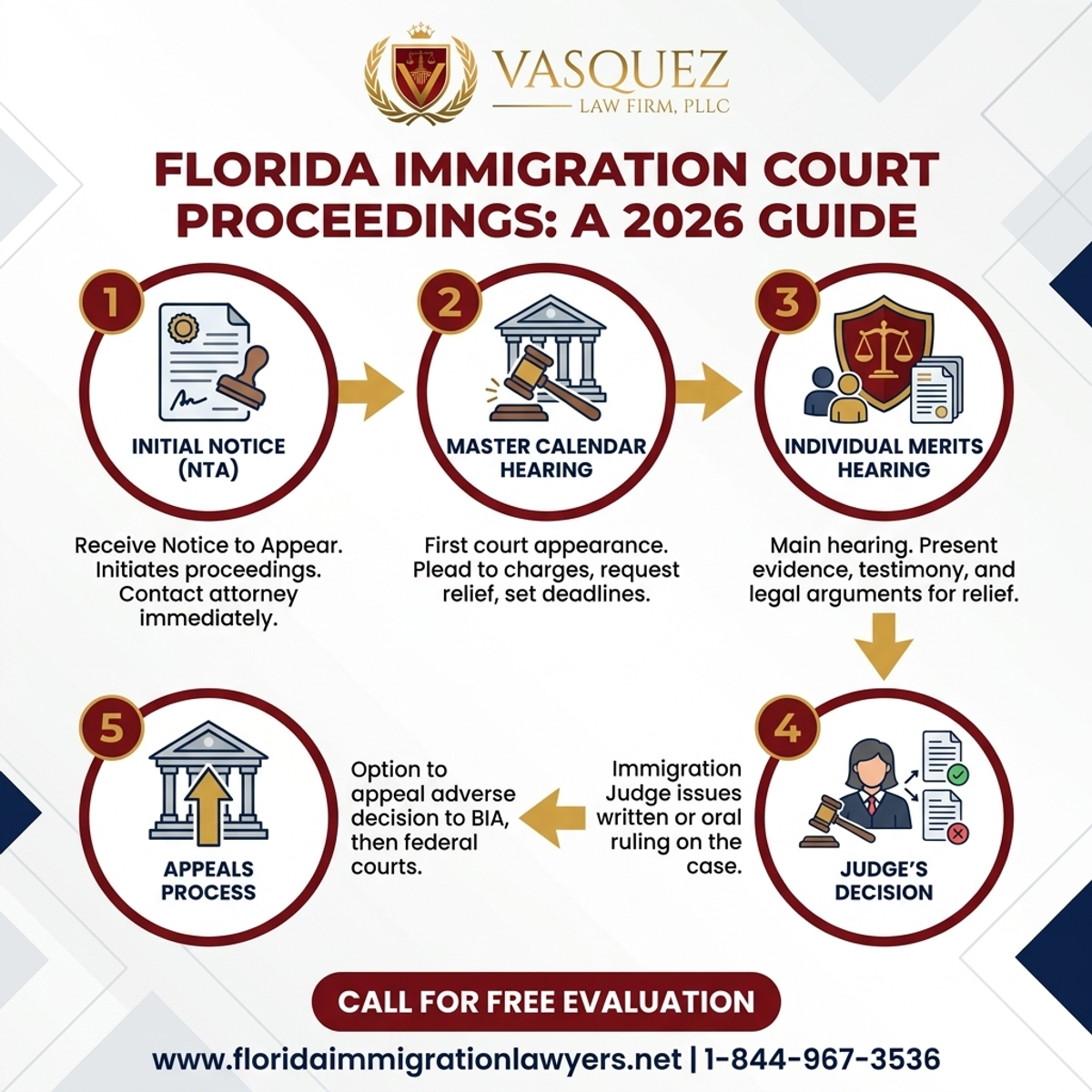
Step-by-Step Process — Immigration Court Proceedings in Florida: A 2026 Guide
Step-by-Step Guide to Removal Proceedings
- Receive a Notice to Appear (NTA).
- Attend a Master Calendar Hearing.
- Prepare for an individual merits hearing.
- Receive the judge's decision.
- File an appeal if necessary.
The NTA is a critical document that outlines the specific allegations against you and the legal charges for which the Department of Homeland Security (DHS) seeks your removal. It also provides the date, time, and location of your first court appearance. It's imperative to review this document carefully with an attorney, as errors or misunderstandings can have serious implications. Your response to the NTA's allegations at the Master Calendar Hearing sets the tone for your entire case.
During the Master Calendar Hearing, the immigration judge will confirm your identity, ensure you received the NTA, and ask you to admit or deny the factual allegations and legal charges. This is also where you will inform the court of any forms of relief from removal you intend to pursue, such as asylum, cancellation of removal, or adjustment of status. For instance, if you are seeking asylum, you would formally state your intention, and the judge would then set a schedule for filing your application and preparing for an Individual Merits Hearing.
The Individual Merits Hearing is essentially a trial, where both you (through your attorney) and the government attorney present evidence, call witnesses, and make legal arguments. This is your opportunity to demonstrate your eligibility for relief from removal. For example, an individual seeking asylum would present testimony about persecution in their home country, supported by country conditions reports, medical records, and witness affidavits. The government attorney will have the opportunity to cross-examine you and your witnesses. Having a skilled attorney from Florida Immigration Lawyers by your side is essential to effectively navigate this complex evidentiary phase.
Understanding the nuances of these stages is crucial. A well-prepared case, backed by robust evidence and compelling legal arguments, can significantly sway the judge's decision. Even after a decision is rendered, there are avenues for appeal to the Board of Immigration Appeals (BIA), and in some cases, to federal circuit courts, offering further opportunities to challenge an unfavorable ruling. This multi-layered process underscores the need for consistent and expert legal guidance.
What Documents Are Needed for Immigration Court?
Documentation is critical in immigration court proceedings. Having the right documents can strengthen your case and demonstrate your eligibility for relief.
- Notice to Appear (NTA)
- Passport and identification documents
- Proof of residence and employment
- Financial records
- Legal documents (e.g., asylum application)
Ensure that all documents are current and accurately reflect your situation. Legal counsel can assist in compiling and presenting these documents effectively.
Beyond the basic list, specific documents will vary greatly depending on the type of relief you are seeking. For instance, if you are applying for asylum, you will need detailed affidavits describing your persecution, country condition reports, medical records, police reports, and witness statements. For cancellation of removal, you'll need extensive proof of continuous physical presence, good moral character, and evidence of exceptional and extremely unusual hardship to qualifying relatives. This often includes birth certificates, school records, utility bills, tax returns, and letters from community members.
Practical tip: Always bring original documents to court, along with multiple copies for the judge, the government attorney, and your own records. Any document not in English must be accompanied by a certified translation. Organizing your documents clearly, perhaps in binders with tabs, can make a positive impression on the judge and streamline the hearing process. Your attorney from Florida Immigration Lawyers will guide you on precisely which documents are most relevant to your specific case and how to best present them.
Remember, the burden of proof often rests on the applicant to demonstrate eligibility for relief. Incomplete or poorly presented documentation can significantly weaken your case, even if you are otherwise eligible. Proactive and meticulous preparation of all required paperwork is a cornerstone of a successful defense in immigration court.
Florida Immigration Court Timeline and Expectations
Understanding the timeline for immigration court proceedings is essential for planning and preparation. Here is a typical timeline:
| Stage | Typical Timeframe | Notes |
|---|---|---|
| Notice to Appear | Immediate | Issued by DHS |
| Master Calendar Hearing | 1-3 months | Initial court appearance |
| Individual Hearing | 6-12 months | Detailed case presentation |
| Judge's Decision | 1-3 months | Can be appealed |
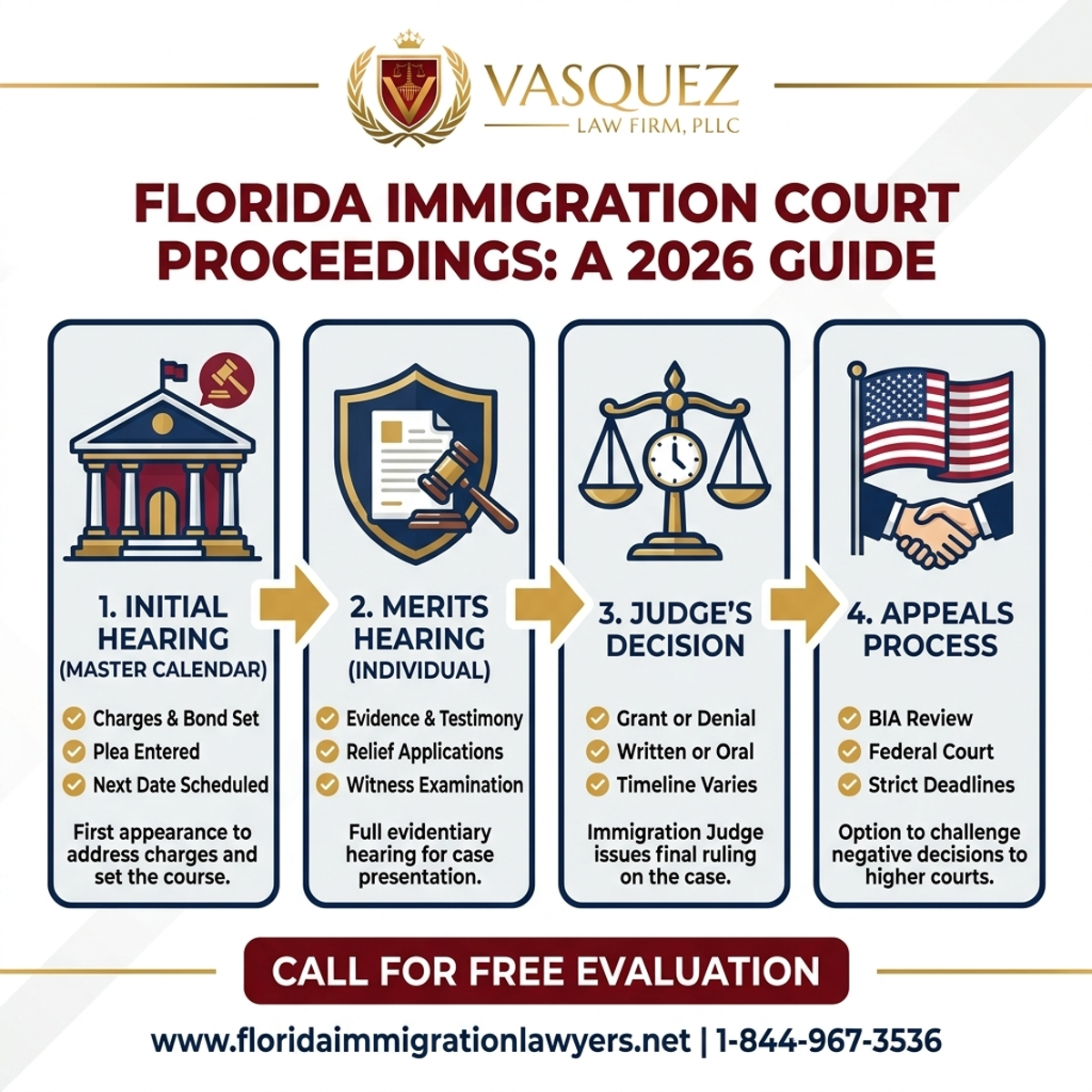
Key Statistics — Immigration Court Proceedings in Florida: A 2026 Guide
Delays can occur due to court backlogs, so it's important to remain patient and informed throughout the process.
It's crucial to recognize that the listed timeframes are averages and actual cases can deviate significantly. Factors such as the specific immigration court's caseload, the availability of the assigned judge, the complexity of your case, and whether you are detained or not can all influence the duration. For example, a complex asylum case involving extensive evidence and multiple witnesses could easily extend beyond the typical 12-month mark for an individual hearing, potentially stretching for several years.
Managing expectations and maintaining open communication with your legal team are vital during these extended periods. While the process can be emotionally taxing, continuous preparation and adherence to all deadlines are non-negotiable. Your attorney from Florida Immigration Lawyers will provide realistic timelines based on current court conditions and your specific circumstances, helping you prepare for the journey ahead.
Practical tip: Use the waiting periods between hearings wisely. This is an opportune time to gather additional evidence, refine your testimony, and explore all potential avenues for relief. Staying organized and proactive, even when the court process feels slow, can make a significant difference in the long run. Always inform your attorney of any changes in your contact information or circumstances.
Cost Factors and Fee Breakdown for Immigration Court
Costs associated with immigration court can vary. Understanding potential expenses helps in financial planning.
| Item | Typical Fee | Notes |
|---|---|---|
| Application Filing Fees | Variable | Depends on application type |
| Attorney Fees | Variable | Based on case complexity |
| Translation Services | Variable | For non-English documents |
Legal counsel can provide an estimate based on your specific circumstances. Do not navigate this process alone. Contact Florida Immigration Lawyers today.
Application filing fees are set by USCIS and can range from a few hundred to over a thousand dollars, depending on the specific form of relief you are seeking (e.g., I-589 for asylum generally has no fee, but an I-485 for adjustment of status does). Fee waivers may be available for certain applications if you meet strict income eligibility requirements. Your attorney can help determine if you qualify for a fee waiver and assist with the application process.
Attorney fees represent a significant portion of the overall cost, but they are an investment in your future. These fees can be structured in various ways: an hourly rate, a flat fee for specific stages of the case (e.g., Master Calendar Hearing, Individual Merits Hearing), or a retainer that is drawn down as work is performed. The total cost will depend on the complexity of your case, the amount of evidence required, the number of hearings, and the experience level of your chosen attorney. It's important to discuss these fee structures transparently with Florida Immigration Lawyers during your initial consultation.
Beyond filing and attorney fees, other potential costs include expert witness fees (e.g., psychologists for trauma evaluations, country conditions experts), travel expenses if you need to attend hearings far from home, and costs for obtaining vital records or criminal background checks. While these additional expenses can add up, they are often crucial for building a strong and successful case. Florida Immigration Lawyers understands these financial considerations and strives to provide clear, upfront cost estimates and discuss potential payment plans to ease the burden.
Common Mistakes to Avoid in Immigration Court
Navigating immigration court is fraught with potential pitfalls that can jeopardize your case. Being aware of these common errors is the first step towards a successful outcome.
- Missing court dates: Can lead to automatic removal orders.
- Submitting incomplete documentation: Weakens your case.
- Not understanding recent policy changes: May affect eligibility.
- Failing to secure legal representation: Reduces chances of success.
- Ignoring deadlines: Risks dismissal of your case.
- Providing inconsistent information: Damages credibility.
- Overlooking the importance of evidence: Essential for favorable outcomes.
- Not preparing for hearings: Leads to inadequate defense.
- Misinterpreting legal terms: Causes confusion and errors.
- Relying on outdated advice: Policies and rules change.
Avoiding these mistakes requires diligence, organization, and most importantly, expert legal guidance. An immigration lawyer acts as your advocate, ensuring you are prepared for every stage and that your rights are fully protected against these common missteps.
When to Call a Lawyer
Consulting an immigration lawyer is crucial at various stages of the court process. If you receive a Notice to Appear or face removal proceedings, legal guidance is essential. Warning signs such as complex legal issues, language barriers, or unfamiliarity with immigration law indicate the need for professional help. Florida Immigration Lawyers offer experienced representation in all aspects of immigration law, ensuring your rights are protected.
The moment you receive a Notice to Appear (NTA) is the ideal time to contact an attorney. Delaying can lead to missed deadlines or misunderstandings that could severely impact your case. An attorney can immediately review the NTA, explain the charges against you, and begin strategizing your defense. This early intervention allows for thorough preparation, from gathering crucial evidence to identifying all potential forms of relief from removal, such as asylum or cancellation of removal.
Furthermore, an immigration lawyer does more than just represent you in court; they act as your guide through a labyrinthine legal system. They can explain complex legal terminology, ensure all documents are properly filed and translated, prepare you for testimony, and negotiate with government attorneys. For instance, if you have a criminal record, an attorney can assess its impact on your immigration case and explore waivers or other legal arguments. Their expertise is invaluable in protecting your rights and maximizing your chances of a favorable outcome. Don't hesitate to call 1-844-YO-PELEO for a free case review with Florida Immigration Lawyers.
About Florida Immigration Lawyers
Florida Immigration Lawyers is a leading firm offering comprehensive immigration services across Florida. Our experienced attorneys specialize in removal defense, citizenship applications, family and business immigration, and more. We are dedicated to providing compassionate and effective legal representation. Available 24/7, we offer free case reviews and serve the entire state of Florida. Call 1-844-YO-PELEO or schedule a free consultation today.
Sources and References
- U.S. Citizenship and Immigration Services (USCIS)
- Executive Office for Immigration Review (EOIR)
- 8 U.S.C. Chapter 12 - Immigration and Nationality Act
Frequently Asked Questions (FAQs)
Here are some common questions about immigration court proceedings in Florida:
Q: Can I represent myself in immigration court?
A: While you have the right to represent yourself, it is strongly discouraged. Immigration law is incredibly complex, with constantly evolving policies and strict procedural rules. Representing yourself significantly lowers your chances of success, as you may miss critical deadlines, fail to present evidence correctly, or overlook viable forms of relief. An attorney understands the nuances and can advocate effectively on your behalf, making legal representation a crucial investment in your case.
Q: What happens if I miss a court date?
A: Missing an immigration court date is a serious error that can lead to an automatic Order of Removal (deportation) being issued against you in absentia. If this happens, you would typically need to file a motion to reopen your case, which is a difficult and often unsuccessful process, requiring proof of exceptional circumstances for your absence. Always attend your hearings or contact your attorney immediately if an unavoidable conflict arises.
Q: How do recent policy changes affect my case?
A: Recent policy changes can significantly impact your eligibility for certain forms of relief, the evidence required, or even the overall processing time of your case. Immigration law is dynamic, with new regulations and interpretations frequently introduced by various administrations. Staying informed is challenging, which is why having an experienced attorney is vital. Florida Immigration Lawyers continuously monitor these changes to ensure your defense strategy remains current and effective.
Q: What is the difference between removal and deportation?
A: Historically, "deportation" referred to the forced removal of non-citizens who had entered the U.S. legally, while "exclusion" or "expulsion" applied to those deemed inadmissible at entry. However, the Immigration and Nationality Act (INA) consolidated these terms under "removal proceedings" in 1996. Today, "removal" is the official legal term encompassing both the deportation of individuals already in the U.S. and the exclusion of those seeking entry. Colloquially, "deportation" is still widely used.
Q: Can I get a work permit while my case is pending?
A: Eligibility for a work permit (Employment Authorization Document or EAD) while your immigration court case is pending depends on the specific type of relief you are seeking. For example, individuals who have filed an asylum application are generally eligible to apply for an EAD after 150 days from the date their application was filed, provided their case is not frivolous. Your attorney can assess your eligibility and help you file the necessary application (Form I-765).
Related services: asylum and refugee protection, immigration waivers, humanitarian protection programs, DACA renewal and applications.
This article provides general legal information and is not intended as legal advice. Every case is unique, and outcomes depend on specific facts and circumstances. Contact an attorney for advice about your particular situation.
Se Habla Espanol - Estamos aqui para ayudarle. Call 1-844-YO-PELEO for a free consultation.
If you need legal assistance, learn more about get deportation defense help today, or call us at 1-844-967-3536 for a free case review.
Do Not Navigate This Process Alone
Our experienced immigration attorneys are ready to fight for you. Get a free, confidential case review today.
Se Habla Español
Or leave your details and we’ll call you:
Free Evaluation in 24 Hours
Or talk to us right now

AI voice assistant — available 24/7
FreeFrequently Asked Questions

William J. Vásquez
Founding Attorney · Vasquez Law Firm
U.S. Air Force veteran and immigration attorney with years of hands-on U.S. immigration experience. J.D., NCCU School of Law. AILA member. Admitted to the 4th, 5th, and 11th Circuit Courts.
Available 24/7 - Free Evaluations
Reviewed for legal accuracy by William J. Vásquez
Licensed in North Carolina; U.S. immigration is federal practice.
Related Legal Services
Our Florida immigration attorneys can help you with free immigration consultation, business immigration and deportation defense. Call today at 1-844-YO-PELEO for a free case review.
Related Links
Related Topics
Free Legal Case Review
Discuss your case with our experienced attorneys. We're available 24/7.
Se Habla Español - Estamos aquí para ayudarle.
Related Articles
Immigration Lawyer Orlando Free Consultation in Florida
For individuals and families in Orlando, Florida, navigating the complexities of U.S. immigration law requires expert guidance. An immigration lawyer in Orlando offers crucial support for everything from visa applications and green card processes to naturalization and deportation defense. This comprehensive guide details what a free consultation covers, providing a step-by-step overview of immigration pathways, essential document checklists, and expected timelines in 2026. We also highlight common mistakes to avoid, discuss the critical role of legal counsel in deportation and asylum cases, and explain why choosing a local Orlando immigration attorney is beneficial. Florida Immigration Lawyers is dedicated to serving the diverse community of Orlando with compassionate, effective legal solutions, ensuring you receive personalized advice and robust representation for a successful immigration journey.
EAD Advance Parole Combo Card in Florida 2026
For individuals with a pending Form I-485, Application to Register Permanent Residence or Adjust Status, the EAD Advance Parole Combo Card is an essential document. This single card combines the authorization to work legally in the U.S. (Employment Authorization Document - EAD) with permission to travel internationally and re-enter without abandoning your green card application (Advance Parole). This guide from Florida Immigration Lawyers provides a comprehensive overview for applicants in Florida in 2026, covering eligibility, the step-by-step application process, required documents, expected processing times, and associated costs. We also highlight common mistakes to avoid and when to seek legal counsel to ensure a smooth and successful immigration journey. Understanding this vital card is key to maintaining stability while awaiting your permanent residency approval.
Immigration Lawyer Orlando Florida: Your 2026 Guide
For those in Orlando, Florida, navigating the complexities of U.S. immigration law demands expert legal assistance. This guide details why hiring an immigration lawyer is crucial, covering essential services like family visas, deportation defense, asylum claims, and naturalization. We provide insights into choosing the right attorney in Orange County, a step-by-step guide for family-based immigration, and a breakdown of associated costs and timelines for 2026. Learn to avoid common pitfalls and understand when professional legal help is indispensable to secure a positive outcome for your immigration case. Florida Immigration Lawyers offers comprehensive support for clients throughout Florida, providing personalized guidance and strong representation.
Immigration Lawyer Services in Gulf Coast Florida
Navigating the U.S. immigration system can be complex, especially with recent policy changes. This article explores how immigration lawyers in Gulf Coast Florida can assist with visa applications, deportation defense, and more. For personalized assistance, contact Florida Immigration Lawyers at 1-844-YO-PELEO for a free case review.