Child Status Protection Act: Florida Guide | VLF Florida
Learn how the Child Status Protection Act (CSPA) can protect your family's immigration status in Florida. This guide covers everything from understanding CSPA to calculating age and avoiding common mistakes. Call Florida Immigration Lawyers for expert help.

- CSPA applies to children under 21 who are derivative beneficiaries.
- It freezes the child's age at certain points in the immigration process.
- Understanding CSPA is crucial for families in Florida facing age-out concerns.
- Consulting with an immigration lawyer can help navigate complex cases.
Introduction
Imagine you're living in Orlando, Florida, and your family is in the process of immigrating to the United States. Your child, a derivative beneficiary, is nearing their 21st birthday, and you're worried they might "age out" of eligibility. This is where the Child Status Protection Act (CSPA) comes into play. This article will explore how CSPA can help families in Florida, particularly in Orlando, by freezing the child's age and maintaining their eligibility for immigration benefits. Call Florida Immigration Lawyers at 1-844-967-3536 for a free consultation.
The journey to immigration can often be long and filled with uncertainties, especially when it involves children. The fear of a child turning 21 before their immigration petition is approved is a common and legitimate concern for many families in Florida. CSPA was specifically designed to alleviate this stress, offering a critical pathway for children to remain eligible for the benefits they are meant to receive.
For families residing in vibrant communities like Orlando, where diverse populations are constantly navigating the immigration system, understanding CSPA is not just beneficial—it's essential. Proactive planning and a clear grasp of CSPA's provisions can safeguard your child's future, ensuring they can join you in the U.S. without unnecessary delays or complications. Our team at Florida Immigration Lawyers is dedicated to guiding you through every step of this complex process.
Understanding the Child Status Protection Act (CSPA)
The Child Status Protection Act, or CSPA, was enacted to address the complex issues surrounding "aging out." This occurs when a child turns 21 and no longer qualifies as a "child" under immigration laws. CSPA helps by freezing the child's age at certain points during the immigration process. This is particularly important for families in Florida who face lengthy immigration proceedings.
Before CSPA, countless families saw their children lose eligibility for visas simply because of administrative delays or backlogs in visa processing. This often meant children had to file new, separate petitions, leading to further delays and, in some cases, separation from their families for extended periods. CSPA sought to rectify this unfair outcome by providing a mechanism to calculate a child's age for immigration purposes in a way that accounts for these processing times.
In Orlando, where immigration cases are common, CSPA provides a critical safety net for families. For instance, if a parent is a lawful permanent resident (LPR) petitioning for a child, CSPA can protect the child's eligibility status even if they turn 21 before the application is fully processed. This protection extends to various categories, including family-sponsored preferences, employment-based preferences, and diversity visa programs, ensuring a broader scope of beneficiaries can benefit. It's crucial to consult with Florida Immigration Lawyers to determine how CSPA applies to your specific category.
How CSPA Applies to Derivative Beneficiaries
Derivative beneficiaries are children who derive immigration benefits from a parent's immigration application. CSPA is crucial for these cases as it allows the child's age to be calculated differently, often preserving eligibility. For example, a child listed on a parent's employment-based petition might "age out" under normal circumstances. However, CSPA can freeze their age, allowing them to continue as a beneficiary.
The CSPA age calculation for derivative beneficiaries is often the most intricate part of the process. It involves subtracting the time a visa petition was pending from the child's age on the date the visa becomes available. This calculation can be a lifeline for families, but any misstep can lead to severe consequences. For example, if a parent's I-140 petition for an employment-based visa was pending for three years, those three years are subtracted from the child's actual age on the day the visa number becomes current.
In Florida, particularly in multicultural hubs like Orlando, many families benefit from this provision. Understanding how CSPA applies to your case can mean the difference between a successful immigration process and starting over. Our attorneys at Florida Immigration Lawyers have extensive experience with these calculations and can provide precise guidance to ensure your child's eligibility is maintained. Don't hesitate to call us at 1-844-967-3536 for expert assistance.
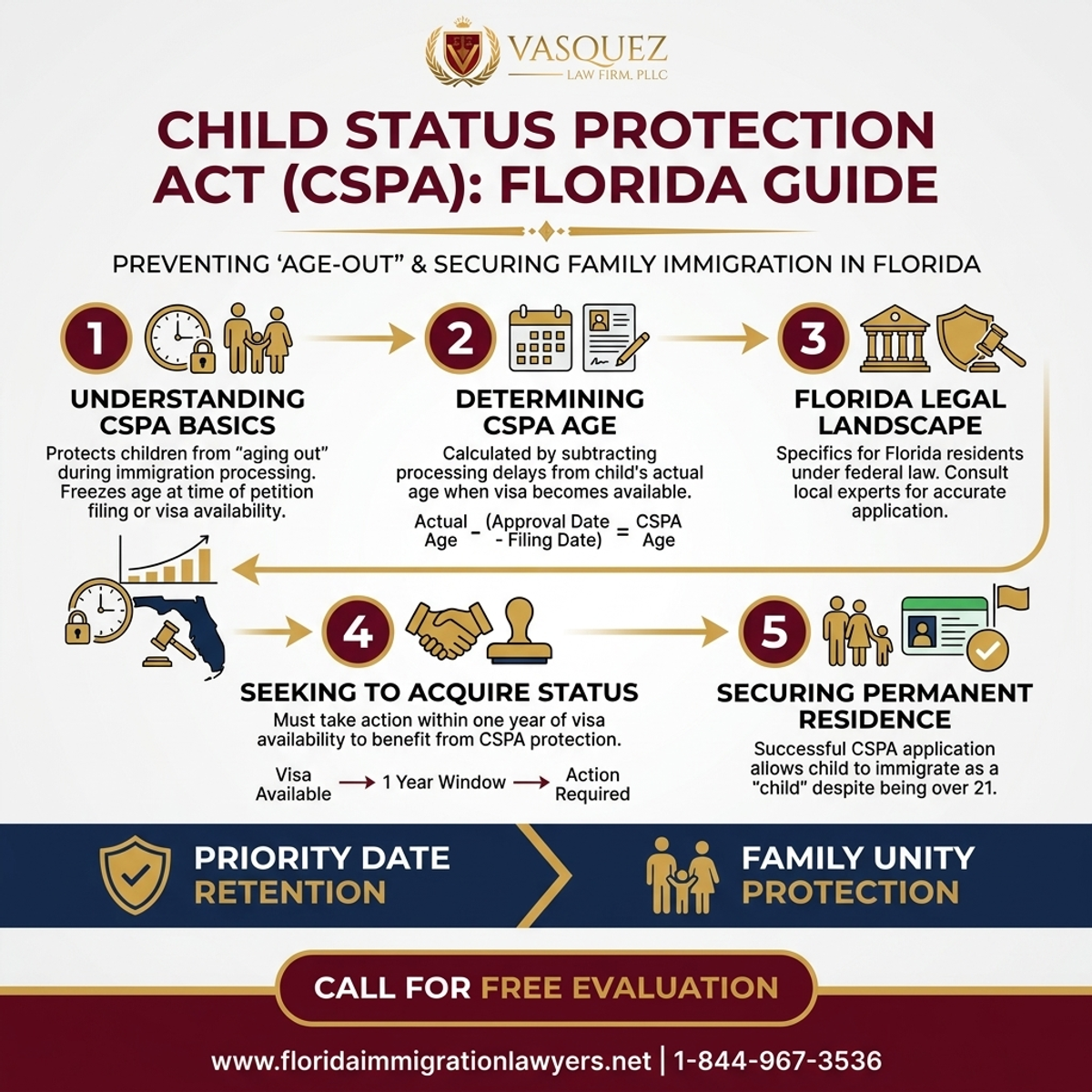
Step-by-Step Process — Child Status Protection Act: Florida Guide
Step-by-Step Guide to Calculate CSPA Age
Accurately calculating a child's CSPA age is paramount to determining their eligibility for immigration benefits. This calculation is not always straightforward and requires careful attention to specific dates and the type of petition involved. Understanding each step ensures that families in Florida can navigate this critical aspect of their immigration journey with confidence.
- Determine the child's age at the time of visa availability by subtracting the I-130 or I-140 petition pending time from the child's actual age.
- Consider the date the priority date becomes current according to the Visa Bulletin.
- Calculate the CSPA age using the formula: Age at visa availability - Pending time = CSPA Age.
- If the CSPA age is under 21, the child remains eligible as a derivative beneficiary.
It's important to note that the "pending time" is the period from when the petition was filed until it was approved, not the entire time the case is open. Also, the child must seek to acquire permanent residence within one year of the visa becoming available. This "one-year filing rule" is critical and often overlooked, leading to loss of CSPA protection. Consulting with Florida Immigration Lawyers can help ensure these precise calculations and deadlines are met.
Document Checklist for CSPA Cases
Having a complete and organized set of documents is vital for any immigration case, and CSPA cases are no exception. These documents serve as proof of your eligibility and help USCIS verify the necessary dates for age calculation. Missing or incorrect documentation can lead to significant delays or even denial of your application, impacting your child's future.
- Birth certificate of the child
- Copy of the I-130 or I-140 petition
- Visa Bulletin showing the priority date
- USCIS notices related to the case
- Any correspondence with immigration authorities
In addition to the core documents, you might need marriage certificates (for parents), divorce decrees (if applicable), and proof of relationship. Maintaining a meticulous record of all submissions and communications with USCIS is a practical tip that can save time and stress. Florida Immigration Lawyers can assist you in compiling this comprehensive checklist and ensuring all required documents are submitted correctly and on time.
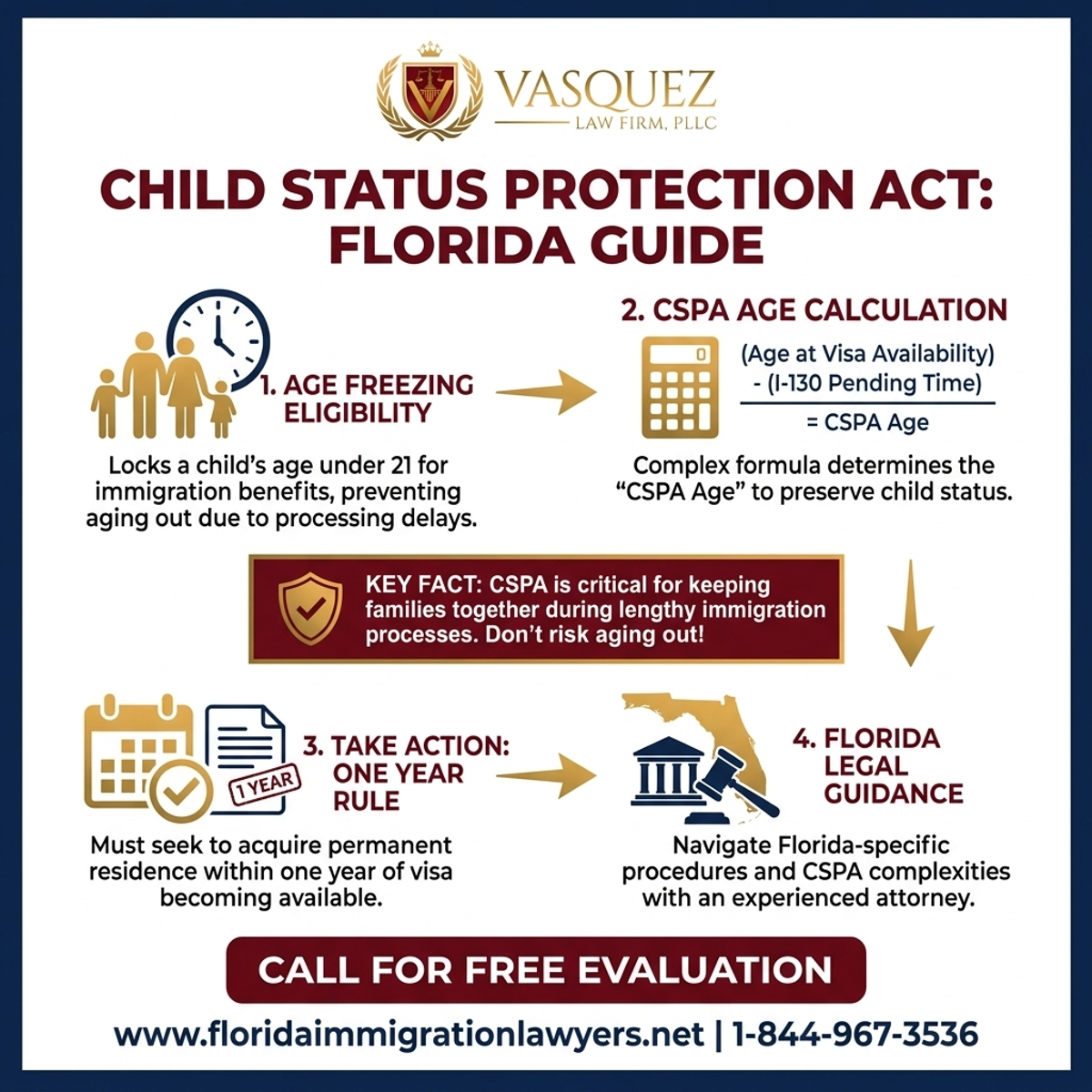
Key Statistics — Child Status Protection Act: Florida Guide
Timeline and Processing Expectations
In Florida, the timeline for processing CSPA-related cases can vary. Typically, understanding the CSPA age involves reviewing the Visa Bulletin and calculating the pending time. Cases may take several months to resolve, especially in busy immigration courts in Orlando.
Several factors can influence the processing timeline, including the specific visa category, the country of origin, and the current workload of USCIS and the National Visa Center. Economic and political shifts can also impact visa bulletin dates, causing priority dates to retrogress or advance unexpectedly. This unpredictable nature underscores the need for constant vigilance and expert guidance.
Having all necessary documents ready and understanding the CSPA process can expedite the timeline. Florida Immigration Lawyers can assist in navigating these timelines effectively, helping you monitor the Visa Bulletin, respond promptly to Requests for Evidence (RFEs), and proactively address any potential issues. Our goal is to minimize delays and ensure the smoothest possible path for your child's immigration.
Cost Factors and Fee Breakdown
While specific fees for immigration filings can change, it is essential to budget for application fees, attorney consultation fees, and potential travel expenses for interviews or court appearances. Consulting with a knowledgeable attorney can help manage costs and avoid unnecessary expenses.
The primary costs typically include USCIS filing fees for the underlying petition (e.g., I-130, I-140), adjustment of status (I-485) or immigrant visa application (DS-260) fees, biometrics fees, and mandatory medical examination fees. These government fees are non-negotiable, but understanding them upfront allows for better financial planning. Be aware that fees are subject to change, so always check the latest USCIS fee schedule.
Beyond government fees, legal representation constitutes another significant cost. Attorney fees can vary depending on the complexity of the case and the firm's experience. While it may seem like an additional expense, investing in experienced legal counsel from Florida Immigration Lawyers can prevent costly mistakes, ensure compliance with all regulations, and ultimately save you time and money in the long run by avoiding rejections or appeals. Do not navigate this process alone. Contact Florida Immigration Lawyers today at 1-844-967-3536.
Common Mistakes to Avoid
- Not keeping track of the priority date: Missing this can lead to miscalculating CSPA age.
- Failing to submit required documents: Incomplete applications can delay the process.
- Not consulting with an attorney: Professional guidance is crucial in complex cases.
- Misunderstanding CSPA eligibility: Assuming all children qualify can lead to issues.
- Ignoring visa bulletin updates: Changes can affect CSPA calculations.
- Not responding to USCIS requests: Timely communication is essential.
- Assuming age protection is automatic: Each case requires specific calculations.
- Missing deadlines for responses: This can jeopardize eligibility.
- Not updating address with USCIS: Communication failures can occur.
- Attempting to handle complex cases alone: Legal assistance can provide clarity and direction.
When to Call a Lawyer
If you're facing an "aging out" scenario in Florida, it's vital to consult a lawyer. Situations where the CSPA calculations are complex or where you receive conflicting information from USCIS are red flags. Florida Immigration Lawyers offer the expertise needed to navigate these challenges.
Beyond just age calculation, legal counsel becomes indispensable in various other situations. If your child has a criminal record, if there are complexities in your family structure (e.g., step-children, adoptions), or if you've previously had an immigration petition denied, an attorney can assess the best course of action. These factors can significantly complicate CSPA eligibility and require nuanced legal strategies.
Even if your case seems straightforward, the ever-changing landscape of immigration law means that what was true yesterday might not be today. An experienced immigration attorney from Florida Immigration Lawyers, serving Orlando and beyond, stays current with all legal updates and can provide peace of mind. Proactive engagement with legal professionals can safeguard your child's future immigration prospects and prevent unforeseen pitfalls. Call 1-844-967-3536 today.
About Florida Immigration Lawyers
Florida Immigration Lawyers is committed to serving the diverse communities across Florida, including Orlando. We offer comprehensive services in immigration law, focusing on family immigration, business immigration, and deportation defense. Call us at 1-844-967-3536 or visit our website. Available 24/7, we offer free consultations and bilingual services. Se Habla Español - Estamos aquí para ayudarle.
Sources and References
- U.S. Citizenship and Immigration Services (USCIS)
- Executive Office for Immigration Review (EOIR)
- 8 U.S.C. Chapter 12 - Immigration and Nationality Act
Related services: immigration practice areas, family immigration services.
This article provides general legal information and is not intended as legal advice. Every case is unique, and outcomes depend on specific facts and circumstances. Contact an attorney for advice about your particular situation.
Final CTA
Protect your family's future under the CSPA. Call Florida Immigration Lawyers at 1-844-967-3536 for a free consultation. Se Habla Español - Estamos aquí para ayudarle.
If you need legal assistance, learn more about how our immigration attorneys can help, or call us at 1-844-967-3536 for a free consultation.
Do Not Navigate This Process Alone
Our experienced immigration attorneys are ready to fight for you. Get a free, confidential consultation today.
Se Habla Español
Frequently Asked Questions
Florida Immigration Lawyers
Immigration Attorney | Founder, Vasquez Law Firm
U.S. Air Force veteran and immigration attorney with thousands of cases resolved. J.D., NCCU School of Law. AILA member. Admitted to the 4th, 5th, and 11th Circuit Courts.
Available 24/7 - Free Evaluations
Related Legal Services
Our Florida immigration attorneys can help you with immigration practice areas, free immigration consultation and experienced immigration attorneys. Call today at 1-844-967-3536 for a free consultation.
Related Links
Related Topics
Free Legal Consultation
Discuss your case with our experienced attorneys. We're available 24/7.
Se Habla Español - Estamos aquí para ayudarle.
Related Articles
Immigration Medical Exam: Florida Doctors Guide | VLF Florida
If you're applying for a green card in Florida, understanding the immigration medical exam is crucial. This guide covers everything from choosing a civil surgeon to what the exam entails. Get a free consultation with Florida Immigration Lawyers.
Solutions for Immigration Backlog in Florida | VLF Florida
Facing immigration backlog in Florida can be daunting. Discover strategies to manage USCIS delays and learn when to seek legal assistance. Call Florida Immigration Lawyers for expert guidance.
Expungement's Impact on Immigration in Florida | VLF Florida
Explore the impact of expungement on immigration status in Florida. Learn about eligibility, process steps, and legal considerations. Contact Florida Immigration Lawyers for a free consultation.
K-3 Spouse Visa Timeline in Florida | FL Immigration Lawyers
Learn about the K-3 spouse visa process in Florida to bring your loved ones closer. Find detailed steps, timelines, and expert advice. Contact us for a free consultation!