K-3 Spouse Visa Timeline in Florida | FL Immigration Lawyers
Learn about the K-3 spouse visa process in Florida to bring your loved ones closer. Find detailed steps, timelines, and expert advice. Contact us for a free consultation!

K-3 Spouse Visa Timeline in Florida | FL Immigration Lawyers
The K-3 nonimmigrant visa allows the foreign spouse of a U.S. citizen to enter the United States while their immigrant visa petition (Form I-130) is pending. This visa was created to shorten the separation time for married couples, enabling the foreign spouse to reside in the U.S. with their citizen spouse much sooner than if they waited for the I-130 to be approved through traditional consular processing. While the K-3 visa process can be complex, understanding the steps and timelines, especially within Florida's immigration landscape, is crucial for a smooth journey. Our experienced Florida immigration lawyers are here to guide you through every stage.
Understanding the K-3 Visa: Purpose and Benefits
The K-3 visa serves as a bridge, allowing spouses to unite in the U.S. more quickly. Historically, the K-3 visa was a popular option for U.S. citizens whose foreign spouses were living abroad, as it often offered a faster route to family reunification compared to waiting for the I-130 petition to be fully processed overseas. While processing times for I-130s have improved in recent years, making the K-3 less universally advantageous than it once was, it still presents a viable option for some couples, particularly those facing specific delays or circumstances. The primary benefit remains the ability for the foreign spouse to enter the U.S. and apply for work authorization while their green card application is processed, minimizing separation and offering greater stability.
Eligibility Requirements for the K-3 Visa
To qualify for a K-3 visa, both the U.S. citizen petitioner and the foreign spouse beneficiary must meet specific criteria:
- Valid Marriage: You must be legally married to a U.S. citizen. The marriage must be valid in the country where it took place.
- Pending I-130 Petition: The U.S. citizen spouse must have already filed Form I-130, Petition for Alien Relative, on behalf of their foreign spouse with U.S. Citizenship and Immigration Services (USCIS).
- U.S. Citizen Petitioner: The petitioner must be a U.S. citizen.
- Foreign Spouse Abroad: The foreign spouse must reside outside the United States. If the foreign spouse is already in the U.S., they typically cannot apply for a K-3 visa and would instead pursue adjustment of status if eligible.
- Intent to Immigrate: The foreign spouse must intend to immigrate to the U.S. and eventually apply for a green card.
It's important to note that the K-3 visa is not a direct path to a green card but rather a nonimmigrant visa that allows entry and work authorization while the immigrant visa process (based on the I-130) continues. Once in the U.S. on a K-3 visa, the foreign spouse will typically file Form I-485, Application to Register Permanent Residence or Adjust Status, to obtain their green card.
The K-3 Visa Application Process: A Step-by-Step Guide
Navigating the K-3 visa process involves several distinct stages, each with its own forms, fees, and requirements. Here's a breakdown of the typical steps:
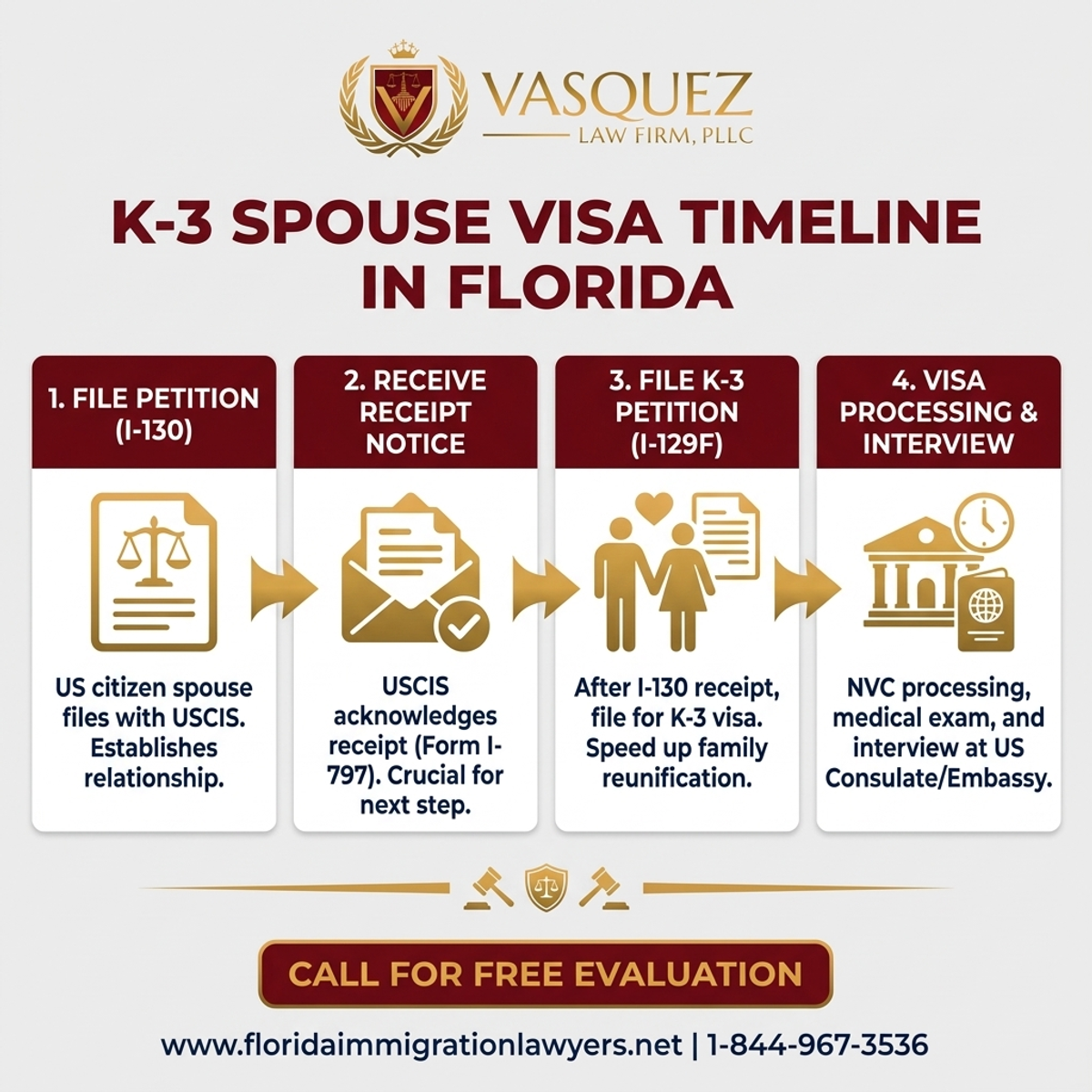
Step 1: File Form I-130, Petition for Alien Relative
The U.S. citizen spouse must first file Form I-130 with USCIS. This petition establishes the bona fide nature of the marriage and the relationship between the petitioner and beneficiary. It's crucial to submit comprehensive evidence of a genuine marriage, such as marriage certificates, joint bank accounts, property deeds, photographs, and affidavits from friends and family. The approval of this petition is a prerequisite for the K-3 visa, though the K-3 allows the spouse to enter before the I-130 is fully processed.
Step 2: File Form I-129F, Petition for Alien Fiancé(e) (or Spouse)
Once the I-130 has been filed (and you have received a receipt notice), the U.S. citizen can then file Form I-129F, Petition for Alien Fiancé(e). Despite its name, this form is also used for K-3 spouses. On this form, you will indicate that you are petitioning for a K-3 spouse. You must include proof that the I-130 has already been filed. This petition is filed with USCIS and, once approved, is forwarded to the National Visa Center (NVC).
Step 3: National Visa Center (NVC) Processing
After USCIS approves the I-129F, it is sent to the NVC. The NVC will then forward the approved petition to the U.S. Embassy or Consulate in the foreign spouse's country of residence. Unlike traditional immigrant visa processing, the NVC's role for K-3 visas is primarily administrative, ensuring the petition is sent to the correct consulate. They typically do not collect civil documents or fees at this stage for K-3s, as those are handled directly by the embassy/consulate.
Step 4: Consular Interview Preparation and Documentation
The foreign spouse will be notified by the U.S. Embassy or Consulate to prepare for their visa interview. This involves completing the Online Nonimmigrant Visa Application (Form DS-160). Required documents typically include:
Step-by-Step Process — K-3 Spouse Visa Timeline in Florida | FL Immigration Lawyers
- Valid passport
- Birth certificate
- Marriage certificate
- Divorce decrees (if applicable for previous marriages)
- Police certificates from all countries lived in for more than six months since age 16
- Medical examination results from an authorized physician
- Affidavit of Support (Form I-864) from the U.S. citizen petitioner, demonstrating financial capability to support the spouse
- Photographs
- Evidence of a bona fide marriage (similar to I-130 evidence)
Gathering these documents meticulously is vital to avoid delays. Our team can assist you in compiling a complete and accurate packet.
Step 5: The Consular Interview
The foreign spouse attends an interview at the designated U.S. Embassy or Consulate. The consular officer will review the application, verify documents, and ask questions to confirm the legitimacy of the marriage and the applicant's eligibility for the K-3 visa. Honesty and consistency are paramount during this interview. If approved, the visa will be stamped in the applicant's passport.
Step 6: Entry into the United States and Adjustment of Status
Upon receiving the K-3 visa, the foreign spouse can travel to the U.S. Once admitted, they can apply for work authorization (Employment Authorization Document - EAD) and travel authorization (Advance Parole). The next critical step is to apply for permanent residence by filing Form I-485, Application to Register Permanent Residence or Adjust Status, with USCIS. This application is based on the previously filed and hopefully approved I-130 petition. This is the stage where the K-3 visa holder transitions to a lawful permanent resident (green card holder).
K-3 Spouse Visa Timeline in Florida
Predicting exact timelines for immigration processes can be challenging due to fluctuating USCIS and NVC workloads, as well as the specific U.S. Embassy or Consulate involved. However, we can provide general estimates for the K-3 visa process:
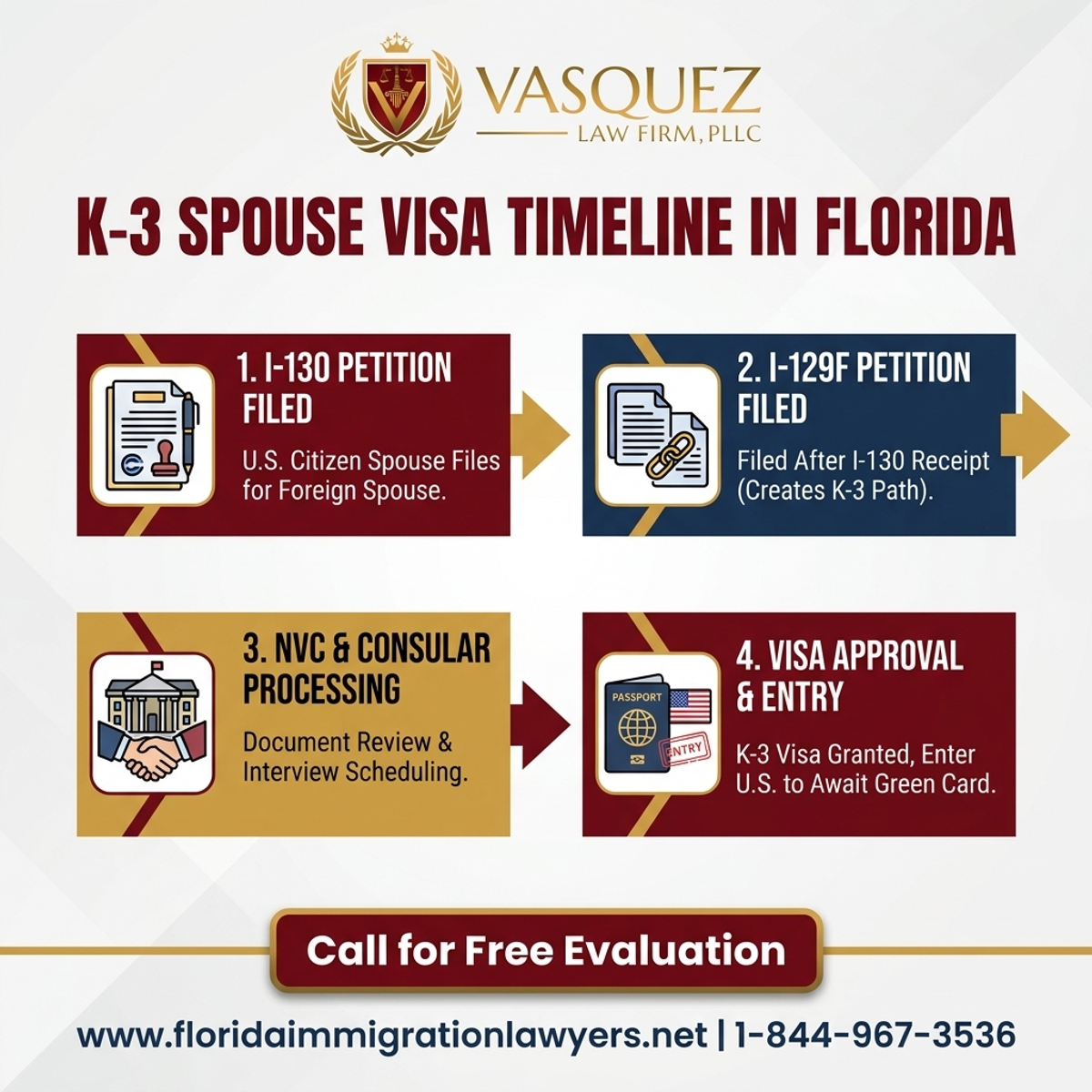
- Form I-130 Processing: This can range from 10 to 18 months or more, depending on the service center.
- Form I-129F Processing: Typically takes 6 to 12 months. It's important to remember that the I-129F for a K-3 is filed *after* the I-130.
- NVC Processing: Relatively quick for K-3s, often a few weeks.
- Consular Interview Scheduling and Processing: Varies significantly by embassy/consulate, from 1 to 4 months or more.
The K-3 visa's primary advantage is that the foreign spouse can enter the U.S. *before* the I-130 is fully approved and an immigrant visa becomes available. However, if the I-130 is approved quickly, sometimes the K-3 process might not offer a significant time advantage, and the couple might proceed directly to immigrant visa processing. Our Florida immigration lawyers stay updated on the latest processing times and can advise you on the most efficient path for your unique situation.
Benefits and Challenges of the K-3 Visa
Benefits:
- Reduced Separation: The main draw is the ability for spouses to reunite in the U.S. sooner.
- Work Authorization: K-3 visa holders can apply for an Employment Authorization Document (EAD) upon arrival, allowing them to work legally in the U.S.
- Travel Authorization: K-3 holders can also apply for Advance Parole, enabling them to travel outside the U.S. and return without abandoning their adjustment of status application.
- Children Included: K-4 visas are available for the minor children (under 21 and unmarried) of the K-3 applicant, allowing the entire family to come together.
Challenges:
- Complexity: Involves multiple forms and agencies (USCIS, NVC, Department of State), increasing the potential for errors.
- Declining Relevance: With improved I-130 processing times, the K-3 visa sometimes offers less of a time advantage than it once did.
- Dual Process: Essentially, you're managing two separate but related processes (I-130 for green card, I-129F for K-3 visa), which can be confusing.
- Potential for Delays: Any missing document or incorrect information can lead to Requests for Evidence (RFEs) or outright denials, significantly prolonging the process.
- Cost: Filing fees for multiple petitions can add up.
Key Statistics — K-3 Spouse Visa Timeline in Florida | FL Immigration Lawyers
Transitioning from K-3 to Green Card: Adjustment of Status
Once the K-3 visa holder is in the United States, the next crucial step is to apply for lawful permanent residence (a green card). This is done through the process of Adjustment of Status (AOS). The foreign spouse will file Form I-485, Application to Register Permanent Residence or Adjust Status, with USCIS. This application is typically filed concurrently with, or after, the approval of the underlying Form I-130 petition. Key components of the AOS application include:
- Form I-485: The main application form.
- Medical Examination: A new medical exam may be required if the previous one for the K-3 visa is no longer valid.
- Affidavit of Support (I-864): The U.S. citizen petitioner must reaffirm their financial sponsorship.
- Supporting Documents: Birth certificate, marriage certificate, passport copies, photos, and evidence of continuous marital bona fides.
- Interview: Most K-3 adjustment of status applicants will attend an interview at a USCIS field office. The purpose is to verify the marriage's legitimacy and the applicant's eligibility for permanent residence.
Upon approval of the I-485, the foreign spouse will receive their conditional (CR1) or unconditional (IR1) green card. If the marriage is less than two years old at the time of I-485 approval, a conditional green card is issued, requiring a subsequent petition (Form I-751) to remove conditions after two years.
Why Choose a Florida Immigration Lawyer for Your K-3 Visa?
The K-3 visa process, while designed to expedite family reunification, is intricate and fraught with potential pitfalls. From ensuring all eligibility criteria are met to meticulously preparing documentation and navigating interviews, the journey demands precision and expertise. A dedicated Florida immigration lawyer offers invaluable assistance at every stage. We understand the nuances of USCIS regulations and Department of State procedures, helping you avoid common mistakes that can lead to delays or denials. Our team can:
- Assess Eligibility: Determine if the K-3 visa is the most suitable option for your specific circumstances, or if direct consular processing for an IR1/CR1 visa might be more efficient.
- Prepare Petitions: Accurately complete and file Forms I-130 and I-129F, ensuring all required supporting evidence is included to establish a bona fide marriage.
- Manage NVC and Consular Processing: Guide you through the often-confusing NVC stage and prepare the foreign spouse for their consular interview, including document review and mock interviews.
- Address Challenges: Respond effectively to Requests for Evidence (RFEs) or Notices of Intent to Deny (NOIDs), which can arise from incomplete information or perceived inconsistencies.
- Facilitate Adjustment of Status: Assist with the subsequent Form I-485 application for permanent residence, ensuring a smooth transition from K-3 nonimmigrant to green card holder.
- Provide Local Expertise: With an understanding of Florida-specific considerations and USCIS field office practices, we offer tailored advice.
Having legal representation means you have an advocate protecting your interests and streamlining a process that can otherwise be overwhelming. We are committed to helping families unite and build their lives together in the United States. Don't navigate this complex journey alone; let our experienced attorneys provide the clarity and support you need. Contact us today for a consultation to discuss your K-3 visa needs.
Related Immigration Options and Considerations
While the K-3 visa is a specific pathway for spouses, it's essential to understand that the broader field of immigration offers
Sources and References
- U.S. Citizenship and Immigration Services (USCIS)
- Executive Office for Immigration Review (EOIR)
- U.S. Department of State - Bureau of Consular Affairs
- Immigration and Nationality Act (INA), 8 U.S.C. Chapter 12
Do Not Navigate This Process Alone
Our experienced immigration attorneys are ready to fight for you. Get a free, confidential consultation today.
Se Habla Español
Frequently Asked Questions
Florida Immigration Lawyers
Immigration Attorney | Founder, Vasquez Law Firm
U.S. Air Force veteran and immigration attorney with thousands of cases resolved. J.D., NCCU School of Law. AILA member. Admitted to the 4th, 5th, and 11th Circuit Courts.
Available 24/7 - Free Evaluations
Related Legal Services
Our Florida immigration attorneys can help you with experienced immigration attorneys, business immigration and asylum protection. Call today at 1-844-967-3536 for a free consultation.
Related Links
Related Topics
Free Legal Consultation
Discuss your case with our experienced attorneys. We're available 24/7.
Se Habla Español - Estamos aquí para ayudarle.
Related Articles
Advance Parole Travel Document in Florida | VLF Florida
Discover how Advance Parole helps Florida residents with pending adjustments travel safely. Learn about eligibility, application steps, and common pitfalls. Contact Florida Immigration Lawyers for guidance.
I-864 Affidavit of Support in Florida: What You Need to Know
If you're sponsoring a family member's immigration to Florida, understanding the I-864 Affidavit of Support is essential. This guide provides a comprehensive overview, including key steps, common mistakes, and when to seek legal help. Call Florida Immigration Lawyers at 1-844-967-3536 for a free consultation.
Immigration Lawyer Miami: Services Overview | VLF Florida
Discover the comprehensive immigration services offered by Miami's top attorneys. From asylum to family immigration, Florida Immigration Lawyers provide expert guidance. Contact us for a free consultation.
Understanding the O-1 Visa for Extraordinary Ability
Explore the O-1 visa, designed for individuals with extraordinary ability, and learn how to navigate the application process in Florida. Call 1-844-967-3536 for expert guidance.