I-864 Affidavit of Support in Florida: What You Need to Know
If you're sponsoring a family member's immigration to Florida, understanding the I-864 Affidavit of Support is essential. This guide provides a comprehensive overview, including key steps, common mistakes, and when to seek legal help. Call Florida Immigration Lawyers at 1-844-YO-PELEO for a free consultation.
The I-864 Affidavit of Support is a crucial document for immigrants seeking permanent residency in Florida. It's a legally binding contract requiring the sponsor to financially support the immigrant, ensuring they will not become a public charge. Key points include:
- Primary sponsor must meet income requirements
- Joint sponsors can assist if needed
- Applies to family-based immigration processes
Introduction
Imagine you're planning to bring a family member to live with you in Jacksonville, Florida. The process can be complex and daunting, particularly when it comes to financial documentation like the I-864 Affidavit of Support. This article will guide you through understanding the affidavit, its importance, and how to ensure you meet all requirements. If you need personalized assistance, call Florida Immigration Lawyers at 1-844-YO-PELEO for a free consultation.
Navigating the U.S. immigration system requires meticulous attention to detail, especially concerning financial obligations. The I-864 form is more than just paperwork; it’s a solemn commitment from the sponsor to the U.S. government, ensuring that the arriving immigrant will not become a financial burden on American taxpayers. Understanding every facet of this document is paramount for a successful immigration journey.
For families across Florida, from Miami to Orlando and right here in Jacksonville, securing a loved one's future in the United States often hinges on demonstrating robust financial support. This guide aims to demystify the I-864, providing clarity on who needs it, what it entails, and how to successfully complete it. We'll also highlight common pitfalls and explain when legal advice from Florida Immigration Lawyers can make all the difference.
What is the I-864 Affidavit of Support?
The I-864 Affidavit of Support is a form required by U.S. Citizenship and Immigration Services (USCIS) to show that an immigrant has adequate financial support and will not become a public charge. The sponsor must demonstrate sufficient income or assets to support the immigrant at 125% of the federal poverty guidelines. This form is mandatory for most family-based and some employment-based immigrants.
The "public charge" rule is a critical component of U.S. immigration law, designed to prevent individuals who are likely to rely on government assistance from obtaining permanent residency. The I-864 serves as a legally enforceable contract, obligating the sponsor to reimburse any government agency that provides means-tested public benefits to the immigrant. This obligation remains until the immigrant becomes a U.S. citizen, has worked for 40 quarters (approximately 10 years), departs the U.S. permanently, or dies.
Understanding the weight of this commitment is essential for any prospective sponsor. It's not merely a formality but a serious financial responsibility that can last for many years. Whether you are sponsoring a spouse, parent, or child, the I-864 ensures that the U.S. government has a recourse if the immigrant requires financial aid. This makes accurate completion and meeting income thresholds incredibly important, especially when navigating the process in a bustling state like Florida.
Step-by-Step Guide to Completing the I-864
- Gather Necessary Documents: Collect your latest tax return, W-2s, and proof of current employment.
- Determine Household Size: Include all dependents listed on your tax return, the immigrant, and any additional household members.
- Calculate Your Income: Ensure it meets the 125% poverty guideline threshold.
- Complete the Form: Carefully fill out each section of the I-864, ensuring accuracy.
- Submit Supporting Documents: Include copies of tax returns, pay stubs, and proof of assets, if applicable.
- Mail the Form: Send the completed I-864 and documents to the appropriate USCIS address provided in the instructions.
Before you even begin filling out the form, meticulous preparation is key. Gathering all required financial documents upfront, such as your federal income tax returns for the most recent tax year (and sometimes the two preceding years), W-2s, 1099s, and recent pay stubs, will streamline the process. Remember, USCIS prefers organized submissions, so having everything in order can prevent requests for evidence (RFEs) that delay your application.
Accurately determining your household size is crucial as it directly impacts the income threshold you must meet. This isn't just about who lives under your roof; it includes anyone you claim as a dependent, the intending immigrant(s), and any other individuals for whom you have previously filed an I-864. Once your household size is established, you can compare your total household income against the USCIS poverty guidelines for the current year. If your income falls short, exploring options like a joint sponsor or utilizing assets becomes necessary.
After completing the form and assembling all supporting documentation, double-check everything before submission. A missing signature, an unchecked box, or an outdated document can lead to significant delays. Consider making a complete copy of the entire package for your records before mailing it. For complex cases or if you're unsure about any step, consulting with Florida Immigration Lawyers at 1-844-YO-PELEO can provide invaluable peace of mind and help ensure your application is robust and complete.
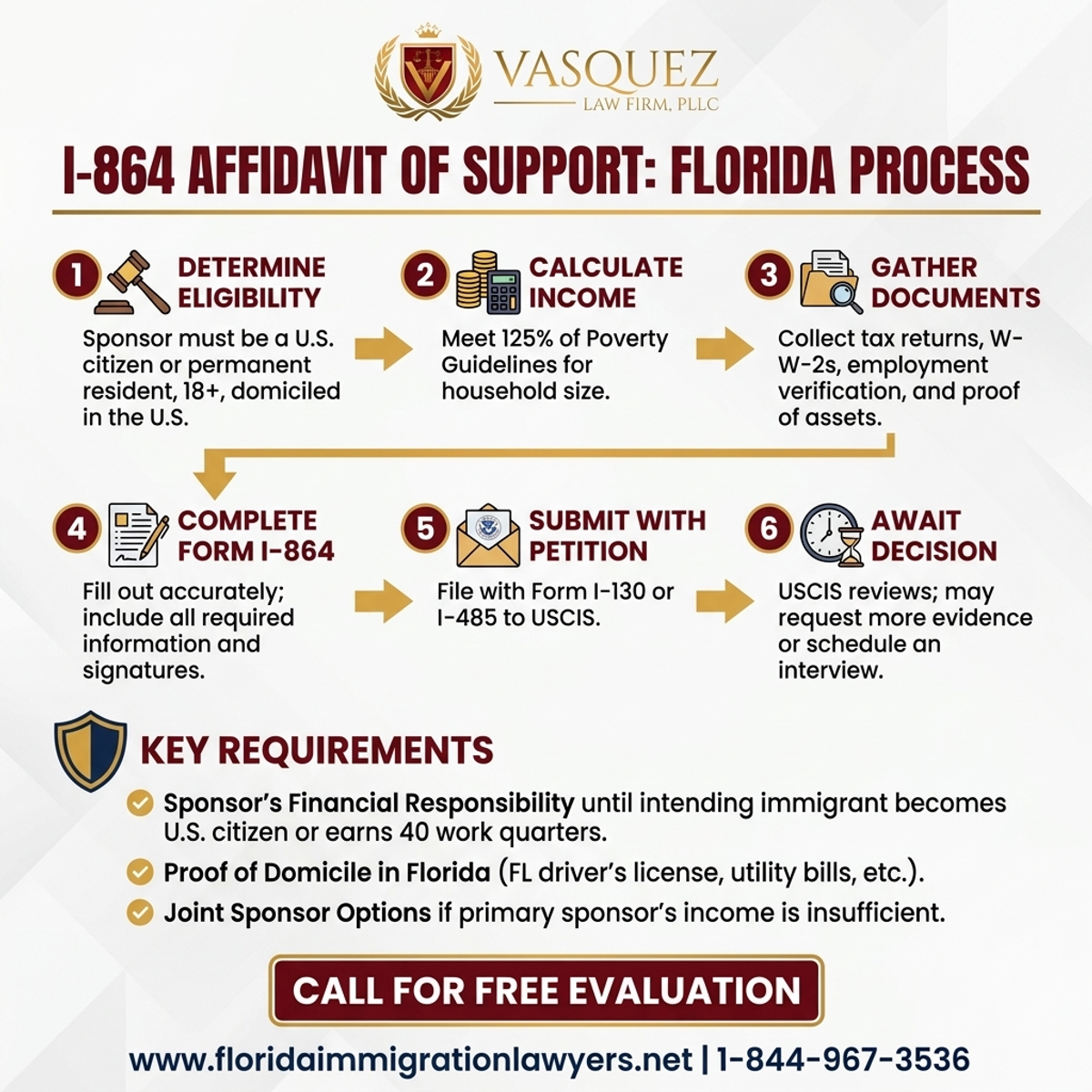
Step-by-Step Process — I-864 Affidavit of Support in Florida: What You Need to Know
Document Checklist for I-864
- Completed I-864 form
- Most recent tax return
- W-2 forms and pay stubs
- Proof of current income
- Proof of U.S. citizenship or lawful permanent residency
- Identification documents (passport, driver’s license)
The documents on this checklist are vital for proving your financial capability and eligibility as a sponsor. Your tax returns, W-2s, and pay stubs provide a clear picture of your income history and current financial standing, which USCIS scrutinizes to ensure you meet the federal poverty guidelines. Without these, your application will likely be deemed incomplete, causing significant delays or even denial.
Beyond financial proof, establishing your legal status as a U.S. citizen or lawful permanent resident is non-negotiable. This can be demonstrated through a copy of your U.S. birth certificate, naturalization certificate, U.S. passport, or green card. Additionally, valid identification documents serve to confirm your identity as the sponsor. Organizing these documents meticulously, perhaps even creating a detailed table of contents, can significantly aid the processing officer and demonstrate your thoroughness.
Timeline and Processing Expectations
The processing time for the I-864 can vary. Typically, it takes about 6 to 8 weeks for the USCIS to process the affidavit once submitted. Delays may occur if additional information is requested or if your application is incomplete. In Florida, particularly in busy areas like Jacksonville, processing times can also be influenced by the volume of applications at local USCIS offices.
It's important to understand that the 6-8 week estimate is for the initial processing of the I-864 itself, often occurring at the National Visa Center (NVC) stage for consular processing, or alongside other forms for adjustment of status. However, the overall immigration process, of which the I-864 is just one part, can take much longer. Factors such as the immigrant's country of origin, visa category, and current USCIS backlogs can all extend the total timeline.
To mitigate potential delays, ensure every piece of information is accurate and consistent across all submitted forms. If USCIS issues a Request for Evidence (RFE), respond promptly and provide exactly what is asked for. Tracking your application online through the USCIS website or NVC portal can help you stay informed. For personalized updates or if you encounter unexpected hurdles, Florida Immigration Lawyers can assist in monitoring your case and responding to any inquiries effectively.
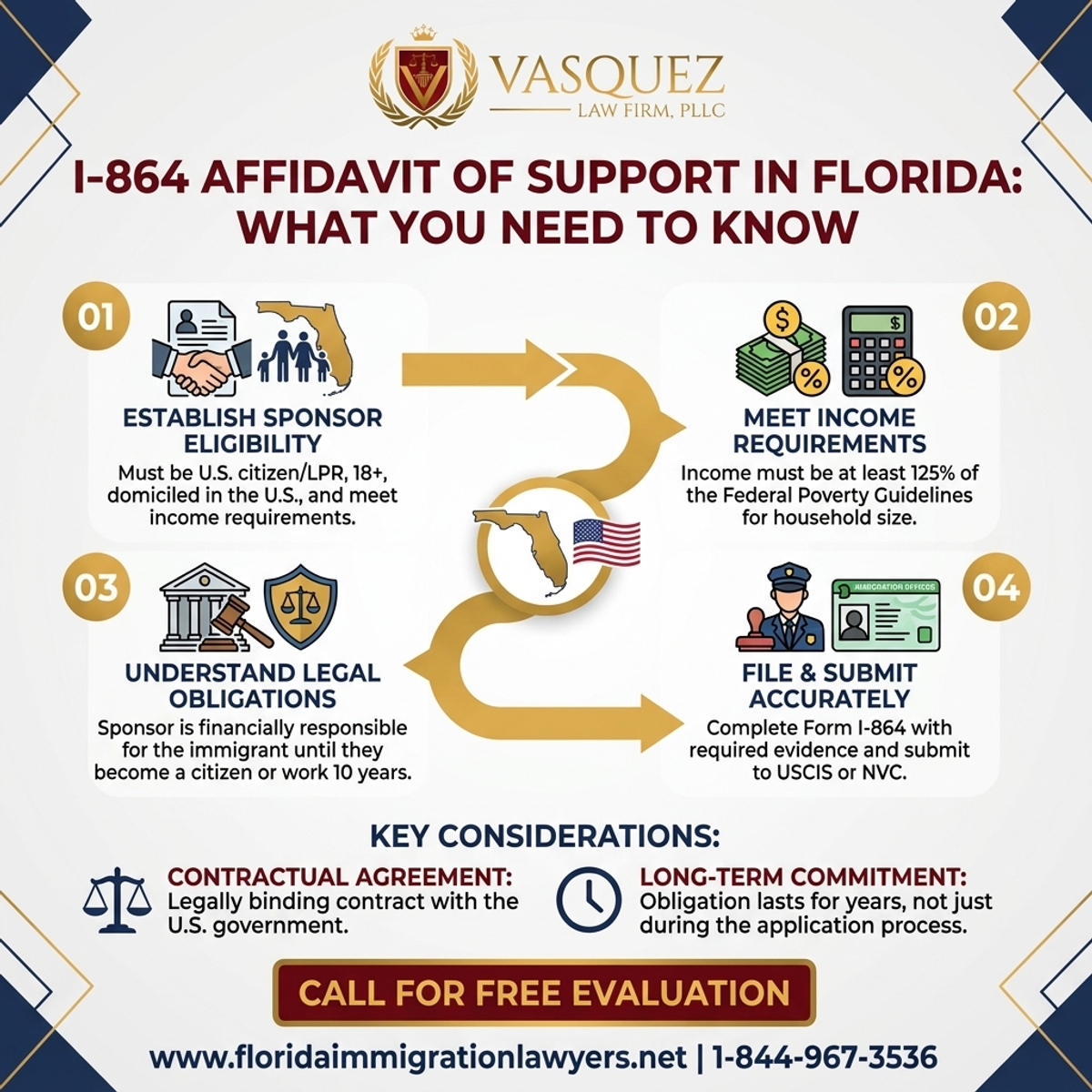
Key Statistics — I-864 Affidavit of Support in Florida: What You Need to Know
Cost Factors and Fee Breakdown
While there is no filing fee for the I-864 itself, there may be associated costs. Legal assistance can vary in cost depending on the complexity of your case and the need for additional documentation. Consult with Florida Immigration Lawyers to understand potential expenses and receive guidance tailored to your situation.
Although the I-864 form itself does not carry a separate filing fee, the overall immigration process involves several fees that sponsors and immigrants should anticipate. These can include fees for the underlying immigrant petition (e.g., Form I-130), visa application fees, biometric services fees, and medical examination fees. Additionally, costs for obtaining certified copies of documents, translations of foreign documents, and postage for mailing applications can add up.
Investing in professional legal guidance, while an additional cost, can often save you significant time and money in the long run by preventing errors and delays. An experienced immigration attorney can help you identify all potential costs, ensure all forms are correctly filed, and represent you in communication with USCIS or the NVC. This can be particularly valuable in complex cases, such as those involving multiple sponsors or unusual financial situations. Contact Florida Immigration Lawyers at 1-844-YO-PELEO for transparent advice on your specific circumstances.
Common Mistakes to Avoid
- Insufficient Income: Failing to meet the income requirement can result in denial.
- Incomplete Forms: Missing sections or signatures can delay the process.
- Outdated Tax Documents: Always use the most recent tax returns.
- Incorrect Household Size Calculation: Miscounting can affect eligibility.
- Failure to Provide Proof of Citizenship: Include all necessary identification.
- Submitting to Wrong Address: Double-check the mailing address for your location.
- Lack of Joint Sponsor When Needed: If your income is insufficient, a joint sponsor is essential.
- Not Keeping Copies: Always keep copies of all submitted documents.
Avoiding these common pitfalls is paramount to a smooth I-864 process. A single oversight, like using an older tax return or miscalculating your household, can trigger a Request for Evidence (RFE) or even a denial, significantly prolonging the wait for your family member. For instance, if you're sponsoring a relative and your income is just below the 125% threshold, proactively securing a joint sponsor can prevent delays rather than waiting for USCIS to reject your initial submission.
Diligent preparation and attention to detail are your best defense against processing delays. Imagine a scenario where a sponsor in Orlando accidentally sends their I-864 to the wrong USCIS lockbox, or forgets to sign a critical page. These seemingly minor errors can lead to weeks or months of unnecessary waiting. Always review the official USCIS instructions meticulously and consider having a second pair of eyes, ideally an experienced immigration attorney, review your completed package before mailing. Taking these extra steps can save you considerable stress and ensure your loved one's journey to Florida progresses without avoidable setbacks.
Frequently Asked Questions (FAQs) About the I-864 Affidavit of Support
What happens if the sponsor's income drops after the I-864 is approved?
The sponsor's obligation under the I-864 remains legally binding even if their income decreases. If the sponsored immigrant receives means-tested public benefits, the government agency providing those benefits can seek reimbursement from the sponsor. This underscores the long-term financial commitment involved. It is crucial for sponsors to understand this ongoing responsibility and plan accordingly, as the obligation typically lasts until the immigrant becomes a U.S. citizen or has worked for 40 qualifying quarters.
Can a joint sponsor be used for any immigration case?
Yes, a joint sponsor can be used when the primary sponsor's income alone is insufficient to meet the federal poverty guidelines. The joint sponsor must independently meet all the same requirements as the primary sponsor, including income, household size calculation, and U.S. citizenship or lawful permanent residency. Each joint sponsor is fully and independently liable for the sponsored immigrant, meaning they assume the same financial obligations as the primary sponsor. This option is invaluable for many families.
How long is the I-864 obligation valid?
The sponsor's financial obligation under the I-864 affidavit continues until the sponsored immigrant becomes a U.S. citizen, has worked for 40 qualifying quarters of coverage under the Social Security Act (which typically amounts to 10 years of work), departs the United States permanently, or dies. This is a significant, long-term commitment that sponsors must take seriously, as it can span many years, even decades. Understanding this duration is key before signing the document.
What if the immigrant receives public benefits despite the I-864?
If the sponsored immigrant receives certain means-tested public benefits (like SSI, TANF, Medicaid), the government agency that provided those benefits can sue the sponsor for reimbursement. This legal enforceability is a core feature of the I-864. The sponsor is legally obligated to repay these funds. This highlights the importance of the sponsor's commitment and the potential financial repercussions if the immigrant does rely on public assistance. Consulting Florida Immigration Lawyers can clarify specific benefit types.
Can I withdraw an I-864 Affidavit of Support?
Generally, once an I-864 Affidavit of Support has been properly filed and accepted by USCIS or the Department of State, it cannot be unilaterally withdrawn by the sponsor. The legal obligation typically attaches when the immigrant becomes a lawful permanent resident. There are very limited circumstances under which an I-864 might be considered void, such as if the immigrant never actually received the visa or adjusted status. If you have concerns about an existing I-864, seeking legal counsel from Florida Immigration Lawyers is highly recommended.
When to Call a Lawyer
If you face challenges meeting the income requirements or have a complex family situation, consulting with a lawyer is crucial. Unexpected requests for additional evidence from USCIS or questions about your eligibility should prompt a call to Florida Immigration Lawyers. Our experienced attorneys can guide you through the intricacies of the immigration process in Florida.
Beyond income issues, a lawyer becomes indispensable in situations involving prior immigration violations, criminal records on either the sponsor's or immigrant's part, or if you're sponsoring multiple family members. For example, if you own a business and your income fluctuates, or if you plan to use assets to meet the poverty guidelines, an attorney can help properly document these complex financial scenarios to USCIS. Attempting to navigate these complexities alone can lead to critical errors and potential denial.
Moreover, if you receive a Notice of Intent to Deny (NOID) or if your case is referred to an immigration judge, immediate legal intervention is necessary. These situations indicate serious issues with your application that require legal strategy and advocacy. Florida Immigration Lawyers are well-versed in handling such challenging cases and can provide the strategic guidance needed to protect your family's immigration goals, offering free consultations at 1-844-YO-PELEO.
About Florida Immigration Lawyers
Florida Immigration Lawyers is dedicated to assisting clients throughout Florida with all immigration needs. Our experienced team offers services in family immigration, deportation defense, citizenship, and more. We provide 24/7 availability and free consultations. Contact us at 1-844-YO-PELEO or visit our website for more information.
Our firm understands the profound impact immigration decisions have on families and individuals. We are committed to providing compassionate, comprehensive, and effective legal representation, whether you're in Jacksonville, Miami, Tampa, or anywhere else in the Sunshine State. With a deep understanding of both federal immigration law and the specific nuances of navigating the system in Florida, we strive to make your immigration journey as smooth and successful as possible.
Sources and References
- U.S. Citizenship and Immigration Services (USCIS) I-864
- Executive Office for Immigration Review (EOIR)
- 8 U.S.C. Chapter 12 - Immigration and Nationality Act
Related services: immigration practice areas, family immigration services, citizenship and naturalization.
This article provides general legal information and is not intended as legal advice. Every case is unique, and outcomes depend on specific facts and circumstances. Contact an attorney for advice about your particular situation.
Call Florida Immigration Lawyers at 1-844-YO-PELEO for your free consultation today. Se Habla Español - Estamos aquí para ayudarle.
If you need legal assistance, learn more about Florida immigration legal team, or call us at 1-844-YO-PELEO for a free consultation.
Do Not Navigate This Process Alone
Our experienced immigration attorneys are ready to fight for you. Get a free, confidential case review today.
Se Habla Español
Or leave your details and we’ll call you:
Free Evaluation in 24 Hours
Or talk to us right now

AI voice assistant — available 24/7
FreeFrequently Asked Questions

William J. Vásquez
Founding Attorney · Vasquez Law Firm
U.S. Air Force veteran and immigration attorney with years of hands-on U.S. immigration experience. J.D., NCCU School of Law. AILA member. Admitted to the 4th, 5th, and 11th Circuit Courts.
Available 24/7 - Free Evaluations
Reviewed for legal accuracy by William J. Vásquez
Licensed in North Carolina; U.S. immigration is federal practice.
Related Legal Services
Our Florida immigration attorneys can help you with immigration lawyer cost in Florida, experienced immigration attorneys and asylum protection. Call today at 1-844-YO-PELEO for a free case review.
Related Links
Related Topics
Free Legal Case Review
Discuss your case with our experienced attorneys. We're available 24/7.
Se Habla Español - Estamos aquí para ayudarle.
Related Articles
Immigration Lawyer Orlando Free Consultation in Florida
For individuals and families in Orlando, Florida, navigating the complexities of U.S. immigration law requires expert guidance. An immigration lawyer in Orlando offers crucial support for everything from visa applications and green card processes to naturalization and deportation defense. This comprehensive guide details what a free consultation covers, providing a step-by-step overview of immigration pathways, essential document checklists, and expected timelines in 2026. We also highlight common mistakes to avoid, discuss the critical role of legal counsel in deportation and asylum cases, and explain why choosing a local Orlando immigration attorney is beneficial. Florida Immigration Lawyers is dedicated to serving the diverse community of Orlando with compassionate, effective legal solutions, ensuring you receive personalized advice and robust representation for a successful immigration journey.
EAD Advance Parole Combo Card in Florida 2026
For individuals with a pending Form I-485, Application to Register Permanent Residence or Adjust Status, the EAD Advance Parole Combo Card is an essential document. This single card combines the authorization to work legally in the U.S. (Employment Authorization Document - EAD) with permission to travel internationally and re-enter without abandoning your green card application (Advance Parole). This guide from Florida Immigration Lawyers provides a comprehensive overview for applicants in Florida in 2026, covering eligibility, the step-by-step application process, required documents, expected processing times, and associated costs. We also highlight common mistakes to avoid and when to seek legal counsel to ensure a smooth and successful immigration journey. Understanding this vital card is key to maintaining stability while awaiting your permanent residency approval.
Child Status Protection Act: Navigating Aging Out in Florida
The Child Status Protection Act (CSPA) is crucial for families in Florida dealing with children aging out of immigration eligibility. Learn how CSPA protects derivative beneficiaries and the steps to apply for protection. Contact Florida Immigration Lawyers for expert assistance.
Special Immigrant Juvenile Status Florida: Your 2026 Guide
Special Immigrant Juvenile Status (SIJS) offers a crucial pathway to lawful permanent residency for vulnerable children in Florida who have experienced abuse, neglect, or abandonment. This 2026 guide explains the eligibility criteria, highlighting the vital role of a Florida state court order, which must find the child dependent and unable to reunite with their parents due to the aforementioned hardships. The article details the multi-step application process, from obtaining the predicate order to filing federal petitions with USCIS and ultimately adjusting status to a Green Card. It also covers typical timelines, potential costs, and the life-changing benefits SIJS provides, such as protection from deportation and access to education. For families and guardians navigating this complex process, understanding the requirements and avoiding common pitfalls is essential. Florida Immigration Lawyers stands ready to provide expert legal guidance.