EAD Advance Parole Combo Card: Your 2026 Guide for Florida
Obtaining an EAD Advance Parole combo card is vital for individuals with a pending adjustment of status in Florida who need to work or travel internationally. This single document combines employment authorization and travel permission, preventing the abandonment of your green card application. As of 2026, understanding its eligibility, the Form I-131 application process, required documentation, and current processing times is crucial. Florida Immigration Lawyers provides expert guidance to navigate this complex process, helping you avoid common mistakes and ensuring your application is meticulously prepared. With offices serving Fort Lauderdale and all of Florida, our compassionate attorneys are ready to assist you with your immigration needs, offering free consultations and dedicated support.

An EAD Advance Parole combo card is a crucial immigration document for individuals with a pending adjustment of status application (Form I-485) in the United States. This single card combines both work authorization (Employment Authorization Document, EAD) and permission to travel internationally (Advance Parole). As of 2026, it allows eligible applicants in Florida to work legally and re-enter the U.S. without abandoning their green card application. Obtaining this card is essential for maintaining legal status and continuity in your life while awaiting a final decision on your permanent residency.
- Combines work authorization (EAD) and travel permission (Advance Parole).
- Required for international travel while your green card application is pending.
- Prevents abandonment of your adjustment of status application upon re-entry.
- Crucial for maintaining legal employment in the U.S. during processing.
- Typically applied for using Form I-765 (EAD) and Form I-131 (Advance Parole).
Introduction: Navigating Your Immigration Journey with Confidence in Florida
For many individuals pursuing permanent residency in the United States, the waiting period can be filled with uncertainty. You might need to work to support yourself and your family, or unforeseen circumstances could require you to travel internationally. Without the proper documentation, these essential activities could jeopardize your entire immigration application. This is where the EAD Advance Parole combo card becomes an indispensable tool, particularly for those with a pending adjustment of status in Florida.
As of 2026, understanding the intricacies of this combined document is more important than ever. This comprehensive guide from Florida Immigration Lawyers will demystify the EAD Advance Parole combo card, explaining its purpose, eligibility requirements, application process, and what you can expect regarding processing times and potential challenges. Whether you reside in Fort Lauderdale, Miami, Orlando, or anywhere else in the Sunshine State, our goal is to provide you with clear, actionable information to navigate this critical phase of your immigration journey.
Don't let the complexities of immigration law overwhelm you. If you have questions about your EAD Advance Parole combo card or any aspect of your adjustment of status application, we are here to help. Call Florida Immigration Lawyers at 1-844-967-3536 for a free consultation. Our experienced team serves clients throughout Florida, offering dedicated and compassionate legal support.
What is an EAD Advance Parole Combo Card and Who Needs It in Florida?
An EAD Advance Parole combo card is a single document issued by U.S. Citizenship and Immigration Services (USCIS) that serves two vital functions for non-citizens in the United States: it grants employment authorization and provides permission to travel abroad and re-enter the U.S. while an application for adjustment of status (Form I-485) is pending. This card is a lifeline for many applicants, preventing the automatic abandonment of their green card application that would otherwise occur if they leave the U.S. without advance parole.
You need an EAD Advance Parole combo card if you have filed Form I-485, Application to Register Permanent Residence or Adjust Status, and you anticipate needing to work or travel internationally before your green card is approved. For individuals living in vibrant communities like Fort Lauderdale, where international connections are common, or those with family abroad, this card offers peace of mind and flexibility. Without it, international travel could lead to significant complications, including being denied re-entry and effectively ending your path to permanent residency. The EAD portion allows you to legally work for almost any employer in the U.S., providing financial stability during what can be a lengthy process. This is particularly relevant in Florida, a state with a diverse economy and high demand for various types of labor.
It is important to note that certain categories of applicants may not need or be eligible for an EAD Advance Parole combo card. For example, those who maintain a valid H-1B, L-1, or K-3/K-4 nonimmigrant visa status might be able to travel and work without abandoning their I-485 application under specific circumstances, known as 'dual intent'. However, even in these cases, an EAD Advance Parole combo card offers additional flexibility and protection. Consulting with an immigration attorney can help you determine if this document is necessary and beneficial for your unique situation, ensuring you make informed decisions about your future in Florida.
How Do I Apply for an EAD Advance Parole Combo Card (Form I-131) in 2026?
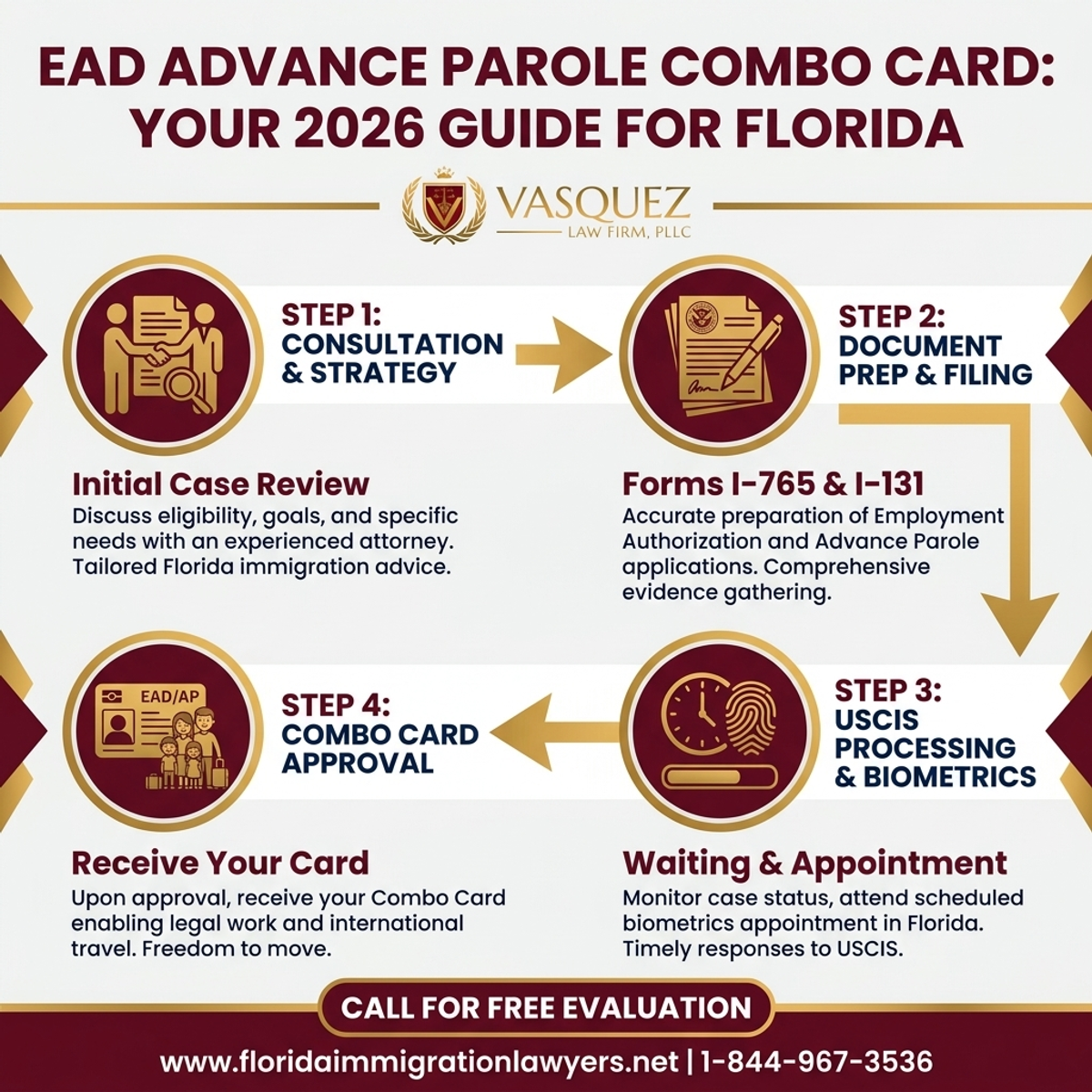
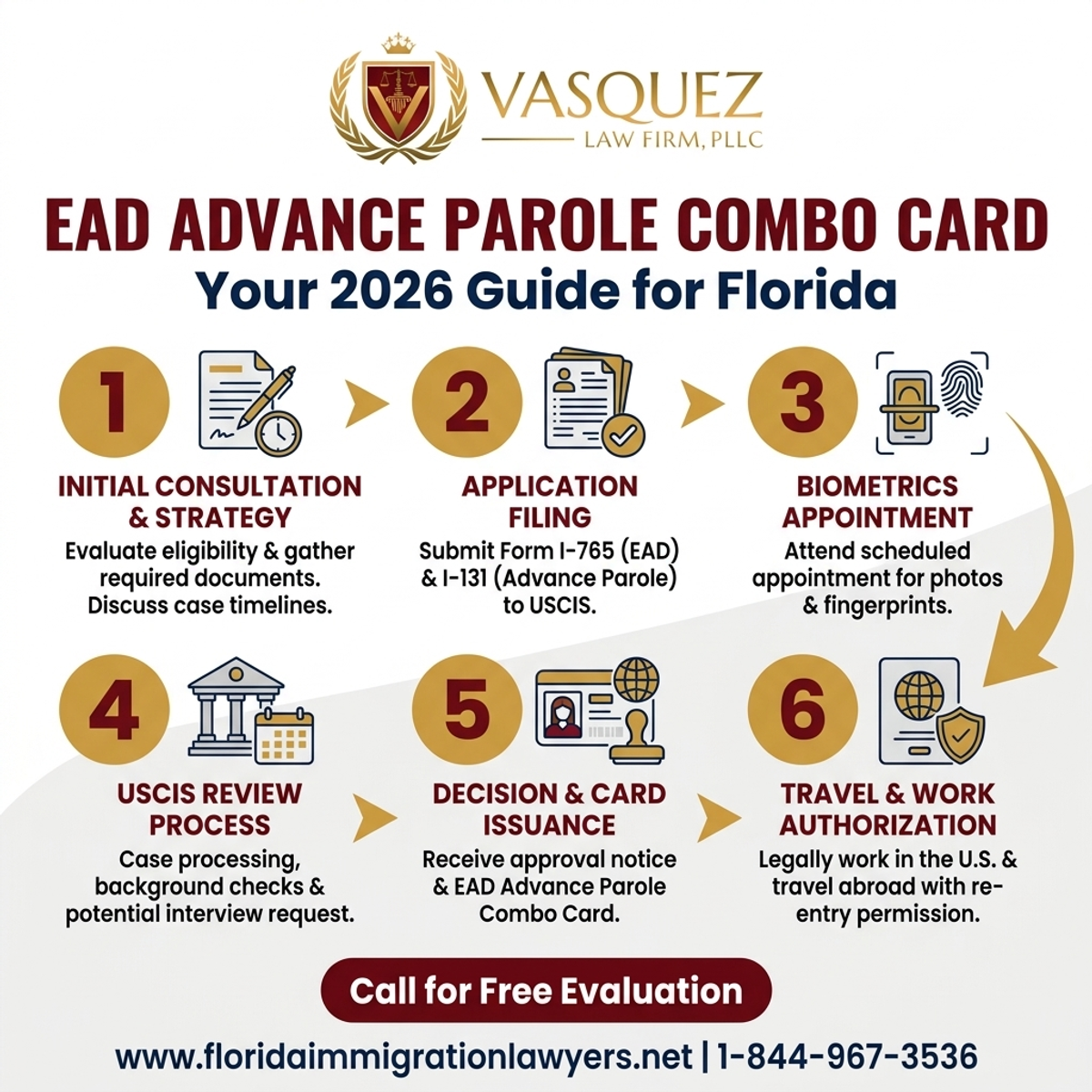
Applying for an EAD Advance Parole combo card involves submitting specific forms and supporting documentation to USCIS. As of 2026, the process generally requires filing Form I-765, Application for Employment Authorization, and Form I-131, Application for Travel Document, concurrently with or after your Form I-485, Application to Register Permanent Residence or Adjust Status. These forms are typically filed together, resulting in a single combo card.
Step-by-Step Guide to Applying for Your Combo Card:
-
Determine Eligibility: First, ensure you have a pending Form I-485 application. Eligibility for the combo card is primarily tied to this application. Most applicants for adjustment of status are eligible, provided they are not in removal proceedings or have certain criminal convictions. Our attorneys can help assess your specific eligibility criteria, especially if you have a complex immigration history in Florida.
-
Complete Form I-765: This is the application for your Employment Authorization Document (EAD). Fill out all sections accurately. For adjustment of status applicants, the eligibility category is typically (c)(9). Ensure your personal information matches your I-485 application precisely to avoid delays. Any discrepancies, even minor ones, can lead to Requests for Evidence (RFEs).
-
Complete Form I-131: This is the application for your Advance Parole travel document. Indicate that you are applying for advance parole by checking the appropriate box (usually Part 2, Item 1.d.). You will also need to provide a reason for travel, although for adjustment of status applicants, stating 'pending adjustment of status' is generally sufficient, as the purpose is to prevent abandonment of the I-485.
-
Gather Supporting Documents: This critical step requires careful attention. You will need copies of your passport, I-94 arrival/departure record, previous EAD/Advance Parole cards (if any), two passport-style photos, and evidence of your pending I-485 application (e.g., receipt notice). For a detailed list, refer to the USCIS instructions for both forms and our comprehensive checklist below. Missing documents are a common cause of delays at the USCIS processing centers that serve Florida.
-
Prepare Fees (if applicable): As of 2026, if you file Form I-765 and Form I-131 concurrently with Form I-485, there is generally no separate fee for the EAD and Advance Parole applications. However, if you file them separately after your I-485, fees may apply for Form I-765. Always check the most current USCIS fee schedule on their website before filing. Fee waivers may be available for eligible low-income applicants.
Step-by-Step Process — EAD Advance Parole Combo Card: Your 2026 Guide for Florida
-
Mail Your Application: Send your completed forms and supporting documents to the correct USCIS lockbox facility. The address depends on the type of application and your residential address in Florida. Double-check the USCIS website for the most current mailing instructions. It is highly recommended to send your application via certified mail with a return receipt to track delivery.
-
Attend Biometrics Appointment: After filing, USCIS will send you an appointment notice for biometrics (fingerprints, photos, and signature) at an Application Support Center (ASC) in Florida, such as those in Fort Lauderdale, Miami, or Orlando. This step is mandatory and crucial for identity verification and background checks.
-
Monitor Your Case Status: You will receive receipt notices from USCIS. Use the receipt number to track your case status online through the USCIS website. Be prepared for potential Requests for Evidence (RFEs) or interview notices.
What Documents Do I Need for an Advance Parole Application in Florida?
When preparing your application for an EAD Advance Parole combo card, having a complete and accurate set of documents is paramount to avoid delays or denials. USCIS requires specific evidence to process your Form I-765 and Form I-131. Failing to submit all necessary paperwork can significantly prolong processing times, which is particularly frustrating when you need to work or travel. Our experience with clients across Florida, from Fort Lauderdale to Jacksonville, shows that thorough preparation is key.
Document Checklist for EAD Advance Parole Combo Card (2026):
- Completed Forms: Signed Form I-765 (Application for Employment Authorization) and Form I-131 (Application for Travel Document).
- Two Identical Passport-Style Photos: Taken within 30 days of filing, unmounted, full-face, against a white to off-white background. Write your name and A-number (if known) lightly on the back of each photo.
- Copy of Government-Issued Photo Identification: Such as your passport identification page, driver's license (if available), or other national identity card.
- Copy of Your Last I-94 Arrival/Departure Record: Or a printout from the CBP website.
- Copy of the Receipt Notice for Your Form I-485: This proves your adjustment of status application is pending. If filed concurrently, include a copy of the entire I-485 package.
- Copies of All Previous EAD Cards and Advance Parole Documents: If you have held them previously.
- Copy of Your Birth Certificate: With a certified translation if not in English.
- Copy of Your Marriage Certificate: If applicable, and also with a certified translation if not in English.
- Evidence of Relationship to Principal Applicant: If you are a dependent (e.g., spouse or child of the primary I-485 applicant).
- Letter Explaining Urgent Need for Advance Parole (Optional, but Recommended for Expedite Requests): If you have an emergency travel need (e.g., family illness or death abroad), include a detailed letter and supporting evidence (e.g., doctor's letter, death certificate).
It is crucial to submit clear, legible copies of all documents. Do not send original documents unless specifically requested by USCIS. Organizing your application package with cover letters and tabs can also assist USCIS officers in processing your case efficiently. For residents of Florida, especially those near the USCIS field offices in Miami or Orlando, preparing a meticulous application can reduce the need for follow-up appointments or document submissions.
How Long Does it Take to Get an EAD Advance Parole Combo Card in 2026?
The processing times for an EAD Advance Parole combo card can vary significantly, depending on several factors including the specific USCIS service center handling your case, the volume of applications, and the complexity of your individual situation. As of 2026, USCIS aims to process these applications efficiently, but applicants should still prepare for a waiting period. It is crucial not to make travel plans until you have received your physical combo card.
Typically, for adjustment of status applicants, the Form I-765 and Form I-131 are processed concurrently. USCIS publishes estimated processing times on its website, which are updated monthly. For residents of Florida, applications are usually processed by the National Benefits Center (NBC), which then forwards cases to local field offices like those in Miami or Fort Lauderdale for interviews. The current trend in 2026 shows processing times ranging from several months to over a year, though this can fluctuate. Factors such as a Request for Evidence (RFE) or issues with background checks can extend these timelines. Expedite requests are possible for urgent humanitarian reasons or severe financial hardship, but they are granted at USCIS's discretion and require substantial evidence. It is generally advisable to apply for your combo card as soon as you file your Form I-485 to minimize any potential gaps in work authorization or travel ability.
Key Statistics — EAD Advance Parole Combo Card: Your 2026 Guide for Florida
| Stage | Typical Timeframe (as of 2026) | Notes |
|---|---|---|
| Application Submission to Receipt Notice | 2-4 weeks | You will receive Forms I-797C, Notice of Action, for each application filed. |
| Biometrics Appointment Scheduling | 3-8 weeks after receipt notice | Notice for appointment at a local Application Support Center (ASC) in Florida. |
| Case Processing (EAD/Advance Parole) | 7-15 months (can vary) | Processing times are highly variable by service center and case volume. Check USCIS website for current estimates. |
| Card Production & Delivery | 7-10 days after approval | Once approved, the card is mailed to your address on file. |
| Total Estimated Time | 8-16 months | This is an average range; some cases may be faster, others slower. |
What Are the Costs Associated with an Advance Parole Application?
Understanding the financial aspects of your immigration application is crucial. For an EAD Advance Parole combo card, the fee structure can be a source of confusion for many applicants. As of 2026, USCIS fees are subject to change, so always verify the current amounts directly on the USCIS website before submitting your application. Generally, if you file your Form I-765 (EAD) and Form I-131 (Advance Parole) concurrently with your Form I-485 (Adjustment of Status), there is no separate fee for the EAD and Advance Parole applications.
However, if you file Form I-765 or Form I-131 separately after your Form I-485 has been filed, specific fees may apply for each application. It is important to remember that these fees are non-refundable, regardless of the outcome of your application. In addition to USCIS filing fees, applicants in Florida should also budget for other potential costs. These can include attorney fees for legal assistance, which can be invaluable for ensuring your application is correctly prepared and submitted. Other expenses might involve fees for obtaining necessary supporting documents, such as birth certificates, marriage certificates, or certified translations if your documents are not in English. Passport-style photos also incur a small cost. Being aware of all potential expenses helps you plan effectively for your immigration journey.
| Item | Typical Fee (as of 2026) | Notes |
|---|---|---|
| Form I-485 Filing Fee | Varies (typically $1,140 - $1,225) | This fee usually covers the I-765 and I-131 if filed concurrently. |
| Form I-765 (EAD) Filing Fee | Varies (if filed separately) | Often $410 - $555. Check USCIS website for current fees. |
| Form I-131 (Advance Parole) Filing Fee | Varies (if filed separately) | Often $575 - $630. Check USCIS website for current fees. |
| Biometrics Services Fee | Included in I-485 fee | This fee covers fingerprinting and photo at an ASC. |
| Attorney Legal Fees | Varies widely | Depends on complexity of case and services provided. Free consultations available. |
| Passport-Style Photos | $10-$20 | Required for the application. |
| Document Translation/Certification | Varies per document | If documents are not in English. |
It is important to budget carefully and consult the official USCIS website for the most current fee information. Fee waivers may be available for certain low-income applicants who meet specific criteria. An experienced immigration lawyer in Florida can provide guidance on current fees and help you understand all potential costs involved in your application process, ensuring there are no unexpected financial surprises.
Do not navigate this complex process alone. Contact Florida Immigration Lawyers today for expert guidance on your EAD Advance Parole combo card application and all your immigration needs. Call us at 1-844-967-3536 for a free consultation.
Common Mistakes to Avoid When Applying for Your EAD Advance Parole Combo Card
Applying for an EAD Advance Parole combo card requires meticulous attention to detail. Even minor errors can lead to significant delays, Requests for Evidence (RFEs), or even denial, jeopardizing your ability to work or travel. Based on our experience with countless cases in Florida, here are some common mistakes applicants make and their potential consequences:
-
Traveling Internationally Before Receiving the Combo Card: This is perhaps the most critical mistake. If you depart the U.S. without a valid Advance Parole document while your adjustment of status is pending, USCIS generally considers your I-485 application to be abandoned. Consequences: You may be denied re-entry into the U.S. and lose your chance at a green card.
-
Failing to Disclose All Prior Immigration History: Any omissions or misrepresentations about your past immigration applications, entries, or violations can lead to serious issues. Consequences: USCIS may issue an RFE, deny your application, or even initiate removal proceedings if fraud is suspected.
-
Submitting Incomplete or Incorrect Forms: Missing signatures, unanswered questions, or incorrect eligibility categories on Form I-765 or I-131 are common. Consequences: Your application will be rejected, returned, or delayed, requiring you to refile and restart the waiting period.
-
Not Including All Required Supporting Documents: Failing to attach copies of your I-94, passport, previous EADs, or I-485 receipt notice can halt processing. Consequences: USCIS will issue an RFE, significantly prolonging the processing time while you gather the missing documents.
-
Using Outdated Forms or Incorrect Fees: USCIS regularly updates its forms and fee schedules. Using an old version or sending the wrong fee amount is a frequent error. Consequences: Your application will be rejected and returned, causing considerable delays.
-
Failing to Respond to RFEs in a Timely Manner: If USCIS requests additional evidence, you have a specific deadline to respond. Missing this deadline is detrimental. Consequences: Your application may be denied without further consideration, requiring you to refile.
-
Incorrectly Mailing the Application: Sending your application to the wrong USCIS lockbox facility can lead to significant delays or rejection. Consequences: Your application may be lost or significantly delayed, extending your wait time.
-
Not Keeping Copies of Everything Filed: It's essential to retain a complete copy of your entire application package. Consequences: If USCIS loses your file or you need to prove what you submitted, you will have no record, making it difficult to resolve issues.
-
Ignoring Changes of Address: If you move while your application is pending, you must notify USCIS within 10 days using Form AR-11. Consequences: You may miss important notices, RFEs, or interview appointments, leading to denial of your case.
-
Assuming Your Current Visa Status Protects You: While some nonimmigrant visas (like H-1B) offer 'dual intent', relying solely on them without an Advance Parole can still be risky for adjustment of status applicants. Consequences: Depending on your specific visa and travel duration, you could still risk abandoning your I-485 application.
When to Call a Lawyer for Your EAD Advance Parole Combo Card in Florida
While some individuals may attempt to file their EAD Advance Parole combo card application independently, the complexities of immigration law often necessitate professional legal guidance. An experienced immigration lawyer from Florida Immigration Lawyers can provide invaluable assistance, minimizing risks and maximizing your chances of a smooth process. You should strongly consider contacting an attorney in the following scenarios:
- Complex Immigration History: If you have previous denials, overstays, criminal records, prior deportations, or any other complications in your immigration history, navigating the application process alone can be perilous. An attorney can assess potential issues and strategize the best approach.
- Uncertain Eligibility: If you are unsure whether you qualify for an EAD Advance Parole combo card or if your specific visa status allows for 'dual intent' travel, a lawyer can provide a clear assessment based on current laws and policies (e.g., Executive Office for Immigration Review (EOIR) rulings).
- Expedite Request Needed: If you have an urgent, unforeseen need to travel internationally due to a family emergency, medical crisis, or critical business matter, an attorney can help prepare and submit a compelling expedite request to USCIS.
- Received a Request for Evidence (RFE) or Notice of Intent to Deny (NOID): These notices indicate that USCIS requires more information or intends to deny your application. Responding correctly and comprehensively is crucial, and a lawyer can draft a strong response with supporting evidence.
- Concerns About Travel: If you need to travel frequently or for extended periods, or if you have specific questions about the implications of travel on your pending I-485, an attorney can provide tailored advice to ensure your green card application remains safe.
- Language Barriers or Difficulty Understanding Forms: Immigration forms and instructions can be dense and complex, especially for non-native English speakers. A bilingual attorney can ensure your application is accurate and complete. Our firm offers services in English and Spanish, serving the diverse communities of Fort Lauderdale and beyond.
Florida Immigration Lawyers has extensive experience assisting individuals across Florida with their EAD Advance Parole combo card applications and broader adjustment of status cases. We understand the specific challenges and opportunities within the state's immigration landscape and are dedicated to providing personalized, effective legal representation. Don't leave your immigration future to chance. Contact us today.
About Florida Immigration Lawyers
Florida Immigration Lawyers is a leading immigration law firm dedicated to serving individuals and families across the entire state of Florida. With a deep understanding of U.S. immigration law and a compassionate approach, we strive to make complex legal processes understandable and manageable for our clients. Our team of experienced attorneys is committed to providing personalized and effective legal solutions, whether you are seeking an EAD Advance Parole combo card, applying for family-based visas, navigating deportation defense, or pursuing citizenship.
We pride ourselves on our client-focused service, offering clear communication, strategic advice, and unwavering advocacy. Our firm understands the unique challenges faced by immigrants in Florida's diverse communities, from Fort Lauderdale to Orlando, and we are here to protect your rights and help you achieve your immigration goals. Available 24/7, we offer free consultations to discuss your case and provide immediate guidance. Choose Florida Immigration Lawyers for dedicated legal representation that truly understands your needs. Our attorneys are ready to assist you every step of the way.
Sources and References
- U.S. Citizenship and Immigration Services (USCIS)
- Executive Office for Immigration Review (EOIR)
- U.S. Department of State - Bureau of Consular Affairs
- 8 U.S.C. Chapter 12 - Immigration and Nationality Act (INA)
- 8 C.F.R. § 274a.12 - Classes of aliens authorized to accept employment
- 8 C.F.R. § 245.2 - Application for adjustment of status
- USCIS Policy Manual - Volume 7, Part B, Chapter 3 - Employment Authorization
- USCIS Policy Manual - Volume 7, Part B, Chapter 5 - Advance Parole
Related services: immigration practice areas, asylum protection, business immigration, experienced immigration attorneys.
This article provides general legal information and is not intended as legal advice. Every case is unique, and outcomes depend on specific facts and circumstances. Contact an attorney for advice about your particular situation.
Your immigration journey is important, and you don't have to face it alone. For reliable legal assistance with your EAD Advance Parole combo card or any other immigration matter in Florida, trust the experienced team at Florida Immigration Lawyers. We offer free, confidential consultations and are available 24/7 to answer your questions. Call us today at 1-844-967-3536. Se Habla Español - Estamos aqui para ayudarle.
Do Not Navigate This Process Alone
Our experienced immigration attorneys are ready to fight for you. Get a free, confidential consultation today.
Se Habla Español
Or leave your details and we’ll call you:
Free Evaluation in 24 Hours
Or talk to us right now

AI voice assistant — available 24/7
FreeFrequently Asked Questions

William J. Vásquez
Founding Attorney · Vasquez Law Firm
U.S. Air Force veteran and immigration attorney with years of hands-on U.S. immigration experience. J.D., NCCU School of Law. AILA member. Admitted to the 4th, 5th, and 11th Circuit Courts.
Available 24/7 - Free Evaluations
Reviewed for legal accuracy by William J. Vásquez
Licensed in North Carolina; U.S. immigration is federal practice.
Related Legal Services
Our Florida immigration attorneys can help you with business immigration, asylum protection and deportation defense. Call today at 1-844-967-3536 for a free consultation.
Related Links
Related Topics
Free Legal Consultation
Discuss your case with our experienced attorneys. We're available 24/7.
Se Habla Español - Estamos aquí para ayudarle.
Related Articles
Immigration Lawyer Orlando Free Consultation 2026
Discover how to find an immigration lawyer in Orlando offering a free consultation. Understand the services available and why choosing Florida Immigration Lawyers can make a difference in your case.
Military Naturalization Expedited in Florida Bases
Explore military naturalization options for families at Florida bases, including parole in place benefits in Miami. Learn how to expedite your application with expert guidance from Florida Immigration Lawyers.
SIJS in Florida: Understanding Juvenile Immigration Status
Special Immigrant Juvenile Status (SIJS) offers a pathway to lawful permanent residency for minors in Florida who have been abused, neglected, or abandoned. Learn about application steps, required documents, and common mistakes. Call Florida Immigration Lawyers at 1-844-967-3536 for a free consultation.
Family Petitions for Citizenship in Florida: 2026 Guide
Securing a family petition and navigating the path to U.S. citizenship in Florida requires a thorough understanding of immigration laws and procedures. This comprehensive guide, updated for 2026, details the Form I-130 petition process, eligibility requirements for various family categories, and the critical documents needed. We explore the typical timelines and associated costs, highlighting the differences between immediate relative and family preference categories. Learn about the unique considerations for immigrants in Florida, including interactions with USCIS field offices in Tampa and Miami, and the role of immigration courts. This article also outlines common mistakes to avoid that can delay or jeopardize your case, such as incomplete documentation or failing to disclose vital information. Discover when it is essential to consult an experienced Florida immigration lawyer to ensure a smooth and successful journey for your loved ones. Florida Immigration Lawyers are dedicated to providing expert legal support for families across the state, offering free consultations to discuss your specific needs.