Re-Entry Permit (Form I-131) Guide for Florida Residents
A re-entry permit (Form I-131) is crucial for lawful permanent residents in Florida planning long-term travel abroad. Learn how to apply and avoid common pitfalls. Florida Immigration Lawyers offer free consultations to guide you through the process.

A re-entry permit, filed using Form I-131, is essential for lawful permanent residents (LPRs) who plan to travel outside the U.S. for extended periods. This document helps prevent green card abandonment, ensuring you can return to the U.S. without issues. Key points include:
- Helps maintain your LPR status during long trips abroad.
- Important for trips longer than six months.
- Must be applied for while in the U.S.
- Valid for up to two years.
- Consult an attorney for assistance.
Introduction
Living as a lawful permanent resident (LPR) in Florida, especially in a bustling city like Orlando, offers numerous opportunities. However, if you're planning to travel abroad for an extended period, understanding the implications on your immigration status is crucial. A re-entry permit, obtained via Form I-131, is vital for safeguarding your green card from being considered abandoned. This guide will walk you through the process, ensuring your travels do not jeopardize your residency status. For personalized assistance, call Florida Immigration Lawyers at 1-844-967-3536 for a free consultation.
Many LPRs mistakenly believe that simply holding a green card is enough to guarantee re-entry, regardless of how long they stay outside the U.S. However, U.S. immigration law presumes that an LPR has abandoned their residency if they remain outside the country for more than 180 days (six months). While this presumption can sometimes be rebutted, it often leads to significant challenges and stress at the port of entry. A re-entry permit serves as official documentation from USCIS affirming your intent to maintain your LPR status, providing invaluable peace of mind during your travels.
Planning for extended international travel requires careful consideration of your immigration responsibilities. Proactively applying for a re-entry permit is a smart move for any LPR who anticipates being abroad for more than six months. This document not only protects your residency but also allows you the flexibility to attend to family matters, pursue educational opportunities, or manage business interests overseas without the constant worry of jeopardizing your ability to return home to Florida. Consulting with an experienced legal team, such as Florida Immigration Lawyers, can help you navigate these requirements seamlessly.
What is a Re-Entry Permit (Form I-131)?
A re-entry permit is a travel document that helps LPRs maintain their residency status while traveling outside the U.S. for extended periods. As of 2026, this permit is crucial for trips longer than six months, as it demonstrates your intention to return and reside permanently in the U.S.
To apply, you must file Form I-131 with U.S. Citizenship and Immigration Services (USCIS) while physically present in the U.S. This form acts as your request for the permit, and once approved, it typically remains valid for up to two years. Applying for a re-entry permit can prevent being deemed to have abandoned your permanent residency status, which is a risk when traveling abroad for extended periods.
The legal framework for presumed abandonment stems from the Immigration and Nationality Act (INA) and its associated regulations. While a stay of less than one year abroad generally doesn't automatically lead to abandonment, a stay exceeding six months can trigger scrutiny by U.S. Customs and Border Protection (CBP) officers upon your return. The re-entry permit acts as a pre-approved waiver of this presumption, signaling to immigration officials that your extended absence is temporary and your intent to reside in the U.S. remains strong. It's a proactive measure that can save you from intense questioning and potential denial of entry.
It's important to differentiate a re-entry permit from other travel documents. Unlike a visa, which allows foreign nationals to enter the U.S., a re-entry permit is specifically for LPRs to preserve their existing status. It is also distinct from an SB-1 Returning Resident Visa, which is a much more complex and challenging process for LPRs who have already abandoned their status and are seeking to re-establish it. A re-entry permit is a preventative tool, allowing you to avoid the difficult situation of having to prove you never abandoned your residency. For instance, consider an LPR who needs to care for an ailing family member in their home country for 18 months; without a re-entry permit, their return to Florida could be fraught with legal challenges.
How Do You Apply for a Re-Entry Permit in Florida?
Applying for a re-entry permit involves several steps, starting with completing Form I-131. Here's a step-by-step guide:
- Complete Form I-131: Ensure all sections are filled accurately. Mistakes can delay processing. It is crucial to use the most current version of Form I-131 available on the USCIS website. Pay close attention to questions regarding your travel plans and reasons for extended absence, providing clear and concise answers. Any inconsistencies or omissions can lead to Requests for Evidence (RFEs) or even denial, prolonging your application process significantly.
- Gather Required Documents: This includes your green card, passport, and any evidence of your intended return to the U.S. Beyond the basic identification, gather proof of your continuing ties to the U.S., such as property deeds, bank statements, tax returns, and family connections. These documents strengthen your case by demonstrating a clear intention to return and reside permanently in Florida.
- Submit Application: Mail your application to the appropriate USCIS lockbox facility. It is highly recommended to send your application via certified mail with a return receipt requested. This provides proof of mailing and delivery, which can be invaluable if there are any questions about your submission. Always keep a complete copy of your submitted application and all supporting documents for your records.
- Attend Biometrics Appointment: You will be notified of the date and location, usually at a nearby USCIS office in Florida. This appointment is mandatory for most applicants between 14 and 79 years old. During this appointment, USCIS will collect your fingerprints, photograph, and signature. Failure to attend without proper rescheduling can result in your application being denied. If you foresee a conflict, contact USCIS immediately to request a reschedule.
- Receive Decision: USCIS will notify you of their decision. If approved, you'll receive your re-entry permit in the mail. If your application is approved while you are still in the U.S., the permit will be mailed to your address. However, if you depart the U.S. after your biometrics appointment but before the decision, you can arrange for the permit to be sent to a U.S. embassy or consulate abroad for pick-up. This flexibility is critical for LPRs with urgent travel needs.
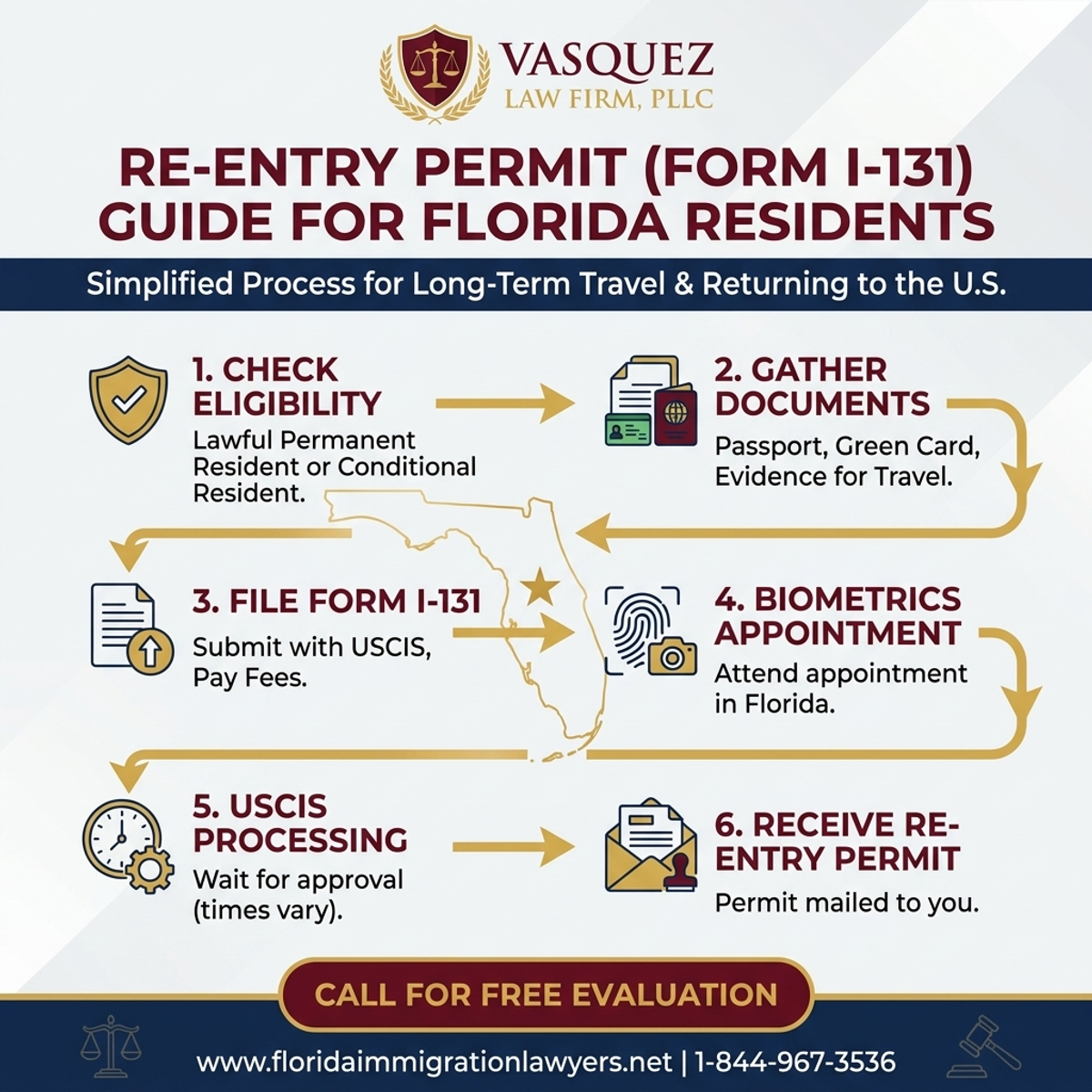
Step-by-Step Process — Re-Entry Permit (Form I-131) Guide for Florida Residents
Ensure you apply while in the U.S., as you cannot apply for a re-entry permit from abroad. For detailed guidance, contact Florida Immigration Lawyers.
A crucial aspect of this process is the requirement to be physically present in the U.S. when filing Form I-131. While you are generally permitted to travel abroad after your biometrics appointment, it is highly advisable to complete both the filing and the biometrics step before departing. This ensures your application is properly initiated and avoids any complications that might arise from attempting to manage the process from overseas. Many LPRs choose to file their application and then wait for their biometrics appointment notice before planning their international travel.
Navigating the intricacies of USCIS forms and requirements can be daunting. Even minor errors can lead to significant delays or even outright rejection of your application. This is where the expertise of Florida Immigration Lawyers becomes invaluable. Our team can help you meticulously prepare your application, ensure all necessary documentation is included, and guide you through each step, from initial filing to receiving your permit. We aim to make the process as smooth and stress-free as possible for our Florida clients.
Document Checklist for Re-Entry Permit Application
When applying for a re-entry permit, having the right documents ready is crucial. Here's a checklist:
- Completed Form I-131: This is the primary application form, which must be accurately filled out and signed. Ensure all questions are answered truthfully and completely, as any discrepancies can lead to delays or requests for additional evidence.
- Copy of your green card (front and back): This serves as proof of your lawful permanent resident status. Make sure the copy is clear and legible.
- Valid passport: Your passport is essential for international travel and identity verification. Ensure it is not expired and has sufficient validity for your intended travel period.
- Two passport-sized photos: These photos must meet USCIS specifications (2x2 inches, white background, taken within 30 days of filing). Attach them securely to your application as instructed.
- Evidence of ties to the U.S. (e.g., property ownership, family relationships): This category is particularly important as it demonstrates your intent to return. Examples include copies of your U.S. tax returns for recent years, bank statements showing active accounts in the U.S., utility bills, car registration, U.S. driver's license, evidence of U.S. employment, enrollment records for your children in U.S. schools, and proof of family members (spouse, children) residing in the U.S.
Having all necessary documents ready can expedite the process and reduce the likelihood of delays.
The strength of your application often hinges on the quality and completeness of your supporting documentation, especially the evidence of your ties to the U.S. USCIS wants assurance that despite an extended absence, you still consider the United States your permanent home. Providing a robust portfolio of documents that illustrate your continuing connections to Florida—be it through property, financial accounts, or family—can significantly bolster your case and demonstrate your genuine intent to return.
Organizing your documents meticulously before submission is a practical tip that can save you time and stress. Create a checklist and double-check each item. Consider making duplicates of all documents for your personal records, especially if you are sending originals (though for most, copies suffice). If any documents are not in English, they must be accompanied by a certified translation. Florida Immigration Lawyers can help you compile and review your documentation to ensure everything is in order before submission, minimizing the chances of an RFE.
Timeline and Processing Expectations
The processing time for a re-entry permit can vary. As of 2026, typical processing times are outlined below:
| Stage | Typical Timeframe | Notes |
|---|---|---|
| Application Submission | 2-4 weeks | Initial processing at USCIS lockbox |
| Biometrics Appointment | 4-8 weeks | Scheduled at local USCIS office |
| Final Decision | 3-5 months | Approval or denial notice sent by mail |
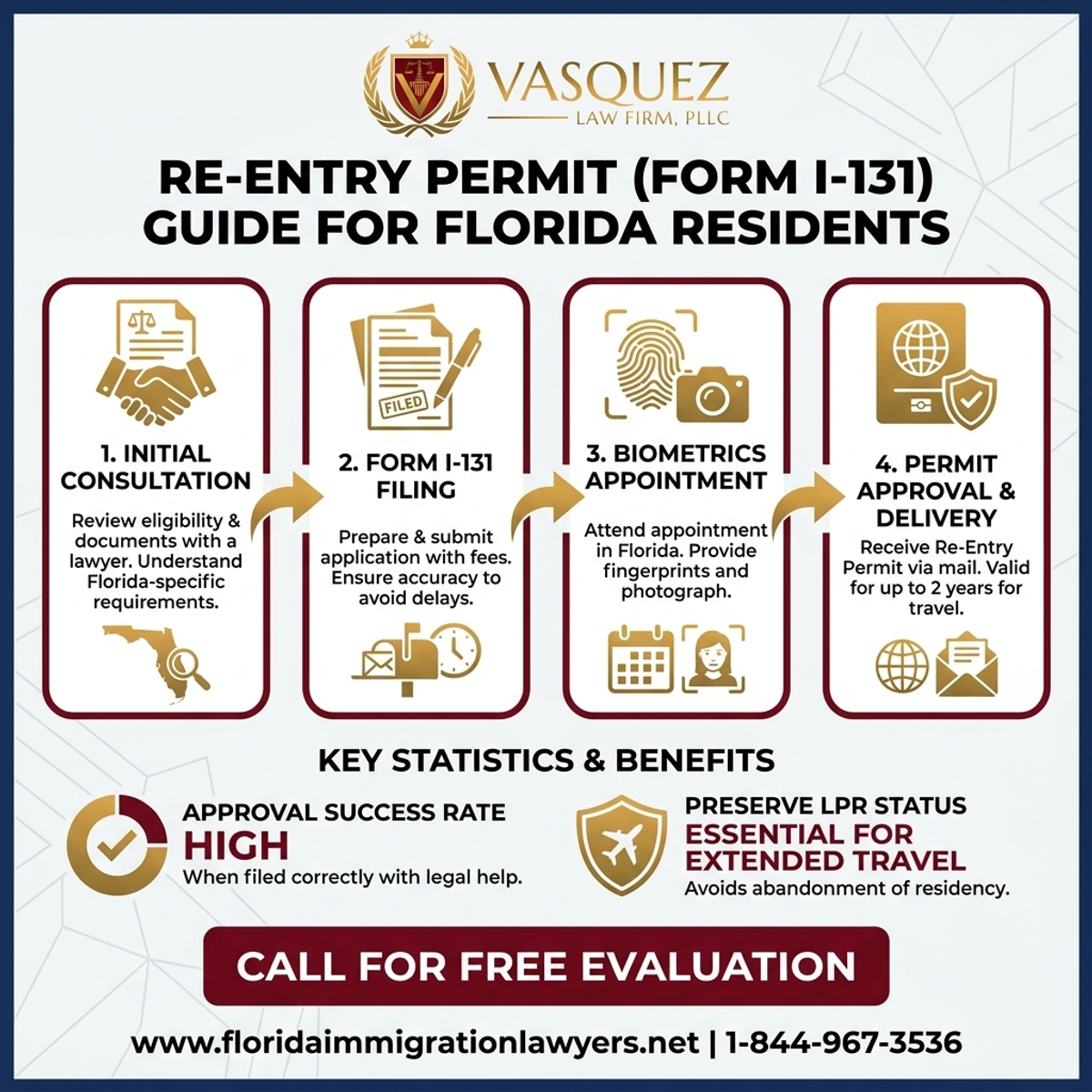
Key Statistics — Re-Entry Permit (Form I-131) Guide for Florida Residents
These timelines are subject to change, so check the latest updates on the USCIS website.
It's crucial to understand that these timeframes are estimates and can fluctuate based on USCIS's workload, policy changes, and the specific service center processing your application. Factors such as the completeness of your application, the volume of submissions, and any requests for additional evidence can all impact how quickly your permit is processed. A practical tip is to submit your application well in advance of your planned departure, ideally several months, to account for any potential delays.
Once you've submitted your application, you can track its progress online using the receipt number provided by USCIS. This allows you to monitor its status from submission to final decision. While expedited processing is rarely granted for re-entry permits, it may be considered in extremely urgent and compelling circumstances, such as a life-threatening illness of a family member abroad. Such requests require substantial evidence and are reviewed on a case-by-case basis. For assistance with tracking your application or exploring expedited options, Florida Immigration Lawyers can provide guidance.
Cost Factors and Fee Breakdown
While specific fees for Form I-131 can vary, here’s a general breakdown of potential costs:
Sources and References
- U.S. Citizenship and Immigration Services (USCIS)
- Executive Office for Immigration Review (EOIR)
- U.S. Department of State - Bureau of Consular Affairs
- Immigration and Nationality Act (INA), 8 U.S.C. Chapter 12
| Item | Typical Fee | Notes |
|---|---|---|
| Form I-131 Filing Fee | Varies | Check USCIS for current fees |
| Biometrics Fee | Varies |
Do Not Navigate This Process Alone
Our experienced immigration attorneys are ready to fight for you. Get a free, confidential consultation today.
Se Habla Español
Or leave your details and we’ll call you:
Free Evaluation in 24 Hours
Or talk to us right now

AI voice assistant — available 24/7
FreeFrequently Asked Questions

William J. Vásquez
Founding Attorney · Vasquez Law Firm
U.S. Air Force veteran and immigration attorney with years of hands-on U.S. immigration experience. J.D., NCCU School of Law. AILA member. Admitted to the 4th, 5th, and 11th Circuit Courts.
Available 24/7 - Free Evaluations
Reviewed for legal accuracy by William J. Vásquez
Licensed in North Carolina; U.S. immigration is federal practice.
Related Legal Services
Our Florida immigration attorneys can help you with family immigration services, immigration practice areas and free immigration consultation. Call today at 1-844-967-3536 for a free consultation.
Related Links
Related Topics
Free Legal Consultation
Discuss your case with our experienced attorneys. We're available 24/7.
Se Habla Español - Estamos aquí para ayudarle.
Related Articles
Immigration Lawyer Orlando Free Consultation 2026
Discover how to find an immigration lawyer in Orlando offering a free consultation. Understand the services available and why choosing Florida Immigration Lawyers can make a difference in your case.
Military Naturalization Expedited in Florida Bases
Explore military naturalization options for families at Florida bases, including parole in place benefits in Miami. Learn how to expedite your application with expert guidance from Florida Immigration Lawyers.
Can DACA Recipients Travel Within the U.S. in 2026? A
For DACA recipients in Florida, understanding travel rules and renewal processes in 2026 is vital. While domestic travel is generally permissible, international travel requires an approved Advance Parole document, presenting significant risks if not handled correctly. This comprehensive guide details the essential requirements for DACA renewal, including necessary forms and documentation, and provides realistic timelines for processing. It also outlines the critical steps for applying for Advance Parole, emphasizing the importance of securing authorization before any international departure. With ongoing legal challenges to DACA, staying informed and proactive is key to maintaining your status. Florida Immigration Lawyers offers expert guidance for DACA recipients navigating these complexities in Tampa and across the state, ensuring compliance and peace of mind.
Can DACA Recipients Travel Within the U.S. 2026?
Explore the 2026 guide to DACA renewal and travel rights for Dreamers in Coral Springs, Florida. Understand the process, avoid common pitfalls, and learn when to seek legal help. Florida Immigration Lawyers are ready to assist you with your immigration needs.