F-1 to H-4 Change of Status in Florida 2026
Explore how to transition from an F-1 to an H-4 visa in Florida, focusing on the I-539 processing at the Texas Service Center in 2026. Learn steps, costs, and common pitfalls in this comprehensive guide for international students.
How to Change from F-1 to H-4 Status?
To change from F-1 to H-4 status, you must file Form I-539 with the USCIS. Ensure all required documents are included, such as a marriage certificate if applicable, and evidence of your spouse's H-1B status.
First, verify eligibility by confirming your spouse's valid H-1B visa. Next, prepare Form I-539, ensuring all sections are complete. Include supporting documents like your current F-1 visa status proof, your spouse's H-1B approval notice, and any financial affidavits. Submit the form to the Texas Service Center and monitor for receipt notices.
The process of changing status from F-1 to H-4 is formally known as a 'change of nonimmigrant status' and is handled by U.S. Citizenship and Immigration Services (USCIS). It's critical to understand that this process changes your immigration status *within* the United States, allowing you to remain lawfully present. Unlike consular processing, where you would apply for an H-4 visa stamp at a U.S. embassy or consulate abroad, a change of status application means you do not need to leave the U.S.
Maintaining your F-1 status throughout the application process is paramount. This means continuing to comply with all F-1 visa regulations, such as maintaining full-time enrollment or engaging in authorized Optional Practical Training (OPT), until your H-4 status is officially approved. Any lapse in F-1 status could jeopardize your change of status application, potentially leading to denial and requiring you to depart the U.S. and apply for an H-4 visa at a consulate abroad. Consulting with Florida Immigration Lawyers can help you navigate this complex requirement.
What Documents Are Needed for the F-1 to H-4 Change?
- Completed Form I-539.
- Copy of your current F-1 visa and I-94.
- Spouse's H-1B approval notice.
- Marriage certificate (if applicable).
- Proof of financial support.
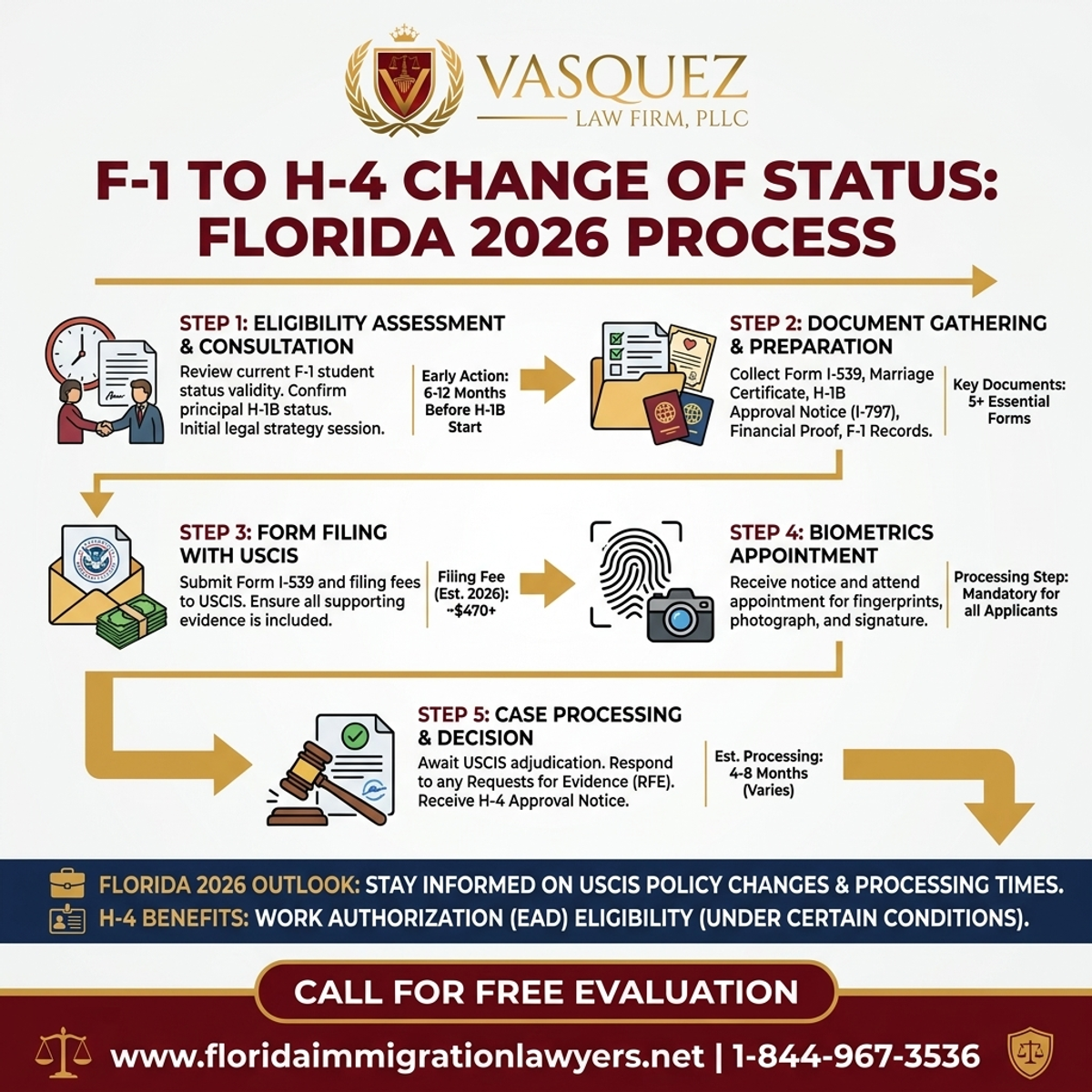
Step-by-Step Process — F-1 to H-4 Change of Status in Florida 2026
Beyond the core documents, it's essential to provide a comprehensive package to USCIS to minimize the chances of a Request for Evidence (RFE). For instance, when submitting your marriage certificate, ensure it is an official, certified copy. If the certificate is not in English, a certified translation must accompany it. Similarly, for your spouse's H-1B approval notice, provide a copy of their most recent Form I-797, Approval Notice, which clearly shows their current H-1B status and validity period.
Proof of financial support is crucial to demonstrate that you will not become a public charge. This can include your spouse's recent pay stubs, employment verification letters, bank statements, and tax returns. If your spouse's income alone isn't sufficient, an affidavit of support from another financially stable individual, along with their financial documents, may be necessary. Always include copies of your passport biographical page, any previous U.S. visas, and your birth certificate to establish identity and nationality.
Processing Time for I-539 at Texas Service Center in 2026
As of 2026, processing times for Form I-539 at the Texas Service Center can vary. Generally, expect a timeframe of several months, but it is subject to change depending on USCIS workload and policy shifts.
| Stage | Typical Timeframe | Notes |
|---|---|---|
| Receipt of Application | 2-3 weeks | Receipt notice sent by USCIS. |
| Initial Review | 3-5 months | Application is evaluated for completeness. |
| Decision | 1-2 months | Final decision issued by USCIS. |
The fluctuating nature of USCIS processing times means that while typical timeframes exist, individual cases can take longer or, in rare instances, be processed more quickly. Factors such as the volume of applications, staffing levels at the Texas Service Center, and the complexity of your specific case can all influence the duration. It's advisable to check the USCIS website's 'Check Case Processing Times' tool regularly for the most current estimates, as these are updated monthly.
For applicants planning travel, the pending status change can pose significant challenges. Generally, traveling outside the U.S. while an I-539 change of status application is pending is considered an abandonment of the application. Therefore, careful planning is required. If international travel is absolutely necessary, it's best to consult with Florida Immigration Lawyers to understand the risks and alternative strategies, such as applying for an H-4 visa at a U.S. consulate abroad after your F-1 status expires.
Considering the potential for extended processing times, especially as we approach 2026, it is highly recommended to file your I-539 application well in advance of your F-1 status expiration date. This proactive approach helps mitigate risks associated with your F-1 status expiring while the H-4 application is still pending. While premium processing is not available for I-539 applications, ensuring your submission is complete and accurate from the outset can prevent delays caused by Requests for Evidence (RFEs).
Cost Factors and Fees for F-1 to H-4 Change
While exact fees can vary, the primary cost involves the I-539 filing fee, along with potential biometrics fees. Always check the current USCIS fee schedule.
| Item | Typical Fee | Notes |
|---|---|---|
| I-539 Filing Fee | Check USCIS for current rate | Required for all applicants. |
| Biometrics Fee | Check USCIS for current rate | If applicable, covers fingerprinting. |
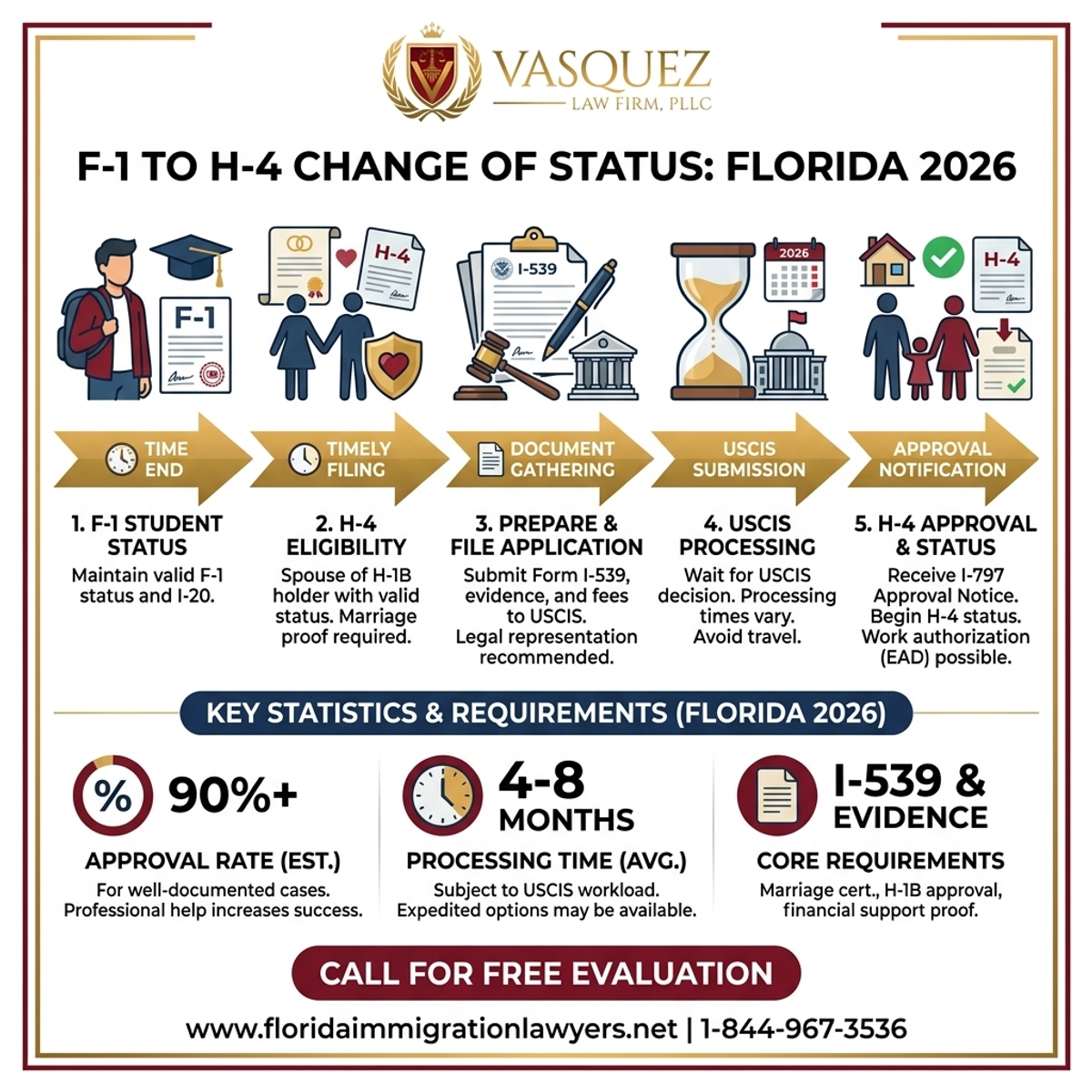
Key Statistics — F-1 to H-4 Change of Status in Florida 2026
The I-539 filing fee is a mandatory, non-refundable charge that USCIS requires to process your application. This fee can be paid via money order, personal check, cashier's check, or by credit card using Form G-1450, Authorization for Credit Card Transactions. It is crucial to ensure the fee amount is correct as per the latest USCIS fee schedule, as incorrect payments are a common reason for application rejection and delays.
The biometrics fee, if applicable, covers the cost of your appointment at an Application Support Center (ASC) where your fingerprints, photograph, and signature will be collected. This biometric data is used for background checks and identity verification. USCIS will send you a separate appointment notice for biometrics after they receive your I-539 application. Missing this appointment without rescheduling can severely impact your case.
Beyond these direct USCIS fees, applicants should budget for other potential costs. These can include attorney fees if you choose to hire an immigration lawyer (which is highly recommended for complex cases), mailing costs (certified mail with tracking is advised), translation fees for any foreign-language documents, and photocopying expenses. Understanding all potential costs upfront helps in financial planning for your change of status.
Steps to Ensure a Successful Status Change
- Verify eligibility and gather necessary documents.
- Complete Form I-539 accurately.
- Submit the form and fees to USCIS.
- Monitor your case status and respond to any USCIS requests for evidence promptly.
- Receive your new status and update your records.
Do not navigate this process alone. Contact Florida Immigration Lawyers today.
To elaborate on step 1, verifying eligibility involves more than just having an H-1B spouse. You must also ensure you have continuously maintained your F-1 status up until the point of filing the I-539. Any period of unlawful presence or unauthorized activity could render you ineligible for a change of status within the U.S. Gathering documents should be systematic, ensuring every required item is present and correctly formatted, including certified translations where necessary.
Regarding step 2, completing Form I-539 accurately means paying close attention to every field. Avoid leaving blank spaces; if a question doesn't apply, write 'N/A'. Ensure consistency in names, dates, and addresses across all documents. A common error is failing to include the correct fee or using an outdated form version, both of which can lead to your application being rejected and returned, causing significant delays.
For step 4, monitoring your case status can be done online using the receipt number provided by USCIS. If you receive a Request for Evidence (RFE), it means USCIS requires more information or clarification. Responding to an RFE promptly and comprehensively is critical. A well-prepared response, often best drafted with legal assistance from Florida Immigration Lawyers, can prevent denial and keep your application on track.
Common Mistakes to Avoid
- Inaccurate or incomplete Form I-539, leading to delays.
- Missing supporting documents, such as marriage certificates.
- Failing to maintain F-1 status until the change is approved.
- Not verifying your spouse's H-1B status.
- Ignoring USCIS requests for additional evidence.
- Submitting outdated forms or incorrect fees.
- Not monitoring processing times and deadlines.
- Assuming automatic approval without checking eligibility.
- Neglecting to seek legal advice when needed.
- Overlooking the importance of financial affidavits.
One critical mistake is failing to maintain your F-1 status. If your F-1 visa or I-94 expires before USCIS approves your H-4 change of status, you could fall out of status. While USCIS generally allows a grace period for 'timely filed' applications, this is a precarious position. You would not be authorized to work or study, and any denial of your I-539 could result in unlawful presence, potentially impacting future immigration benefits. It's always safer to file well in advance.
Another frequent pitfall is ignoring or inadequately responding to Requests for Evidence (RFEs). An RFE is not a denial but a request for more information. A delayed or incomplete response can lead to a denial. For example, if USCIS requests further proof of your marriage's bona fides, providing utility bills, joint bank statements, and photos together can strengthen your case. Florida Immigration Lawyers can guide you in crafting a robust RFE response.
Finally, many applicants underestimate the complexity of immigration law and attempt to navigate the process without legal counsel. While it is possible to file independently, the slightest error can lead to significant setbacks, including denial or deportation. Seeking advice from experienced professionals like Florida Immigration Lawyers can provide peace of mind, ensure accuracy, and significantly increase your chances of a successful outcome, particularly for those in Coral Springs, Florida, facing unique local considerations.
When to Call a Lawyer
Consider legal assistance if you encounter complex immigration issues, such as uncertain eligibility or complications with your spouse's H-1B status. Florida Immigration Lawyers can help you navigate these challenges efficiently.
Beyond initial eligibility concerns, a lawyer becomes indispensable if your spouse's H-1B status encounters issues, such as a job change, layoff, or a need for an H-1B extension. These events can directly impact your H-4 application. An attorney can advise on how to proceed without jeopardizing your application or your spouse's status, ensuring all related filings are coordinated correctly.
Furthermore, if you have any history of immigration violations, criminal convictions, or previous denials of visa applications, your case is inherently complex. These factors can create bars to eligibility or require extensive waivers. An experienced immigration attorney from Florida Immigration Lawyers can assess your specific situation, identify potential hurdles, and develop a strategy to address them proactively, significantly improving your chances of approval.
About Florida Immigration Lawyers
Florida Immigration Lawyers is dedicated to assisting clients across Florida with all immigration needs. Offering free consultations and bilingual services, we are available 24/7. Contact us at 1-844-YO-PELEO or visit our website.
Our team of experienced immigration attorneys understands the intricate and often stressful nature of the U.S. immigration system. We pride ourselves on providing personalized, compassionate, and effective legal representation. Whether you are an international student in Coral Springs, Florida, or anywhere else in the state, we are committed to helping you achieve your immigration goals, from family-based petitions to complex naturalization cases.
At Florida Immigration Lawyers, we believe that everyone deserves access to legal advice. Our free consultation allows you to discuss your F-1 to H-4 change of status case without financial commitment, providing clarity and outlining your best path forward. With our bilingual services, we ensure that language is never a barrier to receiving the legal support you need. Call us today at 1-844-YO-PELEO to begin your journey with confidence.
Sources and References
- U.S. Citizenship and Immigration Services (USCIS)
- Executive Office for Immigration Review (EOIR)
- 8 U.S.C. Chapter 12 - Immigration and Nationality Act
Related services: immigration practice areas, family immigration services, citizenship and naturalization.
This article provides general legal information and is not intended as legal advice. Every case is unique, and outcomes depend on specific facts and circumstances. Contact an attorney for advice about your particular situation.
Se Habla Espanol - Estamos aquí para ayudarle. Call Florida Immigration Lawyers at 1-844-YO-PELEO for your free consultation today.
If you need legal assistance, learn more about experienced immigration attorneys in Orlando, or call us at 1-844-YO-PELEO for a free consultation.
Do Not Navigate This Process Alone
Our experienced immigration attorneys are ready to fight for you. Get a free, confidential case review today.
Se Habla Español
Or leave your details and we’ll call you:
Free Evaluation in 24 Hours
Or talk to us right now
AI voice assistant — available 24/7
FreeFrequently Asked Questions

William J. Vásquez
Founding Attorney · Vasquez Law Firm
U.S. Air Force veteran and immigration attorney with years of hands-on U.S. immigration experience. J.D., NCCU School of Law. AILA member. Admitted to the 4th, 5th, and 11th Circuit Courts.
Available 24/7 - Free Evaluations
Reviewed for legal accuracy by William J. Vásquez
Licensed in North Carolina; U.S. immigration is federal practice.
Related Legal Services
Our Florida immigration attorneys can help you with family immigration services, immigration lawyer cost in Florida and experienced immigration attorneys. Call today at 1-844-YO-PELEO for a free case review.
Related Links
Related Topics
Free Legal Case Review
Discuss your case with our experienced attorneys. We're available 24/7.
Se Habla Español - Estamos aquí para ayudarle.
Related Articles
EB-5 Investor Green Card in Florida: A 2026 Guide
Explore how to obtain an EB-5 investor green card in Florida. Learn about the investment requirements, processes, and benefits of participating in this program. Discover how Florida's economic landscape can be an ideal setting for your investment. Contact Florida Immigration Lawyers for a free case review.
Certificate of Eligibility for Expungement in Florida 2026
For non-U.S. citizens in Florida, understanding how a state expungement impacts immigration status is critical. A certificate of eligibility for expungement in Florida allows a criminal record to be sealed or expunged under state law. However, federal immigration agencies often disregard such state-level relief, still considering the original criminal offense as a conviction for immigration purposes. This can have severe implications for visa applications, green card eligibility, naturalization, and even lead to deportation. This guide clarifies the Florida expungement process, its limited effect on federal immigration law, and key steps to protect your status in 2026. Learn about common mistakes, required documents, timelines, and when to seek expert legal counsel from Florida Immigration Lawyers to navigate these complex issues effectively.
Immigration Lawyer Orlando Free Consultation in Florida
For individuals and families in Orlando, Florida, navigating the complexities of U.S. immigration law requires expert guidance. An immigration lawyer in Orlando offers crucial support for everything from visa applications and green card processes to naturalization and deportation defense. This comprehensive guide details what a free consultation covers, providing a step-by-step overview of immigration pathways, essential document checklists, and expected timelines in 2026. We also highlight common mistakes to avoid, discuss the critical role of legal counsel in deportation and asylum cases, and explain why choosing a local Orlando immigration attorney is beneficial. Florida Immigration Lawyers is dedicated to serving the diverse community of Orlando with compassionate, effective legal solutions, ensuring you receive personalized advice and robust representation for a successful immigration journey.
F-1 Visa Guide for Florida University Students 2026
International students looking to study at Florida universities need to understand the F-1 visa process. This guide covers eligibility, application steps, required documents, and common pitfalls. Learn how Florida Immigration Lawyers can help you navigate your educational journey in the U.S.