Can DACA Recipients Travel Within the U.S. in 2026? A
For DACA recipients in Florida, understanding travel rules and renewal processes in 2026 is vital. While domestic travel is generally permissible, international travel requires an approved Advance Parole document, presenting significant risks if not handled correctly. This comprehensive guide details the essential requirements for DACA renewal, including necessary forms and documentation, and provides realistic timelines for processing. It also outlines the critical steps for applying for Advance Parole, emphasizing the importance of securing authorization before any international departure. With ongoing legal challenges to DACA, staying informed and proactive is key to maintaining your status. Florida Immigration Lawyers offers expert guidance for DACA recipients navigating these complexities in Tampa and across the state, ensuring compliance and peace of mind.

Quick Answer: As of 2026, DACA recipients can generally travel freely within the United States, including to and from Florida, without needing special permission. However, international travel is restricted and typically requires an approved Advance Parole document from USCIS, which allows for temporary re-entry. Traveling outside the U.S. without Advance Parole will likely lead to denial of re-entry and potential loss of DACA status. Always carry valid DACA documentation and a government-issued ID when traveling, even domestically, to avoid complications, especially in sensitive border areas.
- DACA recipients can travel domestically within the U.S. in 2026.
- International travel requires an approved Advance Parole document.
- Traveling internationally without Advance Parole can lead to denial of re-entry.
- Always carry DACA documentation and valid ID, especially in Florida's border zones.
- Consult an immigration attorney for specific travel advice before any international trip.
Navigating the complexities of immigration law can be daunting, especially for DACA recipients in Florida considering travel or renewal in 2026. Many DACA recipients, often referred to as Dreamers, face questions about their ability to move freely within the U.S. or travel abroad. The rules governing Deferred Action for Childhood Arrivals (DACA) are subject to ongoing legal challenges and policy shifts, making it crucial to stay informed about the latest guidelines.
This comprehensive guide from Florida Immigration Lawyers provides up-to-date information for DACA recipients in Florida regarding domestic and international travel, as well as the essential steps for DACA renewal in 2026. We understand the unique challenges you face and are dedicated to helping you understand your rights and options. Our goal is to empower you with the knowledge needed to make informed decisions about your DACA status and travel plans.
Do not navigate this complex legal landscape alone. If you have questions about DACA travel, renewal, or any other immigration matter, reach out for expert guidance. Call Florida Immigration Lawyers at 1-844-967-3536 for a free consultation today. Our experienced team is here to provide the personalized support you need.
Can DACA Recipients Travel Within the U.S. in 2026?
Yes, as of 2026, DACA recipients generally can travel freely within the United States, including all states and territories, without needing specific travel authorization. This includes travel by air, land, or sea between U.S. states, such as flying from Miami to New York or driving from Tampa to Georgia. The ability to travel domestically is a fundamental aspect of the deferred action status, which provides a measure of protection from deportation and allows for a valid work permit.
However, it is vital for DACA recipients to understand that while domestic travel is permitted, certain areas near international borders, like those in South Florida, may have increased presence of U.S. Customs and Border Protection (CBP) checkpoints. While DACA recipients are legally present in the U.S. and should not be detained solely for their immigration status at these checkpoints, it is always wise to carry your DACA approval notice (Form I-797) and employment authorization document (EAD card, Form I-766) along with a government-issued photo ID. This documentation serves as proof of your deferred action status and helps to prevent unnecessary delays or scrutiny. Understanding your rights and responsibilities during domestic travel is crucial for peace of mind and smooth journeys within Florida and beyond.
Understanding DACA Renewal in Florida for 2026
Maintaining your DACA status requires timely renewal, a process that remains critical for Dreamers in Florida in 2026. USCIS advises filing for DACA renewal between 120 and 150 days before your current DACA status expires. This timeframe helps account for potential processing delays and ensures continuity of your work authorization and deferred action. Missing this window can lead to a lapse in your DACA protection, which could have serious consequences, including losing employment authorization and becoming subject to removal proceedings.
The eligibility criteria for DACA renewal in 2026 remain largely consistent with previous years. You must have continuously resided in the U.S. since your last DACA approval, not have departed the U.S. without Advance Parole since August 15, 2012, and not have been convicted of a felony, a significant misdemeanor, or three or more other misdemeanors, and not pose a threat to national security or public safety. Florida Immigration Lawyers regularly assists individuals in Tampa, Orlando, and across Florida with their DACA renewal applications, ensuring all requirements are met and the application is submitted correctly. Staying proactive with your renewal is the best way to safeguard your future in the United States.
Key Eligibility Requirements for DACA Renewal
To be eligible for DACA renewal in 2026, you must meet several key criteria. These include having received DACA previously and not having had your DACA terminated. You must also continue to meet the original DACA guidelines regarding continuous residence in the United States since June 15, 2007, and have been under the age of 31 as of June 15, 2012. Furthermore, you must not have been convicted of certain criminal offenses. Any changes in your criminal record since your last DACA approval must be carefully reviewed by an attorney.
It is important to note that any unauthorized travel outside the U.S. since your last DACA approval, without an approved Advance Parole document, could jeopardize your eligibility for renewal. USCIS carefully reviews all aspects of your application, and inconsistencies or new disqualifying factors can lead to a denial. Consulting with an immigration attorney at Florida Immigration Lawyers can help you assess your eligibility, especially if you have had any changes in your personal circumstances or a previous DACA denial. We serve clients throughout Florida, providing clear guidance and support.
What Documents Do I Need for DACA Renewal and Travel?
Gathering the correct documentation is a critical step for both DACA renewal and applying for Advance Parole in 2026. A meticulous approach to your application ensures a smoother process and reduces the likelihood of requests for evidence or denials. For DACA renewal, you will primarily need to submit forms that confirm your continued eligibility and identity. For travel outside the U.S., a separate application for Advance Parole requires specific evidence of your humanitarian, educational, or employment-related need to travel.
Below is a comprehensive checklist for DACA renewal and Advance Parole applications. Always ensure all documents are current, legible, and submitted as requested by USCIS. If any documents are in a language other than English, they must be accompanied by a certified English translation. Florida Immigration Lawyers can assist you in preparing and organizing all necessary paperwork, helping to avoid common pitfalls that can delay or jeopardize your application.
Document Checklist for DACA Renewal (Form I-821D and I-765)
- Form I-821D, Consideration of Deferred Action for Childhood Arrivals
- Form I-765, Application for Employment Authorization
- Form I-765 Worksheet (if applicable)
- Copies of your previous DACA approval notices (Form I-797)
- Copy of your current Employment Authorization Document (EAD card)
- Copies of any previous EAD cards issued under DACA
- Two passport-style photos (taken within 30 days of filing)
- Proof of continuous residence since your last DACA approval (e.g., utility bills, bank statements, school records, employment records, tax returns)
- Any new certified court dispositions for arrests or convictions since your last DACA approval
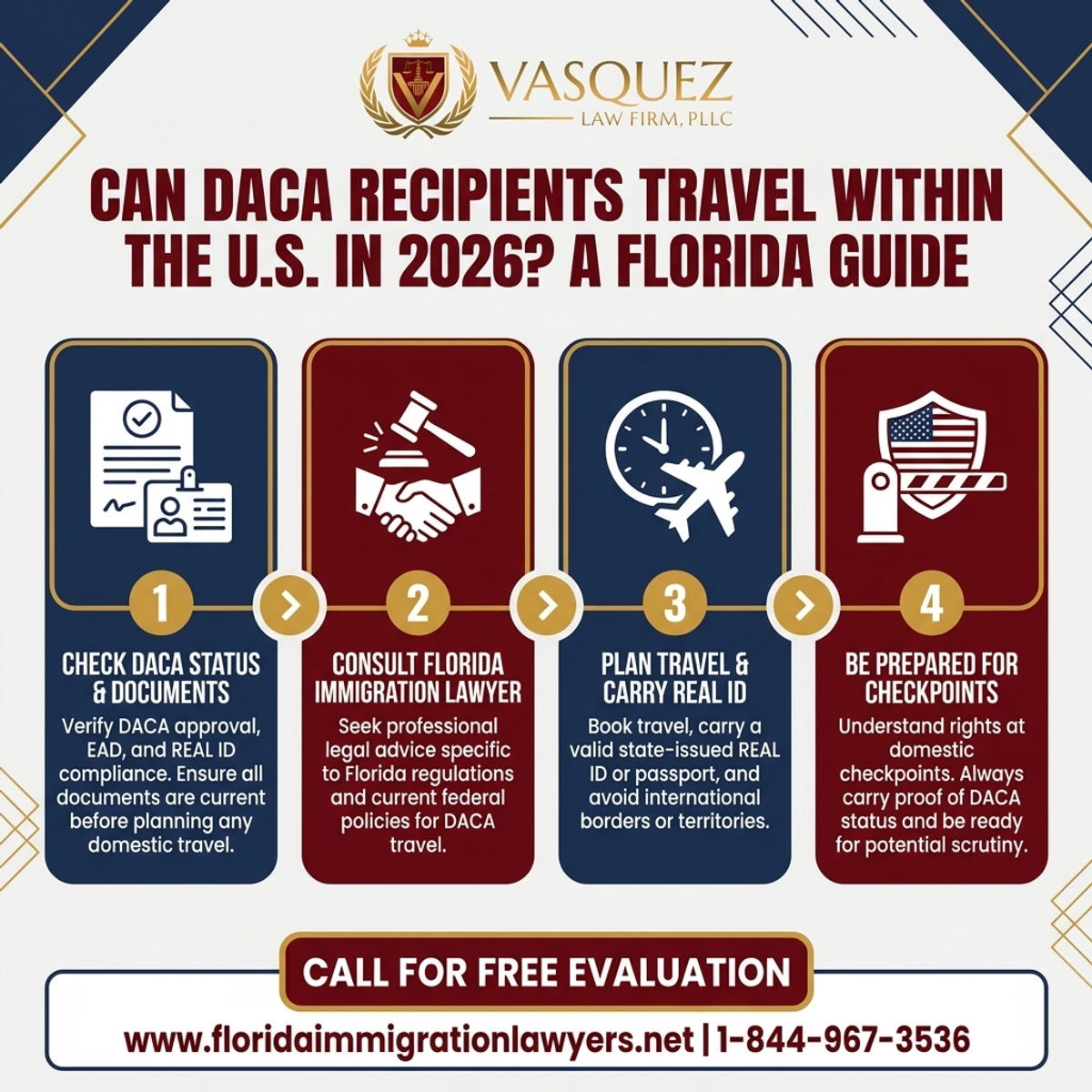
Step-by-Step Process — Can DACA Recipients Travel Within the U.S. in 2026? A Florida Guide
Document Checklist for Advance Parole (Form I-131)
- Form I-131, Application for Travel Document
- Two passport-style photos (taken within 30 days of filing)
- Copy of your current DACA approval notice (Form I-797)
- Copy of your current EAD card
- Copy of a government-issued photo ID (e.g., state ID or driver's license from Florida)
- Evidence supporting your reason for travel (e.g., medical records for humanitarian travel, enrollment verification for educational travel, employer letter for employment travel)
- Any other supporting documentation requested by USCIS specific to your travel purpose
How Long Does DACA Renewal and Advance Parole Processing Take in 2026?
Processing times for DACA renewal and Advance Parole applications can vary significantly in 2026, depending on the USCIS service center handling your case and the volume of applications. It is crucial to monitor these times and plan accordingly, especially when considering international travel. As of early 2026, USCIS provides estimated processing times on its website, but these are subject to change. For DACA renewal, the general recommendation is to file 120 to 150 days before your current DACA expires to avoid a lapse in status.
Advance Parole applications typically take longer to process than DACA renewals, often ranging from several months to over a year. It is imperative that you do not travel outside the U.S. until you have physically received your approved Advance Parole document. Departing without it will likely result in a denial of re-entry. Florida Immigration Lawyers can help you track your application status and provide guidance based on the most current USCIS processing data relevant to our Florida clients.
| Stage | Typical Timeframe (As of 2026) | Notes |
|---|---|---|
| DACA Renewal Filing | 120-150 days before expiration | Recommended window to avoid lapse in status. |
| DACA Renewal Processing | 3-6 months | Can vary by USCIS service center; check USCIS website. |
| Advance Parole Filing | As early as possible before planned travel | No specific window, but long processing times. |
| Advance Parole Processing | 6-18 months | Highly variable; do NOT travel until approved document is received. |
| Biometrics Appointment | 3-5 weeks after filing | Required for both DACA renewal and Advance Parole in most cases. |
What Are the Costs Associated with DACA Renewal and Travel Applications?
Understanding the financial aspects of DACA renewal and Advance Parole is essential for planning in 2026. USCIS fees are subject to change, but generally, there are filing fees associated with both applications. These fees are non-refundable, regardless of the outcome of your application. It is important to submit the correct fee amount to avoid rejection of your application. Always verify the most current fees on the official USCIS website before mailing your application.
Beyond the government filing fees, DACA recipients in Florida may also incur additional costs, such as attorney fees for legal assistance, postal fees for mailing documents, and fees for obtaining supporting documents like birth certificates or certified court records. While some organizations offer assistance with filing fees, these options are limited. Florida Immigration Lawyers offers transparent fee structures for our services, ensuring you understand all costs involved in your DACA renewal or Advance Parole application. We believe in making quality legal representation accessible to Dreamers across Florida.
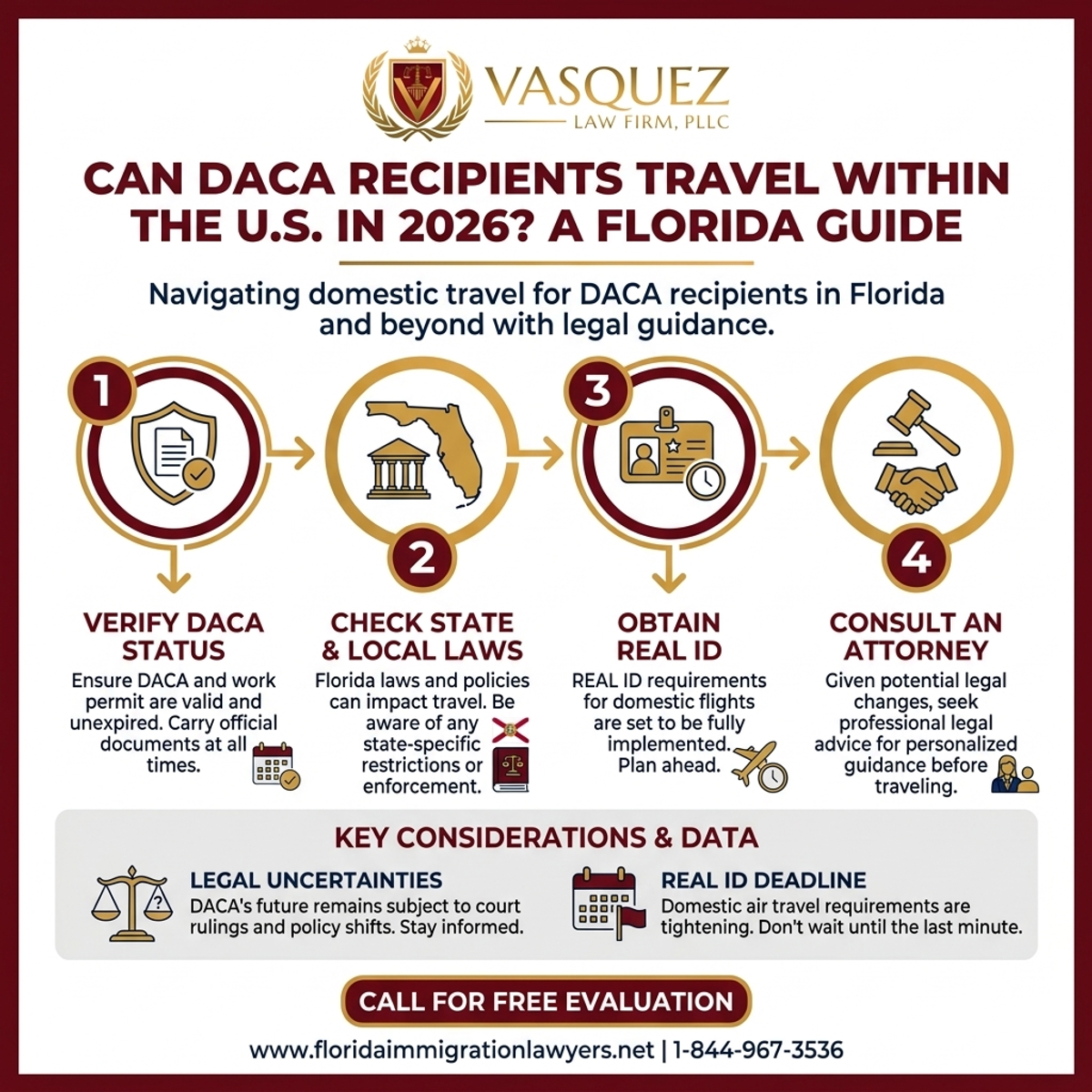
Key Statistics — Can DACA Recipients Travel Within the U.S. in 2026? A Florida Guide
| Item | Typical Fee (As of 2026) | Notes |
|---|---|---|
| Form I-821D (DACA) | No separate fee | Included with I-765 fee. |
| Form I-765 (Employment Authorization) | Varies (check USCIS website) | Includes biometric services fee. This is the primary fee for DACA renewal. |
| Form I-131 (Advance Parole) | Varies (check USCIS website) | Separate fee from DACA renewal. |
| Legal Consultation/Representation | Varies by attorney/case | Highly recommended for complex cases or to ensure proper filing. |
| Passport Photos | $10-$20 | Required for both applications. |
| Certified Translations | Varies by document | If documents are not in English. |
Navigating Travel Restrictions and Advance Parole for DACA Recipients
While domestic travel is largely unrestricted for DACA recipients, international travel presents a different set of rules and significant risks. DACA does not grant a legal immigration status; it only provides deferred action from removal and work authorization. Therefore, departing the U.S. without proper authorization, specifically Advance Parole, is considered self-deportation and will likely lead to an inability to re-enter the country and the termination of your DACA status. This can have devastating consequences for your life in Florida.
Advance Parole (Form I-131) is a document issued by USCIS that allows certain non-citizens to travel abroad and return to the U.S. without jeopardizing their immigration process. For DACA recipients, Advance Parole is typically granted for humanitarian purposes (e.g., critical medical treatment for you or a close relative, attending a funeral), educational purposes (e.g., academic programs, research), or employment purposes (e.g., overseas assignments, conferences). Strict eligibility criteria apply, and a compelling reason for travel must be demonstrated. It is crucial to have the approved document in hand before leaving the U.S. Once approved, re-entry is not guaranteed, and you will still be subject to inspection by CBP officers at ports of entry, such as those in Miami or Orlando. They have the final authority to admit you. For more information, refer to the State Department's guidelines on Advance Parole.
Do not navigate this process alone. Contact Florida Immigration Lawyers today to discuss your DACA renewal or Advance Parole application. We offer free consultations and are available 24/7 to assist you.
Common Mistakes to Avoid with DACA Renewal and Travel
The DACA renewal and Advance Parole processes are complex, and even minor errors can lead to significant delays or denials. Being aware of common mistakes can help you navigate these applications more successfully.
- Filing Late for DACA Renewal: Waiting until the last minute can cause a lapse in your DACA status, leading to loss of employment authorization and potential removal proceedings. USCIS recommends filing 120-150 days before expiration.
- Traveling Internationally Without Advance Parole: This is perhaps the most critical mistake. Leaving the U.S. without an approved Advance Parole document will almost certainly lead to denial of re-entry and termination of your DACA.
- Incomplete or Inaccurate Applications: Failing to fill out all sections of Form I-821D, I-765, or I-131 correctly, or omitting required supporting documents, can result in your application being rejected or delayed.
- Not Disclosing All Criminal History: Even minor arrests or charges that did not lead to a conviction must be disclosed. Failure to do so can be considered misrepresentation and lead to denial.
- Using Outdated Forms or Incorrect Fees: USCIS forms and fees change periodically. Always download the latest forms directly from the USCIS website and verify the current fee schedule.
- Not Responding to Requests for Evidence (RFEs): If USCIS sends an RFE, it is crucial to respond promptly and thoroughly with the requested information. Failure to do so can lead to denial.
- Assuming Re-entry is Guaranteed with Advance Parole: While Advance Parole allows you to seek re-entry, it does not guarantee admission. CBP officers at the port of entry have the final authority.
- Ignoring Changes in Personal Information: Failing to notify USCIS of address changes or other significant life events can cause you to miss important notices or impact your eligibility.
- Not Consulting an Attorney for Complex Cases: If you have a criminal record, a previous denial, or complex travel plans, attempting to file without legal advice can be risky.
- Not Keeping Copies of All Submitted Documents: Always make and keep copies of your entire application package, including all supporting documents, for your records.
When to Call a Lawyer for DACA Renewal or Travel in Florida
While some DACA renewals may seem straightforward, certain situations warrant the immediate attention and expertise of an immigration attorney. Given the constant legal challenges surrounding DACA, having experienced legal counsel is more important than ever. Florida Immigration Lawyers are well-versed in the nuances of DACA policy and can provide invaluable assistance.
You should call a lawyer if you:
- Have any criminal history, including arrests, charges, or convictions, no matter how minor.
- Have previously had a DACA application denied or terminated.
- Are unsure about your continuous residence or physical presence requirements.
- Plan to travel internationally and need to apply for Advance Parole, especially if your travel reason is complex.
- Have lost your DACA documentation or EAD card.
- Received a Request for Evidence (RFE) from USCIS for your DACA renewal or Advance Parole application.
- Are approaching your DACA expiration date and haven't filed for renewal.
- Have questions about how a change in immigration policy might affect your DACA status.
- Are concerned about potential deportation defense issues.
Our firm, Florida Immigration Lawyers, is dedicated to protecting the rights of Dreamers across Florida, from Tampa to Jacksonville. We offer comprehensive services for DACA recipients, including initial applications, renewals, and Advance Parole requests. Our attorneys are here to help you navigate the system effectively.
About Florida Immigration Lawyers
Florida Immigration Lawyers is a leading immigration law firm dedicated to serving individuals and families across the entire state of Florida. With years of specialized experience, our team of compassionate and knowledgeable attorneys provides comprehensive legal services for a wide range of immigration matters. We understand the profound impact immigration issues have on our clients' lives and are committed to offering personalized, effective legal strategies.
Our firm specializes in areas such as DACA, asylum, deportation defense, citizenship, family immigration, and business immigration. We pride ourselves on our client-focused approach, ensuring that every individual receives dedicated attention and clear communication throughout their legal journey. We are available 24/7 to answer your questions and offer free consultations to help you understand your options without financial obligation. Choose Florida Immigration Lawyers for trusted advocacy and exceptional results.
Sources and References
- U.S. Citizenship and Immigration Services (USCIS) - DACA
- U.S. Citizenship and Immigration Services (USCIS) - Form I-131, Application for Travel Document (Advance Parole)
- U.S. Citizenship and Immigration Services (USCIS) - Check Case Processing Times
- U.S. Department of State - Advance Parole
- 8 U.S.C. § 1227 - Deportable aliens (Immigration and Nationality Act - INA)
- 8 CFR Part 274a - Control of Employment of Aliens
Related services: immigration practice areas, free immigration consultation.
This article provides general legal information and is not intended as legal advice. Every case is unique, and outcomes depend on specific facts and circumstances. Contact an attorney for advice about your particular situation.
The journey as a DACA recipient can present unique challenges, but you don't have to face them alone. Whether you're planning domestic travel, considering international travel with Advance Parole, or need to renew your DACA status in 2026, Florida Immigration Lawyers is here to guide you every step of the way. Our dedicated team is committed to providing expert legal assistance and peace of mind.
Don't hesitate to seek professional help to protect your future. Contact Florida Immigration Lawyers today for a free consultation. Call us at 1-844-967-3536. Se Habla Espanol - Estamos aqui para ayudarle.
If you need legal assistance, learn more about our immigration legal services, or call us at 1-844-967-3536 for a free consultation.
Do Not Navigate This Process Alone
Our experienced immigration attorneys are ready to fight for you. Get a free, confidential consultation today.
Se Habla Español
Or leave your details and we’ll call you:
Free Evaluation in 24 Hours
Or talk to us right now
AI voice assistant — available 24/7
FreeFrequently Asked Questions

William J. Vásquez
Founding Attorney · Vasquez Law Firm
U.S. Air Force veteran and immigration attorney with years of hands-on U.S. immigration experience. J.D., NCCU School of Law. AILA member. Admitted to the 4th, 5th, and 11th Circuit Courts.
Available 24/7 - Free Evaluations
Reviewed for legal accuracy by William J. Vásquez
Licensed in North Carolina; U.S. immigration is federal practice.
Related Legal Services
Our Florida immigration attorneys can help you with experienced immigration attorneys, business immigration and asylum protection. Call today at 1-844-967-3536 for a free consultation.
Related Links
Related Topics
Free Legal Consultation
Discuss your case with our experienced attorneys. We're available 24/7.
Se Habla Español - Estamos aquí para ayudarle.
Related Articles
Immigration Lawyer Orlando Free Consultation 2026
Discover how to find an immigration lawyer in Orlando offering a free consultation. Understand the services available and why choosing Florida Immigration Lawyers can make a difference in your case.
Military Naturalization Expedited in Florida Bases
Explore military naturalization options for families at Florida bases, including parole in place benefits in Miami. Learn how to expedite your application with expert guidance from Florida Immigration Lawyers.
Can DACA Recipients Travel Within the U.S. 2026?
Explore the 2026 guide to DACA renewal and travel rights for Dreamers in Coral Springs, Florida. Understand the process, avoid common pitfalls, and learn when to seek legal help. Florida Immigration Lawyers are ready to assist you with your immigration needs.
F-1 to H-4 Change of Status in Florida 2026
Explore how to transition from an F-1 to an H-4 visa in Florida, focusing on the I-539 processing at the Texas Service Center in 2026. Learn steps, costs, and common pitfalls in this comprehensive guide for international students.