Can DACA Recipients Travel Within the U.S. 2026?
For DACA recipients in Florida, understanding your rights and limitations regarding travel and employment is crucial. While DACA generally allows domestic travel within the U.S., international travel requires strict Advance Parole approval. This comprehensive guide clarifies the DACA work permit Florida process, addresses common questions about travel, and provides actionable advice for maintaining your status and pursuing your goals. Learn about application requirements, renewal timelines, essential documents, and common mistakes to avoid. Florida Immigration Lawyers offers guidance on DACA renewals, work permits, and travel queries. We serve DACA recipients across Florida, including Orlando, helping them navigate the complex immigration landscape. Contact us for a free case review to protect your DACA status and future.

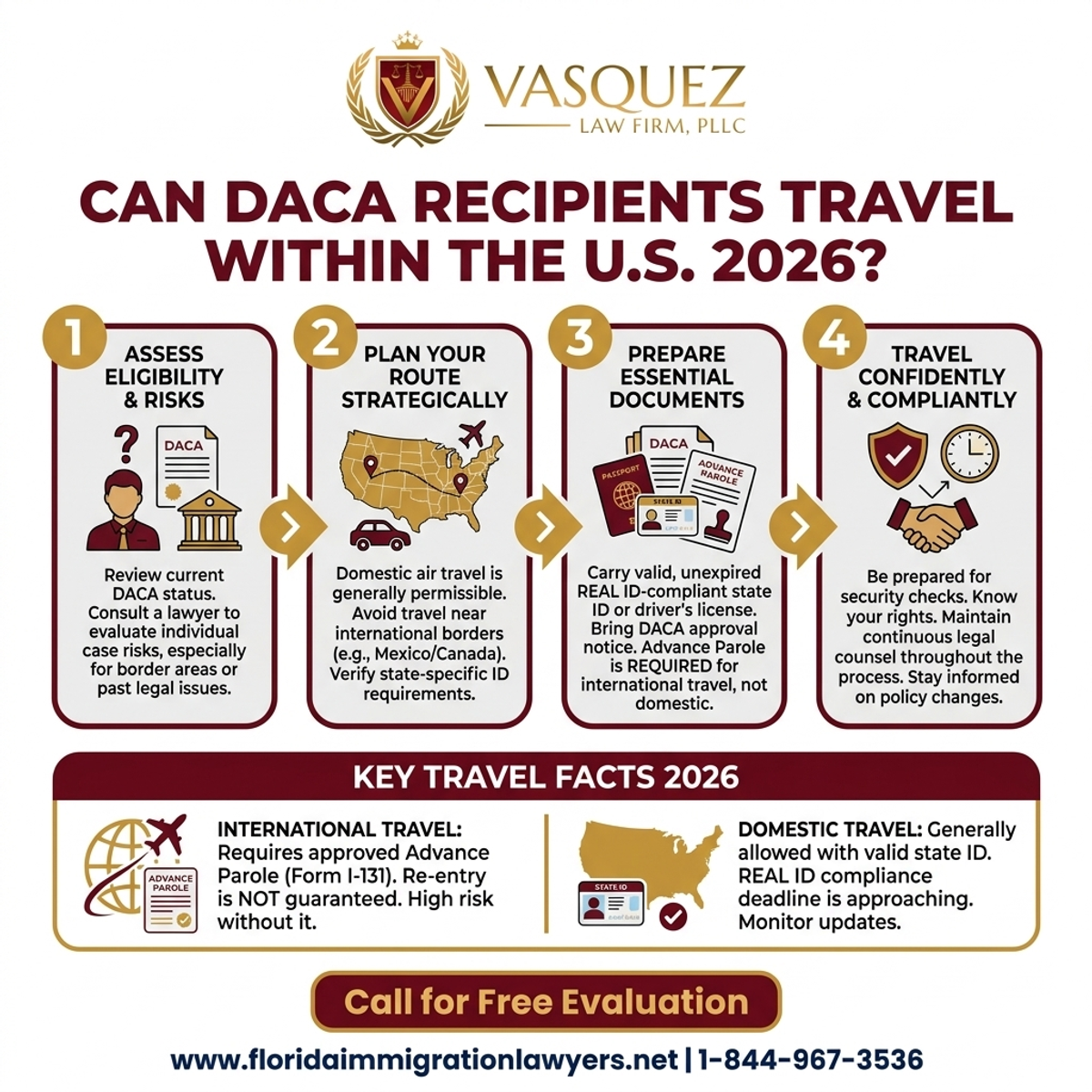
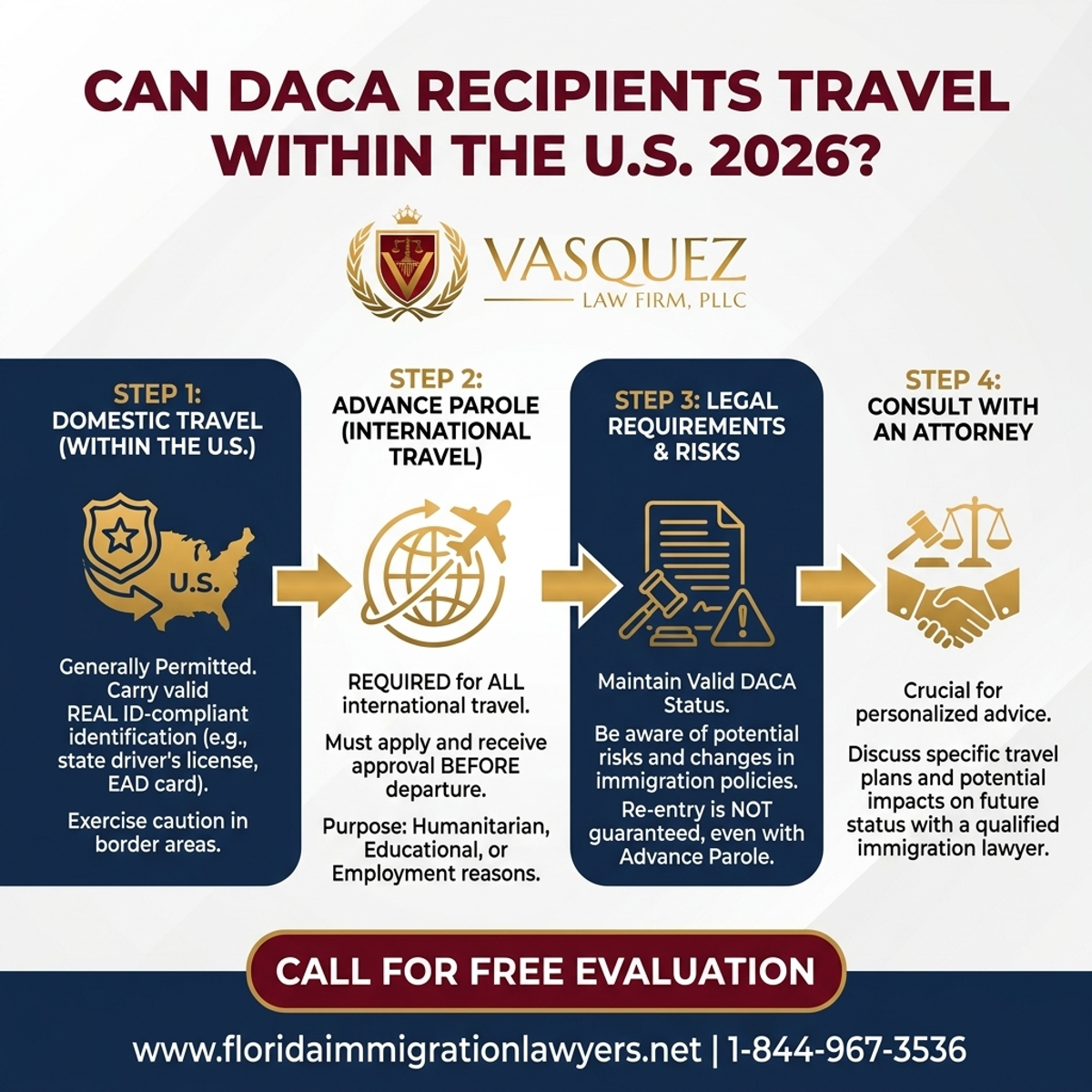
Can DACA recipients travel within the U.S. in 2026? Yes, DACA recipients can generally travel domestically within the United States in 2026. This includes flying between states or driving across state lines. However, international travel is highly restricted and typically requires an approved Advance Parole document from USCIS, which is rarely granted for DACA recipients. Always carry your DACA approval notice (Form I-797) and Employment Authorization Document (EAD, Form I-766) when traveling, even domestically, as proof of your legal status.
- Domestic travel for DACA recipients is generally permitted across all 50 states and territories.
- International travel requires Advance Parole, which is difficult to obtain for DACA.
- Always carry your DACA approval notice and EAD when traveling.
- Avoid travel near international borders without proper documentation, as enforcement can be stricter.
- Consult an immigration attorney for specific travel advice, especially if you have an urgent need for international travel.
For Deferred Action for Childhood Arrivals (DACA) recipients in Florida, understanding your rights and limitations regarding travel and employment is crucial. The DACA program provides temporary relief from deportation and grants eligibility for a work permit (Employment Authorization Document, or EAD) to eligible undocumented immigrants who came to the U.S. as children. As of 2026, the legal landscape surrounding DACA remains complex and subject to ongoing court challenges, making accurate information and legal guidance more important than ever.
Whether you're considering a trip across Florida, planning to visit family in another state, or simply trying to understand your employment options in Orlando, navigating the intricacies of DACA can be daunting. From renewing your DACA work permit to understanding the nuances of domestic travel, every step requires careful attention to detail. This comprehensive guide from Florida Immigration Lawyers aims to clarify the DACA work permit Florida process, address common questions about travel, and provide actionable advice to help you maintain your status and pursue your goals.
Do not risk your DACA status or your future by making uninformed decisions. For personalized legal guidance on DACA renewals, work permits, or travel, call Florida Immigration Lawyers at 1-844-YO-PELEO for a free case review. Our experienced attorneys are here to help you understand your options and protect your rights.
Can DACA Recipients Travel Within the U.S. in 2026?
Yes, DACA recipients can typically travel domestically within the United States in 2026. This includes flying between states, driving across state lines, and traveling to U.S. territories like Puerto Rico. However, international travel requires USCIS-approved Advance Parole, which is rarely granted for DACA recipients and comes with significant risks. Always carry your EAD and DACA approval notice.
For DACA recipients, domestic travel generally poses no issues, provided you carry valid identification and your DACA-related documents. When flying within the U.S., a valid state-issued ID or driver's license, alongside your Employment Authorization Document (EAD), should suffice. It is strongly recommended to always carry your Form I-797 DACA approval notice and your EAD (Form I-766) as proof of your deferred action status and work authorization. While not always requested, these documents can be crucial if you encounter any issues or questions from authorities, particularly at airports or transportation hubs.
Special caution is advised when traveling near U.S. international borders, including coastal areas and within 100 miles of any land border. Customs and Border Protection (CBP) operates checkpoints in these zones, and while DACA provides protection from removal, encounters with CBP can be unpredictable. Carrying your DACA documents at all times in these areas is paramount. For international travel, DACA recipients generally cannot leave the U.S. without an approved Advance Parole document from USCIS (Form I-131). Advance Parole for DACA recipients is typically granted only for humanitarian, educational, or employment purposes and is extremely limited. Leaving the U.S. without it could result in being denied re-entry, even if your DACA status is current. Consult with an attorney before considering any international travel.
Understanding DACA and Work Permits (EAD) in Florida
DACA, or Deferred Action for Childhood Arrivals, is a U.S. immigration policy established in 2012 that allows certain undocumented immigrants who entered the country as minors to receive a renewable two-year period of deferred action from deportation and eligibility for a work permit. This program has profoundly impacted thousands of individuals in Florida, enabling them to work legally, pursue higher education, and contribute to the state's economy and culture. As of recent data, Florida is home to one of the largest populations of DACA recipients in the U.S., with a significant concentration in Central Florida cities like Orlando.
To be eligible for DACA, individuals must meet several strict criteria, including having come to the U.S. before their 16th birthday, having continuously resided in the U.S. since June 15, 2007, being under the age of 31 as of June 15, 2012, being currently in school, having graduated high school, obtained a GED, or honorably discharged from the U.S. Coast Guard or Armed Forces, and having no felony convictions, significant misdemeanors, or multiple misdemeanors. The DACA program does not provide a pathway to lawful permanent residency or U.S. citizenship, but it offers crucial temporary protection and the ability to work legally.
An Employment Authorization Document (EAD), also known as a work permit, is critical for DACA recipients. It allows individuals to obtain a Social Security number, secure lawful employment, and often obtain a driver's license. The EAD is valid for the duration of the DACA deferral period, typically two years, and must be renewed alongside the DACA status itself. Without a valid EAD, DACA recipients cannot legally work in the U.S. Florida Immigration Lawyers regularly assists DACA recipients throughout Florida, including those residing near the USCIS Orlando Field Office, with initial applications and renewals, ensuring they navigate the complex requirements of 8 U.S.C. § 1101 et seq., the Immigration and Nationality Act (INA).
How Do I Apply for a DACA Work Permit Renewal in 2026?
To renew your DACA work permit (Form I-765 and I-821D) in 2026, you must submit your application to USCIS within 120-150 days before your current EAD expires. Ensure all documents are current, fees are paid, and submit your application to the correct USCIS lockbox facility. Proactive submission is key to avoiding a lapse in work authorization.
Renewing your DACA and EAD is a critical process to maintain your status and legal ability to work. As of 2026, USCIS continues to accept DACA renewal applications. It is highly recommended to file your renewal application well in advance of your current DACA and EAD expiration date, ideally between 120 and 150 days before it expires. Filing too early or too late can lead to complications, including potential denial or a lapse in your work authorization. The renewal process requires careful attention to detail and a thorough understanding of the required forms and supporting documentation.
Step-by-Step Process — Can DACA Recipients Travel Within the U.S. 2026?
Step-by-Step Guide to DACA and EAD Renewal:
- Gather Necessary Documents: Collect your previous DACA approval notices (Form I-797), your current EAD card, proof of continuous residence in Florida (e.g., utility bills, bank statements, school records), and any new identity documents or records of criminal history since your last application.
- Complete Form I-821D, Consideration of Deferred Action for Childhood Arrivals: Fill out this form accurately and completely. Be sure to answer all questions honestly, especially regarding any interactions with law enforcement.
- Complete Form I-765, Application for Employment Authorization: This is your application for the work permit. For DACA renewals, you will typically indicate eligibility category (c)(33).
- Complete Form I-765 Worksheet: This supplemental sheet provides additional information required for the EAD application.
- Prepare Passport-Style Photos: Include two identical, color passport-style photos taken within 30 days of filing your application. Write your name and A-number lightly on the back of each photo.
- Pay Required Fees: As of 2026, the filing fee for Form I-765 is typically $410, and the biometrics services fee is $85, totaling $495. Fees are subject to change, so always check the latest USCIS fee schedule. You can pay by money order, personal check, cashier's check, or credit card using Form G-1450, Authorization for Credit Card Transactions.
- Assemble Your Application Package: Organize all forms and supporting documents neatly. Create copies for your records.
- Mail Your Application: Send your complete package to the correct USCIS lockbox facility. The address depends on the state you reside in (e.g., Florida residents typically send to a designated P.O. Box). Double-check the USCIS direct filing addresses before mailing.
- Attend Biometrics Appointment: After filing, you will receive a notice for a biometrics appointment at an Application Support Center (ASC), such as the one in Orlando. This appointment is mandatory for fingerprinting and photographs.
- Receive Decision: USCIS will review your application and send a decision. If approved, you will receive a new Form I-797 (approval notice) and your EAD card.
What Documents Do I Need for DACA and EAD Applications?
A comprehensive set of documents is required for both initial DACA applications and renewals to demonstrate eligibility. Failing to provide complete and accurate documentation can lead to delays or denial. Ensure all documents are translated into English by a certified translator if they are in another language.
DACA and EAD Document Checklist:
- Form I-821D: Consideration of Deferred Action for Childhood Arrivals.
- Form I-765: Application for Employment Authorization.
- Form I-765 Worksheet: Supplemental information for EAD.
- Form G-1450 (if paying by credit card): Authorization for Credit Card Transactions.
- Two Passport-Style Photos: Meeting USCIS specifications.
- Proof of Identity: Copy of passport, birth certificate with photo ID, or school ID with photo.
- Proof of Entry Before Age 16: Passport stamps, I-94 arrival/departure record, or school records from that period.
- Proof of Continuous Residence Since June 15, 2007: School transcripts, employment records, medical records, utility bills, bank statements, rental agreements, tax records.
- Proof of Age: Birth certificate.
- Proof of Education: High school diploma, GED certificate, or current school enrollment records.
- Proof of Honorable Discharge (if applicable): From U.S. Armed Forces or Coast Guard.
- Previous DACA Approval Notices (for renewals): Form I-797 for previous DACA and EAD approvals.
- Previous EAD Card (for renewals): Copy of your expiring EAD.
- Any Criminal Records (if applicable): Certified court dispositions for any arrests or convictions.
DACA Processing Times and Fees in 2026
Understanding the typical processing times and associated fees for DACA and EAD applications is essential for planning and avoiding lapses in work authorization. As of 2026, USCIS processing times can fluctuate based on caseload and policy changes, so it's always best to monitor official USCIS resources. The fees, while standard, are subject to change by federal regulation, typically found in 8 CFR Part 103.7(b).
Typical DACA and EAD Processing Timeline (as of 2026):
| Stage | Typical Timeframe | Notes |
|---|---|---|
| Application Submission to Receipt Notice | 1-3 weeks | You will receive Form I-797C, Notice of Action. |
| Biometrics Appointment Scheduling | 3-6 weeks after receipt notice | Notice will provide date, time, and location (e.g., Orlando ASC). |
| Application Review by USCIS | 3-10 months | Varies significantly based on service center workload and complexity. |
| Decision and Approval Notice (Form I-797) | Immediately after review | Indicates DACA and EAD approval. |
| EAD Card Delivery | 1-2 weeks after approval notice | Your physical work permit card (Form I-766). |
These timeframes are estimates. You can check the current USCIS processing times online by selecting Form I-821D and your service center. It is crucial to file your renewal early to minimize the risk of a gap in your employment authorization.
Key Statistics — Can DACA Recipients Travel Within the U.S. 2026?
DACA and EAD Fee Breakdown (as of 2026):
| Item | Typical Fee | Notes |
|---|---|---|
| Form I-765 (Application for Employment Authorization) | $410 | This fee is for the work permit itself. |
| Biometrics Services Fee | $85 | Required for fingerprinting and background checks. |
| Total Filing Fee | $495 | Combined fee for DACA renewal and EAD. |
Please note that these fees are subject to change. Always verify the most current fees on the official USCIS website before submitting your application. Fee waivers are generally not available for DACA applications, but certain exceptions or payment methods might be discussed with an attorney.
Navigating Employment and Education with DACA in Florida
DACA provides eligible individuals in Florida with the crucial ability to work legally and pursue educational opportunities that might otherwise be out of reach. With a valid Employment Authorization Document (EAD), DACA recipients can secure a Social Security number, obtain a Florida driver's license, and accept lawful employment across various sectors. This opens doors to better-paying jobs, career advancement, and greater financial stability for thousands of individuals and their families in Central Florida and beyond.
In the educational sphere, DACA status can also be beneficial. While DACA does not automatically grant eligibility for federal student aid, many DACA recipients in Florida may qualify for in-state tuition at public colleges and universities, significantly reducing the cost of higher education. Institutions across Florida, including those in Orlando, recognize the importance of providing accessible education to all residents. DACA recipients can pursue degrees and vocational training, contributing to Florida's skilled workforce and intellectual capital. However, it's important to research specific institutional policies, as they can vary.
Despite these benefits, DACA recipients in Florida still face unique challenges. Employment opportunities, while broader with an EAD, may still be limited in certain regulated professions that require U.S. citizenship or lawful permanent residency. Furthermore, the ongoing legal challenges to the DACA program create an environment of uncertainty, which can impact long-term planning for careers and education. Staying informed about policy changes and consulting with an experienced immigration attorney are vital steps for DACA recipients looking to maximize their opportunities and safeguard their future in Florida. Our firm, Florida Immigration Lawyers, is dedicated to helping individuals understand and navigate these complex issues.
Do not navigate this process alone. The complexities of DACA, especially concerning renewals, travel, and employment in Florida, require legal insight. Contact Florida Immigration Lawyers today at 1-844-YO-PELEO for a free case review to ensure your rights are protected and your application is successful.
Common Mistakes DACA Recipients Should Avoid
- Missing Renewal Deadlines: Failing to file your DACA and EAD renewal application between 120 and 150 days before expiration can lead to a lapse in work authorization and potentially put you at risk of removal.
- Submitting Incomplete Applications: Missing forms, signatures, or supporting documents is a common reason for application delays or rejections by USCIS.
- Providing Inaccurate Information: Any false or misleading information on your application can result in denial, accusations of fraud, and severe immigration consequences.
- Not Disclosing Criminal History: Even minor arrests or interactions with law enforcement must be fully disclosed, along with certified court dispositions. Hiding this information is a serious mistake.
- Traveling Internationally Without Advance Parole: Leaving the U.S. without an approved Advance Parole document (Form I-131) will almost certainly result in being denied re-entry, even if your DACA is current.
- Not Updating Your Address with USCIS: If you move, you must notify USCIS of your new address within 10 days using Form AR-11. Failure to do so can cause you to miss important notices.
- Assuming DACA Grants Permanent Status: DACA is a temporary form of relief and does not provide a direct pathway to a Green Card or U.S. citizenship. Misunderstanding this can lead to incorrect long-term planning.
- Failing to Keep Copies of All Submitted Documents: Always retain a complete copy of everything you send to USCIS for your records.
- Not Seeking Legal Advice for Complex Cases: If you have a criminal record, previous deportation orders, or other complex issues, attempting to file without an attorney can be detrimental.
- Using Unofficial or Outdated Forms: Always download the latest forms directly from the USCIS website to ensure you are using the correct version.
- Ignoring Biometrics Appointments: Failure to attend your scheduled biometrics appointment will result in your application being considered abandoned and denied.
When to Call a DACA Immigration Lawyer in Florida
While some DACA renewals may seem straightforward, the program's evolving legal status and the intricate nature of immigration law mean that legal counsel is often invaluable. You should consider contacting an experienced DACA immigration lawyer in Florida, such as those at Florida Immigration Lawyers, in several key scenarios. If you have any criminal history, including arrests or convictions, no matter how minor, seeking legal advice is paramount. Even a seemingly insignificant misdemeanor could impact your DACA eligibility or lead to denial.
Furthermore, if your DACA application has been denied in the past, or if you have received a Request for Evidence (RFE) from USCIS, a lawyer can help you understand the reasons for the denial or RFE and assist in preparing a stronger response. For DACA recipients considering any form of international travel, even with Advance Parole, consulting an attorney is non-negotiable due to the inherent risks. Additionally, if you are unsure about your initial DACA eligibility, have been out of the country, or have any doubts about meeting the continuous residence requirements, an attorney can assess your specific situation and provide clear guidance. Our team at Florida Immigration Lawyers is well-versed in the latest DACA policies and court decisions, providing peace of mind and representation to DACA recipients across Florida, including those in Orlando and the wider Central Florida area.
About Florida Immigration Lawyers
Florida Immigration Lawyers is an immigration law firm dedicated to serving individuals and families throughout Florida. With a deep understanding of the complexities of U.S. immigration law, our experienced attorneys provide compassionate and effective legal representation for a wide range of immigration matters, including DACA applications and renewals, deportation defense, asylum claims, family-based immigration, and citizenship applications. We are committed to protecting the rights of immigrants and helping them achieve their American dreams.
Our firm prides itself on offering personalized attention and strategic legal solutions tailored to each client's unique circumstances. We understand the challenges and anxieties that come with navigating the immigration system, and we are here to provide clear guidance and unwavering support. Located in Orlando, we serve clients across all of Florida, offering services in both English and Spanish. When you choose Florida Immigration Lawyers, you gain a dedicated advocate who will fight for your best interests. We offer free case reviews and are available 24/7 to address your urgent immigration needs.
Sources and References
- U.S. Citizenship and Immigration Services (USCIS)
- Executive Office for Immigration Review (EOIR)
- U.S. Department of State
- 8 U.S.C. Chapter 12 - Immigration and Nationality Act (INA)
- INA § 212(d)(5) - Parole Authority
- 8 CFR Part 103.7(b) - Fees
- 8 CFR Part 274a.12(c)(14) - Employment Authorization for DACA
Related services: H-1B specialty occupation visas, L-1 intracompany transfer visas, work visas for professionals, investment and entrepreneur visas.
This article provides general legal information and is not intended as legal advice. Every case is unique, and outcomes depend on specific facts and circumstances. Contact an attorney for advice about your particular situation.
Do not let uncertainty or fear prevent you from securing your future. If you are a DACA recipient in Florida with questions about your work permit, travel, or any other immigration matter, Florida Immigration Lawyers is here to help. Contact us today for a free, confidential case review. Call 1-844-YO-PELEO now – Se Habla Espanol - Estamos aqui para ayudarle.
If you need legal assistance, learn more about business immigration consultation, or call us at 1-844-YO-PELEO for a free case review.
Do Not Navigate This Process Alone
Our experienced immigration attorneys are ready to fight for you. Get a free, confidential case review today.
Se Habla Español
Or leave your details and we’ll call you:
Free Evaluation in 24 Hours
Or talk to us right now

AI voice assistant — available 24/7
FreeFrequently Asked Questions

William J. Vásquez
Founding Attorney · Vasquez Law Firm
U.S. Air Force veteran and immigration attorney with years of hands-on U.S. immigration experience. J.D., NCCU School of Law. AILA member. Admitted to the 4th, 5th, and 11th Circuit Courts.
Available 24/7 - Free Evaluations
Reviewed for legal accuracy by William J. Vásquez
Licensed in North Carolina; U.S. immigration is federal practice.
Related Legal Services
Our Florida immigration attorneys can help you with citizenship and naturalization, immigration practice areas and free immigration consultation. Call today at 1-844-YO-PELEO for a free case review.
Related Links
Related Topics
Free Legal Case Review
Discuss your case with our experienced attorneys. We're available 24/7.
Se Habla Español - Estamos aquí para ayudarle.
Related Articles
DUI Immigration Consequences in Florida 2026
A DUI conviction in Florida can have severe immigration consequences, potentially leading to inadmissibility, deportation, or denial of immigration benefits. For non-citizens, a DUI is not just a traffic offense but a serious criminal matter that federal immigration law scrutinizes closely. Factors like multiple offenses, injury, or property damage can escalate a simple DUI to a Crime Involving Moral Turpitude (CIMT) or even an aggravated felony, triggering mandatory detention and removal proceedings. Understanding the specific nature of your Florida conviction and its interpretation under the Immigration and Nationality Act (INA) is crucial. This article outlines how DUIs impact immigration status, the grounds for inadmissibility and deportation, a step-by-step guide to navigating the process, essential documentation, and expected timelines for 2026. We also highlight common mistakes to avoid and when to seek legal counsel from an experienced immigration attorney. Florida Immigration Lawyers offers comprehensive support for individuals facing these challenging situations, providing expert guidance through complex legal landscapes.
Dual Citizenship Lawyer in Florida: What You Need to Know
For Florida residents, the concept of dual citizenship, or holding two passports, offers a compelling blend of opportunities and challenges. While the U.S. generally permits dual nationality, the path to achieving this status requires a meticulous understanding of both U.S. immigration laws and the citizenship policies of your country of origin. This guide explores the definition of dual citizenship, the detailed step-by-step process for U.S. naturalization, and the significant benefits and potential pitfalls involved. We cover essential documentation, typical timelines, and cost considerations for 2026, providing crucial insights for anyone in Orlando, Miami, or across Florida considering this important legal step. Learn about common mistakes to avoid and understand when to seek professional legal counsel to navigate this complex process successfully. Florida Immigration Lawyers is here to provide expert, bilingual support for your dual citizenship journey.
Immigration Lawyer Orlando Free Consultation in Florida
For individuals and families in Orlando, Florida, navigating the complexities of U.S. immigration law requires expert guidance. An immigration lawyer in Orlando offers crucial support for everything from visa applications and green card processes to naturalization and deportation defense. This comprehensive guide details what a free consultation covers, providing a step-by-step overview of immigration pathways, essential document checklists, and expected timelines in 2026. We also highlight common mistakes to avoid, discuss the critical role of legal counsel in deportation and asylum cases, and explain why choosing a local Orlando immigration attorney is beneficial. Florida Immigration Lawyers is dedicated to serving the diverse community of Orlando with compassionate, effective legal solutions, ensuring you receive personalized advice and robust representation for a successful immigration journey.
EAD Advance Parole Combo Card in Florida: What You Need
An EAD advance parole combo card allows individuals with pending adjustment applications to both work and travel abroad without jeopardizing their green card application. Learn how to apply in Florida, what documents you need, and common mistakes to avoid.