SIJS in Florida: Understanding Juvenile Immigration Status
Special Immigrant Juvenile Status (SIJS) offers a pathway to lawful permanent residency for minors in Florida who have been abused, neglected, or abandoned. Learn about application steps, required documents, and common mistakes. Call Florida Immigration Lawyers at 1-844-967-3536 for a free consultation.

Special Immigrant Juvenile Status (SIJS) offers a pathway to lawful permanent residency for minors in Florida who have been abused, neglected, or abandoned. Key points include:
- Eligibility requires a state court order.
- Protects against deportation.
- Can lead to a green card.
- Requires cooperation with family and juvenile courts.
Introduction
Imagine being a young immigrant in Naples, Florida, seeking stability and security after facing difficult circumstances in your home country. For many children and teenagers, the journey to the United States is fraught with peril, often leaving them vulnerable and alone. This is where Special Immigrant Juvenile Status (SIJS) becomes crucial. Designed for minors who have been abused, neglected, or abandoned, SIJS provides a vital pathway to lawful permanent residency, offering a chance at a safer, more stable future. It's a humanitarian provision in U.S. immigration law, acknowledging the unique vulnerabilities of these young individuals and prioritizing their well-being.
In Florida, the process involves navigating both state juvenile courts and federal immigration agencies, a complex undertaking that can be daunting without expert guidance. SIJS not only protects these children from deportation but also grants them the opportunity to build a life free from the trauma they experienced. This article delves into the intricate eligibility criteria, the step-by-step application process, and the profound benefits of SIJS, specifically tailored to the legal landscape of Florida. Understanding these nuances is paramount for anyone considering this path. For personalized assistance and to ensure every step is handled correctly, call Florida Immigration Lawyers at 1-844-967-3536 for a free consultation. Our team is dedicated to safeguarding the future of vulnerable youth in our state.
What is SIJS and Who Qualifies?
Special Immigrant Juvenile Status (SIJS) is designed to provide relief to minors who have faced profound abuse, neglect, or abandonment. This status serves as a critical safety net, offering a path to legal protection and stability for children who cannot safely return to their home countries or be reunited with their parents due to these severe circumstances. To qualify, a minor must be under the age of 21 and unmarried at the time of filing the initial petition. A fundamental requirement is obtaining a specific order from a state juvenile court in Florida, which must include findings that reunification with one or both parents is not viable due to abuse, neglect, or abandonment, and that it is not in the minor's best interest to return to their country of origin.
The terms "abuse," "neglect," and "abandonment" are defined broadly to encompass a range of harmful situations. Abuse can include physical, sexual, or emotional harm. Neglect often involves a parent's failure to provide adequate food, shelter, medical care, or supervision. Abandonment refers to a parent's desertion of the child without providing for their care or support. In Florida, these findings are typically made within the context of dependency proceedings, guardianship cases, or family court actions. The court's role is to determine the child's best interests, which is a paramount consideration in all juvenile matters.
SIJS is a crucial step towards obtaining lawful permanent residency in the United States, offering more than just temporary relief. As of 2026, SIJS not only offers protection from deportation but also aligns with broader humanitarian efforts to protect vulnerable minors globally. This pathway recognizes that some children are forced to flee intolerable situations and deserve a chance to rebuild their lives in safety. The state court order, obtained through diligent collaboration with Florida family or juvenile courts, is the bedrock of an SIJS application. It legally substantiates the minor's vulnerability and the impossibility of safe reunification, making it an indispensable document for the federal immigration process. Florida Immigration Lawyers are adept at navigating these complex state court proceedings to secure the necessary judicial findings.
How to Apply for SIJS in Florida
Applying for SIJS involves several critical steps, each requiring precision and a thorough understanding of both state and federal legal requirements. The journey begins with establishing the minor's eligibility through a state court order, a foundational document without which the federal application cannot proceed. This must be followed by submitting Form I-360, Petition for Amerasian, Widow(er), or Special Immigrant, to the U.S. Citizenship and Immigration Services (USCIS). Once this initial petition is approved, and an immigrant visa number becomes available, the minor may then apply for adjustment of status using Form I-485, seeking to become a lawful permanent resident.
- Secure a State Court Order: Work with a family or juvenile court in Florida to obtain the necessary order. This first step is often the most challenging and crucial. In Florida, this typically involves initiating proceedings in a circuit court, which handles family or juvenile dependency matters. The court must make specific factual findings, including that the minor is dependent on the court or has been committed to an agency, that reunification with one or both parents is not possible due to abuse, neglect, or abandonment, and that it is not in the child's best interest to return to their country of origin. This process may involve hearings, gathering evidence, and potentially appointing a guardian ad litem to represent the child's interests. An experienced attorney from Florida Immigration Lawyers can guide you through these intricate state court procedures, ensuring all necessary findings are obtained.
- File Form I-360: Submit this form to USCIS to initiate the SIJS process. This federal petition formally requests SIJS classification. It requires detailed information about the minor, their background, and the circumstances leading to the state court's findings. This stage is critical for establishing the minor's eligibility under federal immigration law. USCIS will review the petition for compliance with all statutory requirements. During this phase, USCIS may issue a Request for Evidence (RFE) if more information is needed, or even schedule an interview. After a thorough review, USCIS will issue a decision, either approving or denying the petition.
- Await USCIS Decision: USCIS will review and approve the petition if eligibility is confirmed. Upon approval of the I-360, the minor enters the final phase: Filing Form I-485 for adjustment of status. This is the application for a green card. For many SIJS applicants, especially those from certain countries, an immigrant visa number may be immediately available, allowing for concurrent filing of the I-360 and I-485. However, for others, there may be a wait due to visa bulletin backlogs.
- File Form I-485: Apply for adjustment of status to become a lawful permanent resident. The I-485 process typically involves a medical examination, biometric appointments, and potentially an interview with a USCIS officer. Successful completion of this step leads to the granting of lawful permanent residency, providing the minor with long-term stability and protection in the United States. Our team at Florida Immigration Lawyers will ensure all forms are meticulously prepared and submitted, maximizing the chances of a favorable outcome.
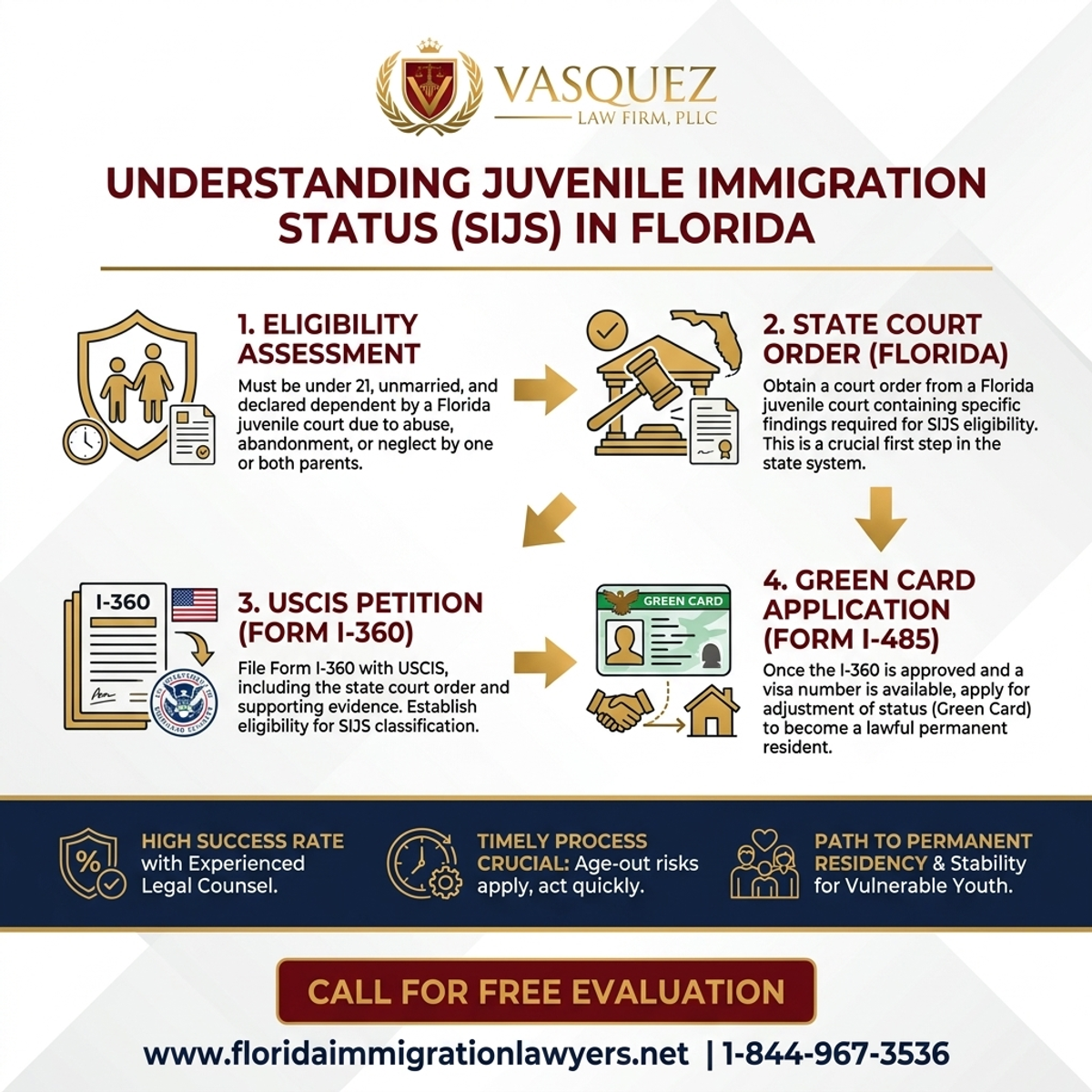
Step-by-Step Process — SIJS in Florida: Understanding Juvenile Immigration Status
Required Documents for SIJS Application
Gathering the correct and comprehensive set of documents is absolutely critical for a successful SIJS application. Any missing or incorrect documentation can lead to significant delays, Requests for Evidence (RFEs), or even denial of the petition. Thorough preparation in this phase can save immense time and stress down the line. Ensure you have the following, meticulously organized and prepared:
- State court order indicating eligibility for SIJS: This is the cornerstone of your application. It must contain specific findings from a Florida state court regarding abuse, neglect, or abandonment, and a determination that it's not in the child's best interest to return to their home country. Without this, the federal SIJS petition cannot be approved.
- Birth certificate or proof of age: Essential for verifying the applicant is under 21 and unmarried. If a birth certificate is unavailable, secondary evidence like baptismal records, school records, or affidavits may be accepted.
- Form I-360, Petition for Amerasian, Widow(er), or Special Immigrant: The primary federal petition. This form must be filled out accurately and completely, providing all requested information about the minor and their circumstances.
- Evidence of abuse, neglect, or abandonment: While the state court order makes the official findings, supporting evidence strengthens the case. This could include police reports, medical records, school records, affidavits from teachers or social workers, or any other documentation that corroborates the abuse, neglect, or abandonment.
- Form I-485, Application to Register Permanent Residence or Adjust Status: This form is for applying for the green card. It requires detailed personal information, immigration history, and often includes supplemental forms such as Form I-693 (medical examination) and Form I-765 (application for employment authorization, if desired).
- Proof of residency in Florida: While not explicitly required by federal SIJS law, demonstrating residency in Florida is crucial for establishing jurisdiction with the state juvenile court that issued the initial order. Documents like school enrollment records, utility bills in a caregiver's name, or affidavits of residency can serve this purpose.
Beyond these core documents, applicants will also need passport-style photographs, identity documents, and potentially other supporting affidavits. The complexity of these requirements underscores the importance of legal counsel. Florida Immigration Lawyers can help you meticulously gather, organize, and present all necessary documentation, ensuring your application is as robust as possible.
SIJS Timeline and Processing Expectations
Understanding the timeline for SIJS processing can significantly help manage expectations, as it is a multi-stage process involving both state and federal agencies. While the table below provides typical timeframes, it's crucial to remember that these are estimates. Actual processing times can vary widely based on individual circumstances, the specific court's caseload, USCIS workload fluctuations, and the completeness of the application. Patience and diligent follow-up are key throughout this journey.
| Stage | Typical Timeframe | Notes |
|---|---|---|
| State Court Order | 2-6 months | Dependent on court schedules, complexity of the case, and availability of judges and social workers. Expedited processing may be possible in some urgent situations. |
| Form I-360 Processing | 6-12 months | USCIS review period. This can be influenced by the service center processing the petition, the volume of applications, and whether a Request for Evidence (RFE) is issued. |
| I-485 Adjustment | 8-14 months | Based on USCIS workload, visa availability (though SIJS often has immediate availability), and whether an interview is required. Concurrent filing with I-360 can sometimes streamline this. |
Several factors can influence these timelines. For instance, the complexity of the minor's case in state court, including the need for extensive evidence or multiple hearings, can extend the initial phase. At the federal level, USCIS processing times are publicly available on their website but are subject to change. Issuance of an RFE means additional time for the applicant to respond and for USCIS to review the new evidence. Furthermore, while SIJS applicants generally do not face visa backlogs, there can still be administrative delays. Having an experienced immigration attorney from Florida Immigration Lawyers can help prepare for potential delays, respond promptly to USCIS requests, and advocate for your case, potentially shortening overall processing times where possible. They can also advise on applying for employment authorization (Form I-765) while waiting for I-485 approval, providing temporary work permission.
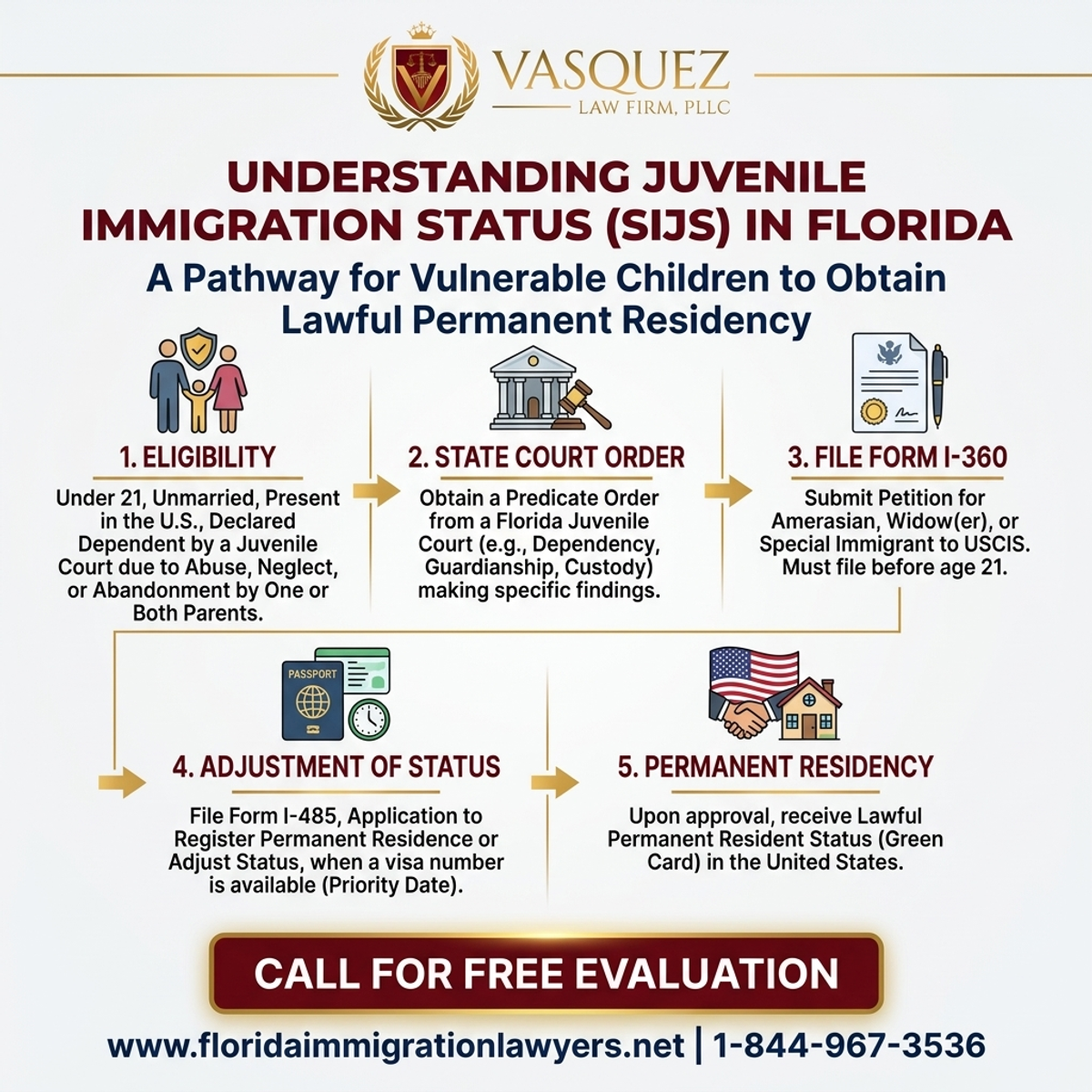
Key Statistics — SIJS in Florida: Understanding Juvenile Immigration Status
Cost Factors and Fee Breakdown for SIJS
While fees for filing forms can fluctuate, understanding potential costs helps significantly in financial planning for the SIJS process. It's important to differentiate between USCIS filing fees and potential legal assistance fees. Fortunately, SIJS applicants benefit from specific fee waivers that can reduce the financial burden, a testament to the humanitarian nature of this status. Here's a general overview:
| Item | Typical Fee | Notes |
|---|---|---|
| Form I-360, Petition for Amerasian, Widow(er), or Special Immigrant | None | The filing fee for Form I-360 is statutorily waived for SIJS applicants, making this crucial initial petition accessible regardless of financial means. |
| Form I-485, Application to Register Permanent Residence or Adjust Status | Varies | The fee for Form I-485 can be substantial. However, SIJS applicants may be eligible for a fee waiver (Form I-912) if they can demonstrate inability to pay, receive a means-tested benefit, or have an income at or below 150% of the federal poverty guidelines. Always check USCIS for the most current fees and eligibility for waivers. |
| Biometrics Services Fee | Included in I-485 fee or waived | This fee covers fingerprinting and background checks. It is typically included in the I-485 fee or can be waived if the I-485 fee is waived. |
| Form I-765, Application for Employment Authorization (Optional) | Varies/Waived | If applying for a work permit while waiting for I-485, there is a fee, but it can also be waived for SIJS applicants
Sources and References
|
Do Not Navigate This Process Alone
Our experienced immigration attorneys are ready to fight for you. Get a free, confidential consultation today.
Se Habla Español
Or leave your details and we’ll call you:
Free Evaluation in 24 Hours
Or talk to us right now

AI voice assistant — available 24/7
FreeFrequently Asked Questions

William J. Vásquez
Founding Attorney · Vasquez Law Firm
U.S. Air Force veteran and immigration attorney with years of hands-on U.S. immigration experience. J.D., NCCU School of Law. AILA member. Admitted to the 4th, 5th, and 11th Circuit Courts.
Available 24/7 - Free Evaluations
Reviewed for legal accuracy by William J. Vásquez
Licensed in North Carolina; U.S. immigration is federal practice.
Related Legal Services
Our Florida immigration attorneys can help you with business immigration, asylum protection and deportation defense. Call today at 1-844-967-3536 for a free consultation.
Related Links
Related Topics
Free Legal Consultation
Discuss your case with our experienced attorneys. We're available 24/7.
Se Habla Español - Estamos aquí para ayudarle.
Related Articles
Immigration Lawyer Orlando Free Consultation 2026
Discover how to find an immigration lawyer in Orlando offering a free consultation. Understand the services available and why choosing Florida Immigration Lawyers can make a difference in your case.
Military Naturalization Expedited in Florida Bases
Explore military naturalization options for families at Florida bases, including parole in place benefits in Miami. Learn how to expedite your application with expert guidance from Florida Immigration Lawyers.
Family Petitions for Citizenship in Florida: 2026 Guide
Securing a family petition and navigating the path to U.S. citizenship in Florida requires a thorough understanding of immigration laws and procedures. This comprehensive guide, updated for 2026, details the Form I-130 petition process, eligibility requirements for various family categories, and the critical documents needed. We explore the typical timelines and associated costs, highlighting the differences between immediate relative and family preference categories. Learn about the unique considerations for immigrants in Florida, including interactions with USCIS field offices in Tampa and Miami, and the role of immigration courts. This article also outlines common mistakes to avoid that can delay or jeopardize your case, such as incomplete documentation or failing to disclose vital information. Discover when it is essential to consult an experienced Florida immigration lawyer to ensure a smooth and successful journey for your loved ones. Florida Immigration Lawyers are dedicated to providing expert legal support for families across the state, offering free consultations to discuss your specific needs.
Re-Entry Permit (Form I-131) Guide for Florida Residents
A re-entry permit (Form I-131) is crucial for lawful permanent residents in Florida planning long-term travel abroad. Learn how to apply and avoid common pitfalls. Florida Immigration Lawyers offer free consultations to guide you through the process.