Child Status Protection Act (CSPA) Florida: Preventing 'Aging
Understand the Child Status Protection Act (CSPA) in Florida and how it prevents 'aging out' for derivative beneficiaries. Navigate complex immigration laws
Child Status Protection Act (CSPA) Florida: Preventing 'Aging Out' for Immigrant Children
For many families navigating the complex U.S. immigration system, the dream of a new life can be fraught with anxiety, especially when it comes to their children. A critical concern is the risk of a child "aging out" – turning 21 before their visa petition is processed, thereby losing their eligibility to immigrate as a derivative child under their parent's petition. This is where the Child Status Protection Act (CSPA) becomes a beacon of hope for countless families in Florida and across the nation.
The CSPA is a vital piece of legislation designed to protect certain children from losing their eligibility for immigration benefits due to administrative delays in the processing of their visa petitions. Without CSPA, many children would find themselves in an impossible situation, separated from their families and facing an entirely different, often more arduous, immigration path. Understanding the nuances of CSPA is paramount for any family in Florida seeking to secure their future in the United States. This comprehensive guide will delve into the intricacies of CSPA, its eligibility requirements, the critical calculation methods, and how experienced immigration attorneys can help you navigate this complex landscape.
What is the Child Status Protection Act (CSPA)?
Enacted in 2002, the Child Status Protection Act (CSPA) is a federal law designed to prevent children from "aging out" of eligibility for certain immigration benefits. Before CSPA, if a child turned 21 while their parent's visa petition was pending, they would often lose their status as a "child" for immigration purposes. This meant they could no longer immigrate with their parents as a derivative beneficiary, forcing them to pursue a separate, often much longer, immigration path, or even face deportation risks if already in the U.S. The CSPA effectively "freezes" a child's age for immigration purposes, allowing them to retain their child status despite turning 21, provided certain conditions are met.
How CSPA Prevents "Aging Out"
The core mechanism of CSPA involves a specific formula that calculates a child's "CSPA age." This CSPA age is determined by subtracting the amount of time an immigrant visa petition was pending from the child's actual age on the date an immigrant visa becomes available. If this calculated CSPA age is under 21, the child remains eligible to immigrate as a derivative beneficiary. This protection applies to various categories, including children of U.S. citizens, lawful permanent residents, and certain humanitarian programs. The intent is to ensure that bureaucratic delays do not unfairly penalize children who would otherwise qualify for immigration benefits.
Who Qualifies as a Derivative Beneficiary?
A derivative beneficiary is an individual who can immigrate to the U.S. based on their relationship to a primary beneficiary, typically a spouse or child. Under CSPA, a "child" is generally defined as an unmarried individual under 21 years of age. CSPA extends its protections to derivative children of family-sponsored preference petitions, employment-based preference petitions, Diversity Visa applicants, and certain asylum and refugee applicants. For example, if a parent is petitioning for a green card, their unmarried children under 21 can typically be included in the same petition as derivative beneficiaries. CSPA ensures that if these children turn 21 during the often lengthy processing period, they can still be considered "children" for immigration purposes.
Key Dates and Categories for CSPA Application
CSPA applies differently depending on the immigration category. For immediate relatives of U.S. citizens (unmarried children under 21), CSPA essentially freezes their age on the date the Form I-130 petition is filed. For family-sponsored and employment-based preference categories, the calculation is more complex, involving the visa availability date from the Visa Bulletin. It's crucial to understand these distinctions, as an error in identifying the correct date can lead to a miscalculation of CSPA age and potentially the loss of eligibility. The specific category under which a petition is filed dictates which CSPA provisions apply, making precise knowledge of immigration law essential.
CSPA Eligibility Requirements in Florida
While the CSPA provides broad protections, specific eligibility requirements must be met for a child to benefit from its provisions. These requirements can vary based on the type of visa petition and the relationship to the petitioner. Understanding these nuances is critical for families in Florida seeking to utilize CSPA effectively. Our immigration attorneys are well-versed in these requirements and can provide tailored advice.
Immediate Relatives vs. Preference Categories
The CSPA applies differently to "immediate relatives" of U.S. citizens compared to "preference categories." Immediate relatives include spouses, unmarried children under 21, and parents of U.S. citizens. For these beneficiaries, CSPA generally freezes their age on the date the Form I-130 petition is filed, provided the child remains unmarried. This is a significant advantage as there is no visa backlog for immediate relatives, meaning the "visa availability date" is essentially the petition filing date. This simplified calculation offers more straightforward protection against aging out.
For family-sponsored preference categories (e.g., unmarried sons and daughters of U.S. citizens, unmarried sons and daughters of LPRs, married sons and daughters of U.S. citizens, brothers and sisters of U.S. citizens) and employment-based preference categories, the CSPA calculation is more intricate. Here, the child's CSPA age is calculated by taking their age on the date the visa becomes available (per the Visa Bulletin) and subtracting the time the visa petition was pending with USCIS. This distinction is vital because preference categories often face significant visa backlogs, making the calculation date much later than the initial filing date.
The "One Year Rule" for CSPA Protection
A critical, often overlooked, requirement for many CSPA beneficiaries in preference categories is the "one year rule." To benefit from CSPA, the child must "seek to acquire" lawful permanent resident (LPR) status within one year of a visa becoming available. "Seeking to acquire" usually means filing Form I-485 (Application to Register Permanent Residence or Adjust Status) if adjusting status within the U.S., or applying for an immigrant visa at a U.S. consulate abroad. Failure to meet this one-year deadline can result in the loss of CSPA protection, even if the child's calculated CSPA age is under 21. This rule underscores the importance of timely action and diligent monitoring of the Visa Bulletin and case status. Our legal team can help ensure all deadlines are met.
Calculating Your CSPA Age: A Step-by-Step Guide
Accurately calculating a child's CSPA age is the cornerstone of determining eligibility. This process can be complex, especially for preference categories, and even a small error can have significant consequences. Understanding the formula and the dates involved is crucial for families in Florida. This section provides a detailed breakdown to help you navigate this critical calculation.
The fundamental CSPA age calculation formula is:
CSPA Age = (Age on Visa Availability Date) - (Time Petition Was Pending)
Step 1: Determine the Visa Availability Date
For family-sponsored and employment-based preference categories, the "visa availability date" is the date when an immigrant visa becomes available for the child's specific preference category and country of chargeability. This date is found in the monthly Visa Bulletin published by the U.S. Department of State. You must look at the "Final Action Dates" chart or, in some cases, the "Dates for Filing" chart, depending on USCIS guidance for that month. It's important to note that this date can move forward or backward, so continuous monitoring is necessary.
For immediate relatives of U.S. citizens, the visa is always considered immediately available. Therefore, the "visa availability date" is simply the date the Form I-130 petition was filed with USCIS.
Step 2: Calculate the Time the Petition Was Pending
The "time the petition was pending" refers to the period from the date the immigrant visa petition (e.g., Form I-130, I-140, I-360) was filed with USCIS until the date it was approved by USCIS. This period is typically measured in days, months, and years. You will need the "Receipt Date" and "Approval Date" from your USCIS notices (e.g., Form I-797C, Notice of Action).
Example: If a petition was filed on January 1, 2015, and approved on January 1, 2017, the pending time is exactly two years.
Step 3: Perform the CSPA Age Calculation
Once you have these two figures, subtract the "time the petition was pending" from the child's actual age on the "visa availability date."
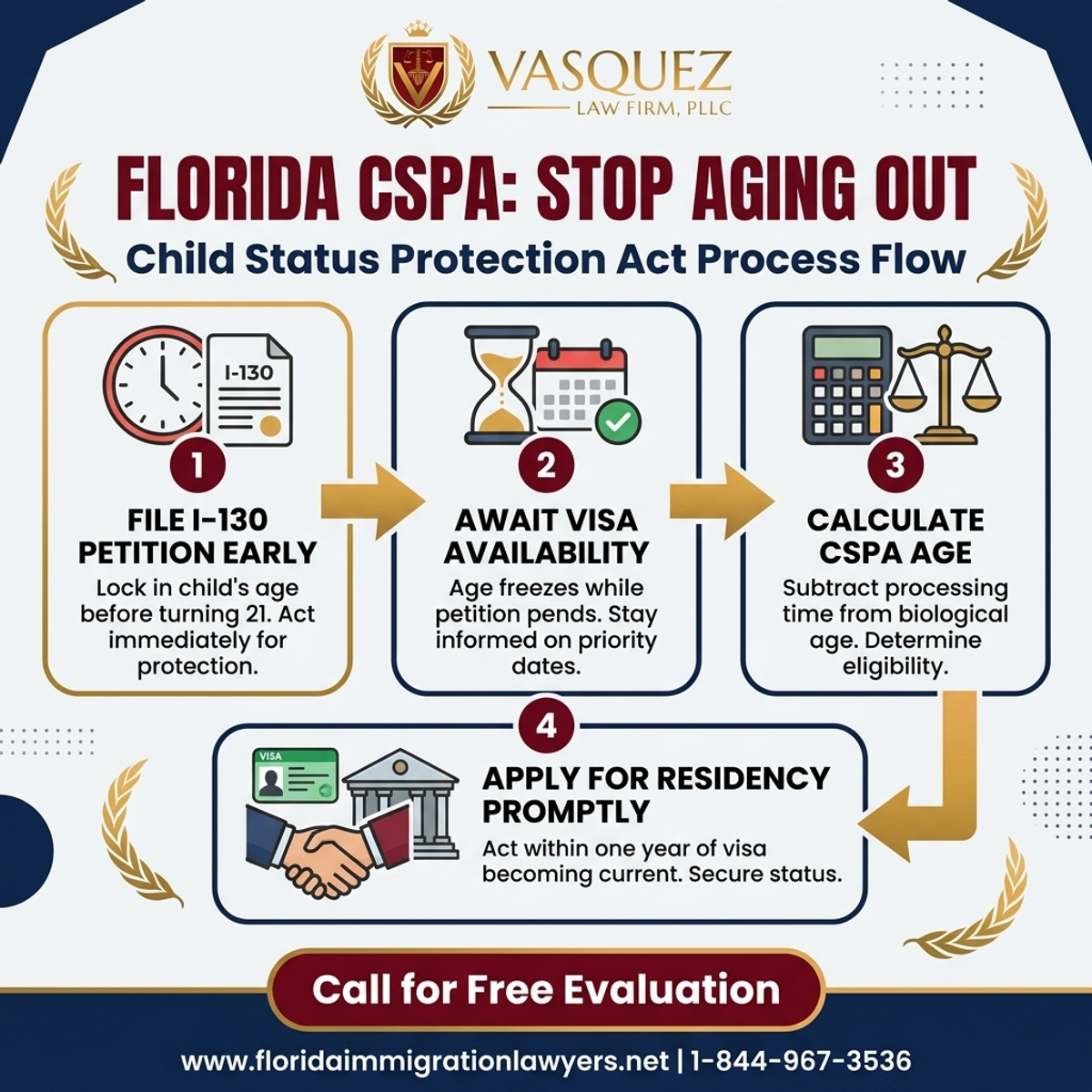
Step-by-Step Process — Child Status Protection Act (CSPA) Florida: Preventing 'Aging Out' for Immigrant Children
Example Scenario:
- Child's Birthday: March 15, 2000
- I-130 Petition Filed: January 1, 2015
- I-130 Petition Approved: January 1, 2017 (Pending time: 2 years)
- Visa Becomes Available (per Visa Bulletin): September 1, 2021
First, determine the child's age on the visa availability date (September 1, 2021):
- Child's age on Sept 1, 2021 = 21 years, 5 months, 17 days (from March 15, 2000)
Now, apply the CSPA formula:
- CSPA Age = (21 years, 5 months, 17 days) - (2 years)
- CSPA Age = 19 years, 5 months, 17 days
In this example, since the calculated CSPA age (19 years, 5 months, 17 days) is under 21, the child is protected by CSPA and remains eligible as a derivative beneficiary, assuming the "one year rule" is also met. This detailed calculation highlights why professional guidance is often invaluable to avoid errors.
Common CSPA Challenges and Pitfalls
While CSPA offers a critical safeguard, navigating its provisions is not without challenges. Many families encounter common pitfalls that can jeopardize their eligibility. Being aware of these issues can help in proactive planning and seeking timely legal assistance.
Miscalculating CSPA Age
One of the most frequent errors is an incorrect calculation of the CSPA age. This can stem from using the wrong visa availability date (e.g., confusing "Dates for Filing" with "Final Action Dates"), miscalculating the petition's pending time, or simply making a mathematical mistake. Because the difference of even a few days can determine eligibility, precision is paramount. Furthermore, the CSPA age is calculated at the moment the visa becomes available, which means that if the Visa Bulletin retrogresses (moves backward), a child who was previously protected might suddenly age out if a new calculation is not performed.
Missing the "One Year Rule"
As discussed, the requirement to "seek to acquire" LPR status within one year of visa availability is a common trap. Families, especially those without legal representation, might not be aware of this strict deadline or might misinterpret what "seeking to acquire" entails. Delays in receiving notifications from USCIS or the National Visa Center (NVC), or simply not understanding the urgency, can lead to missing this crucial window, resulting in the loss of CSPA protection. This is particularly true for individuals applying through consular processing abroad.
Changes in Immigration Law and Policy
Immigration law is dynamic, with policies and interpretations subject to change. New guidance from USCIS or decisions from the Board of Immigration Appeals (BIA) can impact how CSPA is applied. Staying updated on these changes is challenging for laypersons. For instance, there have been various interpretations over the years regarding what constitutes "seeking to acquire" and how to handle cases where the Visa Bulletin retrogresses. Relying on outdated information or advice can lead to adverse outcomes.
Seeking Legal Guidance for CSPA Cases in Florida
Given the complexities of the Child Status Protection Act, particularly the precise calculations and strict deadlines, securing experienced legal representation is not just beneficial but often essential. An immigration attorney specializing in CSPA can provide invaluable assistance to families in Florida, ensuring that every step is taken correctly and promptly.
Our attorneys possess a deep understanding of CSPA provisions and their application to various immigration categories. We can accurately calculate your child's CSPA age, monitor the Visa Bulletin for availability dates, and ensure that all necessary forms are filed within the critical one-year window. We also stay abreast of the latest policy changes from USCIS and the Department of State, providing you with the most current and accurate advice.
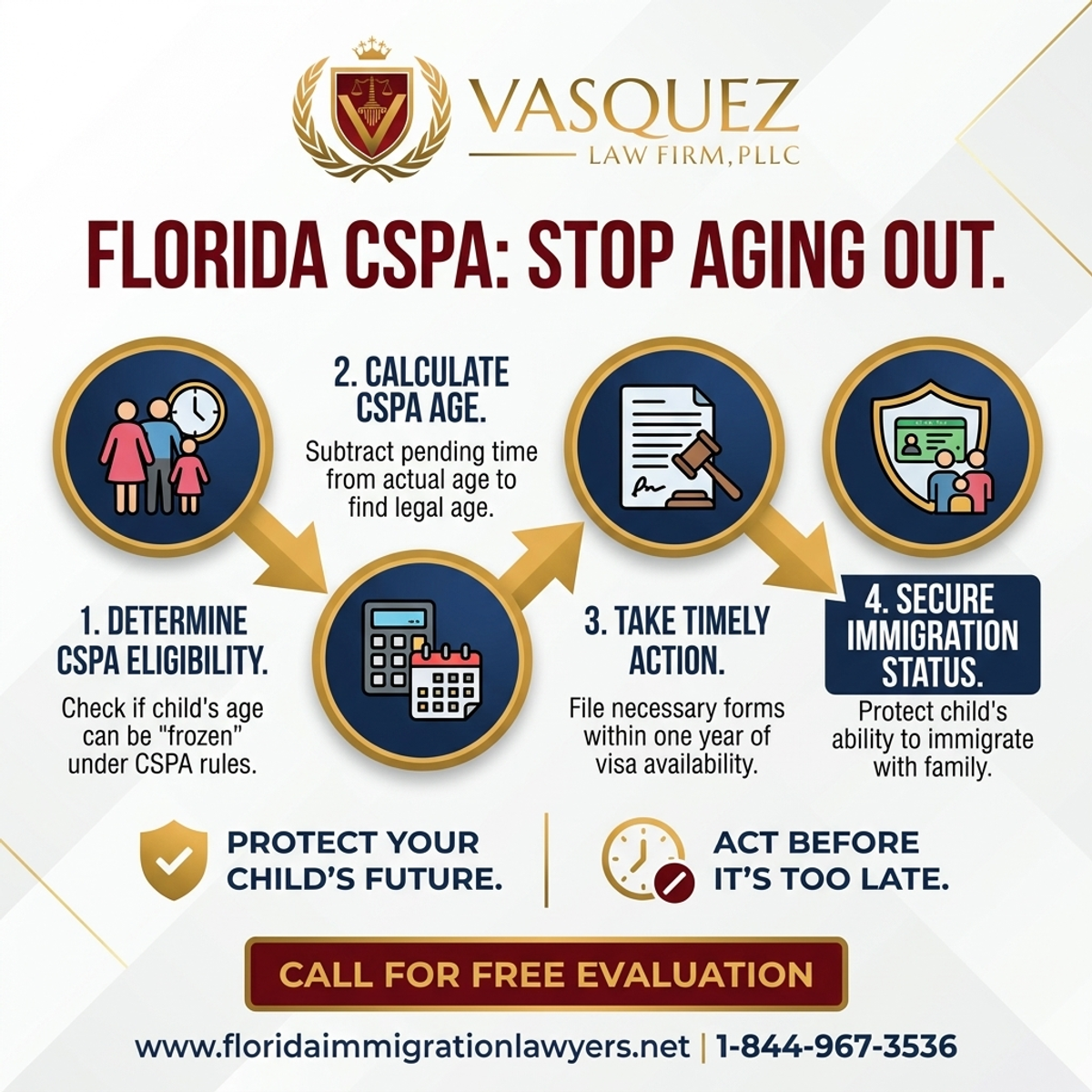
Key Statistics — Child Status Protection Act (CSPA) Florida: Preventing 'Aging Out' for Immigrant Children
Beyond calculations and deadlines, an attorney can represent you in communications with USCIS and the NVC, respond to Requests for Evidence (RFEs), and address any unforeseen issues that may arise during the process. If a CSPA claim is initially denied, an attorney can help appeal the decision or explore other avenues for relief. Don't let the dream of keeping your family together be shattered by a technicality. Contact us today for a consultation to discuss your specific CSPA case and protect your child's future.
Conclusion
The Child Status Protection Act is a critical safeguard for immigrant children, preventing them from "aging out" due to the often lengthy processing times of U.S. immigration petitions. For families in Florida, understanding CSPA's eligibility requirements, the intricate age calculation formula, and the crucial "one year rule" is paramount. While the Act offers significant protection, its complexities demand meticulous attention to detail and timely action. Miscalculations or missed deadlines can lead to devastating consequences, potentially separating families and forcing children onto much longer and more uncertain immigration paths. By seeking the guidance of experienced immigration attorneys, families can navigate these challenges with confidence, ensuring that their children remain eligible for the immigration benefits they deserve and securing their future together in the United States.
Do Not Navigate This Process Alone
Our experienced immigration attorneys are ready to fight for you. Get a free, confidential case review today.
Se Habla Español
Or leave your details and we’ll call you:
Free Evaluation in 24 Hours
Or talk to us right now

AI voice assistant — available 24/7
Free
William J. Vásquez
Founding Attorney · Vasquez Law Firm
U.S. Air Force veteran and immigration attorney with years of hands-on U.S. immigration experience. J.D., NCCU School of Law. AILA member. Admitted to the 4th, 5th, and 11th Circuit Courts.
Available 24/7 - Free Evaluations
Reviewed for legal accuracy by William J. Vásquez
Licensed in North Carolina; U.S. immigration is federal practice.
Related Legal Services
Our Florida immigration attorneys can help you with deportation defense, family immigration services and immigration lawyer cost in Florida. Call today at 1-844-YO-PELEO for a free case review.
Related Links
Related Topics
Free Legal Case Review
Discuss your case with our experienced attorneys. We're available 24/7.
Se Habla Español - Estamos aquí para ayudarle.
Related Articles
Immigration Lawyer Orlando Free Consultation in Florida
For individuals and families in Orlando, Florida, navigating the complexities of U.S. immigration law requires expert guidance. An immigration lawyer in Orlando offers crucial support for everything from visa applications and green card processes to naturalization and deportation defense. This comprehensive guide details what a free consultation covers, providing a step-by-step overview of immigration pathways, essential document checklists, and expected timelines in 2026. We also highlight common mistakes to avoid, discuss the critical role of legal counsel in deportation and asylum cases, and explain why choosing a local Orlando immigration attorney is beneficial. Florida Immigration Lawyers is dedicated to serving the diverse community of Orlando with compassionate, effective legal solutions, ensuring you receive personalized advice and robust representation for a successful immigration journey.
EAD Advance Parole Combo Card in Florida 2026
For individuals with a pending Form I-485, Application to Register Permanent Residence or Adjust Status, the EAD Advance Parole Combo Card is an essential document. This single card combines the authorization to work legally in the U.S. (Employment Authorization Document - EAD) with permission to travel internationally and re-enter without abandoning your green card application (Advance Parole). This guide from Florida Immigration Lawyers provides a comprehensive overview for applicants in Florida in 2026, covering eligibility, the step-by-step application process, required documents, expected processing times, and associated costs. We also highlight common mistakes to avoid and when to seek legal counsel to ensure a smooth and successful immigration journey. Understanding this vital card is key to maintaining stability while awaiting your permanent residency approval.
Immigration Court Proceedings in Florida: A 2026 Guide
Facing immigration court proceedings in Florida can be daunting. This guide covers everything from the role of immigration judges to the impact of recent policy changes. Whether you're facing removal proceedings or seeking to understand the EOIR's role, this article provides crucial insights.
Immigration Lawyer Orlando Florida: Your 2026 Guide
For those in Orlando, Florida, navigating the complexities of U.S. immigration law demands expert legal assistance. This guide details why hiring an immigration lawyer is crucial, covering essential services like family visas, deportation defense, asylum claims, and naturalization. We provide insights into choosing the right attorney in Orange County, a step-by-step guide for family-based immigration, and a breakdown of associated costs and timelines for 2026. Learn to avoid common pitfalls and understand when professional legal help is indispensable to secure a positive outcome for your immigration case. Florida Immigration Lawyers offers comprehensive support for clients throughout Florida, providing personalized guidance and strong representation.