Ley de Protección del Estado del Niño (CSPA) en Florida: Prevención del 'envejecimiento'
Entienda la Ley de Protección del Estado del Niño (CSPA) en Florida y cómo previene el 'envejecimiento' para los beneficiarios derivados. Navegue por complejas leyes de inmigración.
La Ley de Protección del Estado de los Niños (CSPA) en Florida: Previniendo el 'Cumplimiento de Edad' para Niños Inmigrantes
Para muchas familias que navegan por el complejo sistema de inmigración de EE. UU., el sueño de una nueva vida puede estar lleno de ansiedad, especialmente cuando se trata de sus hijos. Una preocupación crítica es el riesgo de que un niño "cumpla 21 años" antes de que se procese su petición de visa, perdiendo así su elegibilidad para inmigrar como hijo derivativo bajo la petición de sus padres. Aquí es donde la Ley de Protección del Estado de los Niños (CSPA) se convierte en un faro de esperanza para innumerables familias en Florida y en todo el país.
La CSPA es una pieza vital de legislación diseñada para proteger a ciertos niños de perder su elegibilidad para beneficios migratorios debido a retrasos administrativos en el procesamiento de sus peticiones de visa. Sin la CSPA, muchos niños se encontrarían en una situación imposible, separados de sus familias y enfrentándose a un camino migratorio completamente diferente, a menudo más arduo. Entender las complejidades de la CSPA es fundamental para cualquier familia en Florida que busque asegurar su futuro en los Estados Unidos. Esta guía integral se adentrará en las intricacias de la CSPA, sus requisitos de elegibilidad, los métodos de cálculo críticos, y cómo los abogados de inmigración pueden ayudarle a navegar este panorama complejo.
¿Qué es la Ley de Protección del Estado de los Niños (CSPA)?
Promulgada en 2002, la Ley de Protección del Estado de los Niños (CSPA) es una ley federal diseñada para prevenir que los niños "cumplan 21 años" y pierdan así la elegibilidad para ciertos beneficios migratorios. Antes de la CSPA, si un niño cumplía 21 años mientras la petición de visa de sus padres estaba pendiente, a menudo perdía su estatus como "niño" para propósitos migratorios. Esto significaba que ya no podrían inmigrar con sus padres como beneficiarios derivados, obligándolos a seguir un camino migratorio separado, a menudo mucho más largo, o incluso enfrentar risgos de deportación si ya estaban en EE. UU. La CSPA efectivamente "congela" la edad de un niño para propósitos migratorios, permitiéndoles mantener su estatus de niño a pesar de cumplir 21 años, siempre que se cumplan ciertas condiciones.
Cómo la CSPA Previene el "Cumplimiento de Edad"
El mecanismo central de la CSPA implica una fórmula específica que calcula la "edad CSPA" de un niño. Esta edad CSPA se determina restando el tiempo que una petición de visa de inmigrante estuvo pendiente de la edad real del niño en la fecha en que una visa de inmigrante se hace disponible. Si esta edad CSPA calculada es menor de 21 años, el niño sigue siendo elegible para inmigrar como beneficiario derivativo. Esta protección se aplica a varias categorías, incluyendo a los hijos de ciudadanos estadounidenses, residentes permanentes legales, y ciertos programas humanitarios. La intención es asegurar que los retrasos burocráticos no penalicen injustamente a los niños que, de otro modo, calificarían para beneficios migratorios.
¿Quién Califica como Beneficiario Derivativo?
Un beneficiario derivativo es una persona que puede inmigrar a EE. UU. en base a su relación con un beneficiario principal, típicamente un cónyuge o un hijo. Bajo la CSPA, un "niño" se define generalmente como un individuo soltero menor de 21 años. La CSPA extiende sus protecciones a los hijos derivados de peticiones de preferencia patrocinadas por familiares, peticiones de preferencia basadas en el empleo, solicitantes de visas de diversidad, y ciertos solicitantes de asilo y refugiados. Por ejemplo, si un padre está solicitando una tarjeta verde, sus hijos solteros menores de 21 años pueden ser incluidos típicamente en la misma petición como beneficiarios derivados. La CSPA asegura que si estos niños cumplen 21 años durante el proceso, que a menudo es largo, aún puedan ser considerados "niños" para propósitos migratorios.
Fechas Clave y Categorías para la Aplicación de la CSPA
La CSPA se aplica de manera diferente dependiendo de la categoría de inmigración. Para los familiares inmediatos de ciudadanos estadounidenses (hijos solteros menores de 21 años), la CSPA congela esencialmente su edad en la fecha en que se presenta la petición del Formulario I-130. Para las categorías de preferencia patrocinadas por familiares y basadas en empleo, el cálculo es más complejo, involucrando la fecha de disponibilidad de visa del Boletín de Visas. Es crucial entender estas distinciones, ya que un error en la identificación de la fecha correcta puede llevar a un cálculo erróneo de la edad CSPA y potencialmente a la pérdida de elegibilidad. La categoría específica bajo la cual se presenta una petición dicta qué disposiciones de la CSPA se aplican, lo que hace esencial el conocimiento preciso de la ley de inmigración.
Requisitos de Elegibilidad de la CSPA en Florida
Aunque la CSPA ofrece amplias protecciones, se deben cumplir requisitos de elegibilidad específicos para que un niño se beneficie de sus disposiciones. Estos requisitos pueden variar según el tipo de petición de visa y la relación con el peticionario. Entender estas complejidades es crítico para las familias en Florida que buscan utilizar la CSPA de manera efectiva. Nuestros abogados de inmigración están bien versados en estos requisitos y pueden proporcionar asesoría personalizada.
Relativos Inmediatos vs. Categorías de Preferencia
La CSPA se aplica de manera diferente a los "relativos inmediatos" de ciudadanos estadounidenses en comparación con las "categorías de preferencia." Los familiares inmediatos incluyen a cónyuges, hijos solteros menores de 21 años, y padres de ciudadanos estadounidenses. Para estos beneficiarios, la CSPA generalmente congela su edad en la fecha en que se presenta la petición del Formulario I-130, siempre que el niño permanezca soltero. Esta es una ventaja significativa ya que no hay acumulación de visas para familiares inmediatos, lo que significa que la "fecha de disponibilidad de visa" es esencialmente la fecha de presentación de la petición. Este cálculo simplificado ofrece una protección más directa contra el cumplimiento de edad.
Para las categorías de preferencia patrocinadas por familiares (por ejemplo, hijos e hijas solteros de ciudadanos estadounidenses, hijos e hijas solteros de residentes permanentes legales, hijos e hijas casados de ciudadanos estadounidenses, hermanos y hermanas de ciudadanos estadounidenses) y las categorías de preferencia basadas en empleo, el cálculo del CSPA es más complicado. Aquí, la edad del niño según el CSPA se calcula tomando su edad en la fecha en que la visa se vuelve disponible (según el Boletín de Visas) y restando el tiempo que la petición de visa estuvo pendiente con USCIS. Esta distinción es vital porque las categorías de preferencia a menudo enfrentan importantes atrasos en las visas, haciendo que la fecha de cálculo sea mucho más tarde que la fecha de presentación inicial.
La "Regla del Año" para la Protección del CSPA
Un requisito crítico, a menudo pasado por alto, para muchos beneficiarios del CSPA en categorías de preferencia es la "regla del año." Para beneficiarse del CSPA, el niño debe "buscar adquirir" estatus de residente permanente legal (LPR) dentro de un año de que una visa se vuelva disponible. "Buscar adquirir" generalmente significa presentar el Formulario I-485 (Solicitud de Registro de Residencia Permanente o Ajuste de Estatus) si se ajusta el estatus dentro de EE. UU., o solicitar una visa de inmigrante en un consulado de EE. UU. en el extranjero. No cumplir con este plazo de un año puede resultar en la pérdida de la protección del CSPA, incluso si la edad calculada del CSPA del niño es menor de 21 años. Esta regla subraya la importancia de actuar a tiempo y monitorear diligentemente el Boletín de Visas y el estado del caso. Nuestro equipo legal puede ayudar a garantizar que se cumplan todos los plazos.
Cálculo de Su Edad CSPA: Una Guía Paso a Paso
Calcular con precisión la edad CSPA de un niño es la piedra angular para determinar la elegibilidad. Este proceso puede ser complejo, especialmente para las categorías de preferencia, y hasta un pequeño error puede tener consecuencias significativas. Entender la fórmula y las fechas involucradas es crucial para las familias en Florida. Esta sección proporciona un desglose detallado para ayudarle a navegar este cálculo crítico.
La fórmula fundamental de cálculo de edad CSPA es:
Edad CSPA = (Edad en la Fecha de Disponibilidad de Visa) - (Tiempo que la Petición Estuvo Pendiente)
Paso 1: Determinar la Fecha de Disponibilidad de Visa
Para las categorías de preferencia patrocinadas por familiares y basadas en empleo, la "fecha de disponibilidad de visa" es la fecha en que una visa de inmigrante se vuelve disponible para la categoría de preferencia específica del niño y el país de carga. Esta fecha se encuentra en el Boletín de Visas publicado por el Departamento de Estado de EE. UU. Debe consultar el gráfico de "Fechas de Acción Final" o, en algunos casos, el gráfico de "Fechas para Presentar", según la guía de USCIS para ese mes. Es importante notar que esta fecha puede adelantarse o atrasarse, por lo que es necesario un monitoreo continuo.
Para los familiares inmediatos de ciudadanos estadounidenses, la visa siempre se considera inmediatamente disponible. Por lo tanto, la "fecha de disponibilidad de visa" es simplemente la fecha en que se presentó la petición del Formulario I-130 ante USCIS.
Paso 2: Calcular el Tiempo que la Petición Estuvo Pendiente
El "tiempo que la petición estuvo pendiente" se refiere al período desde la fecha en que se presentó la petición de visa de inmigrante (por ejemplo, Formulario I-130, I-140, I-360) ante USCIS hasta la fecha en que fue aprobada por USCIS. Este período generalmente se mide en días, meses y años. Necesitará la "Fecha de Recepción" y la "Fecha de Aprobación" de sus avisos de USCIS (por ejemplo, Formulario I-797C, Aviso de Acción).
Ejemplo: Si una petición fue presentada el 1 de enero de 2015 y aprobada el 1 de enero de 2017, el tiempo pendiente es exactamente de dos años.
Paso 3: Realizar el Cálculo de la Edad CSPA
Una vez que tenga estas dos cifras, reste el "tiempo que la petición estuvo pendiente" de la edad actual del niño en la "fecha de disponibilidad de visa."
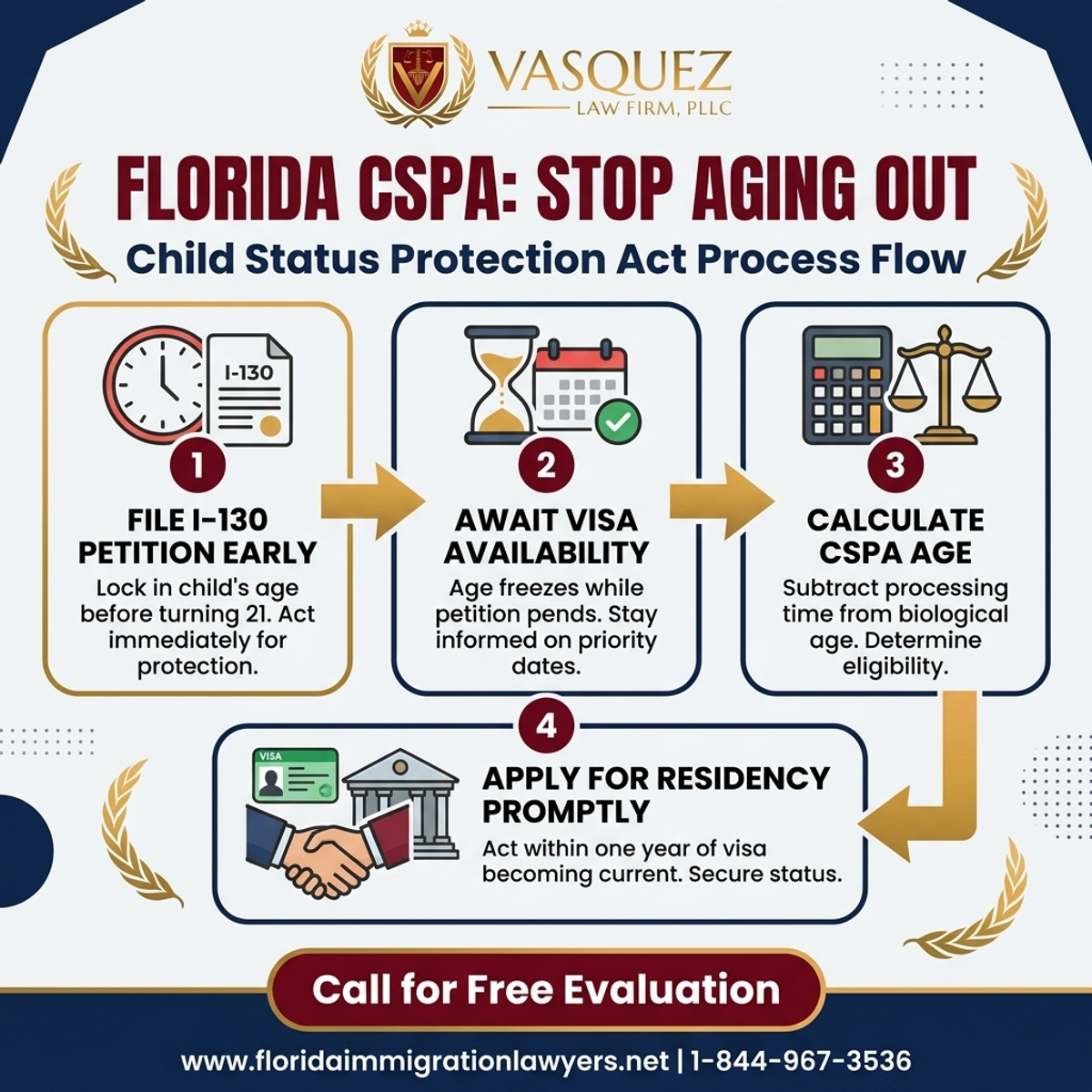
Proceso Paso a Paso — Ley de Protección del Estatus Infantil (CSPA) en Florida: Previniendo la 'Edad de Salida' para Niños Inmigrantes
Escenario Ejemplo:
- Cumpleaños del Niño: 15 de marzo de 2000
- Petición I-130 Presentada: 1 de enero de 2015
- Petición I-130 Aprobada: 1 de enero de 2017 (Tiempo pendiente: 2 años)
- Visa se Vuelve Disponible (según el Boletín de Visas): 1 de septiembre de 2021
Primero, determine la edad del niño en la fecha de disponibilidad de visa (1 de septiembre de 2021):
- Edad del niño el 1 de septiembre de 2021 = 21 años, 5 meses, 17 días (desde el 15 de marzo de 2000)
Ahora, aplique la fórmula CSPA:
- Edad CSPA = (21 años, 5 meses, 17 días) - (2 años)
- Edad CSPA = 19 años, 5 meses, 17 días
En este ejemplo, dado que la edad CSPA calculada (19 años, 5 meses, 17 días) es menor de 21, el niño está protegido por el CSPA y sigue siendo elegible como beneficiario derivado, suponiendo que también se cumpla la "regla del año". Este cálculo detallado resalta por qué la orientación legal suele ser invaluable para evitar errores.
Desafíos y Errores Comunes del CSPA
Si bien la CSPA ofrece una salvaguarda crítica, navegar por sus disposiciones no está exento de desafíos. Muchas familias enfrentan errores comunes que pueden poner en peligro su elegibilidad. Estar conscientes de estos problemas puede ayudar en la planificación proactiva y en la búsqueda de asistencia legal a tiempo.
Cálculo Erróneo de la Edad según la CSPA
Uno de los errores más frecuentes es un cálculo incorrecto de la edad según la CSPA. Esto puede deberse a usar la fecha de disponibilidad de visa equivocada (por ejemplo, confundir las "Fechas para Solicitar" con las "Fechas de Acción Final"), a un incorrecto cálculo del tiempo en espera de la petición, o simplemente a un error matemático. Dado que la diferencia de incluso unos pocos días puede determinar la elegibilidad, la precisión es primordial. Además, la edad según la CSPA se calcula en el momento en que la visa se vuelve disponible, lo que significa que si el Boletín de Visas retrocede (se mueve hacia atrás), un niño que previamente estaba protegido podría dejar de calificar si no se realiza un nuevo cálculo.
Olvidar la "Regla del Año"
Como se ha discutido, el requisito de "buscar adquirir" el estatus de LPR dentro de un año de la disponibilidad de la visa es una trampa común. Las familias, especialmente aquellas sin representación legal, pueden no estar al tanto de este estricto plazo o pueden interpretar incorrectamente lo que significa "buscar adquirir". Los retrasos en la recepción de notificaciones de USCIS o del Centro Nacional de Visas (NVC), o simplemente no entender la urgencia, pueden llevar a perder esta ventana crucial, resultando en la pérdida de la protección de la CSPA. Esto es particularmente cierto para individuos que aplican a través de un proceso consular en el exterior.
Cambios en la Ley y Política de Inmigración
La ley de inmigración es dinámica, con políticas e interpretaciones sujetas a cambios. Nuevas orientaciones de USCIS o decisiones de la Junta de Apelaciones de Inmigración (BIA) pueden impactar cómo se aplica la CSPA. Mantenerse actualizado sobre estos cambios es un desafío para las personas sin experiencia legal. Por ejemplo, ha habido varias interpretaciones a lo largo de los años sobre lo que constituye "buscar adquirir" y cómo manejar los casos donde el Boletín de Visas retrocede. Confiar en información o consejos desactualizados puede llevar a resultados adversos.
Buscando Orientación Legal para Casos de CSPA en Florida
Dadas las complejidades de la Ley de Protección de Estado de los Niños, particularmente los cálculos precisos y plazos estrictos, asegurar representación legal experimentada no solo es beneficioso, sino a menudo esencial. Un abogado de inmigración que maneje casos de CSPA puede proporcionar una asistencia invaluable a las familias en Florida, asegurando que cada paso se realice de manera correcta y oportuna.
Nuestros abogados poseen un profundo conocimiento de las disposiciones de la CSPA y su aplicación a varias categorías de inmigración. Podemos calcular con precisión la edad según la CSPA de su hijo, monitorear el Boletín de Visas para las fechas de disponibilidad, y asegurarnos de que todos los formularios necesarios se presenten dentro de la ventana crítica de un año. También nos mantenemos al tanto de los últimos cambios de política de USCIS y del Departamento de Estado, brindándole el asesoramiento más actual y preciso.
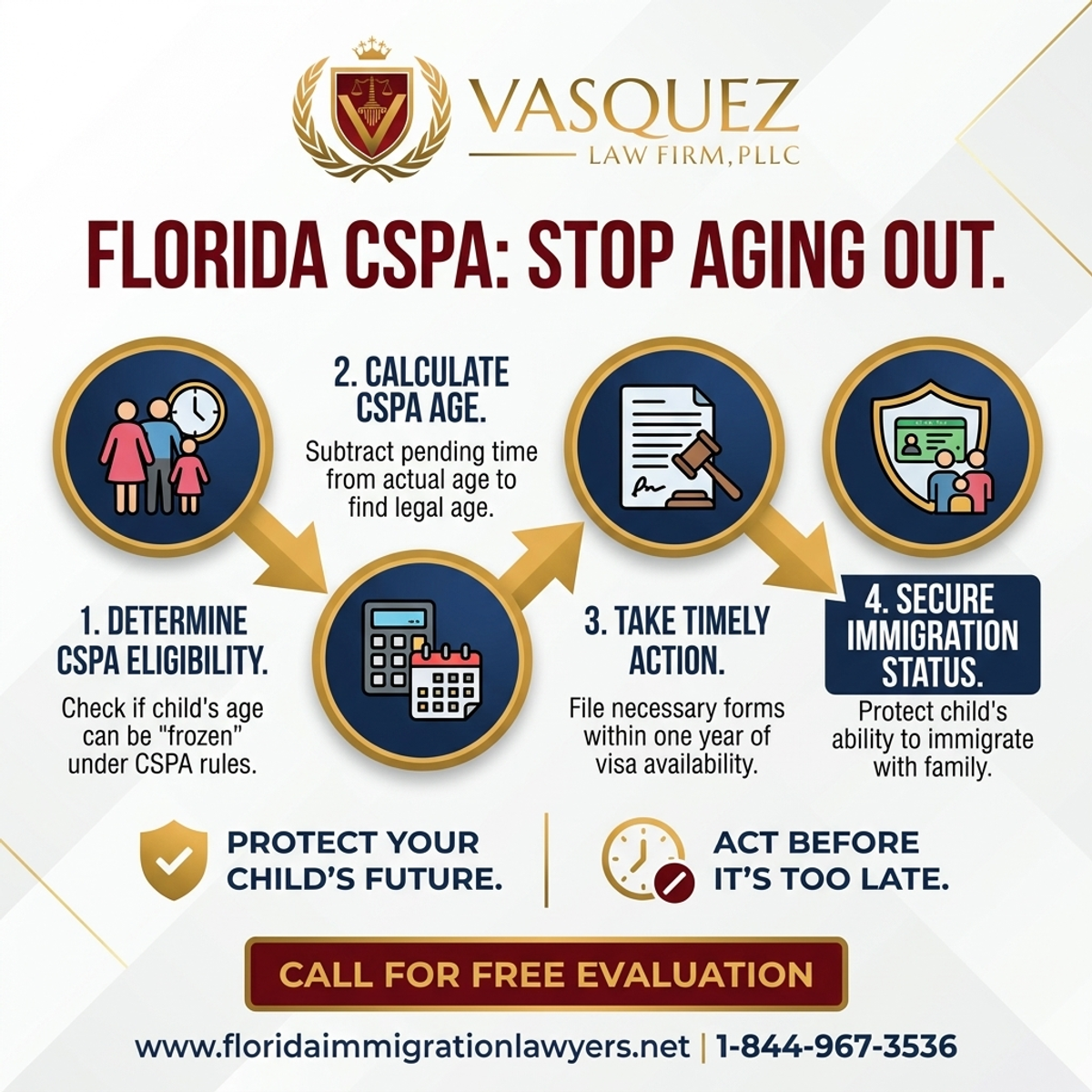
Estadísticas Clave — Ley de Protección de Estado de los Niños (CSPA) Florida: Previniendo el 'Envejecimiento' de Niños Inmigrantes
Más allá de los cálculos y plazos, un abogado puede representarlo en las comunicaciones con USCIS y el NVC, responder a las Solicitudes de Evidencia (RFEs) y abordar cualquier problema imprevisto que pueda surgir durante el proceso. Si una reclamación de CSPA es inicialmente denegada, un abogado puede ayudar a apelar la decisión o explorar otras vías de alivio. No deje que el sueño de mantener a su familia unida se vea afectado por un tecnicismo. Contáctenos hoy para una consulta y discutir su caso específico de CSPA y proteger el futuro de su hijo.
No Navegue Este Proceso Solo
Nuestros abogados de inmigración con experiencia están listos para luchar por usted. Obtenga una evaluación gratis de su caso y confidencial hoy.
We Speak English
O deje sus datos y le llamamos:
Evaluación Gratis en 24 Horas
O hable con nosotros ahora

Asistente de voz IA — disponible 24/7
Gratis
William J. Vásquez
Abogado Fundador · Vasquez Law Firm
Veterano de la Fuerza Aérea de EE.UU. y abogado de inmigración con años de experiencia práctica en inmigración de EE.UU. J.D., NCCU School of Law. Miembro de AILA. Admitido en los Circuitos 4.º, 5.º y 11.º.
Disponible 24/7 - Evaluaciones Gratis de su Caso
Revisado para exactitud legal por William J. Vásquez
Con licencia en Carolina del Norte; la inmigración a EE.UU. es una práctica federal.
Servicios legales relacionados
Nuestros abogados de inmigración en Florida pueden ayudarle con costo de un abogado de inmigración, áreas de práctica de inmigración y servicios de inmigración familiar. Llame hoy al 1-844-YO-PELEO para una evaluación gratis de su caso.
Enlaces Relacionados
Temas Relacionados
Evaluación Legal Gratis de su Caso
Discuta su caso con nuestros abogados experimentados. Estamos disponibles 24/7.
Artículos Relacionados
Abogado de Inmigración Orlando Consulta Gratuita en Florida
Abogado de Inmigración en Orlando, Florida. Consulta gratuita para visas, tarjetas verdes, ciudadanía, asilo y defensa de deportación. Asesoría legal
Tarjeta Combo EAD y Advance Parole en Florida 2026
Para las personas con un Formulario I-485, Solicitud para Registrar Residencia Permanente o Ajustar Estatus, pendiente, la Tarjeta Combo EAD y Advance Parole es un documento esencial. Esta tarjeta única combina la autorización para trabajar legalmente en EE. UU. (Documento de Autorización de Empleo - EAD) con el permiso para viajar internacionalmente y reingresar sin abandonar su solicitud de tarjeta verde (Advance Parole). Esta guía de Florida Immigration Lawyers proporciona una visión general completa para los solicitantes en Florida en 2026, cubriendo la elegibilidad, el proceso de solicitud paso a paso, los documentos requeridos, los tiempos de procesamiento esperados y los costos asociados. También destacamos los errores comunes a evitar y cuándo buscar asesoramiento legal para asegurar un viaje de inmigración sin problemas y exitoso.
Abogado de Inmigración en el Suroeste de Florida: Lo que
Descubra cómo un abogado de inmigración en el suroeste de Florida puede ayudarle a navegar procesos de inmigración complejos. Aprenda sobre costos, tiempos y errores comunes a evitar. Llame a Florida Immigration Lawyers para una revisión gratuita de su caso.