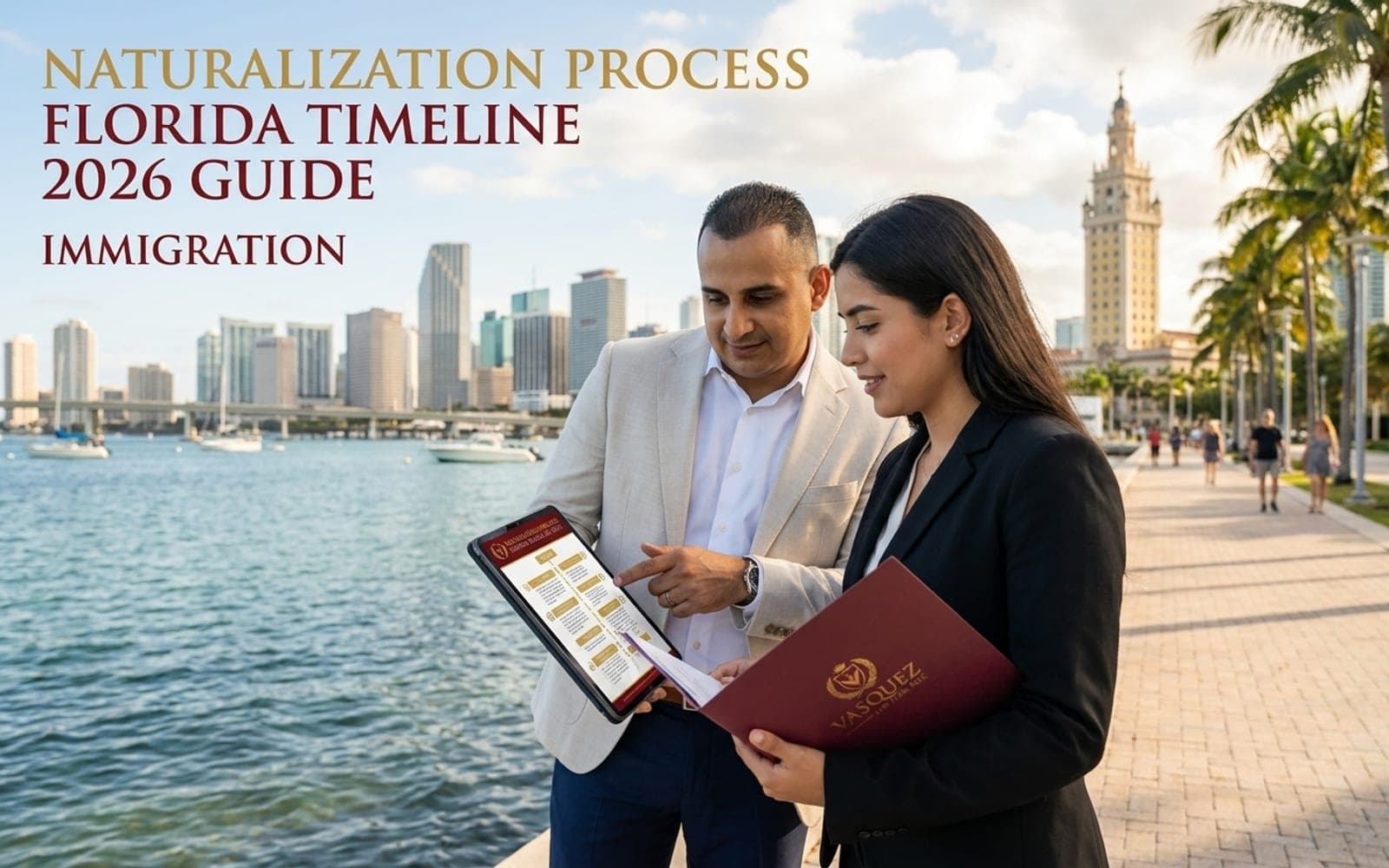
Before filing Form N-400, an attorney reviews your history as a resident to detect problems that could cause a denial. The N-400 asks about trips, addresses, jobs, taxes, arrests, and marriages, and the answers must match your documents and your earlier filings. The attorney confirms the time and presence requirements and prepares you for the interview and the English and civics tests. Vasquez Law Firm serves all of Florida.
- The N-400 asks about trips, addresses, jobs, taxes, arrests, and marriages.
- The requirements for time as a resident, continuous residence, and physical presence are confirmed.
- The attorney prepares you for the interview and the English and civics tests.
- Reconstructing trips with documents helps avoid contradictions.
If you are a permanent resident and want to become a citizen of the United States, an attorney can review your history before you file Form N-400 and detect problems that could cause a denial or something more serious. At Vasquez Law Firm we serve residents throughout Florida from our office in Orlando and by video call, in Spanish and English.
What do citizenship and naturalization attorneys do?
Naturalization seems like a matter of forms, but Form N-400 asks about your entire life as a resident: trips, addresses, jobs, taxes, arrests, marriages, and even whether you ever registered to vote. Citizenship and naturalization attorneys review those answers against your documents so that there are no contradictions with what you stated in earlier filings. Their work includes:
- confirming that you meet the requirements for time as a resident, continuous residence, and physical presence;
- reviewing your original immigration file, especially if your residence came from a complicated case;
- preparing and filing the N-400 with supporting evidence;
- preparing you for the interview and the English and civics tests;
- responding if USCIS asks for more evidence or if the case is denied.
A common example: a person obtained residence years ago through an employer or a relative, traveled often to their home country to care for their parents, and does not remember the exact dates. Before filing, the attorney reconstructs those trips using passport stamps, tickets, and records, because an inaccurate answer on the N-400 can be seen as a lack of truthfulness.
You can read more about this service on our page on naturalization and U.S. citizenship.
General requirements for U.S. citizenship
In general terms, to naturalize a person must:
- be at least 18 years old;
- have been a permanent resident for five years, or three years if they have been married to and living with a U.S. citizen during that time and the spouse has been a citizen for those three years;
- have continuous residence and have been physically in the country for at least half of that period;
- have lived at least three months in the state or USCIS district where they file the application;
- show good moral character;
- pass the English and civics test, unless they qualify for an exception because of age, years of residence, or disability;
- be willing to take the oath of allegiance.
The law allows you to file the N-400 up to 90 days before reaching the required residence period. There are special rules for military members and for children of citizens, who sometimes are already citizens by derivation and do not need to naturalize.
When do I need an attorney for citizenship?
Many people with a simple history file on their own. But if you are wondering "do I need a lawyer for citizenship?", there are situations in which it is wise to consult before sending anything:
- long trips outside the country, especially six months or more;
- any arrest, citation, or conviction, even if it was closed or expunged from the record;
- unfiled taxes or debts to the IRS;
- overdue child support;
- having claimed to be a citizen by mistake or having voted without being a citizen;
- a residence obtained through a marriage that ended soon after, or questions about how you obtained the green card;
- not having registered with the Selective Service when the law required it.
In some of these cases, filing the application can put the residence itself at risk. An immigration attorney for U.S. citizenship will tell you whether it is time to file, whether it is wise to wait, or whether another matter must be resolved first.
What the naturalization process looks like
- Eligibility review. We calculate dates, trips, and background.
- Filing the N-400. It is filed with USCIS with the necessary evidence.
- Biometrics appointment. USCIS takes fingerprints and a photo for the background check.
- Interview. An officer reviews the application under oath and administers the English and civics test at the USCIS office that corresponds to your address.
- Decision and oath. If approved, you attend the oath ceremony, and from that moment you are a citizen.
The times for each stage change depending on the office and USCIS's workload, which is why we do not give fixed timelines. If the case is denied, it is possible to request an administrative hearing with Form N-336, within the deadline stated in the decision.
What to bring to the consultation
- your green card (both sides) and your passport;
- a list of trips outside the U.S. since you obtained residence, with approximate dates;
- addresses and jobs for the last five years;
- tax returns for recent years;
- marriage certificates and divorce decrees, if applicable;
- any court or police document, even if the case was closed.
How to choose among citizenship attorneys
Many citizenship lawyers offer help, and so do "notarios" or agents who are not attorneys and cannot give legal advice in Florida. Before hiring, ask whether the person has a law license, who will review your case, and how they will notify you of each step. Be wary of anyone who promises a sure approval.
A U.S. citizenship attorney should clearly explain the risks of your case, not just fill out the form. If someone tells you the process is "just paperwork" without asking about your trips or background, seek another opinion.
When comparing U.S. citizenship lawyers, it is also worth asking whether they will accompany you to the interview and what happens if USCIS asks for additional documents.
How we work with clients across Florida
Our only office is at 1111 E Amelia Street, Orlando. We serve residents in Miami, Tampa, Jacksonville, Fort Myers, and the rest of the state by phone and secure video call, and in person in Orlando. If you are looking for an immigration citizenship attorney who explains everything in Spanish, our consultations are held in Spanish or English, whichever you prefer. To begin, contact us and schedule your consultation.
This article is general information, not legal advice. Every case is different; speak with an immigration attorney about your situation.