How Long Does U.S. Citizenship Take? Florida N-400 (2026)
Dreaming of becoming a U.S. citizen in Florida? The naturalization process can seem complex, but with the right guidance, it is an achievable goal. This comprehensive guide outlines the naturalization process Florida timeline for 2026, detailing each step from eligibility to the oath ceremony. We cover essential requirements, necessary documents, potential costs, and what to expect regarding processing times. Whether you reside in Naples or anywhere across the Sunshine State, preparing effectively is key to a successful U.S. citizenship application. Learn how Florida Immigration Lawyers can support your journey.
The naturalization process Florida timeline typically ranges from 12 to 24 months in 2026, though individual cases may vary. It involves filing Form N-400, attending a biometrics appointment, undergoing an interview and civics test, and finally, the oath ceremony.
- Eligibility requires continuous residency as a Green Card holder.
- Form N-400 is the primary application for U.S. citizenship.
- Processing times vary by USCIS field office (e.g., Miami, Orlando).
- An attorney can significantly streamline your U.S. citizenship application Florida.
- The final step is the Oath of Allegiance ceremony.
Naturalization Process Florida: 2026 Timeline for U.S. Citizenship
Are you a Green Card holder in Florida dreaming of becoming a U.S. citizen? The journey to naturalization is a significant step, opening doors to full participation in American society. Understanding the naturalization process Florida timeline is crucial for residents in Naples and across the Sunshine State.
This comprehensive guide will walk you through every stage of the U.S. citizenship application Florida for 2026. We will explore what to expect, how to prepare, and how to navigate potential challenges. If you are ready to begin your journey or have questions about the naturalization process Florida timeline, do not hesitate to reach out. For general information, you can also explore our immigration law practice areas. Call Florida Immigration Lawyers at 1-844-YO-PELEO for a free consultation today.
Eligibility Requirements for U.S. Citizenship in Florida
Before beginning the naturalization process Florida timeline, you must meet specific USCIS eligibility criteria. These are fundamental to a successful application for U.S. citizenship.
General Residency and Age Requirements
Applicants must be at least 18 years old when filing Form N-400. Most must be lawful permanent residents (Green Card holders) for at least five years, demonstrating continuous residency and physical presence for at least half of that period (30 months).
If married to a U.S. citizen, this residency requirement can be reduced to three years. You must have resided with your U.S. citizen spouse for this entire period. Additionally, you need to have lived for at least three months in the state or USCIS district where you apply, applicable to residents of Naples, Florida.
Good Moral Character, English, and Civics
USCIS requires applicants to demonstrate good moral character for the statutory period. This involves a review of your criminal record and personal history. Certain offenses can affect this determination.
You must also show the ability to read, write, and speak basic English, and pass a civics test on U.S. history and government. Exceptions exist for specific age, residency, or medical conditions. For details on exemptions, visit USCIS.gov. Finally, you must be willing to take an Oath of Allegiance to the United States.
The Naturalization Process Florida Timeline: A Detailed Guide
Navigating the naturalization process Florida timeline involves distinct stages. Understanding each step helps you prepare thoroughly for your journey to U.S. citizenship.
-
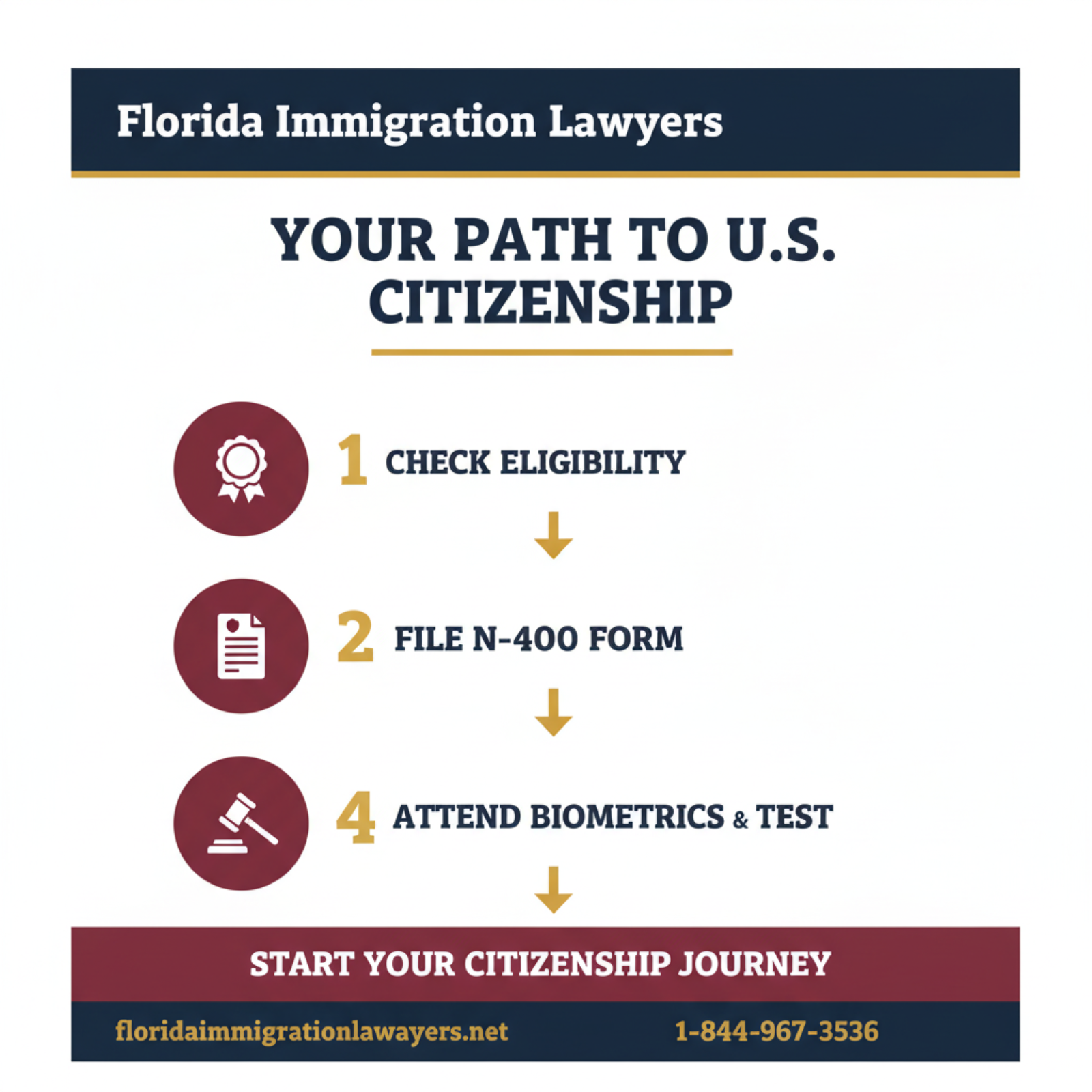
Determine Your Eligibility
Confirm you meet all age, residency, physical presence, and good moral character requirements. An attorney at Florida Immigration Lawyers can help clarify your eligibility.
-
Prepare and File Form N-400
Complete and submit Form N-400, Application for Naturalization, accurately. Gather all supporting documents like your Green Card and marriage certificates. Accuracy is paramount for your N-400 processing time Florida.
-
Attend Your Biometrics Appointment
USCIS will send an appointment notice for fingerprinting and photographs, used for background checks. This mandatory step usually occurs weeks after filing.
-
Complete the Naturalization Interview
Attend your interview at a Florida USCIS office (e.g., Miami, Orlando, Tampa). An officer will review your N-400, verify eligibility, and administer English and civics tests. Be prepared to answer questions about your application and U.S. history.
-
Receive a Decision from USCIS
After your interview, USCIS will issue a decision: approval, Request for Evidence (RFE), or denial. If approved, you will receive an Oath of Allegiance ceremony notice. Respond promptly to RFEs to avoid delays in your U.S. citizenship application Florida.
-
Take the Oath of Allegiance
The final step in the naturalization process Florida timeline is the Oath of Allegiance ceremony. You formally become a U.S. citizen and receive your Certificate of Naturalization, completing your journey.
Essential Documents for Your Naturalization Application
Gathering correct documents is critical for your U.S. citizenship application Florida. Missing items can cause delays or denial. Here is a general checklist for Form N-400:
- Copy of your Green Card (Form I-551), front and back.
- Marriage certificates, divorce decrees, or death certificates (if applicable).
- Birth certificates for children (if applicable).
- Tax returns/transcripts for the past 3 or 5 years.
- Proof of selective service registration (males 18-26).
- Certified court dispositions for any arrests or citations.
- Proof of child support/alimony payments (if applicable).
- Travel records for the last 3 or 5 years.
- Two passport-style photos.
- Form N-400 fee or Form I-912, Request for Fee Waiver.
- Form N-648, Medical Certification for Disability Exceptions (if applicable).
Always keep copies of everything and bring originals to your interview. Refer to USCIS instructions for precise requirements.
Navigating Naturalization Processing Times in Florida
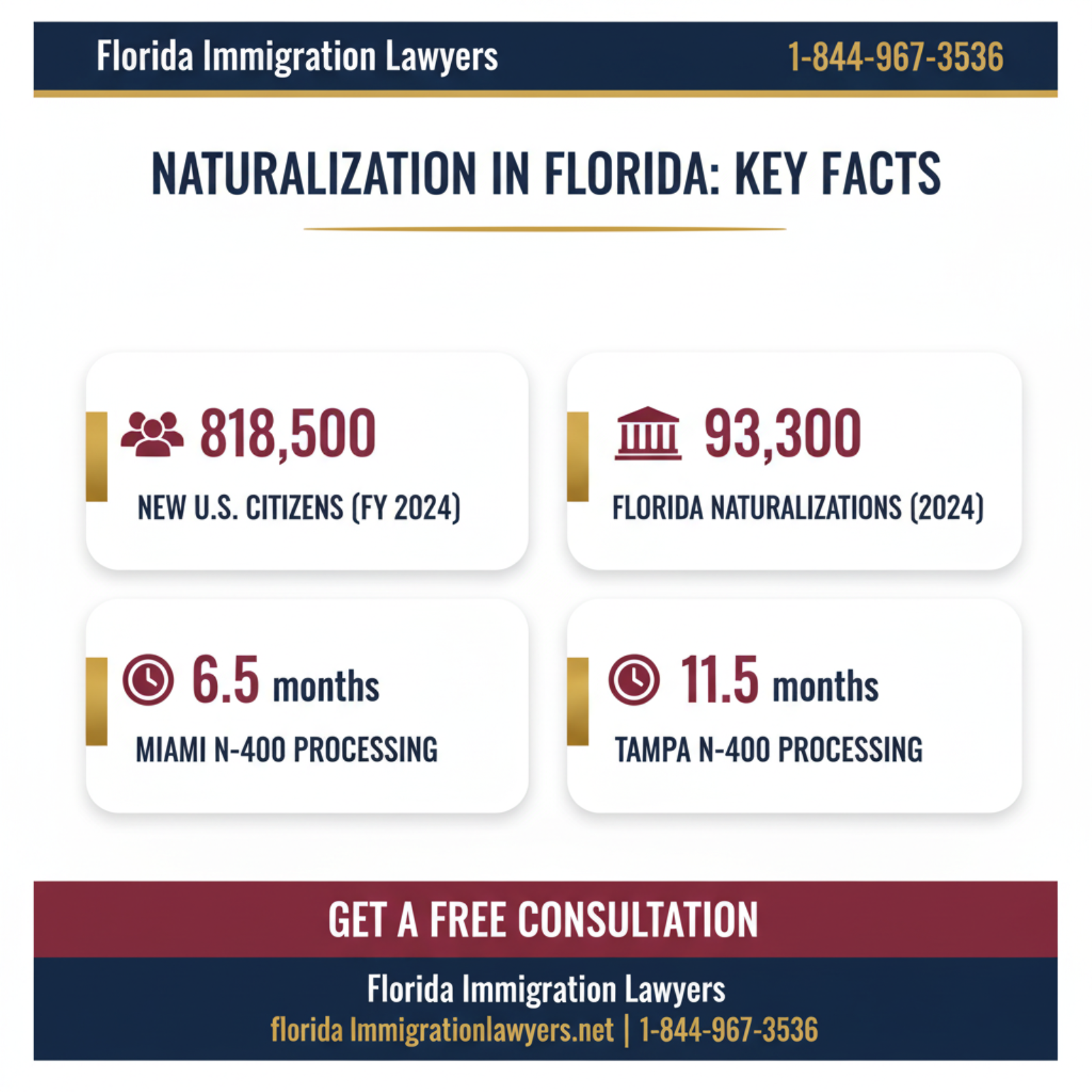
The naturalization process Florida timeline varies. Factors influencing N-400 processing time Florida include the specific USCIS field office (e.g., Miami, Orlando, Tampa), application completeness, and national workload.
Average Processing Times and Delays
In 2026, the entire naturalization process in Florida generally takes 12 to 24 months from filing Form N-400 to the Oath of Allegiance. This is an average; individual cases may differ. Check current times on the USCIS website for your local office.
Delays often stem from incomplete applications, background check issues, interview reschedules, or high application volumes. Responding quickly to Requests for Evidence (RFEs) is crucial. If your case is outside normal processing times, an immigration inquiry Florida can be made. Monitor your case status online using your receipt number for your U.S. citizenship application Florida.
Cost Factors and Fee Waivers for Naturalization
Understanding the financial aspects of the naturalization process Florida timeline is key. Costs typically include USCIS filing fees and potential legal fees.
USCIS Filing Fees and Waivers
The Form N-400 filing fee, including biometrics, is subject to change; always verify current amounts on USCIS.gov. Incorrect payments cause delays. Fee waivers are available via Form I-912 for eligible applicants based on income or receipt of means-tested public benefits. This can significantly reduce the financial burden of the U.S. citizenship application Florida.
Legal Fees for Assistance
While not mandatory, hiring an experienced immigration attorney can streamline your application. Legal fees vary by case complexity. An attorney can ensure accuracy, gather documents, and represent you. This investment can prevent delays or denials, offering peace of mind throughout the naturalization process Florida timeline.
The journey to U.S. citizenship involves important deadlines and complex legal requirements. Do not navigate this process alone. Contact Florida Immigration Lawyers today at 1-844-YO-PELEO to schedule your free consultation. We are here to guide you through every step of the naturalization process Florida timeline.
The Citizenship Interview and English/Civics Test
The naturalization interview is pivotal in the naturalization process Florida timeline. For Naples residents, your interview will likely be at a Florida USCIS field office.
What to Expect and How to Prepare
A USCIS officer will review your Form N-400, verify eligibility, and administer English and civics tests. You will read and write a sentence in English, and answer 6 out of 10 civics questions correctly. Study materials are on USCIS.gov. Answer truthfully and consistently.
Tips for Your Interview: Bring all original documents. Dress professionally and arrive early. Practice for the English and civics tests. If you have a disability waiver, ensure Form N-648 is correctly submitted. An experienced attorney can accompany you, offering invaluable support during this critical step for your U.S. citizenship application Florida.
What Happens After Your Naturalization Interview?
After your interview, you typically receive one of several outcomes, affecting your naturalization process Florida timeline.
Possible Outcomes and The Oath Ceremony
- Approved: You receive an Oath of Allegiance ceremony notice.
- Continued: More information is needed, or you need to retake a test portion. Respond promptly to keep your U.S. citizenship application Florida moving.
- Denied: USCIS determines you are ineligible. You receive a written explanation. You may appeal or refile.
The Oath of Allegiance ceremony is the final, celebratory step. You take the oath, receive your Certificate of Naturalization, and officially become a U.S. citizen. This completes your green card to citizenship Florida journey, granting rights like voting and applying for a U.S. passport.
Common Mistakes to Avoid During the Naturalization Process
The naturalization process Florida timeline is complex. Avoiding common pitfalls can save you time and stress. Here are frequent mistakes:
-
Filing Before Meeting Residency Requirements
Filing Form N-400 too early, before completing the required 3 or 5 years of continuous residency, will result in denial. Always calculate your eligibility date carefully, considering the "90-day early filing" rule.
-
Incomplete or Inaccurate Form N-400
Providing incorrect information or leaving sections blank on your N-400 leads to delays, RFEs, or denial. Every question must be answered truthfully and thoroughly, impacting your N-400 processing time Florida.
-
Not Disclosing All Travel History
Forgetting to list short trips or miscalculating days abroad. USCIS has travel records; inaccuracies raise red flags about continuous residency.
-
Not Disclosing All Arrests or Citations
Even minor or expunged records must be disclosed. Failing to do so can be seen as a lack of good moral character and lead to denial. Always provide certified court dispositions.
-
Poor English Language or Civics Test Preparation
Underestimating these tests is common. They require preparation. Failing can lead to continuation or denial of your U.S. citizenship application Florida.
-
Missing Biometrics or Interview Appointments
Failure to attend scheduled appointments without proper rescheduling can result in your application being considered abandoned. Respond to USCIS notices promptly.
-
Not Consulting an Attorney for Complex Cases
If you have a criminal record, extensive travel, or complicated history, navigating the process alone is risky. An experienced immigration lawyer can identify issues and strategize your application.
When to Call Florida Immigration Lawyers for Naturalization Assistance
Certain circumstances make legal representation essential for the naturalization process Florida timeline. Florida Immigration Lawyers are dedicated to guiding individuals to U.S. citizenship.
Scenarios Requiring Legal Help
- Complex Eligibility: Questions about continuous residency, physical presence, or good moral character (e.g., extensive travel, past legal issues).
- Criminal History: Any arrests, citations, or convictions, even minor ones. An attorney can analyze your record and advise on disclosure.
- Previous Denials: If a prior U.S. citizenship application Florida was denied, an attorney can review reasons and advise on appeals or refiling.
- Disability Waivers: Ensuring Form N-648 for English/civics test waivers is correctly completed.
- Long Delays or USCIS Issues: If your N-400 processing time Florida is significantly beyond normal, or if you have a USCIS missing notice, an attorney can make an immigration inquiry Florida.
Our experienced attorneys at Florida Immigration Lawyers provide personalized, empathetic support to residents throughout Florida, including Naples, Fort Myers, and Tampa. We ensure your path to U.S. citizenship is clear and efficient. Visit our citizenship practice area page to learn more.
Frequently Asked Questions About Naturalization in Florida
1. How long is the wait for naturalization in Florida?
The wait for naturalization in Florida typically ranges from 12 to 24 months from filing Form N-400 to the Oath of Allegiance. This varies by USCIS field office (Miami, Orlando, Tampa) and case complexity. Check official USCIS website for current times.
2. What is the 3-3-3 rule for citizenship?
The "3-3-3 rule" is a mnemonic for key naturalization requirements: 3 years as a permanent resident if married to a U.S. citizen; 3 months residency in the filing state/district; and at least half (e.g., 30 months for 5-year rule) physically present in the U.S. Always review full eligibility criteria.
3. How long is N-400 taking now?
As of 2026, Form N-400 processing time typically falls within 12 to 24 months for Florida residents. These are estimates and can fluctuate due to application volume, USCIS staffing, and application thoroughness. Monitor your case status via the USCIS online tool.
4. How long is the naturalization process right now?
Currently, the entire naturalization process Florida timeline, from application submission to the Oath of Allegiance, generally takes between 12 and 24 months. This includes biometrics, interview, and ceremony. Individual experiences may differ; consulting an attorney can clarify current expectations for your specific situation.
About Florida Immigration Lawyers
Florida Immigration Lawyers is a law firm serving immigrants across the Sunshine State. We represent clients in Naples, Fort Myers, Miami, Orlando, Tampa, and throughout Florida. Our experienced attorneys focus on family-based immigration, business immigration, asylum, deportation defense, and the naturalization process Florida timeline.
We offer personalized attention, strategic advocacy, and a compassionate approach. Available 24/7, we provide free, confidential consultations to help you achieve your American dream. Contact us today at 1-844-YO-PELEO or visit our contact page to learn more about our services.
Sources and References
- U.S. Citizenship and Immigration Services (USCIS) - Citizenship Resource Center
- Form N-400, Application for Naturalization - USCIS
- Executive Office for Immigration Review (EOIR)
- Immigration and Nationality Act (INA) § 316 - Requirements for Naturalization
- 8 U.S.C. § 1427 - Requirements for naturalization
- 8 CFR Part 316 - General Requirements for Naturalization
This article provides general legal information and is not intended as legal advice. Every case is unique, and outcomes depend on specific facts and circumstances. Contact an attorney for advice about your particular situation. Laws are subject to change, and this content reflects information as of the publication date of 2026-03-25.
Embarking on the journey to U.S. citizenship is a profound decision. Having a knowledgeable legal team by your side can make all the difference. At Florida Immigration Lawyers, we are dedicated to helping you navigate every aspect of the naturalization process Florida timeline with confidence.
Do not let uncertainties delay your dream of becoming a U.S. citizen. We offer free consultations to discuss your specific case and outline a clear path forward. Our firm serves all of Florida, including Orlando, offering guidance tailored to your needs.
Call Florida Immigration Lawyers today at 1-844-YO-PELEO to schedule your free consultation. Se Habla Español - Estamos aquí para ayudarle.
Do Not Navigate This Process Alone
Our experienced immigration attorneys are ready to fight for you. Get a free, confidential case review today.
Se Habla Español
Or leave your details and we’ll call you:
Free Evaluation in 24 Hours
Or talk to us right now

AI voice assistant — available 24/7
FreeFrequently Asked Questions

William J. Vásquez
Founding Attorney · Vasquez Law Firm
U.S. Air Force veteran and immigration attorney with years of hands-on U.S. immigration experience. J.D., NCCU School of Law. AILA member. Admitted to the 4th, 5th, and 11th Circuit Courts.
Available 24/7 - Free Evaluations
Reviewed for legal accuracy by William J. Vásquez
Licensed in North Carolina; U.S. immigration is federal practice.
Related Legal Services
Our Florida immigration attorneys can help you with citizenship and naturalization, immigration practice areas and free immigration consultation. Call today at 1-844-YO-PELEO for a free case review.
Related Links
Related Topics
Free Legal Case Review
Discuss your case with our experienced attorneys. We're available 24/7.
Se Habla Español - Estamos aquí para ayudarle.
Related Articles
EAD Advance Parole Combo Card in Florida: What You Need
An EAD advance parole combo card allows individuals with pending adjustment applications to both work and travel abroad without jeopardizing their green card application. Learn how to apply in Florida, what documents you need, and common mistakes to avoid.
PERM Labor Certification in Florida: A 2026 Guide
Learn all about the PERM labor certification process in Florida, essential for employers sponsoring green card applicants. Understand the steps, document requirements, and common mistakes to avoid in this 2026 guide.
Dual Citizenship Lawyer in Florida: What You Need to Know
For Florida residents, the concept of dual citizenship, or holding two passports, offers a compelling blend of opportunities and challenges. While the U.S. generally permits dual nationality, the path to achieving this status requires a meticulous understanding of both U.S. immigration laws and the citizenship policies of your country of origin. This guide explores the definition of dual citizenship, the detailed step-by-step process for U.S. naturalization, and the significant benefits and potential pitfalls involved. We cover essential documentation, typical timelines, and cost considerations for 2026, providing crucial insights for anyone in Orlando, Miami, or across Florida considering this important legal step. Learn about common mistakes to avoid and understand when to seek professional legal counsel to navigate this complex process successfully. Florida Immigration Lawyers is here to provide expert, bilingual support for your dual citizenship journey.
Immigration Lawyer Orlando Free Consultation in Florida
For individuals and families in Orlando, Florida, navigating the complexities of U.S. immigration law requires expert guidance. An immigration lawyer in Orlando offers crucial support for everything from visa applications and green card processes to naturalization and deportation defense. This comprehensive guide details what a free consultation covers, providing a step-by-step overview of immigration pathways, essential document checklists, and expected timelines in 2026. We also highlight common mistakes to avoid, discuss the critical role of legal counsel in deportation and asylum cases, and explain why choosing a local Orlando immigration attorney is beneficial. Florida Immigration Lawyers is dedicated to serving the diverse community of Orlando with compassionate, effective legal solutions, ensuring you receive personalized advice and robust representation for a successful immigration journey.