Citizenship Test Preparation in Florida: A Complete Guide
Applying for U.S. citizenship in Florida requires careful preparation, particularly for the citizenship test. This guide provides insights into preparing for the test, completing the N-400 application, and navigating the process in Orlando. Contact Florida Immigration Lawyers for expert help.
Applying for U.S. citizenship in Florida requires careful preparation, particularly for the citizenship test. The process involves submitting the N-400 form, studying for the civics test, and understanding the naturalization interview. Key takeaways include:
- The citizenship test includes English and civics components.
- Prepare your N-400 application thoroughly.
- Study U.S. history and government topics for the civics test.
Introduction
Deciding to apply for U.S. citizenship is a significant step for many immigrants in Florida. Whether you have a family history deeply rooted in the country or you're beginning a new chapter, understanding the naturalization process is crucial. This guide provides insights into preparing for the citizenship test, completing the N-400 application, and navigating the process in Orlando, Florida. Call Florida Immigration Lawyers at 1-844-YO-PELEO for a free case review.
The journey to becoming a U.S. citizen is transformative, offering new rights and responsibilities, from voting to holding a U.S. passport. However, the path can be complex, filled with specific requirements and procedures that can be daunting without proper guidance. This comprehensive guide aims to demystify the naturalization process, offering practical advice and highlighting key areas where applicants often seek clarity.
In Florida, a state with a diverse immigrant population, understanding local resources and legal support is particularly valuable. From mastering the English language and civics components of the test to meticulously preparing your N-400 application, every step contributes to a successful outcome. We encourage you not to hesitate in seeking professional assistance from experienced legal teams like Florida Immigration Lawyers to ensure your application is robust and error-free.
What is the Citizenship Test in Florida?
The citizenship test is a key component of the naturalization process, assessing applicants on English proficiency and U.S. civics knowledge. It includes reading, writing, and speaking tests in English, plus a civics test covering U.S. history and government.
The test occurs during the naturalization interview. As of 2026, applicants must correctly answer six out of ten civics questions to pass. The questions are chosen from a list of 100 possible questions. Preparing well in advance is essential for success.
The English portion of the test evaluates your ability to understand and communicate basic English. The reading test involves reading one out of three sentences correctly, while the writing test requires writing one out of three sentences accurately. The speaking test is integrated into the naturalization interview itself, where the USCIS officer will assess your ability to answer questions about your N-400 application and personal background in English.
The civics test, on the other hand, delves into your knowledge of American history, government, and geography. While there are 100 potential questions, only ten are asked during your interview, and you must answer six correctly. Topics range from the Constitution and the branches of government to important historical events and figures. It’s not just about memorizing facts but understanding the fundamental principles that govern the United States.
How to Prepare for the Citizenship Test?
To prepare for the citizenship test, applicants should focus on improving their English language skills and studying U.S. civics. Resources available include study guides, flashcards, and practice tests.
- Review the USCIS study materials.
- Practice reading, writing, and speaking English.
- Take online practice tests to familiarize yourself with the test format.
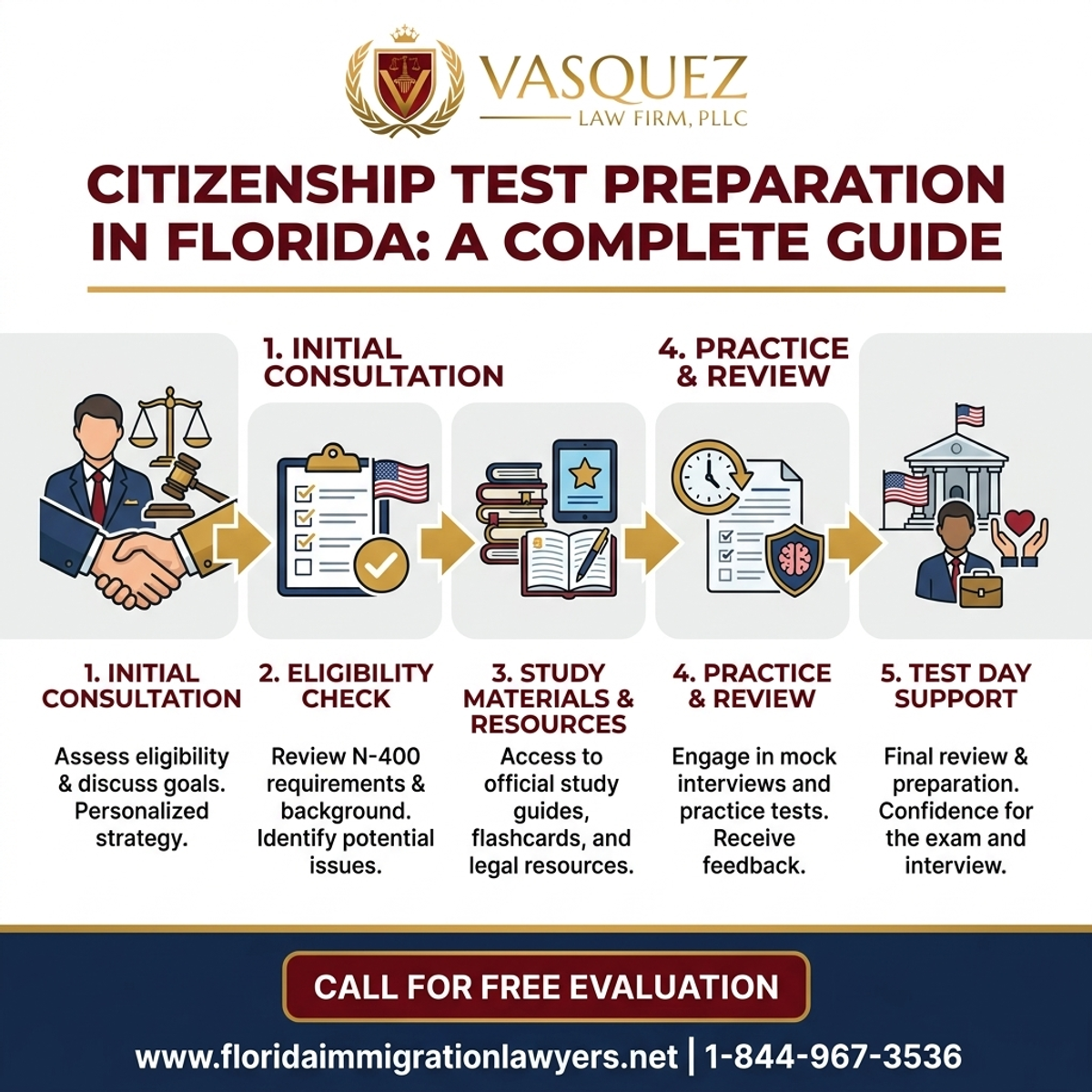
Step-by-Step Process — Citizenship Test Preparation in Florida: A Complete Guide
Consider enrolling in a citizenship preparation class offered by local community centers or libraries in Orlando.
For the English test, practical tips include daily practice. Read English newspapers or books, watch English-language television without subtitles, and engage in conversations with native speakers. For writing, practice dictation or writing short paragraphs about your daily life. Many USCIS resources also include audio versions of the civics questions, which can be incredibly helpful for improving listening comprehension while studying the civics material.
When tackling the civics test, try to understand the concepts behind the answers, rather than just rote memorization. For example, instead of just memorizing the three branches of government, understand their roles and how they interact. Flashcards are excellent for quick recall, but supplementing this with reading about U.S. history and current events will deepen your understanding. Many non-profit organizations and adult education centers in Central Florida, beyond just libraries, offer free or low-cost citizenship classes specifically designed to help you pass.
A real-world example of successful preparation could be an applicant like Maria, a 55-year-old from Colombia living in Orlando. She initially struggled with the English writing component. Her strategy involved attending a local citizenship class twice a week and practicing writing simple sentences daily, often about topics from the civics test. By consistently reviewing the USCIS practice materials and receiving feedback from her instructor, Maria significantly improved her skills and passed her test with confidence. Florida Immigration Lawyers can also provide resources and guidance on where to find these valuable preparation courses.
What Documents are Needed for the N-400 Application?
Filing the N-400 application requires gathering several important documents. These documents verify your eligibility and support your application.
- A copy of your Permanent Resident Card (Green Card).
- Two passport-style photographs.
- Proof of your residence in Florida, such as a utility bill or lease agreement.
- Any documents related to marital status, legal name changes, or criminal records if applicable.
Ensure all documents are current and legible to avoid delays in processing.
Beyond the basics, it's crucial to understand the nuances of each document. For your Permanent Resident Card, ensure it is still valid. The passport-style photographs must meet specific USCIS requirements regarding size, background, and facial expression. For proof of residence, consider providing multiple documents if available, such as tax returns, bank statements, or car registration, to clearly demonstrate continuous residency in Florida.
If you've had any life changes, such as marriage, divorce, or a legal name change, you'll need certified copies of marriage certificates, divorce decrees, or court orders. For those with any past interactions with law enforcement, regardless of the outcome, it is vital to gather all arrest records, court dispositions, and probation records. Even minor infractions should be disclosed. Failing to provide complete and accurate documentation can lead to significant delays or even denial of your application. Always make copies of every document you submit and keep them for your records.
Timeline and Processing Expectations for Naturalization
Understanding the timeline for naturalization helps in planning and setting realistic expectations. The process typically involves several stages.
| Stage | Typical Timeframe | Notes |
|---|---|---|
| N-400 Application Submission | 6-12 months | Varies based on USCIS workload. |
| Biometrics Appointment | 1-2 months after submission | Fingerprinting for background check. |
| Interview and Test | 1-2 months after biometrics | Includes the citizenship test. |
| Oath Ceremony | 1-2 months after interview | Final step for becoming a citizen. |
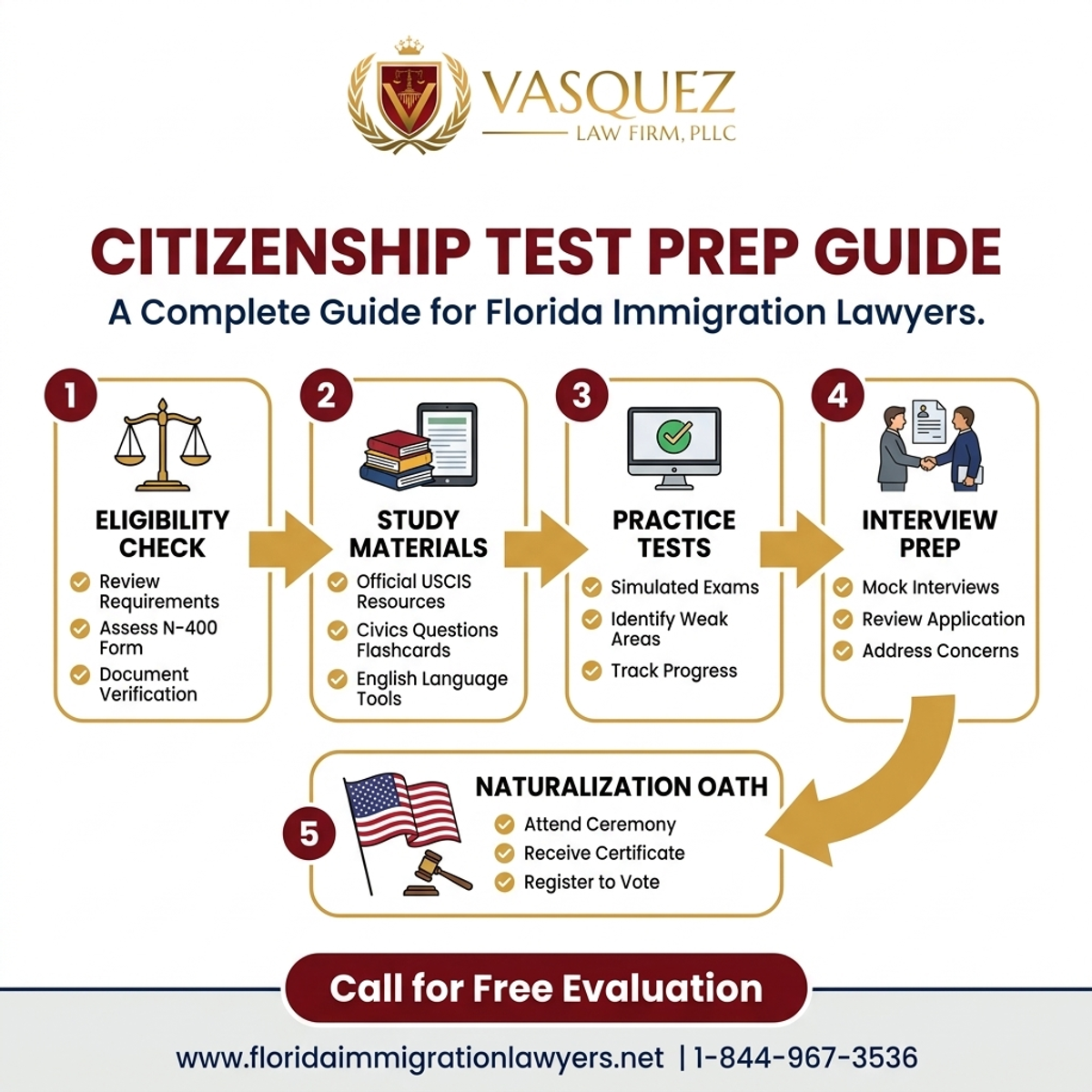
Key Statistics — Citizenship Test Preparation in Florida: A Complete Guide
Timelines can vary based on factors such as location and application volume. It's important to check the status regularly on the USCIS website.
While the table provides typical timeframes, it's essential to remember that these are averages. Factors such as the specific USCIS field office processing your application (e.g., Orlando vs. another city), the complexity of your individual case, and current USCIS processing backlogs can significantly influence the actual duration. For instance, a simple case with a clear history might move faster than one involving extensive travel or a criminal record that requires additional review.
After submitting your N-400, you'll receive a receipt notice. The biometrics appointment is typically a quick process where your fingerprints and photograph are taken for background checks. The interview is a pivotal stage where a USCIS officer reviews your application, asks questions about your eligibility, and administers the English and civics tests. Finally, the Oath of Allegiance ceremony is the official event where you take the oath and receive your Certificate of Naturalization. Keeping track of your application status through the USCIS online tools and promptly responding to any Requests for Evidence (RFEs) are crucial for maintaining momentum.
Cost Factors and Fee Breakdown
Applying for citizenship involves several costs. Here's what to expect:
| Item | Typical Fee | Notes |
|---|---|---|
| N-400 Application Fee | Varies | Includes biometrics fee. |
| Preparation Classes | Free - $200 | Cost depends on provider. |
| Legal Assistance | Varies | Consult an attorney for advice. |
Fee waivers may be available for those who qualify based on financial need. It's advisable to consult with an immigration lawyer to explore all options.
The N-400 application fee is substantial, and it's important to verify the current amount directly on the USCIS website, as it can change. This fee typically covers the processing of your application and the biometrics appointment. For many applicants, this cost can be a significant barrier, which is why understanding fee waiver options is critical. USCIS offers Form I-912, Request for Fee Waiver, for individuals who meet specific income guidelines or are receiving public benefits.
While preparation classes can range from free to a couple of hundred dollars, the investment often pays off in increased confidence and better test performance. However, the cost of legal assistance can vary widely depending on the complexity of your case and the services required. For example, a simple review of your application might cost less than full representation, including attendance at your interview. Consider the cost of not having legal counsel if it leads to delays or denial due to preventable errors.
For instance, an Orlando family, the Garcias, initially hesitated to seek legal advice due to cost concerns. They prepared their N-400 independently but had a minor issue with a past traffic infraction they didn't fully disclose. A consultation with Florida Immigration Lawyers revealed the potential implications and helped them correctly amend their application, ultimately saving them from a possible denial and the associated costs of re-filing. This highlights how a seemingly small legal fee can prevent much larger problems down the road. Do not navigate this process alone. Contact Florida Immigration Lawyers today.
Common Mistakes to Avoid
- Failing to study adequately for the civics test, leading to poor performance.
- Submitting incomplete or incorrect N-400 applications, causing delays.
- Not providing the necessary supporting documents, leading to application rejection.
- Missing the biometrics appointment, delaying the process.
- Neglecting to update address changes with USCIS, risking missed notifications.
- Ignoring the importance of the English test component, which can lead to failure.
- Assuming fee waivers are automatically granted without applying for them.
- Overlooking legal advice, which could prevent costly errors.
- Not checking application status, leading to missed deadlines.
- Forgetting to bring required identification to the interview.
To elaborate on these common pitfalls, consider that failing the civics test often stems from last-minute cramming rather than consistent, spaced-out study. For the N-400, a common error is rushing through the form, leading to typos or misinterpretations of questions, especially those related to good moral character. Always double-check every entry and use the USCIS instructions as a guide.
Regarding supporting documents, applicants sometimes send original documents instead of copies, which can be lost, or fail to provide certified translations for foreign documents. Missing a biometrics appointment is easily avoidable by carefully noting the appointment date and time and setting reminders. Similarly, any change of address must be reported to USCIS promptly using Form AR-11 to ensure you receive all critical correspondence.
The English test is often underestimated; some applicants focus solely on civics, forgetting that proficiency in reading, writing, and speaking is equally vital. Furthermore, fee waivers are not automatic; you must submit Form I-912 with compelling evidence of financial hardship. Finally, legal advice from Florida Immigration Lawyers can act as a crucial safeguard, catching potential issues before they become major problems and ensuring you are fully prepared for every stage of the naturalization process.
When to Call a Lawyer
Legal assistance is crucial in several scenarios, such as if you have a criminal record, complex family history, or face potential deportation issues. An attorney can also help if your application has been denied or delayed.
Florida Immigration Lawyers offer expert guidance and support throughout the naturalization process. Our team can help you navigate challenges and ensure your application is as strong as possible.
Specifically, if you have any arrests, citations, or convictions, even if they were dismissed or occurred many years ago, consulting with an immigration attorney is non-negotiable. Certain offenses can bar you from naturalization, while others may require detailed explanations and supporting court documents. An attorney can assess your criminal history and advise on the best course of action, including whether a waiver is possible or if you should wait longer before applying.
Complex family histories, such as multiple marriages, divorces, children born outside of marriage, or periods of separation from your spouse, can also raise red flags during the naturalization interview. An immigration lawyer can help you prepare the necessary documentation and articulate your circumstances clearly to the USCIS officer. Furthermore, if you've had a previous application denied, or if your current application is experiencing unreasonable delays, a lawyer can investigate the reasons and advocate on your behalf, potentially appealing a denial or expediting a stalled process. Having Florida Immigration Lawyers by your side, especially during the interview, provides peace of mind and professional advocacy.
Frequently Asked Questions (FAQs)
Can I fail the citizenship test? What happens then?
Yes, it is possible to fail either the English or civics portion of the test. If you fail, you will be given a second opportunity to retake only the portion you failed, typically within 60 to 90 days after your initial interview. It's crucial to use this time to intensely study and practice. If you fail the second attempt, your N-400 application will be denied, and you would need to reapply and pay the fees again. Florida Immigration Lawyers can help you prepare for a retest.
What if I have a disability that prevents me from taking the English test?
USCIS provides accommodations for applicants with physical or developmental disabilities and/or mental impairments that prevent them from fulfilling the English and/or civics requirements. You can apply for a medical waiver using Form N-648, Medical Certification for Disability Exceptions. This form must be completed and certified by a licensed medical doctor or clinical psychologist. It's essential to submit this form with your N-400 application and ensure it clearly explains how your condition impacts your ability to learn or demonstrate English and civics knowledge. Consulting Florida Immigration Lawyers is highly recommended for this complex process.
How long do I need to be a permanent resident before applying?
Generally, you must have been a lawful permanent resident (Green Card holder) for at least five years before applying for naturalization. However, there's an exception: if you are married to a U.S. citizen, you may be eligible to apply after just three years of permanent residency, provided you have been living in marital union with your U.S. citizen spouse for at least three years immediately preceding the filing of your N-400 application. Both eligibility periods require continuous residence and physical presence in the U.S.
Can I travel outside the U.S. while my application is pending?
While you can generally travel outside the U.S. with your Green Card while your N-400 application is pending, it's advisable to limit long trips. Extended absences (typically six months or more) can disrupt your continuous residency requirement, which is a key eligibility factor for naturalization. If you must travel for an extended period, consult with Florida Immigration Lawyers to understand the potential impact on your application and explore options like applying for a re-entry permit (Form I-131) if necessary. Always ensure you return well before your interview or oath ceremony.
What is the Oath of Allegiance ceremony?
The Oath of Allegiance ceremony is the final and ceremonial step in the naturalization process, where you publicly declare your commitment to the United States. During this ceremony, you will take an oath, promising to support the Constitution and laws of the U.S. and to renounce allegiance to any foreign state. After taking the oath, you will receive your Certificate of Naturalization, which is proof of your U.S. citizenship. It's a significant and often emotional event, marking the culmination of your journey to becoming an American citizen.
About Florida Immigration Lawyers
Florida Immigration Lawyers is a dedicated firm offering comprehensive immigration services. Located in Orlando, we provide expert legal assistance for citizenship, asylum, deportation defense, and more. Our experienced attorneys work tirelessly to support clients across Central Florida. Call us at 1-844-YO-PELEO for a free consultation. Explore our immigration practice areas.
Our commitment extends beyond just processing paperwork; we provide compassionate and strategic legal counsel tailored to each client's unique situation. We understand the profound impact that achieving U.S. citizenship has on individuals and families, and we are dedicated to making that dream a reality. Our team stays current with the latest immigration laws and policies to offer the most accurate and effective representation. When you choose Florida Immigration Lawyers, you're choosing a partner who will stand with you every step of the way, advocating for your rights and guiding you through the complexities of the immigration system with expertise and care.
Sources and References
- U.S. Citizenship and Immigration Services (USCIS)
- Executive Office for Immigration Review (EOIR)
- 8 U.S.C. Chapter 12 - Immigration and Nationality Act
Related services: citizenship test preparation, dual citizenship guidance, family-based immigration.
This article provides general legal information and is not intended as legal advice. Every case is unique, and outcomes depend on specific facts and circumstances. Contact an attorney for advice about your particular situation.
Call Florida Immigration Lawyers at 1-844-YO-PELEO for expert advice. Se Habla Espanol - Estamos aqui para ayudarle.
If you need legal assistance, learn more about citizenship consultation, or call us at 1-844-967-3536 for a free case review.
Do Not Navigate This Process Alone
Our experienced immigration attorneys are ready to fight for you. Get a free, confidential case review today.
Se Habla Español
Or leave your details and we’ll call you:
Free Evaluation in 24 Hours
Or talk to us right now

AI voice assistant — available 24/7
FreeFrequently Asked Questions

William J. Vásquez
Founding Attorney · Vasquez Law Firm
U.S. Air Force veteran and immigration attorney with years of hands-on U.S. immigration experience. J.D., NCCU School of Law. AILA member. Admitted to the 4th, 5th, and 11th Circuit Courts.
Available 24/7 - Free Evaluations
Reviewed for legal accuracy by William J. Vásquez
Licensed in North Carolina; U.S. immigration is federal practice.
Related Legal Services
Our Florida immigration attorneys can help you with immigration practice areas, free immigration consultation and business immigration. Call today at 1-844-YO-PELEO for a free case review.
Related Links
Related Topics
Free Legal Case Review
Discuss your case with our experienced attorneys. We're available 24/7.
Se Habla Español - Estamos aquí para ayudarle.
Related Articles
DUI Immigration Consequences in Florida 2026
A DUI conviction in Florida can have severe immigration consequences, potentially leading to inadmissibility, deportation, or denial of immigration benefits. For non-citizens, a DUI is not just a traffic offense but a serious criminal matter that federal immigration law scrutinizes closely. Factors like multiple offenses, injury, or property damage can escalate a simple DUI to a Crime Involving Moral Turpitude (CIMT) or even an aggravated felony, triggering mandatory detention and removal proceedings. Understanding the specific nature of your Florida conviction and its interpretation under the Immigration and Nationality Act (INA) is crucial. This article outlines how DUIs impact immigration status, the grounds for inadmissibility and deportation, a step-by-step guide to navigating the process, essential documentation, and expected timelines for 2026. We also highlight common mistakes to avoid and when to seek legal counsel from an experienced immigration attorney. Florida Immigration Lawyers offers comprehensive support for individuals facing these challenging situations, providing expert guidance through complex legal landscapes.
Dual Citizenship Lawyer in Florida: What You Need to Know
For Florida residents, the concept of dual citizenship, or holding two passports, offers a compelling blend of opportunities and challenges. While the U.S. generally permits dual nationality, the path to achieving this status requires a meticulous understanding of both U.S. immigration laws and the citizenship policies of your country of origin. This guide explores the definition of dual citizenship, the detailed step-by-step process for U.S. naturalization, and the significant benefits and potential pitfalls involved. We cover essential documentation, typical timelines, and cost considerations for 2026, providing crucial insights for anyone in Orlando, Miami, or across Florida considering this important legal step. Learn about common mistakes to avoid and understand when to seek professional legal counsel to navigate this complex process successfully. Florida Immigration Lawyers is here to provide expert, bilingual support for your dual citizenship journey.
EAD Advance Parole Combo Card in Florida: What You Need
An EAD advance parole combo card allows individuals with pending adjustment applications to both work and travel abroad without jeopardizing their green card application. Learn how to apply in Florida, what documents you need, and common mistakes to avoid.
EAD Advance Parole Combo Card in Florida 2026
For individuals with a pending Form I-485, Application to Register Permanent Residence or Adjust Status, the EAD Advance Parole Combo Card is an essential document. This single card combines the authorization to work legally in the U.S. (Employment Authorization Document - EAD) with permission to travel internationally and re-enter without abandoning your green card application (Advance Parole). This guide from Florida Immigration Lawyers provides a comprehensive overview for applicants in Florida in 2026, covering eligibility, the step-by-step application process, required documents, expected processing times, and associated costs. We also highlight common mistakes to avoid and when to seek legal counsel to ensure a smooth and successful immigration journey. Understanding this vital card is key to maintaining stability while awaiting your permanent residency approval.