How to Get a Work Permit in Florida for 2026
Learn how to obtain a work permit in Florida through the PERM labor certification process. This guide covers everything from job descriptions to filing the necessary forms. Contact Florida Immigration Lawyers for expert advice.

- PERM certification is a key step for employer-sponsored green cards.
- It requires an employer to prove there are no qualified U.S. workers for the job.
- This process can take several months, so early preparation is crucial.
- Consulting an immigration lawyer can help ensure compliance with all regulations.
Introduction
Securing a work permit in Florida can be a complex process, especially with the ever-changing immigration landscape. The PERM labor certification is a critical step for those seeking employment-based green cards. Understanding how to navigate this process is essential for both employers and potential employees. This article will guide you through the requirements and steps involved in obtaining a work permit via the PERM certification in Naples, Florida. Call Florida Immigration Lawyers at 1-844-967-3536 for a free consultation to ensure your process is smooth and compliant.
Florida's dynamic economy, driven by sectors like tourism, technology, healthcare, and agriculture, often creates a demand for skilled workers that cannot always be met by the domestic labor force alone. This makes the PERM process an invaluable pathway for employers to fill critical positions and for foreign nationals to contribute their expertise to the state's growth. Navigating the intricacies of federal immigration law, combined with specific state-level considerations, requires a meticulous approach.
A successful PERM application not only secures a work permit but also paves the way for permanent residency (a green card), offering stability and long-term opportunities for foreign workers and their families in the United States. Given the significant impact of this process on an individual's future and an employer's workforce needs, thorough preparation and expert legal guidance from a firm like Florida Immigration Lawyers are paramount from the outset.
What is PERM Labor Certification?
The PERM labor certification is a process where employers demonstrate that there are no qualified U.S. workers available for the job they intend to offer a foreign national. This certification is a prerequisite for employer-sponsored green cards.
As of 2026, the PERM process requires employers to conduct recruitment efforts to prove the unavailability of qualified U.S. workers. This involves advertising the position and interviewing candidates. If no U.S. worker is qualified, the employer can proceed with the certification.
Typically, the Department of Labor (DOL) oversees this process, ensuring adherence to regulations and fairness. In Florida, the Naples area has seen an increase in employer-sponsored applications due to its growing economy and diverse workforce needs.
The primary purpose of PERM (Program Electronic Review Management) is to protect the job market for U.S. workers. It ensures that foreign workers are not hired for positions that qualified and willing American workers could fill. This federal regulation is a critical gateway for many employment-based green card categories, specifically the EB-2 (for professionals with advanced degrees or exceptional ability) and EB-3 (for skilled workers, professionals, and other workers) classifications.
The DOL's role extends beyond merely reviewing applications; they set the standards for recruitment, determine prevailing wages, and have the authority to audit applications to verify compliance. This rigorous oversight means employers must maintain detailed records of all recruitment activities, applicant resumes, interview notes, and the reasons for rejecting U.S. applicants. A minor misstep in documenting these efforts can lead to an audit, significantly delaying or even jeopardizing the entire application.
For employers in Florida, understanding the specific labor market conditions in their region, such as Naples, is crucial. While the PERM process is federal, the availability of U.S. workers can vary by location and industry. For instance, highly specialized roles in healthcare, technology, or certain engineering fields in Florida might genuinely face a shortage of qualified U.S. applicants, making PERM a viable and necessary option for employers.
Steps to Apply for a Work Permit through PERM
Embarking on the PERM labor certification journey requires a structured approach, meticulously following each step to ensure compliance and increase the likelihood of approval. This detailed process is designed to confirm that hiring a foreign national will not adversely affect the employment opportunities, wages, or working conditions of U.S. workers.
- Job Description and Requirements: Clearly define the job role and necessary qualifications. It's crucial that the job requirements are legitimate and standard for the occupation, not unduly restrictive, and do not appear tailored to the foreign national. Providing specific duties, minimum education, experience, and any special skills is essential.
- Prevailing Wage Determination: Obtain a prevailing wage determination from the DOL to ensure the wage offered meets the standard for the occupation in the specific geographic area. This step is critical; offering a wage below the prevailing rate is a common reason for denial and can be a costly mistake. The DOL considers factors like job duties, education, experience, and geographic location to establish this wage.
- Recruitment: Conduct recruitment efforts, including advertising the job in local and national platforms. This involves placing advertisements in a state workforce agency job order, two Sunday newspaper advertisements (or a professional journal if appropriate), and three additional recruitment steps (e.g., employer's website, job search website, on-campus recruiting, employee referral program). Employers must demonstrate a good-faith effort to find qualified U.S. workers.
- Filing Form ETA 9089: Once recruitment is complete and no qualified U.S. workers have been found, file Form ETA 9089 with the DOL. This form is a detailed application outlining the job offer, the foreign national's qualifications, and a declaration of the recruitment efforts and results. Accuracy and consistency with all supporting documentation are paramount.
- DOL Review: The DOL reviews the application to ensure compliance with all regulations. During this stage, the DOL may issue an audit request, requiring the employer to submit all recruitment documentation and justification for rejecting U.S. applicants. Preparing thoroughly for a potential audit is vital.
- Approval and Next Steps: Upon approval, proceed to file an I-140 petition with USCIS. This petition, filed by the employer on behalf of the foreign national, classifies the foreign worker as an immigrant under the EB-2 or EB-3 category. After I-140 approval, the foreign national can either adjust status within the U.S. or undergo consular processing abroad to obtain their green card.
Each of these steps carries its own set of detailed requirements and potential pitfalls. For instance, the timing of recruitment efforts relative to the ETA 9089 filing is strictly regulated, typically requiring the recruitment to occur within a specific window before filing. Missing these critical timelines or failing to adequately document every step can lead to significant delays or outright denial. Seeking guidance from experienced professionals at Florida Immigration Lawyers can help streamline this complex process, ensuring all regulatory requirements are met and potential issues are proactively addressed.
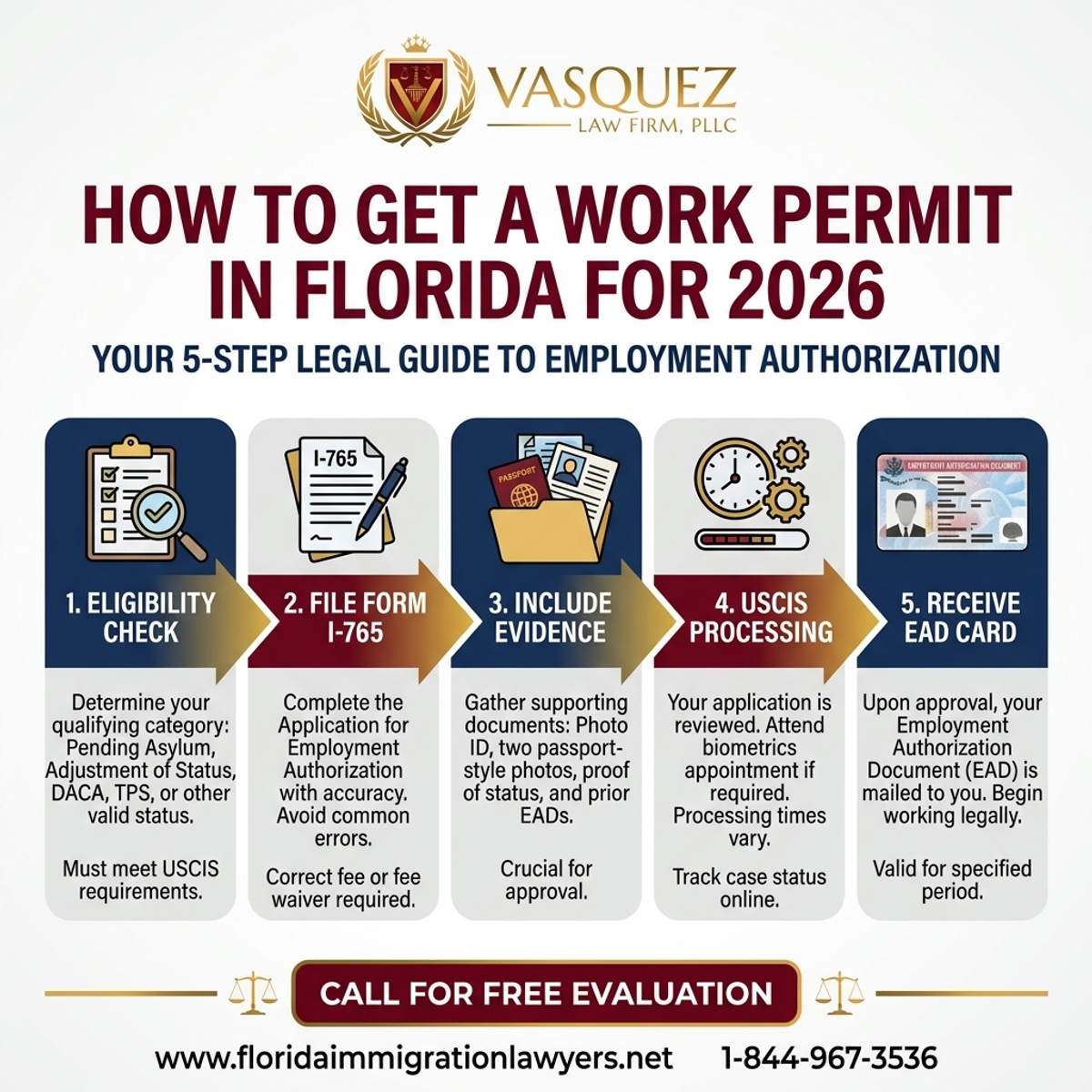
Step-by-Step Process — How to Get a Work Permit in Florida for 2026
Document Checklist for PERM Application
The PERM application process is highly document-intensive, requiring employers to maintain meticulous records of every step taken. A well-organized and complete set of documents is not just a formality; it's the bedrock of a successful application, especially if the DOL decides to conduct an audit.
- Detailed job description
- Prevailing wage determination
- Recruitment advertisements
- Proof of recruitment efforts
- Completed Form ETA 9089
- Employer's financial statements
- Resumes and applications from all U.S. worker applicants
- Interview notes and reasons for rejecting U.S. applicants
- Foreign national's qualifications (transcripts, experience letters)
Ensuring that every piece of documentation is accurately prepared, properly dated, and consistently aligns with the information provided on Form ETA 9089 is critical. Any discrepancies or missing evidence can trigger an audit or lead to a denial. For example, if the job description used for recruitment differs from what's on the ETA 9089, it could raise red flags. Florida Immigration Lawyers can help you compile and review all necessary documents, ensuring your application is robust and audit-ready.
Timeline and Processing Expectations
The PERM labor certification process is known for its lengthy timeline, which can be a source of anxiety for both employers and foreign nationals. Understanding the typical stages and their durations is crucial for managing expectations and strategic planning.
| Stage | Typical Timeframe | Notes |
|---|---|---|
| Prevailing Wage Determination | 2-3 months | Depends on current DOL processing times |
| Recruitment Process | 2+ months | Includes advertising and interviewing |
| PERM Application Review | 6-9 months | Varies based on DOL workload |
| I-140 Petition | 6 months | Post-PERM approval step |
| Adjustment of Status (I-485) or Consular Processing | 6-18 months (or longer depending on visa bulletin) | Final step for green card, varies by country of chargeability and visa availability |
It's important to note that these are typical timeframes, and actual processing times can fluctuate significantly based on factors such as the DOL's current caseload, the complexity of the application, and whether an audit is issued. An audit can add several months, or even over a year, to the PERM processing time. Furthermore, after PERM approval, the I-140 petition can be expedited through premium processing, but this option is not available for the PERM application itself.
Given these variable timelines, proactive planning is essential. Employers and foreign nationals should start the process well in advance of any critical deadlines, such as the expiration of a foreign national's current non-immigrant visa. Consulting with Florida Immigration Lawyers can provide more precise timeline estimates based on current processing trends and help develop a comprehensive strategy to navigate potential delays.
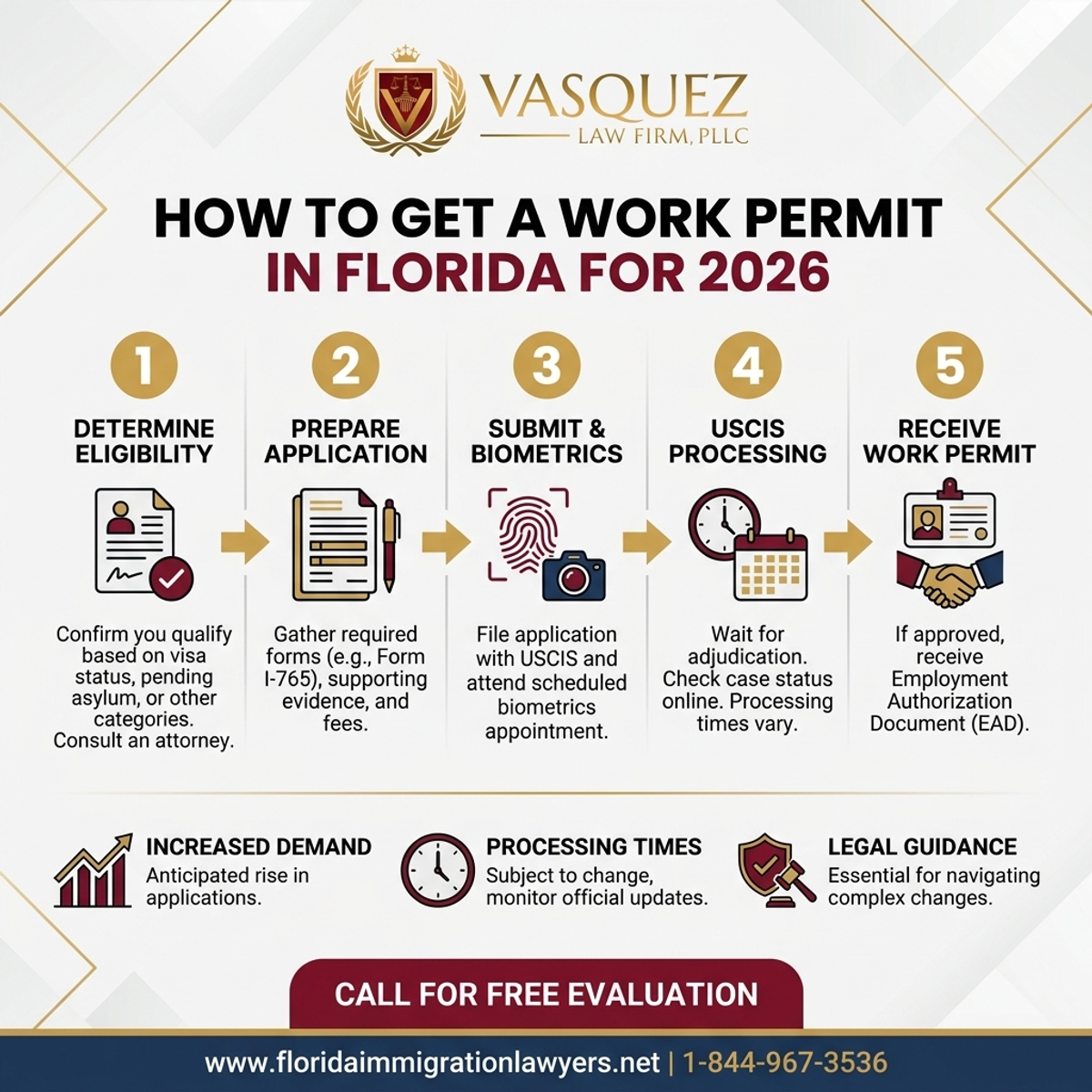
Key Statistics — How to Get a Work Permit in Florida for 2026
Cost Factors and Fee Breakdown
While the PERM labor certification itself does not have a filing fee with the Department of Labor, the overall process involves several significant costs that employers must be prepared to bear. These costs are a necessary investment in securing long-term talent.
| Item | Typical Fee | Notes |
|---|---|---|
| Prevailing Wage Request | Varies | Employer's responsibility |
| Recruitment Costs | Varies | Depends on advertising methods (e.g., newspaper ads, job board subscriptions, professional journal placements). Can range from a few hundred to several thousand dollars. |
| Form ETA 9089 Filing | No fee | For PERM application, but indirect costs apply. |
| Attorney Fees | Varies | Optional but recommended, covering consultation, preparation, filing, and audit response. Typically ranges from $4,000 to $8,000 for PERM. |
| I-140 Petition Filing Fee | $715 (as of 2024) | Paid to USCIS after PERM approval; employer's responsibility. |
| I-485 Adjustment of Status Fee | $1,225 (as of 2024) | Paid to USCIS by the foreign national, includes biometric services. Additional fees for dependents. |
| Medical Examination | Varies | Required for I-485, paid by the foreign national. |
Beyond direct fees, employers should also consider indirect costs such as staff time dedicated to managing the recruitment process, compiling documentation, and communicating with legal counsel. These administrative burdens, while not monetary fees, represent a real cost to the business. It is a common practice for employers to cover most, if not all, of the PERM and I-140 related costs, as these are considered employer-driven processes.
Investing in experienced legal counsel, such as Florida Immigration Lawyers, can ultimately save money by preventing costly errors, delays, or denials that would require re-filing and incur additional expenses. A clear understanding of all potential costs upfront allows for better financial planning and ensures a smoother process for both the employer and the foreign national.
Do not navigate this process alone. Contact Florida Immigration Lawyers today to ensure compliance and increase your chances of success.
Common Mistakes to Avoid
The PERM labor certification process is unforgiving when it comes to errors. Even minor oversights can lead to significant delays, audits, or outright denials, forcing employers to restart the entire lengthy process. Awareness of these common pitfalls is the first step toward avoiding them.
- Inadequate Job Descriptions: Failing to provide detailed job descriptions can lead to application denials. The job description must accurately reflect the duties and minimum requirements for the position, without being overly restrictive or tailored specifically to the foreign national's qualifications. Vague descriptions often trigger audits.
- Ignoring Prevailing Wage Requirements: Offering a wage below the prevailing rate can invalidate the application. The DOL meticulously reviews the wage offered to ensure it meets or exceeds the prevailing wage for that occupation in the specific geographic area. Miscalculating or ignoring this can lead to an immediate denial.
- Insufficient Recruitment Efforts: Not conducting comprehensive recruitment can result in rejection. Employers must demonstrate a good-faith effort to recruit U.S. workers, following all prescribed advertising methods and maintaining thorough documentation of these efforts and their outcomes. Any deviation can be grounds for an audit or denial.
- Missed Deadlines: Timely filing is crucial; missing deadlines can delay the process. Each stage of the PERM process, from the validity of the prevailing wage determination to the timing of recruitment efforts relative to the ETA 9089 filing, has strict deadlines. Missing these can invalidate prior steps.
- Incorrect Form Submission: Ensure all forms are correctly filled and submitted to avoid delays. Errors, omissions, or inconsistencies on Form ETA 9089, even small ones, can lead to Requests for Information (RFIs), audits, or denials. Double-checking every field is essential.
- Lack of Documentation: Failure to provide necessary documentation can lead to denial. Employers must maintain a comprehensive audit file containing all recruitment evidence, resumes of U.S. applicants, interview notes, and justifications for rejections. This file is critical if the DOL requests an audit.
- Not Consulting a Lawyer: Trying to manage the process without legal help can lead to costly errors. The complexity of immigration law, coupled with the strict regulatory framework of PERM, makes professional legal guidance invaluable. An experienced immigration lawyer can identify potential issues before they arise and ensure full compliance.
Avoiding these mistakes requires a deep understanding of PERM regulations and a commitment to meticulous record-keeping. A single misstep can set back the entire green card process by months or even years. This is why engaging with expert legal counsel from Florida Immigration Lawyers is highly recommended to navigate these complexities successfully.
When to Call a Lawyer
Navigating the PERM process can be complex. While some employers might consider managing the initial stages themselves, the intricate details and strict compliance requirements often necessitate professional legal assistance. Recognizing when to consult an immigration lawyer can save significant time, money, and stress.
- Uncertainty about prevailing wage requirements
- Complex recruitment processes
- Previous application denials
- Concerns about meeting deadlines
- Desire to streamline the process
- If your company has never sponsored a foreign worker before
- When facing an audit request from the Department of Labor
- If there are any unique circumstances regarding the job requirements or the foreign national's qualifications
Engaging a lawyer early in the process, rather than waiting until a problem arises, is a proactive approach that significantly increases the chances of a successful outcome. An attorney can help structure the job description correctly, advise on recruitment strategies, ensure accurate wage determinations, and meticulously prepare the application to withstand DOL scrutiny. Florida Immigration Lawyers are here to assist you with every step of your journey, providing peace of mind and expert guidance.
About Florida Immigration Lawyers
Florida Immigration Lawyers is dedicated to helping clients navigate the complexities of immigration law. We offer comprehensive services including PERM labor certifications, asylum applications, deportation defense, and more. Our team is available 24/7 to assist you with personalized legal solutions. Call us at 1-844-967-3536 or visit our website at floridaimmigrationlawyers.net.
With a deep understanding of both federal immigration statutes and the unique economic landscape of Florida, our attorneys provide strategic and effective representation. We pride ourselves on a client-centric approach, ensuring that each case receives the meticulous attention it deserves. Whether you are an employer seeking to secure essential talent or a foreign national aiming for permanent residency, our firm is equipped with the expertise to guide you through every challenge. Our commitment to excellence and our track record of success make us a trusted partner in your immigration journey.
Our team at Florida Immigration Lawyers understands the profound impact immigration decisions have on individuals and businesses. We are not just legal advisors; we are advocates committed to achieving the best possible outcomes for our clients across Naples and the wider Florida region. We invite you to experience the difference that dedicated and knowledgeable legal counsel can make.
Sources and References
- U.S. Citizenship and Immigration Services (USCIS)
- Executive Office for Immigration Review (EOIR)
- 8 U.S.C. Chapter 12 - Immigration and Nationality Act
- U.S. Department of Labor (DOL) - Foreign Labor Certification
Related services: H-1B specialty occupation visas, L-1 intracompany transfer visas, work visas for professionals.
This article provides general legal information and is not intended as legal advice. Every case is unique, and outcomes depend on specific facts and circumstances. Contact an attorney for advice about your particular situation.
Ready to take the next step in your immigration journey? Contact Florida Immigration Lawyers at 1-844-967-3536 for a free consultation. Se Habla Espanol - Estamos aqui para ayudarle.
If you need legal assistance, learn more about how our business immigration attorneys can help, or call us at 1-844-967-3536 for a free consultation.
Do Not Navigate This Process Alone
Our experienced immigration attorneys are ready to fight for you. Get a free, confidential case review today.
Se Habla Español
Or leave your details and we’ll call you:
Free Evaluation in 24 Hours
Or talk to us right now

AI voice assistant — available 24/7
FreeFrequently Asked Questions

William J. Vásquez
Founding Attorney · Vasquez Law Firm
U.S. Air Force veteran and immigration attorney with years of hands-on U.S. immigration experience. J.D., NCCU School of Law. AILA member. Admitted to the 4th, 5th, and 11th Circuit Courts.
Available 24/7 - Free Evaluations
Reviewed for legal accuracy by William J. Vásquez
Licensed in North Carolina; U.S. immigration is federal practice.
Related Legal Services
Our Florida immigration attorneys can help you with asylum protection, citizenship and naturalization and immigration practice areas. Call today at 1-844-YO-PELEO for a free case review.
Related Links
Related Topics
Free Legal Case Review
Discuss your case with our experienced attorneys. We're available 24/7.
Se Habla Español - Estamos aquí para ayudarle.
Related Articles
Immigration Lawyer Orlando Free Consultation in Florida
For individuals and families in Orlando, Florida, navigating the complexities of U.S. immigration law requires expert guidance. An immigration lawyer in Orlando offers crucial support for everything from visa applications and green card processes to naturalization and deportation defense. This comprehensive guide details what a free consultation covers, providing a step-by-step overview of immigration pathways, essential document checklists, and expected timelines in 2026. We also highlight common mistakes to avoid, discuss the critical role of legal counsel in deportation and asylum cases, and explain why choosing a local Orlando immigration attorney is beneficial. Florida Immigration Lawyers is dedicated to serving the diverse community of Orlando with compassionate, effective legal solutions, ensuring you receive personalized advice and robust representation for a successful immigration journey.
Dual Citizenship Lawyer: Interview Tips in Florida
Navigating the citizenship interview process in Florida can be challenging. Learn essential tips and common pitfalls to ensure a successful naturalization process. Whether you're in Orlando or elsewhere, preparing effectively can make a significant difference. Florida Immigration Lawyers offers expert guidance and support to help you achieve your citizenship goals. Call us at 1-844-967-3536 for a free consultation.
Immigration Rights: Know Your Protections in Florida 2026
Understanding your immigration rights in Florida is paramount for your protection and peace of mind. This comprehensive guide details your core constitutional protections, including the right to remain silent and the right to an attorney, regardless of your immigration status. Learn essential strategies for interacting with ICE, what vital documents to carry, and a step-by-step overview of the immigration detention and removal process in Florida. We also cover common mistakes to avoid and when it's crucial to seek expert legal counsel. Florida Immigration Lawyers are dedicated to empowering you with the knowledge and support needed to navigate complex immigration challenges. Our firm offers free case reviews and serves clients across the entire state, ensuring you have access to experienced legal representation when you need it most.
EAD Advance Parole Combo Card: A Guide for Military
For military families in Florida, the EAD Advance Parole Combo Card is a pivotal document, combining work authorization and travel permission for non-citizen family members applying for a green card. This guide from Florida Immigration Lawyers explores how Parole in Place (PIP) paves the way for this card, detailing eligibility, required documents, and processing timelines. We cover the financial aspects, including potential fee waivers for military families, and highlight the critical importance of avoiding common mistakes like traveling without approved advance parole. Understanding these complex immigration benefits is crucial for maintaining family unity and stability while a loved one serves our nation. Our firm is dedicated to providing expert legal assistance to ensure a smooth and successful immigration journey for military families across Florida, from Orlando to every corner of the state. Learn how this essential card can provide peace of mind and flexibility during the adjustment of status process.