Work Permit EAD Application Process in Florida 2026
Applying for a work permit, or Employment Authorization Document (EAD), in Florida is a crucial step for many non-citizens seeking to work legally in the U.S. This comprehensive guide from Florida Immigration Lawyers details the 2026 application process, including eligibility criteria, necessary documentation for Form I-765, typical processing times, and associated costs. We highlight the importance of accurate submission and offer insights into common pitfalls to avoid. Our firm, based in Orlando, Florida, provides expert legal assistance for asylum seekers, adjustment of status applicants, and other eligible individuals. Learn how to prepare for your EAD application and understand when professional legal counsel can make a significant difference in achieving a successful outcome. Secure your right to work with knowledgeable support.
Applying for a work permit, also known as an Employment Authorization Document (EAD) or Form I-765, in Florida allows eligible non-citizens to legally work in the United States. As of 2026, the process typically involves determining your eligibility category, gathering necessary documents, completing Form I-765, and submitting it to USCIS along with the required fees and supporting evidence. Processing times can vary significantly based on the service center and your specific immigration status, often ranging from several months to over a year. Seeking legal guidance from an experienced immigration attorney in Orlando, Florida, can help ensure your application is complete and accurate, minimizing delays and potential issues.
- Eligibility for an EAD depends on your immigration status, such as asylum seeker, TPS recipient, or certain visa holders.
- The primary form for a work permit is Form I-765, Application for Employment Authorization.
- Accurate documentation and timely submission are crucial for a successful application.
- Processing times are variable, so early application is always recommended.
- Consulting an immigration lawyer can streamline the complex application process.
Navigating the complex landscape of U.S. immigration law can be a daunting task, especially when your ability to work and support yourself and your family is at stake. For many non-citizens in Florida, obtaining a work permit, officially known as an Employment Authorization Document (EAD), is a critical step towards achieving stability and independence. Whether you are an asylum applicant, a recipient of Temporary Protected Status (TPS), or a spouse of a U.S. citizen awaiting a green card, understanding the EAD application process is essential. Florida Immigration Lawyers is here to guide you through every stage, ensuring your application is meticulously prepared and submitted.
This comprehensive guide will walk you through the intricacies of applying for a work permit in Florida as of 2026. We will cover eligibility requirements, the step-by-step application process for Form I-765, necessary documentation, typical timelines, and associated costs. Our goal is to demystify the process and provide you with actionable insights to help you secure your employment authorization. Do not face this journey alone; our dedicated team in Orlando, Florida, is ready to assist. Call Florida Immigration Lawyers at 1-844-YO-PELEO for a free case review and let us help you achieve your goals.
What is an Employment Authorization Document (EAD) and Who is Eligible?
An Employment Authorization Document (EAD), commonly referred to as a work permit, is a card issued by U.S. Citizenship and Immigration Services (USCIS) that provides temporary authorization for certain non-citizens to work legally in the United States. This document is crucial for individuals who are not U.S. citizens or lawful permanent residents (green card holders) but are authorized to be employed in the U.S. The EAD card typically displays the individual's photo, name, and validity period, serving as proof of their eligibility to work.
Eligibility for an EAD is not universal; it is granted to specific categories of non-citizens based on their immigration status. As of 2026, common categories include asylum applicants, refugees, individuals granted Temporary Protected Status (TPS), certain non-immigrants with dependent status (like spouses of E or L visa holders), students with specific practical training authorizations (OPT), and individuals with pending adjustment of status applications. For instance, if you have a pending family-based green card application (Form I-485), you are typically eligible to apply for an EAD concurrently. Understanding your specific eligibility category is the first and most vital step in the application process, as it dictates the required documentation and procedures. USCIS lists all eligible categories on its website, which can be found at USCIS Form I-765 instructions. Our attorneys can help you identify if you qualify under one of these categories and ensure you meet all the specific criteria.
How Do I Apply for a Work Permit in Florida? A Step-by-Step Guide
Applying for a work permit in Florida, regardless of your specific location like Orlando or elsewhere in Central Florida, follows a standardized federal process centered around Form I-765. The application requires careful attention to detail and adherence to specific instructions to avoid delays or rejections. As of 2026, the general steps outlined below are critical for a successful submission. Our attorneys at Florida Immigration Lawyers regularly assist clients across the state with this process.
- Determine Your Eligibility Category: Before anything else, confirm that you fall into one of the eligible categories for an EAD. This is crucial because your category (e.g., (c)(8) for asylum applicants, (c)(9) for adjustment of status applicants, (a)(12) for TPS) dictates which documents you need and any specific filing instructions. Review the USCIS Form I-765 instructions thoroughly or consult with an immigration attorney to verify your eligibility.
- Gather Required Documents: Collect all necessary supporting evidence. This typically includes proof of identity, immigration status, photographs, and any documents specific to your eligibility category. A detailed checklist is provided in a later section. Ensure all documents are current and accurately reflect your information.
- Complete Form I-765, Application for Employment Authorization: Fill out the Form I-765 completely and accurately. Pay close attention to every field, especially your personal information, address, and eligibility category. Any errors or omissions can lead to significant delays or a Request for Evidence (RFE). If you have previously held an EAD, ensure you provide that information.
- Prepare Supporting Evidence: Attach all supporting documents as required by your eligibility category. This might include copies of your passport, I-94 arrival/departure record, previous EADs, marriage certificates, birth certificates, asylum application receipts, or TPS designation notices. Organize your documents clearly.
- Calculate and Prepare Filing Fees: As of 2026, USCIS fees are subject to change, so always check the latest fee schedule on the USCIS website. Some categories may be exempt from fees, or you might be eligible for a fee waiver. If a fee is required, submit a check or money order payable to "U.S. Department of Homeland Security." Do not send cash.
- Assemble and Mail Your Application: Organize your application package according to USCIS guidelines. This typically means placing the check on top, followed by Form I-765, and then supporting documents. Mail your complete package to the correct USCIS lockbox facility. The address depends on your eligibility category and where you live. For applicants in Florida, this usually means a lockbox in Texas or Arizona, but always confirm the current address on the USCIS website or in the I-765 instructions.
- Receive Receipt Notice: After USCIS receives your application, they will send you a Form I-797C, Notice of Action, confirming receipt. This notice will contain your receipt number, which you can use to track the status of your case online. Keep this notice in a safe place.
- Attend Biometrics Appointment (if required): Some applicants may receive an appointment notice for biometrics (fingerprints, photos, and signature) at a local Application Support Center (ASC). For Floridians, this could be the Orlando, Miami, or Jacksonville ASC. Attend this appointment as scheduled.
- Respond to Requests for Evidence (RFEs) or Notices of Intent to Deny (NOIDs): If USCIS needs more information, they will send an RFE. If they intend to deny your application, they will send a NOID. It is crucial to respond promptly and thoroughly to these notices. Failing to do so can result in a denial.
- Receive Decision: USCIS will mail you a decision notice. If approved, you will receive your EAD card shortly thereafter. If denied, the notice will explain the reasons, and you may have options to appeal or refile.
What Documents Do I Need for My Florida Work Permit Application?
The specific documents required for your work permit application (Form I-765) in Florida will depend heavily on your eligibility category. However, there is a core set of documents that most applicants will need, along with category-specific evidence. Ensuring you have all these documents prepared and accurately copied is vital for a smooth process. Missing or incorrect documentation is a leading cause of delays and Requests for Evidence (RFEs).
- Form I-765, Application for Employment Authorization: The original, completed, and signed form.
- Two Passport-Style Photographs: Taken within 30 days of filing, unmounted, full frontal view, white background, 2x2 inches.
- Copy of Form I-94, Arrival/Departure Record: Proof of your last lawful admission to the U.S.
- Copy of Current Government-Issued Photo Identification: Such as a passport identity page, national identity card, or driver's license (if applicable and valid).
- Copy of Previous EAD Card (if applicable): Front and back.
- Proof of Identity: E.g., birth certificate with photo ID, or a passport.
- Evidence of Eligibility Category: This is where documents vary significantly:
- Asylum Applicants (c)(8): Copy of Form I-589 (Asylum Application) receipt notice or a copy of the immigration judge's order granting asylum.
- Adjustment of Status Applicants (c)(9): Copy of Form I-485 (Adjustment of Status) receipt notice.
- TPS Beneficiaries (a)(12) or (c)(19): Copy of your Form I-797 approval notice for TPS or a copy of your most recent EAD under TPS.
- Spouses of E or L Visa Holders (a)(17), (a)(18): Copy of your spouse's E or L visa, and your marriage certificate.
- F-1 OPT Students (c)(3)(A), (B), (C): Copy of Form I-20 endorsed by your Designated School Official (DSO) for OPT, academic transcripts.
- Fee Waiver Request (Form I-912, if applicable): If you cannot afford the filing fees.
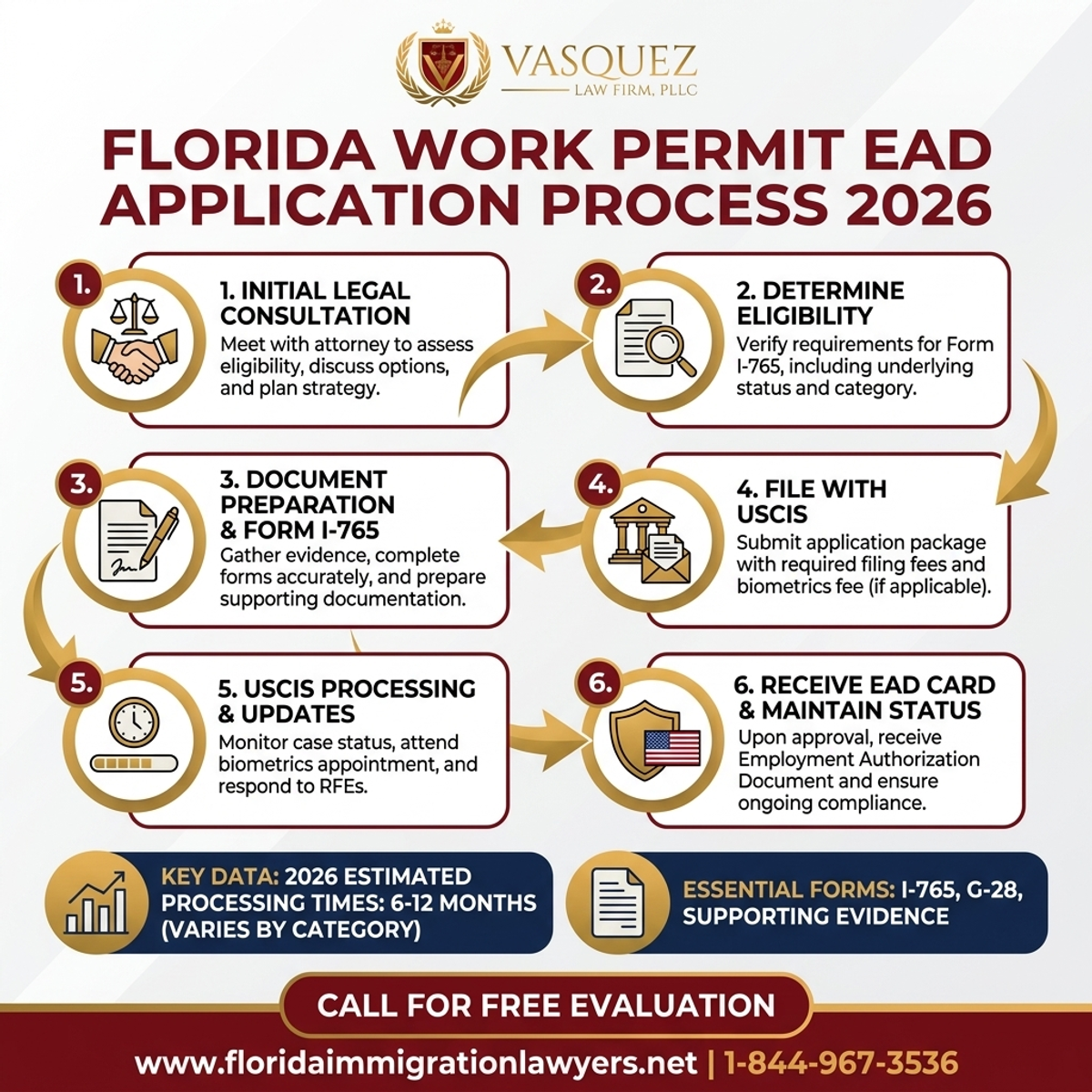
Step-by-Step Process — Work Permit EAD Application Process in Florida 2026
It is always recommended to make copies of all documents you submit for your own records. When sending copies, ensure they are clear and legible. Do not send original documents unless specifically requested by USCIS, as they may not be returned.
How Long Does a Work Permit (EAD) Application Take in Florida in 2026?
The processing time for an Employment Authorization Document (EAD) application (Form I-765) in Florida can vary significantly, ranging from a few months to over a year, depending on several factors as of 2026. These factors include the USCIS service center processing your application, your specific eligibility category, the current workload of USCIS, and whether you have submitted a complete and accurate application package. For instance, some categories like asylum applicants may experience longer wait times compared to those filing concurrently with an adjustment of status application.
USCIS regularly updates its processing times online for different form types and service centers. Applicants in Florida will have their cases routed to various service centers, such as the Texas Service Center or Nebraska Service Center, depending on the form type and category. It is essential to check the most current information available on the USCIS processing times page. While these times serve as estimates, they provide a general idea of what to expect. Delays can occur due to Requests for Evidence (RFEs), background checks, or general backlogs. Our firm advises clients to apply well in advance of any current EAD expiration to avoid gaps in employment authorization.
| Stage | Typical Timeframe (As of 2026) | Notes |
|---|---|---|
| Application Submission to Receipt Notice | 1-4 weeks | USCIS sends Form I-797C, Notice of Action, with your receipt number. |
| Biometrics Appointment (if required) | 3-8 weeks after receipt notice | Scheduled at a local Application Support Center (ASC) in Florida (e.g., Orlando, Miami). |
| Case Review and Decision | 3 months - 18+ months | Highly variable based on eligibility category and service center workload. Check USCIS processing times. |
| EAD Card Production and Mailing | 1-2 weeks after approval | Once approved, the EAD card is produced and mailed to your address. |
| Total Processing Time | 4 months - 20+ months | This is an estimated range; actual times may be shorter or longer. |
What Are the Costs Associated with a Work Permit (EAD) Application?
Applying for a work permit (Form I-765) involves specific filing fees set by U.S. Citizenship and Immigration Services (USCIS). As of 2026, these fees are subject to change, and it is crucial to verify the most current amounts directly on the USCIS website or with an immigration attorney before filing. The cost can vary based on whether you are filing Form I-765 alone or concurrently with another application, such as Form I-485 for adjustment of status.
In many cases, if you are filing Form I-765 concurrently with a Form I-485, Application to Register Permanent Residence or Adjust Status, the EAD filing fee may be included in the I-485 fee. However, if you are filing Form I-765 as a standalone application, a separate fee is typically required. Certain categories of applicants, such as those filing as asylum applicants (c)(8) or for Temporary Protected Status (TPS), may be exempt from the filing fee or eligible to apply for a fee waiver using Form I-912, Request for Fee Waiver. Eligibility for a fee waiver is based on specific income guidelines or receipt of means-tested benefits. Our firm can help you determine if you qualify for an exemption or waiver, potentially saving you significant costs.
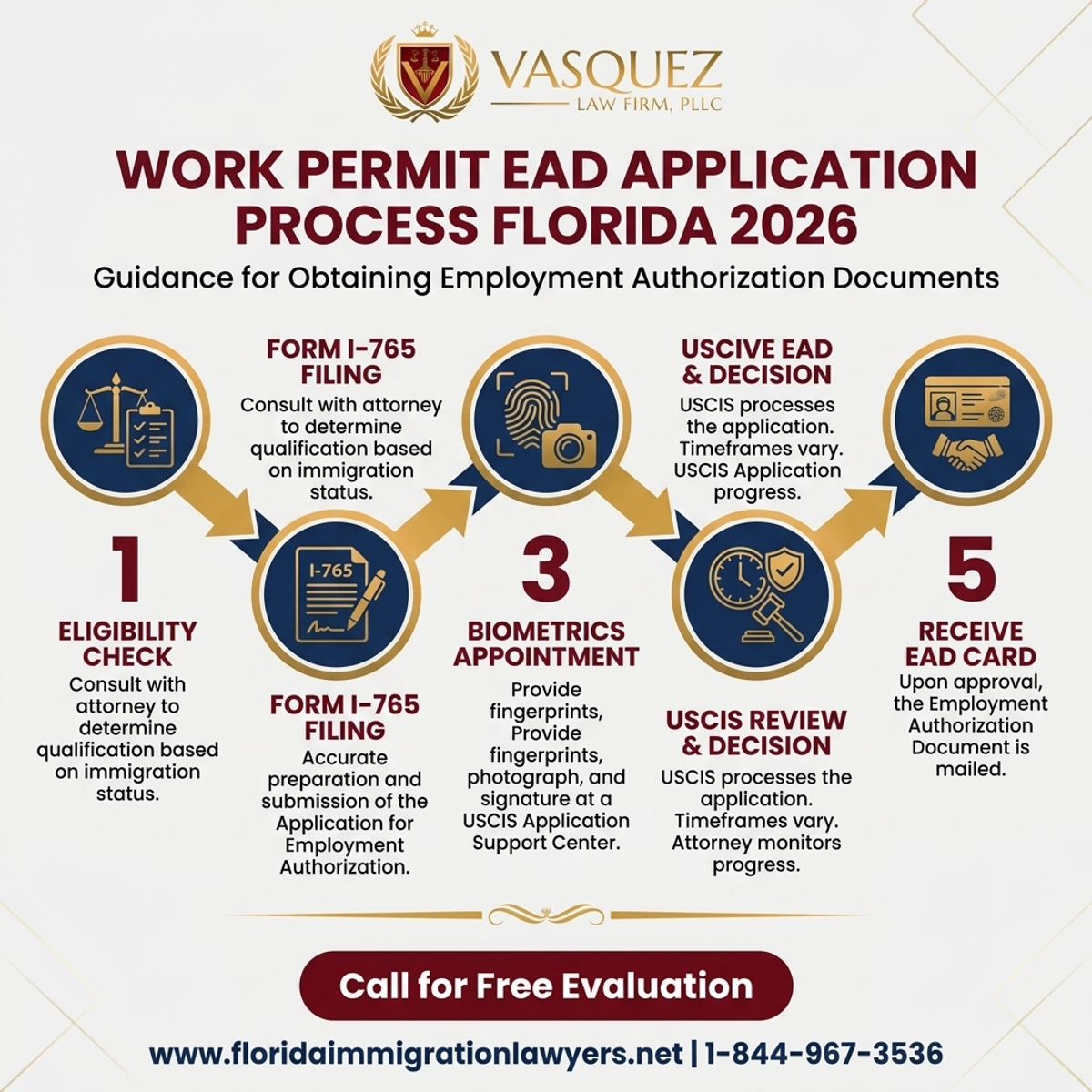
Key Statistics — Work Permit EAD Application Process in Florida 2026
| Item | Typical Fee (As of 2026 - Subject to Change) | Notes |
|---|---|---|
| Form I-765 Filing Fee | Variable (e.g., ~$410 - ~$555) | Check the latest USCIS fee schedule. May be included with Form I-485 fee for some categories. |
| Biometrics Services Fee | Variable (e.g., ~$85) | Required for most applicants, but sometimes included in the I-765 or I-485 fee. |
| Attorney Fees | Varies by case complexity and firm | Covers legal counsel, document preparation, and representation. Florida Immigration Lawyers offers free initial consultations. |
| Passport Photos | $10-$20 | Professional photos are recommended to meet USCIS specifications. |
| Postage/Shipping | $5-$30 | Recommended to use a trackable mailing service. |
Understanding EAD Renewal and Extensions in Florida
For many individuals in Florida, obtaining an initial work permit is just the first step; maintaining continuous employment authorization requires understanding the renewal and extension process. An EAD is typically issued for a specific period, often one or two years, and it is crucial to apply for a renewal well in advance of its expiration date to avoid any gaps in your legal ability to work. As of 2026, USCIS generally recommends filing for EAD renewal approximately 180 days (6 months) before your current card expires.
The renewal process largely mirrors the initial application, requiring you to file a new Form I-765, along with updated supporting documentation and the applicable filing fee (unless eligible for a waiver). The eligibility category for your renewal must be the same as your initial EAD, or you must demonstrate a new basis for eligibility. For example, if your initial EAD was based on a pending asylum application, your renewal will also be based on the continued pendency of that application. Recent policy changes, such as the automatic extension of certain EAD categories, can provide a temporary work authorization while your renewal application is pending. For instance, some categories may receive an automatic extension of up to 540 days if they file Form I-765 on time and their eligibility category is covered. You can find detailed information on automatic EAD extensions on the USCIS website. It is important to confirm if your specific category qualifies for such an extension, as this can be a lifesaver for continued employment. Our team at Florida Immigration Lawyers keeps abreast of all these regulatory updates to provide accurate advice to our clients in Orlando and throughout Florida.
Common Mistakes to Avoid When Applying for a Work Permit
Applying for a work permit in Florida can be complex, and even minor errors can lead to significant delays or outright denial of your application. Avoiding these common mistakes is crucial for a smooth and successful process.
- Failing to Determine Correct Eligibility Category: Many applicants mistakenly select the wrong eligibility category on Form I-765. Each category has specific requirements, and choosing the incorrect one will result in a denial. Always double-check your status against USCIS guidelines.
- Incomplete or Inaccurate Form I-765: Leaving fields blank, providing inconsistent information, or failing to sign the form are common errors. Every question must be answered truthfully and completely. An unsigned form will be rejected.
- Submitting Insufficient or Incorrect Supporting Documents: Failing to include all required evidence for your specific category, or submitting blurry, unreadable copies, will trigger a Request for Evidence (RFE) or denial. Always provide clear copies and ensure they match your application.
- Missing Filing Fees or Incorrect Payment: Sending the wrong fee amount, forgetting to include the fee, or sending an expired check can cause your application to be rejected. Verify the current fee on the USCIS website and ensure your payment method is correct.
- Filing with an Expired or Invalid Immigration Status: If your underlying immigration status that grants EAD eligibility has expired or is no longer valid, your EAD application will be denied. Ensure your status is current or that you have a pending application that extends your status.
- Not Filing for Renewal in Time: Waiting until your current EAD is about to expire to file for renewal can lead to a lapse in employment authorization. USCIS recommends filing 180 days in advance to take advantage of potential automatic extensions.
- Failing to Update Address with USCIS: If you move and do not update your address with USCIS via Form AR-11, you may miss important notices, RFEs, or even your EAD card. This can lead to significant problems and delays.
- Not Responding to Requests for Evidence (RFEs) Promptly: Ignoring an RFE or providing an incomplete response within the given timeframe will almost certainly lead to a denial. Address all points raised in the RFE thoroughly and on time.
- Sending Original Documents: Unless specifically requested, never send original birth certificates, marriage certificates, or passports. Always send clear photocopies. Originals may not be returned.
- Misunderstanding Automatic EAD Extensions: Assuming your EAD is automatically extended without verifying your eligibility category and filing requirements can lead to unauthorized employment. Not all categories qualify for automatic extensions, and specific conditions apply.
When to Call a Florida Immigration Lawyer for Your EAD Application
While the process of applying for a work permit (EAD) may seem straightforward, it often involves complex legal nuances that can significantly impact your eligibility and the outcome of your application. Knowing when to seek professional legal assistance can save you time, stress, and potential setbacks. Florida Immigration Lawyers is here to provide expert guidance for individuals throughout Florida, including Orlando and surrounding areas.
You should consider calling an immigration lawyer if you:
- Are Unsure About Your Eligibility: If your immigration status is complex, or you are unsure which EAD category applies to you, an attorney can assess your situation and confirm your eligibility.
- Have a Criminal Record: Any past arrests or convictions, even minor ones, can complicate your application and potentially lead to denial. An attorney can advise on how to address these issues.
- Have Previous Immigration Violations: Overstays, unauthorized employment, or prior denials can make your EAD application much riskier. Legal counsel is essential to navigate these challenges.
- Received a Request for Evidence (RFE) or Notice of Intent to Deny (NOID): These notices require a precise and timely response. An attorney can help you gather the necessary evidence and craft a compelling reply.
- Have an Expiring EAD and Need to Renew: To ensure continuous work authorization and understand any automatic extension policies, an attorney can help you file your renewal application promptly and correctly.
- Are Experiencing Delays: If your application is taking longer than the posted USCIS processing times, an attorney can inquire with USCIS on your behalf and explore potential remedies.
- Are Applying for a Fee Waiver: An attorney can help you determine if you qualify for a fee waiver and assist with preparing the necessary documentation (Form I-912).
Our attorneys specialize in a wide range of immigration services, including asylum applications, deportation defense, and citizenship pathways, all of which may involve EAD applications. We serve clients across all of Florida, from our base in Central Florida, providing personalized and diligent representation.
About Florida Immigration Lawyers
Florida Immigration Lawyers is a leading law firm dedicated to providing comprehensive and compassionate immigration legal services across the entire state of Florida. From our office in Central Florida, we proudly serve individuals and families navigating the complexities of U.S. immigration law, including those seeking a work permit. Our team of experienced and multilingual attorneys understands the profound impact immigration matters have on our clients' lives and is committed to delivering personalized, effective, and ethical representation.
We offer a wide array of services, including family-based immigration, employment-based visas, naturalization, asylum, and deportation defense. Our firm is built on a foundation of trust, integrity, and a deep understanding of both federal immigration statutes, such as the Immigration and Nationality Act (INA), and the specific challenges faced by immigrants in Florida. We are available 24/7 to address your urgent legal needs and offer free case reviews to help you understand your options without financial commitment. Choosing Florida Immigration Lawyers means choosing a partner who will fight tirelessly for your rights and guide you every step of the way.
Sources and References
- U.S. Citizenship and Immigration Services (USCIS)
- USCIS Form I-765, Application for Employment Authorization
- USCIS Check Case Processing Times
- Executive Office for Immigration Review (EOIR)
- Immigration and Nationality Act (INA) - 8 U.S.C. Chapter 12
- 8 CFR Part 274a - Control of Employment of Aliens
Related services: H-1B specialty occupation visas, L-1 intracompany transfer visas, work visas for professionals, investment and entrepreneur visas.
This article provides general legal information and is not intended as legal advice. Every case is unique, and outcomes depend on specific facts and circumstances. Contact an attorney for advice about your particular situation.
Securing your work permit is a vital step towards building a stable future in Florida. Do not let the complexities of the immigration system overwhelm you. Our dedicated legal team is ready to provide the guidance and representation you need to navigate this process successfully. Contact Florida Immigration Lawyers today for your free case review at 1-844-YO-PELEO. Se Habla Espanol - Estamos aqui para ayudarle.
If you need legal assistance, learn more about learn about business immigration options, or call us at 1-844-967-3536 for a free case review.
Do Not Navigate This Process Alone
Our experienced immigration attorneys are ready to fight for you. Get a free, confidential case review today.
Se Habla Español
Or leave your details and we’ll call you:
Free Evaluation in 24 Hours
Or talk to us right now

AI voice assistant — available 24/7
FreeFrequently Asked Questions

William J. Vásquez
Founding Attorney · Vasquez Law Firm
U.S. Air Force veteran and immigration attorney with years of hands-on U.S. immigration experience. J.D., NCCU School of Law. AILA member. Admitted to the 4th, 5th, and 11th Circuit Courts.
Available 24/7 - Free Evaluations
Reviewed for legal accuracy by William J. Vásquez
Licensed in North Carolina; U.S. immigration is federal practice.
Related Legal Services
Our Florida immigration attorneys can help you with deportation defense, family immigration services and immigration lawyer cost in Florida. Call today at 1-844-YO-PELEO for a free case review.
Related Links
Related Topics
Free Legal Case Review
Discuss your case with our experienced attorneys. We're available 24/7.
Se Habla Español - Estamos aquí para ayudarle.
Related Articles
Certificate of Eligibility for Expungement in Florida 2026
For non-U.S. citizens in Florida, understanding how a state expungement impacts immigration status is critical. A certificate of eligibility for expungement in Florida allows a criminal record to be sealed or expunged under state law. However, federal immigration agencies often disregard such state-level relief, still considering the original criminal offense as a conviction for immigration purposes. This can have severe implications for visa applications, green card eligibility, naturalization, and even lead to deportation. This guide clarifies the Florida expungement process, its limited effect on federal immigration law, and key steps to protect your status in 2026. Learn about common mistakes, required documents, timelines, and when to seek expert legal counsel from Florida Immigration Lawyers to navigate these complex issues effectively.
Immigration Lawyer Orlando Free Consultation in Florida
For individuals and families in Orlando, Florida, navigating the complexities of U.S. immigration law requires expert guidance. An immigration lawyer in Orlando offers crucial support for everything from visa applications and green card processes to naturalization and deportation defense. This comprehensive guide details what a free consultation covers, providing a step-by-step overview of immigration pathways, essential document checklists, and expected timelines in 2026. We also highlight common mistakes to avoid, discuss the critical role of legal counsel in deportation and asylum cases, and explain why choosing a local Orlando immigration attorney is beneficial. Florida Immigration Lawyers is dedicated to serving the diverse community of Orlando with compassionate, effective legal solutions, ensuring you receive personalized advice and robust representation for a successful immigration journey.
Change of Status B-2 to F-1 in Florida: Key Steps
Changing your status from a B-2 tourist visa to an F-1 student visa in Florida involves several crucial steps. This guide provides a comprehensive overview, including the 2026 I-539 processing times, document requirements, and common pitfalls to avoid. Learn how to navigate the process effectively with help from Florida Immigration Lawyers.
TN Visa for Florida Professionals in 2026
The TN visa, under the USMCA, offers a unique opportunity for Canadian and Mexican professionals to work in the United States, particularly in Florida's thriving economy. This detailed guide for 2026 covers everything from eligibility requirements and the specific list of designated professions to the step-by-step application process for both Canadian citizens at ports of entry and Mexican citizens through consular processing. We delve into essential documentation, processing timelines, and associated costs, providing tables for clarity. Additionally, we highlight common mistakes to avoid during the application to ensure a smooth journey. For those considering a professional move to Central Florida, understanding these intricacies is crucial. Florida Immigration Lawyers offers expert guidance to navigate these processes, ensuring compliance and maximizing your chances of success. Discover how to leverage the TN visa for your career in Florida.