Change of Status B-2 to F-1 in Florida: Key Steps
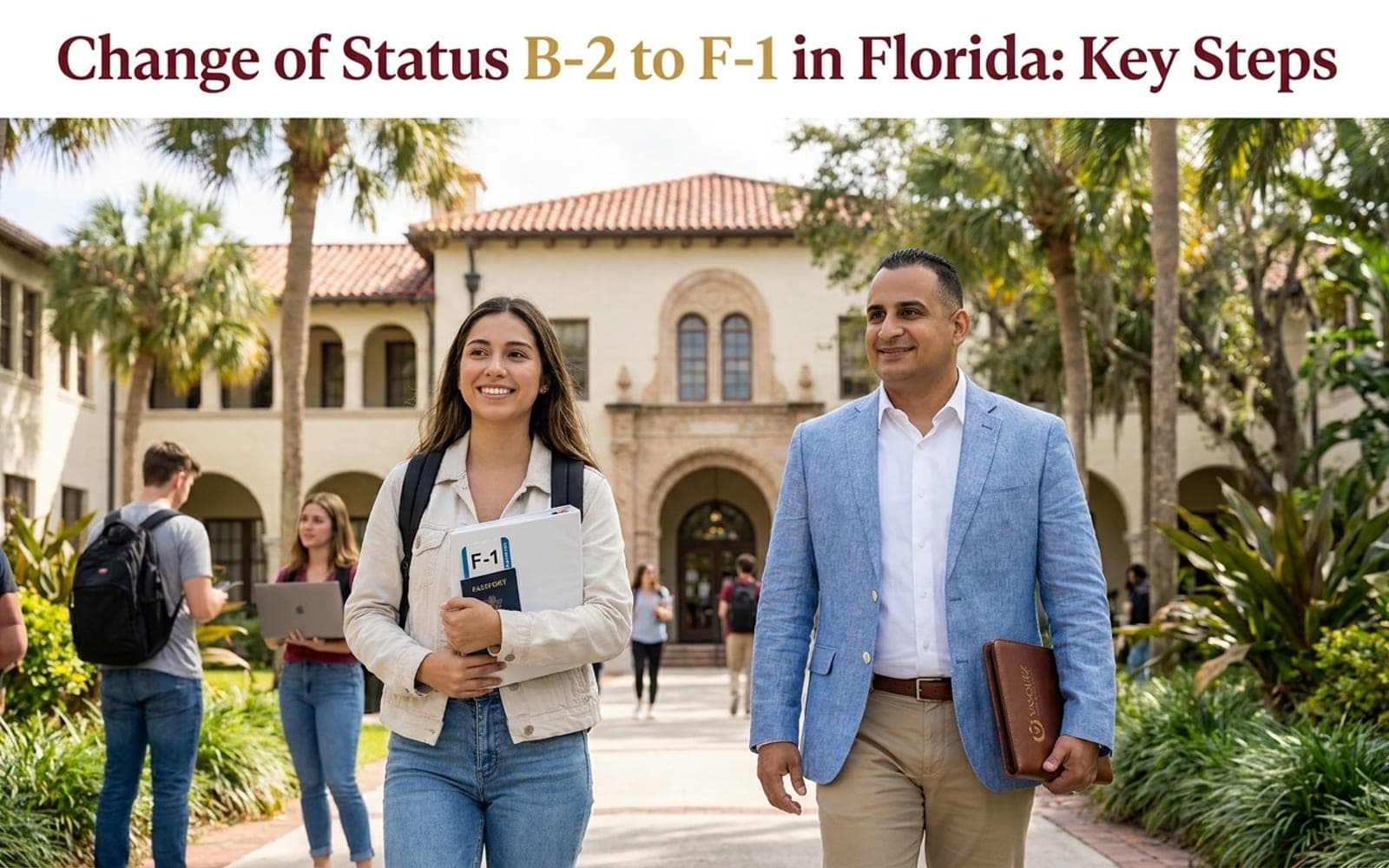
Changing your status from a B-2 tourist visa to an F-1 student visa in Florida involves several crucial steps. This guide provides a comprehensive overview, including the 2026 I-539 processing times, document requirements, and common pitfalls to avoid. Learn how to navigate the process effectively with help from Florida Immigration Lawyers.
- Understand eligibility requirements.
- File Form I-539 correctly.
- Expect processing to take several months.
Introduction
Imagine arriving in sunny Orlando, Florida, on a B-2 tourist visa, captivated by the state’s vibrant culture and educational opportunities. You decide to pursue a degree, but how do you transition from a tourist to a student while staying compliant with U.S. immigration laws? This guide will walk you through the process of changing your status from a B-2 to an F-1 visa in Florida, including the steps involved and common pitfalls to avoid. Call Florida Immigration Lawyers at 1-844-YO-PELEO for a free case review.
Florida, with its diverse universities, research institutions, and community colleges, presents an attractive destination for international students. However, the dream of studying here requires careful navigation of immigration regulations. The process of changing your non-immigrant status from a B-2 visitor to an F-1 student is a common pathway, but it demands meticulous attention to detail and strict adherence to USCIS guidelines.
Understanding the nuances of maintaining legal status, demonstrating proper intent, and submitting a comprehensive application package is paramount. This guide aims to demystify the process, offering practical advice and highlighting crucial considerations to help you achieve your academic goals in the Sunshine State without jeopardizing your immigration standing. Our experienced team at Florida Immigration Lawyers is here to ensure a smooth transition for you.
What is the 2026 I-539 H-4 Change of Status Processing Time in Months?
As of 2026, processing times for the I-539 form, used to change status such as from H-4 to F-1, can range from several months to over a year. Factors influencing this include the applicant’s specific circumstances and USCIS workload. Always check the USCIS website for the most current processing times.
In Florida, especially in areas like Orlando, processing times may align with national averages but can vary based on specific local USCIS office capabilities. It's crucial to understand that while the question specifically mentions H-4, the I-539 form is utilized for various changes of status, including B-2 to F-1. The underlying factors affecting processing times, such as the volume of applications at a specific service center, the complexity of individual cases, and the completeness of submitted documentation, remain consistent across different change of status requests.
Applicants should regularly monitor the USCIS website's 'Check Case Processing Times' tool, as these estimates are dynamic and can fluctuate significantly. For instance, a sudden surge in applications or policy changes can impact wait times. It's also important to differentiate between the time it takes to receive a receipt notice and the final adjudication. A Request for Evidence (RFE) can further extend the processing period, underscoring the importance of a thorough and accurate initial submission. Consulting with Florida Immigration Lawyers can help you prepare for these potential delays and ensure your application is as robust as possible.
How to Change Status from B-2 to F-1 in Florida?
To change your status from a B-2 to F-1, you must file Form I-539 with the USCIS. Key steps include:
- Check Eligibility: Ensure you have not violated any terms of your current B-2 visa.
- Form I-539: Complete and submit this form with required documents, including proof of acceptance to a SEVP-approved school.
- Supporting Documentation: Include financial statements, intent to return to your home country, and other relevant documents.
- Pay Fees: The application involves certain fees, payable to USCIS.
- Await Decision: Processing can take several months. You will receive a notification of the decision by mail.
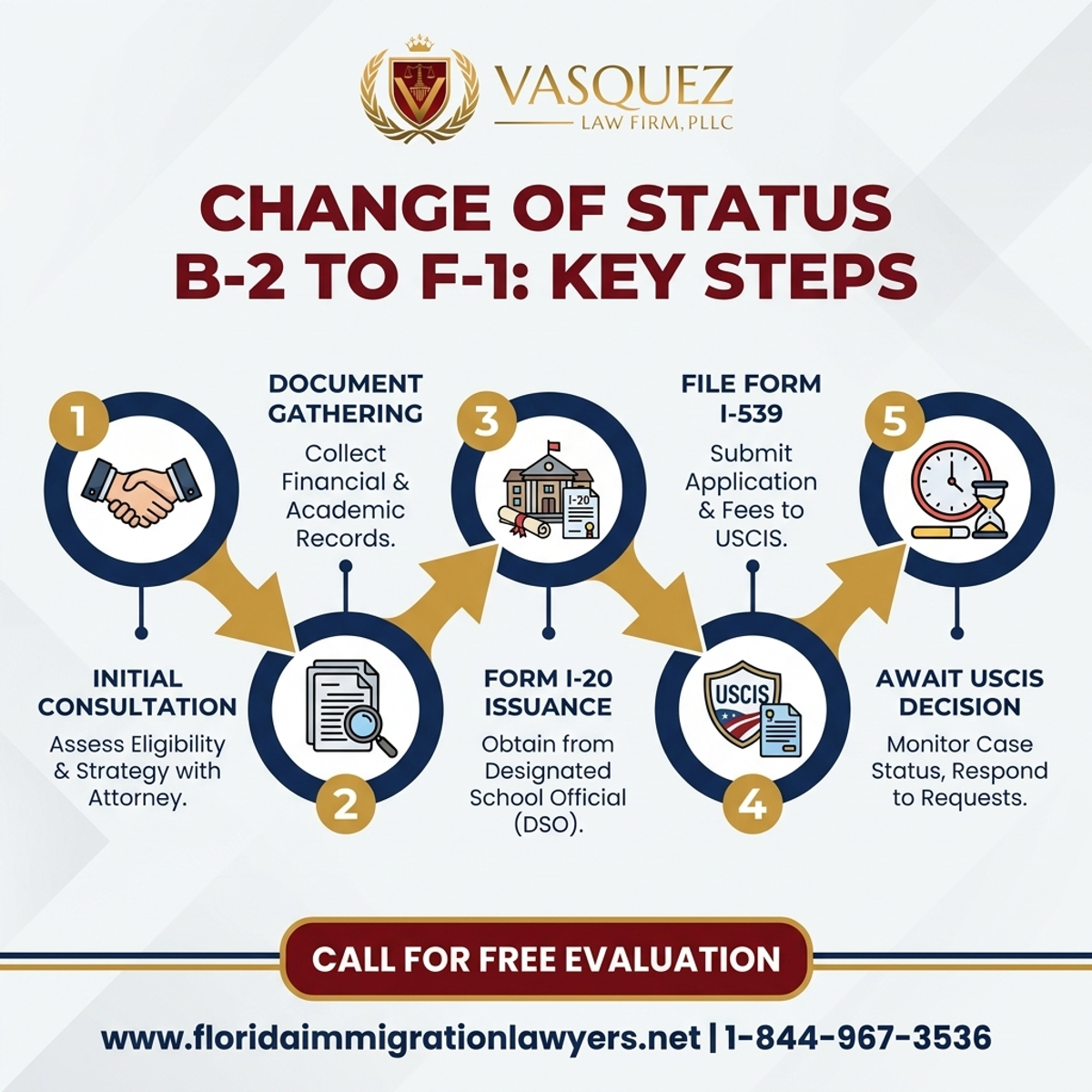
Step-by-Step Process — Change of Status B-2 to F-1 in Florida: Key Steps
Consult with a lawyer to ensure all documentation is accurate and complete.
Let's delve deeper into each of these critical steps. When you initially entered the U.S. on a B-2 visa, you affirmed an intent to visit temporarily and not to study or immigrate. For your change of status to F-1 to be approved, you must convincingly demonstrate that your intent to study arose *after* your entry into the U.S. This is crucial for avoiding accusations of 'preconceived intent,' which can lead to denial. Ensure you have maintained your B-2 status throughout your stay, meaning no unauthorized employment, no overstaying your authorized period, and no other violations of your visa terms.
The Form I-539, Application to Extend/Change Nonimmigrant Status, is the cornerstone of your application. It must be filled out meticulously, using the most current version available on the USCIS website. Every section must be completed accurately, and any errors or omissions can lead to delays or even a denial. If you have dependents (spouse or children) who also need to change their status, they must be included on your Form I-539, or file their own if they are not immediate family, and their applications will typically be filed concurrently using Form I-539A. A strong personal statement explaining your change of intent from tourism to study, detailing your academic goals, and why you chose a specific program in Florida, is highly recommended.
Beyond the forms, the supporting documentation paints a complete picture for USCIS. This includes not just your acceptance letter and I-20 from a SEVP-approved school, but also comprehensive proof of financial capability to cover your tuition, living expenses, and other costs for the entire duration of your program without needing to work illegally. This typically involves bank statements, affidavits of support from sponsors, and scholarship letters. Furthermore, you must provide compelling evidence of your intent to return to your home country upon completion of your studies. This can include documentation of property ownership, family ties, job prospects, or other significant connections to your native country. Gathering these documents can be complex, and Florida Immigration Lawyers can provide invaluable assistance in ensuring your package is complete and persuasive.
Required Documents for Changing Status from B-2 to F-1
When applying for a change of status, ensure you have the following documents ready:
- Completed Form I-539
- Copy of your current B-2 visa and passport
- Acceptance letter from a SEVP-certified school
- Proof of financial support
- Intent to leave the U.S. after studies
- Any other documents requested by USCIS
Having a detailed checklist can help prevent delays in your application process.
Let's elaborate on the specifics of each required document. The completed Form I-539 must be the latest version from the USCIS website, accurately filled out with no blanks or inconsistencies. Attach copies of your valid B-2 visa, the biographical page of your passport, and most importantly, your I-94 Arrival/Departure Record, which proves your legal entry and authorized period of stay. The I-94 can typically be retrieved online from the CBP website.
Your acceptance letter from a SEVP-certified school is critical, as it must be accompanied by Form I-20, 'Certificate of Eligibility for Nonimmigrant Student Status.' This document is issued by your chosen school and confirms your enrollment, program details, and estimated costs. Ensure the I-20 is signed by both you and the Designated School Official (DSO).
Proof of financial support is paramount. You must demonstrate that you have sufficient funds to cover your tuition, fees, and living expenses for at least one year, or the entire duration of your program if it's shorter. Acceptable documents include official bank statements from you or your sponsor, an affidavit of support (Form I-134) from a U.S. sponsor with their financial documentation, or official scholarship letters. The funds must be readily available and verifiable. Finally, a compelling personal statement outlining your genuine intent to change status, your academic goals, and your commitment to returning home after your studies can significantly strengthen your application. Our team at Florida Immigration Lawyers can help you gather and organize all necessary paperwork, ensuring nothing is overlooked.
Timeline for Changing Status from B-2 to F-1 in Florida
| Stage | Typical Timeframe | Notes |
|---|---|---|
| Eligibility Check | 1-2 weeks | Ensure all criteria are met |
| Form Submission | 2-4 weeks | Prepare and submit Form I-539 |
| USCIS Processing | 3-12 months | Varies by case and office |
| Decision Notification | 1-2 weeks | Receive via mail |
These timelines are estimates and can vary based on individual circumstances.
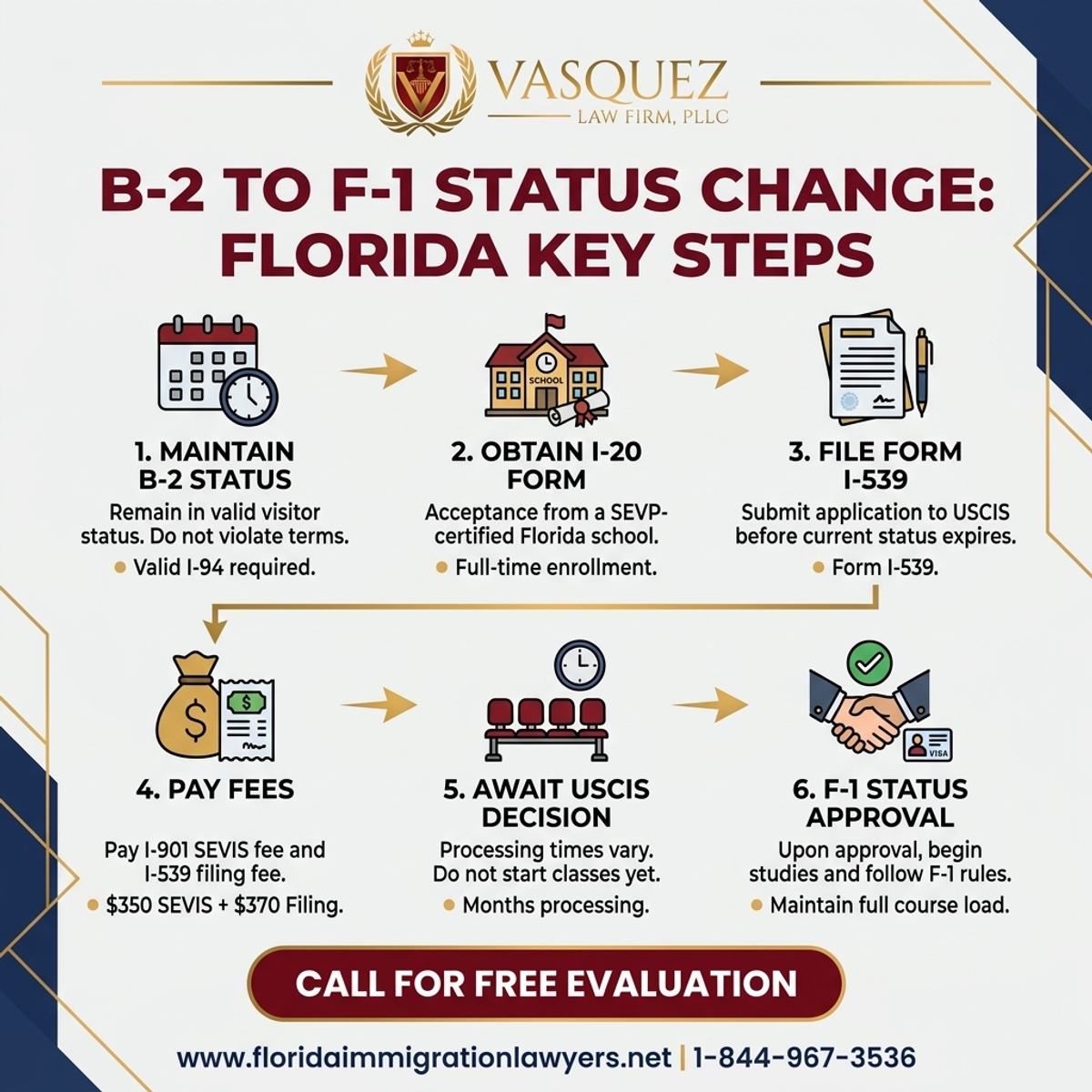
Key Statistics — Change of Status B-2 to F-1 in Florida: Key Steps
Understanding the estimated timeline is crucial for planning your academic journey and ensuring you maintain legal status throughout the process. The initial eligibility check involves a thorough self-assessment, and ideally, a consultation with an immigration attorney from Florida Immigration Lawyers, to confirm you meet all the prerequisites and have a strong case. This preliminary stage ensures you don't waste time and resources on an application that may be denied due to fundamental issues.
The form submission stage is more than just mailing the envelope. It encompasses gathering all required documents, obtaining official transcripts, securing financial statements, drafting your personal statement, and carefully reviewing every detail to prevent errors. This preparation phase is critical for a smooth processing experience. Once your application is submitted, you will typically receive a Form I-797C, Notice of Action (receipt notice), within a few weeks, confirming that USCIS has received your application. This receipt notice is important as it establishes your 'period of authorized stay' while your application is pending, even if your original B-2 I-94 expires.
During the USCIS processing stage, you may be required to attend a biometrics appointment at an Application Support Center (ASC) for fingerprinting and photographs. It's also possible to receive a Request for Evidence (RFE) if USCIS needs more information or clarification on your submitted documents. Responding to an RFE promptly and thoroughly is vital. Throughout this waiting period, it is generally advised *not* to travel outside the U.S., as doing so typically abandons your pending change of status application. You can track your case status online using the receipt number provided on your I-797C. Finally, the decision notification will arrive by mail, either approving or denying your change of status. If approved, you will receive an updated I-94 showing your F-1 status and duration. If denied, immediate action may be required to avoid accruing unlawful presence.
Cost Factors and Fee Breakdown for Change of Status
| Item | Typical Fee | Notes |
|---|---|---|
| Form I-539 Fee | Varies | Check USCIS for latest fees |
| Biometrics Fee | Varies | Required for most applicants |
| Legal Assistance | Varies | Optional but recommended |
Fees can change, so always verify current rates on the official USCIS website.
Navigating the financial aspects of a change of status application is a key part of the planning process. The primary fee is for Form I-539, which, as of recent updates, is typically around $420, but this amount is subject to change. This fee covers the processing of your application to change your nonimmigrant status. In addition to the I-539 fee, most applicants are required to pay a biometrics services fee, which is usually around $85. This fee covers the cost of your fingerprinting and photograph appointment at a USCIS Application Support Center.
It is absolutely essential to check the USCIS website for the most current fee schedule before submitting your application, as fees can be updated without prior notice. Incorrect fee payments, whether underpayment or using an outdated fee, are one of the most common reasons for an application to be rejected and returned, causing significant delays. Payments can typically be made by personal check, money order, or credit card using Form G-1450, Authorization for Credit Card Transactions. Beyond the mandatory USCIS fees, applicants should also budget for potential legal assistance. While optional, retaining an immigration attorney from Florida Immigration Lawyers can provide invaluable guidance, reduce the risk of errors, and improve the overall strength of your application, especially for complex cases. Legal fees can vary widely based on the complexity of the case and the services provided, but they represent an investment in peace of mind and a higher chance of success. Other potential costs might include translation services for foreign documents, postage, and photocopying expenses.
Common Mistakes to Avoid
- Filing Late: Submit your application before your current status expires to avoid illegal presence.
- Incomplete Application: Missing documents can lead to delays or denials.
- Ignoring Financial Proof: Failing to demonstrate sufficient funds can result in denial.
- Incorrect Fee Payment: Ensure all fees are paid in full with correct payment methods.
- Lack of Intent Evidence: Not proving intent to return home after studies can be problematic.
- Wrong Form Version: Always use the most current form version available on the USCIS website.
- Not Consulting Legal Help: Mistakes can be costly; seek professional advice.
Avoiding these common pitfalls can significantly increase your chances of a successful change of status. For instance, **Filing Late** is a critical error; if your B-2 I-94 expires before USCIS receives your I-539, you begin accruing unlawful presence, which can severely impact your ability to obtain future U.S. visas or green cards. Always aim to file well in advance of your authorized stay expiration date, ideally 45-60 days prior.
An **Incomplete Application** often results in a Request for Evidence (RFE), which adds months to your processing time and creates additional stress. A simple missing signature or an overlooked supporting document can trigger an RFE, so a thorough review before submission is paramount. Similarly, **Ignoring Financial Proof** is a direct path to denial; USCIS needs clear, verifiable evidence that you can support yourself financially without resorting to unauthorized employment, which is a violation of F-1 status. Ensure your bank statements are current and reflect the required funds.
**Incorrect Fee Payment** is a common administrative error that leads to your application being rejected and returned, forcing you to resubmit and restart the processing clock. Double-check the current fees on the USCIS website and ensure your payment method is correct. **Lack of Intent Evidence** can be particularly challenging for B-2 to F-1 changes, as USCIS scrutinizes whether you had a 'preconceived intent' to study when you entered as a tourist. A well-crafted personal statement and strong ties to your home country are essential to overcome this hurdle. Finally, using the **Wrong Form Version** or **Not Consulting Legal Help** are easily avoidable mistakes. The USCIS website frequently updates forms; always download the latest. And while you can file independently, the complexity of immigration law means that professional guidance from Florida Immigration Lawyers can be the difference between approval and denial, saving you time, money, and stress in the long run.
When to Call a Lawyer
If you face complex situations, such as previous visa violations or need detailed guidance, it’s best to consult with an immigration lawyer. They can help navigate the nuances of the application process, ensuring all documents are correctly filed and deadlines are met. Contact Florida Immigration Lawyers for expert assistance.
There are several specific scenarios where the expertise of an immigration lawyer becomes not just beneficial, but often critical. If you have any prior immigration history that includes overstays, previous visa denials, or any minor infractions, a lawyer can help assess the potential impact on your current application and strategize the best approach. Similarly, if your B-2 visa status is nearing its expiration date, or if you've had any unauthorized employment, a lawyer can advise on the feasibility and risks of filing a change of status.
Beyond addressing complications, a lawyer provides comprehensive support. They can assist in drafting a compelling personal statement that clearly articulates your change of intent, gather robust evidence of your ties to your home country, and ensure that all financial documentation meets USCIS standards. Should USCIS issue a Request for Evidence (RFE) or call you for an interview, your attorney can help prepare your response or accompany you, advocating on your behalf. The team at Florida Immigration Lawyers possesses deep knowledge of immigration law and USCIS procedures, offering personalized advice and representation to maximize your chances of a favorable outcome. Don't leave your academic future to chance; secure expert guidance.
About Florida Immigration Lawyers
Florida Immigration Lawyers is dedicated to helping clients navigate complex immigration processes. Our team offers personalized services, ensuring your case receives the attention it deserves. We provide free case reviews and are available 24/7 to assist you. Learn more about our immigration services.
At Florida Immigration Lawyers, we understand that pursuing education in a new country is a life-changing decision, and the immigration process should not be a barrier to your dreams. Our firm is committed to providing compassionate, effective, and results-oriented legal representation for individuals and families across Florida. We specialize in a wide array of immigration services, including family immigration, citizenship and naturalization, deportation defense, and asylum protection, in addition to non-immigrant visa matters like the B-2 to F-1 change of status.
Our experienced attorneys pride themselves on staying abreast of the latest immigration laws and policies, ensuring that our advice is always current and strategically sound. We believe in transparent communication, keeping our clients informed at every stage of their application. Whether you're just starting to consider a change of status or facing a complex RFE, our dedicated team is here to offer the guidance and support you need. Contact us today at 1-844-YO-PELEO for your free, no-obligation case review, and let us help you achieve your academic and immigration goals in Florida.
Frequently Asked Questions
Can I start school while my change of status application is pending?
No, you generally cannot begin your F-1 program until your change of status application is officially approved by USCIS. Starting classes before approval would be a violation of your B-2 status and could lead to denial of your F-1 application. You must maintain your B-2 status until the F-1 is approved. It's crucial to wait for the official approval notice from USCIS before enrolling in your desired academic program.
What if my B-2 visa expires while my I-539 is pending?
If you filed your Form I-539 application for a change of status to F-1 before your B-2 I-94 expiration date, you are generally authorized to remain in the U.S. while your application is pending, even if your B-2 status expires. This is known as a 'period of authorized stay.' You do not accrue unlawful presence during this time. However, you must await USCIS's decision before beginning your F-1 activities.
Can I travel outside the U.S. while my B-2 to F-1 change of status is pending?
It is strongly advised against traveling outside the U.S. while your Form I-539 change of status application is pending. Leaving the country typically results in the abandonment of your application. If you depart, you would need to apply for an F-1 visa at a U.S. embassy or consulate abroad and re-enter the U.S. with the new F-1 visa, which can be a lengthy and uncertain process.
What happens if my change of status application is denied?
If your change of status application is denied, you will typically be given a short grace period to depart the U.S. (usually 30 days) to avoid accruing unlawful presence. It's crucial to consult with an immigration attorney immediately upon denial. Florida Immigration Lawyers can assess the reasons for denial, advise on possible appeals, or discuss alternative immigration pathways to ensure you remain compliant with U.S. law.
How do I prove "intent to return" to my home country?
Proving 'intent to return' is vital for non-immigrant visas like the F-1. You can demonstrate this by providing evidence of strong ties to your home country. This includes documentation of property ownership, family members residing there, job offers post-graduation, bank accounts, or other significant assets. A well-written personal statement explaining your future plans and connections to your home country also strengthens your case. Florida Immigration Lawyers can help you compile this evidence effectively.
Is there a premium processing option for B-2 to F-1 change of status?
Currently, premium processing is not available for Form I-539 applications filed to change status from B-2 to F-1. While some other petition types offer expedited processing for an additional fee, this option is not extended to most I-539 filings. Applicants must rely on the standard processing times, which can fluctuate. Therefore, it is crucial to file your application as early as possible to allow ample time for adjudication.
Sources and References
- U.S. Citizenship and Immigration Services (USCIS)
- Executive Office for Immigration Review (EOIR)
- 8 U.S.C. Chapter 12 - Immigration and Nationality Act
Related services: family immigration services, citizenship and naturalization, deportation defense, asylum protection.
This article provides general legal information and is not intended as legal advice. Every case is unique, and outcomes depend on specific facts and circumstances. Contact an attorney for advice about your particular situation.
Final CTA
Ready to change your status? Florida Immigration Lawyers can guide you every step of the way. Call 1-844-YO-PELEO for your free consultation. Se Habla Espanol - Estamos aqui para ayudarle.
If you need legal assistance, learn more about how our immigration attorneys can help, or call us at 1-844-967-3536 for a free case review.
Do Not Navigate This Process Alone
Our experienced immigration attorneys are ready to fight for you. Get a free, confidential case review today.
Se Habla Español
Or leave your details and we’ll call you:
Free Evaluation in 24 Hours
Or talk to us right now
AI voice assistant — available 24/7
FreeFrequently Asked Questions

William J. Vásquez
Founding Attorney · Vasquez Law Firm
U.S. Air Force veteran and immigration attorney with years of hands-on U.S. immigration experience. J.D., NCCU School of Law. AILA member. Admitted to the 4th, 5th, and 11th Circuit Courts.
Available 24/7 - Free Evaluations
Reviewed for legal accuracy by William J. Vásquez
Licensed in North Carolina; U.S. immigration is federal practice.
Related Legal Services
Our Florida immigration attorneys can help you with family immigration services, immigration lawyer cost in Florida and experienced immigration attorneys. Call today at 1-844-YO-PELEO for a free case review.
Related Links
Related Topics
Free Legal Case Review
Discuss your case with our experienced attorneys. We're available 24/7.
Se Habla Español - Estamos aquí para ayudarle.
Related Articles
Certificate of Eligibility for Expungement in Florida 2026
For non-U.S. citizens in Florida, understanding how a state expungement impacts immigration status is critical. A certificate of eligibility for expungement in Florida allows a criminal record to be sealed or expunged under state law. However, federal immigration agencies often disregard such state-level relief, still considering the original criminal offense as a conviction for immigration purposes. This can have severe implications for visa applications, green card eligibility, naturalization, and even lead to deportation. This guide clarifies the Florida expungement process, its limited effect on federal immigration law, and key steps to protect your status in 2026. Learn about common mistakes, required documents, timelines, and when to seek expert legal counsel from Florida Immigration Lawyers to navigate these complex issues effectively.
Immigration Lawyer Orlando Free Consultation in Florida
For individuals and families in Orlando, Florida, navigating the complexities of U.S. immigration law requires expert guidance. An immigration lawyer in Orlando offers crucial support for everything from visa applications and green card processes to naturalization and deportation defense. This comprehensive guide details what a free consultation covers, providing a step-by-step overview of immigration pathways, essential document checklists, and expected timelines in 2026. We also highlight common mistakes to avoid, discuss the critical role of legal counsel in deportation and asylum cases, and explain why choosing a local Orlando immigration attorney is beneficial. Florida Immigration Lawyers is dedicated to serving the diverse community of Orlando with compassionate, effective legal solutions, ensuring you receive personalized advice and robust representation for a successful immigration journey.
TN Visa for Florida Professionals in 2026
The TN visa, under the USMCA, offers a unique opportunity for Canadian and Mexican professionals to work in the United States, particularly in Florida's thriving economy. This detailed guide for 2026 covers everything from eligibility requirements and the specific list of designated professions to the step-by-step application process for both Canadian citizens at ports of entry and Mexican citizens through consular processing. We delve into essential documentation, processing timelines, and associated costs, providing tables for clarity. Additionally, we highlight common mistakes to avoid during the application to ensure a smooth journey. For those considering a professional move to Central Florida, understanding these intricacies is crucial. Florida Immigration Lawyers offers expert guidance to navigate these processes, ensuring compliance and maximizing your chances of success. Discover how to leverage the TN visa for your career in Florida.
Green Card Renewal Process in Florida 2026
Renewing your 10-year green card in Florida is essential to maintain your status as a permanent resident. Learn how to file Form I-90, gather the necessary documents, and avoid common mistakes. Florida Immigration Lawyers can help guide you through the process.