TN Visa for Florida Professionals in 2026
The TN visa, under the USMCA, offers a unique opportunity for Canadian and Mexican professionals to work in the United States, particularly in Florida's thriving economy. This detailed guide for 2026 covers everything from eligibility requirements and the specific list of designated professions to the step-by-step application process for both Canadian citizens at ports of entry and Mexican citizens through consular processing. We delve into essential documentation, processing timelines, and associated costs, providing tables for clarity. Additionally, we highlight common mistakes to avoid during the application to ensure a smooth journey. For those considering a professional move to Central Florida, understanding these intricacies is crucial. Florida Immigration Lawyers offers expert guidance to navigate these processes, ensuring compliance and maximizing your chances of success. Discover how to leverage the TN visa for your career in Florida.

The TN visa, a non-immigrant classification under the United States-Mexico-Canada Agreement (USMCA, formerly NAFTA), allows qualified Canadian and Mexican professionals to work in the U.S. in pre-arranged business activities for U.S. employers. To qualify for a TN visa in Florida, applicants must meet specific educational and professional requirements for one of the designated professions, such as engineers, accountants, or management consultants. The application process typically involves submitting documentation to U.S. Customs and Border Protection (CBP) at a port of entry for Canadians or applying through a U.S. embassy or consulate for Mexicans. This visa provides a streamlined path for professionals to contribute to Florida's economy.
- The TN visa is for Canadian and Mexican professionals under USMCA.
- Applicants must meet specific educational and professional criteria.
- Designated professions include engineers, accountants, and more.
- Canadians apply at a port of entry; Mexicans apply at a consulate.
- It offers a direct route for professionals to work in the U.S.
Florida's vibrant economy and diverse industries make it an attractive destination for professionals worldwide. For Canadian and Mexican citizens, the TN visa offers a unique and expedited pathway to work in the Sunshine State. Established under the North American Free Trade Agreement (NAFTA) and continued under its successor, the United States-Mexico-Canada Agreement (USMCA), the TN non-immigrant classification is specifically designed to facilitate the temporary entry of highly skilled professionals. Whether you are an engineer looking to contribute to Florida's growing tech sector, an accountant seeking opportunities in Orlando's bustling financial landscape, or a healthcare professional responding to the state's medical needs, understanding the nuances of the TN visa is crucial.
Navigating the complexities of U.S. immigration law can be challenging, but with the right guidance, securing a TN visa can be a straightforward process. This comprehensive guide will delve into the eligibility requirements, application procedures, necessary documentation, and typical timelines for obtaining a TN visa in Florida as of 2026. We will also address common pitfalls to avoid and highlight when it is most beneficial to enlist the expertise of an experienced immigration attorney. Our goal is to empower you with the knowledge needed to pursue your professional aspirations in Florida.
Do not let the intricacies of immigration law deter you from your goals. For personalized assistance and a thorough evaluation of your case, call Florida Immigration Lawyers at 1-844-YO-PELEO for a free case review today. We are here to help you understand your options and guide you through every step of the process.
Understanding the TN Visa under USMCA for Florida Professionals
The TN visa is a special non-immigrant classification that allows qualified Canadian and Mexican citizens to work in the United States in a prearranged business activity for a U.S. employer. This visa category was initially created under the North American Free Trade Agreement (NAFTA) and has been continued, with minor adjustments, under the United States-Mexico-Canada Agreement (USMCA), which came into effect on July 1, 2020. The primary objective of the TN visa is to foster economic integration and facilitate the movement of professionals between the three signatory countries.
For professionals eyeing opportunities in Florida, the TN visa presents a significant advantage due to its relatively streamlined application process compared to other work visa categories like the H-1B. Florida's robust economy, particularly in sectors such as tourism, aerospace, healthcare, and technology, offers numerous roles that align with the designated TN professions. From the bustling metropolitan areas like Orlando to the growing economic hubs across Central Florida, there is a constant demand for skilled foreign talent. Understanding the specific requirements of the USMCA and how they apply to your profession is the first critical step toward securing your temporary work authorization.
The USMCA lists over 60 professions eligible for the TN visa, each with specific educational and licensing requirements. These professions range from scientists and engineers to management consultants and registered nurses. It is essential for applicants to meticulously review the list to ensure their qualifications align perfectly with one of the specified categories. Any discrepancy can lead to delays or denial of the visa. The TN visa is typically granted for an initial period of up to three years and can be renewed indefinitely, provided the applicant continues to meet the eligibility criteria and the employment remains temporary. This flexibility makes it an attractive option for long-term professional engagement in Florida.
Who is Eligible for a TN Visa in Florida?
To be eligible for a TN visa in Florida, you must be a citizen of Canada or Mexico, possess the necessary qualifications for a profession listed in Appendix 1603.D.1 of the USMCA, and have a prearranged full-time or part-time job offer from a U.S. employer in that specific professional capacity. Additionally, you must demonstrate non-immigrant intent, meaning you intend to depart the U.S. upon the completion of your temporary employment.
Eligibility for the TN visa hinges on several key factors, primarily your nationality and your professional qualifications. As of 2026, the requirements remain consistent with the USMCA guidelines. You must be a citizen of Canada or Mexico; permanent residents do not qualify. Your profession must be on the specific list of eligible occupations, which includes a wide array of fields such as accountants, architects, computer systems analysts, engineers, scientific technicians, and management consultants. Each listed profession has defined minimum educational requirements, typically a bachelor's degree or a license in a related field. For instance, an accountant generally needs a Baccalaureate or Licenciatura Degree or a Canadian CPA, CGA, or CMA. An engineer requires a Baccalaureate or Licenciatura Degree, or a state/provincial license.
Beyond your professional qualifications, a crucial element of eligibility is having a legitimate job offer from a U.S. employer. This offer must be for a position that falls within your designated TN profession. The employment must be temporary, meaning it has a definite end date or is for a specific project. While there is no explicit limit on the number of times a TN visa can be renewed, applicants must always demonstrate that their stay in the U.S. is temporary and not an attempt to circumvent the permanent residency process. This non-immigrant intent is paramount for approval. Furthermore, if your profession requires a state license to practice in Florida, such as for a registered nurse or a physical therapist, you must possess or be in the process of obtaining that license before commencing employment.
How Do I Apply for a TN Visa in 2026?
The application process for a TN visa in 2026 depends on your nationality. Canadian citizens generally apply directly at a U.S. port of entry or pre-flight inspection station, while Mexican citizens must apply through a U.S. embassy or consulate after their employer files a petition with USCIS. Both processes require detailed documentation demonstrating eligibility.
The application procedure for a TN visa is distinct for Canadian and Mexican citizens. For Canadian citizens, the process is often more straightforward. You can apply for a TN visa directly at a U.S. port of entry (such as at the Florida border or an airport like Orlando International Airport) or a pre-flight inspection station. You will present your application package, including proof of Canadian citizenship, a detailed letter from your prospective U.S. employer, evidence of your professional qualifications, and any required licenses. An immigration officer will review your documents and conduct an interview. If approved, you will be granted TN status for up to three years. There is no prior petition to USCIS required for Canadians applying at the border.
For Mexican citizens, the process is slightly more involved. Your prospective U.S. employer must first file Form I-129, Petition for a Nonimmigrant Worker, with U.S. Citizenship and Immigration Services (USCIS). Once this petition is approved, USCIS will send an approval notice (Form I-797). You will then need to schedule an interview at a U.S. embassy or consulate in Mexico. During the interview, you will present your approved I-797, a valid Mexican passport, the employer's letter, proof of qualifications, and other supporting documents. If approved, a TN visa stamp will be placed in your passport, allowing you to enter the U.S. in TN status. It is crucial for both Canadian and Mexican applicants to ensure all documentation is complete and accurate to avoid processing delays.
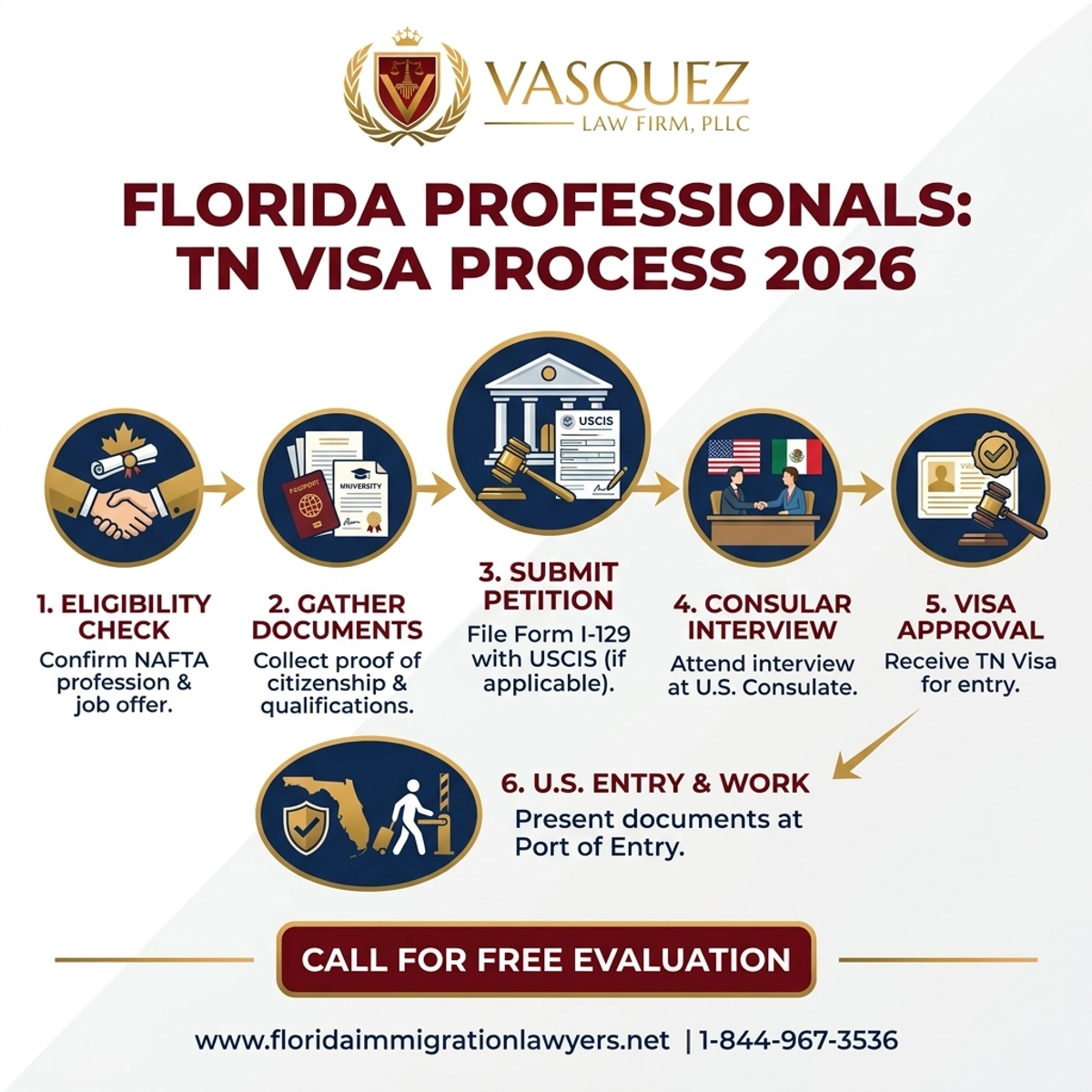
Step-by-Step Process — TN Visa for Florida Professionals in 2026
- Secure a Job Offer: Obtain a job offer from a U.S. employer for a position that qualifies under one of the USMCA's designated TN professions. The offer letter should detail your job duties, salary, and the temporary nature of the employment.
- Gather Documentation: Collect all necessary documents, including proof of citizenship, educational degrees, professional licenses, and transcripts. Ensure these documents are originals or certified copies.
- For Canadian Citizens (Port of Entry Application): Prepare your application package and present it to a U.S. Customs and Border Protection (CBP) officer at a designated port of entry. Be ready for an interview regarding your qualifications and job offer.
- For Mexican Citizens (Consular Application): Your U.S. employer must file Form I-129, Petition for a Nonimmigrant Worker, with USCIS. Once approved, schedule a visa interview at a U.S. embassy or consulate in Mexico. Attend the interview with all required documents.
- Pay Fees: Pay the required application fees. For Canadians, this is typically paid at the port of entry. For Mexicans, there are USCIS filing fees for Form I-129 and visa application fees at the consulate.
- Receive Approval: If approved, Canadian citizens receive an I-94 arrival/departure record noting their TN status. Mexican citizens receive a TN visa stamp in their passport.
- Enter the U.S.: Upon entry to the U.S., you will be admitted in TN status for up to three years.
Required Documents for Your TN Visa Application
A well-prepared application package is vital for a successful TN visa outcome. Regardless of whether you are applying at a port of entry or a consulate, the core set of documents you will need to present remains largely the same. These documents serve to prove your identity, nationality, professional qualifications, and the legitimacy of your job offer. Meticulous organization and attention to detail when compiling these materials can significantly expedite the review process and prevent unnecessary complications or requests for additional evidence.
The primary document for all applicants is proof of citizenship, which for Canadians is typically a passport or birth certificate, and for Mexicans, a valid passport. Beyond identity, the most crucial component is the letter from your prospective U.S. employer. This letter, sometimes referred to as an employer support letter, must be on company letterhead and include specific details: your job title, detailed description of your duties, the temporary nature of the employment, the anticipated length of stay, educational requirements for the position, and your salary. It must clearly state that the position falls under one of the USMCA's eligible professions and that you meet those requirements.
Proof of your professional qualifications is equally important. This typically includes original or certified copies of your educational degrees, diplomas, academic transcripts, and any professional licenses or certifications required for your profession in Florida. For example, if you are applying as a Registered Nurse, you would need proof of your nursing degree and a Florida nursing license or evidence that you are eligible to obtain one. If your degree is from an institution outside Canada, Mexico, or the U.S., a foreign credential evaluation may be required to demonstrate its equivalency to a U.S. bachelor's degree. Providing a comprehensive and clearly organized set of documents will streamline the process for immigration officers.
- Valid passport (for both Canadian and Mexican citizens)
- Proof of Canadian or Mexican citizenship (birth certificate, citizenship card, etc., for Canadians applying at the border)
- Original or certified copies of academic degrees, diplomas, and transcripts
- Professional licenses or certifications required for your profession in Florida
- Detailed letter from your prospective U.S. employer (on company letterhead), including:
- Job title and detailed description of duties
- Explanation of the temporary nature of employment
- Anticipated length of stay in the U.S.
- Educational requirements for the position
- Your salary and terms of employment
- Confirmation that the position is a designated USMCA profession
- Curriculum Vitae (CV) or resume
- Any previous TN approval notices or I-94 records (if applicable)
- Application fees (paid at the port of entry for Canadians; USCIS and consular fees for Mexicans)
- Form I-129 approval notice (Form I-797) for Mexican citizens
What is the TN Visa Processing Timeline and Cost?
As of 2026, the TN visa processing timeline for Canadian citizens can be as short as a few hours at a port of entry, while for Mexican citizens, it typically ranges from several weeks to a few months, factoring in USCIS petition processing and consular interview scheduling. Costs include government filing fees, which vary by application method and can be subject to change.
The processing timeline for a TN visa varies significantly based on your nationality and the application method. For Canadian citizens applying at a U.S. port of entry or pre-flight inspection station, the decision is often made on the spot during the interview. This can mean receiving your TN status and an I-94 record within a few hours. However, if there are complexities in your case or if additional documentation is requested, it could take longer, potentially requiring a follow-up visit. It is always advisable to have all documents meticulously prepared to ensure a swift process. For those seeking to extend their TN status while already in the U.S., filing Form I-129 with USCIS can take several months, with premium processing available for an additional fee to expedite the adjudication to 15 calendar days.
For Mexican citizens, the timeline is generally longer due to the two-step process. First, your U.S. employer must file Form I-129 with USCIS. As of 2026, USCIS processing times for I-129 petitions can range from 2 to 6 months, though this can fluctuate. Once the I-129 is approved, you must then schedule an interview at a U.S. embassy or consulate in Mexico. Consular appointment wait times vary by location and demand but can add several weeks to a few months to the overall timeline. After a successful interview, the visa stamp is typically issued within a week. Understanding these timelines is crucial for planning your move to Florida and coordinating with your prospective employer.
Typical TN Visa Processing Timeline (as of 2026)
| Stage | Typical Timeframe | Notes |
|---|---|---|
| Canadian Citizen - Port of Entry | Immediate (hours) | Decision made during interview; depends on officer's discretion and completeness of documents. |
| Mexican Citizen - Employer Files I-129 | 2-6 months | USCIS processing times can vary; premium processing available for 15-day adjudication. |
| Mexican Citizen - Consular Interview | 2-8 weeks (after I-129 approval) | Wait times depend on embassy/consulate availability and demand. |
| Mexican Citizen - Visa Issuance | 3-7 business days (after interview) | Passport returned with visa stamp. |
| Extension/Change of Status (Form I-129) | 2-6 months | If filed from within the U.S. with USCIS. |
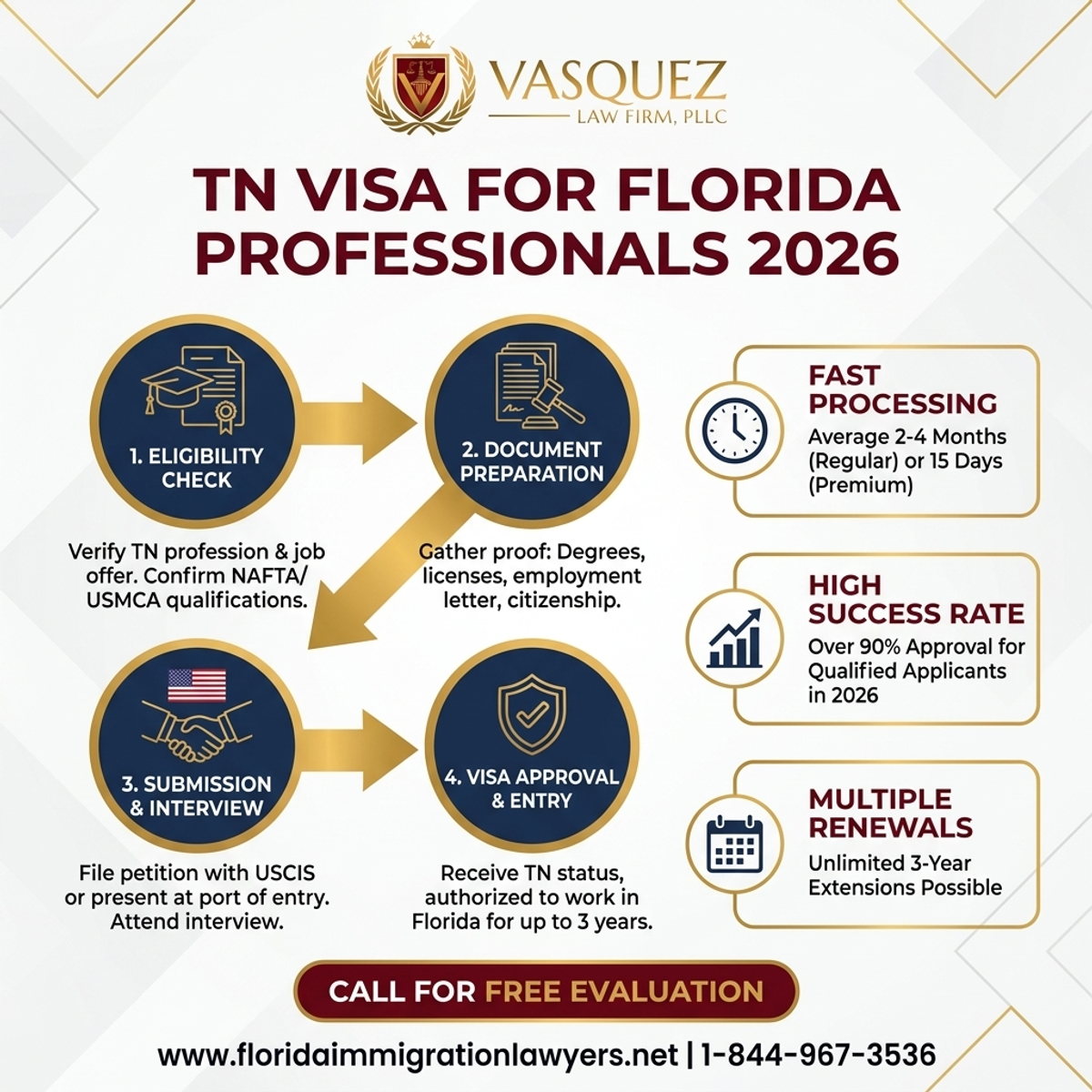
Key Statistics — TN Visa for Florida Professionals in 2026
TN Visa Cost Factors and Fee Breakdown (as of 2026)
The costs associated with a TN visa application are primarily government filing fees, which can change. It is important to note that these fees do not include attorney fees, travel expenses, or other incidental costs. Always check the official State Department and USCIS websites for the most current fee schedules.
| Item | Typical Fee | Notes |
|---|---|---|
| Canadian Citizen - Port of Entry (I-94 fee) | Approximately $50 - $58 USD | Paid directly to CBP at the port of entry. |
| Mexican Citizen - Form I-129 Filing Fee (Employer) | Varies (check USCIS website) | Paid by the U.S. employer to USCIS. |
| Mexican Citizen - Premium Processing (Optional) | Varies (check USCIS website) | Additional fee for 15-day processing of Form I-129. |
| Mexican Citizen - DS-160 Visa Application Fee | Approximately $190 USD | Paid to the U.S. embassy/consulate for the interview. |
| Mexican Citizen - Border Crossing Card (BCC) Fee (if applicable) | Varies (check State Department) | For certain applicants. |
Living and Working in Florida on a TN Visa
Securing a TN visa opens the door to living and working in Florida, a state known for its economic opportunities and high quality of life. As a TN non-immigrant, you are authorized to work for the specific U.S. employer and in the designated profession listed on your application. This status allows you to reside in Florida for the duration of your authorized stay, typically up to three years, with the possibility of extensions. Many professionals find Florida's diverse population and vibrant cultural scene, particularly in Central Florida cities like Orlando, to be welcoming and enriching.
While on a TN visa, you are generally restricted to working for the employer that sponsored your visa. If you wish to change employers or add a second employer, a new TN application or an amended Form I-129 petition must be filed and approved. It is critical to adhere to these employment restrictions to maintain your legal status in the U.S. Family members (spouses and unmarried children under 21) are eligible for TD non-immigrant status, which allows them to reside in the U.S. with the TN visa holder but does not permit them to work. They can, however, attend school or college in Florida, making it a viable option for families.
Florida offers a unique blend of professional growth and lifestyle benefits. From the dynamic business environment of Orlando to the coastal communities, professionals can enjoy a high standard of living. However, it is essential to understand your rights and responsibilities as a TN visa holder. Maintaining valid status, adhering to the terms of your employment, and being aware of the process for extensions or changes in circumstances are all crucial. While the TN visa is a non-immigrant visa, it is possible for some TN visa holders to pursue permanent residency in the U.S. through other immigration avenues, though this typically requires demonstrating an intent to depart the U.S. at the time of TN application and then adjusting intent later for a green card application. This complex area often requires the guidance of an experienced attorney to navigate the dual intent implications.
Do not navigate this process alone. Contact Florida Immigration Lawyers today for a free case review to ensure your TN visa application is handled correctly and efficiently.
Common Mistakes to Avoid When Applying for a TN Visa
Applying for a TN visa requires precision and a thorough understanding of the requirements. Even minor errors can lead to significant delays or outright denial. Being aware of these common pitfalls can save you time, money, and stress.
- Incorrect Profession Classification: One of the most frequent mistakes is attempting to fit a job into a TN category when it doesn't truly align. The USMCA list is specific, and a general job title might not be sufficient. Ensure your job duties directly match a listed profession.
- Lack of Non-Immigrant Intent: The TN visa is for temporary employment. Failing to convince the immigration officer or consular official that you intend to return to your home country after your authorized stay can lead to denial. Avoid expressing any intent to permanently reside in the U.S. during your application.
- Insufficient Documentation: Presenting an incomplete application package is a common reason for delays. Ensure you have all required original or certified copies of degrees, licenses, and a comprehensive employer letter.
- Inadequate Employer Letter: The employer letter is critical. It must clearly define your job duties, confirm the temporary nature of the employment, specify the salary, and state that the position falls under a USMCA-eligible profession. Vague or missing details can cause issues.
- Mismatched Qualifications: Your educational background and experience must precisely meet the minimum requirements for the specific TN profession you are applying under. For example, a general business degree may not qualify for a Management Consultant role without specific experience.
- Overlooking State Licensing Requirements: Many professions, especially in healthcare, require specific state licenses to practice in Florida. Failing to have or be in the process of obtaining the necessary Florida license can result in denial.
- Canadian Citizens Applying for TN-2 (Mexican Process): Canadian citizens often mistakenly believe they need an I-129 petition, which is only required for Mexican citizens or for extensions/changes of status within the U.S. Canadians can apply directly at the border.
- Not Understanding Dual Intent: While a TN visa is non-immigrant, some individuals may wish to pursue a green card later. However, applying for a TN visa requires non-immigrant intent. Discussing any long-term immigration plans during the TN application can be problematic.
- Errors in Form I-129 (for Mexican Citizens/Extensions): Incorrectly completing Form I-129 or submitting it without all necessary supporting evidence can lead to Requests for Evidence (RFEs) or outright denial from USCIS.
- Unprepared for Interview: For both Canadians at the border and Mexicans at the consulate, being unable to articulate your job duties, qualifications, and intent clearly during an interview can raise red flags.
- Assuming NAFTA Rules Still Apply Unchanged: While USMCA largely maintains TN provisions, it's crucial to refer to the current USMCA text and not outdated NAFTA guidelines, as minor changes exist.
- Incorrect Visa Type for Business Visitors: Sometimes, individuals seeking short-term business activities mistakenly apply for a TN visa instead of a B-1 business visitor visa, which is for different purposes.
When to Call a Florida Immigration Lawyer for Your TN Visa
While the TN visa process can appear straightforward, especially for Canadian citizens, certain situations warrant the expertise of an experienced immigration attorney. Florida Immigration Lawyers specializes in navigating the complexities of U.S. immigration law and can provide invaluable assistance to ensure your application is successful and stress-free. Our team is well-versed in the specific requirements for professionals seeking to work in Florida.
You should consider contacting an attorney if your profession is not explicitly listed or if your qualifications are borderline. An attorney can help interpret the regulations and present a strong argument for your eligibility. If you have any previous immigration violations, denials, or criminal history, seeking legal counsel is crucial, as these issues can significantly complicate your application. Additionally, if your employer is unfamiliar with the TN visa process or if there are concerns about the temporary nature of your employment, an attorney can guide both you and your employer to ensure compliance with all legal requirements.
Furthermore, if you are a Mexican citizen and your employer needs assistance with filing Form I-129, or if you receive a Request for Evidence (RFE) from USCIS, our attorneys can help prepare a comprehensive and persuasive response. For those considering a future path to permanent residency while on a TN visa, understanding the concept of dual intent and how to navigate it legally is paramount. Our firm can advise on these complex strategies. Whether you are seeking an initial TN visa, an extension, or a change of employer in Florida, our dedicated business immigration lawyers are here to provide clear guidance and robust representation. We serve clients across all of Florida, including Central Florida, and are available to discuss your unique situation.
About Florida Immigration Lawyers
Florida Immigration Lawyers is a leading immigration law firm dedicated to serving individuals and businesses across the entire state of Florida. With a deep understanding of U.S. immigration law and a commitment to our clients, we provide comprehensive legal services tailored to meet diverse immigration needs. Our experienced attorneys are passionate about helping professionals, families, and businesses achieve their immigration goals, offering personalized attention and strategic advice.
We pride ourselves on our client-focused approach, ensuring that every case is handled with the utmost care and professionalism. Our services span a wide range of immigration matters, including family-based visas, employment-based visas like the TN visa, asylum applications, deportation defense, citizenship and naturalization, and much more. We understand the challenges and anxieties that often accompany immigration processes, which is why we strive to make the journey as smooth and transparent as possible for our clients in Orlando and throughout Central Florida.
Choosing Florida Immigration Lawyers means partnering with a team that is available 24/7, offers free case reviews, and is fluent in both English and Spanish. We leverage our extensive knowledge and resources to advocate effectively on your behalf, providing peace of mind throughout your immigration journey. Let us put our expertise to work for you. Schedule a free consultation with us today and discover how we can help.
Sources and References
- U.S. Citizenship and Immigration Services (USCIS)
- U.S. Department of State
- Executive Office for Immigration Review (EOIR)
- 8 U.S.C. § 1101 et seq. - Immigration and Nationality Act (INA)
- 8 CFR Part 214 - Nonimmigrant Classes
- United States-Mexico-Canada Agreement (USMCA), Appendix 1603.D.1
Related services: immigration practice areas, family immigration services, experienced immigration attorneys, immigration lawyer cost in Florida.
This article provides general legal information and is not intended as legal advice. Every case is unique, and outcomes depend on specific facts and circumstances. Contact an attorney for advice about your particular situation. Immigration laws are subject to change.
Ready to explore your professional opportunities in Florida? Don't leave your immigration future to chance. Call Florida Immigration Lawyers now at 1-844-YO-PELEO for your free, confidential case review. Se Habla Espanol - Estamos aqui para ayudarle.
Do Not Navigate This Process Alone
Our experienced immigration attorneys are ready to fight for you. Get a free, confidential case review today.
Se Habla Español
Or leave your details and we’ll call you:
Free Evaluation in 24 Hours
Or talk to us right now

AI voice assistant — available 24/7
FreeFrequently Asked Questions

William J. Vásquez
Founding Attorney · Vasquez Law Firm
U.S. Air Force veteran and immigration attorney with years of hands-on U.S. immigration experience. J.D., NCCU School of Law. AILA member. Admitted to the 4th, 5th, and 11th Circuit Courts.
Available 24/7 - Free Evaluations
Reviewed for legal accuracy by William J. Vásquez
Licensed in North Carolina; U.S. immigration is federal practice.
Related Legal Services
Our Florida immigration attorneys can help you with immigration lawyer cost in Florida, experienced immigration attorneys and asylum protection. Call today at 1-844-YO-PELEO for a free case review.
Related Links
Related Topics
Free Legal Case Review
Discuss your case with our experienced attorneys. We're available 24/7.
Se Habla Español - Estamos aquí para ayudarle.
Related Articles
Certificate of Eligibility for Expungement in Florida 2026
For non-U.S. citizens in Florida, understanding how a state expungement impacts immigration status is critical. A certificate of eligibility for expungement in Florida allows a criminal record to be sealed or expunged under state law. However, federal immigration agencies often disregard such state-level relief, still considering the original criminal offense as a conviction for immigration purposes. This can have severe implications for visa applications, green card eligibility, naturalization, and even lead to deportation. This guide clarifies the Florida expungement process, its limited effect on federal immigration law, and key steps to protect your status in 2026. Learn about common mistakes, required documents, timelines, and when to seek expert legal counsel from Florida Immigration Lawyers to navigate these complex issues effectively.
Immigration Lawyer Orlando Free Consultation in Florida
For individuals and families in Orlando, Florida, navigating the complexities of U.S. immigration law requires expert guidance. An immigration lawyer in Orlando offers crucial support for everything from visa applications and green card processes to naturalization and deportation defense. This comprehensive guide details what a free consultation covers, providing a step-by-step overview of immigration pathways, essential document checklists, and expected timelines in 2026. We also highlight common mistakes to avoid, discuss the critical role of legal counsel in deportation and asylum cases, and explain why choosing a local Orlando immigration attorney is beneficial. Florida Immigration Lawyers is dedicated to serving the diverse community of Orlando with compassionate, effective legal solutions, ensuring you receive personalized advice and robust representation for a successful immigration journey.
Green Card Renewal Process in Florida 2026
Renewing your 10-year green card in Florida is essential to maintain your status as a permanent resident. Learn how to file Form I-90, gather the necessary documents, and avoid common mistakes. Florida Immigration Lawyers can help guide you through the process.
Immigration Services Treasure Coast Florida: 2026 Guide
Navigating immigration services in Florida's Treasure Coast, including Martin County, requires expert legal guidance. This 2026 guide from Florida Immigration Lawyers provides comprehensive insights into visa applications, green card processes, naturalization, asylum claims, and deportation defense. We cover eligibility, step-by-step procedures, required documents, estimated timelines, and potential costs. Learn about common mistakes to avoid and when it's crucial to consult an experienced immigration attorney. Our firm offers dedicated support across all of Florida, ensuring you have the resources needed for a successful immigration journey. Get personalized advice and understand your options today.