Green Card Renewal Process in Florida 2026
Renewing your 10-year green card in Florida is essential to maintain your status as a permanent resident. Learn how to file Form I-90, gather the necessary documents, and avoid common mistakes. Florida Immigration Lawyers can help guide you through the process.
Renewing your 10-year green card in Florida involves filing Form I-90 with USCIS. Key steps include preparing necessary documents, understanding fees, and tracking your application's progress. Timely renewal is essential to maintain your permanent resident status.
- File Form I-90 for renewal
- Check USCIS fee updates
- Prepare supporting documents
- Track application status online
Introduction
Facing the need to renew your green card can be daunting, especially with changing immigration policies. For permanent residents in Orlando, Florida, understanding the renewal process is crucial. This guide covers everything from filing Form I-90 to common pitfalls and timelines. Call Florida Immigration Lawyers at 1-844-YO-PELEO for a free case review.
Florida is a vibrant and diverse state, home to countless individuals who have built their lives here as permanent residents. Maintaining a valid green card is not just a formality; it's the bedrock of your legal status, ensuring your ability to live, work, and travel freely within the United States. An expired green card can lead to significant disruptions, from employment issues to challenges with international travel and even difficulties proving your legal presence.
This comprehensive guide aims to demystify the green card renewal process specifically for those residing in Florida. We'll walk you through each step, provide practical advice, and highlight critical considerations to ensure a smooth application. Whether you're approaching your card's expiration date or need to replace a lost or stolen card, proactive planning and accurate submission are key. Don't navigate this complex process alone; Florida Immigration Lawyers are here to provide expert guidance and support every step of the way.
What is Form I-90 and Why is it Important?
Form I-90 is used to renew or replace your green card. As of 2026, any permanent resident whose card is expiring must submit this form to USCIS to maintain legal status. Delays can lead to complications in employment and travel.
The form ensures that your personal information and photo are up to date, which is essential for identification and re-entry into the U.S. after travel abroad. Failure to renew can result in fines or even deportation proceedings.
Beyond just expiration, Form I-90 serves several other critical purposes. You might need to file it if your current green card has been lost, stolen, or mutilated. It's also required if your card contains incorrect information due to a USCIS error, or if you legally changed your name and need an updated card reflecting this change. Understanding these various scenarios is vital, as the specific supporting documents might differ slightly depending on your reason for filing.
An expired green card can severely impact your daily life. Without a valid card, you may face difficulties proving your eligibility to work, renewing your driver's license, or accessing certain government benefits. Furthermore, re-entering the U.S. after international travel becomes significantly more complicated and risky without a current Permanent Resident Card. USCIS views the green card as definitive proof of your lawful permanent resident status, making its timely renewal or replacement paramount to protecting your immigration standing.
How Do I Renew My 10-Year Green Card in Florida?
To renew your green card in Florida, you'll need to complete Form I-90, gather necessary documents, and submit your application to USCIS. An updated passport photo and proof of residency may be required.
As of 2026, the typical processing time for a green card renewal is between 8 to 12 months. It's advisable to apply 6 months before your card expires to avoid any lapse in your status.
The process of renewing your 10-year green card generally involves submitting Form I-90 either online through the USCIS website or by mail. While online filing offers convenience and immediate confirmation, mailing your application requires meticulous attention to detail to ensure all components are included. It's crucial to follow the instructions precisely, as even minor errors can lead to delays or rejection of your application. Always keep a copy of your submitted application and all supporting documents for your records.
Once your application is submitted, USCIS will send you a receipt notice (Form I-797C, Notice of Action). This notice is incredibly important as it serves as temporary proof of your continued lawful permanent resident status for an extended period, typically 24 months, while your application is pending. This allows you to continue working and traveling during the processing time. For residents in Florida, understanding this interim proof is vital, especially if you have upcoming travel plans or employment verification needs.
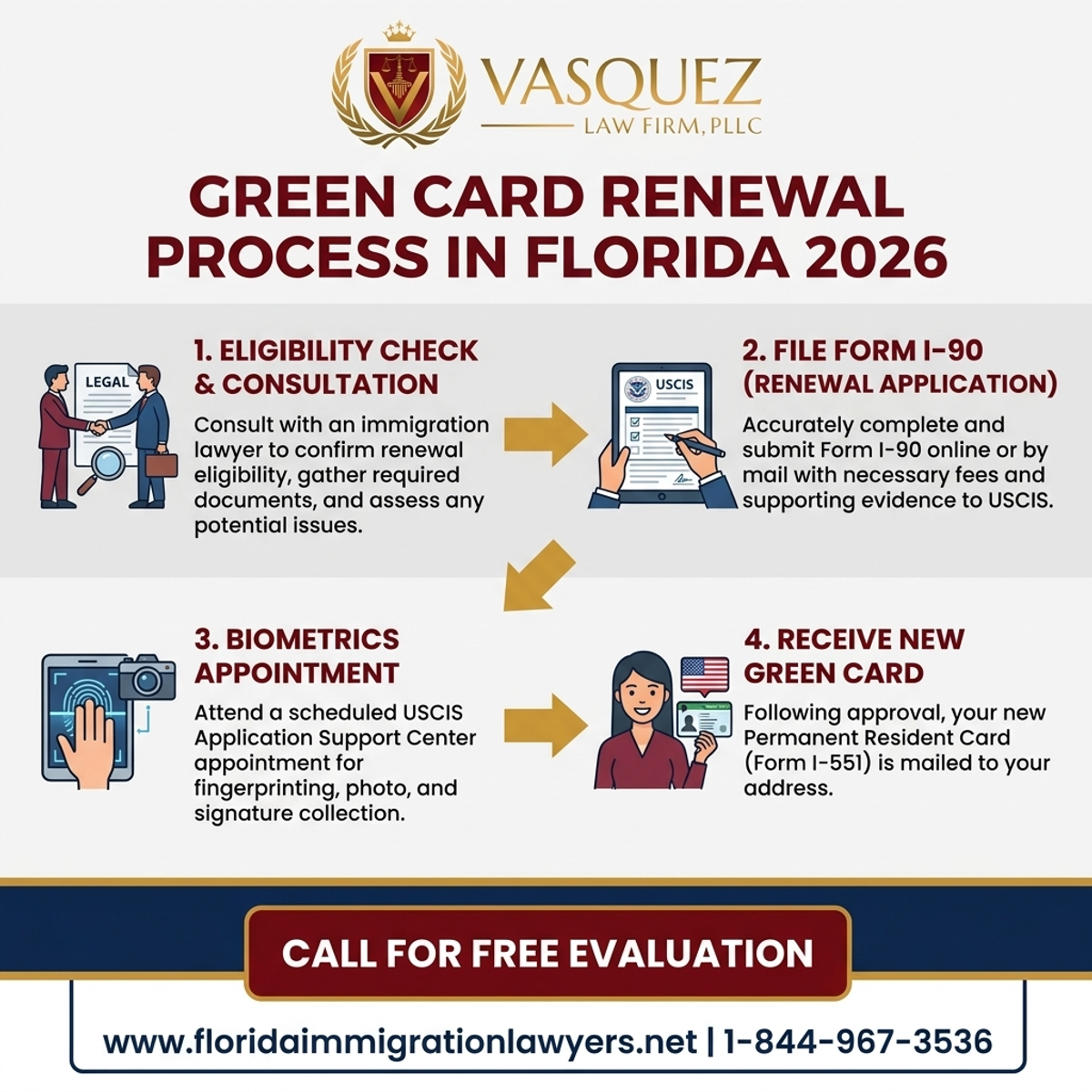
Step-by-Step Process — Green Card Renewal Process in Florida 2026
- Complete Form I-90
- Gather supporting documents
- Submit application and fee
- Attend biometrics appointment
- Track your application status
What Documents Do I Need for Green Card Renewal?
- Completed Form I-90
- Current green card
- Two passport-sized photos
- Proof of residency in Florida
- Government-issued ID
These documents ensure USCIS has accurate information for processing your renewal. Incomplete or incorrect submissions can cause significant delays.
Let's delve deeper into the specific requirements for each document. For the passport-sized photos, USCIS has strict guidelines: they must be color photos taken within the last 6 months, against a white or off-white background, unretouched, and show a full front view of your face. Any deviation from these specifications can lead to a Request for Evidence (RFE) and significant delays. Ensure your photos meet all official requirements before submission.
Proof of residency in Florida can include various documents such as utility bills, lease agreements, mortgage statements, bank statements, or even a Florida driver's license showing your current address. While not always explicitly requested for a standard I-90 renewal, having these ready can be beneficial, especially if there are any questions about your current domicile. If you've had a legal name change since your last green card was issued, you will also need to provide documentation such as a marriage certificate or court order to support the change. This attention to detail can prevent common pitfalls.
In scenarios where your green card was lost or stolen, you might need to provide a police report or an affidavit explaining the circumstances. While not listed as standard, preparing for such eventualities can save time. Always make copies of all documents you submit to USCIS for your personal records. This practice is a crucial safeguard, allowing you to reference your application details if inquiries arise or if original documents are lost in transit. Florida Immigration Lawyers can help you organize and review your documents to ensure completeness and accuracy.
Timeline and Processing Expectations
| Stage | Typical Timeframe | Notes |
|---|---|---|
| Form Submission | 1-2 weeks | Initial processing by USCIS |
| Biometrics Appointment | 4-8 weeks | Notification and scheduling |
| Application Review | 8-12 months | Includes background checks |
| Decision and Card Issuance | 1-2 weeks after approval | Receive new green card |
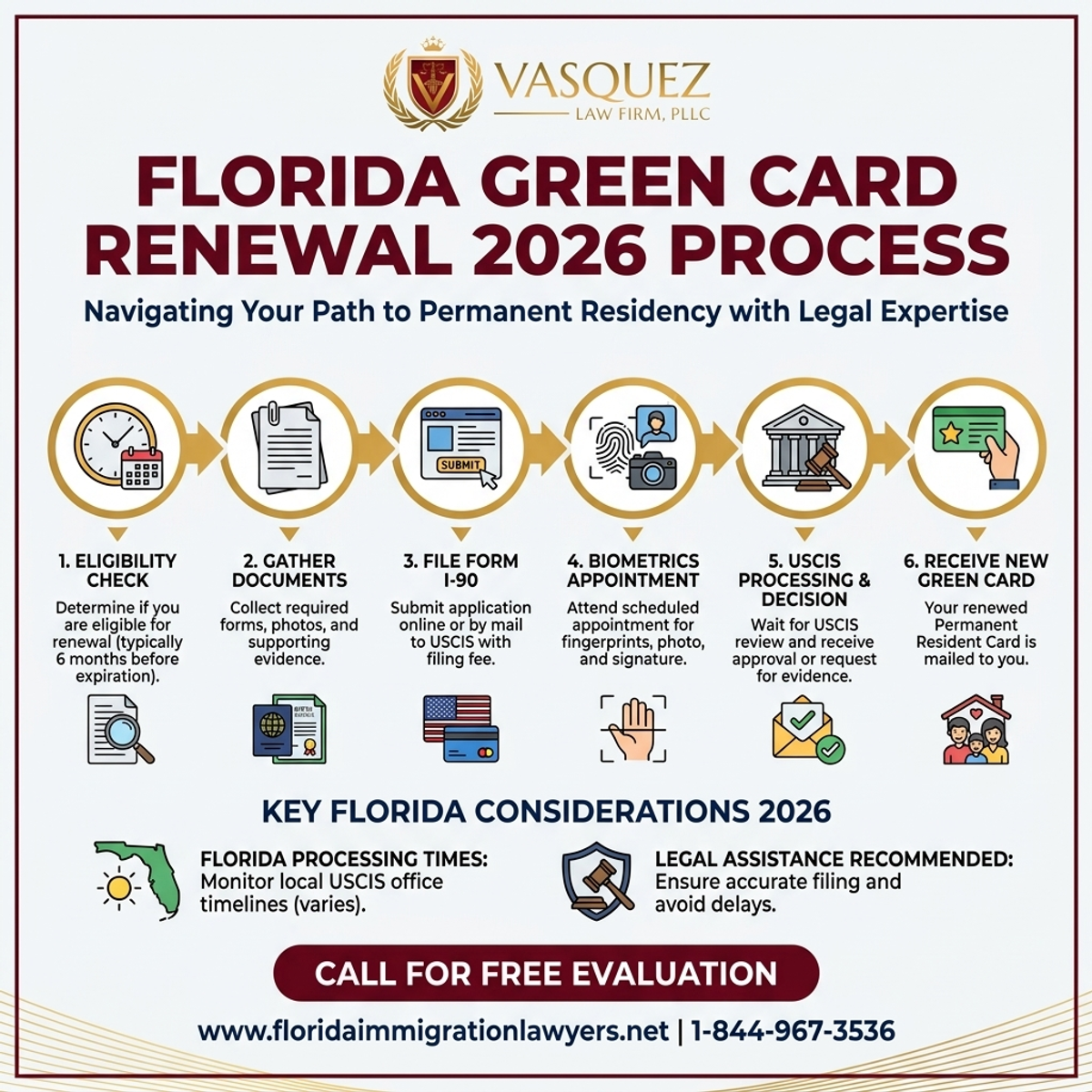
Key Statistics — Green Card Renewal Process in Florida 2026
While the table provides typical timeframes, it's important to understand that these are estimates and actual processing times can vary significantly. Factors such as the current USCIS workload, the complexity of your individual case, and whether you receive a Request for Evidence (RFE) can all impact how long your application takes. USCIS provides an online tool to check current processing times, which are often broken down by service center and form type. Regularly checking this tool can help manage your expectations.
During the "Application Review" stage, USCIS conducts thorough background and security checks. If any issues arise, such as a criminal record or discrepancies in your immigration history, your application could be significantly delayed or even denied. This is a critical period where patience is required, but also where proactive legal counsel from Florida Immigration Lawyers can be invaluable if you anticipate any potential complications. It's essential to respond promptly and thoroughly to any requests for additional information from USCIS.
After your biometrics appointment, where your fingerprints, photo, and signature are captured, you might not hear from USCIS for several months. It's important not to panic during this quiet period. However, if you haven't received any updates for an unusually long time beyond the published processing times, or if you need to travel internationally and require urgent proof of status, you may need to contact USCIS directly or seek assistance from an immigration attorney. An attorney can help inquire about your case status and advise on next steps, ensuring your permanent resident status remains secure.
Cost Factors and Fee Breakdown
| Item | Typical Fee | Notes |
|---|---|---|
| Form I-90 Filing Fee | Check USCIS.gov | Subject to change |
| Biometrics Fee | Check USCIS.gov | Includes fingerprinting |
Fees are subject to change, so always verify the latest costs on USCIS.
It is critical to understand that the filing fee for Form I-90 and the biometrics fee are separate and must be paid correctly. USCIS is very strict about fees; submitting an incorrect amount is a common reason for application rejection. Payment methods typically include money order, personal check, cashier's check, or credit card using Form G-1450. Always double-check the current fee schedule on the USCIS website before preparing your payment.
For individuals facing financial hardship, USCIS offers the possibility of a fee waiver. Eligibility for a fee waiver is based on certain criteria, such as receiving a means-tested benefit, having an income at or below 150% of the Federal Poverty Guidelines, or demonstrating financial hardship. If you believe you qualify, you would need to submit Form I-912, Request for Fee Waiver, along with your Form I-90 application. Navigating fee waiver requirements can be complex, and Florida Immigration Lawyers can provide guidance to determine your eligibility and assist with the application.
Remember that these fees are non-refundable, regardless of the outcome of your application. Therefore, ensuring your application is complete and accurate before submission is paramount to avoid losing your fees due to a preventable error. Budgeting for these costs and understanding the payment process are essential steps in your green card renewal journey.
Common Mistakes to Avoid
- Submitting an incomplete I-90 form: Ensure every required field is filled out accurately, even if it seems minor. Missing information will cause delays.
- Not providing the correct fee amount: Always verify the current fees on USCIS.gov right before sending your application. An incorrect payment will result in rejection.
- Failing to update USCIS with address changes: If you move, file Form AR-11, Alien's Change of Address Card, within 10 days to ensure you receive all crucial correspondence.
- Missing biometrics appointment: Failure to attend without rescheduling can lead to application denial.
Sources and References
- U.S. Citizenship and Immigration Services (USCIS)
- Executive Office for Immigration Review (EOIR)
- U.S. Department of State
- Immigration and Nationality Act (INA), 8 U.S.C. Chapter 12
Do Not Navigate This Process Alone
Our experienced immigration attorneys are ready to fight for you. Get a free, confidential case review today.
Se Habla Español
Or leave your details and we’ll call you:
Free Evaluation in 24 Hours
Or talk to us right now

AI voice assistant — available 24/7
FreeFrequently Asked Questions

William J. Vásquez
Founding Attorney · Vasquez Law Firm
U.S. Air Force veteran and immigration attorney with years of hands-on U.S. immigration experience. J.D., NCCU School of Law. AILA member. Admitted to the 4th, 5th, and 11th Circuit Courts.
Available 24/7 - Free Evaluations
Reviewed for legal accuracy by William J. Vásquez
Licensed in North Carolina; U.S. immigration is federal practice.
Related Legal Services
Our Florida immigration attorneys can help you with experienced immigration attorneys, asylum protection and citizenship and naturalization. Call today at 1-844-YO-PELEO for a free case review.
Related Links
Related Topics
Free Legal Case Review
Discuss your case with our experienced attorneys. We're available 24/7.
Se Habla Español - Estamos aquí para ayudarle.
Related Articles
Certificate of Eligibility for Expungement in Florida 2026
For non-U.S. citizens in Florida, understanding how a state expungement impacts immigration status is critical. A certificate of eligibility for expungement in Florida allows a criminal record to be sealed or expunged under state law. However, federal immigration agencies often disregard such state-level relief, still considering the original criminal offense as a conviction for immigration purposes. This can have severe implications for visa applications, green card eligibility, naturalization, and even lead to deportation. This guide clarifies the Florida expungement process, its limited effect on federal immigration law, and key steps to protect your status in 2026. Learn about common mistakes, required documents, timelines, and when to seek expert legal counsel from Florida Immigration Lawyers to navigate these complex issues effectively.
Immigration Lawyer Orlando Free Consultation in Florida
For individuals and families in Orlando, Florida, navigating the complexities of U.S. immigration law requires expert guidance. An immigration lawyer in Orlando offers crucial support for everything from visa applications and green card processes to naturalization and deportation defense. This comprehensive guide details what a free consultation covers, providing a step-by-step overview of immigration pathways, essential document checklists, and expected timelines in 2026. We also highlight common mistakes to avoid, discuss the critical role of legal counsel in deportation and asylum cases, and explain why choosing a local Orlando immigration attorney is beneficial. Florida Immigration Lawyers is dedicated to serving the diverse community of Orlando with compassionate, effective legal solutions, ensuring you receive personalized advice and robust representation for a successful immigration journey.
Immigration Services Treasure Coast Florida: 2026 Guide
Navigating immigration services in Florida's Treasure Coast, including Martin County, requires expert legal guidance. This 2026 guide from Florida Immigration Lawyers provides comprehensive insights into visa applications, green card processes, naturalization, asylum claims, and deportation defense. We cover eligibility, step-by-step procedures, required documents, estimated timelines, and potential costs. Learn about common mistakes to avoid and when it's crucial to consult an experienced immigration attorney. Our firm offers dedicated support across all of Florida, ensuring you have the resources needed for a successful immigration journey. Get personalized advice and understand your options today.
Immigration Bond Hearing Process in Florida 2026
Understanding immigration bond hearings in Florida is crucial for detained immigrants. This guide covers the process, documents needed, timeline, and costs associated with bond hearings. Discover how legal assistance can impact outcomes and learn common mistakes to avoid. Contact Florida Immigration Lawyers for expert guidance.