Immigration Services Treasure Coast Florida: 2026 Guide
Navigating immigration services in Florida's Treasure Coast, including Martin County, requires expert legal guidance. This 2026 guide from Florida Immigration Lawyers provides comprehensive insights into visa applications, green card processes, naturalization, asylum claims, and deportation defense. We cover eligibility, step-by-step procedures, required documents, estimated timelines, and potential costs. Learn about common mistakes to avoid and when it's crucial to consult an experienced immigration attorney. Our firm offers dedicated support across all of Florida, ensuring you have the resources needed for a successful immigration journey. Get personalized advice and understand your options today.
Immigration services in Florida's Treasure Coast encompass a wide range of legal support for individuals and families navigating the U.S. immigration system. These services, crucial for residents in areas like Martin County, include assistance with visa applications, green card petitions, naturalization, deportation defense, and asylum claims. As of 2026, understanding the latest policies and procedures is vital for a successful outcome. Seeking guidance from experienced Florida immigration lawyers can simplify complex processes and help ensure compliance with federal regulations.
- Comprehensive support for visas, green cards, and citizenship.
- Expert assistance with family-based and employment-based petitions.
- Defense against deportation and representation in immigration court.
- Guidance for asylum seekers and humanitarian relief applications.
- Crucial for residents of the Treasure Coast, including Martin County.
Navigating the complex landscape of U.S. immigration law can be an overwhelming journey, especially for individuals and families residing in Florida's Treasure Coast, including counties like Martin County. The path to legal residency, citizenship, or even temporary status is filled with intricate forms, strict deadlines, and ever-evolving legal requirements. Whether you are seeking to reunite with family, pursue new opportunities, or find safety, understanding the immigration services available to you is the first critical step.
This comprehensive guide, updated for 2026, aims to demystify the immigration process for those living in or planning to move to the Treasure Coast region. We will explore various immigration pathways, detail the application processes, outline potential costs, and highlight common pitfalls to avoid. Our goal is to provide clear, actionable information to empower you in your immigration journey.
The U.S. immigration system is designed to be thorough, but its complexity often requires professional insight. From initial consultations to court appearances, having a knowledgeable advocate on your side can make a significant difference. Do not navigate this intricate system alone. For personalized advice and dedicated representation, call Florida Immigration Lawyers at 1-844-YO-PELEO for a free case review. Our team is ready to assist you.
What Immigration Services Are Available in Florida's Treasure Coast?
Immigration services in Florida's Treasure Coast cover a broad spectrum of legal needs, designed to help individuals and families achieve their immigration goals. These services typically include assistance with family-based petitions, employment visas, naturalization, asylum claims, and defense against deportation. Residents in areas such as Martin County can access support for these critical processes.
For individuals and families residing in the Treasure Coast, accessing reliable immigration services is paramount. Our firm, Florida Immigration Lawyers, based in Central Florida, extends its expert legal assistance across the entire state, including communities in Martin County and surrounding areas. We understand the unique needs of Florida's diverse population and are equipped to handle a wide array of immigration matters. Our services are tailored to guide you through every stage of your immigration journey, from initial application to final resolution. We provide comprehensive support for various visa categories, green card applications, and pathways to U.S. citizenship.
Beyond standard applications, we also specialize in more complex areas such as deportation defense, helping individuals facing removal proceedings protect their right to remain in the U.S. We assist with humanitarian relief options, including asylum and Temporary Protected Status (TPS), ensuring that vulnerable individuals receive the protection they deserve. Our attorneys are adept at navigating the specific requirements of agencies like USCIS and the Executive Office for Immigration Review (EOIR), which oversees immigration courts. Our commitment is to provide compassionate, effective, and results-oriented legal solutions for all our clients, regardless of their location within Florida.
How Do I Apply for a Green Card in Florida?
Applying for a green card in Florida typically involves several steps, including filing a petition, submitting an adjustment of status application or consular processing, and attending an interview. Eligibility pathways generally include family sponsorship, employment sponsorship, and humanitarian programs. The process varies significantly based on the applicant's specific circumstances and whether they are already in the U.S. or abroad.
Obtaining a green card, or lawful permanent resident status, is a significant milestone for many immigrants in Florida. The process can be intricate, requiring careful attention to detail and adherence to specific legal requirements. As of 2026, the most common paths include family-based immigration, employment-based immigration, and the Diversity Visa Lottery. For those already in the U.S. who qualify, adjusting their status is usually the preferred method. If you are outside the U.S., you will likely go through consular processing at a U.S. embassy or consulate abroad. Both paths require a meticulously prepared application and supporting documentation.
Step-by-Step Guide to Green Card Application (Adjustment of Status)
- File an Immigrant Petition: For most family-based green cards, a U.S. citizen or lawful permanent resident sponsor must first file Form I-130, Petition for Alien Relative, with USCIS. For employment-based green cards, an employer typically files Form I-140, Immigrant Petition for Alien Worker. This establishes your eligibility for an immigrant visa category.
- Wait for Visa Availability: Depending on your visa category and country of origin, there might be a waiting period until an immigrant visa number becomes available. You can track this using the Visa Bulletin published monthly by the Department of State.
- File for Adjustment of Status (Form I-485): Once a visa number is available and you are physically present in the U.S., you can file Form I-485, Application to Register Permanent Residence or Adjust Status, along with supporting documents like Form I-765 (Employment Authorization Document) and Form I-131 (Advance Parole).
- Biometrics Appointment: USCIS will schedule an appointment at an Application Support Center (ASC) for you to provide fingerprints, photographs, and a signature. This data is used for background and security checks.
- Attend the Interview: Most green card applicants will be interviewed by a USCIS officer at a local field office, such as the one in Orlando or Miami. During the interview, you will be asked questions about your application and supporting documents to verify your eligibility.
- Decision and Green Card Issuance: If your application is approved, USCIS will mail your green card to you. This card is valid for either two years (conditional) or ten years (unconditional) and grants you lawful permanent resident status.
Understanding Family-Based Immigration and Visa Options
Family-based immigration is a cornerstone of the U.S. immigration system, allowing U.S. citizens and lawful permanent residents to sponsor eligible relatives for green cards. This category includes immediate relatives (spouses, unmarried children under 21, and parents of U.S. citizens) and preference categories (unmarried adult children, married children, and siblings of U.S. citizens, and spouses and unmarried children of permanent residents). The specific visa options and processing times vary significantly based on the relationship and the sponsor's status.
For many individuals in Florida, the dream of uniting with loved ones is a primary motivation for seeking immigration services. Family-based petitions are categorized into two main groups: immediate relatives and family preference categories. Immediate relatives of U.S. citizens have an unlimited number of visas available each year, meaning there is no waiting period for a visa number once the petition is approved. This includes spouses, unmarried children under 21, and parents of U.S. citizens who are at least 21 years old. These cases are generally processed more quickly compared to other categories.
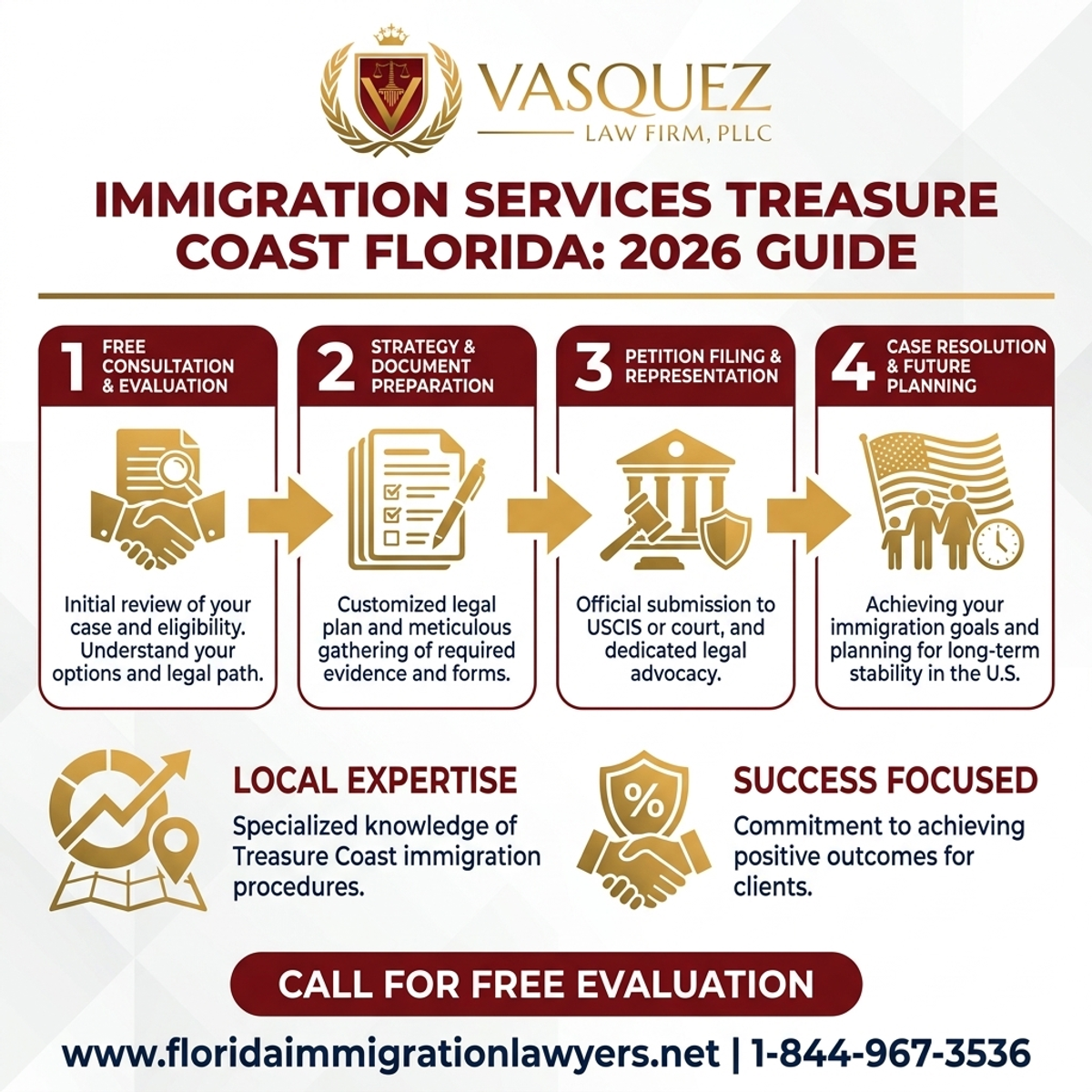
Step-by-Step Process — Immigration Services Treasure Coast Florida: 2026 Guide
Family preference categories, on the other hand, are subject to annual numerical limits, which often result in substantial waiting periods. These categories include unmarried sons and daughters (21 years or older) of U.S. citizens, spouses and unmarried sons and daughters of lawful permanent residents, married sons and daughters of U.S. citizens, and brothers and sisters of U.S. citizens (who are at least 21 years old). The length of these waiting periods can range from a few years to over a decade, depending on the specific category and the applicant's country of chargeability. It is critical to consult the monthly Visa Bulletin from the Department of State to understand current waiting times. Our attorneys in Central Florida are adept at guiding families through these complex processes, ensuring all requirements under the Immigration and Nationality Act (INA), specifically 8 U.S.C. § 1153(a), are met.
What is the Asylum Process in Florida?
The asylum process in Florida allows individuals who fear persecution in their home country due to race, religion, nationality, political opinion, or membership in a particular social group to seek protection in the United States. Applicants can seek asylum affirmatively through USCIS or defensively through the Executive Office for Immigration Review (EOIR) courts. The process involves filing Form I-589, an interview, and potentially court hearings, with a critical deadline of one year from entry to file.
For those seeking refuge from persecution, the asylum process offers a vital pathway to safety and legal status in Florida. Asylum seekers must demonstrate a well-founded fear of persecution based on one of five protected grounds. There are two primary ways to apply for asylum in Florida. The first is affirmative asylum, where an individual who is not in removal proceedings files Form I-589, Application for Asylum and for Withholding of Removal, directly with USCIS. This typically leads to an interview with an asylum officer at a USCIS Asylum Office, such as the one serving Florida in Orlando.
The second path is defensive asylum, which occurs when an individual is already in removal proceedings before an immigration judge at an EOIR court, like the ones in Orlando or Miami. In such cases, the asylum application is presented as a defense against deportation. A critical aspect of the asylum process is the one-year filing deadline, meaning you generally must file your application within one year of your last arrival in the United States, unless an exception applies. Failure to meet this deadline can significantly jeopardize your case. Expert legal counsel is highly recommended to navigate the complexities of asylum law and present a compelling case, adhering to regulations found in 8 CFR Part 208.
Document Checklist for Asylum Seekers
- Form I-589, Application for Asylum and for Withholding of Removal.
- Copy of passport, birth certificate, and other identity documents.
- Evidence of your presence in the U.S. (e.g., I-94, visa, entry stamps).
- Detailed personal statement outlining your fear of persecution.
- Supporting evidence of persecution (e.g., police reports, medical records, news articles, affidavits from witnesses).
- Any other relevant country condition reports or human rights documentation.
- Marriage certificate and birth certificates for dependents included in the application.
How Long Does Naturalization Take in 2026?
As of 2026, the naturalization process, leading to U.S. citizenship, typically takes between 8 to 14 months from the filing of Form N-400 to the Oath of Allegiance ceremony. This timeframe can fluctuate based on the specific USCIS field office processing the application (e.g., Orlando or Miami), the complexity of the case, and current agency backlogs. Eligibility generally requires five years of continuous U.S. residency (three years if married to a U.S. citizen).
Achieving U.S. citizenship through naturalization is the final step for many immigrants who have built their lives in Florida. The journey involves meeting specific eligibility criteria, including continuous residency, physical presence, good moral character, and an ability to read, write, and speak basic English, along with knowledge of U.S. history and government. As of 2026, applicants must file Form N-400, Application for Naturalization, with USCIS. After filing, applicants will typically undergo a biometrics appointment, an interview with a USCIS officer, and finally, the Oath of Allegiance ceremony.
While the average processing time for naturalization in 2026 is generally between 8 to 14 months, it is important to note that these are estimates. Factors such as the volume of applications, staffing levels at local USCIS offices (like the Orlando Field Office serving Central Florida), and any issues arising from background checks can all impact the actual timeline. It is advisable to prepare thoroughly for the civics and English tests, and to ensure all documentation is accurate and complete to avoid delays. Our firm can assist with preparing your application and representing you throughout the process, providing peace of mind as you pursue U.S. citizenship.
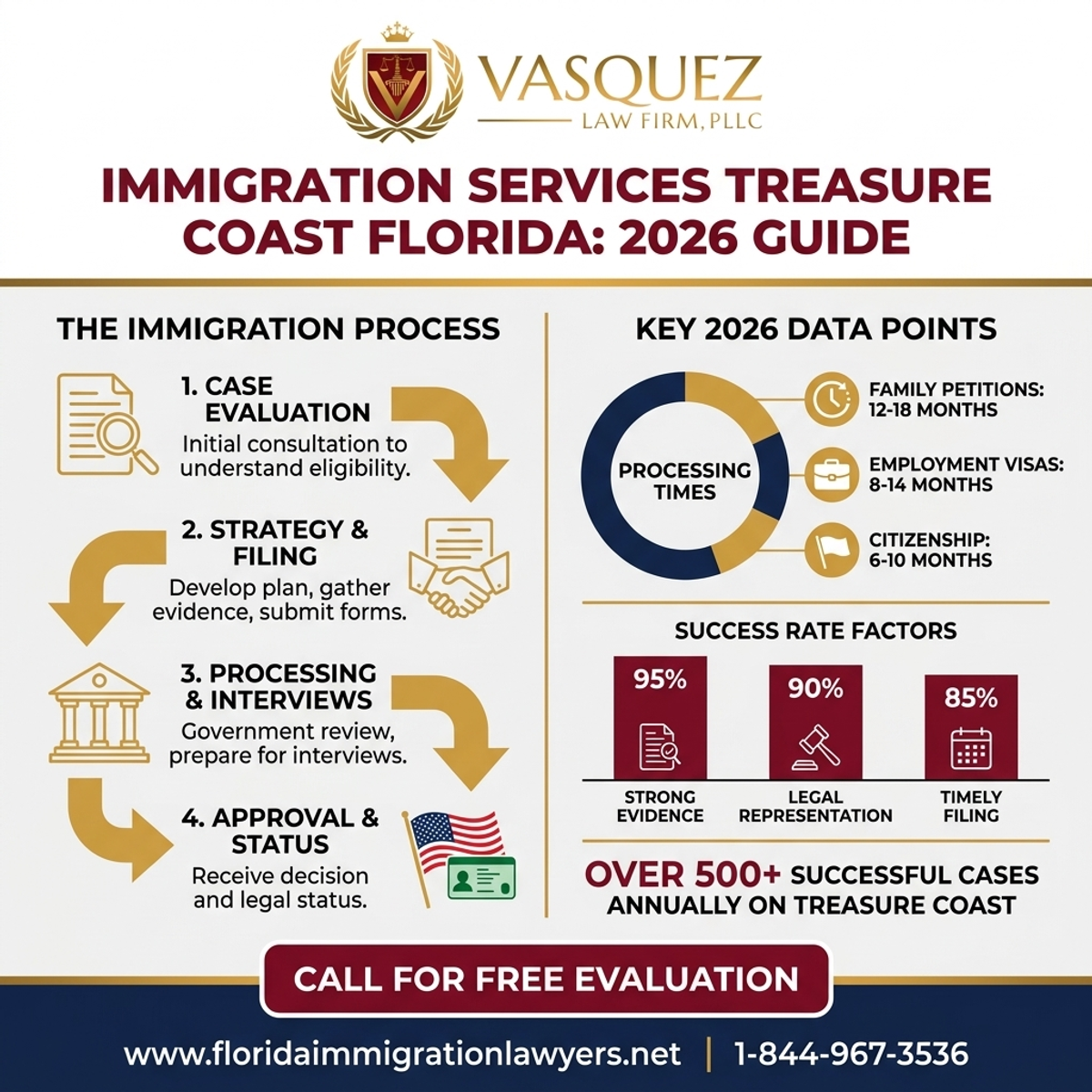
Key Statistics — Immigration Services Treasure Coast Florida: 2026 Guide
Naturalization Process Timeline (Estimated for 2026)
| Stage | Typical Timeframe | Notes |
|---|---|---|
| File Form N-400 | Initial submission | Ensure all documents are attached. |
| Receipt Notice (I-797C) | 1-3 weeks | Confirms USCIS received your application. |
| Biometrics Appointment | 3-8 weeks after filing | Fingerprints, photos, signature for background checks. |
| Interview Scheduling | 2-8 months after biometrics | Notice received for your interview at a local USCIS office. |
| Naturalization Interview | Scheduled date | English and civics tests, review of N-400. |
| Decision on N-400 | Same day to 120 days after interview | Approval or Request for Evidence (RFE). |
| Oath of Allegiance Ceremony | 2-8 weeks after approval | Final step to become a U.S. citizen. |
| Total Estimated Time | 8-14 months | Varies by field office and case complexity. |
What Are the Costs for Immigration Services in Florida?
The costs for immigration services in Florida involve various components, primarily government filing fees and attorney fees. Government fees, set by USCIS and EOIR, are subject to change and vary by application type (e.g., green card, naturalization, visa petition). Attorney fees depend on the complexity of the case, the specific services required, and the lawyer's experience. A comprehensive legal consultation can provide a detailed estimate for your unique situation.
Understanding the financial aspects of immigration is crucial for planning your journey. As of 2026, government filing fees for various forms are determined by U.S. Citizenship and Immigration Services (USCIS) and are subject to periodic adjustments. These fees are non-refundable and must be paid directly to the government agency. Examples include fees for Form I-130 (Petition for Alien Relative), Form I-485 (Application to Adjust Status), and Form N-400 (Application for Naturalization). Fee waivers may be available for certain low-income applicants, but eligibility is strict and must be properly documented.
In addition to government fees, attorney fees constitute a significant portion of the total cost. These fees reflect the expertise, time, and resources required to navigate complex immigration laws, prepare detailed applications, gather supporting evidence, and represent clients in interviews or court proceedings. The cost can vary widely depending on the type of case (e.g., a straightforward family petition versus a complex deportation defense or asylum case), the anticipated duration of the process, and the specific legal services needed. At Florida Immigration Lawyers, we believe in transparent fee structures and offer free initial case reviews to discuss your options and provide a clear understanding of potential costs involved. We serve clients across Florida, including those in the Treasure Coast, from our Central Florida office.
Typical Cost Factors for Immigration Services (Estimated for 2026)
| Item | Typical Fee (Government) | Notes |
|---|---|---|
| Form I-130 (Petition for Alien Relative) | Varies by form | Paid by U.S. citizen/LPR sponsor. |
| Form I-485 (Adjustment of Status) | Varies by form | Includes biometrics fee. |
| Form N-400 (Naturalization) | Varies by form | Fee waivers may be available. |
| Form I-765 (Employment Authorization) | Varies by form | Often filed concurrently with I-485. |
| Form I-589 (Asylum Application) | No fee | No government filing fee for asylum. |
| Medical Examination | Varies by civil surgeon | Required for adjustment of status. |
| Attorney Fees | Varies by case complexity | Consult for a personalized estimate. |
Do not navigate this process alone. The intricacies of immigration law require a seasoned professional who can anticipate challenges and provide strategic advice. Contact Florida Immigration Lawyers today for a free case review and let us guide you through your immigration journey.
Common Mistakes to Avoid in Your Immigration Journey
Navigating the U.S. immigration system is fraught with potential pitfalls that can lead to significant delays, denials, or even deportation. Avoiding these common mistakes is crucial for a successful outcome.
- Filing Incomplete or Inaccurate Forms: Even minor errors or omissions on immigration forms can cause USCIS to reject your application or issue a Request for Evidence (RFE), significantly delaying processing. Ensure all fields are correctly filled and all required documents are attached.
- Missing Deadlines: Strict deadlines apply to many immigration processes, especially for asylum claims (one-year rule) and responses to RFEs. Missing a deadline can result in the denial of your application or even an order of removal.
- Failing to Disclose All Relevant Information: Attempting to conceal past arrests, previous immigration violations, or other pertinent information can be considered misrepresentation and lead to severe penalties, including a permanent bar from the U.S. Honesty is always the best policy.
- Providing Insufficient Supporting Documentation: Each application requires specific evidence to prove eligibility. Failing to provide adequate documentation, such as birth certificates, marriage licenses, financial records, or proof of relationship, can lead to denials.
- Entering the U.S. Illegally or Overstaying a Visa: These actions can trigger bars to future immigration benefits and make it extremely difficult to adjust status or obtain a green card without a waiver. Always strive to maintain legal status.
- Not Updating Your Address with USCIS: If you move, you must inform USCIS within 10 days using Form AR-11. Failure to do so can result in missed notices, interview appointments, or even a decision being made without your knowledge.
- Assuming You Qualify for a Benefit: Immigration law is highly nuanced. What applies to one person may not apply to another. Always confirm your eligibility with a qualified attorney before filing any application to avoid wasted time and money.
- Attending Interviews Unprepared: USCIS interviews are critical. Failing to understand your application, provide consistent answers, or bring all requested documents can jeopardize your case.
- Not Seeking Legal Counsel for Complex Cases: While some simple cases might be manageable, dealing with deportation, criminal records, or previous denials almost always requires professional legal assistance.
- Ignoring Public Charge Rule Changes: The public charge rule has seen various interpretations. Understanding how it affects your application, particularly for green cards, is vital to avoid inadmissibility.
When to Call a Lawyer for Immigration Services in Florida
Deciding when to seek legal counsel is one of the most important decisions you will make in your immigration journey. While some forms might seem straightforward, the underlying legal principles are complex and constantly evolving. You should call an immigration lawyer if you are facing any situation that feels overwhelming, uncertain, or high-stakes.
Specific scenarios that strongly warrant legal intervention include receiving a Notice to Appear (NTA) in immigration court, which initiates deportation proceedings. If you have been arrested or have any criminal history, even minor offenses, these can have severe immigration consequences and require expert legal assessment. Additionally, if your application has been denied, if you have previously been deported, or if you believe you have a complex case involving waivers or humanitarian relief, an attorney is indispensable. Our attorneys at Florida Immigration Lawyers are skilled in navigating these challenging situations, providing robust defense and strategic planning. We can help you understand your options and protect your rights.
Furthermore, if you are applying for asylum, have been a victim of crime, or are seeking specialized visas (like U visas or T visas), the expertise of an immigration lawyer is critical for proper documentation and advocacy. Even for seemingly simple processes like naturalization or family petitions, an attorney can help ensure accuracy, prevent delays, and represent you effectively during interviews. We offer free case reviews to assess your situation and advise on the best course of action. Do not wait for a problem to escalate; proactive legal guidance can save you time, stress, and potential adverse outcomes. Florida Immigration Lawyers serves clients across the state from our Central Florida office.
About Florida Immigration Lawyers
Florida Immigration Lawyers is a leading law firm dedicated to providing exceptional immigration legal services across the entire state of Florida. With our office located in Orlando, Central Florida, we are strategically positioned to serve clients from every corner of the state, including the Treasure Coast and Martin County. Our team of experienced and compassionate attorneys is committed to guiding individuals and families through the complexities of U.S. immigration law.
We offer a comprehensive range of services, including family-based immigration, employment visas, deportation defense, asylum, naturalization, and more. Our approach is client-centered, focusing on clear communication, personalized strategies, and aggressive advocacy to achieve the best possible outcomes. We understand the profound impact immigration matters have on our clients' lives, which is why we offer 24/7 availability and free case reviews. Choose Florida Immigration Lawyers for dedicated legal representation and a team that speaks your language. Schedule a free consultation today and let us help you navigate your immigration journey with confidence.
Sources and References
- U.S. Citizenship and Immigration Services (USCIS)
- Executive Office for Immigration Review (EOIR)
- U.S. Department of State
- 8 U.S.C. Chapter 12 - Immigration and Nationality Act (INA)
- 8 U.S.C. § 1153(a) - Allotment of immigrant visas
- 8 CFR Part 208 - Asylum and Withholding of Removal
- USCIS Policy Manual
Related services: immigration waivers, humanitarian protection programs, DACA renewal and applications.
This article provides general legal information and is not intended as legal advice. Every case is unique, and outcomes depend on specific facts and circumstances. Contact an attorney for advice about your particular situation.
Your immigration journey is too important to face alone. Trust the experienced attorneys at Florida Immigration Lawyers to provide the guidance and representation you need. Call us today at 1-844-YO-PELEO for a free, confidential case review. Se Habla Español - Estamos aquí para ayudarle.
Do Not Navigate This Process Alone
Our experienced immigration attorneys are ready to fight for you. Get a free, confidential case review today.
Se Habla Español
Or leave your details and we’ll call you:
Free Evaluation in 24 Hours
Or talk to us right now

AI voice assistant — available 24/7
FreeFrequently Asked Questions

William J. Vásquez
Founding Attorney · Vasquez Law Firm
U.S. Air Force veteran and immigration attorney with years of hands-on U.S. immigration experience. J.D., NCCU School of Law. AILA member. Admitted to the 4th, 5th, and 11th Circuit Courts.
Available 24/7 - Free Evaluations
Reviewed for legal accuracy by William J. Vásquez
Licensed in North Carolina; U.S. immigration is federal practice.
Related Legal Services
Our Florida immigration attorneys can help you with family immigration services, immigration lawyer cost in Florida and experienced immigration attorneys. Call today at 1-844-YO-PELEO for a free case review.
Related Links
Related Topics
Free Legal Case Review
Discuss your case with our experienced attorneys. We're available 24/7.
Se Habla Español - Estamos aquí para ayudarle.
Related Articles
Certificate of Eligibility for Expungement in Florida 2026
For non-U.S. citizens in Florida, understanding how a state expungement impacts immigration status is critical. A certificate of eligibility for expungement in Florida allows a criminal record to be sealed or expunged under state law. However, federal immigration agencies often disregard such state-level relief, still considering the original criminal offense as a conviction for immigration purposes. This can have severe implications for visa applications, green card eligibility, naturalization, and even lead to deportation. This guide clarifies the Florida expungement process, its limited effect on federal immigration law, and key steps to protect your status in 2026. Learn about common mistakes, required documents, timelines, and when to seek expert legal counsel from Florida Immigration Lawyers to navigate these complex issues effectively.
Immigration Lawyer Orlando Free Consultation in Florida
For individuals and families in Orlando, Florida, navigating the complexities of U.S. immigration law requires expert guidance. An immigration lawyer in Orlando offers crucial support for everything from visa applications and green card processes to naturalization and deportation defense. This comprehensive guide details what a free consultation covers, providing a step-by-step overview of immigration pathways, essential document checklists, and expected timelines in 2026. We also highlight common mistakes to avoid, discuss the critical role of legal counsel in deportation and asylum cases, and explain why choosing a local Orlando immigration attorney is beneficial. Florida Immigration Lawyers is dedicated to serving the diverse community of Orlando with compassionate, effective legal solutions, ensuring you receive personalized advice and robust representation for a successful immigration journey.
Immigration Bond Hearing Process in Florida 2026
Understanding immigration bond hearings in Florida is crucial for detained immigrants. This guide covers the process, documents needed, timeline, and costs associated with bond hearings. Discover how legal assistance can impact outcomes and learn common mistakes to avoid. Contact Florida Immigration Lawyers for expert guidance.
Deportation Attorney: Protect Your Future in Orlando
If you are facing deportation in Orlando, understanding the process and having the right legal support is crucial. Learn about the role of a deportation attorney, how to prepare for immigration court, and common mistakes to avoid. Florida Immigration Lawyers offer expert guidance and free case reviews. Call 1-844-YO-PELEO today.