How to Apply for VAWA in Tampa: A Complete Guide
Discover how to apply for VAWA in Tampa with this comprehensive guide. Learn about eligibility, documentation, and the application process for a successful VAWA self-petition. Understand the importance of timely submissions, complete forms, and evidence gathering. Our Orlando-based law firm is ready to assist you every step of the way.
Applying for VAWA in Tampa involves submitting a Form I-360, Petition for Amerasian, Widow(er), or Special Immigrant, under the Violence Against Women Act (VAWA). This option is available to abused spouses, children, and parents of U.S. citizens or lawful permanent residents. Key steps include gathering evidence of abuse, proving good moral character, and filing with the appropriate USCIS office.
- VAWA allows certain abused immigrants to self-petition for legal status.
- Form I-360 is crucial for the application process.
- Consult an immigration attorney for guidance.
- Timeliness and detailed documentation are critical.
Introduction
Facing abuse is a harrowing experience, especially when it involves your immigration status. Fortunately, the Violence Against Women Act (VAWA) provides a pathway for abused spouses, children, and parents to self-petition for legal status independently of their abuser. This article focuses on how to apply for VAWA in Tampa, providing guidance on eligibility, application processes, and the benefits it offers. Call Florida Immigration Lawyers at 1-844-YO-PELEO for a free case review to discuss your specific situation.
The journey to safety and legal independence can feel overwhelming, but VAWA was specifically designed to offer protection and a fresh start. It empowers victims to escape abusive situations without fear of deportation or reliance on their abuser for immigration purposes. Understanding the nuances of this federal law and its application process in Tampa is the first critical step towards reclaiming your life.
This guide will demystify the VAWA application process, from understanding eligibility to compiling the necessary evidence and navigating the USCIS procedures. We aim to provide clear, actionable information to help you or a loved one pursue this vital pathway to legal residency. Remember, you do not have to endure abuse in silence; legal avenues exist to safeguard your future and provide the stability you deserve.
What is VAWA and Who is Eligible?
VAWA, or the Violence Against Women Act, allows certain abused immigrants to self-petition for legal status without the cooperation of their abusive U.S. citizen or lawful permanent resident family member. As of 2026, eligibility includes spouses, children, and parents of U.S. citizens or lawful permanent residents who have suffered battery or extreme cruelty.
Eligibility criteria include:
- Proof of relationship to the abuser.
- Evidence of battery or extreme cruelty.
- Demonstration of good moral character.
Applicants must provide comprehensive documentation to support their claims, including police reports, medical records, and affidavits from witnesses.
It's crucial to understand that "battery or extreme cruelty" encompasses more than just physical violence. It can include psychological, emotional, financial, and sexual abuse. For instance, an abuser might isolate a spouse from friends and family, control all finances, threaten deportation, or constantly demean and terrorize them. All these forms of abuse can qualify under VAWA, demonstrating the broad protective scope of the act. The key is to document these experiences thoroughly, even if they don't leave visible scars.
The requirement of "good moral character" means that applicants must generally have a clean criminal record and not have engaged in certain activities that would make them inadmissible to the U.S. If you have any past legal issues, it is imperative to discuss them openly with an experienced immigration attorney, such as those at Florida Immigration Lawyers. They can help assess how such issues might impact your case and advise on potential waivers or mitigating circumstances. For example, a minor past offense might be overcome, but more serious crimes could pose significant challenges, making expert legal guidance indispensable.
Furthermore, the relationship requirement is specific. For spouses, you must prove you are or were legally married to a U.S. citizen or LPR. If divorced, the divorce must have occurred within two years of filing the VAWA petition, and it must be connected to the abuse. For children, you must be under 21 (or under 25 in certain circumstances) and unmarried, and your abuser must be your U.S. citizen or LPR parent. Parents must show they were abused by their U.S. citizen or LPR child. These relationships must be proven with official documents like marriage certificates or birth certificates, alongside evidence of the abusive relationship.
How to Apply for VAWA in Tampa?
To apply for VAWA in Tampa, you must file Form I-360. This form is available on the USCIS website. Ensure all parts of the form are completed accurately and that you attach all necessary evidence.
- Complete Form I-360: Provide personal information and details of the abuse.
- Gather Evidence: Collect police reports, medical records, and affidavits.
- File with USCIS: Submit your form and evidence to the appropriate USCIS service center.
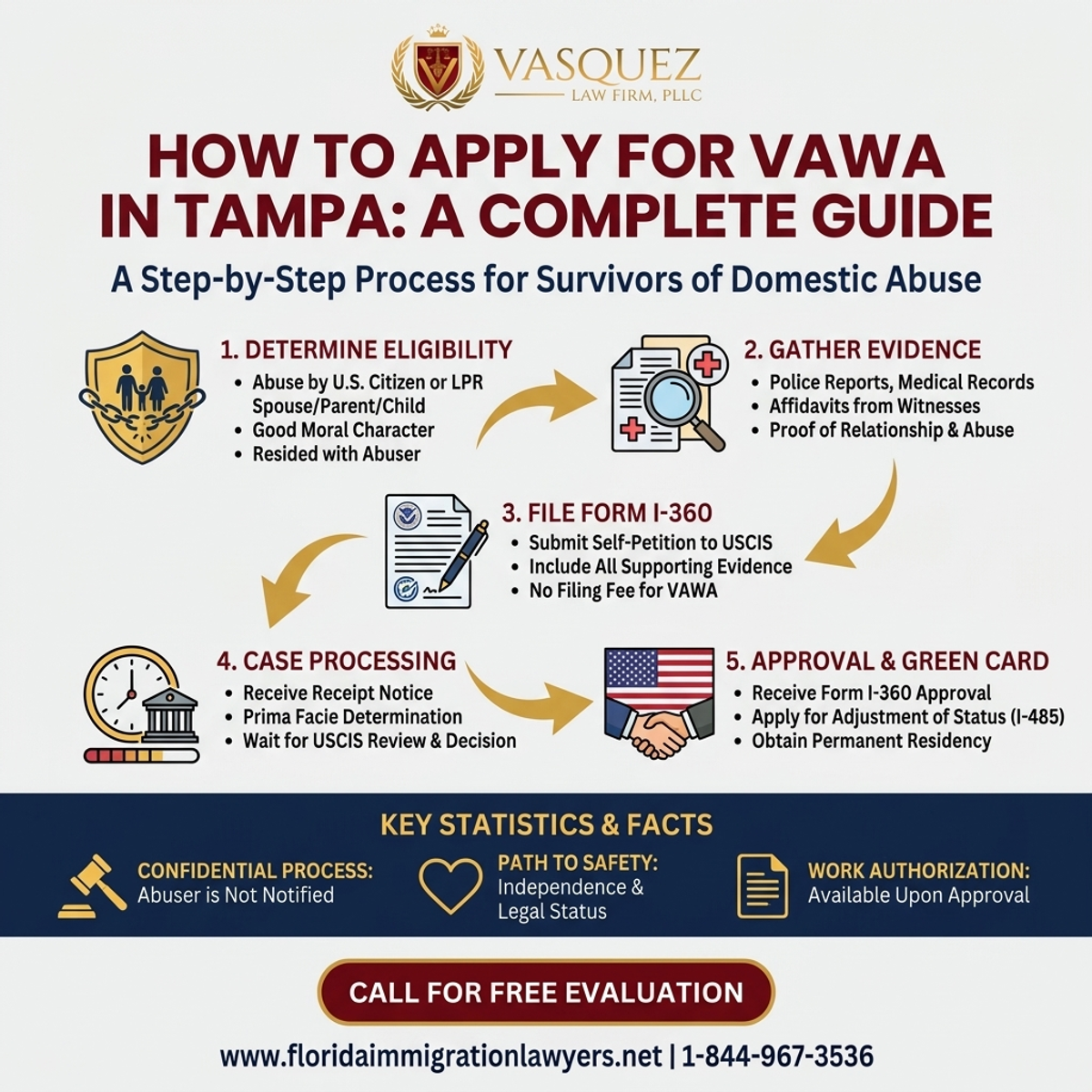
Step-by-Step Process — How to Apply for VAWA in Tampa: A Complete Guide
Processing times vary, and it's advisable to check the USCIS website for current timelines.
Completing Form I-360 requires meticulous attention to detail. Every question must be answered truthfully and thoroughly. This form is your primary opportunity to tell your story to USCIS, so clarity and consistency are paramount. While it might be tempting to rush through, taking your time and reviewing each section multiple times can prevent common errors that lead to delays. A common pitfall is leaving sections blank or providing vague answers, which can raise red flags for adjudicators. If a question doesn't apply, clearly state "N/A."
Gathering evidence is often the most challenging but critical part of the application. Beyond police reports and medical records, consider other forms of proof such as sworn affidavits from friends, family, therapists, or clergy who have witnessed the abuse or its effects. Personal journals, text messages, emails, photographs, voicemails, and even financial records showing control can serve as powerful corroborating evidence. The more diverse and compelling your evidence, the stronger your case will be. Remember, USCIS understands that abuse often occurs in private, so a combination of direct and circumstantial evidence is acceptable.
When filing with USCIS, ensure you send your complete packet to the correct service center, typically via certified mail with a return receipt requested. This provides proof of mailing and delivery, which can be invaluable if any questions arise later. It's also wise to keep a complete copy of everything you send for your records. Given the sensitive nature of VAWA petitions, USCIS maintains strict confidentiality, meaning your abuser will not be notified of your application. This protection is a cornerstone of the VAWA program, allowing victims to seek help without fear of immediate retaliation.
Document Checklist for VAWA Self-Petition
- Completed Form I-360
- Proof of U.S. citizenship or lawful permanent resident status of the abuser
- Marriage certificate (if applicable)
- Evidence of abuse (e.g., police reports, medical records)
- Proof of your good moral character
- Personal statement detailing the abuse
Each item on this checklist plays a vital role in building a strong VAWA case. For instance, proving the abuser's status is non-negotiable, requiring copies of their birth certificate, passport, green card, or naturalization certificate. If you don't have direct access to these, an attorney can help strategize alternative ways to establish this, such as through public records or sworn statements, though direct proof is always preferred.
The "evidence of abuse" category is where applicants often need the most guidance. Think broadly about what constitutes proof. This can include: detailed affidavits from you and any witnesses; photographs of injuries or property damage; police reports (even if no arrest was made); medical records, therapist notes, or counseling reports; protective orders or restraining orders; emails, text messages, or voicemails from the abuser; school records documenting abuse of a child; or even financial statements showing economic control. A strong personal statement, your sworn declaration, is paramount, offering a detailed, chronological narrative of the abuse and its impact on your life.
Demonstrating "good moral character" typically involves providing your criminal history records (or proof of no record) and affidavits from individuals attesting to your character. If you have any criminal history, even minor offenses, it is crucial to disclose this to your attorney. They can help determine if it impacts your eligibility and how to best present your case to mitigate any negative effects. Florida Immigration Lawyers are adept at navigating these complex situations, ensuring all documentation is robust and accurately presented to USCIS.
VAWA Application Timeline and Processing
| Stage | Typical Timeframe | Notes |
|---|---|---|
| Filing Form I-360 | 1-2 months | Initial review by USCIS |
| Biometrics Appointment | 1-2 months post-filing | Fingerprinting and photo |
| Application Decision | 12-24 months | Based on evidence and eligibility |
Do not navigate this process alone. Contact Florida Immigration Lawyers today.
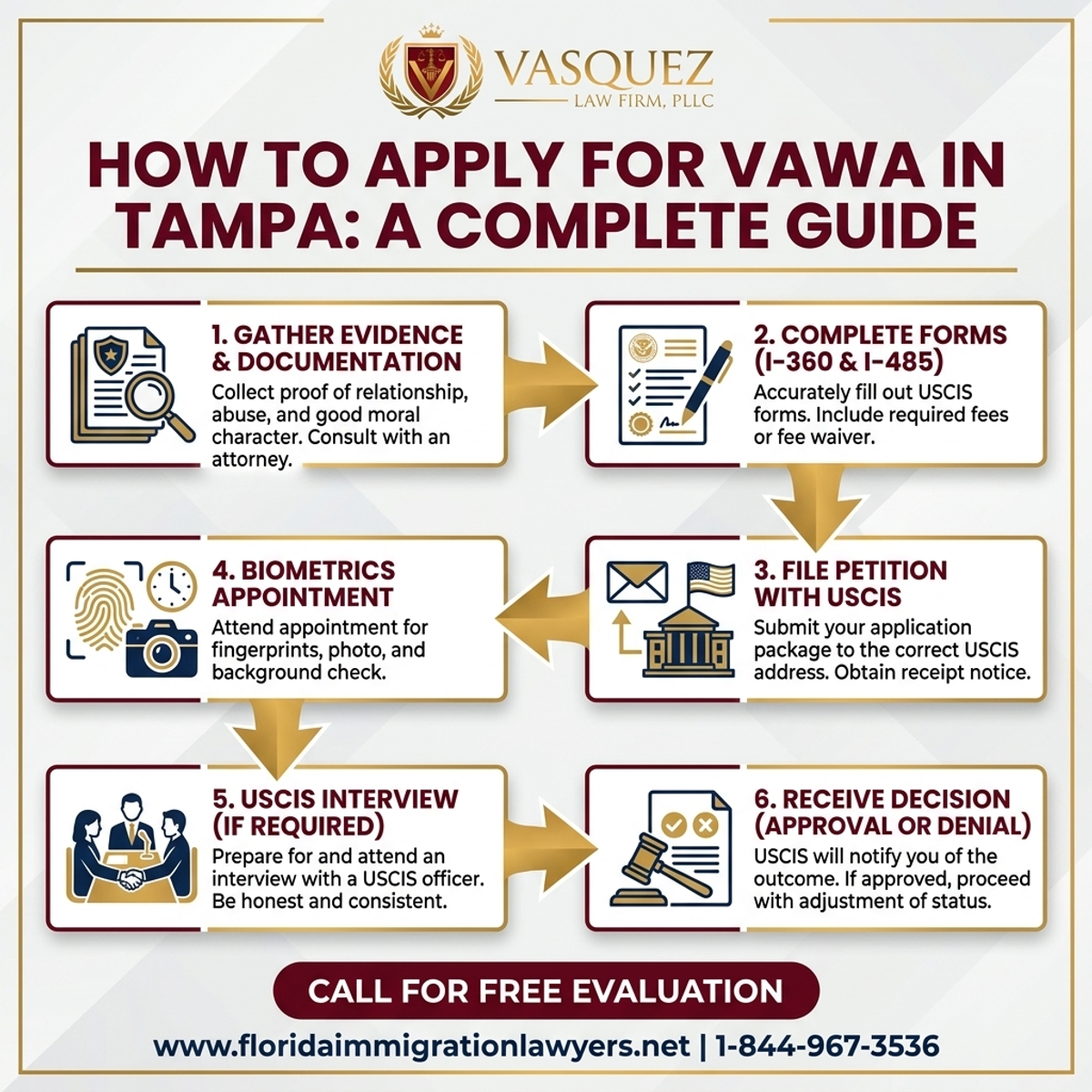
Key Statistics — How to Apply for VAWA in Tampa: A Complete Guide
The VAWA application timeline can be lengthy, and understanding each stage helps manage expectations. After filing your Form I-360, USCIS will issue a receipt notice, typically within a few weeks. This notice confirms they have received your application and provides a receipt number you can use to track your case online. This initial period is often followed by a biometrics appointment, where you will provide fingerprints and a photograph for background checks. Missing this appointment can lead to significant delays or even denial, so it's critical to attend or reschedule promptly if absolutely necessary.
Following biometrics, your application enters the adjudication phase, where a USCIS officer reviews all submitted evidence. During this period, USCIS may issue a Request for Evidence (RFE) if they need more information or clarification. Responding to an RFE accurately and within the specified deadline is crucial, as failure to do so can result in denial. An attorney from Florida Immigration Lawyers can help you prepare a comprehensive response, ensuring all requested information is provided effectively.
The final decision on your I-360 can take anywhere from one to two years, sometimes longer, depending on the service center's workload. If your I-360 is approved, you are then eligible to apply for adjustment of status (Form I-485) to become a lawful permanent resident, commonly known as getting a green card. In many cases, applicants can concurrently file for an Employment Authorization Document (EAD) and Advance Parole (travel document) to gain work authorization and the ability to travel while their application is pending, providing much-needed stability during this waiting period.
Common Mistakes to Avoid in VAWA Applications
- Incomplete Forms: Missing information can lead to delays or denials.
- Insufficient Evidence: Failure to provide adequate proof of abuse can result in denial.
- Missing Biometrics: Not attending your biometrics appointment can halt your application.
- Ignoring Deadlines: Filing late can jeopardize your case.
- Lack of Legal Counsel: Not consulting with an attorney could lead to avoidable errors.
- Inconsistent Testimonies: Contradictory statements can undermine your credibility.
- Failure to Prove Good Moral Character: Omitting evidence of good moral character can be detrimental.
Avoiding these common pitfalls is paramount for a successful VAWA petition. For example, submitting an incomplete Form I-360 is a frequent error that can lead to a Request for Evidence (RFE) or outright denial, significantly prolonging your journey to legal status. Always double-check every field and ensure all required supporting documents are attached before submission.
Insufficient evidence is another major hurdle. USCIS requires compelling proof of abuse and your eligibility. Simply stating you were abused is not enough; you need corroborating documents like police reports, medical records, therapist notes, photographs, and detailed affidavits from witnesses or yourself. A weak evidence package can easily lead to a denial, emphasizing the need for thorough documentation and strategic presentation.
Furthermore, failing to attend your biometrics appointment or respond to an RFE within the given timeframe can be catastrophic. These are critical steps in the process, and missing them often results in the abandonment or denial of your application without further consideration. Maintaining clear communication with your legal team, like Florida Immigration Lawyers, and keeping track of all notices and deadlines is essential to prevent such setbacks.
When to Call a Lawyer
Engaging an immigration attorney is crucial when applying for VAWA due to the complexity of the process. Consider legal help if:
- You have a criminal record that might affect your application.
- Your abuser is contesting the abuse allegations.
- You need assistance gathering evidence.
- You've received a notice of intent to deny from USCIS.
The team at Florida Immigration Lawyers is experienced in handling VAWA cases and can provide the necessary support and guidance.
Beyond the scenarios listed, seeking legal counsel is highly advisable if you are experiencing any language barriers, have difficulty understanding complex legal jargon, or feel overwhelmed by the sheer volume of documentation required. An attorney can translate legal terms, help you articulate your story effectively, and ensure all forms are completed accurately, minimizing the risk of errors that could jeopardize your case. For instance, if you are unsure how to obtain certain records or if your abuser is actively trying to obstruct your application, a lawyer can intervene and guide you through these challenges.
Moreover, if you are considering concurrent filings, such as applying for an Employment Authorization Document (EAD) or Adjustment of Status along with your I-360, an attorney can ensure these applications are properly coordinated and submitted at the optimal time. This integrated approach can significantly expedite your ability to work and live freely while your primary VAWA petition is processed. Florida Immigration Lawyers offers comprehensive support for these complex, multi-faceted immigration processes, ensuring you receive holistic guidance.
Even if your situation seems straightforward, the emotional toll of recounting abuse can make it difficult to focus on legal technicalities. A compassionate attorney provides not only legal expertise but also a layer of emotional support, helping you navigate the process without further trauma. Don't hesitate to reach out to Florida Immigration Lawyers at 1-844-YO-PELEO for a free case review if you are considering a VAWA petition; their expertise can be a lifeline.
About Florida Immigration Lawyers
Florida Immigration Lawyers is dedicated to assisting clients with their immigration needs, including VAWA self-petitions. Our experienced attorneys are committed to providing compassionate and effective legal services. We offer free case reviews and are available 24/7 to serve clients throughout Orlando and Central Florida. Schedule a free consultation with us today.
Our firm understands the sensitive nature of VAWA cases and approaches each client with empathy and respect. We know that survivors of abuse require not just legal representation, but also a safe and supportive environment to share their stories. Our team is trained to handle these delicate situations with the utmost discretion and professionalism, ensuring your privacy and comfort throughout the entire process.
At Florida Immigration Lawyers, we leverage our deep knowledge of immigration law and our extensive experience with VAWA petitions to build the strongest possible case for you. From meticulously gathering evidence to crafting compelling personal statements and responding to USCIS inquiries, we stand by your side every step of the way. Our goal is to empower you to secure your legal status and build a new, safe life for yourself and your family. Reach out to us at 1-844-YO-PELEO for a confidential and free consultation.
Sources and References
- U.S. Citizenship and Immigration Services (USCIS)
- Executive Office for Immigration Review (EOIR)
- 8 U.S.C. Chapter 12 - Immigration and Nationality Act
Frequently Asked Questions About VAWA in Tampa
Can I apply for VAWA if I am already divorced from my abuser?
Yes, you may still be eligible to apply for VAWA even if you are divorced from your abuser. Generally, you must file your VAWA petition within two years of the divorce being finalized. It is critical to demonstrate that the divorce was directly related to or a result of the abuse you experienced. An attorney can help you gather evidence to establish this connection.
Will my abuser be notified if I file a VAWA petition?
No, USCIS is legally prohibited from notifying your abuser about your VAWA petition. This confidentiality provision is a cornerstone of the Violence Against Women Act, designed to protect victims from potential retaliation and further abuse. Your safety and privacy are prioritized throughout the application process, ensuring you can seek help without fear.
Can men apply for VAWA?
Absolutely, VAWA is a gender-neutral law. The protections and pathways to legal status offered by VAWA are available to any eligible individual, regardless of their gender, who has suffered battery or extreme cruelty from a qualifying U.S. citizen or lawful permanent resident family member. Eligibility criteria apply equally to all petitioners.
What if I don't have police reports or medical records?
While police reports and medical records are strong evidence, they are not strictly required for a VAWA petition. USCIS understands that abuse often goes unreported. You can still build a compelling case using other forms of evidence, such as detailed personal affidavits, sworn statements from witnesses, photographs, text messages, emails, therapy records, or journal entries. An attorney can help you identify and gather alternative proofs.
Can I get a work permit while my VAWA application is pending?
Yes, typically, you can apply for an Employment Authorization Document (EAD), also known as a work permit, concurrently with or shortly after filing your Form I-360 VAWA petition. Obtaining an EAD provides you with the legal ability to work in the U.S. while your immigration case is being processed, offering crucial financial independence and stability during this waiting period.
What happens after my I-360 VAWA petition is approved?
Once your Form I-360 VAWA petition is approved, you become a "VAWA self-petitioner." This approval makes you eligible to apply for adjustment of status to become a lawful permanent resident (to get a green card), provided you meet all other eligibility requirements for permanent residency. This is the final step towards securing your long-term legal status in the United States.
Is VAWA only for physical abuse?
No, VAWA's definition of "battery or extreme cruelty" is broad and encompasses much more than just physical abuse. It includes emotional, psychological, sexual, and financial abuse, as well as threats, intimidation, and coercion. Any pattern of behavior that causes severe mental or emotional suffering can qualify, demonstrating the law's comprehensive protection for victims.
Related services: family petition process, family-based green cards, fiancé visa (K-1), marriage-based immigration.
This article provides general legal information and is not intended as legal advice. Every case is unique, and outcomes depend on specific facts and circumstances. Contact an attorney for advice about your particular situation.
Seize the opportunity to protect yourself and your family. Contact Florida Immigration Lawyers at 1-844-YO-PELEO for a free consultation. Se Habla Espanol - Estamos aqui para ayudarle.
If you need legal assistance, learn more about family immigration lawyers in Florida, or call us at 1-844-967-3536 for a free case review.
Do Not Navigate This Process Alone
Our experienced immigration attorneys are ready to fight for you. Get a free, confidential case review today.
Se Habla Español
Or leave your details and we’ll call you:
Free Evaluation in 24 Hours
Or talk to us right now
AI voice assistant — available 24/7
FreeFrequently Asked Questions

William J. Vásquez
Founding Attorney · Vasquez Law Firm
U.S. Air Force veteran and immigration attorney with years of hands-on U.S. immigration experience. J.D., NCCU School of Law. AILA member. Admitted to the 4th, 5th, and 11th Circuit Courts.
Available 24/7 - Free Evaluations
Reviewed for legal accuracy by William J. Vásquez
Licensed in North Carolina; U.S. immigration is federal practice.
Related Legal Services
Our Florida immigration attorneys can help you with business immigration, deportation defense and family immigration services. Call today at 1-844-YO-PELEO for a free case review.
Related Links
Related Topics
Free Legal Case Review
Discuss your case with our experienced attorneys. We're available 24/7.
Se Habla Español - Estamos aquí para ayudarle.
Related Articles
Certificate of Eligibility for Expungement in Florida 2026
For non-U.S. citizens in Florida, understanding how a state expungement impacts immigration status is critical. A certificate of eligibility for expungement in Florida allows a criminal record to be sealed or expunged under state law. However, federal immigration agencies often disregard such state-level relief, still considering the original criminal offense as a conviction for immigration purposes. This can have severe implications for visa applications, green card eligibility, naturalization, and even lead to deportation. This guide clarifies the Florida expungement process, its limited effect on federal immigration law, and key steps to protect your status in 2026. Learn about common mistakes, required documents, timelines, and when to seek expert legal counsel from Florida Immigration Lawyers to navigate these complex issues effectively.
Immigration Lawyer Orlando Free Consultation in Florida
For individuals and families in Orlando, Florida, navigating the complexities of U.S. immigration law requires expert guidance. An immigration lawyer in Orlando offers crucial support for everything from visa applications and green card processes to naturalization and deportation defense. This comprehensive guide details what a free consultation covers, providing a step-by-step overview of immigration pathways, essential document checklists, and expected timelines in 2026. We also highlight common mistakes to avoid, discuss the critical role of legal counsel in deportation and asylum cases, and explain why choosing a local Orlando immigration attorney is beneficial. Florida Immigration Lawyers is dedicated to serving the diverse community of Orlando with compassionate, effective legal solutions, ensuring you receive personalized advice and robust representation for a successful immigration journey.
Understanding Immigration Court in Florida 2026
Navigating immigration court proceedings in Florida can be complex. Learn about the role of the EOIR, removal proceedings, and how to prepare. Reach out to Florida Immigration Lawyers for a free consultation and expert guidance.
Immigration Lawyer Services in Orlando, Florida 2026
Explore how immigration lawyers in Orlando, Florida can assist you with visa applications, deportation defense, and more. Learn about the immigration process and the importance of legal guidance.