Withholding of Removal Florida Defense: Your Guide
If you are facing deportation in Florida and fear persecution or torture upon return to your home country, you may be eligible for withholding of removal or protection under the Convention Against Torture (CAT). These forms of relief are crucial for individuals who cannot return safely. Understanding the strict eligibility requirements, the complex legal process, and the high burden of proof is vital for a successful defense. Florida Immigration Lawyers specializes in deportation defense, offering expert guidance to navigate these challenging cases in courts across Florida. We are here to help you protect your future and explore every possible defense.

Withholding of removal is a form of protection granted to non-citizens in the United States who demonstrate a clear probability of persecution or torture if returned to their home country. Unlike asylum, it does not lead to lawful permanent residency but prevents deportation. To qualify, an applicant must prove it is more likely than not (over 50% chance) that they would face persecution on account of race, religion, nationality, membership in a particular social group, or political opinion, or torture as defined by the Convention Against Torture (CAT). This relief is often sought by individuals facing deportation in Florida who have missed the asylum filing deadline or are otherwise ineligible for asylum due to statutory bars.
- Withholding of removal prevents deportation but does not grant permanent residency.
- Applicants must show a "clear probability" (over 50% chance) of persecution or torture.
- It is distinct from asylum, with different eligibility criteria and bars.
- Protection under the Convention Against Torture (CAT) has a broader scope for torture.
- Legal assistance is crucial for navigating the complex requirements and court proceedings.
Facing a deportation order in Florida can be an incredibly frightening and uncertain experience. The thought of being forced to return to a country where you fear for your safety, or even your life, is a heavy burden. For many non-citizens in this precarious situation, withholding of removal offers a critical lifeline. This form of protection allows individuals to remain in the United States when they can demonstrate a high likelihood of persecution or torture upon return to their native land.
Whether you're in Tallahassee, Miami, Orlando, or anywhere else in the Sunshine State, understanding your options for deportation defense is paramount. This comprehensive guide will delve into the intricacies of withholding of removal and protection under the Convention Against Torture (CAT), explaining who is eligible, the rigorous standards of proof, and the procedural steps involved. We will highlight the distinctions between these forms of relief and asylum, discuss common pitfalls, and emphasize the invaluable role of an experienced immigration attorney. Do not face this complex legal battle alone. Call Florida Immigration Lawyers at 1-844-967-3536 for a free consultation and let us help you explore every possible defense.
Understanding Withholding of Removal in Florida
Withholding of removal, codified under Section 241(b)(3) of the Immigration and Nationality Act (INA), is a mandatory form of relief from deportation. This means that if an immigration judge determines an individual meets the eligibility criteria, the judge must grant the protection. Unlike asylum, which is discretionary and can lead to lawful permanent residency, withholding of removal only prevents deportation to a specific country where the individual's life or freedom would be threatened. It does not provide a path to a green card or citizenship, although individuals granted withholding may eventually be eligible for other forms of relief.
The standard of proof for withholding of removal is significantly higher than that for asylum. An applicant must demonstrate a "clear probability" that their life or freedom would be threatened in the proposed country of removal on account of race, religion, nationality, membership in a particular social group, or political opinion. This means proving it is "more likely than not" (i.e., a greater than 50% chance) that they would face persecution. This stringent standard requires compelling evidence and detailed testimony, often making these cases particularly challenging in Florida's busy immigration courts, such as those in Miami and Orlando, which handle a high volume of complex cases.
Statutory bars also apply to withholding of removal. An individual may be ineligible if they: persecuted others; committed a serious non-political crime outside the U.S.; pose a danger to the security of the U.S.; or have committed a particularly serious crime in the U.S. that constitutes a danger to the community. These bars are strictly applied and require a thorough legal analysis. The Executive Office for Immigration Review (EOIR) oversees the immigration court system, where these cases are adjudicated by immigration judges. Understanding these nuances is crucial for any successful defense strategy in Florida.
Eligibility Requirements for Withholding of Removal
To be eligible for statutory withholding of removal under INA 241(b)(3), an applicant must meet a demanding burden of proof. The core requirement is to establish that it is more likely than not that their life or freedom would be threatened upon return to their country of origin. This threat must be on account of one of the five protected grounds: race, religion, nationality, membership in a particular social group, or political opinion. This means providing substantial evidence that demonstrates a personalized risk, not just general country conditions, though country conditions reports are vital supporting evidence.
The "more likely than not" standard is a probabilistic one, demanding that the applicant show a greater than 50% chance of future persecution. This is a higher threshold than the "well-founded fear" standard for asylum. For example, if an applicant from a country known for political instability and human rights abuses can present specific evidence of past persecution against them or their family members, coupled with expert testimony on the current political climate, they may meet this standard. Without such specific, compelling evidence, even dire country conditions may not suffice on their own.
Furthermore, applicants must not be subject to any of the statutory bars to withholding. These bars include having persecuted others, having committed a serious non-political crime outside the United States, being a danger to the security of the United States, or having committed a particularly serious crime within the United States. For instance, a conviction for an aggravated felony in Florida would almost certainly trigger the "particularly serious crime" bar, making withholding of removal impossible. Navigating these complex eligibility criteria and potential bars requires the keen eye and experience of a dedicated Florida immigration attorney.
Convention Against Torture (CAT) Protection in Florida
In addition to statutory withholding of removal, individuals facing deportation in Florida may also seek protection under the Convention Against Torture (CAT). This international treaty, implemented in U.S. law, offers a crucial layer of defense against forced return to a country where one fears torture. CAT protection is distinct from statutory withholding of removal in several key aspects, making it a viable option for those who might not qualify for other forms of relief, particularly if they are subject to asylum or statutory withholding bars.
To qualify for CAT protection, an applicant must demonstrate that it is more likely than not they would be tortured if removed to the proposed country. The definition of torture under CAT is specific: "any act by which severe pain or suffering, whether physical or mental, is intentionally inflicted on a person for such purposes as obtaining from him or a third person information or a confession, punishing him for an act he or a third person has committed or is suspected of having committed, or intimidating or coercing him or a third person, or for any reason based on discrimination of any kind, when such pain or suffering is inflicted by or at the instigation of or with the consent or acquiescence of a public official or other person acting in an official capacity." This last part, regarding official involvement, is critical.
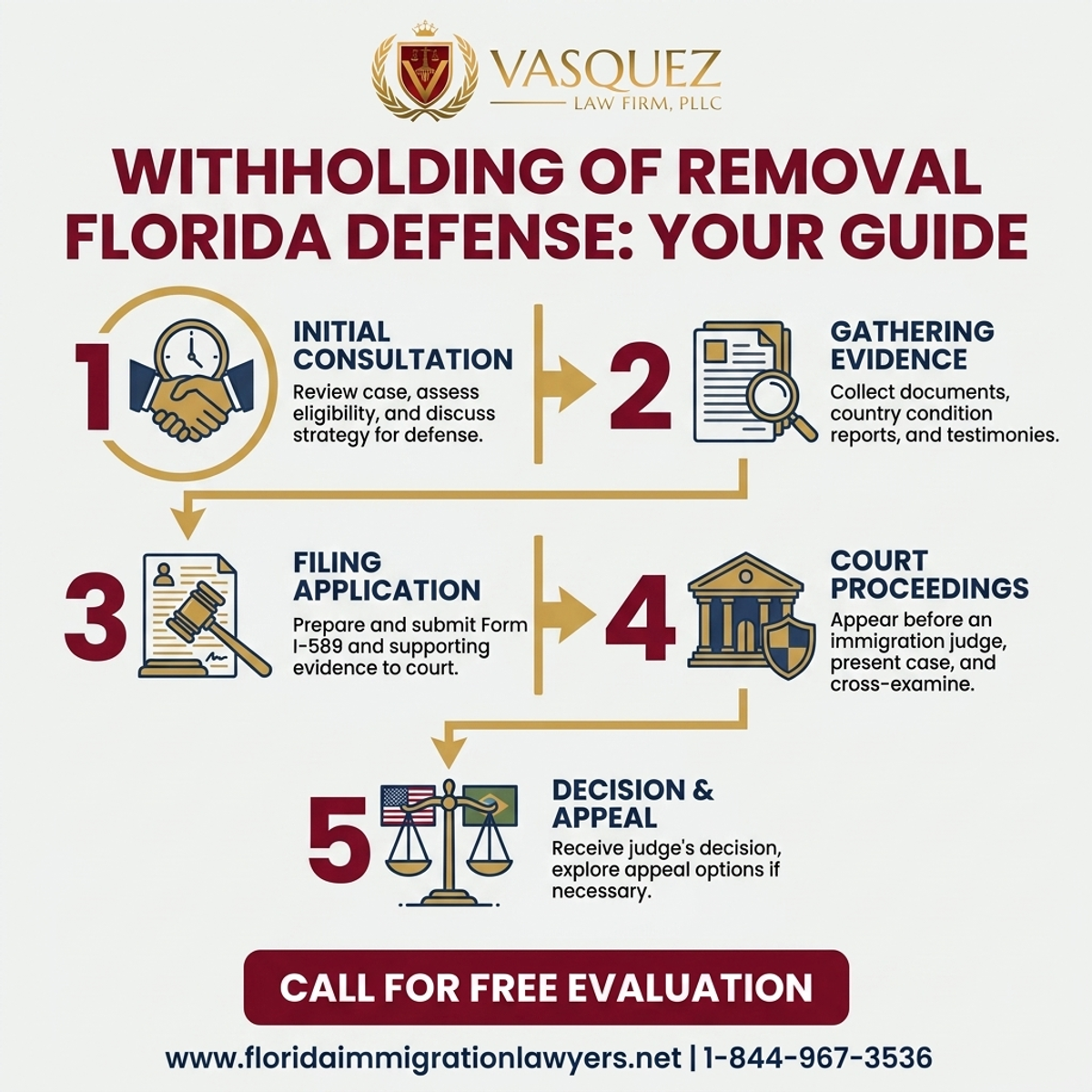
Step-by-Step Process — Withholding of Removal Florida Defense: Your Guide
One significant advantage of CAT protection is that it does not contain the same extensive statutory bars as asylum or statutory withholding. For instance, the "persecutor of others" bar and the "serious non-political crime" bar do not apply to CAT. The only bars to CAT protection are if the individual is a danger to the security of the U.S. or has committed a particularly serious crime, but even these are applied differently. This means individuals with certain criminal histories in Florida, or those who may have missed the asylum filing deadline, could still be eligible for CAT. For example, an individual in Tallahassee fearing torture by corrupt police forces or paramilitary groups with government acquiescence could pursue CAT, even if their fear is not based on a protected ground like political opinion. An attorney from Florida Immigration Lawyers can assess your specific situation and determine if CAT protection is a viable path for your deportation defense.
The Withholding of Removal Process: A Step-by-Step Guide
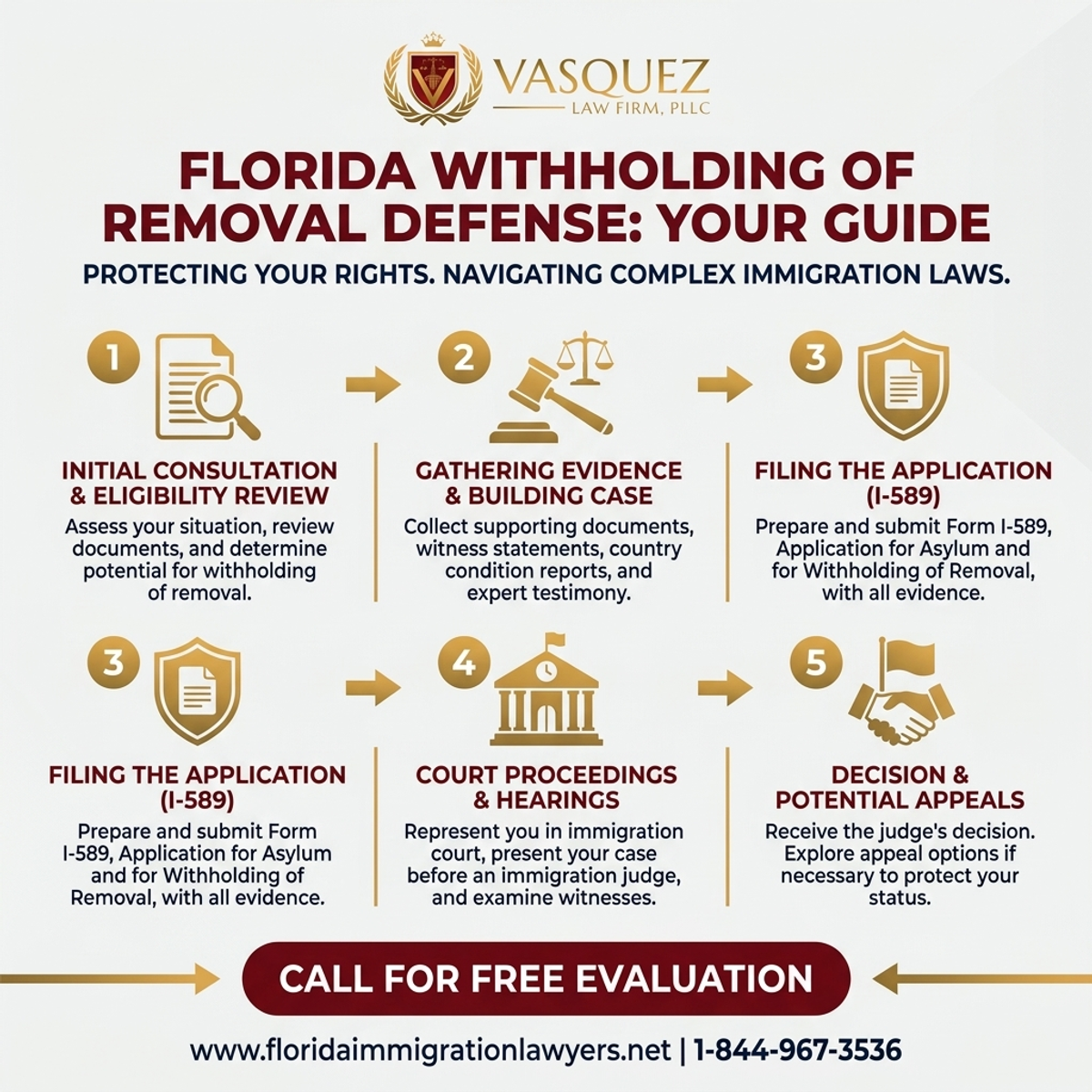
Navigating the withholding of removal process in Florida's immigration courts is complex and requires meticulous attention to detail. This multi-stage process unfolds within the Executive Office for Immigration Review (EOIR) system, involving multiple hearings and strict deadlines. Understanding each step is crucial for preparing a robust defense against deportation.
-
Initial Hearing (Master Calendar Hearing): This is typically the first appearance before an Immigration Judge (IJ). The IJ will explain the allegations in the Notice to Appear (NTA) and the charges of removability. The applicant will be asked to admit or deny the allegations and concede or contest removability. It is during this hearing that the applicant or their attorney must inform the court of their intention to apply for relief, such as asylum, withholding of removal, or CAT. The IJ will set a deadline for filing Form I-589, Application for Asylum and for Withholding of Removal.
-
Filing Form I-589: The Form I-589 is the single application used for asylum, statutory withholding of removal, and CAT protection. It must be filed with the immigration court and the Department of Homeland Security (DHS) by the deadline set by the IJ, typically within 180 days of the Master Calendar Hearing, unless specific exceptions apply. This extensive form requires detailed information about the applicant's fear of return, personal history, and any past persecution or torture. All supporting evidence and documentation should be submitted with the application.
-
Individual Hearing (Merits Hearing): This is the substantive hearing where the applicant presents their case for withholding of removal or CAT protection. It is a full evidentiary hearing, often lasting several hours or even multiple days. The applicant will testify under oath, detailing their experiences and fears. The DHS attorney will cross-examine the applicant, and the IJ may also ask questions. All witnesses, including expert witnesses, will also provide testimony.
-
Evidence Presentation: During the Individual Hearing, the applicant's attorney will present all supporting evidence. This includes country conditions reports, affidavits from witnesses, medical or psychological evaluations, police reports, news articles, and any other documents corroborating the applicant's claim. The quality and relevance of this evidence are paramount to meeting the high burden of proof for withholding of removal or CAT. For example, in a Florida case involving a client from Venezuela, evidence might include reports from the State Department or Amnesty International regarding human rights abuses, combined with personal testimony of persecution by government-backed groups.
-
Immigration Judge Decision: After all evidence and testimony have been presented, the Immigration Judge will issue a decision, either orally at the conclusion of the hearing or in writing at a later date. The IJ will weigh the evidence, assess the applicant's credibility, and determine if the applicant has met the "more likely than not" standard for withholding of removal or CAT. If the relief is granted, the applicant will be protected from deportation to the specified country. If denied, the IJ will issue an order of removal.
-
Appeals Process: If the Immigration Judge denies the application for withholding of removal or CAT, the applicant has the right to appeal the decision to the Board of Immigration Appeals (BIA). This appeal must be filed within 30 days of the IJ's decision. If the BIA upholds the denial, further appeals may be possible to the U.S. Court of Appeals for the Eleventh Circuit, which covers Florida. Each stage of appeal has its own strict deadlines and procedural requirements, emphasizing the need for continuous legal representation.
The entire process, from the initial Master Calendar Hearing to a final decision, can take several years, especially with current backlogs in the immigration court system. For example, cases in the Miami Immigration Court can sometimes take 3-5 years or more to reach a final decision. Throughout this lengthy and challenging journey, having an experienced immigration attorney from Florida Immigration Lawyers by your side is essential to ensure every deadline is met and every legal argument is forcefully presented.
Do not navigate this complex process alone. Contact Florida Immigration Lawyers today to discuss your deportation defense strategy. Our experienced team is ready to provide the guidance and representation you need.
Essential Documentation for Your Withholding of Removal Case
A successful withholding of removal or CAT case hinges on the strength and credibility of the evidence presented. Gathering and organizing the necessary documentation is a critical step that requires meticulous attention. The goal is to provide a compelling and consistent narrative that demonstrates your eligibility for protection, meeting the high "more likely than not" standard.
Document Checklist:
- Form I-589, Application for Asylum and for Withholding of Removal: This is the foundational document. Ensure it is filled out completely and accurately, with detailed answers regarding your fear of return, personal history, and all relevant dates and events.
- Personal Statement/Affidavit: A detailed, sworn statement from the applicant outlining their personal experiences of persecution or torture, the reasons for their fear, and how these experiences relate to the protected grounds (for statutory withholding) or the definition of torture (for CAT). This should be specific, consistent, and emotionally compelling.
- Affidavits from Witnesses: Statements from family members, friends, or other individuals who can corroborate your story, witnessed events, or can attest to your character and credibility. These should also be detailed and notarized.
- Country Conditions Reports: Up-to-date reports from reputable sources such as the U.S. Department of State (State Department), Amnesty International, Human Rights Watch, or academic institutions. These reports should detail human rights abuses, political instability, and dangers specific to your country of origin and, ideally, your particular social group or political affiliation.
- Medical and Psychological Evaluations: If you have suffered physical injuries or psychological trauma due to persecution or torture, a report from a licensed medical doctor or psychologist can provide powerful objective evidence. These evaluations should link your symptoms and injuries directly to the alleged persecution or torture.
- Police Reports, Court Documents, or Official Records: Any official documentation from your home country that corroborates incidents of persecution, arrests, detention, or threats. This could include police reports, court summons, or arrest warrants.
- News Articles and Media Reports: Relevant news clippings or media reports from your home country or international sources that discuss events or conditions directly related to your claim.
- Photographs, Videos, or Other Visual Evidence: Any visual evidence that supports your narrative, such as photos of injuries, destroyed property, political demonstrations, or specific individuals involved in your persecution.
- Proof of Identity and Nationality: Passports, birth certificates, national identity cards, or other documents establishing your identity and citizenship.
- Expert Witness Statements: In complex cases, a statement from an expert on country conditions, political science, or cultural dynamics can significantly strengthen your claim by providing context and validating your experiences.
Key Statistics — Withholding of Removal Florida Defense: Your Guide
It is crucial to provide certified translations for any documents not in English. The more comprehensive and credible your documentation, the stronger your case for withholding of removal or CAT protection will be. Florida Immigration Lawyers assists clients throughout Florida, from Tallahassee to the Keys, in meticulously preparing and presenting their documentary evidence to the immigration court.
Cost Factors and Fee Breakdown for Withholding of Removal Cases
Understanding the potential costs associated with pursuing withholding of removal or CAT protection is an important aspect of preparing for your defense. While the Form I-589 itself generally does not have a filing fee, there are numerous other expenses that applicants should anticipate. These costs can vary significantly based on the complexity of the case, the amount of evidence required, and the specific legal services retained.
Key Cost Categories:
- Attorney Fees: This is typically the largest component of the overall cost. Immigration attorneys may charge hourly rates, flat fees for specific stages of the process, or a combination. Experienced attorneys specializing in deportation defense and complex asylum/withholding cases will often charge higher fees due to their specialized knowledge and track record. For a withholding of removal case, which often involves extensive preparation, multiple court appearances, and detailed evidence presentation, legal fees can range from several thousand dollars to tens of thousands, depending on the case's duration and complexity. It is crucial to have a clear fee agreement with your attorney from the outset.
- Translation Costs: Most documents submitted to the immigration court must be in English or accompanied by a certified English translation. If you have numerous documents from your home country, translation costs can add up quickly. Professional translation services charge per page or per word.
- Expert Witness Fees: In cases requiring specialized testimony on country conditions, psychological evaluations, or medical assessments, expert witnesses will charge for their time and reports. These fees can range from hundreds to several thousand dollars per expert, depending on their credentials and the scope of work.
- Document Retrieval Fees: You may incur costs for obtaining official records from your home country or from U.S. government agencies, such as FBI background checks.
- Travel Expenses: If your attorney needs to travel to attend hearings in different Florida immigration courts (e.g., from Miami to Orlando), or if you need to travel for appointments, these costs should be factored in.
- Postage and Copying: While seemingly minor, the cost of mailing large evidence packets and making multiple copies for the court, DHS, and your own records can accumulate over time.
While the financial investment can be substantial, the cost of not pursuing relief and facing deportation can be far greater, especially if returning to a dangerous situation. Many law firms, including Florida Immigration Lawyers, offer payment plans or flexible arrangements to help clients manage these expenses. During your free consultation, we can provide a transparent overview of the anticipated costs for your specific withholding of removal case, allowing you to make an informed decision about your future.
Common Mistakes to Avoid in Withholding of Removal Cases
Navigating a withholding of removal case is fraught with potential pitfalls that can severely jeopardize your chances of success. Avoiding these common mistakes is critical for anyone seeking protection from deportation in Florida.
-
Missing Filing Deadlines: While withholding of removal does not have the strict one-year filing deadline of asylum, other deadlines apply, such as the one for submitting Form I-589 after an Immigration Judge orders it. Missing these court-imposed deadlines can lead to the denial of your application without a review of the merits, resulting in an order of removal. Always adhere to court schedules and deadlines.
-
Insufficient or Weak Evidence: The "more likely than not" standard for withholding of removal is very high. Many applicants fail to provide enough compelling, specific, and corroborating evidence to meet this burden. Relying solely on general country conditions or vague personal statements will often lead to denial. You need detailed documentation, personal testimony, and, where appropriate, expert reports.
-
Inconsistent Testimony: Credibility is paramount. Any inconsistencies between your written application, oral testimony, and supporting documents can severely undermine your case. Immigration Judges are trained to look for discrepancies. Practice your testimony thoroughly and ensure your story remains consistent throughout the process.
-
Failing to Address Statutory Bars: Applicants often overlook or misunderstand the statutory bars that can prevent them from receiving withholding of removal (e.g., particularly serious crimes, persecuting others). If a bar applies, it must be directly addressed and, if possible, overcome with legal argument. Simply ignoring it is a guaranteed path to denial.
-
Not Seeking Legal Counsel: Attempting to navigate the complex immigration court system and the high standards of withholding of removal without an attorney is a significant risk. An experienced lawyer can help identify all forms of relief, gather appropriate evidence, prepare you for testimony, and present compelling legal arguments. Self-representation often leads to procedural errors and missed opportunities.
-
Misunderstanding the "Clear Probability" Standard: Many applicants confuse the "well-founded fear" standard for asylum with the much higher "clear probability" standard for withholding. This misunderstanding can lead to presenting insufficient evidence or arguments that do not meet the legal threshold, even if a genuine fear exists.
-
Lack of Specificity in Testimony: Vague or generalized statements about fear are not enough. Your testimony must be specific, detailing dates, locations, individuals involved, and the precise nature of the persecution or torture feared. For example, instead of saying "I was threatened," state "On July 10, 2024, I was stopped by three armed men, members of the XYZ group, who warned me that if I continued my political activism, my family would be harmed."
-
Ignoring Florida-Specific Court Procedures: While federal law governs immigration, local court rules, judge preferences, and DHS attorney practices can vary between Florida's immigration courts (e.g., Miami, Orlando). An attorney familiar with the specific court where your case is pending can anticipate these nuances.
When to Call a Lawyer for Your Withholding of Removal Case
The decision to seek legal representation is perhaps the most critical step in a withholding of removal case. Given the high stakes and the intricate legal standards involved, attempting to proceed without an experienced attorney can significantly diminish your chances of success. You should contact a lawyer from Florida Immigration Lawyers immediately if you are facing any of the following scenarios:
- You Have Received a Notice to Appear (NTA): This document initiates deportation proceedings. As soon as you receive an NTA, it is imperative to consult with an attorney to understand the charges against you and begin building your defense.
- You Fear Persecution or Torture in Your Home Country: If you genuinely believe you would face harm upon return to your country of origin, an attorney can assess whether you meet the eligibility criteria for withholding of removal or CAT protection.
- You Have a Complex Case History: This includes prior criminal convictions, previous immigration violations, or a history of missed deadlines. These factors can trigger statutory bars or make your case much more challenging, requiring expert legal analysis.
- You Have Missed the One-Year Asylum Filing Deadline: If you are no longer eligible for asylum due to the one-year deadline, withholding of removal or CAT may be your only remaining options. An attorney can help you explore these alternatives.
- You Need Help Gathering and Presenting Evidence: The burden of proof is high. An attorney can guide you on what evidence is necessary, how to obtain it, and how to present it effectively in court. They can also connect you with expert witnesses for evaluations or country reports.
- You are Not Fluent in English: While interpreters are provided in court, communicating complex legal concepts and personal narratives through an interpreter can be challenging. A bilingual attorney or one experienced with interpreters can ensure your story is accurately conveyed.
- You Have Received an Adverse Decision: If an Immigration Judge denies your application, you have a limited time to appeal. An attorney can evaluate the decision, identify grounds for appeal, and represent you before the Board of Immigration Appeals (BIA) or federal courts.
- You Feel Overwhelmed by the Process: Immigration law is constantly evolving, and the court system can be intimidating. Having a knowledgeable advocate by your side provides peace of mind and ensures your rights are protected throughout the entire process.
Florida Immigration Lawyers has a proven track record of successfully defending individuals facing deportation across Florida. Our attorneys are adept at handling complex withholding of removal and CAT cases, providing compassionate yet aggressive representation.
About Florida Immigration Lawyers
Florida Immigration Lawyers is a leading law firm dedicated to providing comprehensive and compassionate immigration legal services throughout the state of Florida. With a deep understanding of U.S. immigration law and a steadfast commitment to our clients, we stand as a beacon of hope for individuals and families navigating the complexities of the immigration system. Our firm is proud to serve all of Florida, from the bustling cities of Miami and Orlando to the state capital of Tallahassee, and every community in between.
Our experienced attorneys specialize in a wide range of immigration matters, including asylum, deportation defense, family-based immigration, business immigration, citizenship, and more. We understand that each case is unique, and we tailor our strategies to meet the specific needs and goals of our clients. Our approach is client-centered, focusing on clear communication, thorough preparation, and aggressive advocacy.
Choosing Florida Immigration Lawyers means choosing a team that is available 24/7 to address your urgent concerns. We offer free, no-obligation consultations to help you understand your legal options and how we can assist. Our bilingual staff ensures that language is never a barrier to receiving top-tier legal advice. With Florida Immigration Lawyers, you gain a dedicated partner committed to protecting your rights and securing your future in the United States. Call us today at 1-844-967-3536 or visit our website at floridaimmigrationlawyers.net to learn more.
Sources and References
- U.S. Citizenship and Immigration Services (USCIS)
- Executive Office for Immigration Review (EOIR)
- U.S. Department of State (State Department)
- 8 U.S.C. § 1231(b)(3) - Withholding of Removal (Immigration and Nationality Act Section 241(b)(3))
- 8 CFR § 208.16 - Withholding of removal under section 241(b)(3) of the Act and withholding of removal under the Convention Against Torture.
- Convention Against Torture and Other Cruel, Inhuman or Degrading Treatment or Punishment (CAT), G.A. Res. 39/46, 39 U.N. GAOR Supp. (No. 51) at 197, U.N. Doc. A/39/51 (1984).
- USCIS Policy Manual, Volume 12 - Asylum and Withholding of Removal.
Related services: immigration waivers, humanitarian protection programs, DACA renewal and applications, temporary protected status (TPS).
This article provides general legal information and is not intended as legal advice. Every case is unique, and outcomes depend on specific facts and circumstances. Contact an attorney for advice about your particular situation.
If you are facing the possibility of deportation and fear returning to your home country, time is of the essence. Do not delay in seeking expert legal counsel. Florida Immigration Lawyers is here to provide the dedicated and effective representation you deserve. We offer free consultations to help you understand your options and develop a strong defense strategy. Call us today at 1-844-967-3536. Se Habla Español - Estamos aquí para ayudarle.
Do Not Navigate This Process Alone
Our experienced immigration attorneys are ready to fight for you. Get a free, confidential consultation today.
Se Habla Español
Frequently Asked Questions
Florida Immigration Lawyers
Immigration Attorney | Founder, Vasquez Law Firm
U.S. Air Force veteran and immigration attorney with thousands of cases resolved. J.D., NCCU School of Law. AILA member. Admitted to the 4th, 5th, and 11th Circuit Courts.
Available 24/7 - Free Evaluations
Related Legal Services
Our Florida immigration attorneys can help you with asylum protection, deportation defense and citizenship and naturalization. Call today at 1-844-967-3536 for a free consultation.
Related Links
Related Topics
Free Legal Consultation
Discuss your case with our experienced attorneys. We're available 24/7.
Se Habla Español - Estamos aquí para ayudarle.
Related Articles
Voluntary Departure vs Deportation in Florida | VLF Florida
Explore the differences between voluntary departure and deportation in Florida. Understand the implications for immigrants and learn when to seek legal help. Call Florida Immigration Lawyers at 1-844-967-3536.
Consular Return After Visa Denial in Florida | VLF Florida
Facing a visa denial in Florida can be daunting. Learn about the consular return process after a 221(g) notice and get professional help.
Immigration Lawyer Fort Lauderdale: Your Florida Guide 2026
Navigating immigration law in Fort Lauderdale, Florida, requires expert guidance. Our comprehensive guide for 2026 delves into why securing a skilled immigration lawyer Fort Lauderdale is essential. We cover key immigration pathways such as family-based visas, employment-based petitions, asylum claims, and crucial deportation defense strategies specific to Broward County. Learn about the step-by-step process of working with our firm, understanding the costs involved, and setting realistic expectations for timelines. We also highlight common mistakes to avoid and critical scenarios when legal counsel from Florida Immigration Lawyers becomes indispensable. Our firm offers dedicated support for individuals and families across Florida, including Hialeah, ensuring your rights are protected throughout the complex immigration system. Contact us for a free consultation to start your journey with confidence.
Fiance Visa K-1 Process in Florida: Key Steps | VLF Florida
Learn about the K-1 fiancé visa process in Florida, including steps, timeline, and common pitfalls. Contact Florida Immigration Lawyers for expert guidance.
