Voluntary Departure vs Deportation in Florida | VLF Florida
Explore the differences between voluntary departure and deportation in Florida. Understand the implications for immigrants and learn when to seek legal help. Call Florida Immigration Lawyers at 1-844-967-3536.

Voluntary Departure vs Deportation in Florida | VLF Florida
Navigating the complexities of U.S. immigration law can be daunting, especially when facing potential removal from the country. For individuals in Florida, understanding the critical distinctions between voluntary departure and deportation is not just important—it's essential for making informed decisions that can profoundly impact your future. While both outcomes involve leaving the United States, their implications for your legal record, future immigration prospects, and ability to return vary dramatically. At VLF Florida, our dedicated team of immigration attorneys is committed to guiding you through these challenging processes. We understand the nuances of immigration law and are here to provide the expert legal counsel you need.
What is Voluntary Departure?
Voluntary departure is a discretionary form of relief that allows certain non-citizens to leave the United States at their own expense, within a specified timeframe, and without a formal order of removal. This option is typically granted by an immigration judge or, in some cases, by an officer from U.S. Immigration and Customs Enforcement (ICE). Opting for voluntary departure can be a strategic decision, as it prevents the individual from having a formal deportation order on their record, which carries severe long-term consequences.
Eligibility for Voluntary Departure
To be eligible for voluntary departure, an individual must meet several strict criteria. These often include:
- Good Moral Character: The applicant must demonstrate good moral character for at least five years prior to the application.
- No Aggravated Felonies: Individuals with convictions for certain serious crimes (aggravated felonies) are generally ineligible.
- Ability to Depart: The applicant must prove they have the financial means and the intent to depart the U.S. within the allotted time.
- Waiving Appeal Rights: Typically, individuals must waive their right to appeal the immigration judge's decision regarding their removal.
- Absence of Prior Deportation Orders: Having a previous deportation order can disqualify an individual from voluntary departure.
The process involves a request to an immigration judge, who will then assess the individual's eligibility and grant a specific period for departure, usually between 60 and 120 days. Providing a bond may also be required to ensure compliance.
Benefits of Voluntary Departure
The primary advantage of voluntary departure is avoiding the harsh penalties associated with a formal deportation order. A deportation order typically results in a 10-year or even permanent bar from re-entering the U.S., making future visa applications or attempts to return incredibly difficult. With voluntary departure, while there may still be bars to re-entry depending on the reason for removal proceedings, they are often less severe and may be easier to overcome in the future. It also allows an individual to leave with dignity and potentially pursue other immigration avenues later on.
Consequences of Failing to Depart Voluntarily
It is crucial to adhere strictly to the terms of voluntary departure. Failure to leave the U.S. within the specified period will result in an automatic order of deportation, often accompanied by a 10-year bar from re-entering the country, and potentially severe civil penalties. This failure can also lead to additional criminal charges and make any future attempts to seek immigration relief significantly more challenging. This is why precise legal guidance is indispensable when considering or granted voluntary departure.
What is Deportation (Removal)?
Deportation, officially known as “removal” under current U.S. immigration law, is the forced expulsion of a non-citizen from the United States by the government. Unlike voluntary departure, deportation is an involuntary process initiated by the Department of Homeland Security (DHS) and enforced through the immigration court system. It is a severe legal consequence that carries long-lasting ramifications for the individual and their family.
Grounds for Deportation
There are numerous grounds under which a non-citizen can be deported from the U.S. These include, but are not limited to:
- Criminal Offenses: Convictions for certain crimes, particularly aggravated felonies, crimes involving moral turpitude, or drug offenses, are common grounds for deportation.
- Visa Violations: Overstaying a visa, violating the terms of a visa (e.g., working without authorization on a tourist visa), or engaging in fraud to obtain a visa.
- Illegal Entry: Entering the U.S. without inspection or proper authorization.
- Security Concerns: Engaging in activities deemed a threat to national security.
- Public Charge: Becoming dependent on government assistance.
Once grounds for deportation are established, the individual is issued a Notice to Appear (NTA), initiating formal removal proceedings in immigration court.
The Deportation Process
The deportation process is a complex legal journey that typically involves multiple stages:
- Notice to Appear (NTA): The individual receives an NTA, which outlines the charges and the reasons the government believes they should be deported.
- Master Calendar Hearings: These are preliminary hearings where the immigration judge addresses administrative matters, confirms the charges, and sets a schedule for future proceedings.
- Individual Hearings: These are trial-like hearings where evidence is presented, witnesses may testify, and the individual (or their attorney) can argue against deportation or apply for forms of relief.
- Decision and Appeals: The immigration judge issues a decision. If the decision is unfavorable, the individual may have the right to appeal to the Board of Immigration Appeals (BIA) and, in some cases, to federal circuit courts.
Throughout this process, having experienced legal representation for deportation defense is paramount.
Consequences of Deportation
The consequences of a deportation order are severe and far-reaching:
- Bars to Re-entry: A formal deportation order typically results in a 10-year bar from re-entering the U.S. In some cases, such as for aggravated felonies or multiple deportations, the bar can be permanent.
- Family Separation: Deportation often leads to the painful separation of families, especially when U.S. citizen spouses or children are involved.
- Loss of Future Immigration Opportunities: A deportation record makes it extremely difficult, if not impossible, to obtain future visas, green cards, or other immigration benefits.
- Legal Record: The deportation order becomes a permanent part of the individual's immigration record.
Key Differences Between Voluntary Departure and Deportation
While both voluntary departure and deportation result in a non-citizen leaving the U.S., the differences in process and outcome are significant:
- Control and Agency: Voluntary departure offers a degree of control, allowing the individual to leave on their own terms and schedule (within limits). Deportation is a forced removal, with the government dictating the terms.
- Legal Record: Voluntary departure avoids a formal deportation order, resulting in a cleaner immigration record. Deportation leaves a permanent, highly detrimental mark on an individual's record.
- Future Re-entry: While both can create challenges, voluntary departure generally presents fewer obstacles for future attempts to legally re-enter the U.S. compared to a formal deportation order. The 10-year bar is often triggered by a deportation order, not by voluntary departure (though other bars may apply depending on the underlying reason for removal proceedings).
- Consequences of Non-Compliance: Failing to depart voluntarily leads to an automatic deportation order and severe penalties. In deportation, the consequences are immediate removal and bars to re-entry once the order is final.
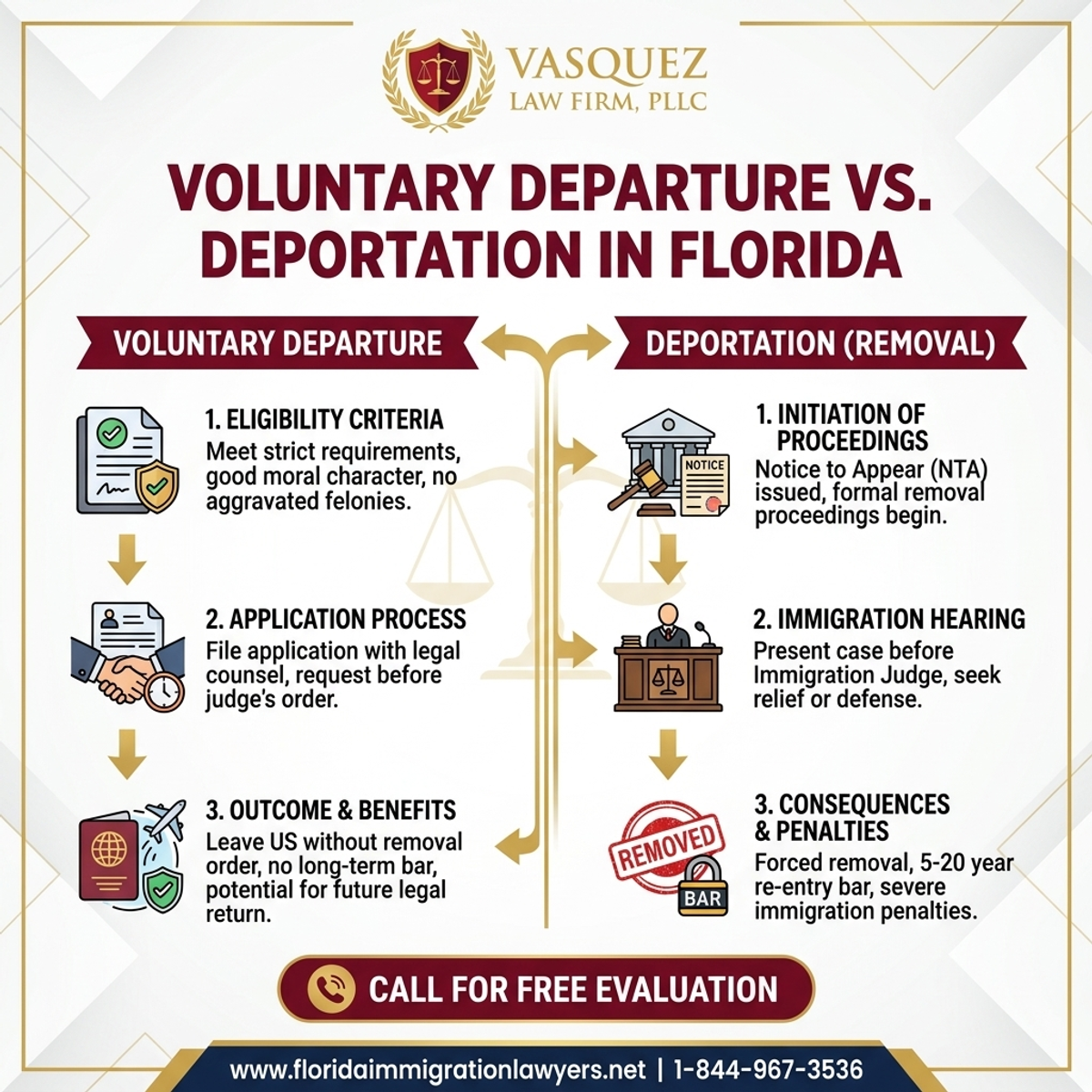
Step-by-Step Process — Voluntary Departure vs Deportation in Florida | VLF Florida
Understanding these distinctions is crucial, as choosing the right path or fighting a deportation order can have life-altering implications.
The Critical Role of Legal Counsel in Voluntary Departure and Deportation Cases
Given the complexity and high stakes involved in both voluntary departure and deportation proceedings, securing experienced legal representation is not merely advisable—it is often essential for protecting your rights and achieving the best possible outcome. An immigration attorney serves as your advocate, guide, and defender throughout this challenging process.
Our attorneys at VLF Florida possess an in-depth understanding of U.S. immigration law and the intricacies of the immigration court system. We can:
- Assess Eligibility: Determine if you qualify for voluntary departure or other forms of relief, carefully evaluating your unique circumstances and legal history.
- Develop a Defense Strategy: For those facing deportation, we build robust deportation defense strategies, challenging the government's charges, presenting evidence, and advocating for your right to remain in the U.S.
- Navigate Court Procedures: Immigration courts have specific rules and deadlines. Our lawyers ensure all documentation is filed correctly and on time, representing you effectively in master calendar and individual hearings.
- Explore All Relief Options: Beyond voluntary departure, there may be other avenues for relief, such as cancellation of removal, adjustment of status, or asylum. We meticulously explore every possibility to find the most favorable resolution for your case.
- Protect Your Rights: We ensure that your due process rights are upheld throughout the proceedings, challenging any procedural errors or abuses of discretion.
- Prepare for Appeals: If an unfavorable decision is rendered, we can guide you through the appeals process to the Board of Immigration Appeals and, when appropriate, to federal courts.
The presence of a knowledgeable attorney can significantly influence the outcome of your case, providing peace of mind and expert guidance during a highly stressful period. Don't face the immigration system alone.
Related Immigration Relief Options in Florida
Beyond voluntary departure and deportation defense, individuals in removal proceedings in Florida may have other avenues for relief. These can include:
- Asylum and Withholding of Removal: For individuals who fear persecution in their home country based on race, religion, nationality, political opinion, or membership in a particular social group. Our firm has extensive experience with asylum claims.
- Cancellation of Removal: Available to certain long-term residents with U.S. citizen or lawful permanent resident family members who would suffer exceptional and extremely unusual hardship if the applicant were deported.
- Waivers of Inadmissibility: In some cases, individuals may be able to apply for waivers to overcome certain grounds of inadmissibility that would otherwise prevent them from obtaining a visa or green card.
- Adjustment of Status: If eligible, some individuals in removal proceedings may be able to adjust their status to lawful permanent resident.
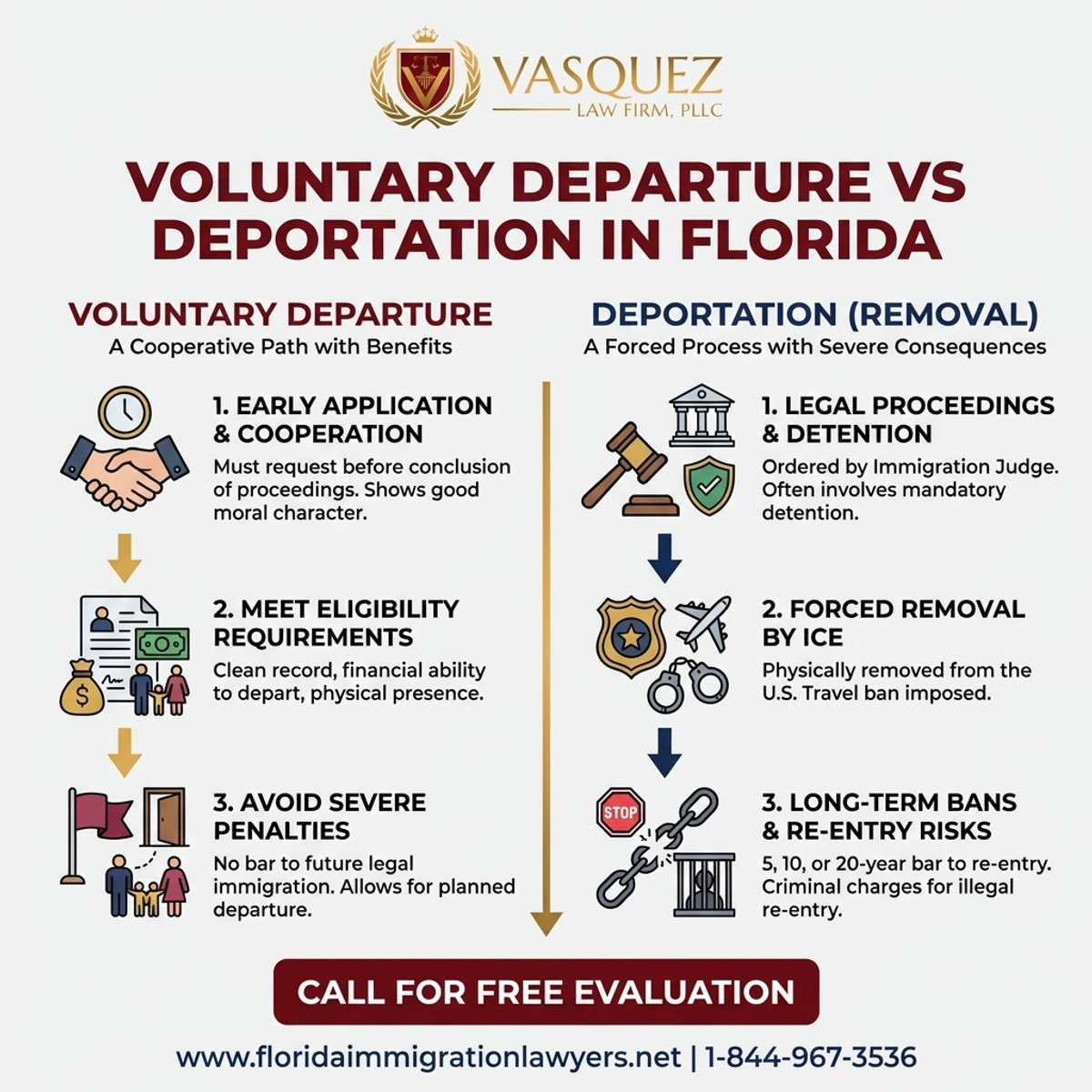
Key Statistics — Voluntary Departure vs Deportation in Florida | VLF Florida
Each of these options has stringent eligibility requirements and a complex application process, making legal guidance indispensable.
Navigating Immigration Courts in Florida
While immigration law is federal, the practicalities of navigating the system often involve local courts and procedures. Florida hosts several key immigration courts, including those in Miami and Orlando, which process a high volume of removal cases. Understanding the specific practices, judges, and resources available within these Florida courts can be a significant advantage. Our firm's local presence and experience in these courts mean we are well-equipped to handle your case effectively, providing tailored advice that considers both federal law and local court dynamics.
Conclusion: Seek Expert Legal Counsel
The choice between voluntary departure and fighting a deportation order is one of the most critical decisions a non-citizen can make. The implications can affect your ability to live and work in the U.S., your family's future, and your long-term immigration prospects. Without a comprehensive understanding of your rights and the available legal options, you risk making choices that could have irreversible negative consequences.
At VLF Florida, we are dedicated to providing compassionate, effective, and strategic legal representation to individuals facing removal proceedings. Our goal is to protect your rights, explore every possible avenue for relief, and guide you toward the most favorable outcome. Don't face the complexities of immigration law alone. Contact us today for a free consultation to discuss your specific situation and learn how we can help you navigate this challenging time.
Sources and References
- U.S. Citizenship and Immigration Services (USCIS)
- Executive Office for Immigration Review (EOIR)
- U.S. Department of State - Bureau of Consular Affairs
- Immigration and Nationality Act (INA), 8 U.S.C. Chapter 12
Do Not Navigate This Process Alone
Our experienced immigration attorneys are ready to fight for you. Get a free, confidential consultation today.
Se Habla Español
Frequently Asked Questions
Florida Immigration Lawyers
Immigration Attorney | Founder, Vasquez Law Firm
U.S. Air Force veteran and immigration attorney with thousands of cases resolved. J.D., NCCU School of Law. AILA member. Admitted to the 4th, 5th, and 11th Circuit Courts.
Available 24/7 - Free Evaluations
Related Legal Services
Our Florida immigration attorneys can help you with business immigration, asylum protection and deportation defense. Call today at 1-844-967-3536 for a free consultation.
Related Links
Related Topics
Free Legal Consultation
Discuss your case with our experienced attorneys. We're available 24/7.
Se Habla Español - Estamos aquí para ayudarle.
Related Articles
Consular Return After Visa Denial in Florida | VLF Florida
Facing a visa denial in Florida can be daunting. Learn about the consular return process after a 221(g) notice and get professional help.
Immigration Lawyer Fort Lauderdale: Your Florida Guide 2026
Navigating immigration law in Fort Lauderdale, Florida, requires expert guidance. Our comprehensive guide for 2026 delves into why securing a skilled immigration lawyer Fort Lauderdale is essential. We cover key immigration pathways such as family-based visas, employment-based petitions, asylum claims, and crucial deportation defense strategies specific to Broward County. Learn about the step-by-step process of working with our firm, understanding the costs involved, and setting realistic expectations for timelines. We also highlight common mistakes to avoid and critical scenarios when legal counsel from Florida Immigration Lawyers becomes indispensable. Our firm offers dedicated support for individuals and families across Florida, including Hialeah, ensuring your rights are protected throughout the complex immigration system. Contact us for a free consultation to start your journey with confidence.
Fiance Visa K-1 Process in Florida: Key Steps | VLF Florida
Learn about the K-1 fiancé visa process in Florida, including steps, timeline, and common pitfalls. Contact Florida Immigration Lawyers for expert guidance.
Understanding U Visa for Crime Victims in Florida | VLF Florida
The U visa provides vital immigration relief for crime victims in Florida. Learn how it works and why legal guidance is crucial for your application. Contact Florida Immigration Lawyers for a free consultation.
