Voluntary Departure vs. Deportation: Florida Guide 2026
Understanding the critical differences between voluntary departure and deportation is essential for anyone in removal proceedings in Florida. Voluntary departure offers a path to leave the U.S. without a formal removal order, preserving future re-entry possibilities. In contrast, a deportation order carries severe, long-lasting consequences, including significant bars to returning legally. This guide details eligibility, the process of requesting voluntary departure, and the grave repercussions of deportation, with a focus on Florida's immigration courts. Learn how to avoid common mistakes and why expert legal counsel from Florida Immigration Lawyers is indispensable for navigating these complex immigration challenges. Contact us for a free consultation to protect your rights and future.

Voluntary departure allows an individual in removal proceedings to leave the U.S. at their own expense and avoid a formal deportation order. This option often preserves the possibility of returning legally in the future. In contrast, deportation, also known as an order of removal, is a formal legal mandate from an immigration judge requiring an individual to leave the country. A deportation order carries severe consequences, including significant bars to future re-entry and a permanent mark on one's immigration record. Seeking voluntary departure in Florida requires meeting strict eligibility criteria and adhering to tight deadlines, making legal guidance crucial for navigating this complex process effectively.
- Voluntary departure avoids a formal removal order.
- Deportation results in severe bars to re-entry.
- Eligibility for voluntary departure is strict and time-sensitive.
- Legal counsel is essential for both processes in Florida.
- Choosing voluntary departure can preserve future immigration options.
Facing removal proceedings in the United States can be an incredibly daunting and uncertain experience. For many individuals in Florida, the prospect of deportation brings immense stress and fear about their future and their families. However, understanding all available options, such as voluntary departure, can empower you to make informed decisions. This crucial alternative offers a path to leave the country under more favorable terms than a formal deportation order.
At Florida Immigration Lawyers, we understand the profound impact these decisions have on your life. This comprehensive guide will explore the key differences between voluntary departure and deportation, outline eligibility requirements, detail the application process, and discuss the significant consequences of each. We will also provide Florida-specific insights to help you navigate the complex immigration court system. Do not face this challenge alone. Call Florida Immigration Lawyers at 1-844-967-3536 for a free consultation today.
Understanding Voluntary Departure vs. Deportation in Florida
When an individual is placed in removal proceedings, they are essentially facing the possibility of being legally expelled from the United States. In Florida, like elsewhere, these proceedings are handled by immigration courts under the Executive Office for Immigration Review (EOIR). The outcome of these proceedings can profoundly shape an individual's future immigration prospects. It is critical to grasp the distinction between voluntary departure and a deportation order, as one offers significantly more flexibility and fewer long-term penalties than the other.
What is Voluntary Departure?
Voluntary departure is a discretionary form of relief that allows a non-citizen to leave the United States at their own expense within a specified timeframe, typically 30 to 120 days, without a formal order of removal. This option is outlined in Section 240B of the Immigration and Nationality Act (INA 240B). Granting voluntary departure means that the individual avoids the severe legal consequences associated with a deportation order, such as a formal bar to re-entry for many years. It is often considered a more favorable outcome for individuals who do not have other forms of relief available but wish to preserve their chances of returning to the U.S. legally in the future. The decision to grant voluntary departure rests with an immigration judge or, in some cases, with U.S. Immigration and Customs Enforcement (ICE).
What is a Deportation Order (Order of Removal)?
A deportation order, officially known as an order of removal, is a legally binding directive issued by an immigration judge requiring a non-citizen to leave the United States. This order is typically issued when an individual is found deportable under Section 240 of the Immigration and Nationality Act (INA 240) and no other form of relief from removal is granted. Once a deportation order is issued, the individual is generally barred from re-entering the U.S. for a period of 5, 10, or even 20 years, or permanently, depending on the grounds for deportation. Furthermore, re-entry after deportation often requires special permission and is significantly more challenging than after a voluntary departure. A deportation order creates a permanent negative mark on an individual's immigration record, impacting all future attempts to seek visas or other immigration benefits.
Eligibility for Voluntary Departure in Florida
Securing voluntary departure is not automatic; it requires meeting specific criteria set forth by immigration law and demonstrating to an immigration judge that you deserve this discretionary relief. The eligibility requirements can vary depending on whether you request voluntary departure before your removal hearing concludes (pre-hearing) or at the conclusion of your hearing (post-hearing). Understanding these distinctions is paramount for anyone considering this option in Florida's immigration courts, such as the prominent Miami Immigration Court.
Pre-Hearing Voluntary Departure
To be eligible for voluntary departure before a final hearing, you generally must: be physically present in the U.S. for at least one year immediately preceding the issuance of the Notice to Appear (NTA); not have been convicted of an aggravated felony or certain other serious crimes; concede deportability; waive any right to appeal the immigration judge's decision; and demonstrate that you have the financial means to depart the U.S. and intend to do so. This early request can often be simpler, as it avoids the full legal battle of a removal proceeding. The judge must be convinced that you are not a flight risk and will comply with the departure order. This option is often explored by individuals who quickly realize their limited options for relief.
Post-Hearing Voluntary Departure
Requesting voluntary departure at the conclusion of your removal proceedings, after a finding of deportability, comes with stricter requirements. You must have been physically present in the U.S. for at least one year immediately preceding the issuance of the NTA; demonstrated good moral character for the past five years (as defined by 8 U.S.C. § 1101(f) and 8 CFR § 240.26); not have been convicted of an aggravated felony or certain other serious crimes; demonstrate the financial ability to depart; and post a voluntary departure bond, typically a minimum of $500, to ensure compliance. The judge will also consider factors such as your ties to the community, your immigration history, and any other equities. The burden is entirely on you to prove that you meet all these requirements and merit the judge's discretion. Due to the complexities, consulting with a Florida immigration lawyer is vital.
The Process of Requesting Voluntary Departure
The process for requesting voluntary departure involves several critical steps that must be followed precisely. Any misstep or missed deadline can jeopardize your chances of receiving this relief. Whether you are in Miami, Orlando, or elsewhere in Florida, the general procedural framework remains consistent across all immigration courts, though local court rules may have minor specificities. Engaging with an experienced attorney from Florida Immigration Lawyers can significantly streamline this process and enhance your likelihood of success.
- Determine Eligibility and Prepare Your Case: The first step is to thoroughly assess your eligibility based on the criteria discussed above. Your attorney will help you gather all necessary documentation to prove good moral character, financial ability to depart, and the absence of disqualifying criminal convictions. This includes financial records, proof of residence, character affidavits, and criminal background checks.
- File a Motion or Make an Oral Request: Depending on the stage of your proceedings, your attorney will either file a formal written motion with the immigration court or make an oral request during a master calendar or individual hearing. For pre-hearing requests, this often happens early in the process. For post-hearing requests, it occurs at the conclusion of your individual merits hearing.
- Demonstrate Good Moral Character: You must convincingly show the immigration judge that you have been a person of good moral character for the requisite period (typically five years for post-hearing requests). This involves presenting evidence such as employment records, community involvement, tax compliance, and testimonials from reputable individuals. Any past criminal history or immigration violations will be scrutinized.
- Prove Financial Means for Departure: You must provide evidence that you can cover the costs of your travel from the U.S. to your home country. This could include bank statements, airline ticket reservations, or affidavits from family members who will pay for your ticket. The judge needs assurance that you will not become a burden on the U.S. government.
- Post a Voluntary Departure Bond (if required): For post-hearing requests, an immigration judge will typically require you to post a voluntary departure bond, which guarantees your departure. The minimum bond amount is usually $500, but it can be higher based on the judge's discretion. This bond is returned to you upon proof of timely departure.
- Receive the Order and Comply with Departure Date: If your request is granted, the immigration judge will issue an order specifying the deadline for your departure. It is absolutely crucial to leave the U.S. on or before this date. Failure to do so will automatically convert the voluntary departure order into a formal order of deportation, trigger the voluntary departure bond to be forfeited, and impose a 10-year bar to re-entry.
What to Expect: The timeline for processing a voluntary departure request can vary. If requested pre-hearing, a decision might come relatively quickly. Post-hearing requests are decided at the conclusion of your individual merits hearing. Once granted, you typically have 30 to 120 days to depart. This period is strictly enforced, and extensions are rarely granted except in extraordinary circumstances. Your attorney will guide you through each step, ensuring all documentation is prepared correctly and deadlines are met. This meticulous approach is critical for a successful outcome.
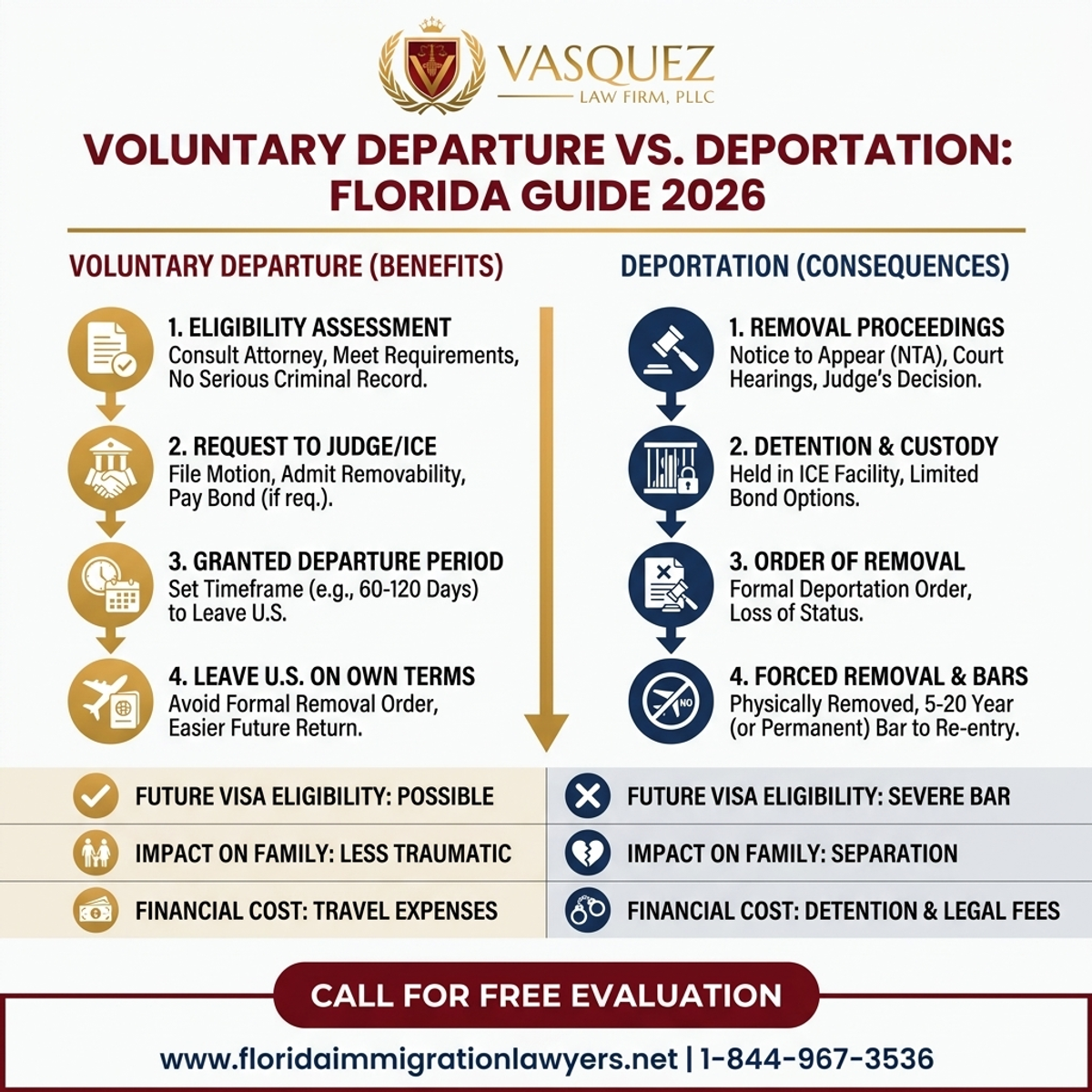
Step-by-Step Process — Voluntary Departure vs. Deportation: Florida Guide 2026
Do not navigate this process alone. The stakes are too high. Contact Florida Immigration Lawyers today to ensure your voluntary departure request is handled with the expertise and attention it deserves.
Consequences of Deportation and Removal Orders
An order of deportation, also known as an order of removal, is one of the most severe outcomes in immigration law. Unlike voluntary departure, which allows for a more controlled exit, deportation carries long-lasting and often devastating consequences for individuals and their families. Understanding these repercussions is vital for anyone facing removal proceedings in Florida, as it underscores the importance of fighting for every available form of relief. The impact extends far beyond simply leaving the country; it can affect your ability to ever return and reunite with loved ones.
Repercussions of a Deportation Order
When an immigration judge issues a deportation order, it means you are legally mandated to leave the United States. This order is a permanent mark on your immigration record. It signals to U.S. immigration authorities that you were formally removed from the country, which can have significant negative implications for any future attempts to obtain a visa or other immigration benefits. In many cases, individuals are physically removed from the U.S. by Immigration and Customs Enforcement (ICE) agents, often with little notice, disrupting their lives and severing ties to their communities and jobs in Florida. The emotional and financial toll on families can be immense, particularly if dependents are U.S. citizens or legal permanent residents.
Bars to Re-Entry
One of the most significant consequences of a deportation order is the statutory bar to re-entry into the U.S. These bars prevent individuals from returning for a specified period, and in some cases, permanently. Under the Immigration and Nationality Act (INA), these bars are: a 5-year bar for those removed through expedited removal; a 10-year bar for those removed after formal removal proceedings (INA 212(a)(9)(A)(ii)); and a 20-year bar for those who have been removed more than once. Furthermore, individuals convicted of an aggravated felony or who have previously violated certain immigration laws may face a permanent bar to re-entry, meaning they can never legally return to the U.S. without a very rare and difficult-to-obtain waiver. These bars apply even if you have U.S. citizen spouses or children, making family reunification incredibly challenging. Navigating these complexities requires an in-depth understanding of immigration law, which a qualified attorney can provide.
Key Differences and Strategic Considerations
The choice between seeking voluntary departure and facing a potential deportation order is one of the most critical decisions an individual in removal proceedings will make. While both options result in leaving the U.S., the legal and practical differences are substantial, particularly concerning future immigration prospects. Understanding these distinctions is key to developing an effective defense strategy with your Florida immigration lawyer. The long-term implications for your ability to re-enter the U.S. are starkly different.
The primary advantage of voluntary departure is the absence of a formal removal order on your record. This means you avoid the automatic re-entry bars imposed by deportation. While you still must leave the country, you do so without the stigma and legal hurdles that accompany a deportation order. This can significantly improve your chances of obtaining a visa or other immigration benefits in the future, as you would not need to overcome the severe re-entry bars. For example, if you wish to apply for a family-based visa petition from abroad, having a voluntary departure instead of a deportation order makes the process much less complicated and more feasible. It also allows for a more dignified and controlled exit, rather than being forcibly removed by immigration authorities.
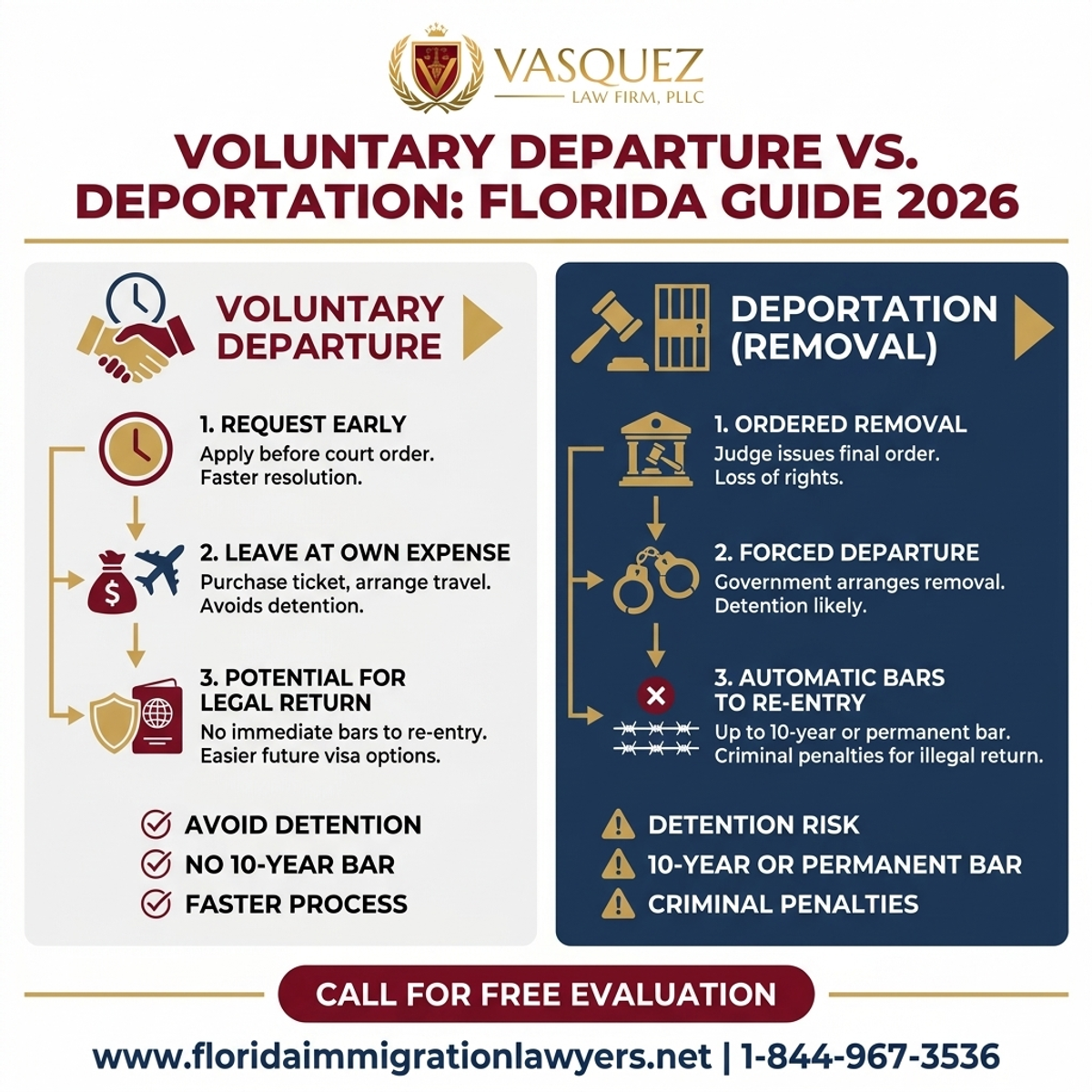
Key Statistics — Voluntary Departure vs. Deportation: Florida Guide 2026
Conversely, the main risk associated with voluntary departure is the strict adherence to the departure deadline. If you fail to depart by the date specified by the immigration judge, the voluntary departure order automatically converts into a deportation order, and you will face the 10-year re-entry bar and forfeiture of any bond posted. This consequence is severe, highlighting the absolute necessity of compliance. Therefore, meticulous planning and commitment to leaving on time are non-negotiable. Your attorney will help you understand the precise deadline and ensure you have a clear plan for your departure. Considering the potential benefits, many individuals facing limited options for relief choose to pursue voluntary departure as the lesser of two evils, safeguarding their future possibilities.
Navigating Florida's Immigration Court System
The immigration court system in Florida, like the rest of the nation, is a federal administrative court system managed by the Executive Office for Immigration Review (EOIR) within the Department of Justice. For many individuals in Florida, removal proceedings will take place at the Miami Immigration Court, which is one of the busiest immigration courts in the country. Understanding the procedures, the roles of various parties, and the unique challenges within this system is crucial for anyone facing a voluntary departure or deportation case. The process can be intimidating, but knowing what to expect can alleviate some stress.
The Role of an Immigration Judge
An immigration judge (IJ) presides over removal proceedings. Their role is to hear evidence, apply immigration law, and make decisions regarding whether an individual is deportable and, if so, whether any forms of relief from removal, such as voluntary departure or asylum, should be granted. IJs are not Article III federal judges; they are administrative judges. They have broad discretion in many areas, and their decisions can significantly impact an individual's life. Having an attorney who is familiar with the specific practices and tendencies of judges at the Miami Immigration Court can be a distinct advantage. Your attorney will present your case, argue on your behalf, and ensure your rights are protected throughout the proceedings.
How Florida Immigration Courts Operate
Immigration court proceedings typically involve several stages: master calendar hearings, where initial pleadings are made and future hearing dates are set; and individual merits hearings, where evidence is presented, witnesses testify, and legal arguments are made. In Florida, these hearings are primarily conducted at the Miami Immigration Court, located downtown. The court's docket is often crowded, and cases can take months or even years to resolve. During these proceedings, you will interact with the Department of Homeland Security (DHS) counsel, who represents the U.S. government, and the immigration judge. All communication, filings, and arguments must adhere to strict court rules and procedures. Missing a court date or failing to submit required documents on time can have severe consequences, including an in absentia deportation order. Therefore, diligent adherence to court instructions and the guidance of an attorney are essential for navigating this complex system successfully.
Cost Factors and Legal Fees in Voluntary Departure Cases
When considering voluntary departure versus fighting a deportation order, it is important to factor in the potential costs involved. These expenses typically include legal fees, administrative filing fees, and travel expenses. While voluntary departure can sometimes be a less costly option in the long run compared to prolonged litigation, it still requires financial planning. Understanding these cost factors is essential for making an informed decision about your immigration strategy in Florida.
Legal fees for an immigration attorney can vary significantly based on the complexity of your case, the stage of the proceedings, and the attorney's experience. For voluntary departure, legal fees generally cover the attorney's time spent assessing eligibility, preparing and filing the necessary motions or requests, gathering supporting documentation, representing you in court, and advising you on compliance with the departure order. These fees are typically structured as flat fees for specific stages of the case, or hourly rates, depending on the firm and the agreement. Investing in experienced legal counsel from Florida Immigration Lawyers can save you considerable time and money by avoiding errors that could lead to a deportation order or a forfeited bond. Our attorneys offer transparent fee structures, and we can discuss payment plans during your free consultation.
Beyond legal fees, you may encounter other costs. While there isn't a separate USCIS filing fee specifically for requesting voluntary departure itself, you might need to pay fees for obtaining supporting documents, such as criminal background checks or certified court records. If a voluntary departure bond is required, this amount (typically starting at $500) must be posted with DHS. This bond is refundable upon proof of timely departure. Most significantly, you are responsible for covering your own travel expenses to your home country. This includes airfare, transportation to the airport, and any other associated travel costs. It is crucial to budget for these expenses, as failure to depart on time due to lack of funds will result in the automatic conversion of voluntary departure to a deportation order and forfeiture of your bond. Planning for these costs is an integral part of successfully completing a voluntary departure.
Common Mistakes to Avoid in Voluntary Departure Cases
Navigating immigration proceedings is fraught with potential pitfalls. Making even a seemingly minor error can have severe, long-lasting consequences, particularly when seeking voluntary departure. Avoid these common mistakes to protect your future immigration prospects:
- Missing Deadlines: The most critical mistake is failing to depart the U.S. by the exact date specified in the voluntary departure order. This automatically converts it into a formal deportation order with a 10-year bar to re-entry and bond forfeiture.
- Failing to Appear in Court: Missing any scheduled immigration court hearing, including master calendar or individual hearings, can result in an in absentia deportation order, meaning you are ordered deported without your presence. This is one of the hardest orders to overturn.
- Not Understanding Eligibility Criteria: Many individuals mistakenly believe they qualify for voluntary departure without meeting all the strict requirements, such as good moral character or the absence of aggravated felony convictions. An attorney can accurately assess your eligibility.
- Failing to Present Clear Evidence: The burden is on you to prove eligibility. Failing to provide sufficient documentation for good moral character, financial ability to depart, or lack of disqualifying criminal history can lead to denial.
- Not Having Funds for Travel: If you cannot demonstrate the financial means to purchase a ticket and depart, an immigration judge may deny your request for voluntary departure, forcing you into a deportation scenario.
- Applying for Voluntary Departure When Other Relief is Available: Sometimes, individuals pursue voluntary departure when they may be eligible for more permanent forms of relief, such as asylum or adjustment of status. Always explore all options with counsel.
- Providing False or Misleading Information: Any attempt to deceive immigration authorities or the court, even minor inaccuracies, can lead to charges of fraud, permanent bars to future immigration benefits, and even criminal prosecution.
- Failing to Post the Required Bond: If a voluntary departure bond is ordered by the judge, failing to post it within the specified timeframe will result in the denial of voluntary departure.
- Not Consulting an Experienced Immigration Attorney: Attempting to navigate removal proceedings and voluntary departure requests without legal counsel is extremely risky. An attorney understands the nuances, deadlines, and legal arguments needed for success.
- Overstaying a Previous Voluntary Departure: If you were granted voluntary departure in the past and failed to leave on time, you are likely ineligible for future voluntary departure requests, and your prior order will have converted to deportation.
- Ignoring DHS/ICE Orders: Even if voluntary departure is granted, you must still comply with any instructions from DHS or ICE regarding your departure process. Non-compliance can lead to complications.
- Underestimating the Seriousness of the Situation: Treating removal proceedings lightly or failing to take prompt action can lead to irreversible negative outcomes, including a final order of deportation.
When to Call a Florida Immigration Lawyer
The complexities of immigration law, particularly when facing potential deportation or seeking voluntary departure, make legal representation not just beneficial, but often essential. You should immediately contact an experienced Florida immigration lawyer if you receive a Notice to Appear (NTA) from the Department of Homeland Security, initiating removal proceedings. This is the critical first step in what can be a long and intricate legal battle.
Specific scenarios that demand immediate legal intervention include having any prior criminal history, regardless of how minor it seems, as this can significantly impact your eligibility for relief. If you have any previous immigration violations, such as overstaying a visa, unlawful entry, or prior deportation orders, your case will be exceptionally complex. Furthermore, if you fear returning to your home country due to persecution or torture, you may be eligible for asylum or withholding of removal, which are separate and critical forms of relief that require specialized legal expertise. Any situation involving appeals of immigration judge decisions or motions to reopen closed cases also necessitates skilled legal counsel. Florida Immigration Lawyers are adept at handling these nuanced situations, providing comprehensive defense strategies, and exploring every possible avenue for relief. We serve individuals throughout Florida, including Miami, Orlando, and Tampa, offering dedicated support every step of the way.
About Florida Immigration Lawyers
Florida Immigration Lawyers is a leading law firm dedicated to providing comprehensive and compassionate legal services to immigrants across the entire state of Florida. With a deep understanding of U.S. immigration law and its unique application in Florida, our attorneys are committed to protecting your rights and achieving the best possible outcomes for your case. We specialize in a wide range of immigration matters, including deportation defense, asylum claims, family-based immigration, business immigration, and naturalization. Our firm is known for its client-centered approach, meticulous attention to detail, and unwavering advocacy.
We believe that everyone deserves access to high-quality legal representation, especially when their future in the United States is at stake. Our team offers personalized strategies tailored to the specific facts and circumstances of your situation, ensuring you receive the dedicated support you need. We understand the cultural and linguistic diversity of Florida's immigrant communities, and our bilingual staff is ready to assist you. Available 24/7 for your convenience, we offer free consultations to discuss your case and provide clear guidance on your options. Contact Florida Immigration Lawyers at 1-844-967-3536 or visit https://www.floridaimmigrationlawyers.net to learn how we can help you navigate the complexities of immigration law. We are here to serve all of Florida.
Sources and References
- U.S. Citizenship and Immigration Services (USCIS)
- Executive Office for Immigration Review (EOIR)
- 8 U.S.C. Chapter 12 - Immigration and Nationality Act (INA)
- INA Section 240B - Voluntary Departure
- INA Section 240 - Removal Proceedings
- 8 U.S.C. § 1101(f) - Definition of good moral character
- 8 CFR § 240.26 - Voluntary departure
- INA Section 212(a)(9)(A)(ii) - Aliens previously removed
Related services: asylum and refugee protection, immigration waivers, humanitarian protection programs, DACA renewal and applications.
This article provides general legal information and is not intended as legal advice. Every case is unique, and outcomes depend on specific facts and circumstances. Contact an attorney for advice about your particular situation.
The decision between voluntary departure and deportation has life-altering implications. Do not leave your future to chance. Secure the experienced legal representation you deserve. Call Florida Immigration Lawyers at 1-844-967-3536 for a free consultation today. Se Habla Español - Estamos aqui para ayudarle.
If you need legal assistance, learn more about deportation defense consultation, or call us at 1-844-967-3536 for a free consultation.
Do Not Navigate This Process Alone
Our experienced immigration attorneys are ready to fight for you. Get a free, confidential consultation today.
Se Habla Español
Frequently Asked Questions
Florida Immigration Lawyers
Immigration Attorney | Founder, Vasquez Law Firm
U.S. Air Force veteran and immigration attorney with thousands of cases resolved. J.D., NCCU School of Law. AILA member. Admitted to the 4th, 5th, and 11th Circuit Courts.
Available 24/7 - Free Evaluations
Related Legal Services
Our Florida immigration attorneys can help you with experienced immigration attorneys, business immigration and asylum protection. Call today at 1-844-967-3536 for a free consultation.
Related Links
Related Topics
Free Legal Consultation
Discuss your case with our experienced attorneys. We're available 24/7.
Se Habla Español - Estamos aquí para ayudarle.
Related Articles
Immigration Attorney Orlando Florida: Your Guide | VLF Florida
Navigating immigration laws in Orlando, Florida can be challenging. Whether you're facing visa applications or family-based immigration issues, having a knowledgeable immigration attorney is crucial. Learn how to find the right expert for your needs in our comprehensive guide.
Work Permit EAD Application in Jacksonville, Florida
Learn how to apply for a work permit (EAD) in Jacksonville, Florida. Understand the process, timeline, and common mistakes to avoid. Contact us for a free consultation today!
DACA Renewal Florida 2026 Guide for Dreamers | VLF Florida
Navigating the DACA renewal process in Florida for 2026 is essential for Dreamers. Learn the steps, avoid common mistakes, and get expert help. Call Florida Immigration Lawyers at 1-844-967-3536 for a free consultation.
H-2A Visa for Agricultural Workers in Florida | VLF Florida
Explore the H-2A visa process for agricultural workers in Florida, focusing on the needs of Kissimmee growers. Learn about the application steps, common mistakes, and when to seek legal help. Contact Florida Immigration Lawyers for expert assistance.