Premium Processing I-140 Florida: Timelines & Guidance
Navigating the I-140 Immigrant Petition for Alien Worker, especially with premium processing, is a critical step for many professionals and employers in Florida seeking an employment-based Green Card. This comprehensive guide from Florida Immigration Lawyers details the benefits of expedited processing for EB-2 and EB-3 categories, explaining the 15-day or 45-day timelines, associated costs, and essential documentation. We provide a step-by-step overview of the process, from PERM Labor Certification to post-approval adjustment of status, with specific insights relevant to Florida applicants. Learn about common mistakes to avoid and when it is crucial to seek legal counsel to ensure a smooth and timely application. With an approved I-140, professionals in Naples and across Florida can accelerate their path to permanent residency, allowing for greater stability and career opportunities. Contact Florida Immigration Lawyers for a free consultation to discuss your specific needs and ensure your petition is handled with precision and expertise.
Premium processing for I-140 petitions in Florida offers a significantly expedited pathway for employment-based immigration, primarily for EB-2 and EB-3 categories. While standard I-140 processing can take months or even years, premium processing guarantees a response from USCIS within 15 calendar days for most cases, or 45 calendar days for specific categories like EB-1C and EB-2 NIW. This service, available for an additional fee, is crucial for professionals and employers in Florida seeking faster adjudication. It provides a quicker route to obtaining an approved I-140, which is often a prerequisite for filing an Adjustment of Status (I-485) or proceeding with consular processing, thereby accelerating the path to a Green Card.
- Premium processing expedites I-140 petitions to 15 or 45 calendar days.
- It requires filing Form I-907 and an additional fee with USCIS.
- Eligibility includes most EB-1, EB-2, and EB-3 classifications.
- Faster I-140 approval can accelerate subsequent Green Card applications.
- Consulting an attorney is vital for navigating eligibility and complex requirements.
Are you a skilled professional or an employer in Florida looking to secure an employment-based Green Card? The immigration journey can often be lengthy and complex, with standard processing times sometimes extending for months or even years. However, for those seeking to expedite the critical I-140 Immigrant Petition for Alien Worker, premium processing I-140 Florida offers a valuable solution. This expedited service can dramatically reduce waiting times, providing much-needed certainty and peace of mind for individuals and businesses across the Sunshine State, particularly in thriving areas like Naples.
At Florida Immigration Lawyers, we understand the urgency and importance of your immigration goals. Our firm is dedicated to guiding you through every step of the process, ensuring your petition is meticulously prepared and filed. This comprehensive guide will explore the intricacies of premium processing for I-140 petitions, detailing eligibility, timelines, costs, and common pitfalls to avoid. We will provide Florida-specific insights to help you navigate this expedited pathway efficiently. Do not leave your immigration future to chance. Call Florida Immigration Lawyers at 1-844-YO-PELEO for a free consultation and let our experienced team assist you.
Understanding I-140 Immigrant Petitions for Florida Professionals
The Form I-140, Immigrant Petition for Alien Worker, is a foundational step for many foreign nationals seeking permanent residency in the United States through employment. This petition is typically filed by a U.S. employer on behalf of a foreign worker, or in some cases, by the foreign national themselves for specific categories like National Interest Waivers (NIW). The I-140 classifies the beneficiary under an employment-based immigration category, primarily EB-1, EB-2, or EB-3, which are defined under the Immigration and Nationality Act (INA) Section 203(b), or 8 U.S.C. § 1153(b).
For professionals in Florida, particularly those in high-demand sectors such as healthcare, technology, and engineering in cities like Naples, Orlando, and Miami, the I-140 is a critical gateway. The EB-2 category is generally for professionals holding advanced degrees or individuals with exceptional ability, while the EB-3 category covers skilled workers, professionals, and other workers. Each category has distinct requirements that must be rigorously met. A successful I-140 approval establishes the foreign worker's eligibility for an employment-based Green Card, paving the way for the final stage of the immigration process, either through Adjustment of Status (I-485) within the U.S. or Consular Processing abroad. Understanding these initial classifications and their demanding criteria is paramount for a successful application.
Navigating the complex requirements of the I-140 petition demands precision and a thorough understanding of immigration law. For more detailed information on employment-based immigration, visit our Business Immigration practice area page. Our firm assists both employers and employees across Florida in preparing robust I-140 petitions that meet USCIS standards, ensuring all necessary documentation and eligibility proofs are meticulously compiled to avoid delays or denials. This careful preparation is even more critical when pursuing premium processing, where any deficiency can halt the expedited timeline.
The Advantage of Premium Processing for I-140 in Florida
Premium processing, formally known as Form I-907, Request for Premium Processing Service, offers a significant advantage for eligible I-140 petitions. This service allows petitioners to request expedited processing for their immigration applications, guaranteeing a response from USCIS within a specific timeframe. For most I-140 petitions, this means a decision, Request for Evidence (RFE), or Notice of Intent to Deny (NOID) within 15 calendar days. For certain complex categories, such as EB-1C (Multinational Executive or Manager) and EB-2 National Interest Waiver (NIW) petitions, the guaranteed processing time is 45 calendar days. This accelerated timeline is invaluable for individuals and employers in Florida who face time-sensitive situations or simply wish to gain certainty much faster than standard processing allows.
The benefits of premium processing extend beyond just speed. For many professionals in Florida, a quicker I-140 approval can unlock subsequent steps in their immigration journey sooner, such as filing for an Adjustment of Status (Form I-485) and concurrently applying for an Employment Authorization Document (EAD) and Advance Parole (travel document). This can significantly reduce the overall waiting period for a Green Card, allowing individuals to pursue career opportunities, travel internationally, and plan their lives with greater stability. The additional fee for premium processing, while substantial, is often considered a worthwhile investment given the peace of mind and operational advantages it provides. You can find more information about the I-907 form and its requirements directly on the USCIS website.
It is important to note that while premium processing guarantees a response within the specified timeframe, it does not guarantee approval. USCIS will still thoroughly review the petition to ensure all eligibility requirements are met. However, the expedited review means that any issues or RFEs will be identified and addressed much faster, allowing for a quicker resolution. For Florida businesses relying on foreign talent, this speed can translate into retaining critical employees sooner and reducing the uncertainty associated with prolonged immigration processes. Our team at Florida Immigration Lawyers is adept at preparing premium processing requests to maximize the chances of a swift and favorable outcome.
Step-by-Step Guide to I-140 Premium Processing in Florida
Navigating the I-140 premium processing pathway requires careful adherence to USCIS procedures. Here is a step-by-step guide for petitioners in Florida:
- PERM Labor Certification (If Applicable): For most EB-2 (excluding NIW) and all EB-3 petitions, the process begins with the employer obtaining a certified PERM Labor Certification from the U.S. Department of Labor. This process verifies that there are no qualified U.S. workers available for the position and that employing a foreign worker will not adversely affect U.S. workers' wages or working conditions. This step alone can take several months.
- Prepare and File Form I-140: Once PERM is certified (or if PERM is not required, such as for EB-1 or EB-2 NIW), the employer (or individual for NIW) prepares and files Form I-140, Immigrant Petition for Alien Worker, with USCIS. This petition includes extensive documentation proving the beneficiary's qualifications and the employer's ability to pay the offered wage.
- Prepare and File Form I-907: To request premium processing, Form I-907, Request for Premium Processing Service, must be prepared and filed. This form can be filed concurrently with the I-140 petition or at a later date, as long as the I-140 is still pending. The I-907 must include the current premium processing fee.
- USCIS Review and Decision: Upon receiving the I-140 and I-907, USCIS begins its expedited review. Within 15 calendar days (or 45 days for specific categories), USCIS will issue a decision (approval or denial), a Request for Evidence (RFE), or a Notice of Intent to Deny (NOID). If an RFE or NOID is issued, a new 15-day or 45-day clock typically begins once USCIS receives the response.
- Post-Approval Steps: If the I-140 is approved, the beneficiary can then proceed with the final stage of their Green Card application, either through filing Form I-485, Application to Register Permanent Residence or Adjust Status (if a visa number is immediately available and they are in the U.S.), or through consular processing at a U.S. embassy or consulate abroad.
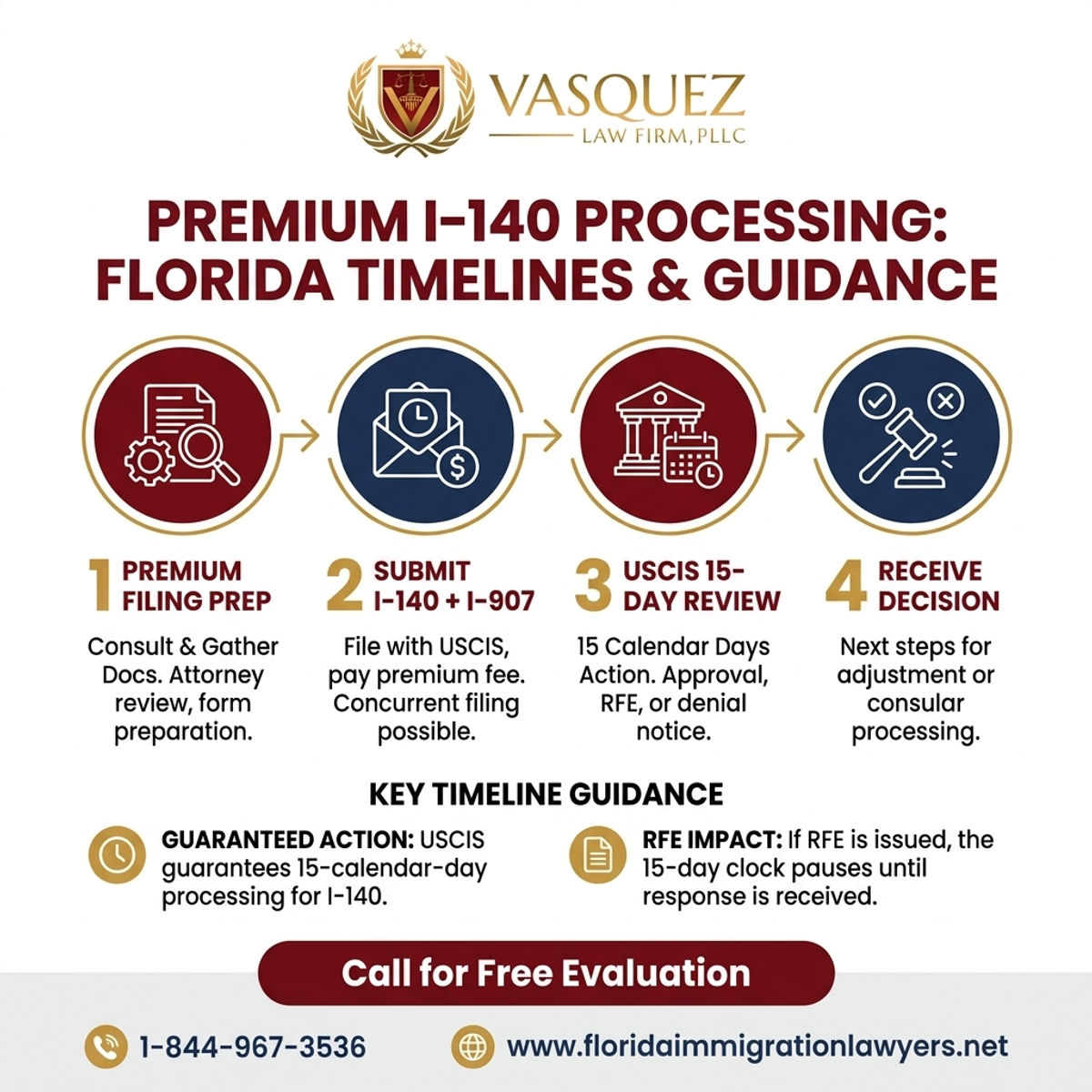
Step-by-Step Process — Premium Processing I-140 Florida: Timelines & Guidance
Throughout this process, accuracy and completeness are paramount. Any errors or omissions can lead to delays, RFEs, or even denials, negating the benefits of premium processing. Florida Immigration Lawyers provides comprehensive support, ensuring each step is executed flawlessly.
Essential Document Checklist for a Robust I-140 Petition
A meticulously prepared I-140 petition is critical for a successful outcome, especially when utilizing premium processing. Any missing or incorrect documentation will inevitably lead to delays, such as a Request for Evidence (RFE), which restarts the premium processing clock. Here is a comprehensive checklist of documents typically required for an I-140 petition, particularly for EB-2 and EB-3 categories:
- Certified PERM Labor Certification: Original Form ETA-9089, if applicable. This is the cornerstone for most EB-2 and EB-3 petitions.
- Academic Credentials: Official university transcripts, diplomas, and degree certificates. For foreign degrees, an educational equivalency evaluation from a recognized credential evaluation service may be required to prove U.S. degree equivalency.
- Experience Letters: Detailed letters from previous employers, verifying job titles, duties, dates of employment, and full-time status. These letters must be on company letterhead and signed by an authorized representative.
- Employer's Financial Documents: Evidence of the petitioning employer's ability to pay the offered wage, such as annual reports, federal tax returns, audited financial statements, or a letter from a financial officer.
- Job Offer Letter: A formal letter from the employer detailing the offered position, job duties, salary, and confirmation of permanent employment.
- Beneficiary's Resume/Curriculum Vitae: A detailed professional history outlining education, work experience, and any relevant achievements.
- Passport Copies: Copies of the beneficiary's passport biographic page and any U.S. visa stamps.
- Marriage Certificate/Birth Certificates: If derivative family members (spouse, children under 21) will be included in subsequent Green Card applications, their civil documents may be needed for family-based filings later.
- Form I-907 (Premium Processing): The completed form and proof of payment for the premium processing fee.
For individuals in Florida, ensuring that all these documents are precisely aligned with USCIS requirements is paramount. Our team at Florida Immigration Lawyers specializes in reviewing and organizing these extensive document packages, preventing common errors that could jeopardize your expedited processing. We understand the specific nuances that USCIS adjudicators in regional centers might look for, providing an extra layer of scrutiny for your benefit.
I-140 Premium Processing Timelines and Expectations in 2026
In 2026, the core promise of premium processing for I-140 petitions remains a guaranteed response within 15 calendar days for most categories, or 45 calendar days for specific classifications like EB-1C and EB-2 NIW. This commitment by USCIS is a crucial factor for many individuals and businesses in Florida planning their immigration strategies. The 15-day clock begins once USCIS officially receives the Form I-907 and the I-140 petition. Within this period, USCIS will issue an approval, a denial, or a Request for Evidence (RFE) or Notice of Intent to Deny (NOID).
If an RFE or NOID is issued, the 15-day or 45-day clock is paused. Once the petitioner submits a comprehensive response to the RFE/NOID, a new premium processing clock typically starts, ensuring another expedited review of the additional information. It is critical to respond to RFEs promptly and thoroughly, as any delay or incomplete response will derail the expedited timeline. You can always check the most current processing times and premium processing availability for various forms on the official USCIS processing times page. While the premium processing itself is fast, it is important to remember that the overall Green Card journey involves other stages, such as the PERM Labor Certification (which can take 6-12 months or more) and the subsequent Adjustment of Status (I-485) or Consular Processing, which are subject to visa bulletin priority dates and separate processing times.
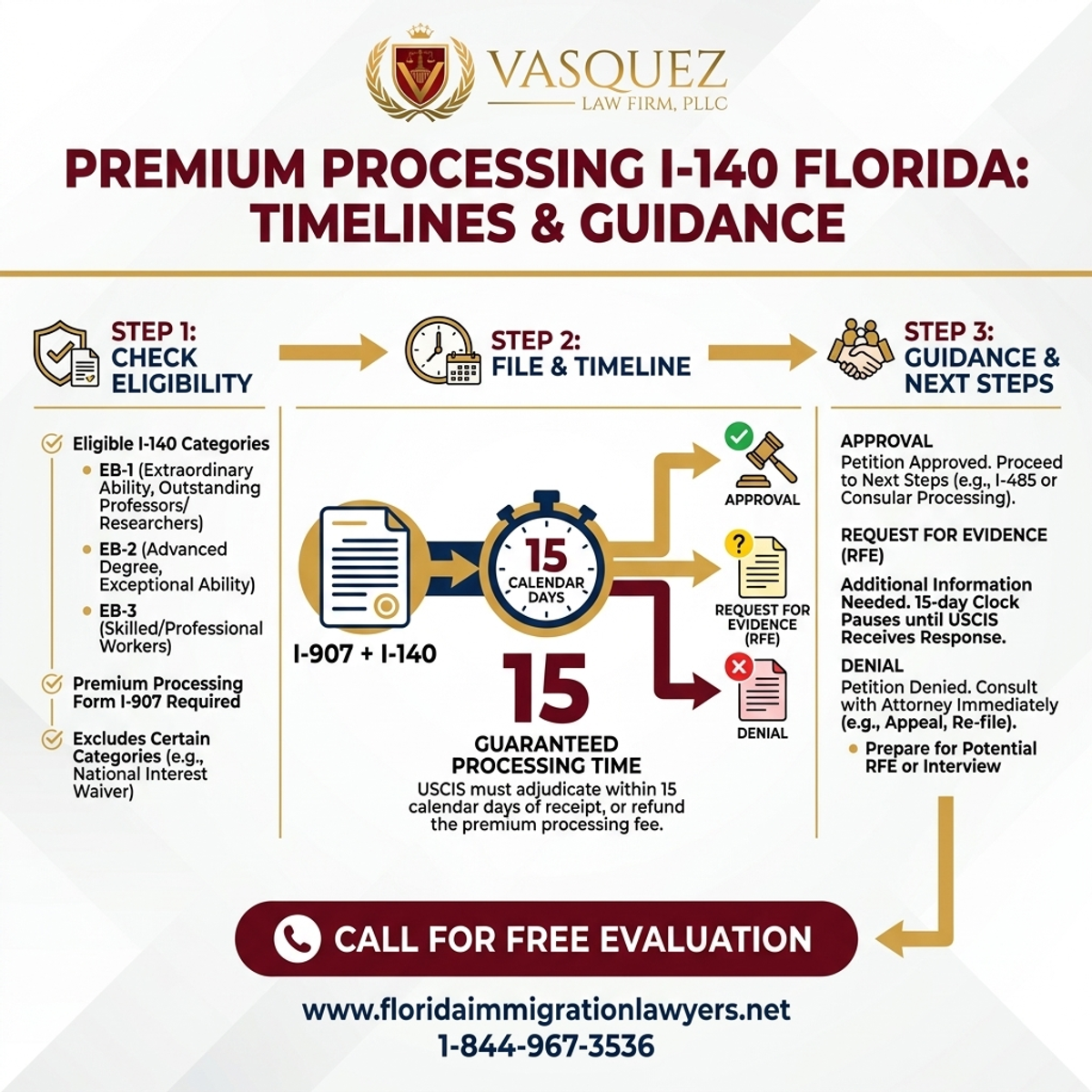
Key Statistics — Premium Processing I-140 Florida: Timelines & Guidance
For applicants in Florida, particularly those in Naples and surrounding communities, understanding these timelines is vital for planning personal and professional transitions. The I-140 approval, especially through premium processing, is a significant milestone that allows for the next steps. However, the final Green Card availability is governed by the U.S. Department of State's monthly Visa Bulletin, which dictates priority dates for different countries and employment-based categories. Even with a quick I-140 approval, if your priority date is not current, you may still face a wait for your I-485 to be filed or approved. Our experienced attorneys help clients understand these complex timelines and develop realistic expectations for their entire immigration process.
Cost Factors and Fee Breakdown for I-140 Premium Processing
Understanding the financial commitment involved in an I-140 petition with premium processing is crucial for budgeting and planning. The costs are generally divided into government filing fees and legal fees, with potential additional expenses depending on the specifics of the case. It is important to note that USCIS fees are subject to change, so always verify the latest amounts directly on the USCIS website.
- USCIS Form I-140 Filing Fee: This is the base fee for filing the Immigrant Petition for Alien Worker. This fee is paid to USCIS regardless of whether you opt for premium processing.
- USCIS Form I-907 Premium Processing Fee: This is an additional, separate fee paid to USCIS specifically for the expedited processing service. This fee is non-refundable, even if the petition is denied.
- PERM Labor Certification Fees (if applicable): While the U.S. Department of Labor does not charge a filing fee for PERM, there are often costs associated with advertising requirements (e.g., job postings in newspapers or online) and legal fees for managing the PERM process itself.
- Legal Fees: These fees cover the professional services provided by your immigration attorney. This includes preparing and filing the I-140 petition, preparing and filing Form I-907, responding to RFEs, and providing ongoing guidance and communication throughout the process. Legal fees vary based on the complexity of the case and the firm's experience.
- Miscellaneous Costs: Other potential expenses may include educational credential evaluations, translation services for foreign documents, courier fees, and medical examination fees (for the subsequent I-485 filing).
For individuals and employers in Florida, investing in expert legal counsel can ultimately save time and money by preventing costly errors and delays. Florida Immigration Lawyers offers transparent fee structures and works diligently to provide comprehensive support, ensuring all financial aspects are clearly understood. We believe in providing value through meticulous preparation and strategic guidance, helping you navigate the financial as well as legal complexities of your immigration journey.
Navigating Post-Approval Steps: Adjustment of Status in Florida
Once your I-140 petition is approved, especially through the accelerated premium processing, the next critical phase is securing your permanent residency. For individuals already present in the United States, this typically involves filing Form I-485, Application to Register Permanent Residence or Adjust Status. This step allows you to change your nonimmigrant status to that of a lawful permanent resident without having to leave the country. The ability to file an I-485 is contingent on a visa number being immediately available for your specific employment-based category and country of chargeability, as determined by the U.S. Department of State's monthly Visa Bulletin.
For many professionals in Florida, particularly those with an approved I-140, concurrent filing of the I-485 (along with applications for an Employment Authorization Document (EAD) and Advance Parole (travel document) is often possible if their priority date is current. The processing times for I-485 applications can vary significantly, often taking several months to over a year, even for those whose I-140 was premium processed. During this period, applicants may be required to attend a biometrics appointment and an interview at a USCIS field office, such as the one serving the Naples area. Our firm, Florida Immigration Lawyers, provides comprehensive support for the I-485 process, including preparing all necessary forms, compiling supporting documentation, and preparing you for your interview. You can explore more about general immigration processes on our Immigration services page.
Alternatively, if you are outside the United States or if consular processing is otherwise more appropriate, you would proceed with immigrant visa processing through a U.S. embassy or consulate in your home country. This involves submitting additional forms, attending an interview, and undergoing a medical examination abroad. Both Adjustment of Status and Consular Processing are complex stages with their own unique requirements and potential hurdles. Having an experienced immigration attorney from Florida Immigration Lawyers by your side ensures that you are well-prepared for each step, whether you are adjusting status within Florida or pursuing your Green Card from abroad, providing continuity and expert advice through the entire journey to permanent residency.
Do not navigate this complex process alone. Contact Florida Immigration Lawyers today for expert guidance tailored to your situation. Our team is ready to assist you.
Common Mistakes to Avoid in I-140 Premium Processing
Even with the promise of expedited processing, certain errors can lead to significant delays or even denials for your I-140 petition. Avoiding these common mistakes is crucial:
- Incomplete or Inaccurate Documentation: Failing to submit all required supporting documents, or submitting documents with errors, is the most common reason for RFEs. An RFE halts the premium processing clock and requires a new expedited review once responded to.
- Incorrect Filing Fees: Submitting the wrong filing fee for either Form I-140 or Form I-907, or failing to submit separate payments, will result in the rejection of your petition and premium processing request.
- Misrepresenting Qualifications: Providing exaggerated or false information regarding the beneficiary's education, experience, or achievements can lead to a denial and potentially severe immigration consequences.
- Employer's Inability to Pay: Not adequately demonstrating the employer's financial ability to pay the proffered wage is a frequent cause of I-140 denials. USCIS scrutinizes financial records closely.
- Ignoring PERM Labor Certification Details: For cases requiring PERM, any discrepancy between the PERM application and the I-140 petition (e.g., job duties, salary) can trigger an RFE or denial.
- Missing Deadlines for RFE Responses: If USCIS issues an RFE, failing to respond within the stipulated timeframe will result in the denial of the petition. Even with premium processing, meeting these deadlines is paramount.
- Assuming Premium Processing Guarantees Approval: While premium processing expedites review, it does not guarantee a favorable outcome. The petition must still meet all eligibility criteria, and a denial is possible if deficiencies exist.
- Not Consulting an Experienced Attorney: Attempting to navigate the complexities of I-140 and premium processing without legal counsel often leads to preventable mistakes, costing more time and money in the long run.
When to Call a Lawyer for I-140 Premium Processing in Florida
While premium processing offers speed, it also amplifies the need for precision. The expedited timeline means less room for error. You should strongly consider contacting an experienced immigration attorney at Florida Immigration Lawyers in several key scenarios:
- Complex Case Scenarios: If your case involves unusual circumstances, such as a prior immigration denial, criminal history, or a complicated employment history, legal expertise is essential to navigate potential hurdles.
- Receiving a Request for Evidence (RFE) or Notice of Intent to Deny (NOID): These notices are critical and require a comprehensive, well-articulated response. An attorney can help you gather the necessary evidence and craft a compelling argument to overcome USCIS concerns within the tight premium processing timeframe.
- Uncertainty About Eligibility: If you are unsure whether you or your employee meets the specific requirements for an EB-2 or EB-3 category, or if premium processing is even available for your I-140 type, an attorney can provide clarity and strategic advice.
- Employer Changes or Business Restructuring: Changes in the petitioning employer's structure, ownership, or financial situation can impact a pending I-140. An attorney can advise on potential implications and necessary actions.
- Need for Meticulous Documentation: The volume and specificity of documents required for I-140 petitions are extensive. An attorney ensures every document is correctly gathered, translated, and presented according to USCIS standards, reducing the risk of RFEs.
- Time Constraints and Stress: The immigration process can be overwhelming. A lawyer manages the complexities, allowing you to focus on your work and personal life without the added stress of navigating dense legal requirements.
Florida Immigration Lawyers has a proven track record of successfully assisting clients with I-140 petitions and premium processing. Our team understands the nuances of USCIS procedures and the specific needs of individuals and businesses throughout Florida. Visit our contact page to schedule a consultation.
About Florida Immigration Lawyers
Florida Immigration Lawyers is a leading immigration law firm dedicated to serving individuals, families, and businesses across the entire state of Florida. With a deep understanding of U.S. immigration law and a commitment to client success, our experienced attorneys provide comprehensive legal services tailored to your unique needs. We specialize in a wide range of immigration matters, including employment-based visas, family-based petitions, deportation defense, asylum, and naturalization. Our firm prides itself on providing compassionate, effective, and results-driven representation.
We believe that everyone deserves access to high-quality legal counsel, which is why we offer free consultations to help you understand your options and develop a clear strategy. Our team is available 24/7 to address your concerns, offering support and guidance in both English and Spanish. Whether you are navigating complex I-140 premium processing timelines in Naples, seeking asylum in Miami, or pursuing citizenship in Orlando, Florida Immigration Lawyers is here to advocate for you. Let us put our expertise to work for your immigration journey. Call us today at 1-844-YO-PELEO or visit our website at https://www.floridaimmigrationlawyers.net.
Sources and References
- U.S. Citizenship and Immigration Services (USCIS)
- Form I-907, Request for Premium Processing Service
- USCIS Processing Times
- U.S. Department of State - Visa Bulletin
- 8 U.S.C. § 1153 - Immigration and Nationality Act (INA) Section 203 - Allocation of immigrant visas
- 8 CFR Part 204 - Petitions, particularly Subpart E - Immigrant Petitions
Related services: immigration practice areas, family immigration services, citizenship and naturalization.
This article provides general legal information and is not intended as legal advice. Every case is unique, and outcomes depend on specific facts and circumstances. Contact an attorney for advice about your particular situation.
Do not delay in securing your future in the United States. Take the first step towards a successful immigration journey by contacting Florida Immigration Lawyers today for a free, no-obligation consultation. Our dedicated team is ready to provide the expert guidance you need. Call us now at 1-844-YO-PELEO. Se Habla Espanol - Estamos aqui para ayudarle.
Do Not Navigate This Process Alone
Our experienced immigration attorneys are ready to fight for you. Get a free, confidential case review today.
Se Habla Español
Or leave your details and we’ll call you:
Free Evaluation in 24 Hours
Or talk to us right now

AI voice assistant — available 24/7
FreeFrequently Asked Questions

William J. Vásquez
Founding Attorney · Vasquez Law Firm
U.S. Air Force veteran and immigration attorney with years of hands-on U.S. immigration experience. J.D., NCCU School of Law. AILA member. Admitted to the 4th, 5th, and 11th Circuit Courts.
Available 24/7 - Free Evaluations
Reviewed for legal accuracy by William J. Vásquez
Licensed in North Carolina; U.S. immigration is federal practice.
Related Legal Services
Our Florida immigration attorneys can help you with asylum protection, citizenship and naturalization and immigration practice areas. Call today at 1-844-YO-PELEO for a free case review.
Related Links
Related Topics
Free Legal Case Review
Discuss your case with our experienced attorneys. We're available 24/7.
Se Habla Español - Estamos aquí para ayudarle.
Related Articles
Immigration Lawyer Orlando Free Consultation in Florida
For individuals and families in Orlando, Florida, navigating the complexities of U.S. immigration law requires expert guidance. An immigration lawyer in Orlando offers crucial support for everything from visa applications and green card processes to naturalization and deportation defense. This comprehensive guide details what a free consultation covers, providing a step-by-step overview of immigration pathways, essential document checklists, and expected timelines in 2026. We also highlight common mistakes to avoid, discuss the critical role of legal counsel in deportation and asylum cases, and explain why choosing a local Orlando immigration attorney is beneficial. Florida Immigration Lawyers is dedicated to serving the diverse community of Orlando with compassionate, effective legal solutions, ensuring you receive personalized advice and robust representation for a successful immigration journey.
EAD Advance Parole Combo Card in Florida 2026
For individuals with a pending Form I-485, Application to Register Permanent Residence or Adjust Status, the EAD Advance Parole Combo Card is an essential document. This single card combines the authorization to work legally in the U.S. (Employment Authorization Document - EAD) with permission to travel internationally and re-enter without abandoning your green card application (Advance Parole). This guide from Florida Immigration Lawyers provides a comprehensive overview for applicants in Florida in 2026, covering eligibility, the step-by-step application process, required documents, expected processing times, and associated costs. We also highlight common mistakes to avoid and when to seek legal counsel to ensure a smooth and successful immigration journey. Understanding this vital card is key to maintaining stability while awaiting your permanent residency approval.
I-601 Waiver Lawyer Florida: Your Guide
Facing inadmissibility issues in Florida? Learn how an I-601 waiver can help you overcome these challenges with the guidance of an experienced lawyer. This guide provides a detailed overview of the process, eligibility requirements, and common pitfalls to avoid. Call Florida Immigration Lawyers at 1-844-YO-PELEO for expert assistance today.
O-1 Visa Extraordinary Ability in Florida: What You Need
Explore the O-1 visa for extraordinary ability in Florida. Learn about eligibility, application process, and common mistakes to avoid. Contact Florida Immigration Lawyers for expert assistance.