Immediate Relative Petition Tampa: Your 2026 Florida Guide
Securing a green card for an immediate relative in Florida involves a detailed process, starting with Form I-130. This guide, updated for 2026, explains who qualifies as an immediate relative-spouses, unmarried children under 21, and parents of U.S. citizens-and outlines the step-by-step journey from petition filing to green card issuance. We cover essential documents, expected timelines, and associated costs, emphasizing the critical difference of no visa backlogs for this category. Learn how to navigate USCIS procedures, whether through adjustment of status in cities like Tampa and Hialeah or consular processing abroad. We also detail common mistakes to avoid and highlight scenarios where legal counsel from Florida Immigration Lawyers is indispensable to ensure a smooth and successful family reunification.

An immediate relative petition in Tampa, Florida, filed using Form I-130, allows U.S. citizens to sponsor their closest family members-spouses, unmarried children under 21, and parents-for a U.S. green card. Unlike other family-sponsored categories, there is no annual limit on the number of visas available for immediate relatives, meaning the process can often be faster once the petition is approved. As of 2026, the process typically involves filing the I-130 petition with USCIS, followed by either adjustment of status within the U.S. or consular processing abroad, culminating in an interview and green card issuance. Navigating this complex process correctly is crucial for a successful outcome.
- Immediate relatives include spouses, unmarried children under 21, and parents of U.S. citizens.
- No annual visa limits mean potentially faster processing compared to other categories.
- The process starts with Form I-130, Petition for Alien Relative, filed by the U.S. citizen.
- Applicants may adjust status in the U.S. or undergo consular processing abroad.
- Consulting an experienced immigration attorney in Florida is highly recommended for guidance.
Introduction: Securing Your Family's Future in Florida
For many U.S. citizens residing in vibrant communities like Tampa, Hialeah, and across Florida, the dream of uniting with loved ones is a powerful motivator. The U.S. immigration system offers a specific pathway for this: the immediate relative petition. This critical legal tool allows U.S. citizens to sponsor their closest family members-spouses, unmarried children under 21, and parents-to live permanently in the United States. Understanding the nuances of this process, particularly in a diverse state like Florida, is essential for a successful journey.
As we look to 2026, the landscape of immigration law continues to evolve, making expert guidance more vital than ever. This comprehensive guide will walk you through everything you need to know about filing an immediate relative petition in Florida, from eligibility requirements and required documents to processing timelines and potential pitfalls. We'll delve into the specific steps involved, highlight common mistakes, and explain when it's crucial to seek professional legal assistance. Our goal is to empower you with the knowledge to confidently pursue family reunification, ensuring your loved ones can join you in the Sunshine State.
Don't navigate this complex legal journey alone. For personalized advice and unwavering support, call Florida Immigration Lawyers at 1-844-967-3536 for a free consultation today. Our experienced team is ready to help you and your family.
What is an Immediate Relative Petition in Tampa, Florida?
An immediate relative petition, primarily initiated through USCIS Form I-130, Petition for Alien Relative, is a fundamental pathway for U.S. citizens to sponsor their closest family members for a green card. This category is distinct because, unlike other family-sponsored preferences, immediate relatives are not subject to numerical visa limitations. This means that once the I-130 petition is approved, a visa number is immediately available, often leading to a more expedited process compared to categories with long wait times. In Tampa, and throughout Florida, this mechanism is frequently utilized to bring families together.
The core principle behind the immediate relative category, as defined by Section 201(b)(2)(A)(i) of the Immigration and Nationality Act (INA), is to prioritize the reunification of nuclear families. This legal framework reflects a long-standing commitment in U.S. immigration policy to keep families intact. The petitioner must be a U.S. citizen, and the beneficiary must fall into one of the specifically defined immediate relative relationships: spouse, unmarried child under 21, or parent. It's important to note that a U.S. citizen must be at least 21 years old to petition for a parent. The location of filing, such as a USCIS field office in Tampa or a service center, depends on various factors, including the beneficiary's location and whether they are filing concurrently for adjustment of status. Understanding these foundational aspects is the first step towards a successful petition in Florida.
Who Qualifies as an Immediate Relative for U.S. Immigration?
To qualify as an immediate relative for U.S. immigration purposes, the beneficiary must be one of three specific types of family members of a U.S. citizen: a spouse, an unmarried child under 21 years of age, or a parent. These categories are strictly defined by immigration law, and meeting these definitions is paramount for the success of an I-130 petition.
A spouse is defined as a legally married partner. The marriage must be valid in the place where it occurred and recognized under U.S. law. This includes common-law marriages if recognized by the jurisdiction of residence. A child refers to an unmarried individual under the age of 21. This can include biological children, stepchildren (if the marriage creating the step-relationship occurred before the child turned 18), and adopted children (if specific adoption requirements are met under INA 101(b)(1)). A parent is the biological or adoptive mother or father of a U.S. citizen, provided the U.S. citizen is at least 21 years old when filing the petition. These precise definitions ensure that only the closest family members benefit from the immediate relative classification, which offers a direct path to a green card without the lengthy visa backlogs faced by other family preference categories. Demonstrating the bona fides of these relationships with strong evidence is crucial for approval.
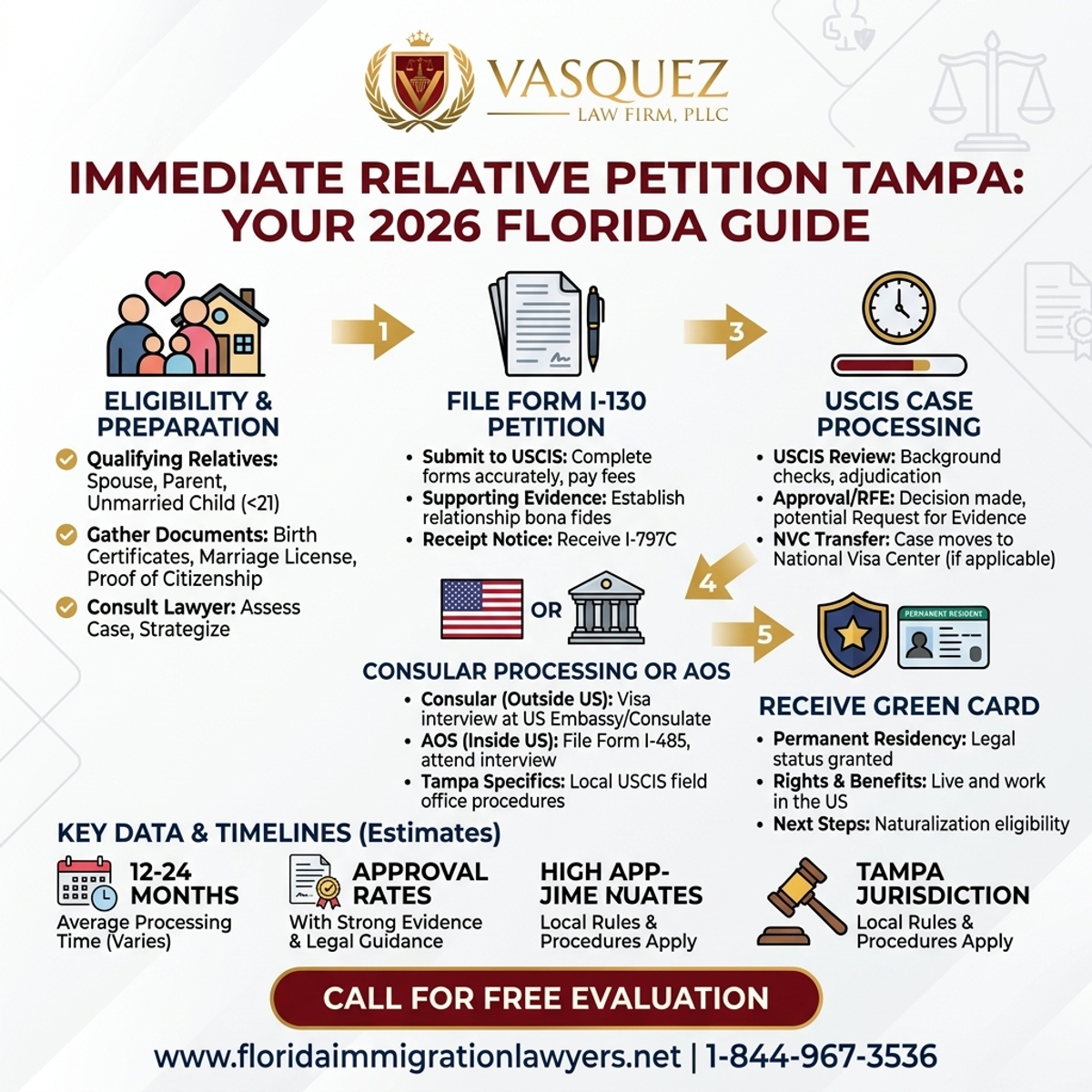
Step-by-Step Process — Immediate Relative Petition Tampa: Your 2026 Florida Guide
What is the Step-by-Step Process for an Immediate Relative Petition in Florida?
The process for an immediate relative petition, whether you are in Hialeah, Tampa, or anywhere else in Florida, involves several critical stages. Following these steps meticulously is key to a smooth application. As of 2026, while specific forms and fees may see minor adjustments, the fundamental procedural steps remain consistent.
-
Step 1: File Form I-130, Petition for Alien Relative: The U.S. citizen petitioner initiates the process by filing Form I-130 with U.S. Citizenship and Immigration Services (USCIS). This form establishes the qualifying relationship between the petitioner and the beneficiary. Along with the form, the petitioner must submit supporting documents such as proof of U.S. citizenship (e.g., birth certificate, passport, naturalization certificate) and evidence of the relationship (e.g., marriage certificate, birth certificate of the child/parent). All documents not in English must be accompanied by a certified translation. This initial step is foundational, and any errors or omissions can lead to delays or even denial. For residents of Florida, petitions are typically mailed to a designated USCIS Lockbox facility, which then forwards them to a service center for processing.
-
Step 2: I-130 Petition Processing and Approval: Once USCIS receives the I-130 petition, they will send a receipt notice (Form I-797C, Notice of Action). This notice includes a case number that can be used to track the petition's status online. USCIS reviews the petition and supporting evidence to determine if a bona fide immediate relative relationship exists. This stage may involve a Request for Evidence (RFE) if additional documentation is needed. If the petition is approved, USCIS sends an approval notice (Form I-797, Approval Notice). As of 2026, I-130 processing times can vary significantly but generally range from 8 to 18 months, depending on the service center and case complexity.
-
Step 3: Adjustment of Status (for beneficiaries in the U.S.) or Consular Processing (for beneficiaries abroad):
-
Adjustment of Status (AOS): If the immediate relative beneficiary is already physically present in the U.S. after a lawful entry, they may be eligible to apply for adjustment of status to a lawful permanent resident. This involves filing Form I-485, Application to Register Permanent Residence or Adjust Status, concurrently with or after the I-130 is approved. Along with I-485, beneficiaries typically file Form I-765 for employment authorization and Form I-131 for advance parole (travel document). This process usually includes biometric appointments at a local USCIS Application Support Center (ASC) in Florida, such as those serving Tampa or Miami, and an interview at a USCIS field office.
-
Consular Processing: If the beneficiary is outside the U.S., their case will be forwarded to the National Visa Center (NVC) after I-130 approval. The NVC collects necessary documents and fees, including the Affidavit of Support (Form I-864) from the petitioner, and conducts background checks. Once the NVC deems the case documentarily complete, it schedules an interview at the appropriate U.S. embassy or consulate in the beneficiary's home country. This is a common path for many families seeking to immigrate to Florida from abroad.
-
-
Step 4: Interview and Decision:
-
For Adjustment of Status: The beneficiary and often the petitioner will attend an interview at a USCIS field office in Florida (e.g., Miami, Orlando, Tampa). During the interview, an immigration officer will verify the information on the application, confirm the bona fides of the relationship, and ensure the applicant is admissible to the U.S. The officer may ask questions about your relationship, background, and intentions. A decision is often made at the interview or shortly thereafter.
-
For Consular Processing: The beneficiary attends an interview at the U.S. embassy or consulate abroad. Similar to AOS interviews, the consular officer will review documents, ask questions about the relationship, and determine eligibility. If approved, the beneficiary will receive an immigrant visa stamp in their passport. They can then travel to the U.S. and will receive their green card by mail after entry.
-
-
Step 5: Green Card Issuance: Upon approval of the adjustment of status application or successful entry into the U.S. with an immigrant visa, the immediate relative becomes a lawful permanent resident. The green card is typically mailed to the beneficiary's address. Conditional green cards are issued for spouses if the marriage is less than two years old at the time of approval, requiring a subsequent petition (Form I-751) to remove conditions. This final step marks the successful completion of the immediate relative petition process.
What Documents Are Needed for an Immediate Relative Petition?
Gathering the correct and complete set of documents is a critical part of filing an immediate relative petition. Missing or incorrect documents are a common cause of delays or Requests for Evidence (RFEs) from USCIS. Ensure all foreign language documents are accompanied by a certified English translation.
- For the U.S. Citizen Petitioner:
- Proof of U.S. Citizenship: Copy of U.S. birth certificate, naturalization certificate, or valid U.S. passport.
- Two passport-style photos.
- Form I-130, Petition for Alien Relative.
- Proof of Domicile in the U.S. (especially for consular processing cases where the petitioner lives abroad, demonstrating intent to return to Florida).
- For the Beneficiary (Immediate Relative):
- Two passport-style photos.
- Copy of birth certificate.
- Copy of passport biographical page.
- Proof of legal entry into the U.S. (if adjusting status): I-94 arrival/departure record, visa stamp.
- Marriage certificate (for spouses).
- Birth certificates of children (for child petitions).
- Birth certificate of the U.S. citizen and the parent's marriage certificate (for parent petitions).
- Divorce decrees or death certificates for any previous marriages of both petitioner and beneficiary.
- Form I-864, Affidavit of Support (and supporting financial documents like tax transcripts, employment letters, pay stubs).
- Form I-485, Application to Register Permanent Residence or Adjust Status (if adjusting status in the U.S.).
- Form I-693, Report of Medical Examination and Vaccination Record, completed by a USCIS-approved civil surgeon in Florida.
- Criminal records, if any, and their certified dispositions.
Key Statistics — Immediate Relative Petition Tampa: Your 2026 Florida Guide
- Evidence of Bona Fide Relationship (especially crucial for spouses):
- Joint bank accounts, credit cards, or utility bills.
- Lease agreements or property deeds showing joint residency.
- Photos together (wedding, family events, vacations).
- Affidavits from friends and family attesting to the relationship.
- Children's birth certificates (if applicable).
- Life insurance policies, wills, or trusts naming each other as beneficiaries.
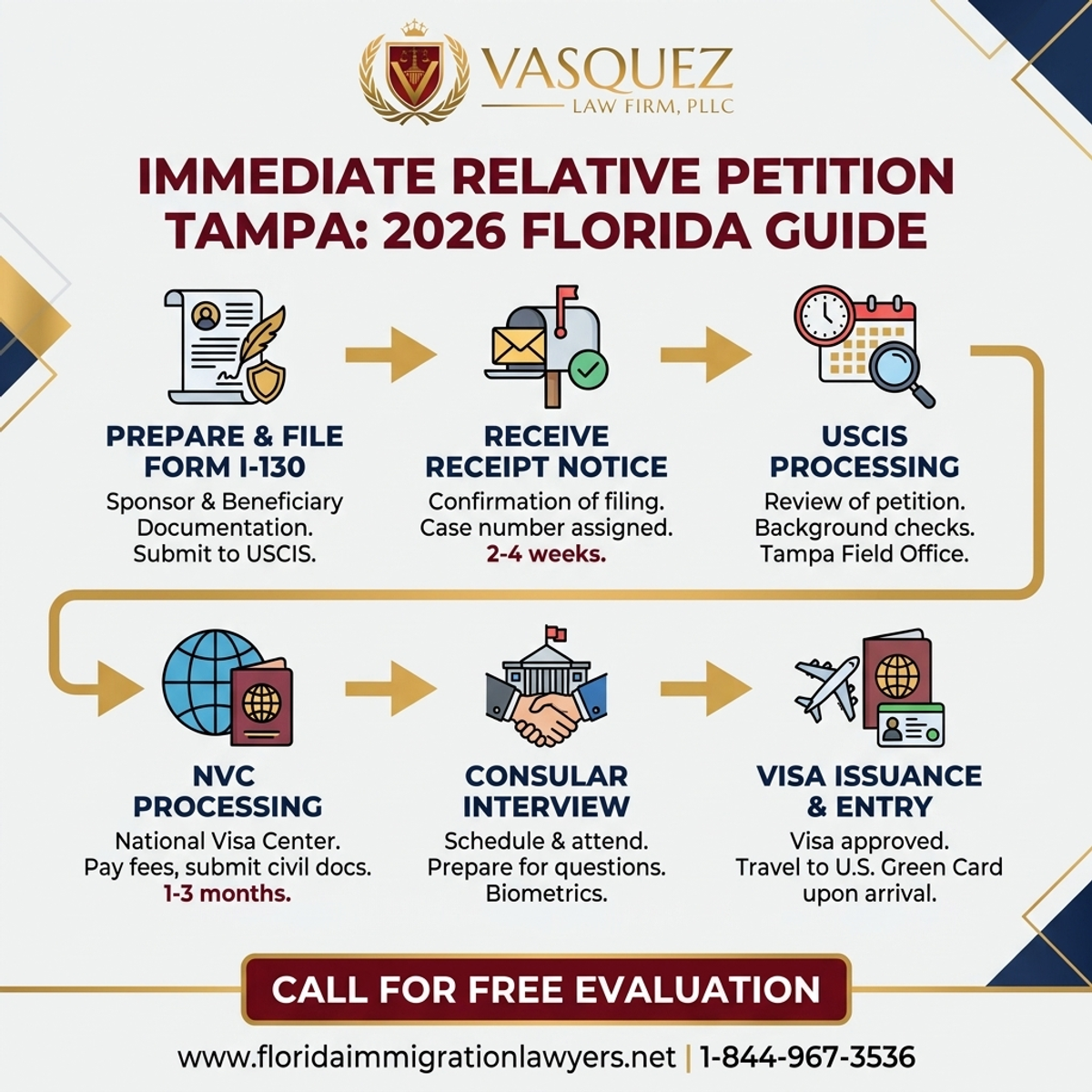
How Long Does an Immediate Relative Petition Take in 2026?
The total time it takes to complete an immediate relative petition and receive a green card can vary significantly based on several factors, including the specific USCIS service center, the complexity of the case, and whether the beneficiary is adjusting status in the U.S. or undergoing consular processing abroad. While immediate relatives are not subject to visa backlogs, the administrative processing itself takes time. As of 2026, here's a general overview of typical timeframes:
| Stage | Typical Timeframe (As of 2026) | Notes |
|---|---|---|
| I-130 Petition Filing to Approval | 8 - 18 months | Varies by USCIS service center. Can be longer with RFEs or complex cases. |
| Concurrent Filing (I-130 & I-485) | 12 - 24 months for I-485 decision | Common for beneficiaries in the U.S. Includes biometrics, interview, and decision. |
| Employment Authorization (EAD) & Advance Parole (AP) for AOS | 5 - 12 months | These are typically filed with I-485 and allow work and travel during processing. |
| National Visa Center (NVC) Processing (after I-130 approval) | 3 - 6 months | Collecting documents, fees, and scheduling the consular interview. |
| Consular Interview & Visa Issuance | 1 - 3 months after NVC completion | Depends on embassy/consulate availability. |
| Green Card Delivery (after approval/entry) | 2 - 4 weeks | Mailed to the address on file. |
It's important to remember that these are average estimates, and individual cases can fall outside these ranges. Factors such as criminal history, previous immigration violations, or issues with documentation can significantly prolong the process. For those in Hialeah or other parts of Florida, an attorney can help manage expectations and address potential delays proactively. Keeping your address updated with USCIS is also critical to receive all notices promptly.
What Are the Costs Associated with an Immediate Relative Petition?
The costs involved in an immediate relative petition can accumulate from various fees charged by government agencies and other service providers. It's important to budget for these expenses upfront, as they are non-refundable regardless of the outcome of the petition. Please note that USCIS fees are subject to change, and it's always best to check the official USCIS website for the most current fee schedule. As of 2026, here’s a breakdown of typical costs:
| Item | Typical Fee (As of 2026) | Notes |
|---|---|---|
| Form I-130, Petition for Alien Relative | Varies (check USCIS website) | Required for all immediate relative petitions. |
| Form I-485, Application to Register Permanent Residence or Adjust Status | Varies (check USCIS website) | Required for beneficiaries adjusting status in the U.S. Includes biometrics fee. |
| Form I-765, Application for Employment Authorization (EAD) | Varies (check USCIS website) | Often filed concurrently with I-485; fee sometimes waived when filing with I-485. |
| Form I-131, Application for Travel Document (Advance Parole) | Varies (check USCIS website) | Often filed concurrently with I-485; fee sometimes waived when filing with I-485. |
| Biometrics Services Fee | Included in I-485 fee or separate for some forms | Fingerprints and photo taken at an Application Support Center. |
| Immigrant Visa Processing Fee (for Consular Processing) | Varies (check State Department website) | Paid to the Department of State for NVC processing. |
| USCIS Immigrant Fee | Varies (check USCIS website) | Paid after visa approval and before entering the U.S. for green card production. |
| Medical Examination (Form I-693) | $200 - $500+ | Paid to a USCIS-approved civil surgeon. Costs vary by provider and location in Florida. |
| Attorney Fees | Varies widely | Highly recommended for complex cases or to ensure proper filing. Fees depend on case complexity and firm. |
| Document Translation Fees | Varies | Required for any non-English documents. |
| Postage/Courier Fees | Minor | Costs for mailing applications and documents securely. |
These fees can add up, and it's important to plan accordingly. While some applicants choose to navigate the process independently, the value of an experienced immigration attorney often outweighs the cost, especially given the potential for costly errors or delays. Florida Immigration Lawyers offers transparent fee structures and can help you understand the full financial scope of your petition, ensuring there are no surprises.
Navigating Immediate Relative Petitions in Hialeah and Across Florida
Florida, with its diverse population and significant immigrant communities, presents unique considerations for immediate relative petitions. Cities like Hialeah, Miami, Orlando, and Tampa are home to large numbers of foreign-born residents, making family immigration a frequent and vital process. Understanding the local context, including USCIS field office operations and community resources, can be highly beneficial.
For beneficiaries adjusting status in Florida, interviews are typically conducted at one of the USCIS field offices located in Miami, Orlando, or Tampa. Each office has its own operational nuances and scheduling backlogs, which can influence processing times. For instance, the Miami field office, serving a large portion of South Florida, often handles a high volume of cases, potentially impacting wait times. It's crucial to be prepared for your interview, as immigration officers are trained to identify fraudulent relationships and will scrutinize the evidence provided. They may ask detailed questions about your life together, shared finances, and future plans. Having an attorney present or thoroughly preparing with one can significantly improve your confidence and the interview's outcome. Furthermore, Florida's unique demographics mean that cultural competence and bilingual services, like those offered by Florida Immigration Lawyers, are invaluable resources for petitioners and beneficiaries navigating the system. We understand the specific challenges and opportunities that arise when processing immigration cases in this vibrant and diverse state.
Do not navigate this process alone. The complexities of immigration law, especially for immediate relative petitions, require meticulous attention to detail and a deep understanding of legal precedents. Contact Florida Immigration Lawyers today for a free consultation at 1-844-967-3536 and let our dedicated team guide you through every step.
Common Mistakes to Avoid in Immediate Relative Petitions
Filing an immediate relative petition can be a straightforward process for some, but it's fraught with potential pitfalls that can lead to significant delays, Requests for Evidence (RFEs), or even outright denials. Avoiding these common mistakes is crucial for a successful outcome in Florida.
-
Incomplete or Incorrect Forms: Submitting forms with missing information, unchecked boxes, or incorrect data is a leading cause of rejection or RFE. USCIS is highly particular about form completion. Always double-check every field and refer to the USCIS instructions. Consequences: Case rejection, significant delays, or a need to refile, losing valuable time and fees.
-
Insufficient Evidence of Relationship: Especially for spousal petitions, failing to provide ample evidence of a bona fide (real) marriage is a common pitfall. USCIS looks for shared financial ties, joint living arrangements, and commingling of lives. Consequences: RFE, interview scrutiny, or denial if the relationship is deemed fraudulent.
-
Lack of Financial Support (Form I-864): The petitioner must demonstrate the ability to financially support the beneficiary to prevent them from becoming a public charge. If the petitioner's income is insufficient, a joint sponsor is needed. Consequences: RFE for additional financial evidence or denial if the public charge requirement is not met, as per INA 212(a)(4).
-
Missing or Uncertified Translations: Any document not in English must be accompanied by a complete and certified English translation. A certified translation includes a statement from the translator affirming their competence and the accuracy of the translation. Consequences: RFE, delays, or rejection of the entire application.
-
Failure to Disclose Criminal History or Prior Immigration Violations: Attempting to conceal past criminal convictions, arrests, or previous immigration violations (e.g., overstaying a visa, unlawful entry) can lead to severe consequences, including findings of misrepresentation and permanent bars to immigration. Consequences: Denial, findings of inadmissibility, or even deportation proceedings.
-
Not Updating Address with USCIS: If you move, you must notify USCIS of your new address within 10 days using Form AR-11. Failure to do so can result in missed notices, interview appointments, or RFEs. Consequences: Case abandonment, delays, or denial due to missed crucial communication.
-
Traveling Without Advance Parole (for AOS applicants): If you have a pending I-485 application and travel outside the U.S. without an approved Advance Parole document (Form I-131), your I-485 application may be considered abandoned upon your departure. Consequences: Automatic termination of your adjustment of status application, requiring you to restart the process or potentially face inadmissibility.
-
Ignoring Legal Advice or Deadlines: The immigration process is governed by strict timelines and legal requirements. Missing a deadline for an RFE response or failing to appear for an interview can have severe repercussions. Consequences: Automatic denial of the petition or application, requiring a new filing and additional fees.
When to Call a Florida Immigration Lawyer
While some immediate relative petitions appear straightforward, many situations warrant the expertise of an experienced Florida immigration lawyer. The complexities of U.S. immigration law, combined with the high stakes of family reunification, make professional guidance invaluable. You should consider contacting Florida Immigration Lawyers if any of the following scenarios apply to your case:
- Complex Relationship Issues: If there are questions about the validity of your marriage (e.g., prior divorces, common-law marriage not recognized in all jurisdictions), or if the relationship is new and lacks extensive joint evidence.
- Beneficiary's Immigration History: If the beneficiary has overstayed a visa, entered the U.S. without inspection, has a deportation order, or has any prior immigration violations. These issues can trigger inadmissibility grounds that require waivers.
- Criminal History: If either the petitioner or beneficiary has any arrests or convictions, even minor ones. Criminal records can lead to serious inadmissibility issues under INA 212(a)(2).
- Previous Denials or Difficulties: If a prior immigration petition was denied, or if you've faced challenges with USCIS in the past. An attorney can analyze the reasons for denial and advise on the best path forward.
- Public Charge Concerns: If the petitioner's income is near the poverty line and requires a joint sponsor, or if there are concerns about the beneficiary potentially becoming a public charge.
- Health-Related Inadmissibility: If the beneficiary has certain medical conditions that might make them inadmissible to the U.S., requiring specific waivers.
- Need for Concurrent Filing Guidance: Deciding whether to file Form I-130 and I-485 concurrently or sequentially can depend on specific circumstances and legal advice.
- Lack of Confidence or Time: If you feel overwhelmed by the paperwork, legal jargon, or simply lack the time to meticulously prepare your application.
Florida Immigration Lawyers has extensive experience with immediate relative petitions, serving clients from Hialeah to Tampa and across the entire state. We can help you identify potential red flags, prepare a robust application, represent you at interviews, and navigate any challenges that arise. Our goal is to protect your family's future and ensure the smoothest possible path to a green card.
About Florida Immigration Lawyers
Florida Immigration Lawyers is a leading immigration law firm dedicated to serving individuals and families throughout the Sunshine State. With a deep understanding of the complexities of U.S. immigration law, our experienced attorneys provide compassionate, effective, and results-driven legal representation. We pride ourselves on offering personalized attention to each client, recognizing that every immigration journey is unique and deeply personal.
Our comprehensive range of services includes family-based immigration, employment visas, deportation defense, asylum claims, naturalization, and more. Whether you are seeking to reunite with an immediate relative in Tampa, adjust your status in Hialeah, or navigate complex visa issues, our firm is equipped to provide the expert guidance you need. We are committed to upholding the rights of immigrants and helping them achieve their American dreams. Our team is available 24/7 to answer your questions and provide support. We offer free consultations to discuss your case and outline your best legal options. Choose Florida Immigration Lawyers for unparalleled dedication and a proven track record of success.
Contact us today at 1-844-967-3536 or visit www.floridaimmigrationlawyers.net to learn more.
Sources and References
- U.S. Citizenship and Immigration Services (USCIS)
- USCIS Form I-130, Petition for Alien Relative
- USCIS Fees Information
- Executive Office for Immigration Review (EOIR)
- 8 U.S.C. Chapter 12 - Immigration and Nationality Act (INA), particularly INA 201(b)(2)(A)(i) and INA 212(a)(4).
- 8 CFR Part 204 - Petitions to Classify Alien as Immediate Relative.
- U.S. Department of State - Bureau of Consular Affairs
Related services: family petition process, family-based green cards, fiancé visa (K-1), marriage-based immigration.
This article provides general legal information and is not intended as legal advice. Every case is unique, and outcomes depend on specific facts and circumstances. Contact an attorney for advice about your particular situation. Immigration laws are subject to change.
Ready to Start Your Immediate Relative Petition?
Don't let the complexities of immigration law prevent you from uniting with your family. The dedicated team at Florida Immigration Lawyers is here to provide the expert guidance and support you need. We offer free, confidential consultations to discuss your immediate relative petition and help you understand your options. Call us now at 1-844-967-3536. Se Habla Español - Estamos aquí para ayudarle.
If you need legal assistance, learn more about family immigration lawyers in Florida, or call us at 1-844-967-3536 for a free consultation.
Do Not Navigate This Process Alone
Our experienced immigration attorneys are ready to fight for you. Get a free, confidential consultation today.
Se Habla Español
Or leave your details and we’ll call you:
Free Evaluation in 24 Hours
Or talk to us right now
AI voice assistant — available 24/7
FreeFrequently Asked Questions

William J. Vásquez
Founding Attorney · Vasquez Law Firm
U.S. Air Force veteran and immigration attorney with years of hands-on U.S. immigration experience. J.D., NCCU School of Law. AILA member. Admitted to the 4th, 5th, and 11th Circuit Courts.
Available 24/7 - Free Evaluations
Reviewed for legal accuracy by William J. Vásquez
Licensed in North Carolina; U.S. immigration is federal practice.
Related Legal Services
Our Florida immigration attorneys can help you with family immigration services, immigration practice areas and free immigration consultation. Call today at 1-844-967-3536 for a free consultation.
Related Links
Related Topics
Free Legal Consultation
Discuss your case with our experienced attorneys. We're available 24/7.
Se Habla Español - Estamos aquí para ayudarle.
Related Articles
Immigration Lawyer Orlando Free Consultation 2026
Discover how to find an immigration lawyer in Orlando offering a free consultation. Understand the services available and why choosing Florida Immigration Lawyers can make a difference in your case.
Military Naturalization Expedited in Florida Bases
Explore military naturalization options for families at Florida bases, including parole in place benefits in Miami. Learn how to expedite your application with expert guidance from Florida Immigration Lawyers.
Immigration Lawyer Orlando Free Consultation in 2026
Discover how to find an immigration lawyer in Orlando offering a free consultation in 2026. This guide from Florida Immigration Lawyers covers essential services, the Green Card application process, typical timelines, and cost factors in Central Florida. Learn about critical documents, common mistakes to avoid, and when expert legal counsel is indispensable for your immigration case. We serve clients across Florida, including Lakeland, Polk County, and Coral Springs, providing compassionate and effective representation for family visas, deportation defense, and naturalization. Get started with a free consultation today.
Work Permit for Permanent Residency: PERM Labor
For those seeking a permanent work permit in Florida through employer sponsorship, the PERM Labor Certification process is a critical first step. This guide explains how the U.S. Department of Labor's PERM program ensures no qualified U.S. workers are available for a position before a foreign national is hired permanently. We cover the step-by-step process, required documentation, typical timelines, and associated costs as of 2026. Learn about common mistakes to avoid and when to seek legal assistance from Florida Immigration Lawyers to navigate this complex path toward an employer-sponsored green card, particularly for roles in West Palm Beach and across the state.