Work Permit for Permanent Residency: PERM Labor
For those seeking a permanent work permit in Florida through employer sponsorship, the PERM Labor Certification process is a critical first step. This guide explains how the U.S. Department of Labor's PERM program ensures no qualified U.S. workers are available for a position before a foreign national is hired permanently. We cover the step-by-step process, required documentation, typical timelines, and associated costs as of 2026. Learn about common mistakes to avoid and when to seek legal assistance from Florida Immigration Lawyers to navigate this complex path toward an employer-sponsored green card, particularly for roles in West Palm Beach and across the state.

To obtain a permanent work permit in Florida via employer sponsorship, the process typically begins with PERM Labor Certification. As of 2026, PERM is a U.S. Department of Labor (DOL) program requiring employers to prove no qualified U.S. workers are available for a position before hiring a foreign national for a permanent role. This certification is a critical first step for many employment-based green card categories (EB-2 and EB-3), demonstrating a genuine labor shortage in the U.S. workforce. Navigating this complex process, especially in a diverse state like Florida, often requires expert legal guidance.
- PERM is the initial stage for many employer-sponsored green cards.
- It verifies a lack of qualified U.S. workers for a specific job.
- The process is managed by the U.S. Department of Labor.
- Compliance with strict recruitment rules is mandatory for employers.
- Legal assistance is highly recommended for successful PERM filings.
Many individuals dream of building a stable career and life in the United States. For those seeking a permanent work permit through employer sponsorship, the journey often begins with a crucial step: the PERM Labor Certification. This complex process, overseen by the U.S. Department of Labor (DOL), is designed to protect the U.S. labor market by ensuring that foreign workers are not hired for positions where qualified American workers are available and willing to take the job. In a vibrant and diverse state like Florida, with its unique economic landscape, understanding the nuances of PERM is essential for both employers and prospective employees.
The PERM process is not merely a formality; it is a rigorous and detailed undertaking that requires meticulous planning, strict adherence to recruitment regulations, and significant documentation. Errors at this stage can lead to costly delays or even denial, jeopardizing a foreign national's path to an employer-sponsored green card. Whether you are an employer in West Palm Beach looking to fill a specialized role or a talented individual seeking permanent residency, understanding each phase of this process is paramount. This comprehensive guide will walk you through the intricacies of PERM Labor Certification in Florida, offering insights into its requirements, timelines, costs, and common pitfalls to avoid. Do not navigate this complex immigration landscape alone. Call Florida Immigration Lawyers at 1-844-967-3536 for a free consultation and let our experienced team help you achieve your immigration goals.
What is PERM Labor Certification in Florida?
PERM Labor Certification is the first and foundational step for most employment-based permanent residency applications, specifically for the EB-2 (Professionals Holding Advanced Degrees and Persons of Exceptional Ability) and EB-3 (Skilled Workers, Professionals, and Other Workers) visa categories. This certification, governed by the U.S. Department of Labor (DOL) under 20 CFR Part 656, is a mandatory prerequisite where an employer must demonstrate that there are no qualified, willing, and available U.S. workers for a specific job opening in the geographic area of intended employment, such as West Palm Beach or other parts of Florida. The goal is to ensure that hiring a foreign national will not adversely affect the wages and working conditions of U.S. workers.
The PERM process requires the employer to conduct specific recruitment efforts to test the U.S. labor market. These efforts typically include placing advertisements in various media, such as a state workforce agency job order, newspaper advertisements, and other professional journals or online job boards. The employer must document all recruitment attempts and any responses received, proving that a good faith effort was made to find a U.S. worker. Only after demonstrating the unavailability of qualified U.S. workers can the employer file the ETA Form 9089, Application for Permanent Employment Certification. This initial phase is critical because any misstep in the recruitment or documentation can lead to an audit or denial, significantly delaying the green card process. Florida's diverse economy, from agriculture in the south to tech in Orlando, means that labor market conditions can vary significantly, impacting recruitment strategies. Our firm, Florida Immigration Lawyers, regularly assists employers across the state in navigating these specific market conditions, ensuring compliance with DOL regulations.
How Does the PERM Process Work for an Employer-Sponsored Green Card?
The PERM labor certification process is a multi-stage procedure that begins with the employer, not the foreign national. As of 2026, it involves a series of meticulously prescribed steps by the U.S. Department of Labor (DOL) to confirm that a U.S. employer genuinely needs a foreign worker for a permanent position because no qualified U.S. workers are available. The employer must first obtain a prevailing wage determination, conduct a detailed recruitment campaign, and then, if no qualified U.S. workers are found, file the application with the DOL. This rigorous process is designed to protect American jobs and ensure fairness in the labor market, forming the bedrock for an employer-sponsored green card. Success hinges on strict adherence to all regulatory requirements.
The process is complex and requires careful attention to detail. Here’s a step-by-step guide:
- Determine Prevailing Wage: The employer must first request a Prevailing Wage Determination (PWD) from the DOL's National Prevailing Wage Center (NPWC). This determines the minimum wage the employer must pay the foreign worker, based on the job duties, education, experience, and geographic location (e.g., West Palm Beach, Florida). The PWD is typically valid for a specific period and must be obtained before or during the recruitment phase. This step ensures that the foreign worker will be paid at least the prevailing wage for that occupation in that area, preventing adverse effects on U.S. workers' wages.
- Conduct Recruitment: After receiving the PWD, the employer must conduct a mandatory recruitment campaign over a period of 30 to 180 days. This includes placing a job order with the State Workforce Agency (SWA) for 30 days and running two Sunday advertisements in a newspaper of general circulation. For professional occupations, additional recruitment steps are required, such as placing ads on the employer's website, job search websites, professional organizations, or campus recruitment. All recruitment efforts must be meticulously documented, including dates, locations, and copies of advertisements.
- Review Applicants and Document Results: The employer must review all applications received from U.S. workers during the recruitment period. If any U.S. workers are identified who are minimally qualified and available for the position, the PERM process cannot proceed. The employer must prepare a recruitment report detailing the recruitment steps, the results, and the lawful job-related reasons why U.S. applicants were not hired. This report is not submitted with the application but must be retained for five years and provided upon audit.
- File ETA Form 9089: If no qualified U.S. workers are found, the employer can then electronically file ETA Form 9089, Application for Permanent Employment Certification, with the DOL. This form contains detailed information about the employer, the foreign worker, the job offer, and the recruitment efforts. It is crucial that all information on this form is accurate and consistent with the recruitment documentation. Errors or inconsistencies can lead to audits or denials. The DOL's processing times can vary, and an audit can significantly extend the timeline.
- PERM Certification: Upon approval, the DOL issues the certified ETA Form 9089. This certification confirms that the employer has met all regulatory requirements and that there are no qualified U.S. workers for the position. The certified PERM is then used as the basis for filing the Immigrant Petition for Alien Worker (Form I-140) with U.S. Citizenship and Immigration Services (USCIS). Without a certified PERM, the I-140 petition cannot be filed for most EB-2 and EB-3 categories. This step marks the transition from the DOL's jurisdiction to USCIS for the next phase of the green card application.
What Documents Are Needed for a PERM Labor Certification Application?
Successful navigation of the PERM Labor Certification process in Florida demands meticulous record-keeping and a comprehensive understanding of required documentation. While most documents are retained by the employer and only submitted if an audit occurs, their availability and accuracy are paramount. As of 2026, employers must be prepared to present evidence of every step taken, from wage determinations to recruitment efforts and applicant reviews. Missing or incomplete documentation is a primary reason for audits and denials, making preparation critical for securing an employer-sponsored green card. This list outlines the key documents an employer must gather and maintain.
The following is a critical checklist of documents and records an employer must maintain for a PERM application:
- Prevailing Wage Determination (PWD) Document: The official determination letter from the National Prevailing Wage Center (NPWC) specifying the required wage for the position.
- Job Order with State Workforce Agency (SWA): Proof of the 30-day job order placed with the Florida Department of Economic Opportunity or relevant SWA.
- Newspaper Advertisements: Copies of the two Sunday newspaper advertisements, including the newspaper name, date, and page number, showing the full ad text.
- Additional Recruitment Evidence (for professional occupations): Copies of at least three additional recruitment efforts chosen from the approved list, such as:
- Employer's website postings.
- Job search website postings (e.g., LinkedIn, Indeed).
- Professional organization advertisements.
- Private employment firm advertisements.
- Campus recruitment documentation.
- Employee referral program notices.
- Trade or professional journal advertisements.
- Recruitment Report: A detailed written report summarizing all recruitment steps, the number of U.S. applicants, and the lawful, job-related reasons for not hiring any U.S. applicants.
- Resumes and Applications: All resumes, applications, and other documentation received from U.S. workers who applied for the position.
- Wage Records: Documentation demonstrating the foreign worker will be paid at or above the prevailing wage (e.g., offer letters, payroll records).
- Employer's Federal Employer Identification Number (FEIN): Necessary for identification purposes.
- Employer's Business License/Registration: Proof of legal operation in Florida.
- Foreign Worker's Qualifications: Copies of the foreign worker's educational degrees, transcripts, professional licenses, and letters of experience to prove they meet the minimum requirements of the job offer.
- Job Description: A detailed description of the job duties, minimum education, experience, and special requirements.
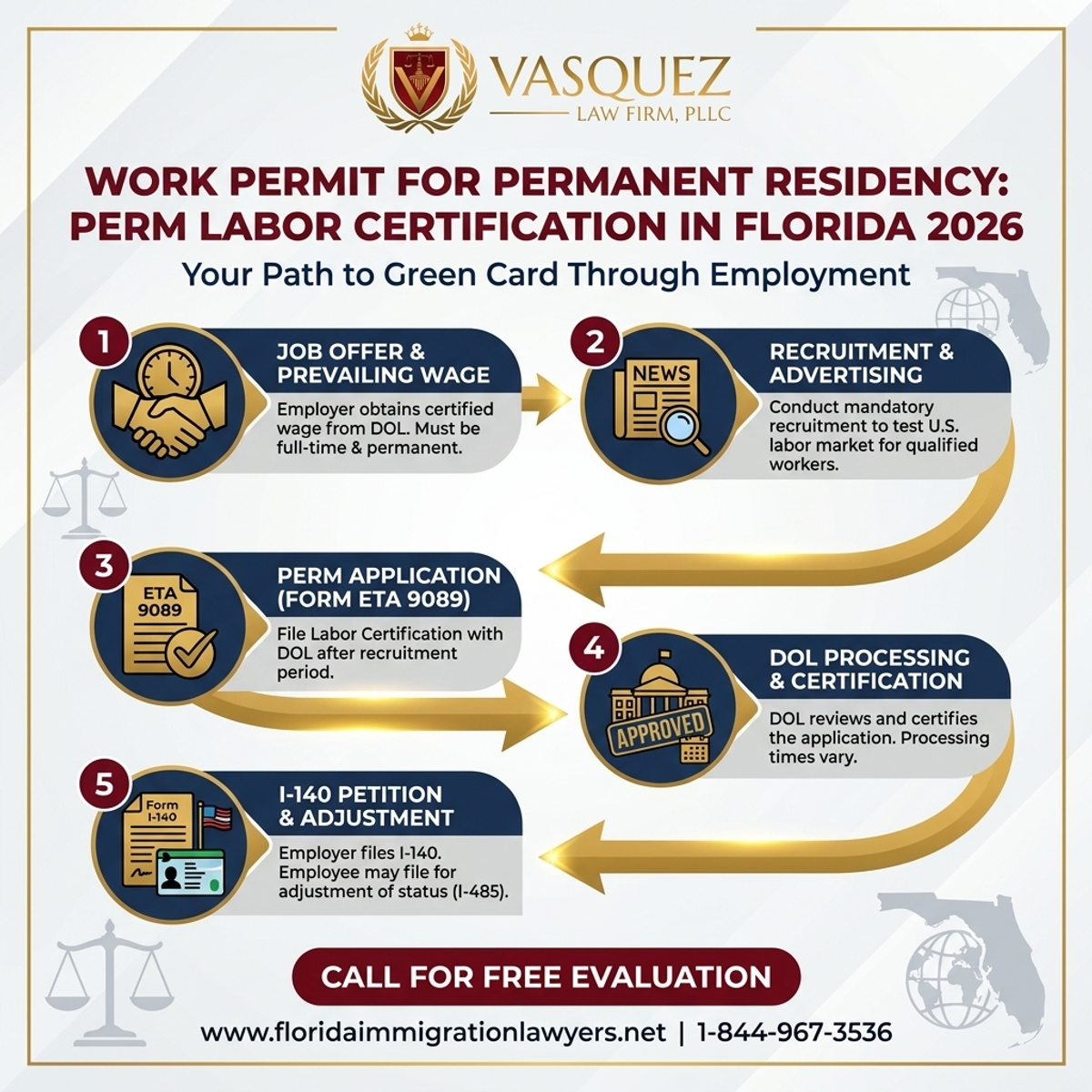
Step-by-Step Process — Work Permit for Permanent Residency: PERM Labor Certification in Florida 2026
What is the Timeline for PERM Labor Certification in 2026?
The timeline for PERM Labor Certification can vary significantly, often spanning many months, and is subject to U.S. Department of Labor (DOL) processing backlogs. As of 2026, while specific dates fluctuate, understanding the typical duration of each stage is crucial for planning your employer-sponsored green card journey in Florida. Factors such as the prevailing wage determination process, the mandatory recruitment period, and the DOL's processing queue all contribute to the overall timeline. Employers and foreign nationals must prepare for a lengthy but essential process, during which consistent communication with legal counsel is invaluable.
Here is a typical timeline for the PERM Labor Certification process:
| Stage | Typical Timeframe (As of 2026) | Notes |
|---|---|---|
| Prevailing Wage Determination (PWD) | 3-6 months | Submitted to DOL's NPWC. Longer for complex cases or during peak demand. Must be requested before or during recruitment. |
| Recruitment Period | 1-3 months | Includes 30-day State Workforce Agency job order and 30 days for newspaper ads to run. Additional recruitment steps may extend this. |
| Quiet Period | 30 days | A mandatory period after all recruitment efforts have concluded and before the PERM application can be filed. No further recruitment or applicant review. |
| DOL Processing of ETA Form 9089 | 6-18 months | Varies greatly depending on DOL's workload. Standard processing is generally 6-12 months, but audits can extend this to 18+ months. |
| Audit (if applicable) | Additional 6-12 months | If the DOL audits the application, response time and subsequent review add significant time. Audits are common for certain industries or if inconsistencies are found. |
| Total PERM Process (without audit) | Approx. 12-24 months | This is for the PERM certification itself. It does not include the subsequent I-140 and adjustment of status/consular processing. |
It is important to remember that these are estimates, and actual processing times can fluctuate. The DOL provides current processing times on its website, but these are averages and do not guarantee individual case outcomes. Factors such as the complexity of the job, the industry, and the specific DOL office's caseload can all influence the duration. Proactive planning and diligent management of each stage are crucial to minimize delays. For instance, in Florida, high demand for certain professionals in the healthcare or tech sectors might see slightly different prevailing wage or recruitment dynamics.
How Much Does PERM Labor Certification Cost in Florida?
Understanding the financial implications of PERM Labor Certification is vital for both employers and foreign nationals pursuing an employer-sponsored green card in Florida. As of 2026, while the U.S. Department of Labor (DOL) does not charge a filing fee for the ETA Form 9089, significant costs are associated with the process, primarily borne by the sponsoring employer. These expenses cover mandatory recruitment activities, legal fees, and potentially other administrative costs. It is crucial to budget appropriately for these expenditures, as they are a necessary part of demonstrating a genuine labor shortage and complying with federal regulations. The financial commitment reflects the rigorous nature of the PERM process.
Here is a breakdown of typical costs associated with PERM Labor Certification:
| Item | Typical Fee (As of 2026) | Notes |
|---|---|---|
| DOL Filing Fee (ETA Form 9089) | $0 | There is no government filing fee for the PERM application itself. |
| Newspaper Advertisements | $1,000 - $3,000+ | Cost for two Sunday ads in a newspaper of general circulation. Varies significantly by newspaper and location (e.g., major Florida cities like Miami or Orlando may be more expensive than smaller towns). |
| Professional Journal/Trade Publication Ads | $500 - $5,000+ | If required for professional occupations, costs vary by publication and industry. |
| Online Job Board Postings | $100 - $500+ | Costs for premium postings on sites like LinkedIn, Indeed, or specialized industry job boards. |
| Attorney Fees | $5,000 - $10,000+ | Highly recommended for navigating the complex PERM process. Fees vary based on the attorney's experience, firm size, and case complexity. This is a crucial investment to avoid costly errors. |
| Miscellaneous Administrative Costs | $100 - $500 | Includes costs for document preparation, postage, and other incidental expenses. |
| Total Estimated Employer Costs | $6,700 - $19,000+ | This estimate does NOT include subsequent USCIS I-140 filing fees or adjustment of status fees, which are separate. |
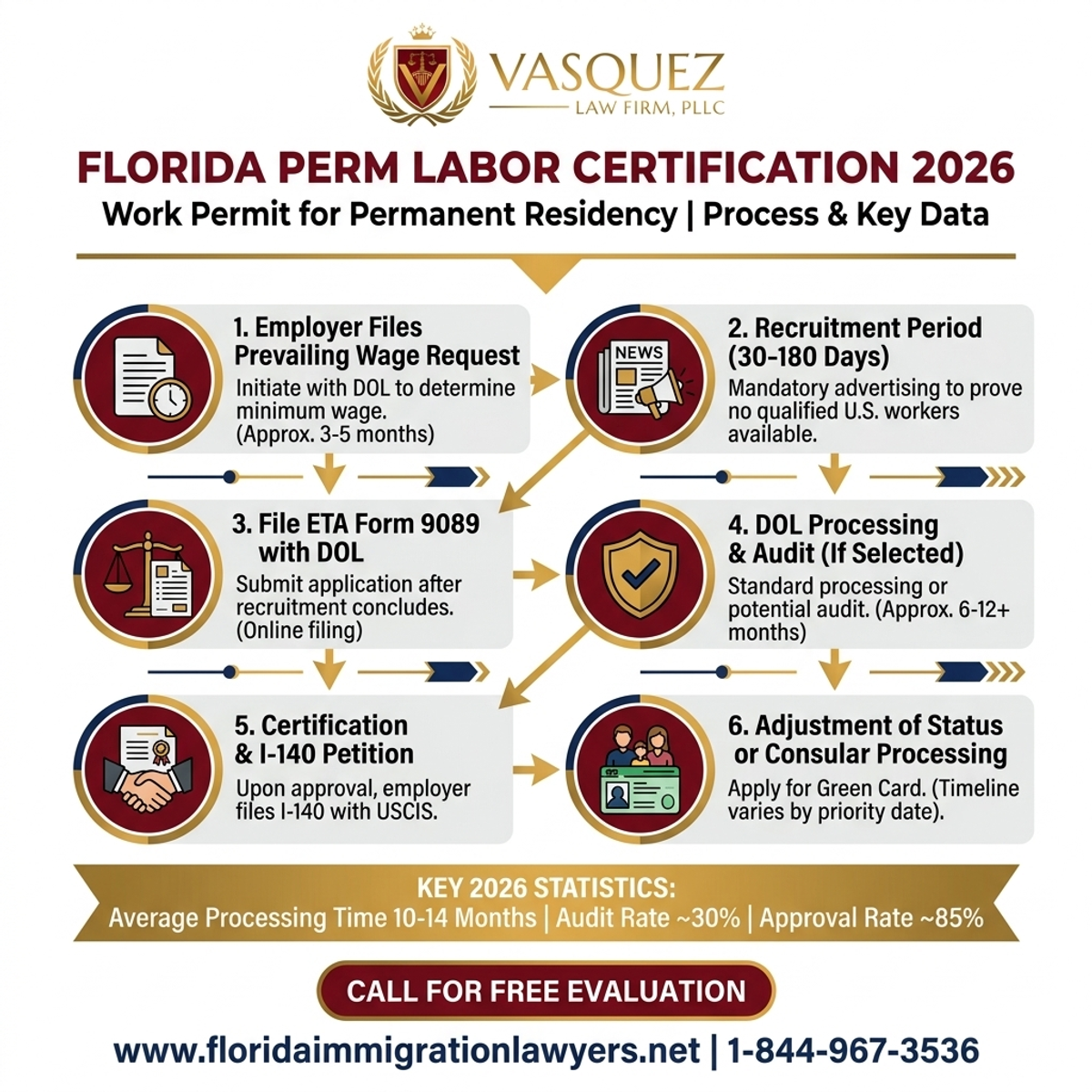
Key Statistics — Work Permit for Permanent Residency: PERM Labor Certification in Florida 2026
It is important to note that PERM regulations generally require the employer to pay all costs associated with the recruitment process and the attorney fees for the PERM application itself. The foreign national may be responsible for fees related to the subsequent I-140 petition and adjustment of status/consular processing, though employers often choose to cover these as well. Transparent communication about these costs with your legal counsel at Florida Immigration Lawyers is essential from the outset. We can provide a clear breakdown of potential expenses and help you manage the financial aspects of your labor certification journey.
Navigating PERM Challenges and Employer Responsibilities in Florida
The PERM labor certification process, while a vital pathway to a permanent work permit, presents numerous challenges for employers in Florida. From understanding complex DOL regulations to managing extensive documentation, employers bear significant responsibility. A primary challenge involves accurately defining the job requirements without being unduly restrictive, yet specific enough to attract qualified candidates. This delicate balance is critical; overly specific requirements might be deemed tailored to the foreign worker, while overly broad ones could attract many U.S. applicants, halting the process. Additionally, the fast-paced nature of Florida's diverse industries, such as tourism, agriculture, and specialized tech sectors in areas like West Palm Beach, means that labor market conditions can shift, impacting recruitment outcomes.
Employers must meticulously track and document all recruitment efforts and applicant responses. The burden of proof lies entirely with the employer to demonstrate that no qualified U.S. workers were available for the position. Any failure to adhere to the prescribed recruitment methods, such as incorrect advertisement placement or insufficient duration, can lead to an audit or denial. Furthermore, employers must commit to paying the foreign worker the prevailing wage, as determined by the DOL, from the date the green card is approved. This financial commitment is continuous and must be maintained throughout the employment. Misinterpretations of regulations, particularly regarding the prevailing wage or recruitment methodologies, are common pitfalls. Working with experienced immigration attorneys at Florida Immigration Lawyers can help employers navigate these complexities, ensuring compliance and increasing the likelihood of a successful PERM certification. Our team understands the unique economic landscape of Florida and can tailor strategies to meet specific industry needs.
From PERM Approval to Green Card: The Next Steps for Your Permanent Work Permit
Receiving a certified PERM Labor Certification is a major milestone, but it is not the end of the journey toward an employer-sponsored green card and a permanent work permit in Florida. The certified ETA Form 9089 is merely the first stage. Once approved by the U.S. Department of Labor (DOL), the process transitions to U.S. Citizenship and Immigration Services (USCIS) and, for some, the U.S. Department of State. Understanding these subsequent steps is crucial for both the employer and the foreign national, as they involve further petitions, fees, and processing times. The overall goal is to secure permanent residency, allowing the foreign national to live and work indefinitely in the U.S.
After PERM certification, the employer must file Form I-140, Immigrant Petition for Alien Worker, with USCIS. This petition formally requests that USCIS classify the foreign national as an immigrant worker based on the certified PERM application. The I-140 requires documentation of the employer's ability to pay the offered wage and the foreign national's qualifications for the position. USCIS processing times for I-140 petitions can vary, and premium processing is often available for an additional fee, potentially accelerating the decision to a few weeks. Once the I-140 is approved, the foreign national's priority date (the date the PERM was filed) becomes critical. Due to annual visa limits under INA Section 203(b), there may be a waiting period for a visa number to become available, especially for individuals from high-demand countries. This waiting period is tracked through the monthly Visa Bulletin published by the U.S. Department of State travel.state.gov.
Once a visa number is available, the final step is either Adjustment of Status (Form I-485) if the foreign national is already in the U.S. and eligible, or Consular Processing through a U.S. embassy or consulate abroad. Adjustment of Status allows the individual to apply for their green card without leaving the U.S., often concurrently with the I-140 if their priority date is current. Consular processing involves an interview at a U.S. embassy or consulate in the foreign national's home country. Both processes require extensive documentation, medical examinations, and background checks. An approved I-485 or successful consular interview results in the issuance of the green card, granting permanent residency and the ability to work without restriction in the U.S. The journey from initial PERM filing to holding a green card can take several years, emphasizing the need for persistent legal guidance. Florida Immigration Lawyers can assist clients throughout these complex stages, ensuring a smooth transition to permanent residency.
Common Mistakes to Avoid in the PERM Labor Certification Process
The PERM Labor Certification process is fraught with potential pitfalls that can lead to significant delays, audits, or even outright denial of an employer-sponsored green card. Avoiding these common mistakes is crucial for a successful outcome, particularly for employers and foreign nationals navigating the complexities in Florida. A single error can undermine months of effort and substantial investment, highlighting the importance of meticulous attention to detail and expert legal guidance. Understanding these common errors can help you proactively safeguard your application.
- Inaccurate Job Requirements: Defining job duties or minimum requirements that are overly restrictive or not genuinely necessary for the position. This can be seen as tailoring the job for the foreign worker, violating DOL rules. The requirements must be standard for the occupation and industry.
- Insufficient Recruitment Efforts: Failing to conduct all mandatory recruitment steps (e.g., missing a newspaper ad, not posting for the full 30 days with the SWA) or not documenting them thoroughly. Any deviation from the prescribed recruitment process can trigger an audit or denial.
- Failure to Pay Prevailing Wage: Not offering or committing to pay the foreign worker at least the prevailing wage determined by the DOL. This is a fundamental requirement to protect U.S. workers' wages and is closely scrutinized.
- Inadequate Documentation and Record-Keeping: Not retaining all recruitment evidence, resumes, interview notes, and other supporting documents for the required five-year period. If audited, the employer must produce these records promptly.
- Poor Recruitment Report: Preparing a recruitment report that lacks specificity or fails to provide lawful, job-related reasons for rejecting U.S. applicants. Vague explanations are often insufficient and can lead to an audit.
- Filing ETA Form 9089 Too Early or Too Late: Filing the PERM application outside the permissible window (after the recruitment period but before the quiet period ends, or after the PWD expires). Strict timelines must be observed.
- Employer/Employee Relationship Issues: If the foreign national has ownership interest in the sponsoring company, or if the employer is essentially owned or controlled by the foreign national, this can raise concerns about the legitimacy of the job offer and lead to denial.
- Mismatched Information: Inconsistencies between the job description on the ETA Form 9089 and the recruitment advertisements, or between the foreign worker's qualifications and the stated job requirements. All information must align perfectly.
- Not Responding to Audits Promptly: Failing to respond to a DOL audit request within the specified timeframe can result in an automatic denial. Audit responses require comprehensive and organized documentation.
When to Call a Florida Immigration Lawyer for PERM Labor Certification
The PERM Labor Certification process is one of the most technical and detail-oriented aspects of U.S. immigration law, making expert legal counsel indispensable. You should contact Florida Immigration Lawyers at the very beginning of considering an employer-sponsored green card. Our attorneys can assess the viability of a PERM application, help define appropriate job requirements, and guide you through the complex prevailing wage determination process. We serve clients across Florida, including West Palm Beach, Miami, Orlando, and Tampa, understanding the local labor market dynamics that can influence recruitment.
Specific scenarios where immediate legal intervention is crucial include: if you receive an audit notification from the Department of Labor; if you are unsure about the appropriate recruitment steps for your specific industry or location in Florida; if you encounter difficulties in documenting recruitment efforts or explaining why U.S. applicants were not qualified; or if you are an employer with no prior experience with PERM filings. Attempting to navigate PERM without experienced legal representation significantly increases the risk of errors, delays, and denials. Our team provides comprehensive support, from drafting job descriptions and reviewing recruitment ads to preparing the ETA Form 9089 and responding to audits, ensuring every step complies with federal regulations and legal citations like 8 U.S.C. § 1153.
About Florida Immigration Lawyers
Florida Immigration Lawyers is a leading immigration law firm dedicated to serving individuals and businesses across the entire state of Florida. Our team of highly experienced attorneys specializes in a broad range of immigration matters, including PERM Labor Certification, employer-sponsored green cards, family immigration, asylum, deportation defense, and naturalization. We understand that immigration law can be complex and intimidating, and we are committed to providing compassionate, effective, and personalized legal representation to each client. Our firm prides itself on its deep knowledge of both federal immigration law and the specific needs of Florida's diverse communities.
We are available 24/7 to address your urgent immigration concerns and offer free consultations to help you understand your options. Our goal is to simplify the legal process, protect your rights, and guide you towards a successful outcome. With offices strategically located and serving clients from West Palm Beach to Jacksonville, we are equipped to handle cases throughout Florida. Choose Florida Immigration Lawyers for dedicated advocacy, clear communication, and a proven track record of success in helping clients achieve their American dream. Call us today at 1-844-967-3536 or visit our website at www.floridaimmigrationlawyers.net to learn more about how we can assist you with your immigration needs, including navigating the intricate PERM process.
Sources and References
- U.S. Citizenship and Immigration Services (USCIS) - Employment-Based Immigration
- U.S. Department of Labor (DOL) - Office of Foreign Labor Certification
- U.S. Department of State - Visa Bulletin
- 8 U.S.C. Chapter 12 - Immigration and Nationality Act (INA) Section 203(b)
- 20 CFR Part 656 - Labor Certification Process for the Permanent Employment of Aliens in the United States
Related services: H-1B specialty occupation visas, L-1 intracompany transfer visas, work visas for professionals, investment and entrepreneur visas.
This article provides general legal information and is not intended as legal advice. Every case is unique, and outcomes depend on specific facts and circumstances. Contact an attorney for advice about your particular situation. Immigration laws are subject to change, and specific fee amounts are not guaranteed.
Secure Your Permanent Work Permit with Expert Legal Help
Do not let the complexities of the PERM Labor Certification process stand between you and your dream of a permanent work permit and green card in Florida. The stakes are too high to proceed without experienced legal representation. Florida Immigration Lawyers is here to provide the dedicated and knowledgeable support you need. Our team is ready to guide you through every step, ensuring compliance and maximizing your chances of success. Se Habla Espanol - Estamos aqui para ayudarle. Contact us today for your free consultation. Call 1-844-967-3536 now and take the first step towards your future in the U.S.
If you need legal assistance, learn more about speak with a business immigration lawyer, or call us at 1-844-967-3536 for a free consultation.
Do Not Navigate This Process Alone
Our experienced immigration attorneys are ready to fight for you. Get a free, confidential consultation today.
Se Habla Español
Or leave your details and we’ll call you:
Free Evaluation in 24 Hours
Or talk to us right now

AI voice assistant — available 24/7
FreeFrequently Asked Questions

William J. Vásquez
Founding Attorney · Vasquez Law Firm
U.S. Air Force veteran and immigration attorney with years of hands-on U.S. immigration experience. J.D., NCCU School of Law. AILA member. Admitted to the 4th, 5th, and 11th Circuit Courts.
Available 24/7 - Free Evaluations
Reviewed for legal accuracy by William J. Vásquez
Licensed in North Carolina; U.S. immigration is federal practice.
Related Legal Services
Our Florida immigration attorneys can help you with citizenship and naturalization, family immigration services and immigration practice areas. Call today at 1-844-967-3536 for a free consultation.
Related Links
Related Topics
Free Legal Consultation
Discuss your case with our experienced attorneys. We're available 24/7.
Se Habla Español - Estamos aquí para ayudarle.
Related Articles
Immigration Lawyer Orlando Free Consultation 2026
Discover how to find an immigration lawyer in Orlando offering a free consultation. Understand the services available and why choosing Florida Immigration Lawyers can make a difference in your case.
Military Naturalization Expedited in Florida Bases
Explore military naturalization options for families at Florida bases, including parole in place benefits in Miami. Learn how to expedite your application with expert guidance from Florida Immigration Lawyers.
Immigration Lawyer Orlando Free Consultation in 2026
Discover how to find an immigration lawyer in Orlando offering a free consultation in 2026. This guide from Florida Immigration Lawyers covers essential services, the Green Card application process, typical timelines, and cost factors in Central Florida. Learn about critical documents, common mistakes to avoid, and when expert legal counsel is indispensable for your immigration case. We serve clients across Florida, including Lakeland, Polk County, and Coral Springs, providing compassionate and effective representation for family visas, deportation defense, and naturalization. Get started with a free consultation today.
Farmers and H-2A Visa: Navigating Agricultural Labor in
Florida's agricultural sector, a cornerstone of its economy, faces persistent challenges in securing a stable seasonal workforce. The H-2A visa program provides a crucial pathway for Florida growers to bring in temporary foreign agricultural workers when domestic labor is unavailable. This comprehensive guide for 2026 details the multi-agency application process involving the Department of Labor (DOL) and U.S. Citizenship and Immigration Services (USCIS), outlining the step-by-step requirements, necessary documentation, and associated timelines and costs. We delve into employer obligations such as fair wages, compliant housing, and transportation, highlighting the benefits of a reliable workforce while addressing the administrative burdens and potential pitfalls. Florida Immigration Lawyers offers expert guidance to ensure compliance and navigate the complexities of securing your H-2A farm labor.