Farmers and H-2A Visa: Navigating Agricultural Labor
Florida's agricultural sector, a cornerstone of its economy, faces persistent challenges in securing a stable seasonal workforce. The H-2A visa program provides a crucial pathway for Florida growers to bring in temporary foreign agricultural workers when domestic labor is unavailable. This comprehensive guide for 2026 details the multi-agency application process involving the Department of Labor (DOL) and U.S. Citizenship and Immigration Services (USCIS), outlining the step-by-step requirements, necessary documentation, and associated timelines and costs. We delve into employer obligations such as fair wages, compliant housing, and transportation, highlighting the benefits of a reliable workforce while addressing the administrative burdens and potential pitfalls. Florida Immigration Lawyers offers expert guidance to ensure compliance and navigate the complexities of securing your H-2A farm labor.
Quick Answer: H-2A Visa for Florida Growers
The H-2A visa program allows Florida agricultural employers to bring foreign nationals to the U.S. for temporary or seasonal agricultural work when there are not enough U.S. workers available. As of 2026, the process involves a multi-agency application including the Department of Labor (DOL) for a temporary labor certification, and USCIS for visa petitions. This program is vital for Florida's diverse agricultural sector, from citrus groves to vegetable farms, ensuring a stable workforce. Employers must meet strict requirements regarding wages, housing, and transportation to protect both U.S. and H-2A workers.
- H-2A visas address seasonal agricultural labor shortages in Florida.
- The process requires approval from both the DOL and USCIS.
- Employers must provide adequate wages, housing, and transportation.
- Compliance with regulations is crucial to avoid penalties and delays.
- Florida Immigration Lawyers can guide growers through the complex application process.
Florida's agricultural industry is a cornerstone of its economy, producing everything from citrus and tomatoes to sugar cane and ornamental plants. This vibrant sector relies heavily on a robust and reliable workforce, especially during peak harvest seasons. However, finding sufficient domestic labor for these temporary and seasonal jobs often presents a significant challenge for Florida growers. This is where the H-2A visa program becomes an indispensable tool, allowing agricultural employers to legally bring foreign nationals to the United States to fill these critical roles. Navigating the complexities of this program, particularly in 2026 with evolving regulations and heightened scrutiny, requires precise attention to detail and a thorough understanding of federal requirements.
For Florida farm labor, the H-2A visa offers a structured pathway to meet seasonal demands, but it comes with stringent obligations for employers. These include demonstrating a genuine need for foreign workers, offering fair wages, providing suitable housing, and covering transportation costs. The application process itself is multi-layered, involving coordination with the Department of Labor (DOL), U.S. Citizenship and Immigration Services (USCIS), and potentially the Department of State. A single misstep can lead to costly delays, denials, or even legal repercussions, jeopardizing an entire harvest season for a Florida agricultural worker employer.
This comprehensive guide will walk Florida growers through the intricacies of the H-2A visa program in 2026, from initial requirements to common pitfalls and best practices. We will delve into the step-by-step application process, outline necessary documentation, discuss timelines and costs, and highlight when legal counsel is essential. Our goal is to equip you with the knowledge needed to successfully secure the workforce your farm needs, ensuring compliance and operational continuity. Do not navigate this complex process alone. Call Florida Immigration Lawyers at 1-844-YO-PELEO for a free consultation and expert guidance tailored to your specific needs.
What is the H-2A Visa Program for Agricultural Workers in Florida?
The H-2A visa program is a nonimmigrant visa category specifically designed for agricultural employers in the U.S. to bring foreign nationals to perform temporary or seasonal agricultural labor. This program is available to employers who can demonstrate that there are not enough U.S. workers who are able, willing, qualified, and available to perform the temporary agricultural work, and that employing H-2A workers will not adversely affect the wages and working conditions of similarly employed U.S. workers. In Florida, where agriculture is a multi-billion dollar industry, the H-2A visa is a lifeline for many growers, ensuring that crops are planted, cultivated, and harvested efficiently.
As of 2026, the H-2A program operates under strict federal regulations outlined in the Immigration and Nationality Act (INA) at 8 U.S.C. §1101(a)(15)(H)(ii)(a) and further detailed in Department of Labor (DOL) regulations at 20 CFR Part 655 Subpart B. These regulations cover everything from recruitment efforts for U.S. workers to the specific terms and conditions of employment for H-2A workers. For Florida farmers, understanding these legal frameworks is paramount. The H-2A visa addresses a critical labor gap, allowing Florida's farms, from the tomato fields of Immokalee to the plant nurseries near Miami, to maintain productivity and contribute to the national food supply chain without disruption. Without this program, many Florida growers would face severe labor shortages, leading to significant economic losses and potential impacts on consumer prices.
The temporary or seasonal nature of the work is a key characteristic of the H-2A program. This means the employer's need for the services or labor must be for a period of no more than one year, and it must be either a one-time occurrence, a seasonal need, a peak load need, or an intermittent need. For example, a Florida citrus grower might need H-2A workers for a few months during the winter harvest, or a vegetable farm might need them for planting and harvesting specific crops in spring and fall. The program mandates that employers offer H-2A workers the same wages and working conditions as those offered to U.S. workers, and often requires adherence to the Adverse Effect Wage Rate (AEWR) set by the DOL, which is typically higher than the state's minimum wage. This commitment to fair labor practices is central to the program's integrity and is heavily enforced.
How Can Florida Growers Apply for an H-2A Visa in 2026? A Step-by-Step Guide
Applying for an H-2A visa in 2026 involves a multi-stage process that requires careful planning and adherence to strict deadlines. Florida growers must navigate several federal agencies, starting with the Department of Labor (DOL) and then moving to U.S. Citizenship and Immigration Services (USCIS). Missing a deadline or failing to provide complete information can lead to significant delays or even denial, impacting your ability to secure the necessary agricultural workforce for your Florida farm. It is advisable to begin preparations well in advance of the anticipated start date for workers, typically 60-75 days prior.
Here is a detailed step-by-step guide for Florida agricultural employers:
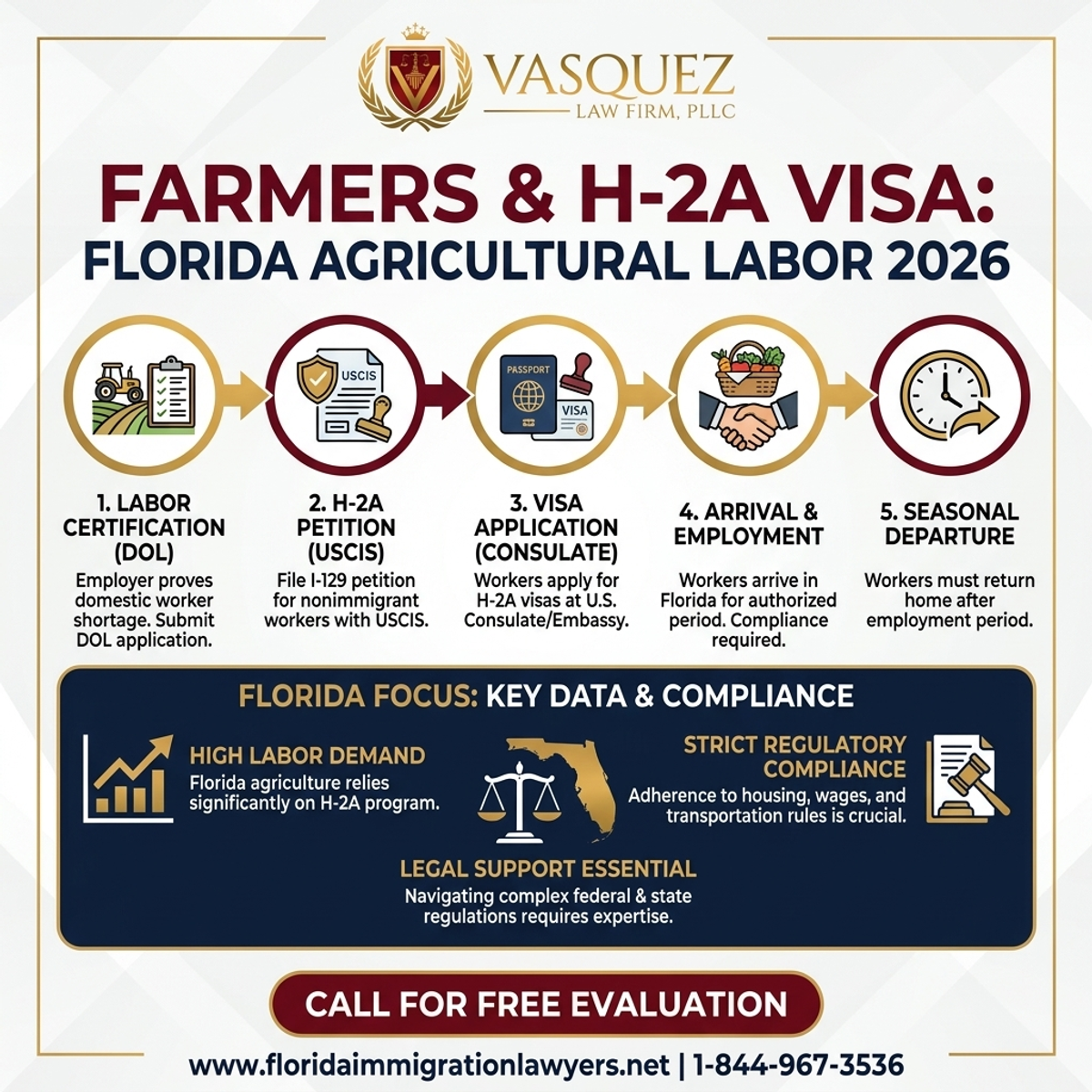
Step-by-Step Process — Farmers and H-2A Visa: Navigating Agricultural Labor in Florida 2026
- Step 1: Obtain a Temporary Labor Certification (TLC) from DOL. This is the most crucial initial step. Approximately 60 to 75 calendar days before the workers are needed, the employer must submit Form ETA-9142A, Application for Temporary Employment Certification, to the Department of Labor. This application includes details about the job offer, wages, working conditions, and housing. Before filing, the employer must conduct a good faith effort to recruit U.S. workers by placing job orders with the State Workforce Agency (SWA) in Florida and engaging in other recruitment activities. The DOL reviews the application to ensure the employer's need is temporary, that U.S. workers are unavailable, and that H-2A employment will not adversely affect U.S. workers.
- Step 2: File Form I-129, Petition for a Nonimmigrant Worker, with USCIS. Once the DOL certifies the temporary labor application, the Florida grower must file Form I-129 with USCIS. This petition requests approval for the H-2A workers. It must be filed with the approved ETA-9142A and other supporting documentation, such as proof of the employer's need for temporary workers and the beneficiaries' qualifications. USCIS will review the petition to ensure all immigration eligibility criteria are met.
- Step 3: H-2A Workers Apply for Visas at a U.S. Embassy or Consulate. After USCIS approves the Form I-129 petition, it sends the approval notice to the National Visa Center (NVC). The NVC then forwards the case to the appropriate U.S. Embassy or Consulate abroad where the prospective H-2A workers will apply for their visas. Workers must attend an interview, submit required documents (e.g., passport, DS-160 confirmation), and undergo security checks. The U.S. Department of State oversees this part of the process, ensuring that the workers meet all eligibility and admissibility criteria for entry into the U.S. in their home country.
- Step 4: Entry into the United States. Upon receiving their H-2A visas, workers can travel to the U.S. They will be inspected at the port of entry by U.S. Customs and Border Protection (CBP) officers. CBP officers will verify their identity and visa validity and determine their admissibility. Once admitted, H-2A workers are authorized to work only for the petitioning employer in the specific agricultural job outlined in the visa petition.
- Step 5: Employer Responsibilities During Employment. Throughout the employment period, Florida growers must comply with all H-2A program regulations. This includes paying the required wage, providing safe and sanitary housing, offering transportation from the housing to the worksite, and reimbursing workers for inbound transportation costs. Employers must also maintain accurate records of hours worked, wages paid, and other employment terms. Compliance is regularly monitored by the DOL and other agencies, and failure to meet these obligations can result in severe penalties, including debarment from the program.
What Documents and Information Do Florida Growers Need for H-2A Visas?
A successful H-2A visa application hinges on meticulous documentation and accurate information. Florida growers preparing to apply in 2026 must gather a comprehensive set of documents for both the DOL temporary labor certification stage and the USCIS petition stage. Any missing or incorrect information can cause significant delays, requiring resubmission or potentially leading to a denial. Organizing these documents early in the process is crucial for a smooth application.
Here is a checklist of essential documents and information:
- Employer Information: Legal business name, address, EIN, contact person details, and proof of agricultural business operations in Florida (e.g., farm deeds, leases, agricultural licenses).
- Job Offer Details: Detailed description of the job duties, required qualifications, specific crop(s) involved, start and end dates of employment, number of workers needed, and the specific worksite locations (e.g., fields in Homestead, groves in Vero Beach).
- Wage Information: The proposed wage rate, which must be at least the highest of the Adverse Effect Wage Rate (AEWR) for Florida, the federal minimum wage, the state minimum wage, or the prevailing wage rate.
- Housing Details: Documentation proving that free, safe, and sanitary housing is available and compliant with DOL and state health and safety standards. This includes housing inspection reports and details on occupancy limits. For example, housing for agricultural workers in rural Miami-Dade County must meet specific local and federal codes.
- Transportation Plans: A detailed plan for daily transportation from housing to the worksite, and arrangements for inbound and outbound transportation costs (e.g., airfare, bus tickets) for workers.
- Recruitment Efforts: Evidence of good faith efforts to recruit U.S. workers, including copies of job orders placed with the Florida State Workforce Agency (SWA), newspaper advertisements, and any other recruitment activities undertaken.
- Proof of Temporary Need: Documentation demonstrating the seasonal or temporary nature of the agricultural work, such as historical planting and harvest schedules, crop cycles, or other business records justifying the need for a temporary workforce.
- Employer Declarations: Signed attestations confirming compliance with all H-2A program requirements, including worker protections, non-discrimination policies, and commitment to providing workers' compensation insurance.
- Beneficiary Information (for USCIS): For each prospective H-2A worker, you will need their full legal name, date of birth, country of birth, country of citizenship, passport number, and other biographical data.
- Previous H-2A Petitions: If applicable, copies of previously approved H-2A petitions and temporary labor certifications.
What are the H-2A Visa Processing Timelines and Cost Factors in 2026?
Understanding the timelines and associated costs for the H-2A visa program is critical for Florida growers to plan their agricultural operations effectively for 2026. The process involves multiple government agencies, each with its own processing times and fees, which can fluctuate. Delays can be costly, potentially impacting planting or harvesting schedules, so budgeting both time and finances is essential. While specific fee amounts can change, the structure of costs and typical processing durations remain relatively consistent.
As of 2026, here are the typical timeframes and cost factors:
Typical H-2A Visa Processing Timeline (2026)
| Stage | Typical Timeframe | Notes |
|---|---|---|
| Temporary Labor Certification (DOL) | 60-75 days prior to need date | Includes filing Form ETA-9142A, recruitment period, and DOL review. Early submission is critical. |
| Form I-129 Petition (USCIS) | 2-5 months (standard) | Processing times vary by service center (e.g., Nebraska Service Center). Premium Processing (15 days) is available for an additional fee. |
| Visa Interview (Consulate) | 1-4 weeks after I-129 approval | Depends on embassy workload and worker's country. Scheduling can take time. |
| Total End-to-End Process | 5-8 months | From initial DOL filing to worker's arrival. Plan well in advance for peak seasons in Florida. |
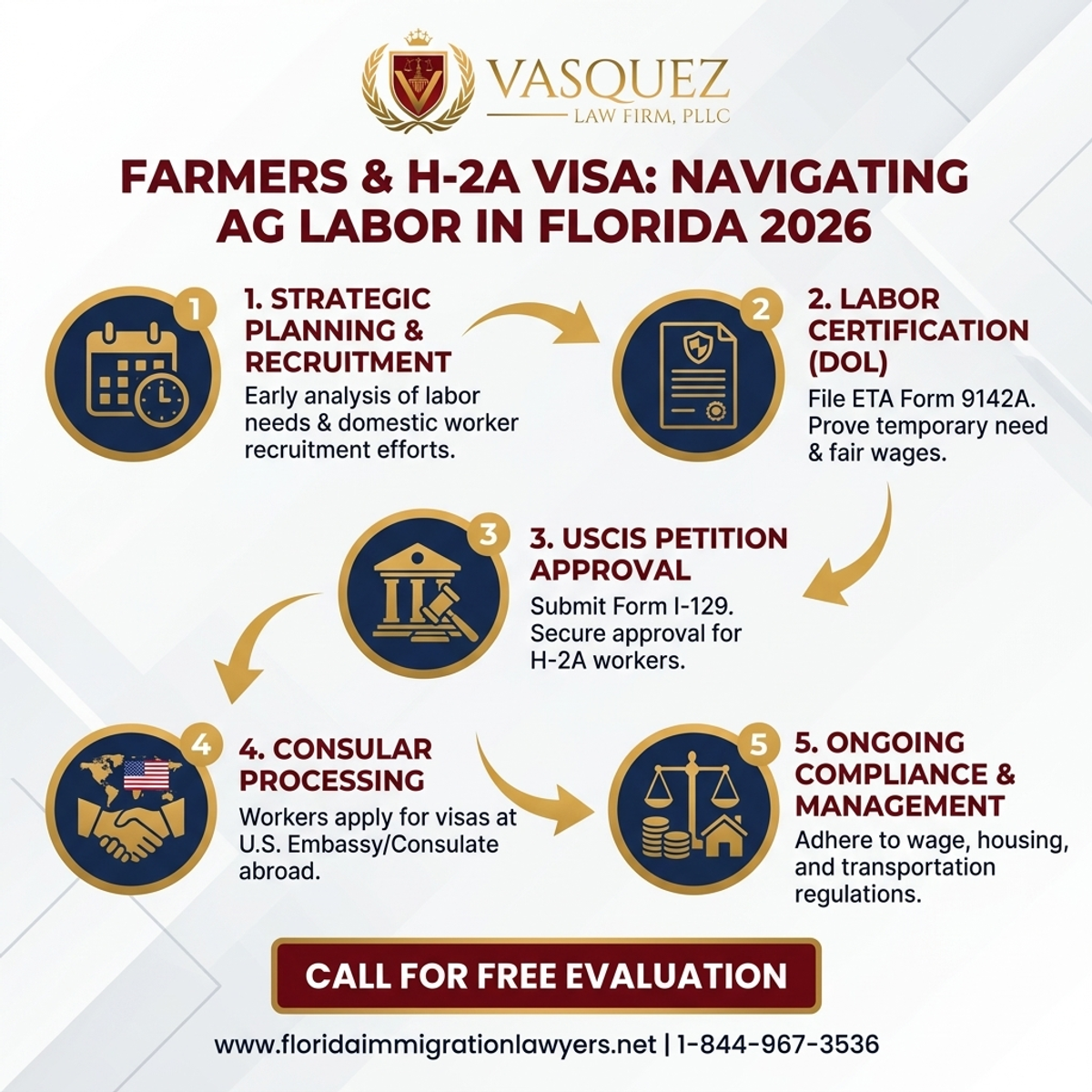
Key Statistics — Farmers and H-2A Visa: Navigating Agricultural Labor in Florida 2026
H-2A Visa Cost Factors and Fee Breakdown (2026)
| Item | Typical Fee (Approximate) | Notes |
|---|---|---|
| DOL Filing Fee (ETA-9142A) | No direct fee to DOL | Costs are indirect, related to recruitment (advertisements, SWA fees). |
| USCIS Form I-129 Filing Fee | Varies by petition type and number of workers. | Always check the latest USCIS fee schedule. Generally, one fee covers multiple workers on a single petition. |
| USCIS Premium Processing (Form I-907) | Significant additional fee per petition. | Optional, but guarantees 15-day processing for I-129. Essential for urgent needs. |
| Visa Application Fee (DS-160) | Per worker, paid to Department of State. | Typically paid by the worker, but often reimbursed by employer as part of travel costs. |
| Transportation Costs | Varies widely (airfare, ground travel). | Employer must pay for inbound transportation from worker's home country to Florida and return transportation upon completion of contract. |
| Housing Costs | Significant variable cost. | Employer must provide free, compliant housing. This includes maintenance, utilities, and potentially initial setup. |
| Attorney Fees | Varies by firm and complexity. | Highly recommended for navigating the complex process and ensuring compliance. |
| Recruitment Costs | Varies (advertisements, job fairs). | Costs associated with recruiting U.S. workers as part of the DOL certification process. |
It is important for Florida growers to remember that these are approximate costs and can change. Always consult the official websites of USCIS and the Department of State for the most current fee information. The investment in the H-2A program, while substantial, is often necessary to secure the reliable workforce that Florida's agricultural sector demands.
Understanding Employer Obligations for H-2A Workers in Florida
Participating in the H-2A visa program comes with significant responsibilities for Florida agricultural employers. These obligations are designed to protect both H-2A workers and the domestic labor market, ensuring fair treatment and preventing exploitation. Failure to comply with these requirements can lead to severe penalties, including fines, debarment from the program for multiple years, and even criminal charges in some cases. For Florida growers, a clear understanding of these duties is not just good practice, but a legal imperative.
One of the primary obligations is the provision of adequate wages. Employers must pay H-2A workers no less than the Adverse Effect Wage Rate (AEWR) for Florida, the federal minimum wage, the state minimum wage, or the prevailing wage rate, whichever is highest. As of 2026, the AEWR is updated annually by the Department of Labor and is typically higher than standard minimum wages, reflecting the need to prevent adverse effects on U.S. workers' wages. Employers must also guarantee at least three-fourths of the work hours specified in the contract and pay for all hours worked. This commitment ensures financial stability for the temporary worker.
Another critical obligation is the provision of free, safe, and sanitary housing. This housing must be available to all H-2A workers who are not reasonably able to return to their permanent residence daily. For example, a farm near Homestead, Florida, bringing in workers from outside the immediate area must provide housing that meets specific federal and state housing standards, including requirements for space, sanitation, and utilities. The employer is responsible for all costs associated with this housing, including utilities. Additionally, employers must provide transportation from the housing to the worksite each day, free of charge. Upon completion of the contract, the employer is also typically responsible for the workers' return transportation costs to their home country, ensuring they are not stranded in Florida.
Beyond these core requirements, Florida growers must also: provide workers' compensation insurance, ensure access to necessary tools and equipment without charge, and maintain accurate payroll records. They must also comply with all applicable federal, state, and local labor laws, including those related to worker safety and health. The DOL conducts regular audits and investigations to ensure compliance, and workers have avenues to report violations. For a large farm in Central Florida relying on dozens of H-2A workers, maintaining meticulous records and adhering to every detail of the program is a full-time commitment, often necessitating legal counsel to ensure continuous compliance and mitigate risks.
What are the Benefits and Challenges of the H-2A Visa for Florida Agriculture?
The H-2A visa program presents both significant benefits and considerable challenges for Florida's agricultural sector. For many growers, it is an essential tool for maintaining operations, especially given the fluctuating availability of domestic farm labor. However, the program's stringent requirements and administrative burden can also pose substantial hurdles. Understanding this balance is key for any Florida agricultural business considering the H-2A program in 2026.
One of the primary benefits is access to a reliable and authorized workforce. In industries like citrus harvesting, vegetable picking, or nursery cultivation, where labor demands are seasonal and intense, the H-2A program ensures that Florida growers have the necessary hands to plant, cultivate, and harvest their crops on time. This stability allows farms to plan their seasons more effectively, reduce crop loss due to labor shortages, and maintain their competitive edge in the market. For instance, a large tomato farm in Southwest Florida can secure a predictable number of workers for a critical harvest period, which is invaluable for operational efficiency and profitability. Furthermore, using the H-2A program helps combat unauthorized employment, contributing to a more regulated and transparent labor market.
However, the challenges associated with the H-2A program are equally substantial. The administrative burden is often cited as a major hurdle. The multi-agency application process, extensive documentation requirements, and strict deadlines demand significant time and resources from employers. The costs involved, including filing fees, recruitment expenses, providing housing, transportation, and higher wage rates (AEWR), can be considerable, particularly for smaller farms. For a small family farm in North Florida, these upfront investments might be prohibitive. The risk of audits and penalties for non-compliance adds another layer of complexity, requiring constant vigilance and meticulous record-keeping. Moreover, the program's cap (though generally not reached for H-2A as it's demand-driven, delays can still occur) and potential for changes in immigration policy add an element of uncertainty. Recent news, such as debates around immigration policies and the stability of worker statuses like TPS, highlight the volatile environment in which these programs operate. Despite these challenges, for many Florida growers, the benefits of securing a dependable workforce often outweigh the complexities, making the H-2A visa an indispensable part of their labor strategy.
Do not navigate this process alone. Contact Florida Immigration Lawyers today at 1-844-YO-PELEO for a free consultation. Our experienced team can help you understand your options and ensure compliance every step of the way.
Common Mistakes Florida Growers Make with H-2A Visas
The H-2A visa program is fraught with complexities, and even experienced Florida growers can make mistakes that lead to delays, denials, or severe penalties. Avoiding these common pitfalls is crucial for a successful application and compliant employment of agricultural workers. Understanding these errors can save your farm significant time, money, and legal trouble.
- Failing to Plan Ahead: Many employers underestimate the lengthy processing times. Starting the application less than 75 days before the needed start date almost guarantees delays, potentially missing critical planting or harvest windows.
- Inadequate U.S. Worker Recruitment: Employers must demonstrate a good faith effort to recruit U.S. workers. Insufficient advertising, failure to list with the State Workforce Agency (SWA), or not documenting recruitment efforts can lead to DOL certification denial.
- Incorrect Wage Rate Calculation: Not paying the highest of the Adverse Effect Wage Rate (AEWR), federal minimum wage, state minimum wage, or prevailing wage is a common and serious violation. This can result in back pay demands and fines.
- Substandard Housing or Transportation: Providing housing that does not meet DOL and state health and safety standards, or failing to provide free daily transportation to the worksite, are major compliance issues that can lead to debarment from the program.
- Poor Record-Keeping: Inaccurate or incomplete records of wages paid, hours worked, housing expenses, and recruitment efforts can be detrimental during an audit. Meticulous documentation is non-negotiable for Florida farm labor.
- Modifying Job Duties or Locations Without Approval: Deviating from the job duties or worksite locations specified in the temporary labor certification and I-129 petition without seeking proper amendments from DOL and USCIS can result in violations and penalties.
- Not Providing Workers' Compensation: Failing to secure and maintain workers' compensation insurance for H-2A workers is a serious legal and ethical lapse, exposing the employer to significant liability.
- Ignoring Post-Certification Obligations: Assuming the process ends with certification. Employers must continue to recruit U.S. workers and adhere to all terms of the job offer throughout the contract period, including offering employment to qualified U.S. applicants.
- Lack of Legal Counsel: Attempting to navigate the entire H-2A process without experienced immigration counsel can lead to costly errors due to the program's complexity and constantly evolving regulations.
When Should Florida Growers Call an Immigration Lawyer?
The H-2A visa program is one of the most complex areas of U.S. immigration law, especially for Florida agricultural employers dealing with specific state regulations and agricultural cycles. While some large corporations may have in-house legal teams, most Florida growers will significantly benefit from the expertise of an immigration lawyer specializing in H-2A visas. Engaging legal counsel can prevent costly errors, ensure compliance, and streamline the entire process, providing peace of mind amidst the demands of running a farm.
You should call Florida Immigration Lawyers immediately if you are a Florida grower considering the H-2A program for the first time. The initial application is critical, and professional guidance can help you establish a compliant and efficient process from the outset. Our attorneys can assist with determining your eligibility, preparing the temporary labor certification application (ETA-9142A), and advising on recruitment strategies for U.S. workers to meet DOL requirements. We ensure that your job offer meets all federal and state wage, housing, and transportation standards, minimizing the risk of issues down the line.
Furthermore, if you have previously applied for H-2A visas and faced denials, requests for evidence (RFEs) from USCIS, or audits from the Department of Labor, it is imperative to seek legal assistance. These situations indicate potential compliance issues or procedural missteps that an experienced lawyer can identify and rectify. For example, if your farm in Miami-Dade County received an RFE regarding housing conditions, an attorney can help gather the necessary documentation and respond effectively. Any allegation of H-2A program violations, such as wage disputes, housing complaints, or debarment proceedings, warrants immediate legal intervention to protect your business and reputation. Even for routine renewals, having an attorney review your applications ensures continued compliance with the latest regulations and policies, including those from the Executive Office for Immigration Review (EOIR) if any appeals become necessary.
About Florida Immigration Lawyers
Florida Immigration Lawyers is a leading immigration law firm dedicated to serving individuals and businesses across the entire state of Florida. With a deep understanding of both federal immigration law and the unique needs of Florida's diverse communities, our team provides comprehensive legal services for a wide range of immigration matters. From assisting Florida growers with complex H-2A visa applications to helping families achieve permanent residency or defending individuals against deportation, we are committed to delivering compassionate, effective, and results-driven representation.
Our experienced attorneys specialize in various practice areas, including general immigration law, family-based immigration, business immigration, asylum claims, and deportation defense. We pride ourselves on our client-focused approach, ensuring that every client receives personalized attention and strategic advice tailored to their unique circumstances. Our firm understands the critical role that a stable workforce plays in Florida's agricultural economy, and we are adept at navigating the specific challenges faced by Florida farm labor employers seeking H-2A visas.
At Florida Immigration Lawyers, we believe that everyone deserves access to high-quality legal representation. We offer free consultations to discuss your case and provide clear, honest assessments of your options. Our team is available 24/7 to address urgent concerns, and we proudly offer bilingual services (Se Habla Español) to ensure effective communication with our diverse clientele. Whether you are a Florida grower seeking to secure temporary agricultural workers or an individual needing assistance with citizenship, our attorneys are here to guide you through every step of the immigration process. Contact us today to learn how we can help you achieve your immigration goals.
Sources and References
- U.S. Citizenship and Immigration Services (USCIS)
- Executive Office for Immigration Review (EOIR)
- U.S. Department of State (Travel.State.Gov)
- 8 U.S.C. Chapter 12 - Immigration and Nationality Act (INA), specifically INA §101(a)(15)(H)(ii)(a) and INA §218
- 20 CFR Part 655 Subpart B - Labor Certification Process for Temporary Agricultural Employment of H-2A Aliens in the United States
- USCIS Policy Manual
Related services: immigration practice areas.
This article provides general legal information and is not intended as legal advice. Every case is unique, and outcomes depend on specific facts and circumstances. Contact an attorney for advice about your particular situation.
Securing a reliable agricultural workforce is paramount for Florida growers. The H-2A visa program offers a vital solution, but its complexities demand expert guidance. Don't risk your harvest or your business by navigating these intricate regulations alone. Florida Immigration Lawyers is here to provide the experienced legal support you need. Call us today at 1-844-YO-PELEO for a free, confidential consultation. Se Habla Espanol - Estamos aqui para ayudarle.
Do Not Navigate This Process Alone
Our experienced immigration attorneys are ready to fight for you. Get a free, confidential case review today.
Se Habla Español
Or leave your details and we’ll call you:
Free Evaluation in 24 Hours
Or talk to us right now

AI voice assistant — available 24/7
FreeFrequently Asked Questions

William J. Vásquez
Founding Attorney · Vasquez Law Firm
U.S. Air Force veteran and immigration attorney with years of hands-on U.S. immigration experience. J.D., NCCU School of Law. AILA member. Admitted to the 4th, 5th, and 11th Circuit Courts.
Available 24/7 - Free Evaluations
Reviewed for legal accuracy by William J. Vásquez
Licensed in North Carolina; U.S. immigration is federal practice.
Related Legal Services
Our Florida immigration attorneys can help you with immigration lawyer cost in Florida, experienced immigration attorneys and asylum protection. Call today at 1-844-YO-PELEO for a free case review.
Related Links
Related Topics
Free Legal Case Review
Discuss your case with our experienced attorneys. We're available 24/7.
Se Habla Español - Estamos aquí para ayudarle.
Related Articles
Immigration Lawyer Orlando Free Consultation in Florida
For individuals and families in Orlando, Florida, navigating the complexities of U.S. immigration law requires expert guidance. An immigration lawyer in Orlando offers crucial support for everything from visa applications and green card processes to naturalization and deportation defense. This comprehensive guide details what a free consultation covers, providing a step-by-step overview of immigration pathways, essential document checklists, and expected timelines in 2026. We also highlight common mistakes to avoid, discuss the critical role of legal counsel in deportation and asylum cases, and explain why choosing a local Orlando immigration attorney is beneficial. Florida Immigration Lawyers is dedicated to serving the diverse community of Orlando with compassionate, effective legal solutions, ensuring you receive personalized advice and robust representation for a successful immigration journey.
EAD Advance Parole Combo Card in Florida 2026
For individuals with a pending Form I-485, Application to Register Permanent Residence or Adjust Status, the EAD Advance Parole Combo Card is an essential document. This single card combines the authorization to work legally in the U.S. (Employment Authorization Document - EAD) with permission to travel internationally and re-enter without abandoning your green card application (Advance Parole). This guide from Florida Immigration Lawyers provides a comprehensive overview for applicants in Florida in 2026, covering eligibility, the step-by-step application process, required documents, expected processing times, and associated costs. We also highlight common mistakes to avoid and when to seek legal counsel to ensure a smooth and successful immigration journey. Understanding this vital card is key to maintaining stability while awaiting your permanent residency approval.
I-601 Waiver Lawyer Florida: Your Guide
Facing inadmissibility issues in Florida? Learn how an I-601 waiver can help you overcome these challenges with the guidance of an experienced lawyer. This guide provides a detailed overview of the process, eligibility requirements, and common pitfalls to avoid. Call Florida Immigration Lawyers at 1-844-YO-PELEO for expert assistance today.
O-1 Visa Extraordinary Ability in Florida: What You Need
Explore the O-1 visa for extraordinary ability in Florida. Learn about eligibility, application process, and common mistakes to avoid. Contact Florida Immigration Lawyers for expert assistance.