Work Permit EAD Application in Jacksonville, Florida
Learn how to apply for a work permit (EAD) in Jacksonville, Florida. Understand the process, timeline, and common mistakes to avoid. Contact us for a free consultation today!

- Eligibility depends on your immigration status.
- Timely submission is crucial.
- Consult an attorney to ensure accuracy.
Introduction
Securing a work permit, or Employment Authorization Document (EAD), is a critical step for many immigrants in Jacksonville, Florida, seeking to work legally in the United States. Whether you're adjusting your status or seeking asylum, having the right to work can significantly impact your quality of life. This article provides a comprehensive guide on applying for an EAD in Florida, with a focus on Jacksonville. Call Florida Immigration Lawyers at 1-844-967-3536 for a free consultation.
Beyond the immediate financial benefits, an EAD empowers individuals to fully integrate into the community, build a career, and contribute to the local economy. It offers a sense of stability and independence, allowing you to pursue educational opportunities, obtain a driver's license, and access other essential services. Understanding the nuances of the EAD application process is paramount to a successful outcome, and this guide aims to demystify each stage for residents of Jacksonville and throughout Florida.
Navigating immigration law can be complex, but with the right information and professional guidance, obtaining your work permit can be a straightforward process. Our goal is to equip you with the knowledge needed to confidently apply for your EAD, highlighting key considerations and potential pitfalls to avoid. Remember, your ability to work legally is a cornerstone of building a new life in the U.S., and we are here to support you every step of the way.
Understanding the Work Permit (EAD)
The Employment Authorization Document (EAD) is a legal document issued by the U.S. Citizenship and Immigration Services (USCIS) that allows immigrants to work in the United States. For many, this document is essential for ensuring financial stability while navigating their immigration status. In Jacksonville and the broader Florida area, the demand for EADs is significant, given the diverse immigrant population. Understanding eligibility is crucial. Generally, individuals with pending asylum applications, DACA recipients, and those adjusting their status are eligible to apply.
The EAD serves as proof to employers that you are legally authorized to work in the U.S., eliminating barriers to employment. It's more than just a work permit; it's a gateway to financial independence, the ability to obtain a Social Security number, and often, a driver's license. These elements are vital for establishing a stable life and contributing to the vibrant community of Jacksonville and Florida at large.
Eligibility for an EAD extends to various immigration categories, not just asylum seekers or DACA recipients. This includes certain non-immigrant visa holders and their dependents (like spouses of L-1 or E visa holders), individuals granted Temporary Protected Status (TPS), students on Optional Practical Training (OPT), and those who have filed an application for adjustment of status to lawful permanent resident. Each category has specific requirements, making it crucial to verify your eligibility accurately. Consulting with Florida Immigration Lawyers can help you determine the correct category for your situation and ensure you meet all criteria.
Having an EAD can also be a significant step in a longer immigration journey. For many, it's a temporary authorization that bridges the gap while they await decisions on permanent residency or other long-term immigration benefits. It provides a crucial period of stability, allowing individuals to support themselves and their families while their primary immigration case progresses. This interim authorization is invaluable for maintaining continuity in life and work.
Step-by-Step Guide to Applying for an EAD
- Determine Eligibility: Confirm that you meet the eligibility criteria based on your current immigration status.
- Complete Form I-765: Accurately fill out the Application for Employment Authorization, available on the USCIS website.
- Gather Supporting Documents: Collect necessary documents such as your current immigration paperwork, identification, and any previous EADs.
- Pay the Application Fee: Fees may vary, so check the current amount on the USCIS website.
- Submit Your Application: Mail your completed application to the appropriate USCIS address for Florida residents.
- Attend Biometric Appointment: You may be required to attend a biometric appointment for fingerprinting.
- Await Decision: Processing times can vary, so check the USCIS processing times for the latest updates.
Embarking on the EAD application journey requires meticulous attention to detail and a thorough understanding of each step. Rushing through the process or overlooking minor requirements can lead to significant delays or even denial. This comprehensive guide is designed to help you navigate each phase confidently, ensuring your application is as strong as possible.
When completing Form I-765, pay close attention to every section. Even seemingly minor omissions or inconsistencies can trigger a Request for Evidence (RFE) from USCIS, prolonging your wait. For example, ensuring your name matches exactly across all submitted documents and providing a complete address history are critical. If you've previously held an EAD, accurately listing its details and expiration date is also essential. A common practical tip is to review the form multiple times, perhaps with a trusted friend or, ideally, an immigration attorney, before submission.
The biometric appointment, if required, is a mandatory step where USCIS collects your fingerprints, photograph, and signature. This data is used for background checks and to verify your identity. You will receive an appointment notice specifying the date, time, and location. It's crucial to attend this appointment, arrive on time, and bring the required identification documents, typically your appointment notice and a government-issued photo ID. Missing this appointment without rescheduling can significantly delay your application or even lead to its denial.
After submitting your application, patience is key. USCIS processing times fluctuate based on various factors, including the specific service center, the volume of applications, and your eligibility category. Regularly checking the USCIS website for current processing times for Form I-765 can help manage your expectations. You can also track your individual case status online using the receipt number provided by USCIS. If your processing time exceeds the published range, that might be a trigger to consult with Florida Immigration Lawyers to inquire about your case.
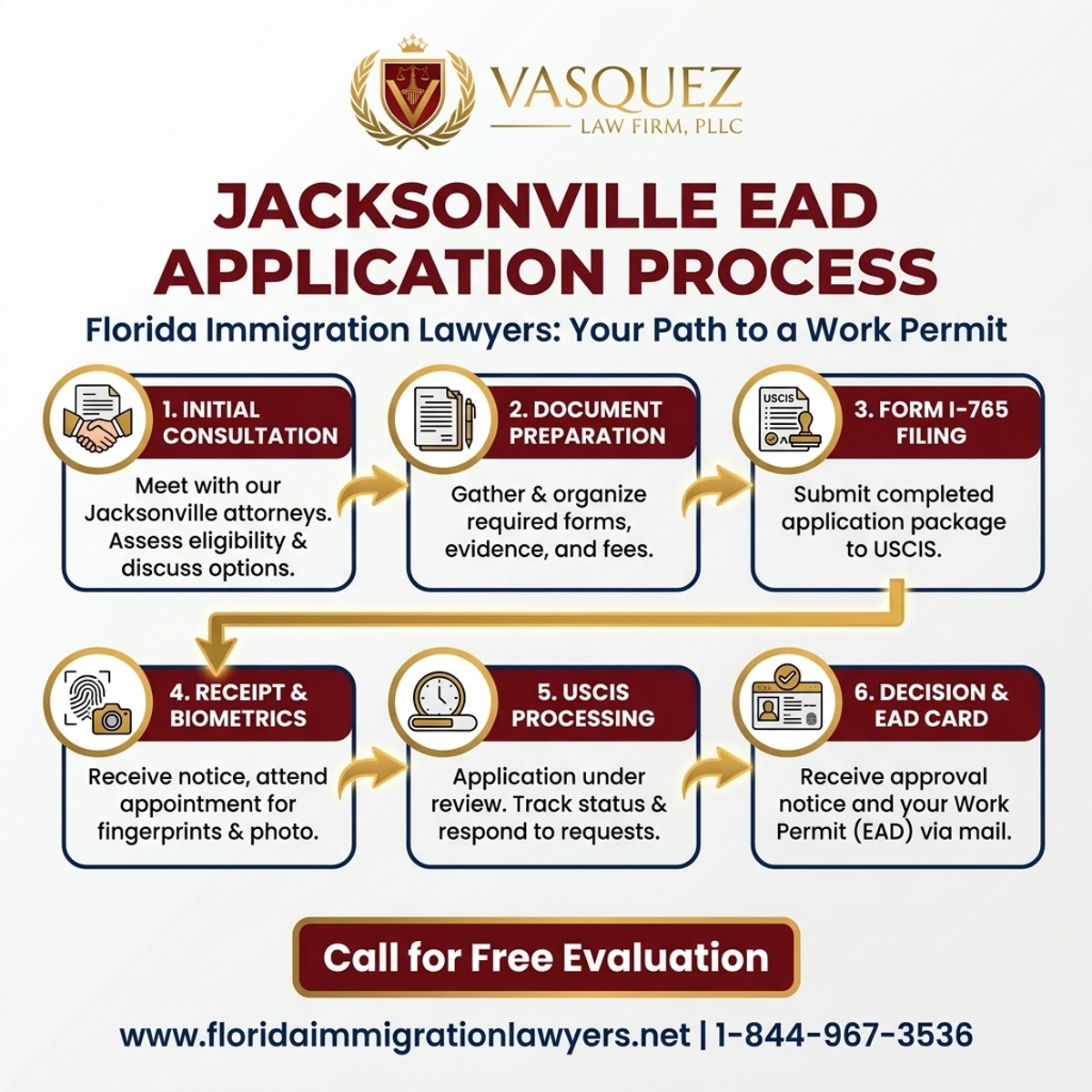
Step-by-Step Process — Work Permit EAD Application in Jacksonville, Florida
Document Checklist for EAD Application
- Completed Form I-765
- Copy of your current immigration status document
- Copy of previous EAD (if applicable)
- Two passport-sized photos
- Proof of identity (passport or national ID)
- Application fee payment
Thoroughly preparing your supporting documents is just as important as accurately filling out Form I-765. Any missing or improperly prepared document can lead to delays or a request for additional evidence, extending the overall processing time. Organize your documents clearly, perhaps using tabs or dividers, to ensure USCIS can easily review your submission.
For instance, the "current immigration status document" could be a copy of your Form I-94 Arrival/Departure Record, a visa stamp in your passport, an asylum interview notice, or a receipt notice for a pending adjustment of status application (e.g., Form I-485). The specific documents required will depend heavily on your eligibility category. Always refer to the USCIS instructions for Form I-765 for the most up-to-date and category-specific requirements. It's a good practice to make copies of your entire application packet for your records before mailing it, including the payment receipt.
When submitting passport-sized photos, ensure they meet USCIS specifications: full-face, unmounted, and taken within the last six months. These photos are critical for your EAD card. For proof of identity, a copy of your passport biographic page or a national identity card from your home country is typically acceptable. Always ensure that all copies are clear and legible. If any document is not in English, it must be accompanied by a certified English translation.
Timeline and Processing Expectations
Processing times for EAD applications can vary significantly. In Florida, typical processing might range from 3 to 6 months, depending on the applicant's category and the workload of the local USCIS office. It is essential to apply as early as possible to avoid any gaps in employment authorization.
Several factors can influence how long it takes for your EAD application to be processed. These include the specific USCIS service center handling your case, the volume of applications they are currently receiving, and the complexity of your individual immigration history. For example, categories like DACA renewals often have more predictable timelines than initial asylum-based EAD applications, which can sometimes take longer due to the nature of the underlying immigration case.
To manage expectations, regularly check the USCIS website's "Check Case Processing Times" tool. You'll need to select Form I-765 and your specific eligibility category. This tool provides an estimated range, but remember these are averages and individual cases can fall outside them. If your application exceeds the posted processing times, you may be able to submit an inquiry with USCIS, or Florida Immigration Lawyers can assist you in escalating the matter.
A critical practical tip is to apply for EAD renewal well in advance of its expiration. USCIS recommends filing for renewal 120 to 180 days before your current EAD expires. For some categories, a timely filed renewal application allows for an automatic extension of employment authorization for up to 540 days, preventing a lapse in your ability to work. Understanding these rules is vital to maintaining continuous employment authorization.
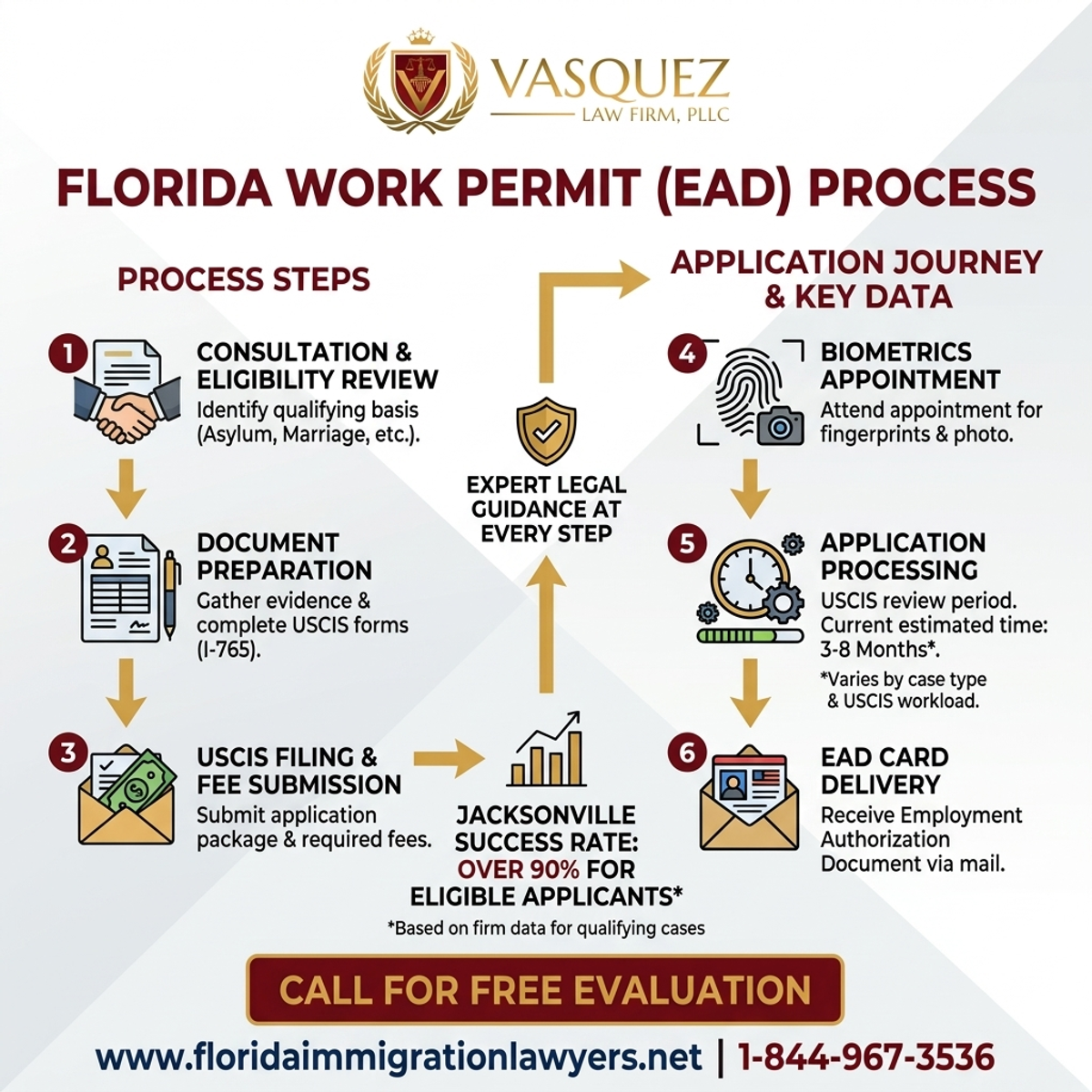
Key Statistics — Work Permit EAD Application in Jacksonville, Florida
Cost Factors and Fee Breakdown
The cost of applying for an EAD varies based on the applicant's category and any applicable waivers. While the base fee is published on the USCIS website, additional costs such as biometric fees may apply. It is crucial to verify the exact amounts before applying. Consider consulting an attorney to explore potential fee waivers if you're experiencing financial hardship.
The standard filing fee for Form I-765 is generally a significant component of the total cost. In addition to this, some applicants may also be required to pay a separate biometric services fee, which covers the cost of fingerprinting and background checks. It's essential to check the most current fee schedule on the USCIS website, as these amounts can change periodically. Submitting an incorrect fee can lead to your application being rejected and returned, causing unnecessary delays.
For individuals facing financial hardship, USCIS offers the possibility of a fee waiver. To apply for a fee waiver, you typically need to submit Form I-912, Request for Fee Waiver, along with your Form I-765 application. Eligibility for a fee waiver is usually based on receiving a means-tested benefit, having an income below 150% of the Federal Poverty Guidelines, or demonstrating that you cannot pay the fee due to financial hardship. Providing robust documentation to support your fee waiver request is crucial.
Payment methods accepted by USCIS typically include personal checks, money orders, or cashier's checks made payable to the "U.S. Department of Homeland Security." For applications filed at a Lockbox facility, you may also have the option to pay by credit card using Form G-1450, Authorization for Credit Card Transactions. Always double-check the payable amount and ensure your payment information is accurate to prevent rejection of your application. Florida Immigration Lawyers can provide guidance on current fees and fee waiver eligibility.
Do not navigate this process alone. Contact Florida Immigration Lawyers today.
Common Mistakes to Avoid
- Incomplete Form I-765: Ensure all sections are filled out completely and accurately to avoid delays.
- Incorrect Fee Submission: Submitting the wrong fee can result in application rejection.
- Lack of Supporting Documents: Missing documents can lead to requests for additional evidence, prolonging the process.
- Not Checking Application Status: Regularly check your case status online to stay informed about your application's progress.
- Ignoring Biometric Appointment: Missing this appointment can delay or halt your application.
- Outdated Information: Using outdated forms or guidelines can lead to rejections.
- Failure to Update USCIS with Address Changes: USCIS needs your current address to communicate effectively.
The EAD application process, while seemingly straightforward, is fraught with potential pitfalls that can lead to significant delays or even outright denial. Avoiding these common mistakes is paramount to ensuring a smooth and timely approval of your work permit. A single error can set you back by months, impacting your ability to work and support yourself.
Regarding an incomplete Form I-765, it's not just about filling every box, but filling it correctly. For instance, if you've ever used a different name, ensure you list all variations. If a question doesn't apply to you, indicate 'N/A' rather than leaving it blank. A common oversight is forgetting to sign the form; an unsigned application will be rejected immediately. Always review the form multiple times before mailing it.
For supporting documents, the key is not just to include them but to ensure they are legible copies and directly relevant to your eligibility category. For example, if you are applying based on a pending adjustment of status, you must include a copy of your I-485 receipt notice. If you are an asylum applicant, a copy of your asylum application receipt or interview notice is crucial. Always consult the specific instructions for your category to avoid submitting irrelevant documents or missing crucial ones.
Furthermore, failing to update USCIS with an address change can result in critical notices, RFEs, or even your EAD card being sent to the wrong address. Use Form AR-11, Alien's Change of Address Card, to notify USCIS promptly of any relocation. This simple step can prevent significant communication breakdowns and ensure you receive all correspondence in a timely manner. Proactive communication with USCIS is always beneficial.
When to Call a Lawyer
There are several scenarios where calling an immigration lawyer is advisable. If you receive a request for evidence from USCIS, face delays beyond typical processing times, or have a complicated immigration history, consulting with Florida Immigration Lawyers can provide clarity and assistance. Our team is equipped to handle complex cases and ensure your rights are protected.
While the EAD application process can be managed independently for straightforward cases, certain situations warrant the immediate attention of an experienced immigration attorney. For instance, if you have any criminal history, even minor infractions, it could potentially impact your eligibility for an EAD or other immigration benefits. An attorney can assess the severity of the issue and advise on the best course of action to mitigate any negative consequences.
Another scenario where legal counsel is invaluable is if your EAD application has been denied. Understanding the reasons for denial and strategizing an appeal or a new application requires deep knowledge of immigration law. Florida Immigration Lawyers can review your denial notice, identify the underlying issues, and help you prepare a robust response or reapplication, significantly improving your chances of success.
Additionally, if your immigration status is complex, involves multiple applications, or you have previously been out of status, an attorney can help ensure that your EAD application aligns with your overall immigration strategy. This proactive approach can prevent future complications and streamline your path toward long-term residency. Don't hesitate to call Florida Immigration Lawyers at 1-844-967-3536 for a free consultation if you encounter any of these complex scenarios.
About Florida Immigration Lawyers
Florida Immigration Lawyers is a dedicated law firm serving immigrants throughout Florida. Our experienced attorneys specialize in various immigration matters, including work permits, asylum, and family-based immigration. We offer free consultations and are available 24/7 to assist you. Call us at 1-844-967-3536 or visit our website at www.floridaimmigrationlawyers.net.
Our commitment extends beyond just processing paperwork; we are dedicated to providing compassionate and effective legal representation, understanding the profound impact immigration matters have on individuals and families. We pride ourselves on clear communication, keeping our clients informed at every stage of their case, and fighting tirelessly to protect their rights and achieve their immigration goals.
With a deep understanding of U.S. immigration laws and policies, our team at Florida Immigration Lawyers is uniquely positioned to offer tailored advice and strategic solutions for your specific situation. From the initial consultation to the final decision, we stand by our clients, offering peace of mind and expert guidance. We believe everyone deserves a fair chance to build a better life, and we are here to make that a reality for you in Jacksonville and across Florida.
Frequently Asked Questions (FAQs) About EAD Applications
Sources and References
- U.S. Citizenship and Immigration Services (USCIS)
- Executive Office for Immigration Review (EOIR)
- 8 U.S.C. Chapter 12 - Immigration and Nationality Act
Related services: H-1B specialty occupation visas, L-1 intracompany transfer visas, work visas for professionals, investment and entrepreneur visas.
This article provides general legal information and is not intended as legal advice. Every case is unique, and outcomes depend on specific facts and circumstances. Contact an attorney for advice about your particular situation.
For personalized assistance with your EAD application, contact Florida Immigration Lawyers at 1-844-967-3536. Se Habla Español - Estamos aquí para ayudarle.
If you need legal assistance, learn more about our business immigration practice, or call us at 1-844-967-3536 for a free consultation.
Do Not Navigate This Process Alone
Our experienced immigration attorneys are ready to fight for you. Get a free, confidential consultation today.
Se Habla Español
Or leave your details and we’ll call you:
Free Evaluation in 24 Hours
Or talk to us right now
AI voice assistant — available 24/7
FreeFrequently Asked Questions

William J. Vásquez
Founding Attorney · Vasquez Law Firm
U.S. Air Force veteran and immigration attorney with years of hands-on U.S. immigration experience. J.D., NCCU School of Law. AILA member. Admitted to the 4th, 5th, and 11th Circuit Courts.
Available 24/7 - Free Evaluations
Reviewed for legal accuracy by William J. Vásquez
Licensed in North Carolina; U.S. immigration is federal practice.
Related Legal Services
Our Florida immigration attorneys can help you with free immigration consultation, experienced immigration attorneys and business immigration. Call today at 1-844-967-3536 for a free consultation.
Related Links
Related Topics
Free Legal Consultation
Discuss your case with our experienced attorneys. We're available 24/7.
Se Habla Español - Estamos aquí para ayudarle.
Related Articles
Immigration Lawyer Orlando Free Consultation 2026
Discover how to find an immigration lawyer in Orlando offering a free consultation. Understand the services available and why choosing Florida Immigration Lawyers can make a difference in your case.
Military Naturalization Expedited in Florida Bases
Explore military naturalization options for families at Florida bases, including parole in place benefits in Miami. Learn how to expedite your application with expert guidance from Florida Immigration Lawyers.
Immigration Lawyer Orlando Free Consultation: 2026 Policy
For those in Orlando, Pembroke Pines, and throughout Florida, understanding evolving immigration policies is crucial. With anticipated immigration policy changes in 2026, seeking expert legal guidance is more important than ever. This comprehensive guide details the expected shifts in federal and state immigration laws, their impact on various visa types and humanitarian relief, and essential steps for securing your future. Learn about the process for obtaining an immigration lawyer Orlando free consultation, what to expect regarding timelines and costs, and common mistakes to avoid. Florida Immigration Lawyers provides dedicated support, offering free consultations and 24/7 availability to help you navigate these complexities with confidence.
Immediate Relative Petition Tampa: Your 2026 Florida Guide
Securing a green card for an immediate relative in Florida involves a detailed process, starting with Form I-130. This guide, updated for 2026, explains who qualifies as an immediate relative-spouses, unmarried children under 21, and parents of U.S. citizens-and outlines the step-by-step journey from petition filing to green card issuance. We cover essential documents, expected timelines, and associated costs, emphasizing the critical difference of no visa backlogs for this category. Learn how to navigate USCIS procedures, whether through adjustment of status in cities like Tampa and Hialeah or consular processing abroad. We also detail common mistakes to avoid and highlight scenarios where legal counsel from Florida Immigration Lawyers is indispensable to ensure a smooth and successful family reunification.