VAWA Immigration Relief Florida: Protecting Abuse Victims
For immigrants in Florida facing domestic violence or extreme cruelty, VAWA immigration relief offers a confidential pathway to a green card. This guide from Florida Immigration Lawyers details eligibility for abused spouses, children, and parents of U.S. citizens or LPRs. Learn about the Form I-360 self-petition process, essential documentation, and typical timelines. We emphasize the importance of strong evidence, confidentiality, and avoiding common mistakes. Discover how fee waivers can help manage costs and when to seek expert legal counsel. Florida Immigration Lawyers provides compassionate support across Florida, including Jacksonville, to help you secure safety and legal status.

VAWA immigration relief in Florida offers a critical pathway to legal status for victims of domestic violence, abuse, or extreme cruelty. Under the Violence Against Women Act (VAWA), certain abused spouses, children, and parents of U.S. citizens or lawful permanent residents can self-petition for a green card without the abuser's knowledge or cooperation. This protection is vital for immigrants in Jacksonville and across Florida who face dangerous situations at home. The process involves filing Form I-360, Petition for Amerasian, Widow(er), or Special Immigrant, supported by substantial evidence of the abuse and good moral character. It provides a confidential and independent route to safety and stability.
- VAWA allows abuse victims to self-petition for immigration status.
- Eligibility extends to spouses, children, and parents of U.S. citizens or LPRs.
- The process is confidential and does not require the abuser's involvement.
- A successful petition can lead to a green card and a life free from abuse.
- Legal assistance is highly recommended to navigate this complex process effectively.
Experiencing domestic violence or extreme cruelty is devastating, especially when your immigration status feels tied to your abuser. For many immigrants in Florida, including those in Jacksonville, the fear of deportation or losing their children can trap them in dangerous situations. You are not alone, and you have rights. The VAWA immigration relief Florida program, established under the Violence Against Women Act, provides a confidential and independent pathway for victims of abuse to seek legal immigration status, free from their abuser's control.
This comprehensive guide will walk you through the intricacies of VAWA, outlining who qualifies, the step-by-step application process, essential documentation, and what to expect regarding timelines and costs. We understand the sensitivity and urgency of these cases. Our goal is to empower you with the knowledge needed to pursue safety and independence. At Florida Immigration Lawyers, we are dedicated to protecting your rights and helping you secure a brighter future. Do not hesitate to seek help. Call Florida Immigration Lawyers at 1-844-967-3536 for a free, confidential consultation today.
Understanding VAWA Immigration Relief in Florida
The Violence Against Women Act (VAWA) offers a lifeline to immigrant survivors of domestic violence, allowing them to petition for lawful permanent residency (a green card) without the abuser's knowledge or involvement. This critical provision was enacted to prevent abusers from using their victim's immigration status as a tool for control and coercion. For individuals living in Florida, from Jacksonville to Miami, understanding VAWA is the first step towards freedom.
VAWA applies to abused spouses, children, and parents of U.S. citizens (USC) or lawful permanent residents (LPR). This means that even if your abuser is a green card holder, you may still qualify for protection. The law recognizes various forms of abuse, including physical battery, extreme cruelty, psychological abuse, emotional abuse, sexual abuse, and neglect. It's important to remember that you do not need to prove physical harm to demonstrate extreme cruelty. Coercion, threats, isolation, and financial control can all be considered forms of abuse under VAWA.
One of the most significant aspects of VAWA is the confidentiality clause. USCIS is prohibited from disclosing information about a VAWA self-petitioner to the abuser, ensuring the safety and privacy of the victim. This is crucial for individuals in Florida who fear retaliation or further abuse. The process is designed to be survivor-centered, recognizing the unique challenges faced by those escaping violent situations. Our attorneys at Florida Immigration Lawyers are deeply familiar with these protections and work diligently to ensure your safety throughout the process, providing expert guidance on VAWA immigration relief Florida applications.
Eligibility Criteria for VAWA Self-Petitioners
To be eligible for VAWA self-petitioning, you generally must meet several key criteria. As an abused spouse, you must show that you are or were married to a U.S. citizen or LPR, that the marriage was entered into in good faith, that you resided with the abuser, and that you were subjected to battery or extreme cruelty during the marriage. You must also demonstrate good moral character. If you are divorced, you may still be eligible if you file your petition within two years of the divorce and the divorce was related to the abuse.
Abused children (under 21, or in some cases under 25) can self-petition if they have been battered or subjected to extreme cruelty by a USC or LPR parent. Similarly, abused parents of a USC child can self-petition if they have been battered or subjected to extreme cruelty by their USC son or daughter. Each category has specific requirements regarding the relationship, the nature of the abuse, and the abuser's immigration status. Our firm can help you assess your unique situation and determine your eligibility under these complex regulations, ensuring your application for VAWA immigration relief Florida is robust.
The Confidentiality of VAWA Petitions
The confidentiality provisions under VAWA are paramount. This means that when you file a VAWA petition (Form I-360), USCIS is legally obligated not to contact your abuser or disclose any information about your filing. This protection is critical for your safety and peace of mind, allowing you to pursue immigration relief without fear of further harm or interference from your abuser. This also extends to any law enforcement agencies or other government entities that might otherwise interact with your abuser. Your safety is a top priority.
The VAWA Self-Petition Process: A Step-by-Step Guide
Navigating the VAWA self-petition process can seem daunting, but breaking it down into manageable steps can help. This process typically begins with filing Form I-360, Petition for Amerasian, Widow(er), or Special Immigrant, with U.S. Citizenship and Immigration Services (USCIS). Understanding each stage is crucial for a successful outcome, especially for those seeking VAWA immigration relief Florida. Here’s a detailed guide:
-
Gather Evidence: The most crucial step is to collect comprehensive evidence proving your relationship to the abuser, the abuse itself, your residence with the abuser, and your good moral character. This can include police reports, medical records, affidavits from friends or family, counseling records, photos, text messages, and financial records. The stronger your evidence, the more compelling your petition will be. Our attorneys specialize in helping clients compile robust evidence packages.
-
Prepare and File Form I-360: Complete Form I-360 accurately and thoroughly. This form is the core of your VAWA petition. Attach all supporting documentation, including your personal declaration detailing the abuse. It is vital that your declaration is detailed, credible, and consistent with other evidence. This form is typically filed at the Vermont Service Center. For detailed instructions and the form itself, you can visit the official USCIS website.
-
Receive Prima Facie Determination: After filing, USCIS will review your petition to determine if it establishes a “prima facie” case, meaning it appears to be approvable based on the initial evidence. If successful, you will receive a notice of prima facie determination, which can provide temporary immigration benefits, such as eligibility for work authorization, while your petition is pending. This is an important milestone in the VAWA immigration relief Florida journey.
-
Respond to Requests for Evidence (RFE): USCIS may send a Request for Evidence (RFE) if they need more information or clarification. Responding promptly and thoroughly to an RFE is critical. Failure to do so can lead to a denial. Our legal team can help you prepare a comprehensive response to any RFE received.
-
Interview (If Required): While many VAWA self-petitions are approved without an interview, USCIS reserves the right to request one. If an interview is scheduled, it will typically be at a local USCIS field office, such as those in Jacksonville, Orlando, or Miami, Florida. An attorney can prepare you for the interview and may accompany you to provide support.
-
Adjustment of Status (Green Card Application): If your I-360 petition is approved, you become an eligible VAWA self-petitioner. If you are physically present in the U.S. and an immigrant visa is immediately available, you can then file Form I-485, Application to Register Permanent Residence or Adjust Status, to obtain your green card. This is the final step towards becoming a lawful permanent resident.
What to Expect After Filing
After you file your Form I-360 petition, you will receive a receipt notice from USCIS. This notice confirms that your petition has been received and is being processed. It typically takes several months to receive a prima facie determination notice. During this waiting period, it is important to keep USCIS updated on any changes to your contact information or if you move. The process requires patience, but each step brings you closer to safety and legal status through VAWA immigration relief Florida.
Essential Documents for Your VAWA Petition
A well-prepared VAWA petition hinges on robust and credible evidence. Gathering the necessary documents is a critical step that requires careful attention to detail. The more compelling and consistent your evidence, the stronger your case for VAWA immigration relief Florida will be. Here’s a comprehensive checklist of documents you should aim to collect:
- Proof of Relationship:
- Marriage certificate (for spouses)
- Birth certificates (for children and parents)
- Divorce decrees (if applicable, especially if filing within 2 years of divorce)
- Proof of good faith marriage (joint bank accounts, leases, utility bills, photos, affidavits from friends/family attesting to the marriage)
- Proof of Abuser's Status:
- Copy of abuser's U.S. birth certificate, passport, naturalization certificate, or green card (if available)
- If not available, any documents showing the abuser's U.S. citizenship or LPR status (e.g., driver's license, employment records, school records)
- Proof of Residence with Abuser:
- Leases or rental agreements
- Utility bills in both names or showing shared address
- Mail addressed to both parties at the same address
- Affidavits from landlords or neighbors
- Evidence of Battery or Extreme Cruelty:
- Your detailed personal declaration (affidavit) describing the abuse, its frequency, and impact
- Police reports, arrest records, court orders (e.g., restraining orders, protection orders)
- Medical records, hospital reports, photos of injuries
- Psychological evaluations, counseling records, therapist notes
- Affidavits from witnesses (friends, family, clergy, social workers, teachers)
- Emails, text messages, voicemails, letters from the abuser
- Financial records showing control or abuse (e.g., denied access to funds, forced debt)
- Photos or videos depicting abuse or its aftermath
- Documentation from shelters or support groups
Step-by-Step Process — VAWA Immigration Relief Florida: Protecting Abuse Victims
- Proof of Good Moral Character:
- Police clearances from all places you have lived for six months or more since age 16
- Affidavits from reputable individuals (employers, community leaders) attesting to your character
- Criminal record information (if any, with explanations and evidence of rehabilitation)
- Birth Certificate and Passport:
- Copy of your birth certificate
- Copy of your passport (if available) and any prior visas or entry stamps
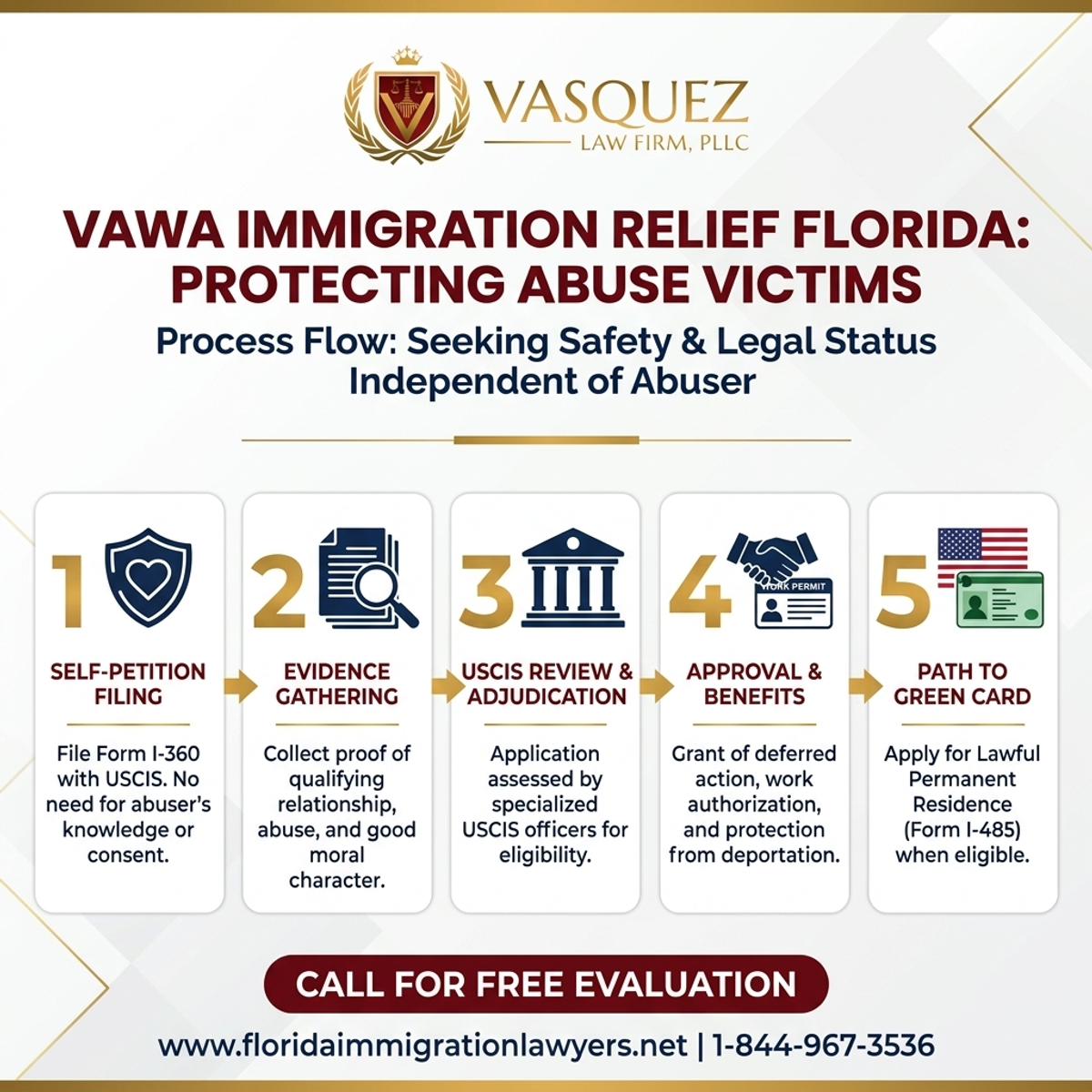
Our experienced immigration attorneys can help you identify and gather the most relevant and persuasive evidence for your specific case, ensuring your VAWA petition is as strong as possible. We understand the sensitivity involved in collecting these documents and will guide you with compassion and expertise.
Navigating VAWA Timelines and Processing Expectations in Florida
The processing times for VAWA petitions can vary significantly, depending on USCIS caseloads, the complexity of your case, and the thoroughness of your initial submission. While there isn't a fixed timeline, understanding the general expectations can help manage the process for VAWA immigration relief Florida. It's important to prepare for a journey that can take several months, or even a few years, from initial filing to final green card approval.
Typically, after filing Form I-360, you can expect to receive a receipt notice within a few weeks. The initial review for a prima facie determination usually takes anywhere from 4 to 8 months. A positive prima facie finding is a crucial step, as it can make you eligible for work authorization (Employment Authorization Document or EAD) and deferred action, protecting you from deportation while your petition is pending. This offers a significant measure of relief and stability for survivors.
After the prima facie determination, the full adjudication of your I-360 petition can take an additional 12 to 24 months, or even longer in some instances. If an interview is required, this can add to the processing time. Once your I-360 is approved, and if a visa is immediately available (which is generally the case for VAWA self-petitioners), you can then apply for adjustment of status (Form I-485) to get your green card. The I-485 processing can take another 8 to 18 months, depending on the local USCIS field office in Florida (e.g., Jacksonville, Orlando, Miami) and their specific backlogs.
Florida-Specific Processing Considerations
While VAWA petitions are processed centrally at the USCIS Vermont Service Center, subsequent adjustment of status interviews, if required, would be handled by local USCIS field offices across Florida. The efficiency of these offices can vary. For instance, the Miami field office, serving a large immigrant population, might have different processing times than a smaller office. Our attorneys stay updated on these regional variations and can provide more specific insights based on your location within Florida. Understanding these potential delays allows us to set realistic expectations and plan strategically, ensuring continuous progress in your pursuit of VAWA immigration relief Florida.
Do not navigate this complex process alone. The stakes are too high. Contact Florida Immigration Lawyers today at 1-844-967-3536 for expert guidance and compassionate support through every step of your VAWA journey.
Cost Factors and Fee Waivers for VAWA Applicants
One of the significant advantages of applying for VAWA immigration relief is the availability of fee waivers, recognizing that abuse victims may have limited financial resources, often due to their abuser's control. Understanding the cost factors involved and how to utilize fee waivers is crucial for applicants seeking VAWA immigration relief Florida.
The good news is that there are no filing fees for the Form I-360, Petition for Amerasian, Widow(er), or Special Immigrant, for VAWA self-petitioners. This is a deliberate provision to ensure that financial barriers do not prevent victims from seeking safety and status. However, other related applications, such as the Form I-485, Application to Register Permanent Residence or Adjust Status, and Form I-765, Application for Employment Authorization, typically have filing fees.
For these associated applications, VAWA self-petitioners are generally eligible for fee waivers. To request a fee waiver, you must file Form I-912, Request for Fee Waiver, along with your application. USCIS will grant a fee waiver if you can demonstrate that you are receiving a means-tested benefit, your household income is at or below 150% of the Federal Poverty Guidelines, or you are experiencing financial hardship. Providing clear and compelling evidence of your financial situation is key to a successful fee waiver request. This can include documentation of public assistance, income statements, or letters explaining your hardship.
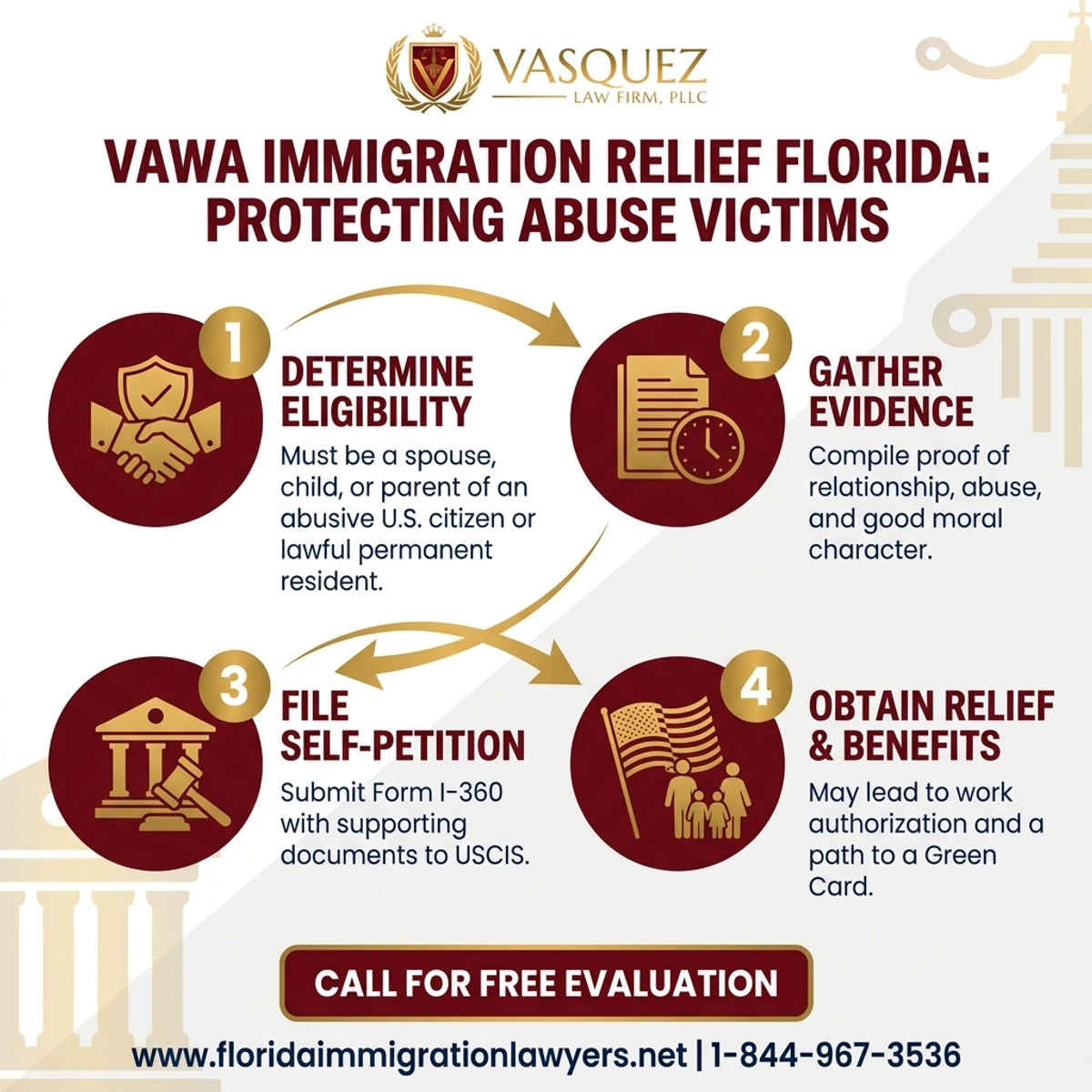
Key Statistics — VAWA Immigration Relief Florida: Protecting Abuse Victims
While filing fees may be waived, it is important to consider the costs associated with legal representation. Navigating the VAWA process is highly complex, requiring meticulous documentation, adherence to strict deadlines, and a deep understanding of immigration law. An experienced immigration attorney can significantly increase your chances of success, help you gather and present evidence effectively, respond to RFEs, and represent you if an interview is required. While legal fees are an investment, they often prove invaluable for ensuring a smooth and successful outcome, providing peace of mind and securing your future. Many firms, including Florida Immigration Lawyers, offer flexible payment options or free initial consultations to help make legal assistance accessible for victims seeking VAWA immigration relief Florida.
Common Mistakes to Avoid in VAWA Petitions
Applying for VAWA immigration relief is a sensitive and complex process. Even minor errors can lead to significant delays or even denial. Being aware of common pitfalls can help you avoid them and strengthen your application for VAWA immigration relief Florida.
-
Insufficient Evidence: This is perhaps the most common mistake. Applicants often underestimate the amount and type of evidence required to prove abuse, good faith marriage, and good moral character. USCIS requires compelling, corroborating evidence beyond just your personal testimony. Always aim for a robust package of documents.
-
Inconsistent Story: Your personal declaration must be consistent with all other evidence submitted. Any inconsistencies, even minor ones, can raise red flags for USCIS and cast doubt on your credibility, potentially jeopardizing your VAWA immigration relief Florida petition.
-
Missing Deadlines: VAWA has specific filing deadlines, especially for divorced spouses (within two years of divorce related to abuse) and children aging out. Missing these deadlines can lead to an outright denial, regardless of the merits of your case.
-
Not Filing a Fee Waiver: For associated applications like Form I-485, fees apply. Many VAWA petitioners are eligible for fee waivers. Failing to request one or not providing sufficient evidence for the waiver can lead to delays or rejection of the subsequent application.
-
Lack of Good Moral Character Documentation: While the focus is often on abuse, proving good moral character is equally vital. Neglecting to provide police clearances or adequately address any past legal issues can lead to denials.
-
Filing Without Legal Counsel: The complexity of immigration law, the need for specific evidence, and the sensitivity of abuse cases make legal representation highly advisable. Attempting to navigate the VAWA process alone significantly increases the risk of errors and missed opportunities.
-
Not Updating USCIS on Address Changes: If you move while your petition is pending, you must inform USCIS of your new address promptly. Failure to do so can result in missed notices, RFEs, or interview appointments, leading to delays or denial.
-
Not Understanding the Definition of Abuse: VAWA covers more than just physical abuse. Emotional, psychological, financial, and sexual abuse, and extreme cruelty, are all recognized. Many victims do not realize their experiences qualify. Clearly articulating the full scope of abuse is important for your VAWA immigration relief Florida case.
-
Communicating with the Abuser: While sometimes unavoidable, extensive communication with the abuser during the petition process can be misconstrued by USCIS as a lack of separation or ongoing relationship, potentially undermining your claim of abuse.
-
Failure to Disclose Criminal History: It is crucial to be entirely truthful about any past arrests or convictions, even minor ones. USCIS will discover them. Providing full disclosure with explanations and evidence of rehabilitation is far better than concealment.
When to Call a Lawyer for VAWA Immigration Relief
While the prospect of seeking legal help might seem overwhelming, especially when you are recovering from abuse, a skilled immigration attorney can be your strongest ally in securing VAWA immigration relief Florida. There are several critical scenarios where legal counsel is not just helpful but often essential for a successful outcome.
You should contact Florida Immigration Lawyers immediately if your abuser has initiated deportation proceedings against you or if you are already in removal proceedings. VAWA offers a powerful defense against deportation for eligible victims. Our attorneys have extensive experience in both family immigration and deportation defense, providing comprehensive representation. Also, if you have any criminal history, even minor infractions, it can complicate your VAWA petition. An attorney can assess the impact of your record and help mitigate potential issues, including helping you demonstrate good moral character despite past challenges.
If your case involves complex forms of abuse, such as psychological manipulation, financial exploitation, or threats that are not easily documented with police reports, an attorney can help you gather and present compelling evidence. They understand how to weave together various forms of proof, including affidavits from experts and witnesses, to build a strong narrative of extreme cruelty. Furthermore, if you've previously applied for immigration benefits and were denied, or if your abuser has filed conflicting petitions on your behalf, navigating these complexities requires expert legal advice. The team at Florida Immigration Lawyers is here to provide the compassionate, knowledgeable support you need to secure your future and freedom through VAWA immigration relief Florida.
About Florida Immigration Lawyers
Florida Immigration Lawyers is a leading law firm dedicated to providing comprehensive and compassionate immigration legal services across the entire state of Florida. With a deep understanding of U.S. immigration law and a commitment to protecting the rights of immigrants, our experienced attorneys offer unparalleled representation for a wide range of immigration matters, including asylum, deportation defense, citizenship, family immigration, and business immigration. We are particularly proud of our work helping vulnerable individuals secure critical protections like VAWA immigration relief Florida.
Our firm stands out for its personalized approach, ensuring that every client receives the attention and tailored strategy their unique case deserves. We are available 24/7, recognizing that immigration issues often arise unexpectedly and require immediate action. We offer free consultations, allowing you to discuss your situation confidentially with an expert without financial obligation. Our team is fluent in both English and Spanish, ensuring clear and effective communication for all our clients. When your future and freedom are at stake, choose Florida Immigration Lawyers for dedicated, knowledgeable, and empathetic legal advocacy. Call us today at 1-844-967-3536 to learn how we can help you.
Sources and References
- U.S. Citizenship and Immigration Services (USCIS) - VAWA I-360
- Executive Office for Immigration Review (EOIR)
- 8 U.S.C. § 1154(a)(1)(A) - Immigration and Nationality Act (INA) Section 204(a)(1)(A)
- 8 CFR § 204.2(c) - Petitions for aliens as spouses, children, or parents of U.S. citizens or lawful permanent residents (VAWA provisions)
- U.S. Department of State - Visa Bulletin
Related services: immigration practice areas.
This article provides general legal information and is not intended as legal advice. Every case is unique, and outcomes depend on specific facts and circumstances. Contact an attorney for advice about your particular situation.
If you or a loved one in Florida is suffering from abuse and needs to explore options for VAWA immigration relief Florida, do not wait. Your safety and future depend on taking action. Florida Immigration Lawyers offers free, confidential consultations to help you understand your rights and begin your journey to independence. Our compassionate team is ready to listen and provide the expert legal guidance you deserve. Call us now at 1-844-967-3536. Se Habla Espanol - Estamos aqui para ayudarle.
If you need legal assistance, learn more about speak with an immigration lawyer, or call us at 1-844-967-3536 for a free consultation.
Do Not Navigate This Process Alone
Our experienced immigration attorneys are ready to fight for you. Get a free, confidential consultation today.
Se Habla Español
Frequently Asked Questions
Florida Immigration Lawyers
Immigration Attorney | Founder, Vasquez Law Firm
U.S. Air Force veteran and immigration attorney with thousands of cases resolved. J.D., NCCU School of Law. AILA member. Admitted to the 4th, 5th, and 11th Circuit Courts.
Available 24/7 - Free Evaluations
Related Legal Services
Our Florida immigration attorneys can help you with experienced immigration attorneys, business immigration and asylum protection. Call today at 1-844-967-3536 for a free consultation.
Related Links
Related Topics
Free Legal Consultation
Discuss your case with our experienced attorneys. We're available 24/7.
Se Habla Español - Estamos aquí para ayudarle.
Related Articles
Fiance Visa K-1 Process in Florida | FL Immigration Lawyers
Learn how to bring your fiancé to Florida with a K-1 visa. Understand the process, requirements, and common pitfalls. Contact us for a free consultation.
I-601 Waiver Guide for Florida Immigrants | VLF Florida
Facing inadmissibility issues in Florida? Discover how the I-601 waiver can help you stay in the U.S. by demonstrating extreme hardship to a qualifying relative. Learn about eligibility, process, and common mistakes to avoid. Contact Florida Immigration Lawyers for expert guidance.
I-601 Waiver Guide for Florida Immigrants | VLF Florida
The I-601 waiver is essential for immigrants in Coral Springs, Florida, facing inadmissibility. Learn about eligibility, documentation, and common mistakes to avoid. Contact Florida Immigration Lawyers for a free consultation.
Understanding U Visa Certification in Florida | VLF Florida
Explore the process of U visa certification in Florida, focusing on law enforcement's role and how it aids crime victims. Contact Florida Immigration Lawyers for guidance.
