H-4 Premium Processing 2026: I-539 Change of Status
Explore the 2026 updates for USCIS premium processing of I-539 H-4 applications, offering expedited work authorization for H-4 spouses in Florida. Learn about the process, timelines, and costs involved, and avoid common pitfalls with our guidance.
- Premium processing is optional and incurs additional fees.
- Expedited decisions are typically issued within 15 days.
- Available for certain H-4 dependents, particularly spouses of H-1B visa holders.
Introduction
For H-4 visa holders in Hialeah, Florida, 2026 brings significant changes with the introduction of USCIS premium processing for I-539 H-4 change of status applications. This development is particularly relevant for spouses of H-1B visa holders seeking work authorization. In this blog, we will cover the process, necessary documents, timelines, cost factors, and common mistakes to avoid. Call Florida Immigration Lawyers at 1-844-YO-PELEO for a free consultation.
The availability of premium processing for H-4 change of status is a game-changer for many families across Florida and the nation. It addresses a long-standing need for faster processing times, which can directly impact an H-4 spouse's ability to pursue employment opportunities, contribute to their household income, and advance their careers without undue delays. This enhancement reflects USCIS's ongoing efforts to streamline immigration processes and support the H-1B ecosystem by providing greater stability and predictability for dependent family members.
Understanding the intricacies of this new option is crucial for anyone looking to leverage it. From ensuring eligibility to meticulously preparing documentation and understanding the financial implications, each step requires careful attention. Our goal is to provide a comprehensive guide that not only explains the 'what' but also the 'how' and 'why,' empowering H-4 visa holders in Florida to navigate this process successfully. Remember, guidance from Florida Immigration Lawyers is always available to clarify any doubts and ensure a smooth application journey.
What is USCIS Premium Processing for I-539 H-4 in 2026?
As of 2026, USCIS offers premium processing for I-539 H-4 change of status applications. This option allows for expedited processing, typically within 15 calendar days, for eligible applicants.
Premium processing is a service that requires additional fees and is designed to help H-4 visa holders, particularly spouses of H-1B visa holders, receive quicker decisions on their work authorization applications. This can significantly reduce waiting times and help families plan better for their future in Florida.
The introduction of premium processing for H-4 applications, specifically for Form I-539 (Application to Extend/Change Nonimmigrant Status), marks a pivotal moment for H-4 dependents. Previously, these applications could languish for many months, causing significant anxiety and uncertainty for families. This expedited service is a direct response to the demand for more efficient processing, aligning H-4 processing with other critical immigration categories that already benefit from premium options.
It's important to understand that the 15-calendar-day processing period begins once USCIS properly receives the Form I-907, Request for Premium Processing Service. If USCIS fails to process the application within this timeframe, the premium processing fee is typically refunded, and the agency continues to process the application. This provides a level of assurance for applicants investing in the service. For H-4 spouses in Florida, this means they can potentially receive their new status and subsequently apply for or renew their Employment Authorization Document (EAD) much faster, enabling them to start or continue working without prolonged interruptions.
This service is particularly beneficial for H-4 dependents who are concurrently filing their I-765 (EAD application) or those whose H-1B spouse's petition (Form I-129) is also being processed under premium processing. The ability to coordinate these applications can prevent gaps in employment authorization and ensure family stability. Consulting with an immigration attorney at Florida Immigration Lawyers can help determine if premium processing is the right choice for your specific circumstances and how best to integrate it into your overall immigration strategy.
How to Apply for H-4 EAD in Florida?
Applying for an H-4 EAD (Employment Authorization Document) in Florida involves several steps. Here's a detailed guide:
- Eligibility Check: Ensure you are eligible for an H-4 EAD. Typically, this is available to spouses of H-1B visa holders with an approved I-140 or whose H-1B status is extended beyond the sixth year.
- Prepare Form I-765: Complete Form I-765, Application for Employment Authorization. Ensure all sections are filled accurately to avoid delays.
- Gather Supporting Documents: Collect necessary documents such as a copy of your H-4 visa, marriage certificate, and the principal H-1B holder's documents.
- Submit Application: Send your application to the appropriate USCIS address for processing. Consider using premium processing for faster results.
- Receive EAD Card: Once approved, you will receive your EAD card, allowing you to work legally in the U.S.
Let's delve deeper into each of these crucial steps to ensure a seamless application process. For the eligibility check, it's vital to confirm that your H-1B spouse either has an approved Form I-140, Immigrant Petition for Alien Worker, or has been granted an H-1B extension beyond the six-year limit under sections 104(c) or 106(a) and (b) of the American Competitiveness in the Twenty-first Century Act of 2000 (AC21). A common scenario involves an H-1B worker whose green card process has started, and their I-140 is approved, making their H-4 spouse eligible for an EAD. Without meeting these specific criteria, your H-4 EAD application will likely be denied, leading to wasted time and fees.
When preparing Form I-765, precision is paramount. Any discrepancies or missing information can trigger a Request for Evidence (RFE) or even a denial. Pay close attention to the specific filing category for H-4 EAD, which is (c)(26). Ensure your name, date of birth, and other personal details match exactly across all submitted documents. It's highly recommended to download the latest version of Form I-765 directly from the USCIS website, as forms are updated periodically. A practical tip is to fill out the form digitally, print it, and then sign it in blue ink, making it legible and professional.
The submission of your application requires careful attention to the correct filing address, which depends on your state of residence (Florida, in this case) and the type of application being filed. Always check the USCIS website for the most current mailing addresses. If you are filing your H-4 change of status (I-539) and H-4 EAD (I-765) concurrently, which is often advisable, ensure both forms and their respective supporting documents are packaged together correctly. Utilizing a reliable mail service with tracking is a smart move to confirm delivery and provide peace of mind. For those opting for premium processing, remember to include Form I-907 and the additional fee.
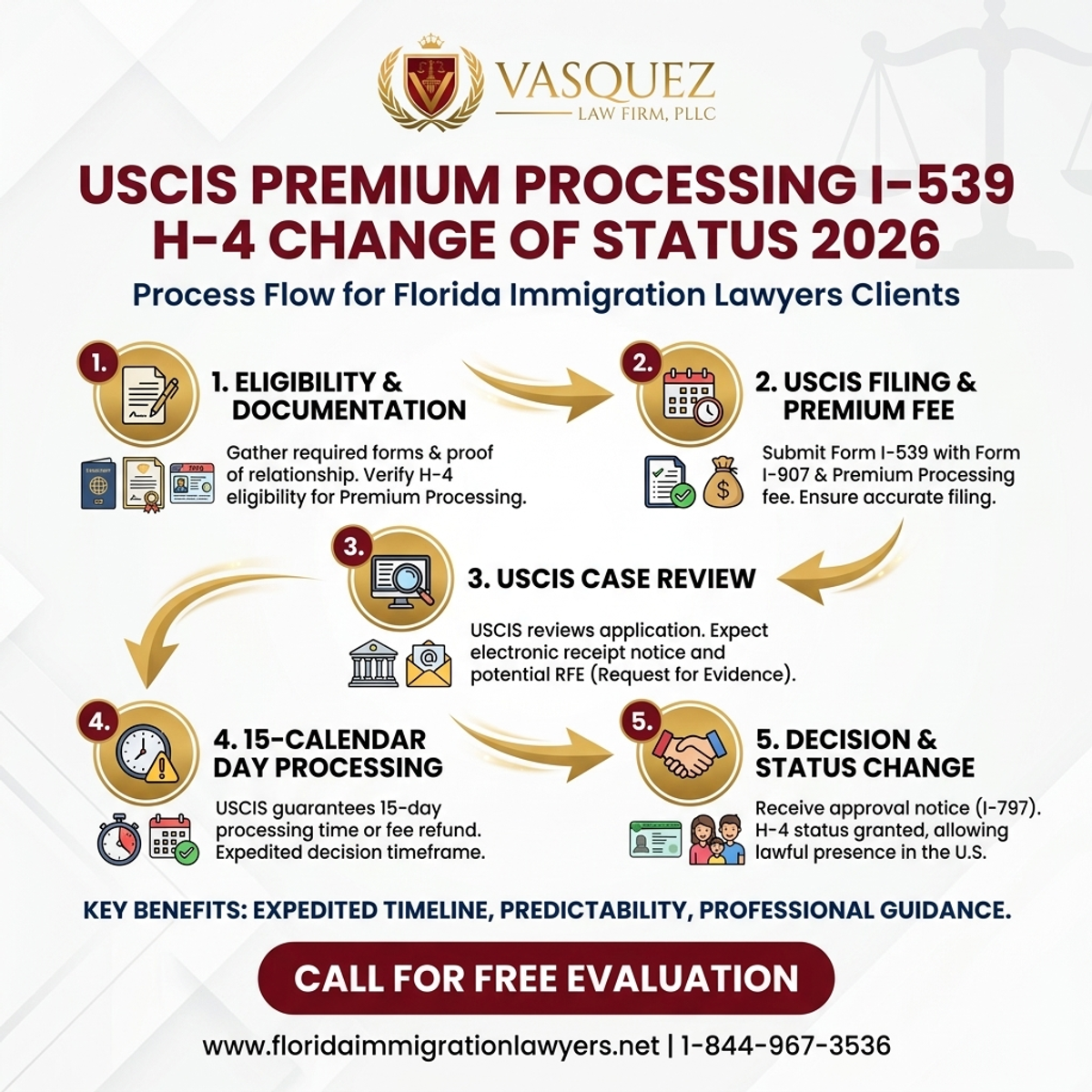
Step-by-Step Process — USCIS Premium Processing I-539 H-4 Change of Status 2026
Documents Required for H-4 EAD Application
- Completed Form I-765: This is your primary application for employment authorization, requiring accurate personal and immigration details.
- Copy of H-4 visa: Include a copy of your most recent H-4 visa stamp in your passport, if applicable, showing your current nonimmigrant status.
- Marriage certificate: A certified copy of your marriage certificate is crucial to prove your spousal relationship with the principal H-1B holder.
- Copy of the H-1B visa holder's I-140 approval notice: This document, Form I-797, proves the principal H-1B holder's eligibility for an immigrant visa, which in turn grants you H-4 EAD eligibility.
- Two passport-sized photos: These photos must meet USCIS specifications, typically taken within 30 days of filing, with a white background and no glasses.
- Proof of current H-4 status: This can include your most recent Form I-94 (arrival/departure record), Form I-797 approval notice for your H-4 status, or a copy of your H-4 visa stamp.
- Copy of principal H-1B holder's most recent I-797 approval notice for their H-1B status: This confirms their valid H-1B status.
- Copy of principal H-1B holder's passport biographic page and visa stamp: Further proof of their identity and valid nonimmigrant status.
When compiling these documents, it's a good practice to create a checklist to ensure nothing is overlooked. Organize your documents neatly, perhaps with tabs or separators, making it easier for the USCIS officer to review your application. Always provide clear, legible copies of all documents; avoid sending original documents unless specifically requested by USCIS. If any of your supporting documents are not in English, you must include a certified English translation along with a copy of the original document. The translator must provide a certification that they are competent to translate and that the translation is accurate.
For example, if your marriage certificate is in Spanish, you would need to submit both the original Spanish certificate and a certified English translation. Failing to provide accurate translations or certified copies can lead to delays or RFEs. Consider making a complete copy of your entire application package before mailing it to USCIS. This personal record can be invaluable if you need to refer back to your submission or if any issues arise during processing. Florida Immigration Lawyers can assist in reviewing your document packet to ensure completeness and accuracy before submission.
Timeline and Processing Expectations
| Stage | Typical Timeframe | Notes |
|---|---|---|
| Application Submission | Immediate | Consider premium processing for faster results. |
| USCIS Processing | 15 days (premium) | Standard processing can take several months. |
| EAD Card Delivery | 1-2 weeks post-approval | Delivered via mail. |
While premium processing promises a decision within 15 calendar days, it's crucial to understand what this means. The 15-day clock begins once USCIS officially receives your Form I-907 and the premium processing fee. This period covers the time until USCIS issues an approval notice, a denial, a Request for Evidence (RFE), or a Notice of Intent to Deny (NOID). It does not include the time it takes for the physical EAD card to be produced and mailed to you, which typically adds another 1-2 weeks after approval.
For those who opt for standard processing, the timeline can be significantly longer, often ranging from several months to over a year, depending on the current USCIS workload and service center processing times. This extended wait can be particularly challenging for H-4 spouses who are eager to begin working or whose current EAD is expiring, potentially leading to gaps in employment. Therefore, if timely work authorization is critical for your career or financial planning, the investment in premium processing for your I-539 H-4 change of status is highly recommended, especially when filing concurrently with Form I-765.
It's important to monitor USCIS processing times online, even with premium processing, as unforeseen circumstances can sometimes affect even expedited cases. If USCIS fails to meet the 15-day deadline for a premium processed case, they are generally required to refund the premium processing fee. However, the application will still be processed, albeit without the expedited guarantee. Staying informed and potentially seeking advice from Florida Immigration Lawyers if your premium processed case exceeds its timeline can help you understand your options.
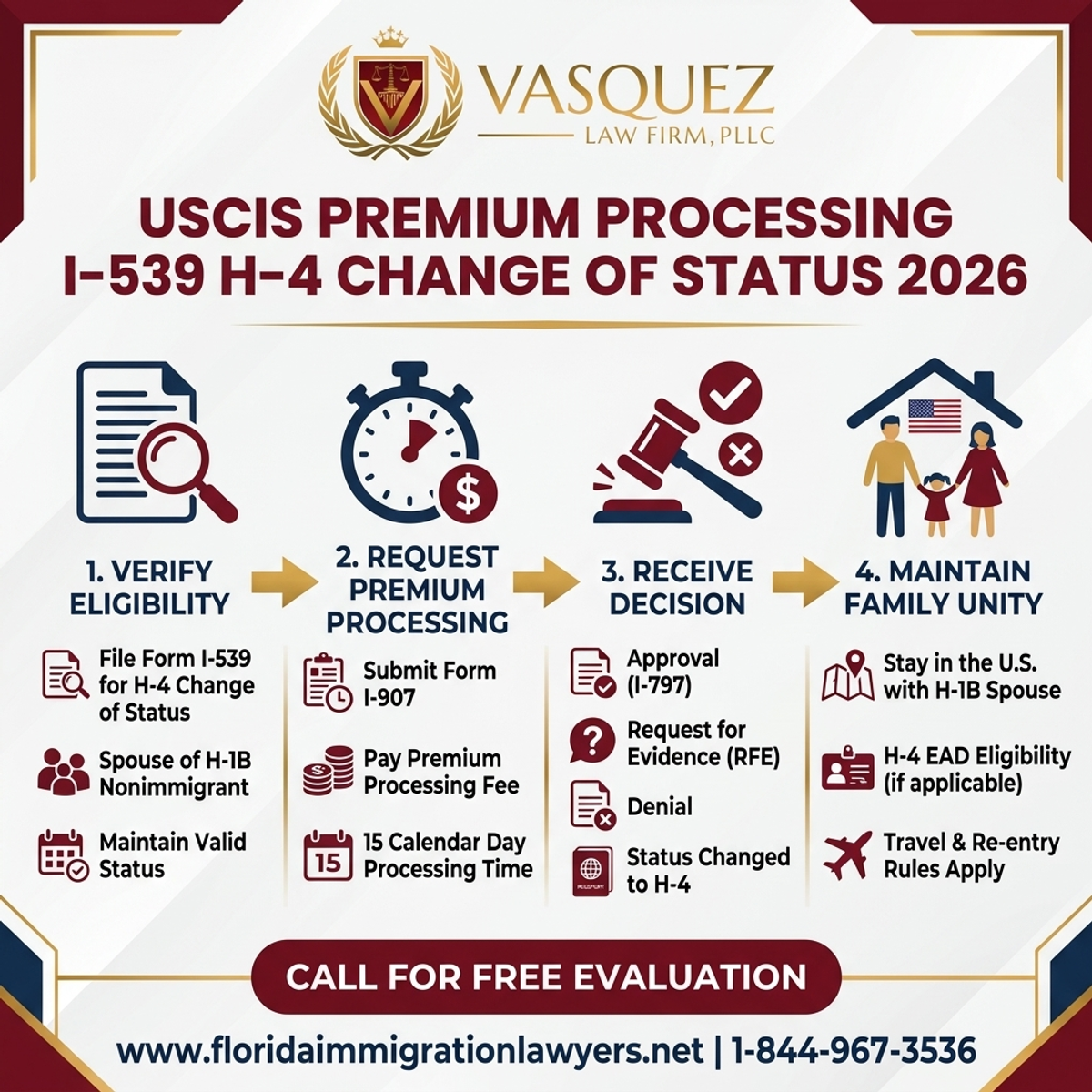
Key Statistics — USCIS Premium Processing I-539 H-4 Change of Status 2026
Cost Factors and Fee Breakdown
| Item | Typical Fee | Notes |
|---|---|---|
| Form I-765 Filing Fee | Variable | Check USCIS for current fees. |
| Premium Processing Fee | Additional | Optional for expedited service. |
| Attorney Fees | Variable | Depends on legal representation. |
Navigating the financial aspects of an H-4 EAD application requires careful budgeting. The filing fee for Form I-765 is subject to change, so always verify the most current amount on the official USCIS website before submitting your application. This fee is non-refundable, even if your application is denied. It's usually paid via check or money order made payable to the 'U.S. Department of Homeland Security'. Ensure the amount is correct to avoid your application being rejected for incorrect payment.
The premium processing fee is a separate, additional cost for Form I-907, specifically for expediting your I-539 H-4 change of status. This fee is substantial but often considered a worthwhile investment for the peace of mind and significantly reduced waiting time it provides. Similar to the I-765 fee, the premium processing fee must be paid correctly and is subject to change. It is crucial to submit a separate check or money order for this fee to avoid any confusion or processing errors.
Finally, attorney fees for legal representation vary depending on the complexity of your case and the services provided. While optional, engaging an experienced immigration attorney, such as Florida Immigration Lawyers, can be invaluable. They can help you accurately prepare all forms, ensure all required documents are included, respond to RFEs, and generally streamline the process, potentially saving you time and money in the long run by avoiding common pitfalls that lead to delays or denials. Their expertise can be particularly beneficial for complex cases or if you have a history of immigration issues.
Do not navigate this process alone. Contact Florida Immigration Lawyers today.
Common Mistakes to Avoid
- Incorrect Form Completion: Mistakes on Form I-765 can delay processing. Even minor errors, like an incorrect date or unchecked box, can lead to a Request for Evidence (RFE) or outright denial. Always double-check every field and refer to the official USCIS instructions meticulously.
- Missing Documents: Failing to include all required documents can lead to application denial. A common oversight is forgetting to include copies of the H-1B spouse's I-140 approval or their most recent H-1B approval notice. Create a checklist and verify each item before mailing your package.
- Not Using Premium Processing: If eligible, consider premium processing to expedite your case. While it incurs an additional fee, the benefit of receiving a decision within 15 days can be crucial for employment continuity and peace of mind, especially when compared to standard processing times that can stretch for months.
- Ignoring USCIS Updates: Regulations and forms can change, always check the latest information. USCIS frequently updates its forms and fee schedules. Using an outdated form or sending an incorrect fee amount will result in your application being rejected, causing significant delays.
- Incorrect Fee Payment: Ensure you pay the correct filing fees to avoid delays. Double-check the current fees on the USCIS website for both Form I-765 and, if applicable, Form I-907 for premium processing. Always use a check or money order made payable to 'U.S. Department of Homeland Security' for the exact amount.
- Delayed Application Submission: Submit your application as soon as possible to avoid unnecessary waiting. Especially for EAD renewals, filing well in advance of your current EAD's expiration date is critical to prevent gaps in employment authorization. Proactive filing is always better than reactive.
- Not Consulting an Attorney: Professional legal advice can prevent costly mistakes. An experienced immigration attorney from Florida Immigration Lawyers can review your application, identify potential issues, and provide strategic advice, significantly increasing your chances of a smooth and successful outcome.
- Inconsistent Information: Ensure all information across your application forms and supporting documents is consistent. Discrepancies in names, dates of birth, or addresses can raise red flags with USCIS and lead to RFEs or denials.
- Poor Quality Copies: Submit clear, legible copies of all supporting documents. Blurry or unreadable copies can cause delays as USCIS may request clearer versions, prolonging the processing time.
Frequently Asked Questions (FAQ)
Can I apply for premium processing for my H-4 EAD if my H-1B spouse's I-140 is not approved yet?
No, premium processing for the H-4 change of status (I-539) is separate from the H-4 EAD (I-765) application. While you can premium process your I-539, your H-4 EAD eligibility still hinges on your H-1B spouse having an approved I-140 or a qualifying H-1B extension beyond the sixth year. Without meeting this fundamental eligibility for the EAD, even an expedited I-539 approval won't grant you work authorization. It's crucial to confirm EAD eligibility first.
What if my H-4 status expires while my EAD application is pending?
If you have a timely filed I-539 (H-4 extension) and I-765 (H-4 EAD) application, your H-4 status is generally extended for up to 240 days beyond its expiration date, allowing you to remain in the U.S. However, your work authorization (EAD) does not automatically extend. If your EAD expires while a renewal is pending, you must cease employment until the new EAD is approved. Premium processing for your I-539 can help mitigate this risk by speeding up your status extension.
Can I travel internationally while my H-4 EAD application is pending with premium processing?
Traveling internationally while your H-4 EAD application (Form I-765) is pending is generally not advised, especially if you also have a pending H-4 change of status (Form I-539). Departing the U.S. while an I-539 is pending can be considered an abandonment of the application. If you must travel, consult with Florida Immigration Lawyers beforehand to understand the potential risks and whether it might be possible to re-enter on your existing H-4 visa without jeopardizing your pending applications.
Is premium processing available for initial H-4 EAD applications or only renewals?
Premium processing is now available for the Form I-539 H-4 change of status, which is often filed concurrently with an initial or renewal H-4 EAD (Form I-765). While the premium processing itself applies to the I-539, expediting your H-4 status can indirectly speed up the overall process for obtaining your EAD, whether it's your first time applying or you're seeking a renewal. This ensures a quicker path to work authorization for eligible H-4 spouses.
When to Call a Lawyer
It is advisable to call a lawyer if you face any complications during your H-4 EAD application process, receive a request for evidence (RFE), or if your application is denied. Florida Immigration Lawyers can provide guidance and representation to help you navigate these challenges.
You should also consider contacting an attorney if your case involves complex scenarios, such as a prior immigration violation, a criminal record, or if your H-1B spouse's immigration status is complicated. An attorney can help you understand the nuances of the law and ensure your application is as strong as possible. Furthermore, if you are nearing the expiration of your current H-4 status or EAD and are concerned about potential gaps in employment, legal counsel can provide strategic advice on timely filing and utilizing premium processing effectively. Don't hesitate to reach out to Florida Immigration Lawyers at 1-844-YO-PELEO for a free consultation to discuss your specific situation.
About Florida Immigration Lawyers
Florida Immigration Lawyers is a leading firm focusing on immigration law. We offer comprehensive services including family immigration, deportation defense, and business immigration. Our team is available 24/7, providing free consultations to serve all of Florida. Call us at 1-844-YO-PELEO or visit our website. Our commitment is to provide personalized and effective legal solutions, ensuring that individuals and families can achieve their immigration goals with confidence and peace of mind.
Sources and References
- U.S. Citizenship and Immigration Services (USCIS)
- Executive Office for Immigration Review (EOIR)
- U.S. Department of State
- 8 U.S.C. Chapter 12 - Immigration and Nationality Act
Related services: family petition process, family-based green cards, fiancé visa (K-1), marriage-based immigration.
This article provides general legal information and is not intended as legal advice. Every case is unique, and outcomes depend on specific facts and circumstances. Contact an attorney for advice about your particular situation.
Call Florida Immigration Lawyers at 1-844-YO-PELEO for a free consultation. Se Habla Español - Estamos aquí para ayudarle.
If you need legal assistance, learn more about Florida family immigration legal team, or call us at 1-844-YO-PELEO for a free consultation.
Do Not Navigate This Process Alone
Our experienced immigration attorneys are ready to fight for you. Get a free, confidential case review today.
Se Habla Español
Or leave your details and we’ll call you:
Free Evaluation in 24 Hours
Or talk to us right now

AI voice assistant — available 24/7
FreeFrequently Asked Questions

William J. Vásquez
Founding Attorney · Vasquez Law Firm
U.S. Air Force veteran and immigration attorney with years of hands-on U.S. immigration experience. J.D., NCCU School of Law. AILA member. Admitted to the 4th, 5th, and 11th Circuit Courts.
Available 24/7 - Free Evaluations
Reviewed for legal accuracy by William J. Vásquez
Licensed in North Carolina; U.S. immigration is federal practice.
Related Legal Services
Our Florida immigration attorneys can help you with deportation defense, family immigration services and immigration lawyer cost in Florida. Call today at 1-844-YO-PELEO for a free case review.
Related Links
Related Topics
Free Legal Case Review
Discuss your case with our experienced attorneys. We're available 24/7.
Se Habla Español - Estamos aquí para ayudarle.
Related Articles
DUI Immigration Consequences in Florida 2026
A DUI conviction in Florida can have severe immigration consequences, potentially leading to inadmissibility, deportation, or denial of immigration benefits. For non-citizens, a DUI is not just a traffic offense but a serious criminal matter that federal immigration law scrutinizes closely. Factors like multiple offenses, injury, or property damage can escalate a simple DUI to a Crime Involving Moral Turpitude (CIMT) or even an aggravated felony, triggering mandatory detention and removal proceedings. Understanding the specific nature of your Florida conviction and its interpretation under the Immigration and Nationality Act (INA) is crucial. This article outlines how DUIs impact immigration status, the grounds for inadmissibility and deportation, a step-by-step guide to navigating the process, essential documentation, and expected timelines for 2026. We also highlight common mistakes to avoid and when to seek legal counsel from an experienced immigration attorney. Florida Immigration Lawyers offers comprehensive support for individuals facing these challenging situations, providing expert guidance through complex legal landscapes.
PERM Labor Certification in Florida: A 2026 Guide
Learn all about the PERM labor certification process in Florida, essential for employers sponsoring green card applicants. Understand the steps, document requirements, and common mistakes to avoid in this 2026 guide.
Dual Citizenship Lawyer in Florida: What You Need to Know
For Florida residents, the concept of dual citizenship, or holding two passports, offers a compelling blend of opportunities and challenges. While the U.S. generally permits dual nationality, the path to achieving this status requires a meticulous understanding of both U.S. immigration laws and the citizenship policies of your country of origin. This guide explores the definition of dual citizenship, the detailed step-by-step process for U.S. naturalization, and the significant benefits and potential pitfalls involved. We cover essential documentation, typical timelines, and cost considerations for 2026, providing crucial insights for anyone in Orlando, Miami, or across Florida considering this important legal step. Learn about common mistakes to avoid and understand when to seek professional legal counsel to navigate this complex process successfully. Florida Immigration Lawyers is here to provide expert, bilingual support for your dual citizenship journey.
Immigration Lawyer Orlando Free Consultation in Florida
For individuals and families in Orlando, Florida, navigating the complexities of U.S. immigration law requires expert guidance. An immigration lawyer in Orlando offers crucial support for everything from visa applications and green card processes to naturalization and deportation defense. This comprehensive guide details what a free consultation covers, providing a step-by-step overview of immigration pathways, essential document checklists, and expected timelines in 2026. We also highlight common mistakes to avoid, discuss the critical role of legal counsel in deportation and asylum cases, and explain why choosing a local Orlando immigration attorney is beneficial. Florida Immigration Lawyers is dedicated to serving the diverse community of Orlando with compassionate, effective legal solutions, ensuring you receive personalized advice and robust representation for a successful immigration journey.