Deportation Defense Attorney Florida: Navigating Removal
Facing deportation in Florida can be an incredibly stressful and complex experience. This comprehensive guide from Florida Immigration Lawyers provides vital information on removal proceedings, defense strategies, and how a skilled deportation defense attorney in Florida can protect your rights. Learn about the step-by-step process in immigration courts like Orlando and Jacksonville, essential documents for your defense, and common mistakes to avoid. With current policies constantly evolving, understanding your options and securing expert legal representation is more crucial than ever. Our firm offers compassionate, aggressive advocacy for non-citizens throughout Florida, ensuring you have the best possible chance to remain in the U.S. We are available 24/7 for free consultations to discuss your specific situation.

A deportation defense attorney in Florida is crucial for individuals facing removal proceedings. They provide expert legal representation, help identify available forms of relief from deportation, and guide non-citizens through the complexities of immigration court. This includes preparing compelling arguments, gathering essential evidence, and representing clients in master calendar hearings, individual merits hearings, and bond hearings. With the legal landscape constantly shifting, especially concerning detention policies and public charge rules as of 2026, experienced counsel is vital to protect your rights and pursue the best possible outcome.
- An attorney provides expert representation in immigration court.
- They identify eligible forms of relief from deportation.
- Legal counsel helps navigate complex court procedures and deadlines.
- They assist with bond hearings to secure release from detention.
- Representation is key for appealing unfavorable decisions.
The thought of facing deportation can be terrifying, bringing immense uncertainty and fear for your future in the United States. For many non-citizens and their families across Florida, from Jacksonville to Orlando and beyond, a Notice to Appear (NTA) in immigration court marks the beginning of a daunting legal battle. This is not a process you should ever attempt to navigate alone. The stakes are incredibly high, affecting your ability to live, work, and remain with your loved ones in the country you call home.
At Florida Immigration Lawyers, we understand the profound impact removal proceedings have on individuals and families. Our dedicated team of immigration law experts is here to provide the compassionate and aggressive defense you need. This comprehensive guide will explain what deportation defense entails, outline the process in Florida's immigration courts, detail common defense strategies, and highlight why securing a skilled deportation defense attorney in Florida is your most critical step. Do not wait to protect your future. Call Florida Immigration Lawyers at 1-844-967-3536 for a free consultation today.
What are Removal Proceedings and How Do They Start in Florida?
Removal proceedings are the legal process by which the U.S. government seeks to deport a non-citizen from the country. These proceedings typically begin when the Department of Homeland Security (DHS), usually through Immigration and Customs Enforcement (ICE), issues a Notice to Appear (NTA). This document formally charges a non-citizen with being removable from the United States and instructs them to appear before an Immigration Judge.
In Florida, individuals may receive an NTA for various reasons, including overstaying a visa, entering the U.S. without inspection, or committing certain criminal offenses. The NTA will specify the alleged violations of immigration law, often citing sections of the Immigration and Nationality Act (INA). Once issued, the NTA is filed with the Executive Office for Immigration Review (EOIR), which oversees the nation's immigration courts, including those in Orlando and Miami, and at detention facilities like Krome Service Processing Center. Understanding the specific charges in your NTA is the first critical step in building your deportation defense.
Navigating the initial stages of removal proceedings can be confusing and intimidating. The NTA details the legal basis for your potential removal, and it is imperative to respond appropriately and on time. An attorney can help you understand these charges, assess their validity, and prepare your initial plea before the Immigration Judge. This proactive approach is essential, especially as policies surrounding detention and enforcement continue to evolve, making the process even more challenging for those without legal representation. Reference: INA Section 240 (8 U.S.C. § 1229a).
How Can a Deportation Defense Attorney in Florida Help My Case?
A skilled deportation defense attorney in Florida offers indispensable assistance by providing comprehensive legal representation, meticulously evaluating your eligibility for various forms of relief, and expertly navigating the intricate immigration court system. Facing an Immigration Judge alone can lead to missed opportunities and unfavorable outcomes, making professional legal counsel a vital asset.
Evaluating Eligibility for Relief from Removal
One of the primary roles of your attorney is to identify and pursue all available forms of relief from deportation. These options are often complex and require a deep understanding of immigration law. Common forms of relief include:
- Asylum, Withholding of Removal, or Protection under the Convention Against Torture (CAT): For individuals who fear persecution or torture in their home country. This is a critical area, especially with ongoing global conflicts and the need for robust evidence. You can learn more about this on our asylum practice area page.
- Cancellation of Removal: Available to certain long-term residents (LPRs) with U.S. citizen or LPR family members, or to non-LPRs who have been physically present in the U.S. for at least 10 years, have good moral character, and whose U.S. citizen or LPR family members would suffer exceptional and extremely unusual hardship if they were deported.
- Adjustment of Status: If you are eligible for a green card through a family petition or employment, and meet specific criteria, you may be able to adjust your status while in removal proceedings.
- Waivers of Inadmissibility or Deportability: These waivers can forgive certain violations or grounds of inadmissibility/deportability, allowing you to remain in the U.S.
- Prosecutorial Discretion: In some cases, an attorney can convince ICE to close or terminate proceedings based on humanitarian factors, U.S. citizen family ties, or other mitigating circumstances.
- Voluntary Departure: Allows you to leave the U.S. voluntarily at your own expense, avoiding a formal order of removal and its severe consequences for future immigration benefits.
Your attorney will meticulously review your entire immigration history, family ties, and any criminal record to determine the most viable defense strategy. They will also consider any recent policy changes, such as the expansion of public charge evaluations, which could impact adjustment of status applications.
Court Representation and Advocacy
Beyond identifying relief options, your attorney will represent you at every stage of the immigration court process. This includes:
- Master Calendar Hearings: Attending initial hearings, entering pleas to the charges, and requesting forms of relief.
- Individual Merits Hearings: Presenting your case, including witness testimony, expert reports, and documentary evidence, and cross-examining government witnesses.
- Bond Hearings: Advocating for your release from detention by demonstrating you are not a flight risk or a danger to the community. This is especially critical given the recent increase in federal confinement and detention battles.
- Appeals: If an Immigration Judge issues an unfavorable decision, your attorney can file an appeal with the Board of Immigration Appeals (BIA) and, if necessary, federal circuit courts.
Having an experienced attorney by your side ensures that your rights are protected, deadlines are met, and your case is presented with the strongest possible arguments. This is particularly vital in busy courts like the Orlando Immigration Court, where judges manage heavy dockets.
What is the Step-by-Step Process for a Removal Case in Jacksonville Immigration Court?
The removal process in Florida's immigration courts, including those serving the Jacksonville area, typically follows a structured path. It begins with the issuance of a Notice to Appear, progresses through various hearings, and culminates in a decision by an Immigration Judge, with potential for appeal.
-
Receipt of Notice to Appear (NTA): This is the official document from DHS/ICE charging you with being removable and ordering you to appear before an Immigration Judge. It outlines the legal reasons for your potential deportation. It is imperative to review this document immediately with legal counsel.
-
First Master Calendar Hearing (MCH): This initial hearing is administrative. You will formally acknowledge receipt of the NTA, state whether you admit or deny the charges, and inform the judge of your intent to seek relief from removal. The judge will then set deadlines for filing applications for relief and schedule your Individual Merits Hearing. For individuals in Florida, this may take place at courts in Orlando or Miami, depending on your jurisdiction or detention location.
-
Filing Applications for Relief: If you are eligible for a form of relief (e.g., asylum, cancellation of removal, adjustment of status), your attorney will prepare and file the necessary applications and supporting documentation with the court and/or USCIS within the deadlines set by the judge. This stage is critical and requires meticulous attention to detail and extensive evidence.
-
Individual Merits Hearing (IMH): This is your trial before the Immigration Judge. Both you and the government (represented by an ICE attorney) will present evidence, call witnesses, and cross-examine opposing witnesses. You will testify about your eligibility for the relief sought, and your attorney will make legal arguments on your behalf. This hearing is often lengthy and can be highly emotional.
Step-by-Step Process — Deportation Defense Attorney Florida: Navigating Removal in 2026
-
Immigration Judge Decision: After the IMH, the Immigration Judge will issue a decision. This can happen immediately at the end of the hearing or be reserved for a later date. The judge will either grant the relief you sought, allowing you to remain in the U.S., or order your removal. If removal is ordered, the judge may also grant voluntary departure if you qualify.
-
Appeals: If the Immigration Judge's decision is unfavorable, you generally have 30 days to file an appeal with the Board of Immigration Appeals (BIA). If the BIA denies your appeal, further appeals can sometimes be made to a U.S. Circuit Court of Appeals. This appellate process is complex and requires specialized legal knowledge. Visit EOIR's website for more details on the appellate process.
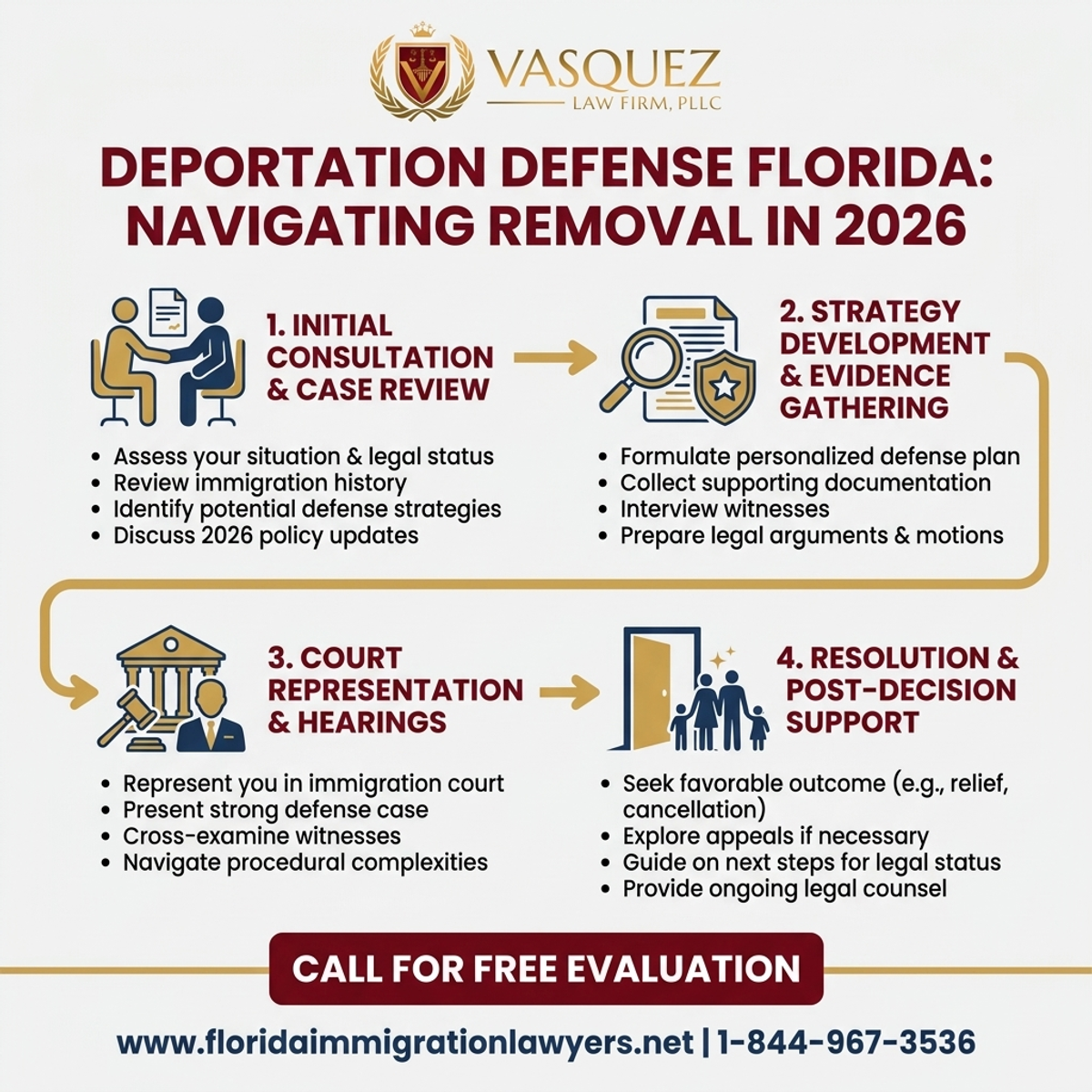
Each step requires careful preparation and adherence to strict legal procedures. Having a seasoned deportation defense attorney in Florida is paramount to successfully navigate this challenging journey, particularly in the busy Florida immigration courts.
What Documents Do I Need for a Strong Deportation Defense?
To build a robust deportation defense, it is absolutely essential to gather a comprehensive set of documents. These documents serve as critical evidence to support your claims for relief and to counter the government's allegations. Your attorney will work closely with you to identify and prepare all necessary paperwork.
Essential documents for deportation defense typically include proof of identity, evidence directly supporting your eligibility for any form of relief you are seeking, and a complete record of your immigration and, if applicable, criminal history. Organize these meticulously as even minor discrepancies can impact your case.
Key Documents Checklist:
- Identity and Nationality Documents: Passport, birth certificate, national identity card, or any other proof of your identity and country of origin.
- Proof of Entry and Immigration History: I-94 arrival/departure record, visa stamps, copies of any previous immigration applications (e.g., I-130, I-485, I-589) or petitions, Notices of Action from USCIS, and any other correspondence from immigration authorities.
- Evidence for Asylum Claims: Detailed personal statement describing fear of persecution, country conditions reports, news articles, affidavits from witnesses, and any evidence of past persecution (e.g., medical records, police reports).
- Evidence for Cancellation of Removal: Proof of continuous physical presence in the U.S. (e.g., utility bills, tax returns, employment records, school records), proof of good moral character (e.g., letters from employers, community leaders, police clearances), and extensive evidence of exceptional and extremely unusual hardship to your qualifying U.S. citizen or LPR family members (e.g., medical records, psychological evaluations, financial statements).
- Evidence for Adjustment of Status: Marriage certificate, birth certificates of U.S. citizen children or spouse, financial documents (affidavit of support), and a medical examination report.
- Criminal Records: Certified copies of all arrest records, court dispositions, and sentencing documents, even for minor offenses. This is crucial as certain convictions can make you deportable or inadmissible.
- Financial Documents: Tax returns (ITIN or SSN), bank statements, pay stubs, and employment letters, especially for demonstrating financial stability or hardship. These can also be relevant for public charge considerations.
- Witness Affidavits/Letters of Support: Statements from family, friends, employers, or community members attesting to your character, ties to the U.S., or hardship they would face if you were removed.
- Medical Records: Any documentation of health conditions, particularly if they are part of a hardship claim or an asylum claim (e.g., related to torture).
- Marriage and Birth Certificates: For all family members, especially those who are U.S. citizens or Lawful Permanent Residents, to establish qualifying relationships.
Organizing these documents thoroughly and accurately is paramount. Your deportation defense attorney in Florida will guide you through this process, ensuring no critical piece of evidence is overlooked and all submissions meet court requirements.
What is the Typical Timeline and Cost for Deportation Defense in 2026?
Understanding the potential timeline and associated costs for deportation defense is critical for planning. As of 2026, both aspects can vary significantly based on the complexity of the case, the specific immigration court's backlog, and the forms of relief pursued. Recent increases in federal confinement and legal battles over detention policies further highlight the dynamic nature of these proceedings.
Typical Timeline for Removal Proceedings (As of 2026):
Immigration court dockets, particularly in Florida, are often heavily backlogged, leading to lengthy processing times. The following table provides general estimates:
| Stage | Typical Timeframe | Notes |
|---|---|---|
| NTA to First Master Calendar Hearing | 2-12 months | Highly dependent on the court's current docket and whether the individual is detained or not. Detained cases are often expedited. |
| Master Calendar to Individual Merits Hearing | 1-3 years (or more) | This is often the longest waiting period due to heavy court backlogs, especially in active courts like Orlando Immigration Court and Miami Immigration Court. Complex cases require more time for evidence gathering. |
| Decision by Immigration Judge | Immediately after hearing or within weeks | Some judges issue oral decisions on the spot; others may reserve judgment for a written decision later. |
| Board of Immigration Appeals (BIA) Appeal | 1-3 years | Processing times for appeals can be substantial, adding significant duration to the overall case. |
| Federal Circuit Court Appeal | 2-5 years | Only pursued in very specific circumstances after BIA denial, adding further complexity and time. |
It is important to remember these are estimates. Your attorney can provide a more personalized projection based on the specifics of your case and the current conditions of the Jacksonville or Orlando immigration court dockets. Reference: 8 CFR Part 1003 (EOIR procedures).
Cost Factors and Fee Breakdown for Deportation Defense:
The cost of deportation defense is primarily composed of legal fees for attorney services and government filing fees for applications for relief. These costs can fluctuate based on several factors:
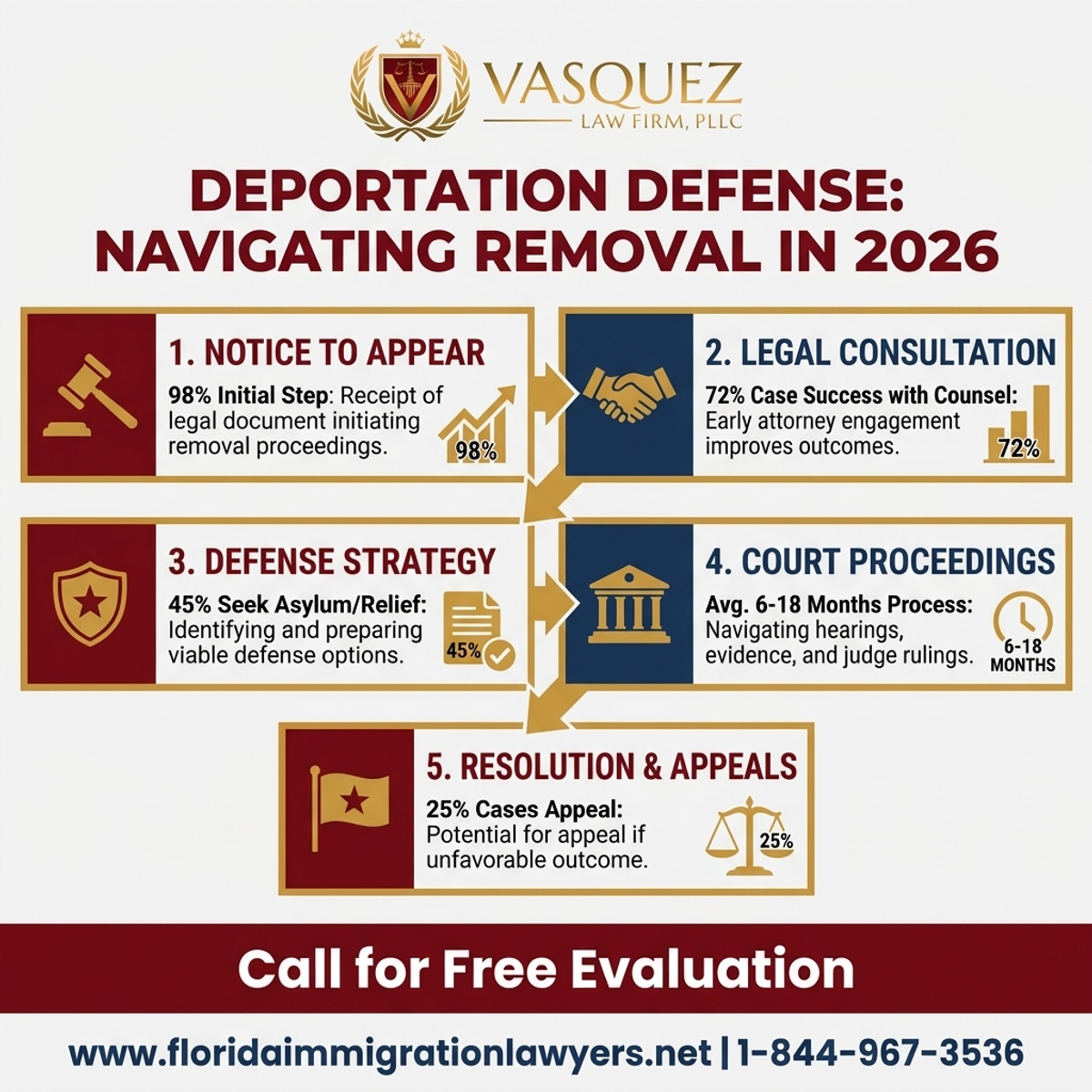
Key Statistics — Deportation Defense Attorney Florida: Navigating Removal in 2026
| Item | Typical Fee | Notes |
|---|---|---|
| Attorney Legal Fees | Varies significantly ($5,000 - $20,000+) | This is the largest component. It depends on the complexity of the case, the specific forms of relief sought, the number of hearings required, and the attorney's experience. Fees are often structured as flat fees for specific stages or as hourly rates. Many firms, including Florida Immigration Lawyers, offer payment plans. |
| USCIS Filing Fees | Varies by form (e.g., I-485, I-589) | Government fees are separate from legal fees. For example, an application for adjustment of status (Form I-485) has a substantial filing fee, while an asylum application (Form I-589) currently does not. Fee waivers may be available for certain low-income applicants for some forms. |
| Expert Witness Fees | Optional (hundreds to thousands) | If your case requires expert testimony (e.g., from a psychologist for hardship claims, or a country conditions expert for asylum), these fees are additional. |
| Translation and Interpretation Costs | Varies by document volume and hearing needs | For documents not in English, certified translations are required. While immigration courts provide interpreters, some clients prefer to bring their own for additional comfort or clarity. |
| Travel and Miscellaneous Expenses | Varies | Costs for travel to court if you live far from the immigration court in Orlando or Miami, postage, copying, and obtaining certified records. |
It is important to discuss all potential costs with your attorney during your initial consultation. While the expenses can seem significant, investing in experienced legal representation is often the best way to protect your right to remain in the U.S. Reference: 8 CFR Part 106 (USCIS fee schedule).
Do not navigate this process alone. The complexities of immigration law and the high stakes involved demand professional guidance. Contact Florida Immigration Lawyers today to discuss your specific situation and explore your defense options. We are here to help.
Common Mistakes to Avoid in Removal Proceedings
Facing deportation is a serious matter, and even minor missteps can have severe, irreversible consequences. Being aware of common pitfalls can help you avoid jeopardizing your case. An experienced deportation defense attorney in Florida can help you steer clear of these errors.
- Missing Court Deadlines or Hearings: Failing to appear for a scheduled hearing or missing a filing deadline can lead to an immediate order of removal (deportation) in absentia, often without any further opportunity to present your case.
- Failing to Disclose All Relevant Information to Your Attorney: Withholding details, especially about past criminal history, previous immigration applications, or entries/exits, can severely undermine your defense strategy and lead to unexpected complications.
- Providing False Information: Lying or submitting fraudulent documents to immigration authorities or the court is a serious offense that can lead to permanent bars from future immigration benefits and even criminal charges.
- Not Understanding the Charges Against You: The Notice to Appear can be confusing. Without understanding the specific allegations, you cannot effectively plan your defense. Always seek clarification from an attorney.
- Attempting to Represent Yourself in Immigration Court: Immigration law is incredibly complex. Representing yourself against trained government attorneys and before an Immigration Judge significantly reduces your chances of a favorable outcome.
- Not Gathering Sufficient Evidence: A strong defense relies on compelling evidence. Failing to collect all necessary documents, affidavits, and expert reports can weaken your case for relief.
- Ignoring a Notice to Appear (NTA): Some individuals mistakenly believe that if they ignore the NTA, the problem will go away. This is a critical error that almost always results in a deportation order in absentia.
- Traveling Outside the U.S. During Proceedings: Leaving the country while in removal proceedings can be seen as an abandonment of your case and may trigger an automatic order of removal, making it extremely difficult to return. Always consult your attorney before any travel.
- Assuming a Criminal Conviction is Not an Immigration Issue: Many criminal offenses, even seemingly minor ones, can have severe immigration consequences, including making you deportable or inadmissible. Always consult an immigration attorney if you have any criminal history.
- Not Updating Your Address with EOIR: If you move, you must notify the immigration court (EOIR) of your new address immediately. Failure to do so means you might not receive vital court notices, leading to missed hearings and potential deportation orders.
- Failing to Seek a Bond Hearing When Detained: If detained by ICE, not actively pursuing a bond hearing with legal assistance means you could remain in custody for months or even years while your case progresses, impacting your ability to prepare your defense.
- Signing Documents Without Understanding Them: Never sign any immigration document presented by an officer without fully understanding its contents and implications. You could inadvertently waive critical rights or agree to voluntary departure without realizing the consequences.
When to Call a Deportation Defense Lawyer in Florida
The time to contact a deportation defense attorney in Florida is as soon as you become aware of any situation that could lead to your removal from the United States. Early intervention by legal counsel can significantly impact the outcome of your case. Do not wait for a crisis to unfold; proactive legal guidance is always the best strategy.
You should immediately call Florida Immigration Lawyers if:
- You have received a Notice to Appear (NTA): This is the official start of removal proceedings. An attorney can help you understand the charges and prepare your defense from day one.
- You or a family member has been detained by ICE: Detention significantly complicates matters. An attorney can work to secure release through a bond hearing and ensure your rights are protected while in custody.
- You fear persecution or torture in your home country: If you believe you are eligible for asylum or other forms of protection, an attorney can help you file the necessary applications and present a compelling case.
- You have a criminal record: Even minor criminal offenses can have severe immigration consequences. An attorney can assess the impact of your record and identify potential waivers or defense strategies.
- Your visa has been canceled or revoked: This often leads to removal proceedings.
- You have been denied an immigration benefit (e.g., green card, visa) and fear further action: A denial can sometimes trigger removal proceedings.
- You have a previous order of deportation or removal: Reopening old cases or seeking new forms of relief requires specialized legal knowledge.
- You are confused by immigration documents or communications: The language used by immigration agencies can be complex. An attorney can clarify your situation and advise on the appropriate response.
- You are considering traveling outside the U.S. while in an uncertain immigration status: Always consult an attorney before international travel to avoid issues at the border or being barred from re-entry.
Warning signs like receiving official letters from ICE or USCIS, being questioned by immigration officers, or learning about changes in immigration policy that might affect you, are all indicators that you should seek legal advice. Florida Immigration Lawyers serves clients across the entire state, including Orlando, offering dedicated support for all your immigration defense needs.
About Florida Immigration Lawyers
Florida Immigration Lawyers is a leading immigration law firm dedicated to serving individuals and families across the entire state of Florida. With a deep understanding of the complexities of U.S. immigration law, our experienced attorneys provide comprehensive legal services tailored to meet the unique needs of each client. We are committed to protecting your rights and helping you achieve your immigration goals, whether you are seeking deportation defense, asylum, family-based visas, or U.S. citizenship.
Our firm is founded on principles of integrity, empathy, and unwavering advocacy. We believe that everyone deserves exceptional legal representation, especially when facing life-altering immigration challenges. We offer free consultations to assess your case and provide clear, honest advice on your best path forward. Available 24/7, our team is always ready to provide the timely and effective legal support you need. We proudly offer bilingual services, with a dedicated team ready to assist our Spanish-speaking clients. When your future in the U.S. is on the line, trust Florida Immigration Lawyers to be your steadfast advocates.
Contact us today for a free consultation: 1-844-967-3536 or visit our website at www.floridaimmigrationlawyers.net.
Sources and References
- U.S. Citizenship and Immigration Services (USCIS)
- Executive Office for Immigration Review (EOIR)
- U.S. Department of State (Travel.State.Gov)
- 8 U.S.C. Chapter 12 - Immigration and Nationality Act (INA), particularly Section 240 (8 U.S.C. § 1229a) - Removal Proceedings
- 8 CFR Part 1003 - Executive Office for Immigration Review (EOIR) Procedures
- 8 CFR Part 106 - USCIS Fee Schedule
Related services: immigration waivers, humanitarian protection programs, DACA renewal and applications, temporary protected status (TPS).
This article provides general legal information and is not intended as legal advice. Every case is unique, and outcomes depend on specific facts and circumstances. Contact an attorney for advice about your particular situation.
Your future in the United States is too important to leave to chance. If you or a loved one is facing deportation, securing experienced legal representation is not just recommended, it's essential. Florida Immigration Lawyers is here to fight for you. Contact us today for a free, confidential consultation. Call 1-844-967-3536 now. Se Habla Espanol - Estamos aqui para ayudarle.
If you need legal assistance, learn more about speak with a deportation defense lawyer, or call us at 1-844-967-3536 for a free consultation.
Do Not Navigate This Process Alone
Our experienced immigration attorneys are ready to fight for you. Get a free, confidential case review today.
Se Habla Español
Or leave your details and we’ll call you:
Free Evaluation in 24 Hours
Or talk to us right now

AI voice assistant — available 24/7
FreeFrequently Asked Questions

William J. Vásquez
Founding Attorney · Vasquez Law Firm
U.S. Air Force veteran and immigration attorney with years of hands-on U.S. immigration experience. J.D., NCCU School of Law. AILA member. Admitted to the 4th, 5th, and 11th Circuit Courts.
Available 24/7 - Free Evaluations
Reviewed for legal accuracy by William J. Vásquez
Licensed in North Carolina; U.S. immigration is federal practice.
Related Legal Services
Our Florida immigration attorneys can help you with business immigration, deportation defense and family immigration services. Call today at 1-844-967-3536 for a free case review.
Related Links
Related Topics
Free Legal Case Review
Discuss your case with our experienced attorneys. We're available 24/7.
Se Habla Español - Estamos aquí para ayudarle.
Related Articles
Immigration Lawyer Orlando Free Consultation in Florida
For individuals and families in Orlando, Florida, navigating the complexities of U.S. immigration law requires expert guidance. An immigration lawyer in Orlando offers crucial support for everything from visa applications and green card processes to naturalization and deportation defense. This comprehensive guide details what a free consultation covers, providing a step-by-step overview of immigration pathways, essential document checklists, and expected timelines in 2026. We also highlight common mistakes to avoid, discuss the critical role of legal counsel in deportation and asylum cases, and explain why choosing a local Orlando immigration attorney is beneficial. Florida Immigration Lawyers is dedicated to serving the diverse community of Orlando with compassionate, effective legal solutions, ensuring you receive personalized advice and robust representation for a successful immigration journey.
Orlando Cancellation of Removal Attorney: Your Guide
Facing deportation in Orlando, Florida? Learn about cancellation of removal, a form of relief available in immigration court. Understand eligibility requirements, application processes, and the importance of legal representation. Discover common mistakes to avoid and when to seek legal help. Call Florida Immigration Lawyers for expert guidance.
K3 Visa Processing Time 2026: Your Florida Guide
For U.S. citizens in Florida hoping to reunite with their foreign spouses, understanding the K3 visa processing time in 2026 is essential. This non-immigrant visa allows spouses to enter the U.S. while their immigrant visa petition (Form I-130) is pending, bridging the gap to permanent residency. While processing times for the K-3 visa can range from 12 to 24 months, various factors, including USCIS caseloads and the completeness of your application, play a significant role. This comprehensive guide details K-3 visa eligibility, the step-by-step application process, required documentation, and associated costs. We also address how the Visa Bulletin and priority dates factor into the subsequent adjustment of status. Navigating this intricate legal journey requires precision and expertise. Florida Immigration Lawyers is here to provide the support and guidance you need, ensuring your application is meticulously prepared and strategically managed. Don't hesitate to reach out for a free case review to discuss your specific circumstances and plan your path forward.
Florida Refugee Immigration Help: 2026 Guide
For those seeking Florida refugee immigration help, understanding the path to safety and resettlement is critical. Refugee status is granted to individuals facing persecution in their home countries, and the process typically begins overseas, involving referrals from UNHCR or U.S. Embassies. This guide clarifies eligibility criteria, the multi-step application process, and the vital role of resettlement agencies in Florida, particularly in the Orlando area. We detail the necessary documentation, provide an estimated timeline for the various stages, and break down potential costs, emphasizing that government application fees for refugees are generally waived. Avoiding common mistakes like inconsistent information or missed deadlines is paramount. Florida Immigration Lawyers offers compassionate, expert legal counsel to navigate these complexities, from preparing for USCIS interviews to addressing family reunification concerns. We are dedicated to advocating for your rights and helping you build a secure future in Florida. Contact us for a free case review.