U Visa Crime Victims Immigration Relief in Florida
Discover how the U visa provides essential immigration relief for crime victims in Florida, helping them gain stability and safety. Learn about eligibility, application steps, and how Florida Immigration Lawyers can assist you.

U Visa Crime Victims Immigration Relief in Florida
For immigrants in Florida who have been victims of serious crimes, the U Nonimmigrant Status, commonly known as the U Visa, offers a beacon of hope and a pathway to legal residency. This crucial humanitarian relief provides protection and a chance to rebuild lives for those who have suffered substantial physical or mental abuse and are willing to assist law enforcement in the investigation or prosecution of criminal activity. Understanding the intricacies of the U Visa process is vital, especially in a diverse state like Florida, where immigrant communities are a significant part of the social fabric.
Understanding the U Visa: A Shield for Victims
The U Visa was created by Congress with the passage of the Victims of Trafficking and Violence Protection Act (VTVPA) in October 2000. Its primary purpose is twofold: to protect non-citizen victims of certain crimes and to strengthen the ability of law enforcement agencies to investigate and prosecute those crimes. By offering a legal status, the U Visa encourages victims, who might otherwise fear deportation, to come forward and cooperate with authorities without fear of immigration consequences. This cooperation is critical in bringing criminals to justice and making our communities safer. It's an essential component of broader immigration relief efforts.
Eligibility Criteria for U Visa Applicants in Florida
To qualify for a U Visa, an applicant must meet several strict requirements. Navigating these criteria can be complex, and it's where the expertise of an immigration attorney becomes invaluable. The four main eligibility requirements are:
-
Victim of a Qualifying Criminal Activity:
The applicant must have been a victim of specific criminal activities. These include, but are not limited to, domestic violence, sexual assault, trafficking, torture, blackmail, kidnapping, abduction, felonious assault, murder, manslaughter, witness tampering, obstruction of justice, and other related crimes. The crime must have occurred in the United States or violated U.S. law. It's important to note that the list of qualifying crimes is extensive, and understanding if your specific situation fits can be challenging without legal guidance.
-
Suffered Substantial Physical or Mental Abuse:
As a direct result of the qualifying criminal activity, the applicant must have suffered substantial physical or mental abuse. This is not always easy to quantify and often requires documentation, such as medical records, psychological evaluations, police reports, and personal affidavits detailing the impact of the crime. The severity of the abuse is assessed on a case-by-case basis, considering factors like the nature of the injury, the severity of the crime, and the duration of the abuse.
-
Possession of Information and Helpfulness to Law Enforcement:
The applicant must possess information concerning the criminal activity and have been helpful, is being helpful, or is likely to be helpful to a federal, state, or local law enforcement agency, prosecutor, judge, or other authority investigating or prosecuting the crime. This is a crucial element, as the U Visa is designed to encourage cooperation. Simply being a victim is not enough; active participation in the investigative or prosecutorial process is required. This cooperation can take many forms, from providing statements to testifying in court.
-
Admissibility to the United States:
Applicants must generally be admissible to the United States. If an applicant has certain inadmissibility grounds (e.g., prior deportations, criminal convictions unrelated to the victimization), they may need to file a Form I-192, Application for Advance Permission to Enter as a Nonimmigrant, to waive these grounds. Waivers are often granted for U Visa applicants due to the humanitarian nature of the relief, but they are not guaranteed and require a compelling case.
The Critical Role of Law Enforcement Certification
One of the most unique and critical components of the U Visa application is the law enforcement certification. This involves obtaining a signed certification from a qualifying official (such as a police chief, sheriff, prosecutor, or judge) confirming that the applicant was a victim of a qualifying crime and has been, is being, or is likely to be helpful in the investigation or prosecution of that crime. This document, typically Form I-918, Supplement B, is paramount. Without it, the application cannot proceed. Securing this certification can be a challenging step, as it requires effective communication and collaboration with law enforcement agencies, which may have varying levels of familiarity with the U Visa process. An experienced attorney can often facilitate this communication and ensure the certification accurately reflects the applicant's cooperation.
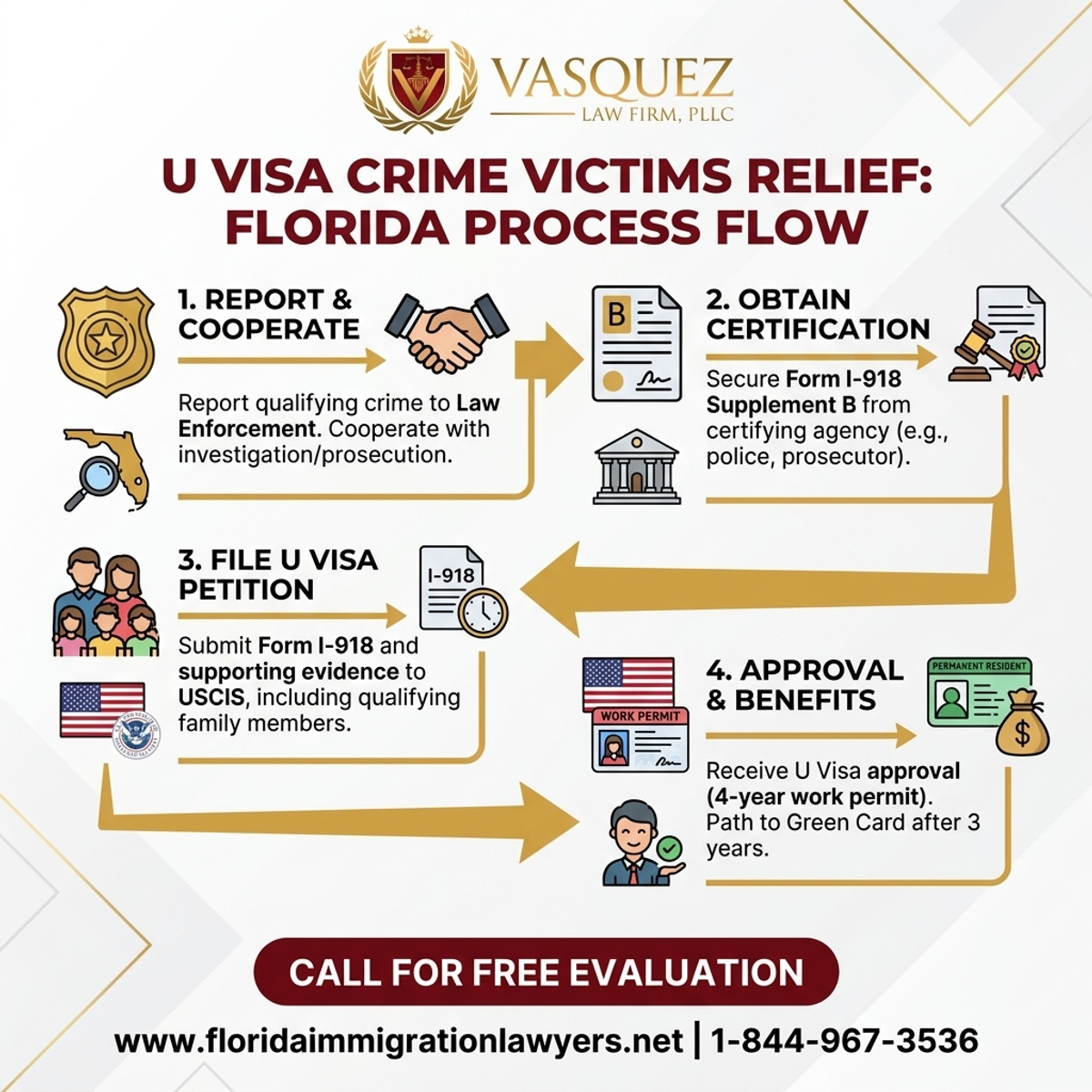
Step-by-Step Process — U Visa Crime Victims Immigration Relief in Florida
The Application Process: A Step-by-Step Guide
Applying for a U Visa involves several key steps:
- Gathering Documentation: This includes personal identification, evidence of the crime (police reports, court documents), medical and psychological evaluations, and affidavits from the applicant and witnesses.
- Obtaining Law Enforcement Certification: As discussed, this is a crucial step that often requires persistent follow-up and clear communication with the certifying agency.
- Filing Form I-918, Petition for U Nonimmigrant Status: This is the main application form, submitted to USCIS, along with all supporting documentation, including the law enforcement certification.
- Filing Form I-918, Supplement A (for family members): Eligible family members (spouse, children, parents, siblings depending on the principal applicant's age) can be included in the same petition.
- Filing Form I-765, Application for Employment Authorization: This allows applicants to obtain work authorization while their U Visa petition is pending, offering immediate relief.
- Waiting List and Deferred Action: Due to an annual cap of 10,000 U Visas, many applicants are placed on a waiting list. While on the waiting list, applicants often receive deferred action, which protects them from deportation and grants work authorization until a U Visa becomes available.
The entire process can be lengthy, often taking several years from initial filing to final approval. Patience and consistent legal guidance are essential.
Benefits of U Visa Status
Receiving a U Visa offers significant benefits:
- Legal Status: It provides temporary legal status in the U.S. for four years.
- Work Authorization: U Visa holders are eligible for work authorization, allowing them to legally work and support themselves and their families.
- Protection from Deportation: It offers protection from removal proceedings.
- Path to Green Card: After three years in U status, holders can apply for lawful permanent residency (a Green Card), provided they meet certain conditions.
- Derivative Benefits for Family: Spouses, children, and in some cases, parents and unmarried siblings of the principal applicant can also obtain U Nonimmigrant Status.
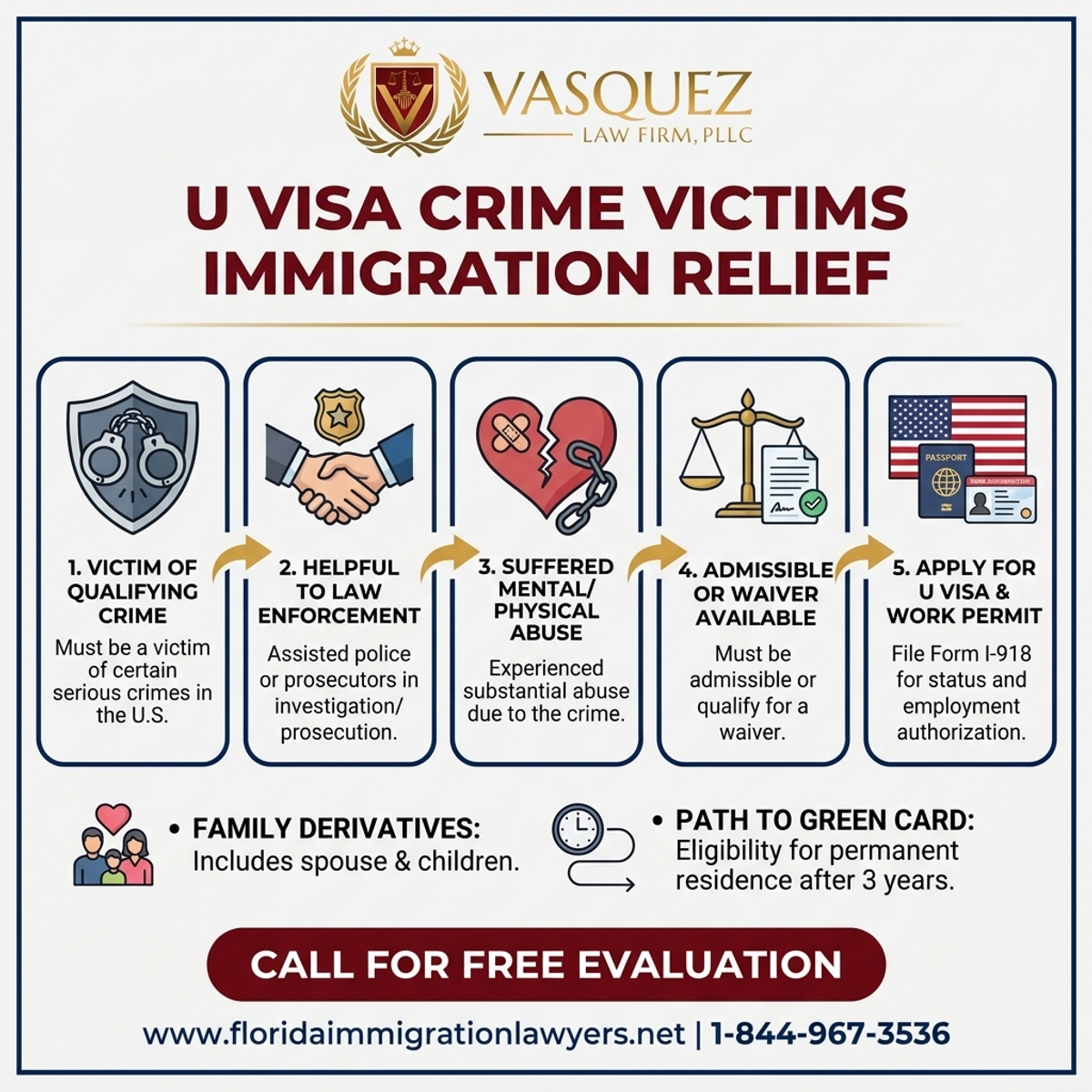
Key Statistics — U Visa Crime Victims Immigration Relief in Florida
Life After U Visa Approval: Path to Permanent Residency
Obtaining U Visa status is a significant milestone, but for many, it's a stepping stone towards a more permanent future in the United States. After holding U Nonimmigrant Status for three continuous years, U Visa holders become eligible to apply for Adjustment of Status to become lawful permanent residents (Green Card holders). This is a crucial phase that requires careful planning and adherence to specific requirements.
To adjust status, the U Visa holder must demonstrate:
- Continuous Physical Presence: They must have been continuously physically present in the United States for a period of at least three years since the date of initial admission as a U nonimmigrant. Brief, casual, and innocent departures from the U.S. generally do not break continuous physical presence.
- No Unreasonable Refusal to Cooperate: They must not have unreasonably refused to provide assistance in the investigation or prosecution of the qualifying criminal activity since obtaining U nonimmigrant status. Continued cooperation with law enforcement, if requested, is expected.
- Humanitarian Grounds, Public Interest, or Family Unity: USCIS must determine that their presence in the United States is justified on humanitarian grounds, to ensure family unity, or is otherwise in the public interest. This is a discretionary determination, and a strong application highlighting the applicant's contributions and ties to the community is beneficial.
- Admissibility: The applicant must still be admissible to the United States for permanent residency. While many grounds of inadmissibility may have been waived for the U Visa, new issues or previously undisclosed issues could arise.
The application for adjustment of status is filed using Form I-485, Application to Register Permanent Residence or Adjust Status. This process involves submitting extensive documentation, attending an interview with USCIS, and undergoing background checks. Successfully navigating this final step can lead to the coveted Green Card, offering stability, security, and the full rights of a lawful permanent resident. It's a testament to the U Visa's purpose: not just to protect victims, but to offer them a true opportunity for a new life.
Common Challenges and How to Overcome Them
Despite its protective intent, the U Visa process is fraught with potential challenges. Delays are common due to the annual cap and extensive background checks. Obtaining the law enforcement certification can be difficult, as agencies may be unfamiliar with the process or overwhelmed with their own caseloads. Furthermore, demonstrating 'substantial' abuse and 'helpfulness' requires compelling evidence and often subjective interpretation. Applicants might also face issues with inadmissibility or maintaining continuous physical presence. Working with an experienced immigration attorney is crucial to anticipate these hurdles, prepare robust documentation, and advocate effectively on the applicant's behalf, increasing the likelihood of a successful outcome.
U Visa vs. Other Humanitarian Reliefs (VAWA, T Visa, Asylum)
It's important for victims of crime to understand that the U Visa is one of several humanitarian immigration options available. Other forms of relief include:
- VAWA (Violence Against Women Act): Provides a pathway to legal status for victims of domestic violence (spouses, children, or parents) by U.S. citizens or lawful permanent residents, allowing them to self-petition without the abuser's knowledge or cooperation.
- T Visa (Victims of Human Trafficking): Specifically designed for victims of severe forms of human trafficking who are willing to assist law enforcement in the investigation and prosecution of trafficking cases.
- Asylum: Available to individuals who have suffered persecution or have a well-founded fear of persecution in their home country based on race, religion, nationality, political opinion, or membership in a particular social group.
Each of these options has distinct eligibility criteria and benefits. A thorough assessment of a victim's unique circumstances is necessary to determine the most appropriate and effective form of relief. An immigration expert can help clarify which path offers the best chance for protection and stability.
Why Expert Legal Representation is Crucial in Florida
The U Visa application process is complex, requiring a deep understanding of immigration law, meticulous documentation, and effective communication with various agencies. For crime victims in Florida, securing experienced legal representation is not just beneficial, but often essential for success. An immigration attorney specializing in U Visas can:
- Assess eligibility and identify potential challenges.
- Assist in gathering crucial evidence, including medical records and police reports.
- Facilitate communication and secure the necessary law enforcement certification.
- Prepare and submit a comprehensive and compelling petition to USCIS.
- Represent clients in interviews and respond to requests for evidence.
- Provide guidance on related issues, such as work authorization and adjustment of status.
- Offer compassionate support throughout what can be a traumatic and lengthy process.
Given the high stakes involved – safety, legal status, and the chance for a new life – entrusting your case to knowledgeable professionals can make all the difference.
Conclusion & Your Next Steps
The U Visa offers a vital lifeline for crime victims in Florida, providing protection, a path to work authorization, and ultimately, an opportunity for permanent residency. While the process is challenging, it is a powerful tool for justice and healing. If you or someone you know has been a victim of a qualifying crime and is willing to cooperate with law enforcement, exploring the U Visa option is a critical step towards securing your future.
Don't navigate this complex journey alone. Our dedicated team of immigration attorneys in Florida is here to provide the expert guidance and compassionate support you need. We offer free consultations to assess your unique situation and explain your options. Take the first step towards safety and stability today.
Free consultation — call (844) 967-3536 or contact us online to schedule your appointment.
Sources and References
- U.S. Citizenship and Immigration Services (USCIS)
- Executive Office for Immigration Review (EOIR)
- U.S. Department of State - Bureau of Consular Affairs
- Immigration and Nationality Act (INA), 8 U.S.C. Chapter 12
Do Not Navigate This Process Alone
Our experienced immigration attorneys are ready to fight for you. Get a free, confidential consultation today.
Se Habla Español
Frequently Asked Questions
Harold Estrada-Rodriguez
Florida Immigration Attorney · FL Bar No. 1041171
Florida Bar attorney handling Florida-jurisdiction immigration matters. Bilingual representation, free consultations.
Available 24/7 - Free Evaluations
Related Legal Services
Our Florida immigration attorneys can help you with deportation defense, citizenship and naturalization and family immigration services. Call today at 1-844-967-3536 for a free consultation.
Related Links
Related Topics
Free Legal Consultation
Discuss your case with our experienced attorneys. We're available 24/7.
Se Habla Español - Estamos aquí para ayudarle.
Related Articles
OPT STEM Extension Florida: Guide for Graduates 2026
For Florida F-1 graduates with a STEM degree, the 24-month OPT STEM extension is a critical opportunity to gain further work experience in the U.S. This comprehensive guide for 2026 details eligibility, the step-by-step application process, required documents, and expected timelines. We cover common mistakes to avoid and explain when seeking legal counsel from Florida Immigration Lawyers can be invaluable. From verifying your STEM eligibility to understanding USCIS fees and processing, this article provides essential information for international students in Kissimmee, Orlando, and across Florida. Learn how to secure your extended work authorization and continue building your career in the Sunshine State.
H-4 EAD: Spouse Work Permit for H-1B Families in Florida
The H-4 EAD provides crucial work authorization for eligible spouses of H-1B visa holders, enabling them to pursue employment or start businesses across Florida, from Hialeah to Orlando. This guide from Florida Immigration Lawyers details eligibility criteria, the step-by-step application process for Form I-765, required documentation, and current processing timelines as of 2026. We also cover associated costs, the scope of work authorization including entrepreneurship, and how to avoid common application mistakes. Understanding these rules is vital for H-1B families seeking to enhance their financial stability and professional growth in the U.S. Contact Florida Immigration Lawyers for a free consultation to navigate your H-4 EAD application with confidence.
Green Card Through Marriage in Florida | VLF Florida
Learn how to obtain a green card through marriage in Florida. Discover the qualifications, steps, common mistakes, and when to seek legal help. Call Florida Immigration Lawyers for a free consultation.
DACA Work Permit Process in Florida 2026 | VLF Florida
Explore the process of obtaining a DACA work permit in Florida. This guide covers eligibility, application steps, and common mistakes to avoid. Call Florida Immigration Lawyers for expert assistance.
