Adjustment of Status Venice Florida: Your 2026 Guide
For individuals in Venice, Gainesville, and across Florida, understanding the adjustment of status process is key to securing permanent residency. This comprehensive guide details who is eligible, the step-by-step application process for Form I-485 in 2026, and the essential documents required. We cover typical timelines, associated costs, and what to expect during a USCIS interview, providing a clear roadmap. Learn about common mistakes to avoid that could jeopardize your application and identify when professional legal assistance from Florida Immigration Lawyers is crucial. Our firm provides guidance for your green card journey, ensuring you navigate the complexities with confidence.

Quick Answer: Adjustment of Status in Florida
Adjustment of Status (AoS) allows eligible individuals already present in the U.S. to obtain lawful permanent resident status (a green card) without leaving the country. For residents in Venice, Gainesville, and across Florida, this process typically involves filing Form I-485, undergoing a medical examination, attending a biometrics appointment, and potentially an interview at a USCIS field office. Eligibility hinges on a valid immigrant petition, lawful entry, and meeting specific criteria under the Immigration and Nationality Act. As of 2026, navigating this complex process often benefits from experienced legal counsel.
- AoS grants green card status without leaving the U.S.
- Requires filing Form I-485 and supporting documents.
- Eligibility includes a valid immigrant petition and lawful entry.
- Process involves biometrics, medical exam, and a potential interview.
- Legal guidance is highly recommended for Florida applicants.
Are you living in Venice, Gainesville, or anywhere across Florida and dreaming of permanent residency in the United States? The path to a green card can seem daunting, but for many, adjustment of status offers a direct route to achieving that dream without the need to leave the country. This crucial immigration process allows eligible individuals who are already present in the U.S. to apply for lawful permanent resident status. Understanding the intricacies of this process, especially as it applies to Florida residents, is essential for a successful application.
As an immigration law firm serving all of Florida, Florida Immigration Lawyers understands the unique challenges and opportunities faced by immigrants in our diverse state. This comprehensive guide will walk you through everything you need to know about adjustment of status, covering eligibility, the application process, required documents, timelines, and common pitfalls to avoid. Our goal is to empower you with the knowledge to navigate this journey with confidence, ensuring you understand every step towards securing your future in Florida.
Do not navigate this complex journey alone. For personalized guidance and to discuss your specific situation, call Florida Immigration Lawyers at 1-844-YO-PELEO for a free consultation today. Our experienced team is ready to help you understand your options and achieve your immigration goals.
What is Adjustment of Status and Who is Eligible in Florida?
Adjustment of Status (AoS) is the legal procedure that allows an eligible non-citizen physically present in the United States to apply for lawful permanent resident status (a green card) without having to return to their home country to complete visa processing. This is a critical distinction from consular processing, which requires applicants to attend an interview at a U.S. consulate or embassy abroad. For individuals residing in Florida, including communities like Venice and Gainesville, AoS offers a streamlined pathway to permanent residency, provided they meet specific criteria.
Eligibility for adjustment of status is primarily governed by Section 245(a) of the Immigration and Nationality Act (INA), found at 8 U.S.C. § 1255. Generally, applicants must have been inspected and admitted or paroled into the U.S., be the beneficiary of an approved immigrant visa petition (such as Form I-130 for family-based or Form I-140 for employment-based immigration), and have an immigrant visa immediately available to them at the time of filing their Form I-485 application. Certain categories, such as immediate relatives of U.S. citizens, often have visas immediately available. Additionally, applicants must not be subject to any bars to adjustment, such as engaging in unauthorized employment or having a criminal record, unless a waiver or specific exception applies. Florida's vibrant immigrant communities mean a wide range of family and employment-based cases are pursued, making understanding these eligibility requirements paramount.
For individuals in Florida, the ability to adjust status means avoiding the often-lengthy and uncertain process of leaving the U.S. and reapplying from abroad, which can be particularly challenging if one has established deep roots here. This process is available to various categories of immigrants, including immediate relatives of U.S. citizens (spouses, unmarried children under 21, and parents), other family-sponsored immigrants (under preference categories), employment-based immigrants, asylees, refugees, and certain special immigrants. Each category has its own specific requirements and nuances, emphasizing the importance of a thorough eligibility assessment. USCIS field offices in Florida, such as those in Orlando, Miami, and Tampa, handle many of these interviews, requiring applicants to be prepared for local procedures.
How Do I Apply for Adjustment of Status (Form I-485) in 2026?
To apply for Adjustment of Status (AoS) in 2026, you will primarily need to file Form I-485, Application to Register Permanent Residence or Adjust Status, along with a significant packet of supporting documentation, after an immigrant visa petition has been approved and a visa is immediately available. The process is meticulous and requires careful attention to detail.
The application process for adjustment of status is a multi-step journey designed to verify your eligibility for permanent residency. As of 2026, the general steps remain consistent across the U.S., including for applicants in Florida. The first critical step is to ensure that an immigrant visa petition has been filed and approved on your behalf. This could be a Form I-130, Petition for Alien Relative, filed by a U.S. citizen or lawful permanent resident family member, or a Form I-140, Immigrant Petition for Alien Worker, filed by an employer. In some cases, such as for asylees, the underlying petition might be Form I-589, Application for Asylum and for Withholding of Removal. Once the underlying petition is approved and your priority date is current (meaning a visa is immediately available), you can proceed with filing your Form I-485 application. This concurrent filing is permitted for immediate relatives of U.S. citizens, simplifying the process by allowing the I-130 and I-485 to be filed together.
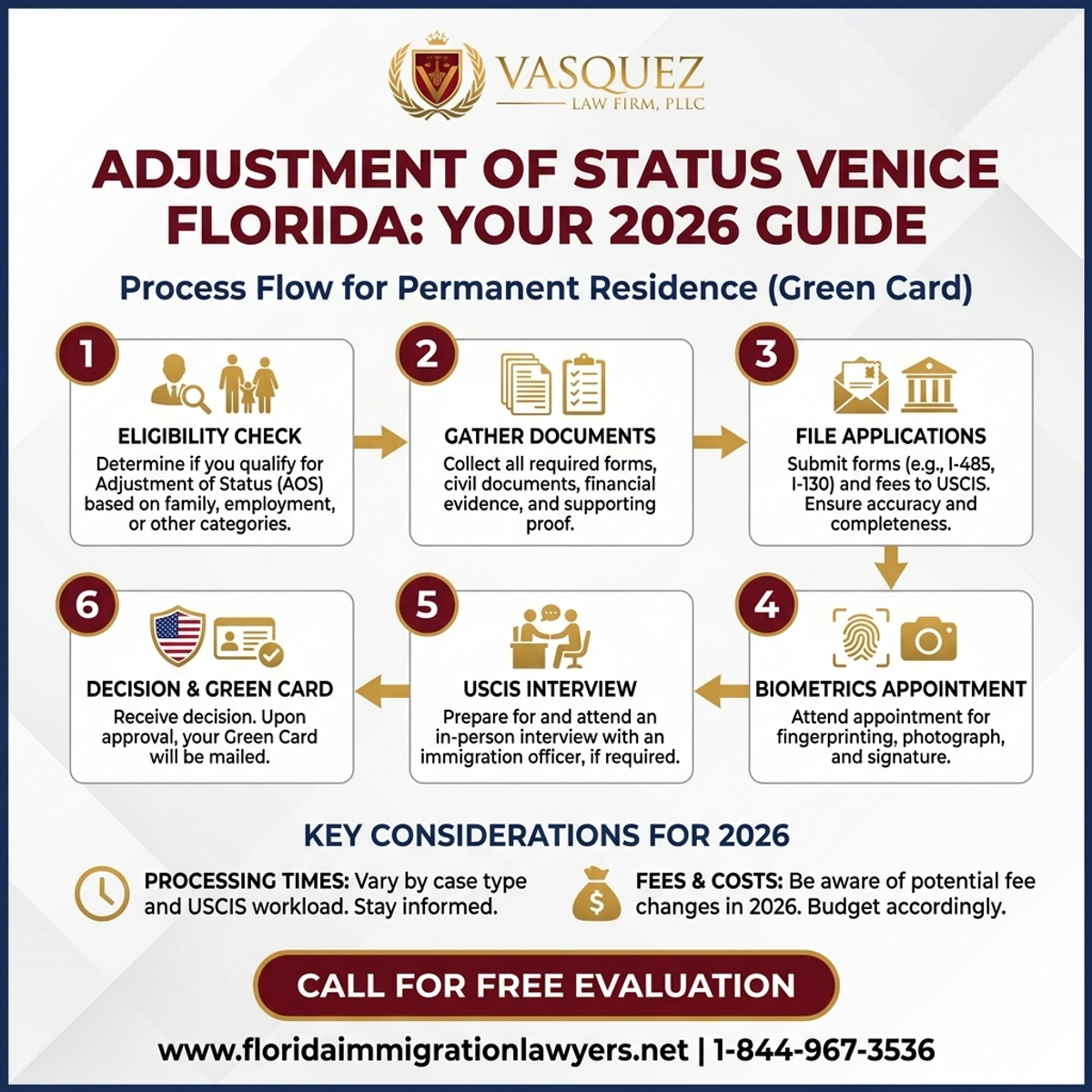
Step-by-Step Process — Adjustment of Status Venice Florida: Your 2026 Guide
- Establish Eligibility and Underlying Visa Petition: Ensure you meet the basic eligibility criteria for AoS, including lawful entry into the U.S. and that an immigrant visa petition (e.g., I-130, I-140) has been approved or is being filed concurrently. Verify that an immigrant visa is immediately available for your category, typically by checking the Department of State Visa Bulletin.
- Gather All Required Documents: This is arguably the most time-consuming step. You will need personal documents, financial evidence, medical records, and more. A comprehensive checklist is provided in the next section.
- Complete and File Form I-485 Packet: This includes Form I-485 itself, along with various supplementary forms like Form I-765 (Application for Employment Authorization, EAD) and Form I-131 (Application for Travel Document, Advance Parole), if you wish to work or travel while your application is pending. Ensure all forms are accurately filled out and signed, and all required filing fees are included. Mail the complete packet to the appropriate USCIS lockbox facility.
- Receive Biometrics Appointment Notice: After USCIS receives your application, you will typically receive a receipt notice, followed by an appointment notice for biometrics (fingerprints, photos, and signature). This appointment will be at a local Application Support Center (ASC) in Florida.
- Attend Interview (If Required): Many applicants, especially those based on family petitions, will be scheduled for an interview at a USCIS field office in Florida (e.g., Orlando, Miami, Tampa). During the interview, an immigration officer will review your application and documents and ask questions to confirm your eligibility.
- Receive Decision: Following the interview, USCIS will make a decision on your application. If approved, you will receive your green card in the mail. If denied, you will receive a written explanation, and in some cases, you may be able to appeal or refile.
What Documents Do I Need for an I-485 Application in Florida?
For an I-485 application in Florida, you will need to compile a comprehensive packet of documents to establish your identity, eligibility, and admissibility. This includes personal identification, proof of the underlying immigrant petition, financial support, and medical clearance. Missing or incorrect documents can significantly delay your application or lead to a denial.
Gathering the correct documentation is a critical phase for anyone applying for adjustment of status in Florida. USCIS requires a thorough submission to ensure all eligibility criteria are met and to prevent fraud. It is essential to provide certified copies of all original documents unless USCIS specifically requests originals. For any documents not in English, you must provide a certified English translation. This applies to all applicants, whether they are in Gainesville, Venice, or other parts of the state. Starting early and organizing your documents systematically can help avoid common errors and delays.
Key Documents for Your I-485 Packet:
- Two passport-style photos.
- Copy of government-issued identity document with photograph.
- Copy of your birth certificate.
- Copy of your passport page with nonimmigrant visa (if applicable).
- Copy of your passport page with admission or parole stamp (Form I-94, Arrival/Departure Record).
- Copy of the approval notice for the immigrant petition (Form I-797, Notice of Action), if already approved.
- Form I-864, Affidavit of Support (for family-based applications), along with supporting financial documents from the sponsor.
- Form I-693, Report of Medical Examination and Vaccination Record, completed by a USCIS-authorized civil surgeon.
- Certified copies of court and police records, if you have any arrests or convictions.
- Form I-765, Application for Employment Authorization (optional, but highly recommended).
- Form I-131, Application for Travel Document (optional, for Advance Parole).
- Marriage certificate (if applicable).
- Divorce decrees or death certificates (for previous marriages, if applicable).
- Evidence of continuous lawful presence since entry (e.g., old I-94s, visa stamps, school records).
What is the Timeline for Adjustment of Status in Florida in 2026?
The timeline for Adjustment of Status (AoS) in Florida in 2026 can vary significantly based on the specific USCIS field office (e.g., Orlando, Miami, Tampa), the type of underlying petition, and current caseloads. While some cases, particularly for immediate relatives, might be processed within 8-14 months, others can take several years, especially if there are complexities or backlogs in preference categories.
As of 2026, predicting the exact processing time for an adjustment of status application can be challenging due to various factors. USCIS continually updates its processing times, which are accessible on their website and are often broken down by form type and specific service center or field office. For applicants in Florida, the specific USCIS field office jurisdiction (e.g., Orlando, Miami, Tampa) can influence how quickly an interview is scheduled and a decision is rendered. Cases based on family petitions, particularly for immediate relatives of U.S. citizens, generally have shorter waiting periods compared to preference categories that are subject to visa availability according to the Visa Bulletin. Complex cases involving waivers, criminal histories, or extensive requests for evidence (RFEs) will naturally take longer. It is crucial to monitor USCIS processing times and respond promptly to any requests for additional information.
Understanding the typical stages and their general durations can help manage expectations:
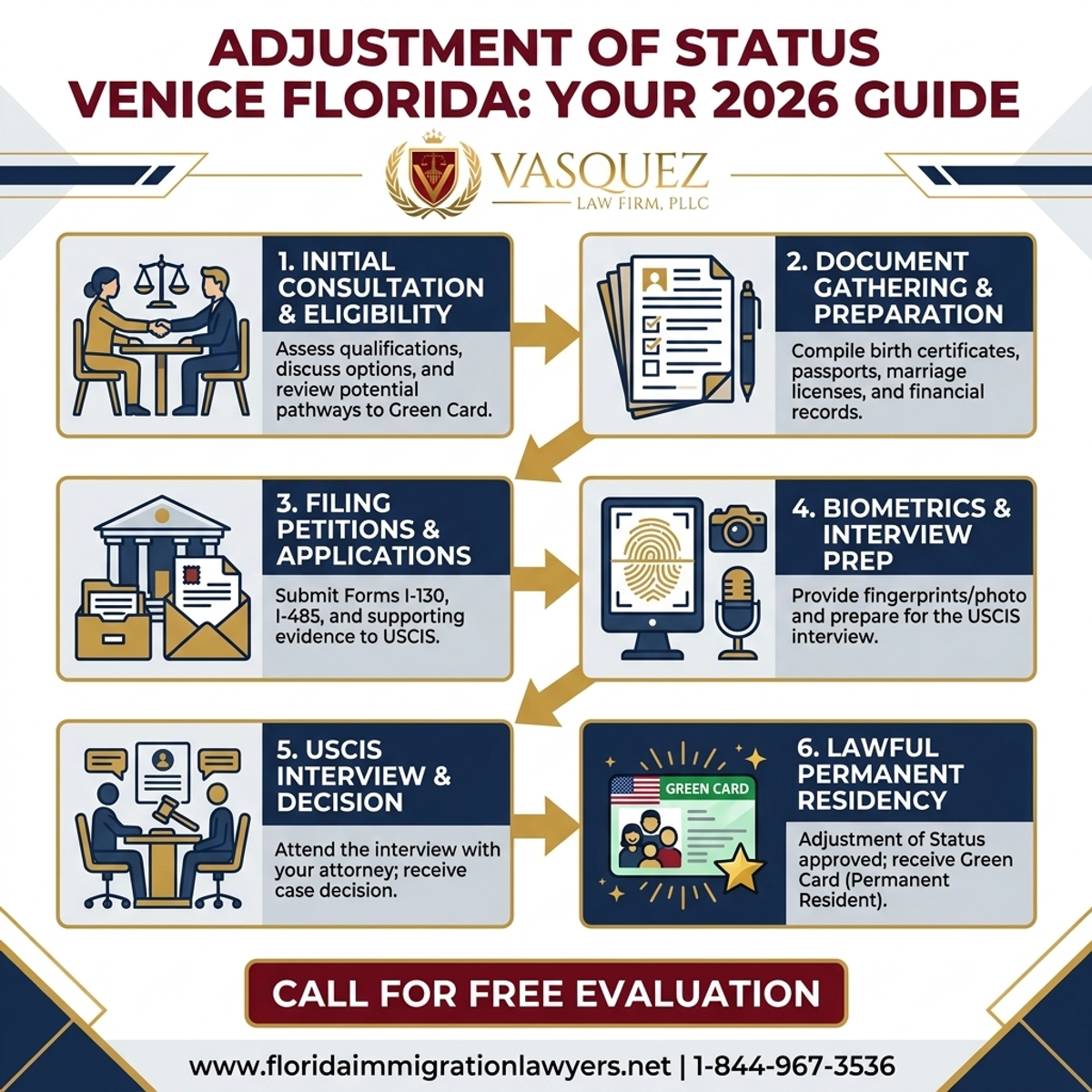
Key Statistics — Adjustment of Status Venice Florida: Your 2026 Guide
| Stage | Typical Timeframe (As of 2026) | Notes |
|---|---|---|
| Filing I-130 / I-140 Petition | 6-18 months | Varies by petition type and service center. Immediate relatives may file I-130 and I-485 concurrently. |
| Filing I-485 Application | Immediate (after petition approval or concurrently) | Ensure visa availability before filing, especially for preference categories. |
| Receipt Notice & Biometrics Appointment | 1-3 months after filing I-485 | Fingerprints, photos, and signature taken at a local ASC in Florida. |
| EAD & Advance Parole (I-765/I-131) | 6-12 months | Work permit and travel document can be approved while I-485 is pending. |
| Interview Scheduling | 6-18 months after biometrics | Varies greatly by USCIS field office (e.g., Orlando, Miami, Tampa) and caseload. Not all cases require an interview. |
| Decision on I-485 | Weeks to months after interview | Approval results in a green card being mailed; denial receives written explanation. |
What Are the Costs Associated with Adjustment of Status?
The costs associated with Adjustment of Status (AoS) include various government filing fees, medical examination fees, and potentially legal fees. While government fees are set by USCIS and are subject to change, the total expense can vary significantly based on the complexity of the case and whether legal representation is sought. It's crucial to budget carefully for all components of the application.
Understanding the financial implications of applying for adjustment of status is a vital part of the planning process for Florida residents. As of 2026, USCIS filing fees are periodically updated, so it is always essential to check the most current fee schedule on the USCIS website before submitting your application. These fees are non-refundable, regardless of the outcome of your case. Beyond the government fees, other significant costs include the required medical examination by a USCIS-approved civil surgeon, which can vary widely by provider in Florida. If you choose to hire an immigration attorney, which is highly recommended for such complex applications, legal fees will also be a factor. While this represents an additional investment, it often proves invaluable in ensuring accuracy, completeness, and guidance throughout the process, potentially saving time and preventing costly errors.
Typical Cost Factors for I-485 Applications:
| Item | Typical Fee (As of 2026) | Notes |
|---|---|---|
| Form I-130 (Petition for Alien Relative) | Refer to USCIS website | If required as the underlying petition. Fee is for the petitioner. |
| Form I-485 (Application for Adjustment of Status) | Refer to USCIS website | Includes biometrics fee. Check current fee for your age group. |
| Form I-765 (Employment Authorization) | Refer to USCIS website | Often included with I-485 filing, but check fee schedule. |
| Form I-131 (Advance Parole) | Refer to USCIS website | Often included with I-485 filing, but check fee schedule. |
| Medical Examination (Form I-693) | Varies by civil surgeon ($200-$500+) | Must be completed by a USCIS-authorized civil surgeon in Florida. |
| Attorney Fees | Varies by complexity and attorney | Highly recommended for guidance and to avoid mistakes. |
| Document Translation/Preparation | Varies | Costs for certified translations of non-English documents. |
What Happens During the Adjustment of Status Interview?
The Adjustment of Status (AoS) interview is a crucial step for many applicants, particularly those applying through family-based petitions. During the interview, a USCIS officer will review your application, verify your identity, and ask questions to confirm your eligibility for permanent residency. This is an opportunity for you to clarify any information and provide additional documentation if requested.
For applicants in Florida, including those from Gainesville or Venice, the adjustment of status interview typically takes place at a local USCIS field office (such as in Orlando, Miami, or Tampa). The primary purpose of the interview is for the immigration officer to ensure that all information provided in your Form I-485 and supporting documents is accurate and consistent. They will also assess your admissibility to the United States and confirm that you meet all legal requirements for a green card. For family-based petitions, especially those involving marriage, the officer will focus on verifying the bona fides of the relationship, asking questions about how you met, your daily life, and shared experiences. It is essential to be truthful, consistent, and prepared to answer questions about your entire immigration history.
Tips for Your USCIS Interview:
- Arrive Prepared: Bring all original documents that you submitted with your application, plus any additional documents requested by USCIS. This includes your passport, birth certificate, marriage certificate, and the original medical exam (if not already submitted).
- Be Punctual: Arrive at least 15-30 minutes before your scheduled appointment time.
- Dress Appropriately: Present yourself professionally.
- Be Truthful and Consistent: Answer all questions honestly. Inconsistencies between your interview answers and your application documents can raise red flags.
- Clarify if Unsure: If you do not understand a question, politely ask the officer to repeat or rephrase it. Do not guess.
- Legal Representation: Your attorney from Florida Immigration Lawyers can accompany you to the interview, providing invaluable support and ensuring your rights are protected.
While not all adjustment of status cases require an interview (e.g., some employment-based cases or those where USCIS waives the interview), it is prudent to prepare as if one will occur. The interview is a significant milestone, and adequate preparation can greatly influence the outcome of your application. Your attorney can help you prepare for common questions and gather all necessary documentation, reducing stress and increasing your chances of success.
Do not navigate this complex process alone. The stakes are high, and the legal landscape is constantly evolving. Contact Florida Immigration Lawyers today at 1-844-YO-PELEO for a free consultation. Our dedicated team is here to provide the guidance you need every step of the way.
Common Mistakes to Avoid in Your Adjustment of Status Application
Applying for adjustment of status is a detailed legal process where even minor errors can lead to significant delays or outright denial. Being aware of common mistakes can help you avoid pitfalls and ensure a smoother application journey toward your green card in Florida.
- Incomplete or Inaccurate Forms: Failing to fill out every section of Form I-485 or providing incorrect information can lead to a Request for Evidence (RFE) or denial. Always double-check every entry.
- Missing Supporting Documentation: Not including all required documents, such as birth certificates, marriage licenses, or the medical exam (Form I-693) in a sealed envelope, will cause delays.
- Failure to Disclose All Immigration History: Omitting details about previous visa applications, entries, departures, or prior immigration violations can be considered misrepresentation, leading to severe consequences, including inadmissibility.
- Not Disclosing Criminal History: Any arrests, charges, or convictions, even if expunged or minor, must be disclosed. Failure to do so is a serious offense and can result in denial and potential deportation.
- Traveling Without Advance Parole: If you leave the U.S. while your I-485 is pending without obtaining Advance Parole (Form I-131), your adjustment of status application may be considered abandoned, potentially barring your re-entry.
- Unlawful Presence or Unauthorized Employment: Accumulating unlawful presence or engaging in unauthorized employment without an Employment Authorization Document (EAD) can make you ineligible for adjustment of status, unless specific exceptions apply (e.g., immediate relatives of U.S. citizens under certain conditions).
- Not Attending Biometrics or Interview: Missing scheduled appointments for biometrics or your interview without proper rescheduling can lead to your application being denied.
- Ignoring Requests for Evidence (RFEs): Failing to respond fully and timely to an RFE from USCIS will result in your application being denied.
- Misrepresenting Marital Bona Fides: For marriage-based applications, not providing sufficient evidence of a bona fide (real) marriage can lead to denial. USCIS scrutinizes these cases closely.
- Failing to Update Your Address: If you move while your application is pending, you must notify USCIS using Form AR-11 within 10 days. Failure to do so can result in missed notices and critical updates.
- Submitting Expired Medical Exam Results: Form I-693, Report of Medical Examination and Vaccination Record, has a validity period. Ensure it is valid when submitted and at the time of adjudication.
- Hiring Unqualified Assistance: Relying on notarios or unqualified consultants for legal advice can lead to irreversible errors and harm your case. Immigration law is complex and requires licensed legal professionals.
When to Call a Florida Immigration Lawyer for Adjustment of Status
While the prospect of adjusting your status to a permanent resident is exciting, the process is fraught with complexities that often necessitate professional legal guidance. Knowing when to call a Florida immigration lawyer can be the difference between a successful application and a costly denial.
You should consider contacting Florida Immigration Lawyers if your case involves any of the following scenarios:
- Complex Eligibility Issues: If you are unsure about your eligibility for adjustment of status due to prior immigration violations, unlawful presence, or questions about your entry into the U.S.
- Criminal History: Even minor arrests or convictions can significantly impact your admissibility. An attorney can assess your criminal record and determine if waivers are available or if you are at risk of inadmissibility.
- Previous Denials or Deportation Orders: If you have had previous immigration applications denied, or if you have any past deportation or removal orders, your case is highly complex and requires expert intervention.
- Marriage-Based Applications with Red Flags: If there are significant age differences, cultural differences, or a history of previous marriages, USCIS may scrutinize your marriage more closely. An attorney can help you prepare compelling evidence of a bona fide marriage.
- Unusual Travel History: Frequent travel in and out of the U.S. or extended stays abroad during your nonimmigrant status can raise questions about your intent.
- Health-Related Inadmissibility: If you have certain medical conditions that could make you inadmissible, an attorney can advise on potential waivers.
- Requests for Evidence (RFEs) or Notices of Intent to Deny (NOIDs): Receiving these from USCIS indicates a problem with your application. An attorney can help you formulate a strong and timely response.
- You Need to Understand Your Options: If you're simply overwhelmed by the paperwork, timelines, and legal jargon, a free consultation with Florida Immigration Lawyers can clarify your path forward.
Our attorneys at Florida Immigration Lawyers are adept at handling intricate immigration cases, including those involving waivers, appeals, and complex eligibility determinations. We serve clients across Florida, including those in Gainesville, Venice, and the surrounding regions, providing tailored advice and robust representation. Do not risk your future by navigating this intricate legal landscape alone. Our firm is committed to protecting your rights and advocating for your best interests.
About Florida Immigration Lawyers
Florida Immigration Lawyers is an immigration law firm dedicated to serving individuals and families throughout the state of Florida. With a deep understanding of U.S. immigration laws and policies, our experienced attorneys provide comprehensive legal services designed to navigate the complexities of the immigration system. We are committed to delivering compassionate, effective, and results-driven representation to our diverse clientele.
Our firm focuses on a wide range of immigration matters, including family-based immigration, employment visas, deportation defense, asylum claims, naturalization, and, of course, adjustment of status applications. We pride ourselves on offering personalized attention to each case, recognizing that every client's situation is unique. Our team works tirelessly to prepare strong applications, anticipate potential challenges, and advocate vigorously on behalf of our clients. From the initial consultation to the final resolution, we are your trusted partners in achieving your immigration goals.
At Florida Immigration Lawyers, we believe everyone deserves access to high-quality legal representation. We offer free consultations to discuss your case and are available 24/7 to address your urgent concerns. Our bilingual staff ensures clear communication, making the legal process accessible to English and Spanish speakers alike. Choose Florida Immigration Lawyers for extensive experience, unwavering support, and a commitment to your success. Call us today at 1-844-YO-PELEO or visit www.floridaimmigrationlawyers.net to learn more.
Sources and References
- U.S. Citizenship and Immigration Services (USCIS)
- Executive Office for Immigration Review (EOIR)
- U.S. Department of State (Travel.State.Gov)
- 8 U.S.C. § 1255 - Adjustment of status of nonimmigrant to that of person admitted for permanent residence (INA Section 245)
- 8 CFR Part 245 - Adjustment of status to that of person admitted for permanent residence
- Immigration and Nationality Act (INA)
Related services: immigration practice areas, family immigration services, citizenship and naturalization.
This article provides general legal information and is not intended as legal advice. Every case is unique, and outcomes depend on specific facts and circumstances. Contact an attorney for advice about your particular situation.
Your journey to a green card in Florida is a significant step towards a new life. Do not leave your future to chance. With the complexities of the adjustment of status process, legal guidance is invaluable. Contact Florida Immigration Lawyers today for a free consultation at 1-844-YO-PELEO. Se Habla Español - Estamos aqui para ayudarle.
If you need legal assistance, learn more about our immigration legal services, or call us at 1-844-YO-PELEO for a free consultation.
Do Not Navigate This Process Alone
Our experienced immigration attorneys are ready to fight for you. Get a free, confidential case review today.
Se Habla Español
Or leave your details and we’ll call you:
Free Evaluation in 24 Hours
Or talk to us right now
AI voice assistant — available 24/7
FreeFrequently Asked Questions

William J. Vásquez
Founding Attorney · Vasquez Law Firm
U.S. Air Force veteran and immigration attorney with years of hands-on U.S. immigration experience. J.D., NCCU School of Law. AILA member. Admitted to the 4th, 5th, and 11th Circuit Courts.
Available 24/7 - Free Evaluations
Reviewed for legal accuracy by William J. Vásquez
Licensed in North Carolina; U.S. immigration is federal practice.
Related Legal Services
Our Florida immigration attorneys can help you with deportation defense, family immigration services and immigration lawyer cost in Florida. Call today at 1-844-YO-PELEO for a free case review.
Related Links
Related Topics
Free Legal Case Review
Discuss your case with our experienced attorneys. We're available 24/7.
Se Habla Español - Estamos aquí para ayudarle.
Related Articles
DUI Immigration Consequences in Florida 2026
A DUI conviction in Florida can have severe immigration consequences, potentially leading to inadmissibility, deportation, or denial of immigration benefits. For non-citizens, a DUI is not just a traffic offense but a serious criminal matter that federal immigration law scrutinizes closely. Factors like multiple offenses, injury, or property damage can escalate a simple DUI to a Crime Involving Moral Turpitude (CIMT) or even an aggravated felony, triggering mandatory detention and removal proceedings. Understanding the specific nature of your Florida conviction and its interpretation under the Immigration and Nationality Act (INA) is crucial. This article outlines how DUIs impact immigration status, the grounds for inadmissibility and deportation, a step-by-step guide to navigating the process, essential documentation, and expected timelines for 2026. We also highlight common mistakes to avoid and when to seek legal counsel from an experienced immigration attorney. Florida Immigration Lawyers offers comprehensive support for individuals facing these challenging situations, providing expert guidance through complex legal landscapes.
PERM Labor Certification in Florida: A 2026 Guide
Learn all about the PERM labor certification process in Florida, essential for employers sponsoring green card applicants. Understand the steps, document requirements, and common mistakes to avoid in this 2026 guide.
Dual Citizenship Lawyer in Florida: What You Need to Know
For Florida residents, the concept of dual citizenship, or holding two passports, offers a compelling blend of opportunities and challenges. While the U.S. generally permits dual nationality, the path to achieving this status requires a meticulous understanding of both U.S. immigration laws and the citizenship policies of your country of origin. This guide explores the definition of dual citizenship, the detailed step-by-step process for U.S. naturalization, and the significant benefits and potential pitfalls involved. We cover essential documentation, typical timelines, and cost considerations for 2026, providing crucial insights for anyone in Orlando, Miami, or across Florida considering this important legal step. Learn about common mistakes to avoid and understand when to seek professional legal counsel to navigate this complex process successfully. Florida Immigration Lawyers is here to provide expert, bilingual support for your dual citizenship journey.
Immigration Lawyer Orlando Free Consultation in Florida
For individuals and families in Orlando, Florida, navigating the complexities of U.S. immigration law requires expert guidance. An immigration lawyer in Orlando offers crucial support for everything from visa applications and green card processes to naturalization and deportation defense. This comprehensive guide details what a free consultation covers, providing a step-by-step overview of immigration pathways, essential document checklists, and expected timelines in 2026. We also highlight common mistakes to avoid, discuss the critical role of legal counsel in deportation and asylum cases, and explain why choosing a local Orlando immigration attorney is beneficial. Florida Immigration Lawyers is dedicated to serving the diverse community of Orlando with compassionate, effective legal solutions, ensuring you receive personalized advice and robust representation for a successful immigration journey.