Updated I-864 Form in Florida: A 2026 Guide for Sponsors
Understanding the I-864 Affidavit of Support is crucial for family-based immigration in Florida. This detailed 2026 guide covers sponsor eligibility, income requirements, and a step-by-step filing process for the updated I-864 form. Learn about common mistakes, the role of joint sponsors, and the significant legal obligations involved. Whether you're in Miami, Orlando, or Tampa, ensuring your affidavit is accurate and complete is vital for a successful green card application. Florida Immigration Lawyers offers guidance to navigate these complexities, minimize delays, and secure your family's future in the U.S.
The I-864 Affidavit of Support is a legally binding contract required for most family-based and some employment-based immigration cases in Florida, ensuring that an immigrant will not become a public charge in the United States. As of 2026, sponsors must meet specific income thresholds, typically 125% of the U.S. Poverty Guidelines for their household size, and be domiciled in the U.S. This form is crucial for green card applicants, especially those in Florida, as it demonstrates financial stability and prevents potential delays or denials in the immigration process. Understanding the updated requirements and proper filing procedures is essential for success.
- The I-864 is a mandatory financial guarantee for many green card applicants.
- Sponsors must meet 125% of the U.S. Poverty Guidelines based on household size.
- Proof of U.S. domicile and consistent income are critical requirements.
- Incorrectly filed forms or insufficient documentation lead to significant delays.
- Seeking legal advice from Florida Immigration Lawyers can prevent costly mistakes.
Navigating the complex world of U.S. immigration can feel overwhelming, especially when your family's future hangs in the balance. For many individuals seeking to bring family members to the United States, the I-864 Affidavit of Support is a cornerstone of the immigration process. This crucial document serves as a promise, a legally binding contract between the sponsor and the U.S. government, ensuring that the immigrant will be financially supported and will not become a public charge.
In Florida, a state with a vibrant and diverse immigrant community, understanding the nuances of the I-864 form is more vital than ever. The requirements, income thresholds, and filing procedures can change, and staying updated, particularly with the updated I-864 form, is key to a smooth application process. This comprehensive guide, tailored for 2026, will demystify the I-864, covering everything from sponsor eligibility and required documentation to potential pitfalls and timelines, with a special focus on the unique considerations for Florida residents.
Whether you're a U.S. citizen or lawful permanent resident living in Miami, Orlando, Tampa, or anywhere across the Sunshine State, preparing an accurate and complete I-864 is paramount. Don't let uncertainty jeopardize your family's immigration journey. For personalized guidance and to ensure your application meets all current standards, call Florida Immigration Lawyers at 1-844-YO-PELEO for a free consultation today. Our experienced attorneys are here to help you every step of the way.
What is the I-864 Affidavit of Support and Why is it Essential in Florida?
The I-864 Affidavit of Support is a fundamental document in the U.S. immigration system, particularly for family-sponsored immigrants and certain employment-based immigrants. It is a sworn declaration by a financial sponsor to accept legal responsibility for financially supporting the sponsored immigrant(s) until they become U.S. citizens, can be credited with 40 quarters of work (typically 10 years), depart the U.S. permanently, or die. This contract is mandated by Section 213A of the Immigration and Nationality Act (INA), found at 8 U.S.C. § 1183a, and is designed to prevent immigrants from relying on public assistance.
For individuals and families in Florida, a state known for its large immigrant population, the I-864 holds particular significance. USCIS and consular officers rigorously review these forms to ensure compliance with the public charge rule, which aims to prevent individuals from becoming primarily dependent on government benefits. Without a properly executed and approved I-864, an immigrant visa or adjustment of status application will almost certainly be denied. This document is a critical safety net, assuring the government that the immigrant will be supported by their sponsor rather than taxpayer-funded programs. In Florida's diverse communities, from the bustling streets of Miami to the quieter towns, understanding this commitment is crucial for both sponsors and beneficiaries.
The legal obligations of signing an I-864 are substantial and long-lasting. It creates a legally enforceable contract between the sponsor and the U.S. government, as well as the sponsored immigrant. If the immigrant receives certain means-tested public benefits, the sponsoring government agency or the immigrant themselves can sue the sponsor for reimbursement. This means the sponsor's financial responsibility is not merely symbolic but carries real legal and financial consequences. Given the high stakes, completing this form accurately and understanding its implications is paramount for anyone involved in the immigration process in Florida.
What are the Eligibility Requirements for an I-864 Sponsor in Florida as of 2026?
As of 2026, to be an eligible sponsor for an I-864 Affidavit of Support in Florida, you must meet several key criteria. These requirements are designed to ensure that the sponsor has the financial capacity and legal standing to support the immigrant. Meeting these criteria is non-negotiable for the approval of the immigrant's application.
First, you must be a U.S. citizen or a lawful permanent resident (green card holder). You must also be at least 18 years old. Importantly, you must be domiciled in the United States, meaning your primary residence must be within the U.S. or its territories. For Florida residents, this means having established your home in the state, evidenced by factors like a Florida driver's license, voter registration, employment, or property ownership. If you are living abroad, you must demonstrate your intent to re-establish domicile in the U.S. no later than the date of the sponsored immigrant's admission or adjustment of status. This is a common point of confusion and requires careful documentation.
Second, and perhaps most critically, you must demonstrate that your household income meets or exceeds 125% of the U.S. Federal Poverty Guidelines for your household size. For active duty military personnel sponsoring a spouse or child, the income threshold is 100% of the Poverty Guidelines. These guidelines are updated annually, so it is vital to use the most current figures for 2026, which can be found on the USCIS website. Your household size includes yourself, your dependents, any other immigrants you have previously sponsored, and the immigrant(s) you are currently sponsoring. If your income alone is insufficient, you may include the income of other household members who sign Form I-864A, Contract Between Sponsor and Household Member, or you may need a joint sponsor. Proving consistent income, typically through federal income tax returns for the most recent three years, is essential for a successful application in any Florida USCIS field office.
How Do I Complete and File the I-864 Form: A Step-by-Step Guide for Florida Residents?
Completing and filing the I-864 Affidavit of Support correctly is a critical step in the immigration process for Florida residents. A single error or omission can lead to significant delays or even a denial of the immigrant's application. As of 2026, the process remains meticulous, requiring careful attention to detail. Here’s a step-by-step guide to help you navigate this complex form:
- Determine Sponsorship Need and Type: First, confirm if an I-864 is required for your specific immigration case. Most family-based immigrants (spouses, children, parents, siblings) require one, as do some employment-based immigrants if a relative filed the immigrant petition or has a significant ownership interest in the petitioning entity. Identify if you will be the sole sponsor or if a joint sponsor or household member's income will be needed.
- Gather Essential Documents: Collect all necessary financial and personal documents. This includes your most recent federal income tax returns (preferably for the last three years), W-2s, 1099s, pay stubs, employment verification letters, bank statements, and proof of assets if relying on them. You'll also need proof of your U.S. citizenship or lawful permanent resident status, and evidence of your U.S. domicile (e.g., Florida driver's license, utility bills, property deeds). For any foreign language documents, ensure certified English translations are provided.
- Complete Form I-864 Accurately: Download the latest version of Form I-864 from the USCIS website. Fill out every section completely and truthfully. Pay close attention to Part 3 (Information About the Immigrant(s) You Are Sponsoring), Part 4 (Information About You, The Sponsor), Part 5 (Household Size), and Part 6 (Sponsor's Employment and Income). Ensure all calculations for household size and income are precise according to the 2026 Poverty Guidelines.
- Sign the Form: Once completed, sign the form in ink. An unsigned form will be rejected. Ensure all necessary signatures are present, especially if household members or a joint sponsor are also signing I-864A or a separate I-864.
- Assemble the Complete Package: Organize all supporting documents in the order requested by USCIS or the National Visa Center (NVC). Include copies of your tax returns, W-2s, employment letters, proof of status, and any I-864A forms. Do not send original documents unless specifically requested. Create a cover letter and a checklist to ensure nothing is missed.
- Submit with the Immigration Application: The I-864 and its supporting documents are typically submitted with the immigrant visa application to the NVC or with the Form I-485, Application to Register Permanent Residence or Adjust Status, to USCIS. For Florida residents, this might mean mailing to a specific USCIS Lockbox facility or presenting it at an interview at a local USCIS field office like those in Miami, Orlando, or Tampa.
I-864 Document Checklist for Sponsors
To ensure a complete and accurate submission of your I-864 Affidavit of Support, gather the following documents:
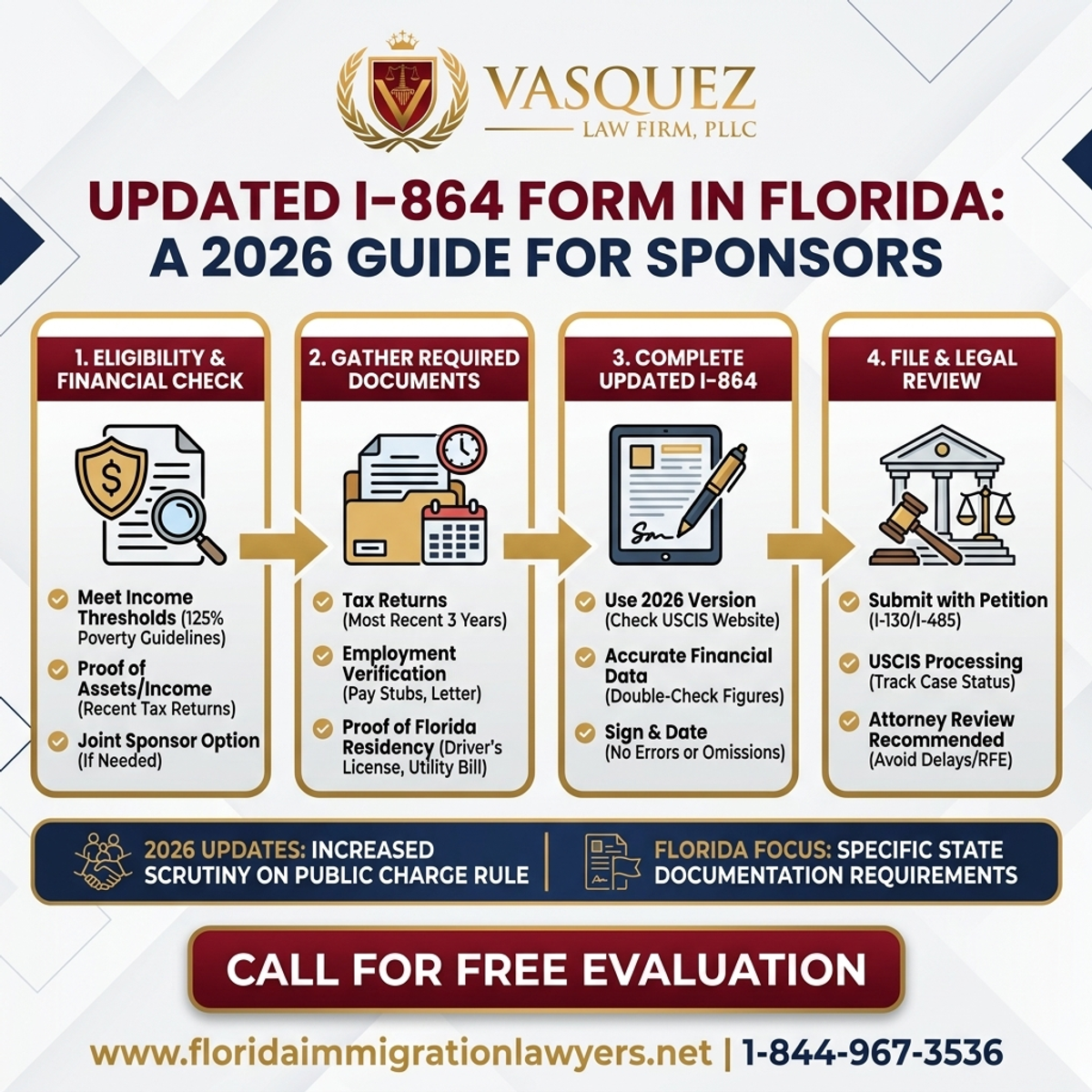
Step-by-Step Process — Updated I-864 Form in Florida: A 2026 Guide for Sponsors
- Completed and signed Form I-864 (and I-864A if applicable).
- Proof of U.S. citizenship or lawful permanent resident status (e.g., U.S. passport, birth certificate, naturalization certificate, green card copy).
- Proof of domicile in the U.S. (e.g., Florida driver's license, state ID, utility bills, lease agreements, property deeds, voter registration).
- Copies of your federal income tax returns for the most recent three tax years (e.g., 2025, 2024, 2023).
- Copies of all W-2s and/or 1099s for the most recent three tax years.
- Current employment verification letter (on company letterhead, stating position, salary, and start date).
- Recent pay stubs (typically 6 months).
- Bank statements (if relying on assets, typically 12 months).
- Proof of other assets, if applicable (e.g., property deeds, stock certificates).
- Certified English translations for any non-English documents.
- Copy of the immigrant visa petition (I-130 or I-140) approval notice, if available.
What is the I-864 Processing Timeline and Fee Structure in 2026?
The processing timeline for the I-864 Affidavit of Support can vary significantly depending on whether it is filed with an immigrant visa application through the National Visa Center (NVC) or with an adjustment of status application through USCIS. As of 2026, there is generally no separate filing fee for Form I-864 itself when submitted with the primary application, but associated costs should be considered.
When the I-864 is submitted to the NVC as part of the immigrant visa process, the NVC typically reviews the document package for completeness. This initial review can take several months. Once the NVC accepts the I-864 and all supporting civil documents, the case is scheduled for an interview at a U.S. Embassy or Consulate abroad. For adjustment of status cases filed with USCIS in Florida, the I-864 is reviewed as part of the Form I-485 application. Processing times for I-485 can range from several months to over a year, depending on the USCIS field office (e.g., Miami, Orlando, Tampa) and the specific case complexities. It is crucial to monitor the USCIS website for current processing times, as these can fluctuate.
Typical I-864 Processing Timeline (As of 2026)
The following table outlines general timeframes for the I-864 process:
| Stage | Typical Timeframe | Notes |
|---|---|---|
| Document Gathering & Form Preparation | 2-4 weeks | Depends on sponsor's organization and availability of documents. |
| NVC Review (for Immigrant Visas) | 3-6 months | Initial review for completeness, RFE (Request for Evidence) can extend this. |
| USCIS Review (for Adjustment of Status) | 6-18+ months | Part of the I-485 processing; varies by field office like Miami or Orlando. |
| Interview Scheduling | 1-3 months post-review | After NVC or USCIS approves documents, interview is scheduled. |
| Final Decision | Days to weeks post-interview | Immediate decision or further review. |
| Total Process (Estimated) | 6-24+ months | Highly variable depending on case complexity, RFE, and agency backlogs. |
I-864 Cost Factors and Fee Breakdown (As of 2026)
While there is no direct filing fee for Form I-864 itself, there are associated costs within the broader immigration process. It's important to understand these potential expenses:
| Item | Typical Fee | Notes |
|---|---|---|
| I-864 Filing Fee | $0 | No separate fee if filed with Form I-485 or immigrant visa application. |
| Immigrant Visa Application Fee (DS-260) | Varies (approx. $325) | Required for consular processing, paid to the Department of State. |
| Form I-485 Adjustment of Status Fee | Varies (approx. $1,140-$1,225) | Required for filing in the U.S., includes biometric services fee. |
| Attorney Fees | Varies widely | For legal assistance in preparing and submitting forms, highly recommended for complex cases. |
| Document Costs | Minor | Costs for obtaining certified copies, translations, postage. |
| Medical Examination Fee | Varies (approx. $200-$500) | Required for adjustment of status or immigrant visa, paid to USCIS-approved doctor. |
Understanding Joint Sponsors and Household Members for I-864 in Florida
In many immigration cases across Florida, the primary petitioner may not meet the income requirements for the I-864 Affidavit of Support. This is where the concepts of a joint sponsor and including household members' income become crucial. These provisions allow immigrants to still qualify for a green card by demonstrating sufficient financial support from other eligible individuals.
A joint sponsor is an individual who meets all the same eligibility requirements as the primary sponsor (U.S. citizen or LPR, at least 18 years old, domiciled in the U.S., and meets the 125% poverty guideline income threshold). This person must be willing to accept joint and several liability with the primary sponsor for the financial support of the sponsored immigrant. The joint sponsor completes a separate Form I-864 and provides all their own supporting financial documentation. They do not need to be related to either the primary sponsor or the immigrant. In Florida's diverse communities, it's common for a friend, extended family member, or even a community leader to step forward as a joint sponsor to help an immigrant adjust their status.
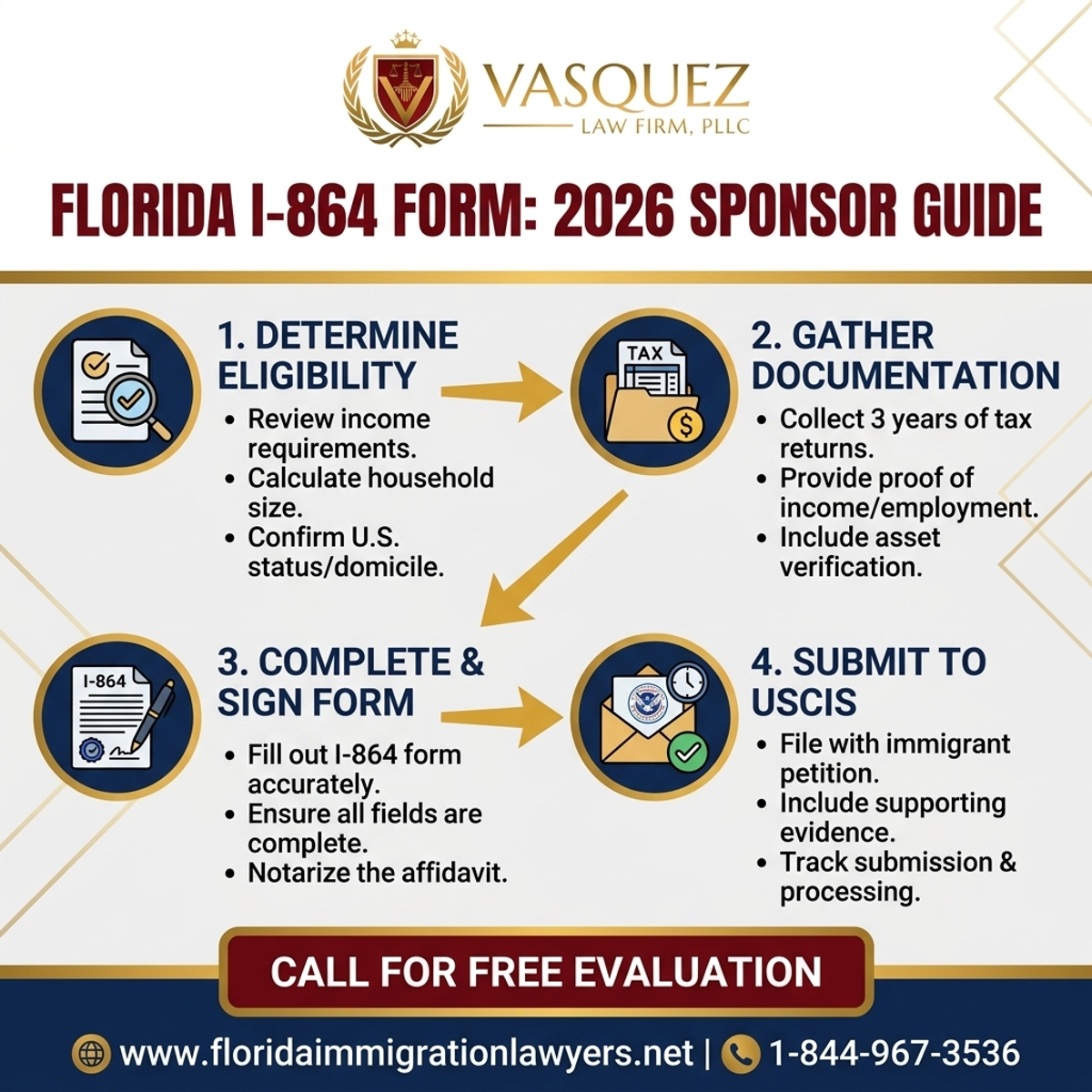
Key Statistics — Updated I-864 Form in Florida: A 2026 Guide for Sponsors
Alternatively, if the primary sponsor's income is insufficient, they may be able to include the income and assets of certain household members. A household member is generally anyone related to the sponsor by birth, marriage, or adoption who has been living with the sponsor, or a person listed as a dependent on the sponsor's most recent federal tax return. These household members must be at least 18 years old, be U.S. citizens, LPRs, or U.S. nationals, and must complete and sign Form I-864A, Contract Between Sponsor and Household Member. By signing Form I-864A, they agree to make their income and/or assets available to help support the sponsored immigrant and assume joint and several liability with the primary sponsor. This is particularly common in multi-generational households found throughout Florida, where combined family income can meet the necessary thresholds. Both options provide pathways for immigrants when the primary sponsor's income alone is not enough, but each carries significant legal obligations that must be fully understood.
What are the Legal Obligations and Risks of Signing the I-864 Affidavit?
Signing the I-864 Affidavit of Support is not a mere formality; it is a serious and legally binding contract with significant long-term obligations and potential risks for the sponsor. Many individuals in Florida underestimate the extent of this commitment, which can lead to unforeseen financial and legal challenges down the road. Understanding these obligations is crucial before signing the document.
The primary obligation is to financially support the sponsored immigrant(s) at an annual income level that is at least 125% of the Federal Poverty Guidelines for their household size. This responsibility begins when the immigrant obtains lawful permanent resident status and continues until one of five events occurs: the immigrant becomes a U.S. citizen, can be credited with 40 quarters of work (approximately 10 years of employment), departs the U.S. permanently, has their green card revoked and departs, or dies. The sponsor's obligation does not end if they divorce the sponsored immigrant. This long-term commitment means the sponsor is essentially guaranteeing financial support for potentially a decade or more, regardless of changes in their own financial circumstances or relationship with the immigrant.
The risks associated with this obligation are substantial. If the sponsored immigrant receives certain means-tested public benefits (such as SNAP, TANF, Medicaid, or SSI), the government agency that provided those benefits can sue the sponsor for reimbursement. Furthermore, the sponsored immigrant themselves can sue the sponsor to enforce the terms of the affidavit if the sponsor fails to provide adequate financial support. This means a sponsor could face legal action in Florida courts, potentially resulting in wage garnishments or liens on property. Recent news regarding increased scrutiny on public charge issues, though primarily affecting applicants, underscores the government's emphasis on financial self-sufficiency and the sponsor's role. It is imperative for sponsors to fully grasp that this is a real, enforceable contract under federal law (8 CFR 213a.4), and a failure to uphold its terms can have severe financial repercussions. Consulting with Florida Immigration Lawyers can help sponsors fully understand these risks and make informed decisions.
Do not navigate this complex process alone. The requirements for the I-864 Affidavit of Support are detailed and the legal obligations are profound. Mistakes can lead to significant delays, denials, or even future legal liabilities. Contact Florida Immigration Lawyers today at 1-844-YO-PELEO for a free consultation to ensure your application is handled correctly and efficiently.
Common Mistakes to Avoid with the I-864 Affidavit of Support
The I-864 Affidavit of Support is a highly scrutinized document, and even minor errors can lead to Requests for Evidence (RFEs) or outright denials. Avoiding these common mistakes can save you time, stress, and potential legal issues:
- Insufficient Income: Many sponsors miscalculate their household income or fail to meet the 125% (or 100% for military) of the Federal Poverty Guidelines. This is the most common reason for an RFE. Ensure your income is clearly documented and meets the current 2026 guidelines for your household size.
- Incorrect Domicile: Failing to prove your U.S. domicile can lead to denial. You must show that you live in the U.S. or intend to re-establish domicile by the time the immigrant obtains permanent residence. Simply owning property in Florida isn't enough; you need to demonstrate actual residency.
- Incomplete or Outdated Documentation: Submitting an I-864 without all required supporting documents (tax returns, W-2s, employment letters) or providing outdated forms (not the updated I-864 form) will cause delays. Always use the latest form version from USCIS and provide comprehensive evidence.
- Failure to Update Information: If your income, employment, or address changes after filing, you must notify USCIS or the NVC. Failure to do so can create discrepancies and raise red flags during the review process.
- Misunderstanding Joint Sponsor Role: Joint sponsors must independently meet all eligibility criteria, including the 125% income threshold. Some mistakenly believe their income is simply added to the primary sponsor's, or that their liability is less significant. This is incorrect; their liability is full and independent.
- Ignoring Legal Obligations: Many sponsors do not fully grasp the long-term, legally binding nature of the I-864, including the potential for lawsuits for reimbursement of public benefits. This can lead to unexpected financial burdens years later.
- Incorrectly Calculating Household Size: An inaccurate household size calculation can lead to an incorrect income threshold. Remember to include yourself, all dependents, all sponsored immigrants, and anyone else who signed an I-864A.
- Not Providing Certified Translations: Any documents in a foreign language must be accompanied by a complete and certified English translation. Submitting untranslated documents will result in an RFE or rejection.
- Errors in Form Completion: Simple mistakes like unchecked boxes, missing dates, or inconsistent information across different sections of the form can cause processing delays. Review the form meticulously before submission.
- Failing to Consult an Attorney: Attempting to navigate the complexities of the I-864 without legal guidance, especially for complicated financial situations or previous immigration issues, significantly increases the risk of errors and denials.
When to Call a Lawyer for Your I-864 Affidavit of Support in Florida
While the instructions for the I-864 Affidavit of Support may seem straightforward, the implications and complexities often require legal guidance. Knowing when to call a lawyer can make all the difference in the success and efficiency of your immigration case, especially in a state like Florida where immigration law is constantly evolving.
You should strongly consider contacting Florida Immigration Lawyers if you encounter any of the following scenarios: your income fluctuates significantly or is just above the poverty guidelines; you need to rely on assets instead of income; you require a joint sponsor or multiple household members' income; you have previously sponsored other immigrants; you have a complex tax history or unusual income sources; or you are an active duty military member with specific considerations. Furthermore, if you have received a Request for Evidence (RFE) from USCIS or the NVC regarding your I-864, it is crucial to seek immediate legal counsel to formulate a strong response. An attorney can help you understand the nuances of the public charge rule and its impact on your case in light of recent policy changes.
Our attorneys at Florida Immigration Lawyers are adept at handling intricate I-864 cases, including those involving unique financial situations or questions of domicile in Florida. We can help you accurately calculate your household size and income, gather the correct documentation, and ensure that your updated I-864 form is completed without errors. Our goal is to minimize delays and maximize the chances of a successful outcome for your family's immigration journey in Miami, Orlando, Tampa, or anywhere across Florida. Don't take chances with such a vital document; let our experience guide you.
About Florida Immigration Lawyers
Florida Immigration Lawyers is an immigration law firm dedicated to serving individuals and families across the entire state of Florida. With a deep understanding of U.S. immigration law and a commitment to our clients, we provide compassionate, effective, and results-driven legal representation. Our experienced attorneys focus on a wide range of immigration services, including family-based petitions, adjustment of status, consular processing, asylum, deportation defense, citizenship, and business immigration.
We pride ourselves on our client-centered approach, ensuring that each case receives personalized attention and strategic guidance. We understand the profound impact immigration matters have on lives and futures, which is why we strive to make the legal process as clear and stress-free as possible. Our firm is available 24/7 to address your urgent needs, and we offer free consultations to help you understand your options without financial commitment. We are proud to offer bilingual services, with a dedicated team ready to assist clients in both English and Spanish. When you choose Florida Immigration Lawyers, you choose a partner committed to protecting your rights and achieving your immigration goals. Visit our website at www.floridaimmigrationlawyers.net or call us at 1-844-YO-PELEO to schedule your free consultation.
Sources and References
- U.S. Citizenship and Immigration Services (USCIS)
- Executive Office for Immigration Review (EOIR)
- U.S. Department of State
- 8 U.S.C. Chapter 12 - Immigration and Nationality Act (INA)
- 8 U.S.C. § 1183a - Requirements for sponsor's affidavit of support (INA Section 213A)
- 8 CFR Part 213a - Affidavits of Support on Behalf of Immigrants
- USCIS Form I-864, Affidavit of Support Under Section 213A of the INA Instructions
- USCIS Form I-864P, Poverty Guidelines
Related services: immigration practice areas, family immigration services.
This article provides general legal information and is not intended as legal advice. Every case is unique, and outcomes depend on specific facts and circumstances. Contact an attorney for advice about your particular situation.
Securing your family's future in Florida requires careful attention to every detail of the immigration process. The I-864 Affidavit of Support is a critical component that demands accuracy and a thorough understanding of its legal implications. Don't leave your family's dreams to chance. For legal guidance and a free, confidential consultation, contact Florida Immigration Lawyers today. Call us at 1-844-YO-PELEO. Se Habla Espanol - Estamos aqui para ayudarle.
If you need legal assistance, learn more about speak with an immigration lawyer, or call us at 1-844-YO-PELEO for a free consultation.
Do Not Navigate This Process Alone
Our experienced immigration attorneys are ready to fight for you. Get a free, confidential case review today.
Se Habla Español
Or leave your details and we’ll call you:
Free Evaluation in 24 Hours
Or talk to us right now
AI voice assistant — available 24/7
FreeFrequently Asked Questions

William J. Vásquez
Founding Attorney · Vasquez Law Firm
U.S. Air Force veteran and immigration attorney with years of hands-on U.S. immigration experience. J.D., NCCU School of Law. AILA member. Admitted to the 4th, 5th, and 11th Circuit Courts.
Available 24/7 - Free Evaluations
Reviewed for legal accuracy by William J. Vásquez
Licensed in North Carolina; U.S. immigration is federal practice.
Related Legal Services
Our Florida immigration attorneys can help you with asylum protection, citizenship and naturalization and immigration practice areas. Call today at 1-844-YO-PELEO for a free case review.
Related Links
Related Topics
Free Legal Case Review
Discuss your case with our experienced attorneys. We're available 24/7.
Se Habla Español - Estamos aquí para ayudarle.
Related Articles
Immigration Lawyer Orlando Free Consultation in Florida
For individuals and families in Orlando, Florida, navigating the complexities of U.S. immigration law requires expert guidance. An immigration lawyer in Orlando offers crucial support for everything from visa applications and green card processes to naturalization and deportation defense. This comprehensive guide details what a free consultation covers, providing a step-by-step overview of immigration pathways, essential document checklists, and expected timelines in 2026. We also highlight common mistakes to avoid, discuss the critical role of legal counsel in deportation and asylum cases, and explain why choosing a local Orlando immigration attorney is beneficial. Florida Immigration Lawyers is dedicated to serving the diverse community of Orlando with compassionate, effective legal solutions, ensuring you receive personalized advice and robust representation for a successful immigration journey.
EAD Advance Parole Combo Card in Florida 2026
For individuals with a pending Form I-485, Application to Register Permanent Residence or Adjust Status, the EAD Advance Parole Combo Card is an essential document. This single card combines the authorization to work legally in the U.S. (Employment Authorization Document - EAD) with permission to travel internationally and re-enter without abandoning your green card application (Advance Parole). This guide from Florida Immigration Lawyers provides a comprehensive overview for applicants in Florida in 2026, covering eligibility, the step-by-step application process, required documents, expected processing times, and associated costs. We also highlight common mistakes to avoid and when to seek legal counsel to ensure a smooth and successful immigration journey. Understanding this vital card is key to maintaining stability while awaiting your permanent residency approval.
VAWA Immigration Relief for Abused Spouses in Florida
Discover how the Violence Against Women Act (VAWA) provides crucial immigration relief for abused spouses in Florida. Learn about eligibility, the application process, and how Florida Immigration Lawyers can assist you.
H-4 EAD Work Authorization for Spouses in Florida 2026
For H-1B families in Florida, the H-4 EAD (Employment Authorization Document) is a critical pathway allowing eligible spouses to work legally in the U.S. This comprehensive guide, updated for 2026, explains who qualifies, the step-by-step application process, current processing times, and associated costs. We delve into the impact of H-4 EAD on financial stability and career opportunities for H-1B families in vibrant Florida communities like Orlando. Learn about essential documents, common mistakes to avoid, and when seeking legal counsel from Florida Immigration Lawyers can ensure a smooth and successful application. Our firm provides expert guidance for initial applications and renewals, helping H-4 spouses navigate complex immigration regulations with confidence. Understand your rights and secure your work authorization.