H-4 EAD Work Authorization for Spouses in Florida 2026
For H-1B families in Florida, the H-4 EAD (Employment Authorization Document) is a critical pathway allowing eligible spouses to work legally in the U.S. This comprehensive guide, updated for 2026, explains who qualifies, the step-by-step application process, current processing times, and associated costs. We delve into the impact of H-4 EAD on financial stability and career opportunities for H-1B families in vibrant Florida communities like Orlando. Learn about essential documents, common mistakes to avoid, and when seeking legal counsel from Florida Immigration Lawyers can ensure a smooth and successful application. Our firm provides expert guidance for initial applications and renewals, helping H-4 spouses navigate complex immigration regulations with confidence. Understand your rights and secure your work authorization.

An H-4 EAD (Employment Authorization Document) allows eligible H-4 visa holders, primarily spouses of H-1B nonimmigrants, to work legally in the United States. As of 2026, eligibility generally requires the H-1B spouse to have an approved Form I-140, Immigrant Petition for Alien Worker, or to have been granted H-1B status under sections 106(a) and (b) of the American Competitiveness in the Twenty-first Century Act (AC21). This work authorization is a crucial benefit for many H-1B families in Florida, offering financial stability and career opportunities for spouses. The application process involves filing Form I-765 with USCIS, often concurrently with an H-4 extension or change of status. Understanding the specific rules and requirements is essential for a successful application.
- H-4 EAD grants work authorization to eligible H-4 visa holders.
- Primarily for spouses of H-1B nonimmigrants with approved I-140 or AC21 status.
- Application involves filing Form I-765 with USCIS.
- Crucial for financial stability and career opportunities for H-1B families in Florida.
- Rules and processing times are subject to change; legal guidance is highly recommended.
H-4 EAD Work Authorization for Spouses in Florida 2026
Navigating the complex landscape of U.S. immigration law can be challenging, especially when it concerns work authorization for family members. For many H-1B visa holders and their families in Florida, the H-4 EAD, or Employment Authorization Document, represents a vital opportunity for spouses to contribute to their household income and pursue their professional aspirations. This document allows certain H-4 visa holders, typically the spouses of H-1B nonimmigrants, to work legally in the United States, offering significant relief and flexibility to H-1B families.
Florida, with its booming tech, healthcare, and tourism industries, attracts a significant number of H-1B professionals, many of whom reside in vibrant areas like Orlando. For these families, understanding the intricacies of the H-4 EAD rules, eligibility criteria, and application process is paramount. As of 2026, the H-4 EAD remains a critical pathway, but the requirements and processing times can evolve, making up-to-date information indispensable. This comprehensive guide will delve into everything H-1B families in Florida need to know about securing an H-4 EAD, from eligibility and application steps to common pitfalls and when to seek legal counsel.
Whether you are considering applying for the first time, renewing your existing H-4 EAD, or simply seeking clarity on your options, this article aims to provide clear, actionable insights. The ability for spouses to work can transform the quality of life for H-1B families, fostering greater integration and economic stability within the community. Do not navigate this crucial process alone. Call Florida Immigration Lawyers at 1-844-YO-PELEO for a free case review and let our experienced team guide you through every step.
What is an H-4 EAD and who is eligible in Florida?
An H-4 EAD is an Employment Authorization Document issued by U.S. Citizenship and Immigration Services (USCIS) that permits certain H-4 nonimmigrants to work in the United States. This benefit is specifically available to eligible H-4 spouses of H-1B nonimmigrants. The primary purpose of the H-4 EAD is to alleviate the financial burden on H-1B families and to allow spouses to pursue their careers, which was not possible for many years prior to the rule change.
As of 2026, eligibility for an H-4 EAD generally falls into two main categories. First, the H-1B principal must have an approved Form I-140, Immigrant Petition for Alien Worker. This indicates that their green card process has commenced and they are a step closer to permanent residency. Second, the H-1B principal may be eligible if they have been granted H-1B status under sections 106(a) and (b) of the American Competitiveness in the Twenty-first Century Act (AC21). This typically applies to H-1B nonimmigrants who are seeking an extension of their H-1B status beyond the six-year limit, often because their green card application is pending but not yet approved. In Florida, many H-1B professionals working in tech hubs like Orlando, Tampa, and Miami fall into these categories, making the H-4 EAD a highly sought-after document.
It is crucial to understand that not all H-4 visa holders are eligible for an EAD. For instance, H-4 children of H-1B workers are not eligible. The H-4 EAD is solely for the spouse. Furthermore, the H-1B principal must maintain valid H-1B status for the H-4 spouse to be eligible for and maintain their EAD. Any disruption to the H-1B status can directly impact the H-4 EAD holder's authorization to work. USCIS regulations, specifically 8 CFR 274a.12(c)(26), outline these eligibility criteria. Our firm frequently assists H-1B families in Central Florida, including those in Orlando, in determining their eligibility and preparing robust applications. Ensuring all criteria are met before filing is critical to avoiding delays or denials.
How do I apply for an H-4 EAD in 2026?
To apply for an H-4 EAD in 2026, eligible H-4 spouses must file Form I-765, Application for Employment Authorization, with U.S. Citizenship and Immigration Services (USCIS). This form must be accompanied by specific supporting documentation and the appropriate filing fee. The process can be initiated concurrently with an H-4 visa extension or change of status application (Form I-539) or as a standalone application.
The application process for an H-4 EAD in Florida, as of 2026, involves several key steps to ensure all requirements are met and the application is properly submitted. Attention to detail is paramount to avoid requests for evidence (RFEs) or outright denials. Here is a step-by-step guide:
-
Determine Eligibility: First, confirm that the H-1B principal spouse meets the eligibility criteria (approved I-140 or H-1B status under AC21). Gather all relevant documentation proving the H-1B status and the spouse's H-4 status. This foundational step is critical before proceeding.
-
Complete Form I-765: Accurately fill out Form I-765, Application for Employment Authorization. Ensure all sections are completed, especially Part 2, Item 27, where you must select the appropriate eligibility category (c)(26) for H-4 EAD. Double-check for any errors or omissions, as these can cause significant delays. Remember to sign the form in blue ink.
-
Gather Supporting Documents: Collect all necessary supporting documents as detailed in the checklist below. This includes proof of H-4 status, marriage certificate, H-1B principal's status documents, and evidence of H-1B eligibility for EAD. Original documents are generally not required; clear copies are usually sufficient.
-
Prepare Photos: Provide two identical, passport-style photographs taken within 30 days of filing. Ensure they meet USCIS specifications for size, background, and facial expression. Write your name and A-Number (if applicable) lightly on the back of each photo.
-
Include Filing Fee: Attach the required filing fee. As of 2026, check the latest USCIS fee schedule on USCIS.gov, as fees are subject to change. Payment can be made by money order, personal check, cashier's check, or credit card using Form G-1450, Authorization for Credit Card Transactions. Do not send cash.
-
Mail the Application Package: Send the complete application package to the correct USCIS lockbox facility. The specific mailing address depends on where you live and whether you are filing Form I-765 alone or concurrently with other forms like Form I-539. Always verify the most current filing address on the USCIS website. If filing from Florida, you will typically send it to a designated lockbox.
-
Receive Receipt Notice: After USCIS receives your application, they will send a Form I-797C, Notice of Action, acknowledging receipt. This notice will contain your receipt number, which you can use to track the status of your application online. Keep this notice safe.
-
Biometrics Appointment (if required): In some cases, USCIS may require a biometrics appointment to collect fingerprints, photographs, and a signature. If needed, you will receive a separate appointment notice. It is crucial to attend this appointment.
-
Decision: USCIS will process your application and issue a decision. If approved, you will receive your H-4 EAD card via mail. If denied, the notice will explain the reasons for the denial, and you may have options to appeal or refile.
Document Checklist for H-4 EAD Application
Having all the correct documents is paramount for a smooth H-4 EAD application. Here is a comprehensive checklist:
- Completed and signed Form I-765.
- Two passport-style photographs.
- Copy of your current H-4 visa (if applicable) and passport biographic page.
- Copy of your H-4 Form I-94 Arrival/Departure Record (front and back).
- Copy of your marriage certificate (with certified translation if not in English).
- Copy of the H-1B principal spouse's Form I-797, Approval Notice, for current H-1B status.
- Copy of the H-1B principal spouse's current I-94 Arrival/Departure Record.
- Evidence that the H-1B principal spouse meets EAD eligibility criteria:
- Copy of the H-1B principal spouse's approved Form I-140, Immigrant Petition for Alien Worker, or
- Proof that the H-1B principal spouse has been granted H-1B status under AC21 sections 106(a) and (b) (e.g., copies of previous H-1B approval notices extending beyond 6 years).
- Copy of any previously issued EAD cards (if applying for renewal).
- Copy of a government-issued photo identification (e.g., driver's license).
- Filing fee (check, money order, or G-1450).
What are the processing times for H-4 EAD applications in Florida?
As of 2026, the processing times for H-4 EAD applications can vary significantly depending on the USCIS service center handling the case and the current workload. While there is no specific USCIS office dedicated solely to Florida applications, cases filed from Florida are routed to various service centers. USCIS aims to process applications efficiently, but applicants should prepare for potential delays. Expedited processing is rarely granted and only under specific, urgent circumstances.
Historically, H-4 EAD processing has ranged from a few months to over a year. USCIS provides estimated processing times on its website, which are updated regularly. Applicants should monitor these times for the service center handling their case. Concurrently filed H-4 (I-539) and H-4 EAD (I-765) applications are often processed together, and delays in one can affect the other. It is important to remember that these are estimates, and individual case factors can influence the actual timeline. For instance, a Request for Evidence (RFE) will inevitably extend the processing time. Planning ahead, especially for renewals, is crucial to avoid gaps in work authorization. Our team at Florida Immigration Lawyers can help you track your application and provide updates based on our experience with similar cases in Central Florida.
Here is a typical timeline expectation for H-4 EAD applications:
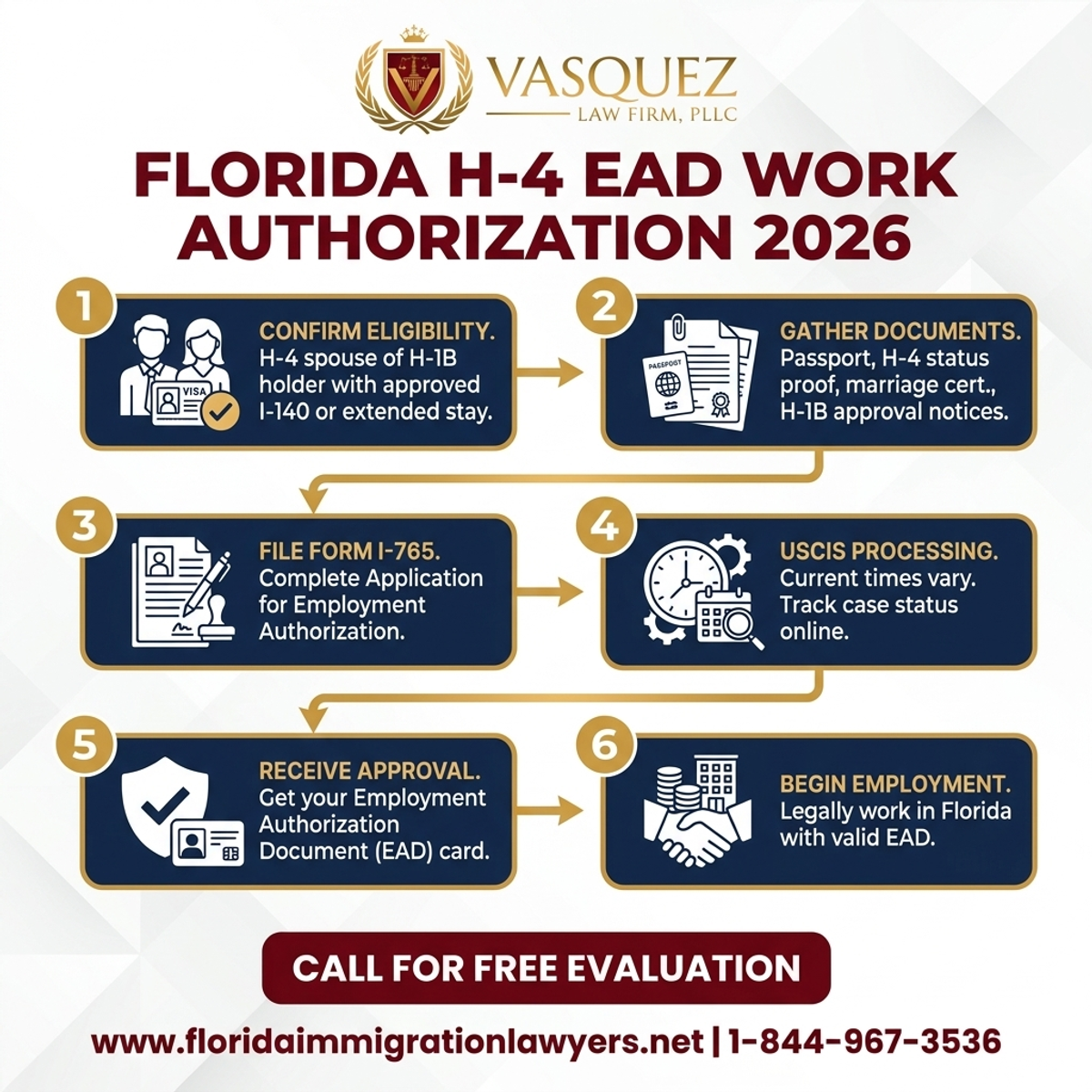
Step-by-Step Process — H-4 EAD Work Authorization for Spouses in Florida 2026
| Stage | Typical Timeframe (As of 2026) | Notes |
|---|---|---|
| Application Submission to Receipt Notice | 1-3 weeks | USCIS sends Form I-797C, Notice of Action. |
| Biometrics Appointment (if required) | 3-8 weeks after receipt | Not all H-4 EAD applicants require biometrics, but many do, especially with concurrent I-539. |
| Processing at Service Center | 6-12 months (can be longer) | Varies significantly by service center. Check USCIS processing times online. |
| Decision and EAD Card Delivery | 1-3 weeks after approval | Approval notice followed by EAD card mailing. |
How much does it cost to apply for an H-4 EAD in 2026?
As of 2026, the filing fee for Form I-765, Application for Employment Authorization, is a critical component of the H-4 EAD application process. It is important to note that USCIS fees are subject to change, so applicants should always verify the most current fees directly on the USCIS website or consult with an immigration attorney. The fee is typically paid by check or money order made out to "U.S. Department of Homeland Security." Using Form G-1450 for credit card payments is also an option.
Beyond the USCIS filing fee, applicants in Florida should also consider potential legal fees if they choose to hire an immigration attorney. While not mandatory, legal representation can significantly streamline the process, reduce errors, and provide peace of mind, especially for complex cases or those involving concurrent filings. Attorneys' fees vary based on the complexity of the case and the firm's experience. Additionally, there might be minor costs for document preparation, such as obtaining certified translations for non-English documents, passport-style photos, and postage. Understanding the full financial commitment upfront helps in proper planning for your H-4 EAD application.
Here is a breakdown of typical costs associated with an H-4 EAD application:
| Item | Typical Fee (As of 2026) | Notes |
|---|---|---|
| USCIS Form I-765 Filing Fee | Variable (check USCIS website) | Mandatory filing fee for the application. Always verify current fees on USCIS.gov. |
| Legal Fees (Attorney) | Variable (consult attorney) | Recommended for expert guidance, especially for complex cases or renewals. |
| Passport-Style Photos | $10-$20 | Cost for two photos meeting USCIS specifications. |
| Certified Translations | Variable (per page/document) | If any supporting documents are not in English (e.g., marriage certificate). |
| Postage/Shipping | $5-$30 | For mailing the application package to USCIS. |
Understanding the Impact of H-4 EAD on H-1B Families in Florida
The H-4 EAD has profoundly impacted H-1B families, particularly in states like Florida, by offering greater financial stability and professional fulfillment for spouses. Before the H-4 EAD rule was introduced, H-4 spouses were generally unable to work, leading to significant challenges for many families. Spouses, often highly educated and experienced professionals, found themselves unable to utilize their skills, which could lead to feelings of isolation and underutilization. The EAD changed this dynamic, allowing H-4 spouses to pursue employment in various sectors, contributing to the U.S. economy and their family's well-being.
For H-1B families in Florida, where the cost of living in major metropolitan areas such as Orlando and Miami can be substantial, the H-4 EAD provides an essential second income stream. This not only eases financial pressure but also offers spouses the independence and opportunity to build their own careers in the U.S. This improved quality of life can reduce stress on the H-1B principal, allowing them to focus better on their work. Furthermore, the H-4 EAD helps retain skilled H-1B workers in the U.S. by making the immigration journey more palatable for their families. It is a win-win situation, benefiting both the immigrant families and the U.S. economy by leveraging the talents of a broader pool of professionals. Understanding the full implications of this work authorization is key for any H-1B family considering a long-term stay in Florida.
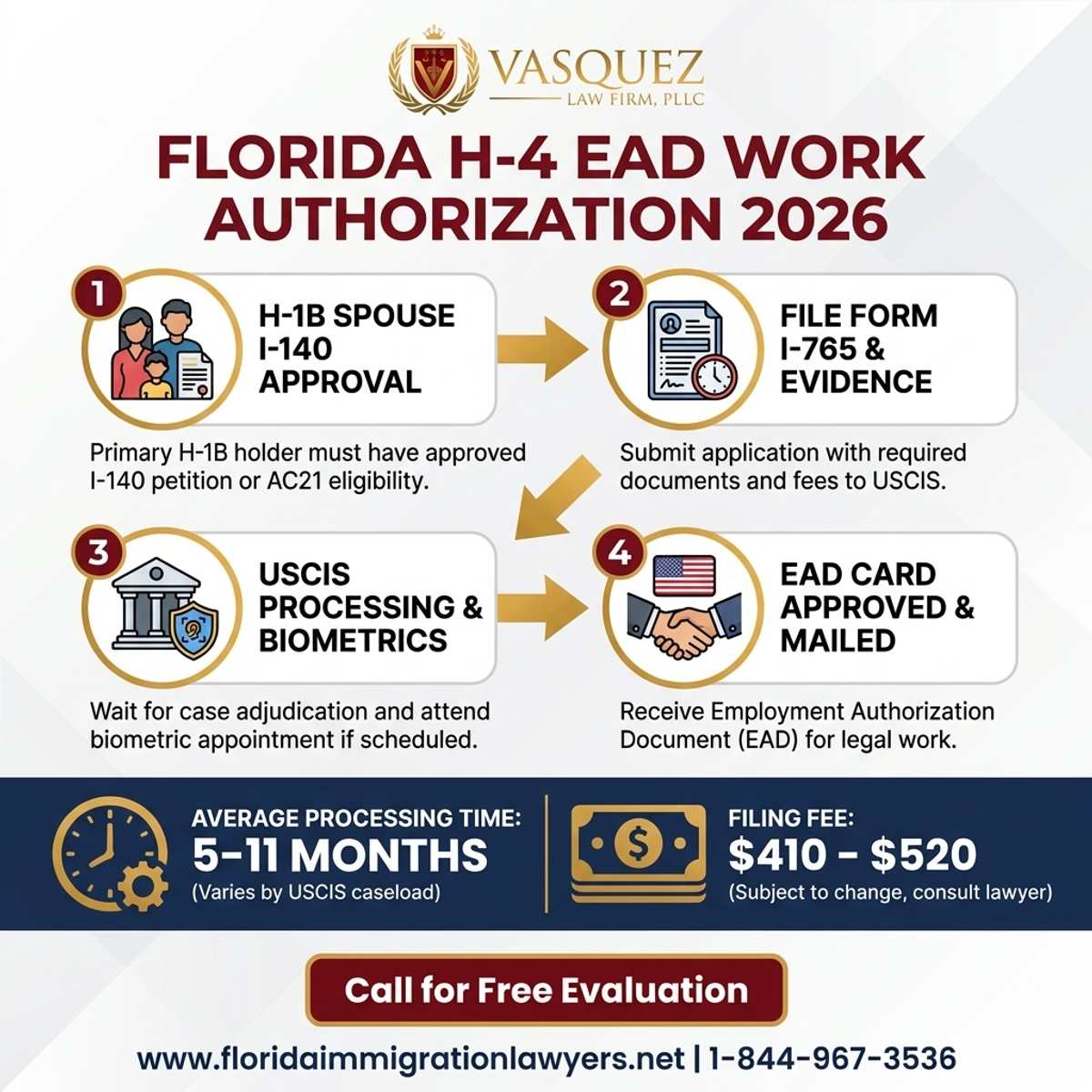
Key Statistics — H-4 EAD Work Authorization for Spouses in Florida 2026
Key Requirements for H-4 EAD Renewal in Florida
Renewing an H-4 EAD in Florida is a process similar to the initial application but requires careful timing to avoid gaps in employment authorization. As of 2026, the fundamental eligibility criteria remain the same: the H-1B principal must continue to hold an approved Form I-140 or be in H-1B status under AC21 Sections 106(a) and (b). It is highly recommended to file for renewal at least 180 days before your current EAD expires, given the variable processing times at USCIS service centers. This proactive approach helps ensure continuous work authorization.
When renewing, you will again need to submit Form I-765, along with the required filing fee and supporting documentation. This documentation includes copies of your previous H-4 EAD card, proof of your current H-4 status (I-94), your marriage certificate, and updated evidence of the H-1B principal's eligibility (e.g., their most recent H-1B approval notice and I-140 approval). USCIS policy allows for certain H-4 EAD renewal applicants to continue working for up to 540 days beyond the expiration date of their EAD, provided they filed their renewal application on time and remain eligible for the EAD. This automatic extension is a crucial safeguard for many H-4 EAD holders in Florida, preventing immediate loss of employment. Our firm assists many clients in Orlando and across Florida with timely and accurate H-4 EAD renewals, ensuring they maintain their ability to work without interruption.
Common Mistakes to Avoid When Applying for H-4 EAD
Applying for an H-4 EAD can be complex, and even minor errors can lead to significant delays or denials. Being aware of common mistakes can help applicants in Florida navigate the process more smoothly.
-
Failing to Meet H-1B Principal's Eligibility: The H-4 EAD is contingent on the H-1B principal having an approved I-140 or being in H-1B status under AC21. Filing without meeting these criteria will result in denial. Always confirm the H-1B spouse's status first.
-
Incorrectly Filling Out Form I-765: Typos, omissions, or incorrect eligibility category selection (e.g., not selecting (c)(26)) are common errors. Double-check every field and ensure the form is signed.
-
Missing or Insufficient Supporting Documentation: Not including all required documents, such as a marriage certificate, copies of I-94s, or the H-1B principal's I-140 approval, can lead to Requests for Evidence (RFEs) or denials. A comprehensive checklist is vital.
-
Submitting Outdated Filing Fees: USCIS fees change periodically. Submitting an incorrect fee, even by a small amount, will cause the application to be rejected and returned. Always verify the latest fees on the USCIS website as of 2026.
-
Not Filing for Renewal in Time: For renewals, waiting until the last minute can lead to a gap in employment authorization. It's best to file at least 180 days before your current EAD expires to benefit from the automatic extension provisions.
-
Incorrect Passport Photos: Photos that do not meet USCIS specifications (size, background, age) will be rejected. Ensure they are recent and professionally taken.
-
Mailing to the Wrong USCIS Lockbox: USCIS has different filing addresses depending on the form and your state of residence. Sending your application to the wrong address will cause significant delays. Always check the USCIS website for the correct filing location.
-
Not Responding to RFEs Promptly: If USCIS sends a Request for Evidence, failing to respond by the deadline or providing incomplete information will almost certainly lead to a denial. Address all RFE points thoroughly.
-
Assuming Concurrent Filing is Automatic: If you are filing an H-4 extension (I-539) and H-4 EAD (I-765) concurrently, you must explicitly state this and ensure both applications are properly linked. Delays in I-539 can impact the EAD.
-
Lack of Certified Translations: Any document not in English must be accompanied by a complete and certified English translation. Failing to provide this can invalidate the document and delay your application.
When to Call a Lawyer for Your H-4 EAD Application in Florida
While some H-4 EAD applications may seem straightforward, the complexities of immigration law often warrant professional legal assistance. It is particularly advisable to contact an experienced immigration lawyer like those at Florida Immigration Lawyers if you encounter any of the following scenarios:
- Complex Eligibility Issues: If there is any doubt about whether the H-1B principal meets the I-140 or AC21 criteria, a lawyer can provide a clear assessment.
- Previous Immigration Issues: Any past visa denials, overstays, or other immigration complications for either the H-1B or H-4 spouse can make the H-4 EAD application more challenging.
- Concurrent Filings: When filing Form I-765 concurrently with an H-4 change of status or extension (Form I-539), ensuring proper coordination and linking of applications is crucial.
- Expiring Status or EAD: If your H-4 status or current EAD is nearing expiration, a lawyer can help expedite the filing process and advise on strategies to avoid gaps in authorization.
- Requests for Evidence (RFEs) or Notice of Intent to Deny (NOID): Receiving an RFE or NOID indicates that USCIS has concerns about your application. A lawyer can help you craft a comprehensive and timely response.
- Changes in Circumstances: Life events such as divorce, job changes for the H-1B principal, or other significant changes can impact H-4 EAD eligibility.
- Desire for Peace of Mind: Even in seemingly simple cases, having an expert prepare and review your application can provide invaluable peace of mind, knowing that all details are handled correctly.
Our attorneys at Florida Immigration Lawyers are well-versed in H-4 EAD regulations and have extensive experience assisting H-1B families across Florida, including those in Orlando. We understand the specific needs of individuals and families in Central Florida and are dedicated to providing personalized, efficient legal solutions. We can help you navigate the application process, prepare all necessary documentation, and represent your interests before USCIS, ensuring your application is as strong as possible.
About Florida Immigration Lawyers
Florida Immigration Lawyers is a leading immigration law firm dedicated to serving individuals and families throughout Florida. With a deep understanding of U.S. immigration laws and a commitment to our clients, we provide comprehensive legal services tailored to your unique needs. Our team of experienced attorneys specializes in various immigration matters, including H-4 EAD applications, H-1B visas, family immigration, asylum, deportation defense, and citizenship. We pride ourselves on offering compassionate, effective, and results-driven representation.
Located in Orlando, we are strategically positioned to assist clients across Central Florida and beyond. We understand the anxieties and complexities associated with immigration processes and strive to make your journey as smooth as possible. Our firm is available 24/7, offering free case reviews to help you understand your options and develop a robust legal strategy. We believe everyone deserves high-quality legal representation, and our bilingual team is ready to assist you. Call us today at 1-844-YO-PELEO or schedule a free consultation to discuss your immigration needs. Se Habla Español.
Sources and References
- U.S. Citizenship and Immigration Services (USCIS)
- Executive Office for Immigration Review (EOIR)
- 8 U.S.C. Chapter 12 - Immigration and Nationality Act (INA)
- 8 CFR 274a.12(c)(26) - Classes of aliens authorized to work for a specific employer without a specific employment authorization document.
- American Competitiveness in the Twenty-first Century Act (AC21) Sections 106(a) and (b)
Related services: family petition process, family-based green cards, fiancé visa (K-1), marriage-based immigration.
This article provides general legal information and is not intended as legal advice. Every case is unique, and outcomes depend on specific facts and circumstances. Contact an attorney for advice about your particular situation. Immigration laws are subject to change.
Empower your family's future in Florida. If you are an H-4 spouse seeking work authorization, do not delay in exploring your options. Contact Florida Immigration Lawyers for a free, confidential case review today. Call us at 1-844-YO-PELEO. Se Habla Espanol - Estamos aqui para ayudarle.
If you need legal assistance, learn more about our family immigration practice, or call us at 1-844-967-3536 for a free case review.
Do Not Navigate This Process Alone
Our experienced immigration attorneys are ready to fight for you. Get a free, confidential case review today.
Se Habla Español
Or leave your details and we’ll call you:
Free Evaluation in 24 Hours
Or talk to us right now

AI voice assistant — available 24/7
FreeFrequently Asked Questions

William J. Vásquez
Founding Attorney · Vasquez Law Firm
U.S. Air Force veteran and immigration attorney with years of hands-on U.S. immigration experience. J.D., NCCU School of Law. AILA member. Admitted to the 4th, 5th, and 11th Circuit Courts.
Available 24/7 - Free Evaluations
Reviewed for legal accuracy by William J. Vásquez
Licensed in North Carolina; U.S. immigration is federal practice.
Related Legal Services
Our Florida immigration attorneys can help you with free immigration consultation, business immigration and deportation defense. Call today at 1-844-YO-PELEO for a free case review.
Related Links
Related Topics
Free Legal Case Review
Discuss your case with our experienced attorneys. We're available 24/7.
Se Habla Español - Estamos aquí para ayudarle.
Related Articles
Immigration Lawyer Orlando Free Consultation in Florida
For individuals and families in Orlando, Florida, navigating the complexities of U.S. immigration law requires expert guidance. An immigration lawyer in Orlando offers crucial support for everything from visa applications and green card processes to naturalization and deportation defense. This comprehensive guide details what a free consultation covers, providing a step-by-step overview of immigration pathways, essential document checklists, and expected timelines in 2026. We also highlight common mistakes to avoid, discuss the critical role of legal counsel in deportation and asylum cases, and explain why choosing a local Orlando immigration attorney is beneficial. Florida Immigration Lawyers is dedicated to serving the diverse community of Orlando with compassionate, effective legal solutions, ensuring you receive personalized advice and robust representation for a successful immigration journey.
EAD Advance Parole Combo Card in Florida 2026
For individuals with a pending Form I-485, Application to Register Permanent Residence or Adjust Status, the EAD Advance Parole Combo Card is an essential document. This single card combines the authorization to work legally in the U.S. (Employment Authorization Document - EAD) with permission to travel internationally and re-enter without abandoning your green card application (Advance Parole). This guide from Florida Immigration Lawyers provides a comprehensive overview for applicants in Florida in 2026, covering eligibility, the step-by-step application process, required documents, expected processing times, and associated costs. We also highlight common mistakes to avoid and when to seek legal counsel to ensure a smooth and successful immigration journey. Understanding this vital card is key to maintaining stability while awaiting your permanent residency approval.
VAWA Immigration Relief for Abused Spouses in Florida
Discover how the Violence Against Women Act (VAWA) provides crucial immigration relief for abused spouses in Florida. Learn about eligibility, the application process, and how Florida Immigration Lawyers can assist you.
Vasquez Law Firm: U Visa Certification for Florida Crime
For crime victims in Florida, understanding U visa certification is crucial for obtaining legal protection and status. This comprehensive guide, updated for 2026, explains the U visa process, from securing the vital I-918 Supplement B from Florida law enforcement agencies to filing your petition with USCIS. Learn about eligibility criteria, the specific documents required, and what to expect regarding processing timelines, including the Bona Fide Determination (BFD) and the annual visa cap. We also cover potential costs, fee waivers, and common pitfalls to avoid. If you are a crime victim in Orlando or anywhere in Florida, knowing your rights and the steps to take is essential. Discover how expert legal assistance can navigate the challenges, ensuring your application is complete and compelling. Florida Immigration Lawyers are dedicated to providing compassionate, knowledgeable support for your U visa journey.