U Visa for Crime Victims in Florida: Key Insights
Discover how the U Visa offers critical immigration relief for crime victims in Florida. Learn about eligibility, application steps, and why professional guidance is crucial. Call Florida Immigration Lawyers for expert assistance.

The U Visa provides immigration relief for crime victims who assist law enforcement in Florida. It helps victims gain legal status while contributing to crime investigations. Key points include:
- Eligibility requires victimization from qualifying crimes.
- Certification from law enforcement is mandatory.
- Includes potential pathways to a green card.
- Offers protection from deportation.
Introduction
Imagine being a victim of a serious crime in Florida, and your immigration status is uncertain. The U Visa is a lifeline for many in this situation, offering a pathway to safety and legal status. This article explores the U Visa process in West Palm Beach, Florida, providing vital information and guidance. Call Florida Immigration Lawyers at 1-844-967-3536 for a free consultation.
Beyond the legal complexities, being a victim of crime, especially while navigating an unfamiliar immigration system, can be incredibly traumatic. The U Visa not only offers a legal pathway but also provides a crucial sense of security and stability, allowing victims to heal and rebuild their lives without the constant fear of deportation. This humanitarian relief recognizes the immense courage it takes for victims to come forward and assist law enforcement.
In Florida, where diverse communities thrive, understanding your rights and available protections is paramount. Florida Immigration Lawyers are committed to empowering crime victims by guiding them through the U Visa process, ensuring they receive the expert legal representation and compassionate support they deserve. We stand ready to help you understand every aspect, from initial eligibility to the final application, offering a free consultation to start your journey towards safety and legal status. Call us at 1-844-967-3536.
What is a U Visa and Who is Eligible?
The U Visa is a form of immigration relief aimed at crime victims who assist law enforcement in investigations or prosecutions. As of 2026, to be eligible for a U Visa, you must have suffered substantial mental or physical abuse as a result of certain criminal activities.
These crimes include, but are not limited to, domestic violence, sexual assault, trafficking, and other serious offenses. The victim must possess information concerning the criminal activity and be willing to assist in the investigation or prosecution.
The U Visa provides important benefits, such as protection from deportation and work authorization. Additionally, after three years of holding U Visa status, recipients may apply for a green card, offering a pathway to permanent residency in the U.S.
The requirement of "substantial mental or physical abuse" is critical. This isn't limited to visible injuries; it can include severe emotional distress, psychological trauma, or lasting physical pain. Examples of qualifying abuse might involve persistent threats, severe beatings, sexual assault, prolonged confinement, or psychological manipulation resulting from crimes like domestic violence, human trafficking, or aggravated assault. Documenting this abuse through medical records, psychological evaluations, and personal statements is crucial for a strong application.
Furthermore, the list of qualifying criminal activities is extensive and designed to cover a wide range of serious offenses. Beyond domestic violence, sexual assault, and trafficking, it includes crimes such as kidnapping, abduction, torture, felonious assault, murder, manslaughter, blackmail, extortion, false imprisonment, obstruction of justice, perjury, and witness tampering. The key is that you were a direct victim of one of these crimes or an attempt, conspiracy, or solicitation to commit one of these crimes, and it occurred in the U.S. or violated U.S. law.
Your willingness to assist law enforcement is the cornerstone of the U Visa. This means providing truthful and helpful information, cooperating with interviews, and potentially testifying in court, if requested. This cooperation is not just about reporting the crime; it's about actively participating in the investigative or prosecutorial efforts. The U Visa acknowledges that victims, particularly those with uncertain immigration status, play a vital role in bringing criminals to justice and enhancing public safety, and in return, offers them a chance at legal residency. Florida Immigration Lawyers can help you understand what "willingness to assist" truly means for your specific case.
How to Apply for a U Visa in Florida?
Applying for a U Visa involves several critical steps. It is crucial to understand the process thoroughly to avoid delays or denials.
- Obtain Law Enforcement Certification: You must first secure a certification from a law enforcement agency, confirming your helpfulness in the investigation or prosecution of the crime.
- Complete Form I-918: Fill out the U Visa application (Form I-918) and include all necessary supporting documentation, such as evidence of victimization and cooperation with law enforcement.
- File the Application: Submit your application to the appropriate U.S. Citizenship and Immigration Services (USCIS) office. In Florida, applications are typically processed by the USCIS Vermont Service Center.
- Await Approval: Processing times vary, but applicants should expect to wait several months for a decision.
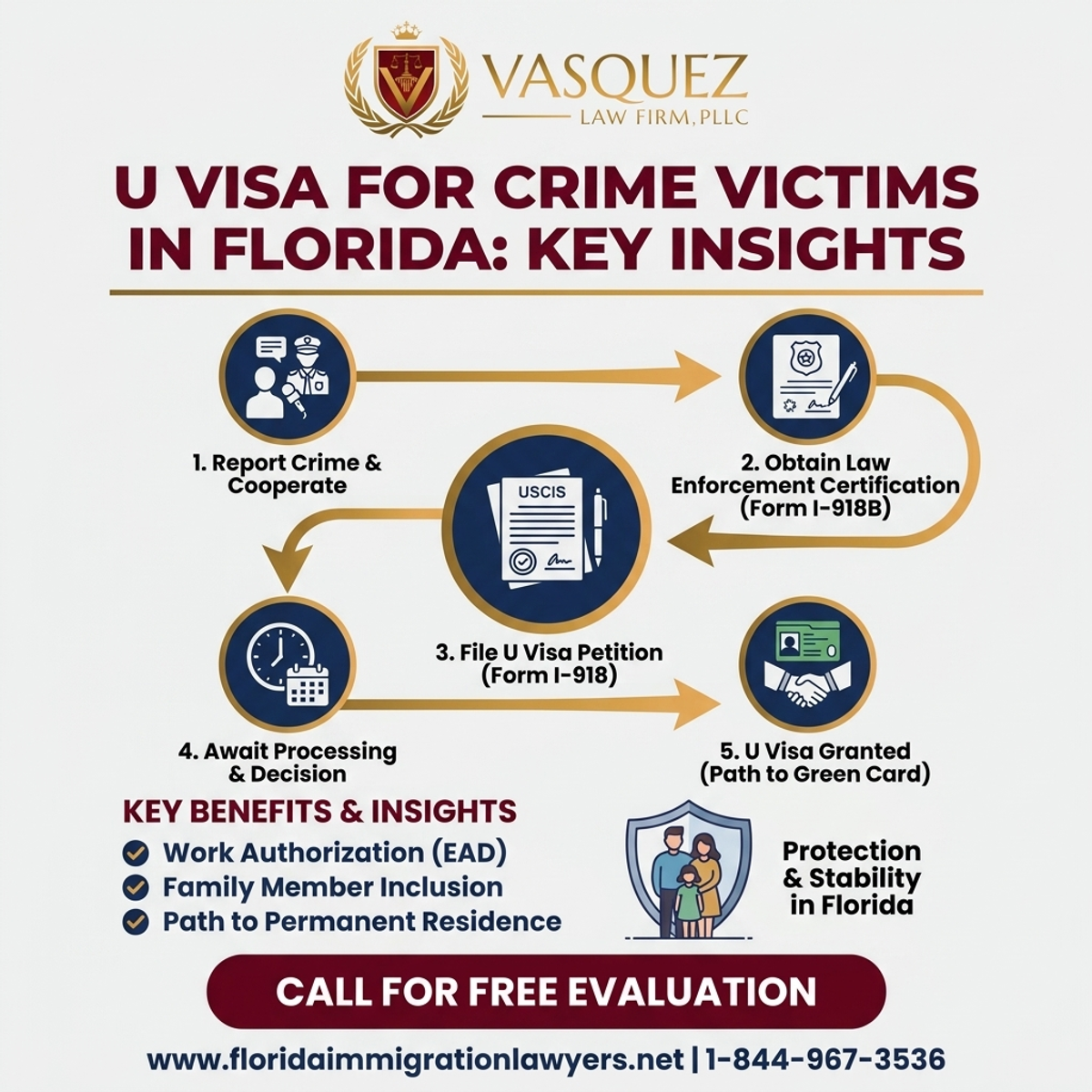
Step-by-Step Process — U Visa for Crime Victims in Florida: Key Insights
Each step must be carefully executed to ensure a successful application. Consult with an immigration attorney to navigate this complex process effectively.
Securing the law enforcement certification (Form I-918, Supplement B) is often the most challenging initial step. This certification must be signed by an authorized official from a qualifying agency, such as a police department, sheriff’s office, prosecutor’s office, or even a judge, confirming that you were a victim of a qualifying crime and have been, are being, or are likely to be helpful in the investigation or prosecution. Florida Immigration Lawyers can assist in communicating with law enforcement agencies to facilitate this critical document, ensuring your cooperation is properly acknowledged.
When completing Form I-918, the details matter immensely. Your personal statement should be a comprehensive narrative, explaining the crime, the abuse you suffered, and your assistance to authorities. It’s also vital to include applications for any qualifying family members (spouses, children, and in some cases, parents or siblings) who may be eligible for derivative U Visa status, using Form I-918, Supplement A. Each piece of evidence strengthens your case, painting a clear picture for USCIS adjudicators.
After filing, USCIS will send a receipt notice, acknowledging they have received your application. Subsequently, you will likely receive an appointment notice for biometrics (fingerprints and photos). During this waiting period, USCIS will conduct a "bona fide determination" (BFD) review. If your application appears legitimate and meets initial requirements, you may be granted deferred action and work authorization, offering significant relief while you await a final decision. This interim protection is a crucial benefit for many applicants in Florida.
What Documents are Required for a U Visa Application?
- Completed Form I-918 and I-918 Supplement B (Law Enforcement Certification)
- Personal statement detailing the crime and its effects
- Evidence of cooperation with law enforcement
- Medical records or affidavits proving substantial abuse
- Identity documents, such as passports
Ensure all documents are accurate and complete to avoid unnecessary delays in processing. Documentation plays a pivotal role in demonstrating eligibility for the U Visa.
Your personal statement is more than just a recounting of facts; it's your voice. It should detail the timeline of events, the specific acts of abuse you endured, the emotional and physical impact, and every instance of your cooperation with law enforcement. This narrative helps USCIS understand the depth of your experience and your eligibility under the U Visa provisions. Be honest, detailed, and clear, as this document often serves as the emotional core of your application.
Evidence of cooperation can take many forms, including police reports, court transcripts, prosecutor letters, and even emails or text messages demonstrating your communication with investigators. Medical records are vital for proving substantial abuse; this can include emergency room visits, doctor's notes, psychological evaluations, or affidavits from mental health professionals detailing the trauma you experienced. Collecting these documents diligently is paramount, and Florida Immigration Lawyers can guide you through obtaining official copies while protecting your privacy.
Furthermore, identity documents are crucial for establishing who you are. These might include copies of your birth certificate, national identity card, passport, or any other government-issued identification. If any of your supporting documents are not in English, certified translations are mandatory. An immigration attorney can help you organize these materials, ensure their accuracy, and present a compelling, well-supported application to USCIS, significantly increasing your chances of approval.
How Long Does It Take to Get a U Visa?
Processing times for U Visas can vary significantly. As of 2026, applicants might wait several years due to high demand and limited annual allocations.
| Stage | Typical Timeframe | Notes |
|---|---|---|
| Application Submission | Immediate | Ensure all forms and documents are complete. |
| USCIS Processing | 12-18 months | Processing times can fluctuate based on caseload. |
| Waitlist | Several years | Due to a cap of 10,000 U Visas issued annually. |
| Final Decision | Varies | Depends on individual case circumstances. |
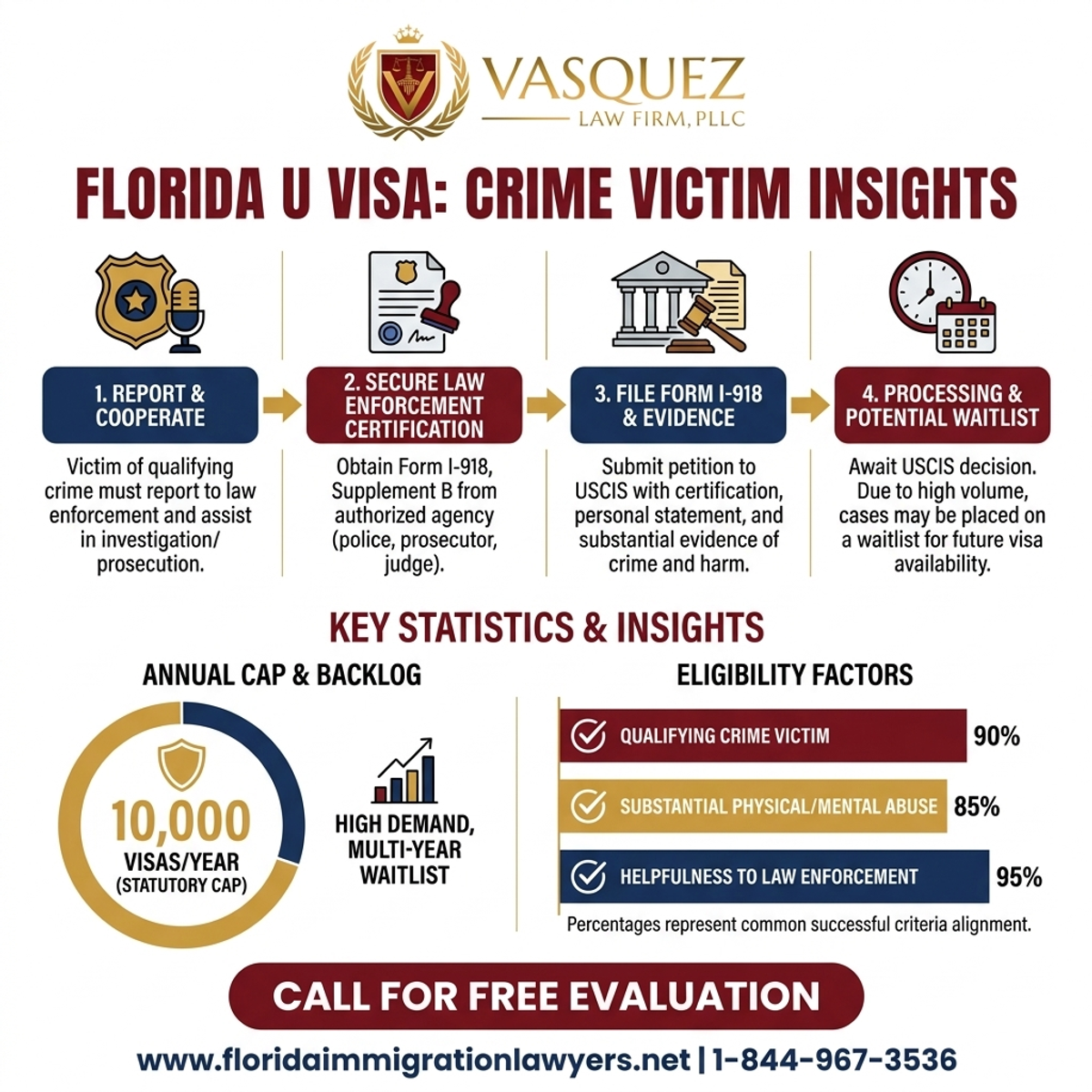
Key Statistics — U Visa for Crime Victims in Florida: Key Insights
For many, the wait can be long, but the protection and benefits offered by the U Visa make it a worthwhile pursuit.
The primary reason for the extended waitlist is the statutory cap of 10,000 U Visas issued annually. While USCIS receives tens of thousands of applications each year, only a limited number can be approved for final U status. This discrepancy creates a significant backlog, necessitating the waitlist. However, it's important to remember that being placed on the waitlist means USCIS has determined you are prima facie eligible, which is a significant step towards eventual approval.
During the waitlist period, many applicants receive a "bona fide determination" (BFD) approval. This means USCIS has reviewed your application and found that you meet the basic eligibility requirements for a U Visa. A BFD approval grants you deferred action, protecting you from deportation, and provides work authorization, allowing you to legally work in the U.S. This interim relief is a game-changer for many victims, offering stability and the ability to support themselves and their families while they await final U Visa approval. Florida Immigration Lawyers can help you understand the implications of BFD and navigate the process.
Managing the wait requires patience and careful planning. It's crucial to keep USCIS updated on any changes to your contact information or address. While the wait is long, the benefits of a U Visa – including the pathway to a green card – make it a life-changing opportunity for crime victims. Our firm can provide ongoing support and monitor your application's progress, ensuring you are informed every step of the way.
What Are the Costs Associated with a U Visa Application?
There are no filing fees for the U Visa application itself; however, other costs may apply, such as attorney fees or costs for obtaining necessary documentation.
| Item | Typical Fee | Notes |
|---|---|---|
| Attorney Fees | Varies | Depends on the complexity of the case. |
| Document Procurement | Varies | Costs for obtaining police reports, medical records, etc. |
| Translation Services | Varies | Essential for non-English documents. |
Consulting with an attorney can provide a clearer understanding of potential costs and financial planning for the application process.
While USCIS does not charge a filing fee for the U Visa application itself, the value an experienced immigration attorney brings is often immeasurable. Attorney fees cover expert legal advice, assistance with gathering complex documentation, communication with law enforcement, preparation of compelling personal statements, and representation throughout the entire process. This professional guidance can help avoid critical mistakes that could lead to delays or denial, ultimately saving time and stress.
Document procurement costs can include fees for obtaining certified copies of police reports, medical records from hospitals or clinics, and court documents. These small fees can add up, but they are essential for providing comprehensive evidence. Additionally, if you have documents in a language other than English, you will need certified translations, which involve professional translation services. Ensuring these translations are accurate and properly certified is vital for USCIS acceptance.
It's also worth noting that while the U Visa application itself is fee-exempt, certain related applications, such as subsequent applications for work authorization renewals (Form I-765), might have fees. However, fee waivers may be available for these forms based on financial hardship. Discussing all potential costs and payment options with Florida Immigration Lawyers during your free consultation can help you budget and plan effectively for your U Visa journey.
Do not navigate this process alone. Contact Florida Immigration Lawyers today.
Common Mistakes to Avoid When Applying for a U Visa
- Failing to Obtain Certification: Without law enforcement certification, your application cannot proceed.
- Incomplete Documentation: Missing or incorrect documents can lead to delays or denials.
- Insufficient Evidence of Abuse: Failing to demonstrate substantial abuse can jeopardize your application.
- Not Consulting an Attorney: Navigating the immigration system without professional guidance can be risky.
- Ignoring Application Updates: Failing to respond to USCIS requests can delay processing.
- Misunderstanding Eligibility Requirements: Ensure you understand all eligibility criteria before applying.
- Missing Deadlines: Timely submissions are critical to maintaining your case's momentum.
Here are some expanded insights into common mistakes and how to avoid them:
- Failing to Obtain Certification: This is the cornerstone of your U Visa application. Without a signed Form I-918, Supplement B from an authorized law enforcement official, USCIS cannot process your case. An attorney can help you approach the appropriate agency and advocate for your certification.
- Incomplete Documentation: Submitting an application with missing forms, unsigned declarations, or insufficient evidence is a common pitfall. This will inevitably lead to Requests for Evidence (RFEs) or even outright denial, significantly delaying your path to relief.
- Insufficient Evidence of Abuse: Simply stating you were abused is not enough. You must provide clear, compelling evidence such as medical records, psychological evaluations, police reports, or detailed personal statements to demonstrate the substantial mental or physical abuse you suffered.
- Not Consulting an Attorney: The U Visa process is intricate and highly nuanced. Attempting to navigate it without professional legal guidance can lead to critical errors, missed deadlines, and a higher risk of denial. An expert immigration lawyer provides invaluable support.
- Ignoring Application Updates: USCIS may send notices requesting additional information or clarification. Failing to respond promptly and thoroughly to these Requests for Evidence (RFEs) or Notices of Intent to Deny (NOIDs) can result in your application being closed or denied.
- Misunderstanding Eligibility Requirements: Each U Visa requirement has specific definitions and criteria. A common mistake is to assume eligibility without fully understanding the nuances of qualifying crimes, the definition of substantial abuse, or the extent of required cooperation.
- Missing Deadlines: While the U Visa itself doesn't have a strict filing deadline related to the crime, responding to USCIS requests within their specified timeframes is crucial. Missing these deadlines can jeopardize your entire application.
- Not Disclosing All Relevant Immigration History: It is imperative to be completely honest about your past immigration history, including any prior deportations, removals, or criminal convictions. An attorney can help address these issues and determine if waivers are available.
When to Call a Lawyer
If you are a crime victim seeking a U Visa, navigating the legal landscape can be daunting. An experienced immigration lawyer can help clarify eligibility, gather necessary documentation, and ensure all application steps are correctly followed.
Seek legal assistance if you encounter complex situations, such as a denial or need for an appeal, or if you have questions about the process. Florida Immigration Lawyers offer expert guidance and support throughout your immigration journey.
An experienced immigration lawyer from Florida Immigration Lawyers can be your most valuable asset. They can meticulously review your case, identify potential challenges, and develop a robust legal strategy. From helping you compile compelling evidence and drafting a persuasive personal statement to communicating with law enforcement agencies for certification and responding to USCIS inquiries, their expertise ensures every aspect of your application is handled with precision and care.
Consider seeking legal assistance particularly if your case involves complex factors such as prior immigration violations, criminal history, or if you are unsure about obtaining law enforcement certification. Even if your application has been denied, an attorney can assess the possibility of an appeal or re-filing. Don't let the complexity of the U Visa process deter you from seeking the protection and relief you deserve. Our team is available 24/7 to provide the guidance you need.
About Florida Immigration Lawyers
Florida Immigration Lawyers are dedicated to providing expert legal assistance to immigrants across Florida. Our experienced attorneys specialize in various immigration matters, from U Visas to deportation defense. We offer personalized attention to each case, ensuring the best possible outcomes for our clients. Call 1-844-967-3536 or visit our website for a free consultation. Available 24/7, we proudly serve the entire state of Florida.
At Florida Immigration Lawyers, we understand the profound impact that crime can have on victims and their families, especially when immigration status adds another layer of vulnerability. Our dedicated team approaches each U Visa case with empathy, discretion, and a deep commitment to justice. We leverage our extensive knowledge of immigration law and our experience working with law enforcement agencies across Florida to advocate tirelessly for our clients, ensuring their voices are heard and their rights are protected.
Our firm prides itself on offering comprehensive legal support, from the initial consultation to the final resolution of your case. We are not just your lawyers; we are your advocates, guiding you through every step with clarity and unwavering support. Whether you are in West Palm Beach, Miami, Orlando, or anywhere else in the state, Florida Immigration Lawyers is here to provide accessible, high-quality legal services. Contact us today at 1-844-967-3536 for a free, confidential consultation and take the first step towards securing your future in the U.S. Se Habla Español.
Sources and References
- U.S. Citizenship and Immigration Services (USCIS)
- Executive Office for Immigration Review (EOIR)
- 8 U.S.C. Chapter 12 - Immigration and Nationality Act
Related services: asylum and refugee protection, asylum application process, refugee status and resettlement.
This article provides general legal information and is not intended as legal advice. Every case is unique, and outcomes depend on specific facts and circumstances. Contact an attorney for advice about your particular situation.
Seize the opportunity for immigration relief and protection. Call Florida Immigration Lawyers at 1-844-967-3536 for a free consultation today. Se Habla Español - Estamos aquí para ayudarle.
If you need legal assistance, learn more about speak with an immigration lawyer, or call us at 1-844-967-3536 for a free consultation.
Do Not Navigate This Process Alone
Our experienced immigration attorneys are ready to fight for you. Get a free, confidential consultation today.
Se Habla Español
Frequently Asked Questions
Harold Estrada-Rodriguez
Florida Immigration Attorney · FL Bar No. 1041171
Florida Bar attorney handling Florida-jurisdiction immigration matters. Bilingual representation, free consultations.
Available 24/7 - Free Evaluations
Related Legal Services
Our Florida immigration attorneys can help you with free immigration consultation, experienced immigration attorneys and business immigration. Call today at 1-844-967-3536 for a free consultation.
Related Links
Related Topics
Free Legal Consultation
Discuss your case with our experienced attorneys. We're available 24/7.
Se Habla Español - Estamos aquí para ayudarle.
Related Articles
F-1 Reinstatement Student Visa Process in Florida | VLF Florida
F-1 reinstatement allows students in Coral Springs, Florida, to regain their student visa status if they have fallen out of status. This comprehensive guide covers eligibility, application steps, and common pitfalls, ensuring you are well-prepared. Contact Florida Immigration Lawyers at 1-844-967-3536 for a free consultation.
Find an Immigration Lawyer in Cape Coral | VLF Florida
Navigating immigration in Cape Coral and Southwest Florida requires expert guidance. Learn how to choose the right lawyer and understand local immigration processes. Contact Florida Immigration Lawyers for personalized assistance.
E-2 Visa for Florida Business Investors | VLF Florida
Learn about the E-2 investor visa for Florida business opportunities, tailored for Fort Lauderdale entrepreneurs. Discover the process, requirements, and common pitfalls. Contact Florida Immigration Lawyers for expert assistance.
Immigration Documents Checklist for Florida | VLF Florida
Navigating immigration processes in Florida requires a comprehensive checklist of documents. This guide helps you gather all necessary paperwork to ensure a successful application. Consult Florida Immigration Lawyers for personalized assistance.
