F-1 Reinstatement Student Visa Process in Florida
F-1 reinstatement allows students in Coral Springs, Florida, to regain their student visa status if they have fallen out of status. This comprehensive guide covers eligibility, application steps, and common pitfalls, ensuring you are well-prepared. Contact Florida Immigration Lawyers at 1-844-967-3536 for a free consultation.

F-1 Reinstatement Student Visa Process in Florida | VLF Florida
Maintaining your F-1 student visa status is crucial for international students in the United States. Falling out of status, even unintentionally, can lead to serious consequences, including the risk of deportation and future visa denials. Fortunately, for many students, the F-1 reinstatement process offers a pathway to regain legal status. This comprehensive guide will walk you through the intricacies of F-1 reinstatement in Florida, outlining eligibility, the application process, potential challenges, and how expert legal assistance can make a critical difference. If you find yourself in this challenging situation, understanding your options and acting promptly is paramount. Contact VLF Florida today for a free consultation with our experienced Florida Immigration Lawyers.
Understanding F-1 Student Status and 'Out of Status'
An F-1 student visa allows foreign nationals to pursue academic studies and language training programs in the U.S. Maintaining this status requires adherence to specific regulations set by U.S. Citizenship and Immigration Services (USCIS) and your Designated School Official (DSO). When a student fails to comply with these regulations, they are considered 'out of status'.
What Does 'Out of Status' Mean?
Being 'out of status' means you have violated the terms and conditions of your F-1 visa. Common violations include:
- Failing to enroll in a full course of study.
- Unauthorized employment (working without proper authorization).
- Failing to complete your program by the program end date on your I-20.
- Transferring schools without following proper procedures.
- Withdrawing from school without prior authorization from your DSO.
- Taking an unauthorized leave of absence.
- Failing to extend your I-20 before its expiration.
Once you are out of status, your F-1 visa becomes invalid, and you lose the benefits associated with it, such as the ability to work on campus or apply for Optional Practical Training (OPT). More critically, you begin accruing unlawful presence, which can lead to significant bars to re-entry into the U.S. in the future. Facing such a situation can be daunting, but options like F-1 reinstatement are designed to help eligible students rectify their status.
Eligibility Requirements for F-1 Reinstatement
To be eligible for F-1 reinstatement, you must meet several strict criteria established by USCIS. It's not an automatic process, and each condition must be carefully addressed in your application. The primary conditions include:
- No Willful Violation: You must demonstrate that your violation of F-1 status was due to circumstances beyond your control, or that the violation relates to a reduction in your course load that would have been acceptable had you obtained prior approval from your DSO, and that you would still be pursuing a full course of study or have resumed a full course of study at the time of filing. You cannot have willfully violated your status. Examples of circumstances beyond your control might include serious illness, an accident, or unforeseen financial difficulties.
- No Unauthorized Employment: You must not have engaged in unauthorized employment. Any work performed without proper authorization, such as CPT or OPT, will generally disqualify you from reinstatement.
- Currently Pursuing or Intending to Pursue a Full Course of Study: You must currently be pursuing, or intend to pursue, a full course of study at an SEVP-approved institution. Your DSO will issue a new I-20 with a reinstatement recommendation.
- Not Subject to Deportation Proceedings: You must not be in removal (deportation) proceedings. If you are, your options are different, and you should seek immediate legal counsel specializing in deportation defense.
- No History of Gross Misconduct: You must not have a history of repeated or gross violations of immigration regulations.
- Timeliness of Application: You must file your Form I-539, Application to Extend/Change Nonimmigrant Status, within five months of falling out of status. While exceptions exist for extraordinary circumstances, it is always best to file as soon as possible.
- No Unlawful Presence: You must not have accrued more than 180 days of unlawful presence.
Understanding these requirements is the first step. A thorough review of your specific situation by an immigration attorney is highly recommended to determine your eligibility.
The F-1 Reinstatement Application Process (Form I-539)
The F-1 reinstatement process primarily involves filing Form I-539, Application to Extend/Change Nonimmigrant Status, with USCIS. This application is complex and requires meticulous preparation. Here's a breakdown of the key steps and required documentation:
Step-by-Step Guide to Filing Form I-539 for Reinstatement:
- Obtain a New I-20 with Reinstatement Recommendation: Your DSO at your current school must issue a new Form I-20, Certificate of Eligibility for Nonimmigrant Student Status, with the box for 'Reinstatement' checked and a detailed explanation of why you fell out of status and why reinstatement is warranted. This is a critical document.
- Complete Form I-539: Fill out Form I-539 accurately and completely. Ensure all sections are relevant to your situation and consistently reflect the information on your I-20 and supporting documents.
- Prepare a Personal Statement: This is one of the most crucial components. You must write a compelling letter explaining in detail:
- How and why you fell out of status (e.g., unexpected illness, financial hardship, administrative error).
- That the violation was not willful.
- Your commitment to maintaining F-1 status moving forward.
- Your intent to continue your education.
- Any steps you have taken to rectify the situation.
- Gather Supporting Documentation: Assemble all necessary documents, which typically include:
- The new I-20 with reinstatement recommendation.
- All previous I-20s.
- Copies of your passport (biographic page), visa, and I-94 arrival/departure record.
- Academic transcripts from all U.S. institutions attended.
- Proof of financial ability to cover tuition and living expenses (e.g., bank statements, scholarship letters).
- Evidence supporting your claim that the violation was beyond your control (e.g., medical records, death certificates, letters from advisors).
- Proof of enrollment in a full course of study.
- Any other relevant documents that strengthen your case.
- Pay the Filing Fee: Include the correct filing fee for Form I-539. Check the USCIS website for the most current fee.
- Mail Your Application: Send the complete application package to the appropriate USCIS service center. Always keep a copy of everything you submit for your records.
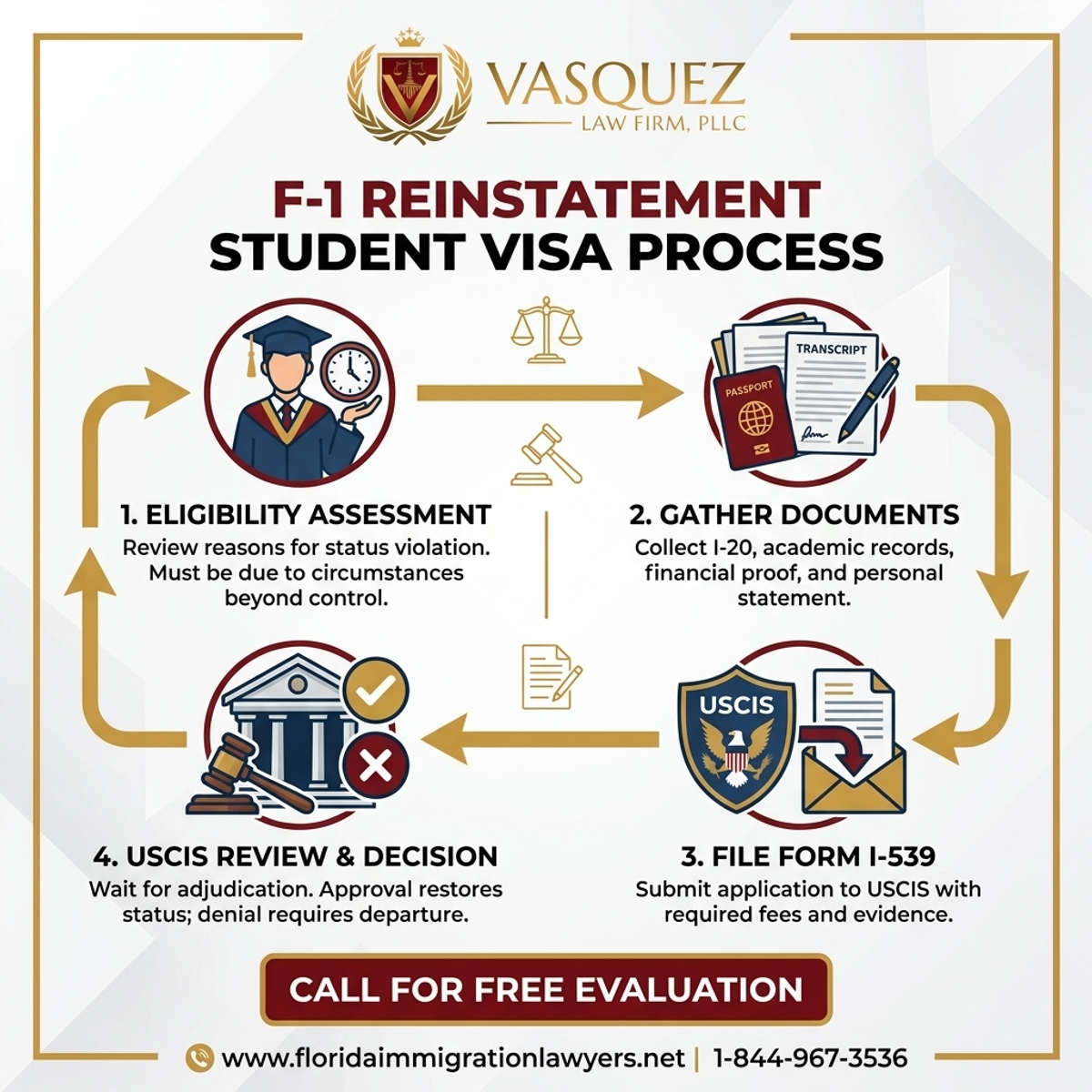
Step-by-Step Process — F-1 Reinstatement Student Visa Process in Florida | VLF Florida
The processing times for F-1 reinstatement can vary significantly, often taking several months. During this time, you are generally permitted to remain in the U.S. and continue your studies, but you cannot travel internationally until your reinstatement is approved. If you leave the U.S. while your I-539 is pending, USCIS will consider your application abandoned.
Navigating the F-1 Reinstatement Process: Common Challenges and Expert Guidance
The F-1 reinstatement process is fraught with potential challenges that can easily lead to a denial if not handled correctly. From intricate documentation requirements to effectively articulating your case to USCIS, students often benefit immensely from professional legal assistance. Our experienced immigration attorneys at VLF Florida are well-versed in these complexities and can provide invaluable support.
One of the most common hurdles is proving that your status violation was 'not willful.' This requires a clear, consistent, and well-supported narrative. For instance, a student who simply forgot to extend their I-20 might struggle to prove non-willfulness without additional compelling circumstances. Medical emergencies, severe family crises, or administrative errors by the school are generally stronger arguments. Crafting a persuasive personal statement and gathering corroborating evidence is critical. Our legal team can help you structure this narrative and identify the strongest supporting documents to present your case effectively.
Another challenge arises from USCIS Requests for Evidence (RFEs). An RFE indicates that USCIS needs more information or clarification to make a decision. Responding to an RFE correctly and comprehensively is vital, as a weak or incomplete response can lead to denial. Our attorneys are adept at interpreting RFEs and preparing robust responses that address all USCIS concerns. Furthermore, the legal landscape of immigration is constantly evolving. Staying updated on new policies, processing times, and specific requirements for students in Florida can be overwhelming. We provide current and accurate advice, ensuring your application adheres to the latest regulations.
Finally, the emotional and psychological toll of being out of status can be immense. Having a knowledgeable advocate by your side can alleviate stress and provide peace of mind. We act as your liaison with USCIS, handle all communications, and ensure your rights are protected throughout the process. For any questions or to begin your reinstatement application with confidence, reach out to us for a consultation.
Consequences of Not Seeking Reinstatement or Denial
If you fall out of F-1 status and do not apply for reinstatement, or if your reinstatement application is denied, the consequences can be severe:
- Accrual of Unlawful Presence: You begin accruing unlawful presence from the date you fell out of status. Accruing more than 180 days of unlawful presence can trigger a 3-year bar from re-entering the U.S., and more than one year can trigger a 10-year bar.
- Deportation Risk: You become subject to removal (deportation) from the U.S. USCIS may issue a Notice to Appear (NTA), initiating formal deportation proceedings.
- Future Visa Denials: Falling out of status can negatively impact your ability to obtain future U.S. visas, including tourist visas, work visas, or even other student visas.
- Ineligibility for Other Immigration Benefits: You may become ineligible to adjust status or apply for other immigration benefits in the future.
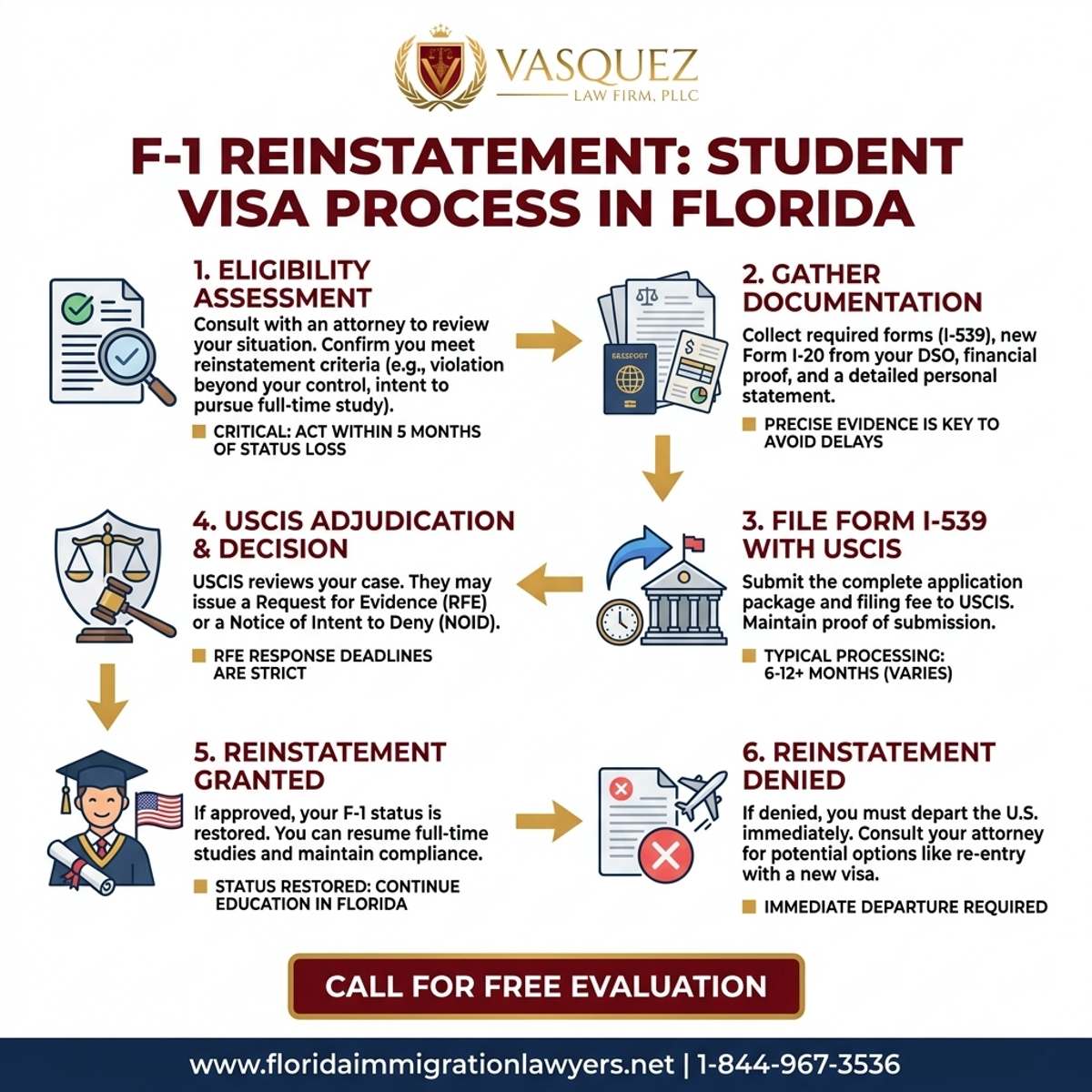
Key Statistics — F-1 Reinstatement Student Visa Process in Florida | VLF Florida
It is critical to address your status issue immediately. If reinstatement is not an option or is denied, exploring alternatives with an immigration attorney is essential.
Alternatives to F-1 Reinstatement
While reinstatement is often the preferred path, it's not always feasible or approved. In such cases, other options might be available:
- Departing the U.S. and Re-entering with a New I-20: If you are out of status but have not accrued significant unlawful presence (less than 180 days), you might be able to leave the U.S., obtain a new I-20 from your school, apply for a new F-1 visa at a U.S. consulate abroad, and re-enter. This option carries risks, as the consular officer will review your previous status violation.
- Changing to Another Nonimmigrant Status: In very limited circumstances, if you are eligible for another nonimmigrant visa category (e.g., H-1B, B-2), you might be able to apply for a change of status. However, being out of status often makes this difficult.
- Exploring Other Immigration Options: In rare and extreme cases, if returning to your home country is unsafe, other avenues like asylum might be considered. This is a complex and highly specialized area of law, requiring immediate consultation with an attorney.
Each alternative has its own set of requirements, risks, and benefits. It is crucial to discuss these options with a qualified immigration attorney to determine the best course of action for your unique situation.
Preventative Measures: How to Maintain F-1 Status
Prevention is always better than cure. F-1 students can take several proactive steps to avoid falling out of status:
- Communicate Regularly with Your DSO: Your Designated School Official is your primary resource for F-1 status questions. Inform them immediately of any changes in your academic plans, financial situation, or personal circumstances that might affect your status.
- Understand Your I-20: Pay close attention to the program end date on your Form I-20. Apply for an extension well in advance if you need more time to complete your program.
- Maintain a Full Course of Study: Ensure you are always enrolled in the required number of credits for a full course of study. Obtain prior authorization from your DSO for any reduced course load.
- Avoid Unauthorized Employment: Never work off-campus without explicit authorization (CPT or OPT) from your DSO and USCIS.
- Keep Records Organized: Maintain copies of all immigration documents, including I-20s, I-94s, visas, and academic records.
- Know Your Rights and Responsibilities: Familiarize yourself with F-1 visa regulations and your responsibilities as an international student.
The Role of an Immigration Attorney in F-1 Reinstatement
Navigating the F-1 reinstatement process without legal guidance can be overwhelming and risky. An experienced immigration attorney can provide invaluable assistance at every stage:
- Eligibility Assessment: An attorney can thoroughly review your case to determine if you meet the complex eligibility criteria for reinstatement.
- Document Preparation: We assist in gathering and organizing all necessary documents, ensuring accuracy and completeness.
- Crafting a Compelling Personal Statement: Our team helps you articulate your circumstances clearly and persuasively, highlighting the non-willful nature of your status violation.
- Responding to RFEs: If USCIS issues a Request for Evidence, we prepare a robust and timely response to address all concerns.
- Representation: While not always required for F-1 reinstatement, an attorney can represent you in communications with USCIS and provide strategic advice.
- Exploring Alternatives: If reinstatement is not possible, we can advise you on other potential immigration pathways, including the risks and benefits of leaving the U.S. and re-applying, or other complex options like asylum if applicable to your unique circumstances and fears of return.
At VLF Florida, our dedicated immigration lawyers have a deep understanding of F-1 student visa regulations and the reinstatement process. We are committed to helping international students in Florida overcome immigration challenges and continue their academic journeys. Our goal is to provide clear, effective, and compassionate legal representation.
Contact VLF Florida for Expert F-1 Reinstatement Assistance
If you are an F-1 student in Florida who has fallen out of status, time is of the essence. The sooner you address the issue, the better your chances of a successful reinstatement. Don't navigate this complex process alone. Our Florida immigration lawyers are here to provide the guidance and support you need.
Schedule a Free Consultation Today
Frequently Asked Questions About F-1 Reinstatement
Q1: How long does F-1 reinstatement take?
A1: Processing times for F-1 reinstatement can vary significantly, typically ranging from a few months to over a year, depending on the USCIS service center workload and the complexity of your case. It's crucial to file as soon as possible and avoid international travel while your application is pending.
Q2: Can I work while my F-1 reinstatement application is pending?
A2: No, you are generally not authorized to work while your F-1 reinstatement application is pending. Engaging in unauthorized employment can lead to a denial of your application and further jeopardize your immigration status.
Q3: What happens if my F-1 reinstatement is denied?
A3: If your F-1 reinstatement application is denied, you will be considered out of status and may begin accruing unlawful presence. You would then need to explore other options, such as departing the U.S. and applying for a new visa abroad, or potentially facing deportation proceedings. It is crucial to consult with an immigration attorney immediately upon denial.
Q4: Do I need a new I-20 for F-1 reinstatement?
A4: Yes, you must obtain a new Form I-20 from your Designated School Official (DSO) with the reinstatement recommendation box checked. This new I-20 is a critical component of your application package.
Q5: What are 'circumstances beyond my control' for F-1 reinstatement?
A5: 'Circumstances beyond your control' typically refer to unforeseen events that caused you to fall out of status, such as serious illness or injury, severe financial hardship (documented), natural disasters, or administrative errors by your school. You must provide strong evidence to support your claim.
Q6: Can I travel outside the U.S. while my F-1 reinstatement is pending?
A6: No, it is generally not advisable to travel outside the U.S. while your F-1 reinstatement application is pending. If you leave, USCIS will consider your application abandoned, and you will need to apply for a new F-1 visa at a U.S. consulate abroad to re-enter, which can be risky.
Q7: How can an immigration lawyer help with F-1 reinstatement?
A7: An immigration lawyer can assess your eligibility, help gather and organize documentation, draft a compelling personal statement, respond to RFEs, and represent you in communications with USCIS. They can significantly increase your chances of a successful outcome and advise on alternatives if reinstatement is not viable. Our attorneys are ready to assist.
Q8: What if I have accrued unlawful presence?
A8: Accruing unlawful presence is a serious issue. If you have accrued more than 180 days, you may be subject to a 3-year or 10-year bar from re-entry to the U.S. F-1 reinstatement is generally not possible if you have accrued significant unlawful presence. You should consult an immigration attorney immediately to discuss your limited options.
Q9: Is there a deadline to apply for F-1 reinstatement?
A9: Yes, you must generally file your Form I-539 application within five months of falling out of F-1 status. While USCIS may consider applications filed beyond this deadline in extraordinary circumstances, it is always best to apply as soon as possible.
Q10: Can I apply for F-1 reinstatement if I worked without authorization?
A10: Generally, no. Engaging in unauthorized employment is a serious violation of F-1 status and typically renders you ineligible for F-1 reinstatement. USCIS explicitly states that applicants must not have engaged in unauthorized employment to be eligible.
Sources and References
- U.S. Citizenship and Immigration Services (USCIS)
- Executive Office for Immigration Review (EOIR)
- U.S. Department of State - Bureau of Consular Affairs
- Immigration and Nationality Act (INA), 8 U.S.C. Chapter 12
Do Not Navigate This Process Alone
Our experienced immigration attorneys are ready to fight for you. Get a free, confidential consultation today.
Se Habla Español
Frequently Asked Questions
Harold Estrada-Rodriguez
Florida Immigration Attorney · FL Bar No. 1041171
Florida Bar attorney handling Florida-jurisdiction immigration matters. Bilingual representation, free consultations.
Available 24/7 - Free Evaluations
Related Legal Services
Our Florida immigration attorneys can help you with free immigration consultation, experienced immigration attorneys and business immigration. Call today at 1-844-967-3536 for a free consultation.
Related Links
Related Topics
Free Legal Consultation
Discuss your case with our experienced attorneys. We're available 24/7.
Se Habla Español - Estamos aquí para ayudarle.
Related Articles
U Visa for Crime Victims in Florida: Key Insights | VLF Florida
Discover how the U Visa offers critical immigration relief for crime victims in Florida. Learn about eligibility, application steps, and why professional guidance is crucial. Call Florida Immigration Lawyers for expert assistance.
Find an Immigration Lawyer in Cape Coral | VLF Florida
Navigating immigration in Cape Coral and Southwest Florida requires expert guidance. Learn how to choose the right lawyer and understand local immigration processes. Contact Florida Immigration Lawyers for personalized assistance.
E-2 Visa for Florida Business Investors | VLF Florida
Learn about the E-2 investor visa for Florida business opportunities, tailored for Fort Lauderdale entrepreneurs. Discover the process, requirements, and common pitfalls. Contact Florida Immigration Lawyers for expert assistance.
Immigration Documents Checklist for Florida | VLF Florida
Navigating immigration processes in Florida requires a comprehensive checklist of documents. This guide helps you gather all necessary paperwork to ensure a successful application. Consult Florida Immigration Lawyers for personalized assistance.
