U Visa for Crime Victims in Florida: Your 2026 Guide
For crime victims in Florida, the U visa offers a critical pathway to legal status and protection. This humanitarian immigration relief is available to individuals who have suffered substantial physical or mental abuse as a result of certain serious crimes and are willing to assist law enforcement in their investigation or prosecution. From domestic violence to human trafficking, understanding your eligibility and the complex application process is vital. This guide provides a comprehensive overview of the U visa, including specific qualifying crimes, the step-by-step application process, required documentation, and current processing timelines and fees for 2026. We also highlight common mistakes to avoid and explain when seeking legal counsel from experienced immigration attorneys at Florida Immigration Lawyers is essential. Our firm, based in Orlando, serves all of Florida, offering compassionate guidance and strategic advocacy to help crime victims achieve safety and legal residency.
The U visa provides critical immigration relief to victims of certain serious crimes who have suffered substantial physical or mental abuse and are willing to assist law enforcement or government officials in the investigation or prosecution of criminal activity. In Florida, this status can lead to lawful permanent residency and offer protection from deportation for eligible individuals and their qualifying family members. Obtaining a U visa requires demonstrating eligibility, including a qualifying crime, substantial harm, and certification from a law enforcement agency confirming your helpfulness. The process is complex, making legal guidance essential.
- Eligibility: Victim of qualifying criminal activity, substantial harm, helpfulness to law enforcement.
- Certification: Requires a signed Form I-918, Supplement B, from a qualifying agency.
- Benefits: Legal status, work authorization, path to green card, protection from removal.
- Complexity: The application process is detailed and often requires legal assistance.
Navigating the aftermath of a crime is a traumatic experience, especially for immigrants who may fear interacting with law enforcement or lack understanding of their rights. If you or a loved one has been a victim of a serious crime in Florida, you may be eligible for a crucial form of immigration relief known as the U nonimmigrant status, or U visa. This humanitarian visa offers protection and a pathway to legal status for those who have suffered substantial abuse and are willing to assist in the investigation or prosecution of the crime.
At Florida Immigration Lawyers, we understand the unique challenges faced by crime victims in our diverse communities across Florida. Our dedicated team is here to guide you through every step of the U visa application process, ensuring your rights are protected and your voice is heard. This comprehensive guide will explain the U visa, its eligibility requirements, the application process, and what you can expect as a crime victim seeking immigration relief in Florida. Do not face this journey alone. Call Florida Immigration Lawyers at 1-844-967-3536 for a free case review today.
What is a U Visa and Who is Eligible in Florida?
The U nonimmigrant status, commonly known as a U visa, was created by Congress to protect victims of certain serious crimes who have suffered substantial physical or mental abuse and are willing to help law enforcement in the investigation or prosecution of those crimes. This visa helps law enforcement agencies solve crimes and prosecute criminals by encouraging victims, regardless of their immigration status, to come forward without fear of deportation.
As of 2026, to be eligible for a U visa in Florida, you must meet several key criteria. First, you must have been a victim of qualifying criminal activity. The Immigration and Nationality Act (INA) lists specific crimes, including but not limited to domestic violence, sexual assault, trafficking, abduction, torture, felonious assault, and witness tampering. Second, you must have suffered substantial physical or mental abuse as a direct result of being a victim of the qualifying crime. This harm must be significant, and USCIS evaluates it based on factors like the nature of the injury, severity, duration of the abuse, and intervention efforts. Third, you must possess information concerning the criminal activity and be willing to assist law enforcement or government officials in the investigation or prosecution of the crime. This willingness is crucial and must be certified by a qualifying agency. Lastly, the criminal activity must have occurred in the United States or violated U.S. laws. Florida's diverse population means many individuals may be eligible, and local law enforcement agencies, such as the Orlando Police Department or Orange County Sheriff's Office, are often involved in the certification process.
Qualifying Criminal Activities for U Nonimmigrant Status
The list of qualifying crimes is extensive and includes offenses like rape, torture, trafficking, incest, domestic violence, sexual assault, abusive sexual contact, prostitution, sexual exploitation, abduction, false imprisonment, kidnapping, murder, manslaughter, felonious assault, blackmail, extortion, hostage taking, peonage, involuntary servitude, slave trade, unlawful criminal restraint, and witness tampering. It also covers attempt, conspiracy, or solicitation to commit any of these crimes. Understanding if your experience falls under these categories is a critical first step. Our immigration attorneys can help assess your specific situation against these complex legal definitions.
How Do I Apply for a U Visa as a Crime Victim in Florida?
Applying for a U visa involves a detailed, multi-step process that requires careful attention to detail and thorough documentation. As of 2026, the primary application form is Form I-918, Petition for U Nonimmigrant Status, submitted to U.S. Citizenship and Immigration Services (USCIS). This form must be accompanied by several supporting documents, most critically the Form I-918, Supplement B, U Nonimmigrant Status Certification, signed by a qualifying law enforcement agency.
The application process begins with gathering evidence of the crime, your victimization, the substantial harm suffered, and your cooperation with law enforcement. This includes police reports, medical records, psychological evaluations, and any other evidence that corroborates your story. Once you have compiled your evidence and obtained the law enforcement certification, you will submit the complete package to USCIS. USCIS will review your petition and may request additional evidence or schedule an interview. If approved, you will receive U nonimmigrant status, typically for a period of four years, along with work authorization. After three years in U status, you may be eligible to apply for lawful permanent residency (a green card). The Orlando USCIS Field Office may process certain follow-up applications or interviews for Florida residents, though initial U visa petitions are centrally processed.
Step-by-Step Guide to the U Visa Application Process
- Seek Legal Counsel: Contact an experienced immigration attorney at Florida Immigration Lawyers. We can assess your eligibility, help gather evidence, and guide you through the entire process.
- Report the Crime: If you haven't already, report the crime to the appropriate law enforcement agency in Florida (e.g., local police, sheriff's office, State Attorney's Office, FDLE).
- Cooperate with Law Enforcement: Actively assist in the investigation or prosecution. This cooperation is vital for obtaining the necessary certification.
- Obtain Law Enforcement Certification: Your attorney will help you request Form I-918, Supplement B, from the certifying agency. This form confirms that you were a victim of a qualifying crime and were helpful, are being helpful, or are likely to be helpful to the investigation or prosecution. Agencies in Central Florida, such as the Seminole County Sheriff's Office or the Osceola County Sheriff's Office, are familiar with this process.
- Prepare Form I-918 and Supporting Documents: Complete Form I-918 and gather all required evidence, including personal statements, police reports, medical records, psychological evaluations, and affidavits from witnesses. Include evidence of substantial physical or mental abuse.
- File with USCIS: Submit the complete Form I-918 package, including Supplement B and all supporting documentation, to the USCIS Vermont Service Center.
- Receive Prima Facie Determination: USCIS may issue a prima facie determination, indicating that you appear eligible. This can provide certain benefits, like deferred action, while your application is pending.
- Wait for Adjudication: Due to the annual cap of 10,000 U visas, there is often a significant waiting list. USCIS processes petitions in the order received, and applicants typically receive deferred action and work authorization while on the waiting list.
- Attend Biometrics Appointment: You will likely be scheduled for a biometrics appointment at an Application Support Center (ASC) in Florida, such as those in Orlando, Tampa, or Miami, to provide fingerprints and photos.
- Interview (if requested): USCIS may request an interview. Your attorney can prepare you for this step.
- Receive Decision: If approved, you will be granted U nonimmigrant status.
- Apply for Adjustment of Status: After three years in U status, you may be eligible to apply for lawful permanent residency (green card) using Form I-485, Application to Register Permanent Residence or Adjust Status.
What Documents Do I Need for a U Visa Application?
A successful U visa application hinges on providing comprehensive and accurate documentation. Preparing these documents can be overwhelming, but with proper legal guidance, it becomes manageable. Here's a general checklist of essential documents you will need to compile:
- Form I-918, Petition for U Nonimmigrant Status: The main application form.
- Form I-918, Supplement B, U Nonimmigrant Status Certification: Signed by a qualifying law enforcement agency or government official. This is perhaps the most crucial document.
- Personal Statement: A detailed narrative from you describing the crime, the harm you suffered, and your cooperation with law enforcement.
- Police Reports: Official reports from the law enforcement agency that investigated the crime.
- Medical Records: Documentation of physical injuries, psychological trauma, or any other health issues resulting from the crime.
- Psychological Evaluations: Assessments from licensed mental health professionals detailing the mental or emotional abuse suffered.
- Court Documents: If the case went to court, include relevant filings, transcripts, or orders.
- Affidavits: Sworn statements from witnesses, family members, or service providers who can corroborate your story or the harm you experienced.
- Evidence of Immigration Status: Any documents related to your current or past immigration status.
- Identity Documents: Passport, birth certificate, national ID, or other forms of identification.
- Forms I-918, Supplement A, Petition for Qualifying Family Member of U-1 Nonimmigrant: If applying for family members (spouse, children, parents for child victims under 21, unmarried siblings under 18 for child victims under 21).
- Photos: Passport-style photographs for you and any qualifying family members.
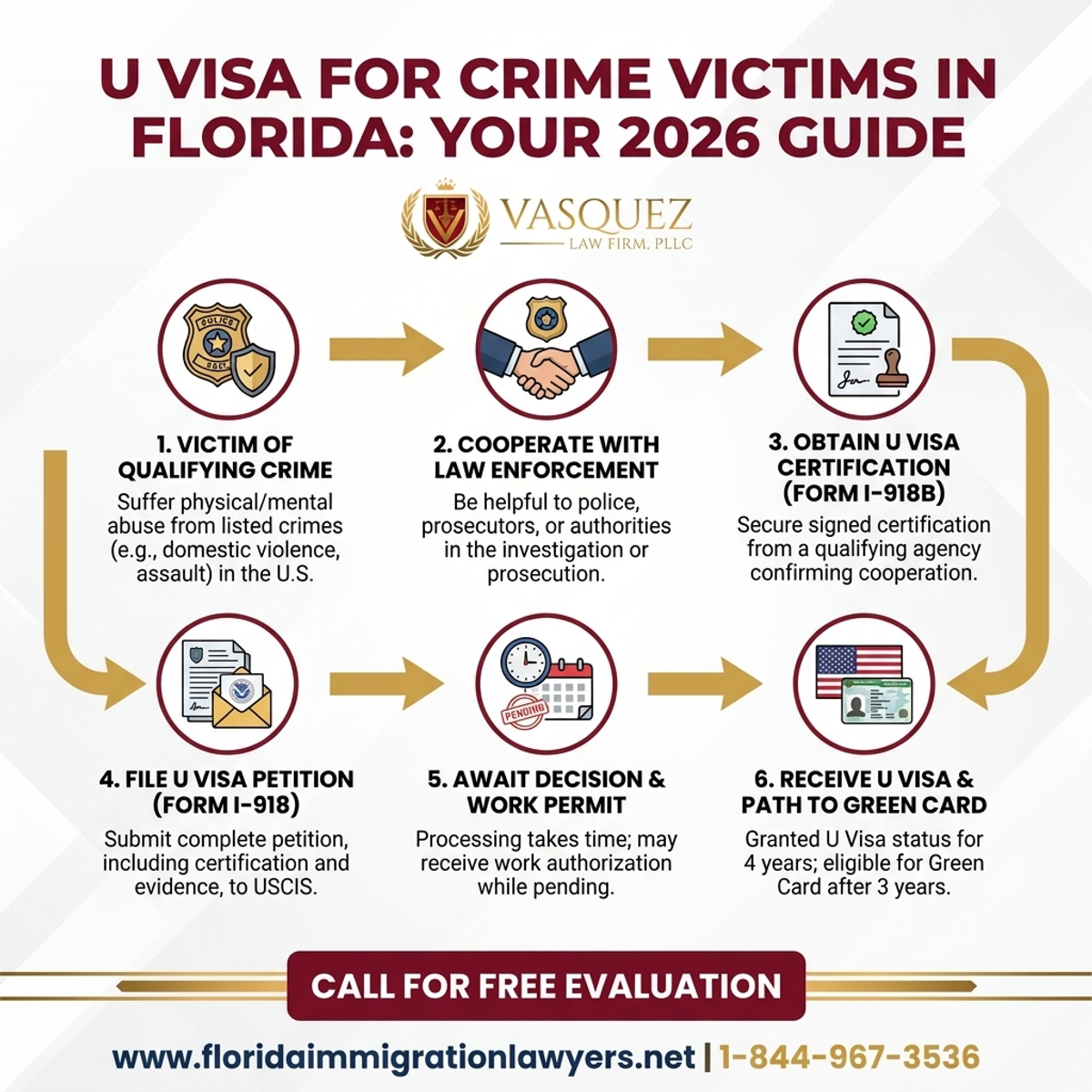
Step-by-Step Process — U Visa for Crime Victims in Florida: Your 2026 Guide
It is important to provide certified translations for any documents not in English. Your attorney can help ensure all documentation meets USCIS requirements and is presented effectively.
How Long Does a U Visa Application Take and What Are the Fees in 2026?
The U visa application process is known for its significant processing times due to the annual statutory cap of 10,000 U visas issued each fiscal year, as outlined in INA Section 214(p)(2). As of 2026, applicants often face a multi-year wait from the initial filing to final adjudication. However, USCIS has implemented a bona fide determination process to provide some relief to applicants while they wait.
The fees associated with the U visa application are generally minimal for the primary applicant. There is no filing fee for Form I-918, Petition for U Nonimmigrant Status. However, there may be fees for biometric services. If you apply for family members using Form I-918, Supplement A, there are also no filing fees for those petitions. The primary costs are typically legal fees for attorney assistance, which is highly recommended given the complexity of the process, and any costs associated with obtaining supporting documents like medical evaluations or certified translations.
U Visa Processing Timeline (Estimated as of 2026)
| Stage | Typical Timeframe | Notes |
|---|---|---|
| Preparation & Filing | 3-6 months | Gathering documents, obtaining certification, attorney review. |
| Receipt Notice & Initial Review | 1-3 months | USCIS acknowledges receipt. |
| Prima Facie Determination | 12-18 months | If met, grants deferred action and work authorization while on waiting list. |
| Waiting List for U Visa | 5-7 years | Due to the annual cap of 10,000 visas. Applicants typically have deferred action and EAD during this period. |
| Final Adjudication & Approval | Upon reaching the front of the waiting list | U visa status granted for 4 years. |
| Adjustment of Status (Green Card) | After 3 years in U status + 6-12 months processing | Eligibility to apply for lawful permanent residency. |
U Visa Cost Factors and Fee Breakdown (Estimated as of 2026)
| Item | Typical Fee | Notes |
|---|---|---|
| Form I-918, Petition for U Nonimmigrant Status | $0 | No USCIS filing fee for the primary applicant. |
| Form I-918, Supplement A (for family members) | $0 | No USCIS filing fee. |
| Biometrics Services Fee | $85 (approx.) | For fingerprinting and background checks. This fee is subject to change. |
| Legal Representation | Varies significantly | Highly recommended. Fees depend on case complexity and attorney experience. |
| Medical/Psychological Evaluations | Varies | If required to document substantial harm. |
| Document Translation & Certification | Varies | For any non-English documents. |
While the direct USCIS fees for the U visa are minimal, the overall cost can add up, primarily due to legal fees and associated documentation expenses. Investing in experienced legal counsel is often the most cost-effective approach in the long run, as it minimizes errors and maximizes the chances of approval. For the most current fee information, always consult the official USCIS website.
Do not navigate this complex process alone. Contact Florida Immigration Lawyers today at 1-844-967-3536 for a free case review and expert legal assistance.
Understanding U Visa Certification in Florida
The U visa certification is arguably the most critical component of the application. It is a document, Form I-918, Supplement B, signed by a qualifying law enforcement agency or government official, confirming that you were a victim of a qualifying crime and have been, are being, or are likely to be helpful in the investigation or prosecution of that crime. Without this certification, your U visa petition will almost certainly be denied.
In Florida, various agencies can sign the U visa certification. These include federal, state, and local law enforcement agencies, such as the FBI, Department of Homeland Security, local police departments (e.g., Orlando Police Department, Miami-Dade Police Department), sheriff's offices (e.g., Hillsborough County Sheriff's Office, Duval County Sheriff's Office), State Attorney's Offices, or even certain judges. The certifying official must be someone with authority over the investigation or prosecution of the criminal activity. Many agencies in Central Florida are increasingly familiar with the U visa certification process, understanding its importance in fostering trust between immigrant communities and law enforcement. Our attorneys frequently work with these agencies to facilitate the certification process, ensuring that the necessary information is provided clearly and accurately to support your case.
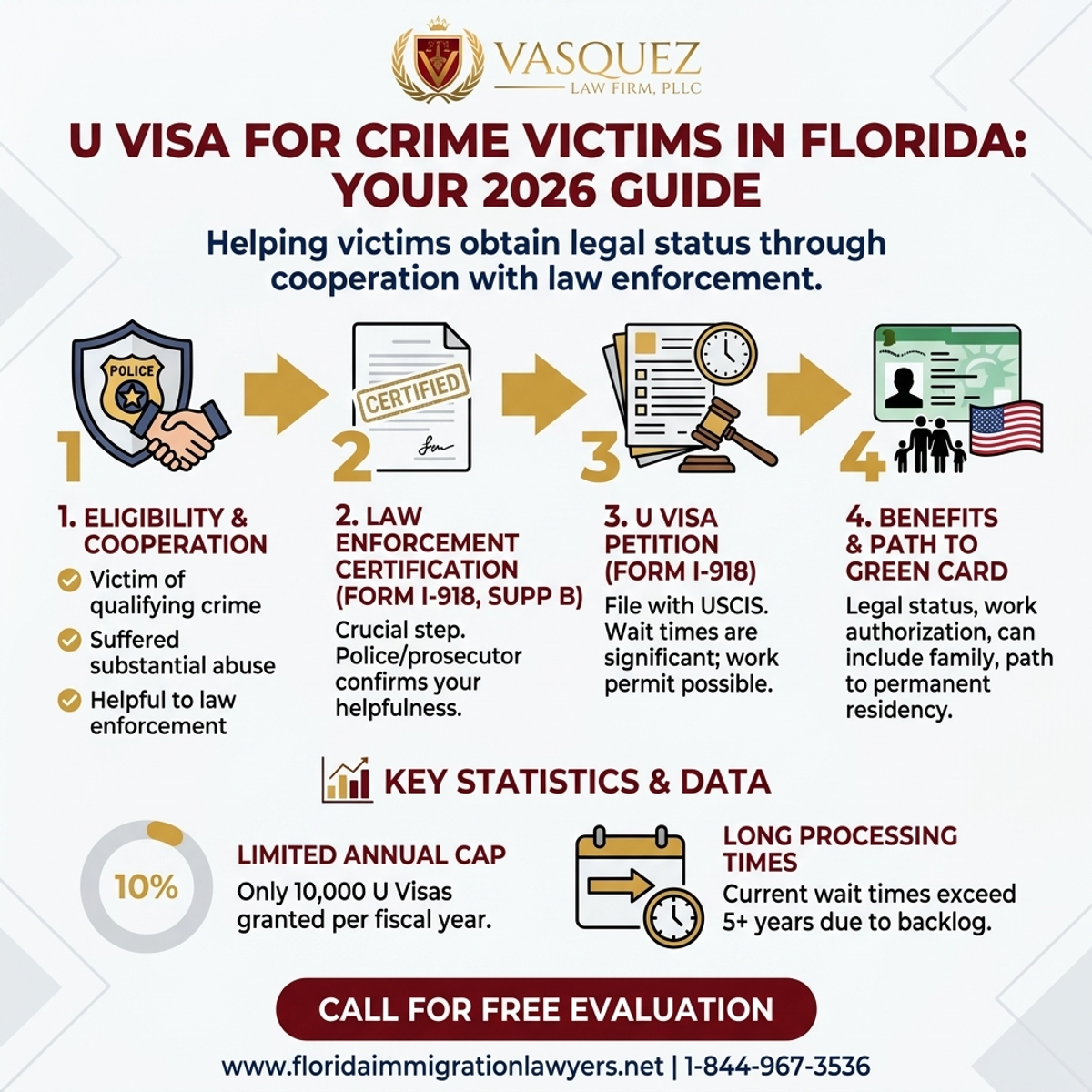
Key Statistics — U Visa for Crime Victims in Florida: Your 2026 Guide
Overcoming Challenges in Obtaining Certification
Obtaining certification can sometimes be challenging, as agencies may have varying policies or levels of familiarity with the U visa. It is crucial to demonstrate your helpfulness clearly and to maintain communication with the agency involved. An attorney can be instrumental in advocating on your behalf, explaining the legal requirements of the U visa, and ensuring that your request for certification is properly considered. We can help prepare a compelling request letter and provide supporting documentation to the certifying agency, highlighting your cooperation and the details of the crime. This proactive approach can significantly increase your chances of securing the necessary certification for your U visa application.
Common Mistakes to Avoid When Applying for a U Visa
The U visa application is highly detailed, and even minor errors can lead to significant delays or outright denial. Avoiding these common pitfalls is crucial for a successful outcome:
- Failing to Obtain Proper Law Enforcement Certification: This is the most common reason for denial. Ensure Form I-918, Supplement B, is correctly completed, signed by an authorized official, and details your helpfulness. Without it, your case cannot proceed.
- Not Reporting the Crime: If the crime was not reported to law enforcement, it becomes nearly impossible to obtain certification of your helpfulness. Report the crime as soon as safely possible.
- Insufficient Evidence of Substantial Harm: Merely stating you were harmed is not enough. You need concrete evidence like medical records, psychological evaluations, and detailed personal statements describing the physical and mental abuse.
- Incomplete or Inconsistent Information: Any discrepancies in your application, personal statement, or supporting documents can raise red flags with USCIS, leading to requests for evidence or denial.
- Missing Deadlines: Failing to respond to USCIS requests for evidence (RFEs) or notices of intent to deny (NOIDs) within the specified timeframe will result in the denial of your application.
- Not Disclosing All Relevant Information: Hiding past arrests, immigration violations, or other potentially negative information can be seen as misrepresentation and lead to severe consequences. An attorney can help address these issues appropriately.
- Filing Without Legal Counsel: The U visa process is complex, involving legal definitions, detailed evidence, and interaction with various government agencies. Attempting to navigate it alone significantly increases the risk of errors and denial.
- Lack of Cooperation with Law Enforcement: If you are unwilling or unable to cooperate with the investigation or prosecution, you will not meet a fundamental requirement for the U visa.
- Not Including Qualifying Family Members: Forgetting to include eligible family members on your application or their respective Supplement A forms means they will miss out on the opportunity for derivative U nonimmigrant status.
- Failing to Provide Certified Translations: Any document not in English must be accompanied by a complete and certified English translation.
- Ignoring Public Charge Rule Implications: While U visa applicants are largely exempt from the public charge rule, recent changes in immigration policy mean understanding any potential implications is still important, especially for future adjustment of status.
- Submitting Outdated Forms or Incorrect Fees: USCIS forms and fees can change. Always ensure you are using the most current version of forms and submitting the correct fees, if any.
When Should I Call an Immigration Lawyer for a U Visa in Florida?
Given the complexities and sensitive nature of the U visa application, contacting an experienced immigration attorney should be one of your first steps. You should call an immigration lawyer immediately if you:
- Have been a victim of a crime: Even if you are unsure if the crime qualifies for a U visa, a lawyer can assess your situation and advise on eligibility.
- Are considering reporting a crime: An attorney can explain your rights, guide you on how to interact with law enforcement, and prepare you for the certification process.
- Need help obtaining law enforcement certification: This is often the most challenging part. An attorney can advocate on your behalf with agencies like the Florida Department of Law Enforcement or local police departments in Orlando, Tampa, or Miami.
- Have received a Request for Evidence (RFE) or Notice of Intent to Deny (NOID): These notices indicate that USCIS requires more information or intends to deny your application. Prompt and accurate legal response is critical.
- Have a criminal history or prior immigration violations: Certain inadmissibility grounds can be waived for U visa applicants, but this requires a robust legal argument and careful documentation.
- Need to include family members: An attorney can ensure all qualifying family members are properly included in your petition.
- Are applying for adjustment of status after receiving a U visa: The transition from U status to a green card also has specific requirements that a lawyer can help you navigate.
Florida Immigration Lawyers has extensive experience assisting crime victims across Florida, from Orlando to the Panhandle, in securing U nonimmigrant status. We understand the nuances of the law, including INA Section 101(a)(15)(U), and the specific procedures of USCIS and local law enforcement agencies. Our team can help you gather compelling evidence, prepare a strong application, and represent your interests effectively. We are committed to providing compassionate and effective legal representation to help you achieve safety and legal status.
About Florida Immigration Lawyers
Florida Immigration Lawyers is a leading immigration law firm dedicated to serving individuals and families across the entire state of Florida. With our office strategically located in Orlando, we provide comprehensive and compassionate legal representation for a wide range of immigration matters, including U visas, asylum, deportation defense, citizenship, family immigration, and business immigration. Our experienced attorneys are available 24/7 to offer free case reviews, ensuring that you have access to expert legal advice when you need it most. We understand the profound impact immigration issues have on your life and are committed to protecting your rights and helping you achieve your American dream. We pride ourselves on clear communication, strategic advocacy, and a deep commitment to our clients' success. Contact us today to schedule a free consultation.
Sources and References
- U.S. Citizenship and Immigration Services (USCIS)
- Executive Office for Immigration Review (EOIR)
- U.S. Department of State
- Immigration and Nationality Act (INA) Section 101(a)(15)(U) - 8 U.S.C. § 1101(a)(15)(U)
- 8 CFR Part 214.14 - Regulations for U Nonimmigrant Status
- USCIS Policy Manual, Volume 3, Part B, Chapter 5 - U Nonimmigrant Status
Related services: asylum application process, refugee status and resettlement, withholding of removal, humanitarian protection programs.
This article provides general legal information and is not intended as legal advice. Every case is unique, and outcomes depend on specific facts and circumstances. Contact an attorney for advice about your particular situation.
If you are a crime victim in Florida and believe you may qualify for a U visa, do not delay. The process is complex, but with the right legal support, you can secure your future and find peace of mind. Contact Florida Immigration Lawyers today at 1-844-967-3536 for a free, confidential case review. Se Habla Espanol - Estamos aqui para ayudarle.
Do Not Navigate This Process Alone
Our experienced immigration attorneys are ready to fight for you. Get a free, confidential case review today.
Se Habla Español
Or leave your details and we’ll call you:
Free Evaluation in 24 Hours
Or talk to us right now

AI voice assistant — available 24/7
FreeFrequently Asked Questions

William J. Vásquez
Founding Attorney · Vasquez Law Firm
U.S. Air Force veteran and immigration attorney with years of hands-on U.S. immigration experience. J.D., NCCU School of Law. AILA member. Admitted to the 4th, 5th, and 11th Circuit Courts.
Available 24/7 - Free Evaluations
Reviewed for legal accuracy by William J. Vásquez
Licensed in North Carolina; U.S. immigration is federal practice.
Related Legal Services
Our Florida immigration attorneys can help you with family immigration services, immigration lawyer cost in Florida and experienced immigration attorneys. Call today at 1-844-967-3536 for a free case review.
Related Links
Related Topics
Free Legal Case Review
Discuss your case with our experienced attorneys. We're available 24/7.
Se Habla Español - Estamos aquí para ayudarle.
Related Articles
Immigration Lawyer Orlando Free Consultation in Florida
For individuals and families in Orlando, Florida, navigating the complexities of U.S. immigration law requires expert guidance. An immigration lawyer in Orlando offers crucial support for everything from visa applications and green card processes to naturalization and deportation defense. This comprehensive guide details what a free consultation covers, providing a step-by-step overview of immigration pathways, essential document checklists, and expected timelines in 2026. We also highlight common mistakes to avoid, discuss the critical role of legal counsel in deportation and asylum cases, and explain why choosing a local Orlando immigration attorney is beneficial. Florida Immigration Lawyers is dedicated to serving the diverse community of Orlando with compassionate, effective legal solutions, ensuring you receive personalized advice and robust representation for a successful immigration journey.
Application for Re-Entry Permit: A Florida LPR Guide 2026
For Lawful Permanent Residents (LPRs) in Florida, extended international travel can pose a risk to their green card status. An application for re-entry permit (Form I-131) is a vital document designed to prevent the presumption of green card abandonment, which can occur after prolonged absences from the U.S. This permit demonstrates your intent to maintain permanent residency and facilitates your re-entry without issues at U.S. ports of entry. This comprehensive guide covers everything Florida LPRs need to know about the I-131 re-entry permit in 2026, including eligibility, the step-by-step application process, required documents, typical processing timelines, and associated costs. We also highlight common mistakes to avoid and crucial factors that can lead to green card abandonment. Understanding these nuances is essential for safeguarding your LPR status and ensuring a smooth return to your home in Florida. Florida Immigration Lawyers is ready to assist you in navigating this critical process.
F-1 Student Visa for Florida Universities in 2026
Embarking on an academic journey at a Florida university as an international student requires a thorough understanding of the F-1 student visa process. This comprehensive guide, updated for 2026, details everything from initial eligibility and securing your Form I-20 to navigating the DS-160 application, paying the SEVIS fee, and successfully completing your visa interview. We cover essential documents, financial requirements, and provide a clear timeline for processing, helping you plan your studies effectively. Additionally, we explore authorized work options like CPT and OPT, along with common pitfalls to avoid that could jeopardize your F-1 status. With Florida's vibrant educational landscape attracting students globally, understanding these regulations is more crucial than ever. For personalized guidance and to ensure a smooth application, Florida Immigration Lawyers offers expert legal support for all international students aiming to study in Florida.
Orlando Cancellation of Removal Attorney: Your Guide
Facing deportation in Orlando, Florida? Learn about cancellation of removal, a form of relief available in immigration court. Understand eligibility requirements, application processes, and the importance of legal representation. Discover common mistakes to avoid and when to seek legal help. Call Florida Immigration Lawyers for expert guidance.