Application for Re-Entry Permit: A Florida LPR Guide 2026
For Lawful Permanent Residents (LPRs) in Florida, extended international travel can pose a risk to their green card status. An application for re-entry permit (Form I-131) is a vital document designed to prevent the presumption of green card abandonment, which can occur after prolonged absences from the U.S. This permit demonstrates your intent to maintain permanent residency and facilitates your re-entry without issues at U.S. ports of entry. This comprehensive guide covers everything Florida LPRs need to know about the I-131 re-entry permit in 2026, including eligibility, the step-by-step application process, required documents, typical processing timelines, and associated costs. We also highlight common mistakes to avoid and crucial factors that can lead to green card abandonment. Understanding these nuances is essential for safeguarding your LPR status and ensuring a smooth return to your home in Florida. Florida Immigration Lawyers is ready to assist you in navigating this critical process.
An application for re-entry permit, filed using Form I-131 with USCIS, is crucial for Lawful Permanent Residents (LPRs) in Florida who plan to remain outside the United States for an extended period, typically over one year but less than two. This document serves as advance permission to re-enter the U.S. without the presumption of green card abandonment, which can occur after prolonged absences. It demonstrates your intent to maintain permanent residency and helps avoid issues at the port of entry. Securing a re-entry permit is a proactive step to protect your LPR status.
- A re-entry permit (Form I-131) prevents the presumption of green card abandonment for LPRs traveling abroad.
- It is generally valid for up to two years and must be obtained before departure.
- Proof of intent to return to the U.S. is essential for approval.
- Filing while physically present in the U.S. is usually required, with biometrics appointment in Florida.
- Consulting an experienced Florida immigration lawyer is highly recommended for complex cases.
For many Lawful Permanent Residents (LPRs) in Florida, maintaining a connection to their home country is important, whether for family visits, business opportunities, or personal reasons. However, extended absences from the United States can jeopardize your hard-earned green card status, leading to a presumption of green card abandonment. This is where the application for re-entry permit becomes an indispensable tool. If you are an LPR living in Orlando or anywhere across Florida and anticipate being outside the U.S. for more than six months, understanding the I-131 re-entry permit process is critical to safeguarding your future.
This comprehensive guide will walk you through everything you need to know about the re-entry permit, including eligibility requirements, the application process, potential pitfalls, and what to expect in 2026. We'll delve into the nuances of preventing green card abandonment and provide Florida-specific insights to help you navigate this complex immigration process. Protecting your permanent residency is paramount, and proactive planning is key. Do not leave your LPR status to chance. Call Florida Immigration Lawyers at 1-844-YO-PELEO for a free case review and ensure your right to return to the U.S. is secure.
What is a Re-Entry Permit and Who Needs One in Florida?
A re-entry permit is an essential travel document issued by U.S. Citizenship and Immigration Services (USCIS) to Lawful Permanent Residents (LPRs) and conditional permanent residents (CPRs) who plan to travel outside the United States for an extended period. Its primary purpose is to allow an LPR to return to the U.S. without needing to obtain a returning resident visa from a U.S. embassy or consulate abroad, and, more importantly, to overcome the presumption of green card abandonment. Without this permit, absences of one year or more can lead immigration officials to conclude that you have abandoned your permanent residency, making re-entry challenging.
You need an application for re-entry permit if you are an LPR in Florida and anticipate being outside the U.S. for one year or longer. While it is generally advised for absences exceeding six months, it becomes critical for trips over one year. The permit serves as evidence to Customs and Border Protection (CBP) officers at ports of entry, such as Miami International Airport or Orlando International Airport, that your intention is to return to the U.S. and maintain your permanent resident status. It also allows you to apply for a visa at a U.S. consulate or embassy abroad without difficulty, as it proves your LPR status. This is particularly relevant for individuals with family ties or business interests overseas, especially within Florida's diverse communities with strong international connections.
As of 2026, the re-entry permit is typically valid for two years from the date of issuance. For conditional permanent residents (CPRs), the permit's validity usually aligns with the expiration date of their conditional green card, or for a maximum of two years if their conditional status expires beyond that timeframe. It's important to note that a re-entry permit does not guarantee re-entry if other grounds of inadmissibility arise during your absence. However, it significantly strengthens your position by addressing the issue of intent to abandon residency. For LPRs frequently traveling for work or family from Florida, securing this document offers peace of mind and protection for their immigration status. Understanding this vital document is the first step in ensuring your continued status as an LPR in the United States.
How Do I File an Application for Re-Entry Permit (Form I-131) in 2026?
To file an application for re-entry permit (Form I-131) in 2026, you must generally be physically present in the United States when you file the application. This is a critical requirement, as you will likely need to attend a biometrics appointment at a USCIS Application Support Center (ASC) in Florida, such as the one in Orlando, before you depart. Failing to attend this appointment can lead to the denial of your application.
The process of applying for an I-131 re-entry permit involves several key steps. It requires careful attention to detail and timely submission of all necessary documentation. Given the importance of maintaining your LPR status, it is often beneficial to seek legal guidance from a Florida immigration lawyer who can help ensure your application is complete and accurate. The general steps are outlined below:
Step-by-Step Guide to Filing Form I-131:
- Complete Form I-131, Application for Travel Document: Fill out all sections accurately. Ensure your name, address, and green card information match your official records. Clearly state your reason for needing a re-entry permit and the estimated duration of your trip abroad.
- Gather Required Supporting Documents: Collect all necessary evidence, including copies of your green card (Form I-551), a valid government-issued photo identification, and two passport-style photographs taken within 30 days of filing. If applicable, include evidence supporting your reason for extended travel, such as a letter from an employer or family medical records.
- Prepare the Filing Fee: As of 2026, the fee for Form I-131 must be paid by check, money order, or credit card (using Form G-1450). Do not send cash. Ensure the fee amount is current by checking the USCIS website.
- Mail Your Application to the Correct USCIS Lockbox: The filing address depends on the type of application and the mail service you use. Always refer to the "Where to File" section on the USCIS Form I-131 page for the most current address.
- Attend Your Biometrics Appointment: After filing, USCIS will send you a notice (Form I-797C, Notice of Action) with the date, time, and location of your biometrics appointment. You must attend this appointment at your assigned Application Support Center (ASC) in Florida. This typically occurs within 3-8 weeks of filing.
- Receive Decision and Re-Entry Permit: USCIS will process your application. If approved, your re-entry permit will be mailed to the address provided on your application, or to your attorney if represented. You may depart the U.S. after attending your biometrics appointment, but you must arrange to have your permit mailed to you abroad or to a trusted contact in the U.S. who can forward it.
Document Checklist for Form I-131:
- Completed Form I-131, Application for Travel Document.
- Copy of your Permanent Resident Card (Form I-551, Green Card) - front and back.
- Two identical passport-style photographs (2x2 inches, white background, taken within 30 days).
- Copy of a valid government-issued photo identification (e.g., driver's license).
- Copy of your passport biographical page.
- Proof of payment for the filing fee (check, money order, or Form G-1450).
- (Optional) Letter explaining the purpose and duration of your extended travel.
- (Optional) Evidence of ties to the U.S. (property, employment, family).
Navigating these steps correctly is crucial. Any errors or omissions can cause delays or even lead to denial, potentially impacting your ability to travel and return to Florida. For complex situations or if you have a history of immigration issues, consulting with a knowledgeable Florida immigration lawyer is highly advisable to ensure a smooth application process.
How Long Does It Take to Get an I-131 Re-Entry Permit Approved in Florida?
As of 2026, the processing time for an I-131 application for re-entry permit can vary significantly, typically ranging from 7 to 15 months. These estimates are subject to change based on USCIS workload, policy updates, and the specific service center handling your case. It is crucial for LPRs in Florida to file their application well in advance of any planned extended international travel, as the permit must be issued before you depart if you wish to receive it in the U.S. However, you are permitted to depart after your biometrics appointment.
It's important to remember that while you can depart the U.S. after your biometrics appointment, the re-entry permit itself will be mailed to your designated address in the U.S. or to your legal representative. Therefore, you must make arrangements to have it forwarded to you abroad or pick it up upon your return. The table below provides a general overview of the typical stages and timeframes involved, based on current USCIS processing trends for applications filed from Florida and across the nation.
I-131 Re-Entry Permit Processing Timeline (As of 2026):
| Stage | Typical Timeframe | Notes |
|---|---|---|
| Application Filing to Receipt Notice | 1-3 weeks | USCIS sends Form I-797C confirming receipt. |
| Receipt Notice to Biometrics Appointment | 3-8 weeks | Appointment at a USCIS ASC, e.g., in Orlando, Florida. You may depart after this. |
| Biometrics to Case Decision/Approval | 6-14 months | This is the longest stage; processing times vary by service center. |
| Decision to Document Production/Mailing | 1-3 weeks | The physical re-entry permit is printed and mailed. |
| Total Estimated Processing Time | 7-15 months | Always check the USCIS website for the most current processing times. |
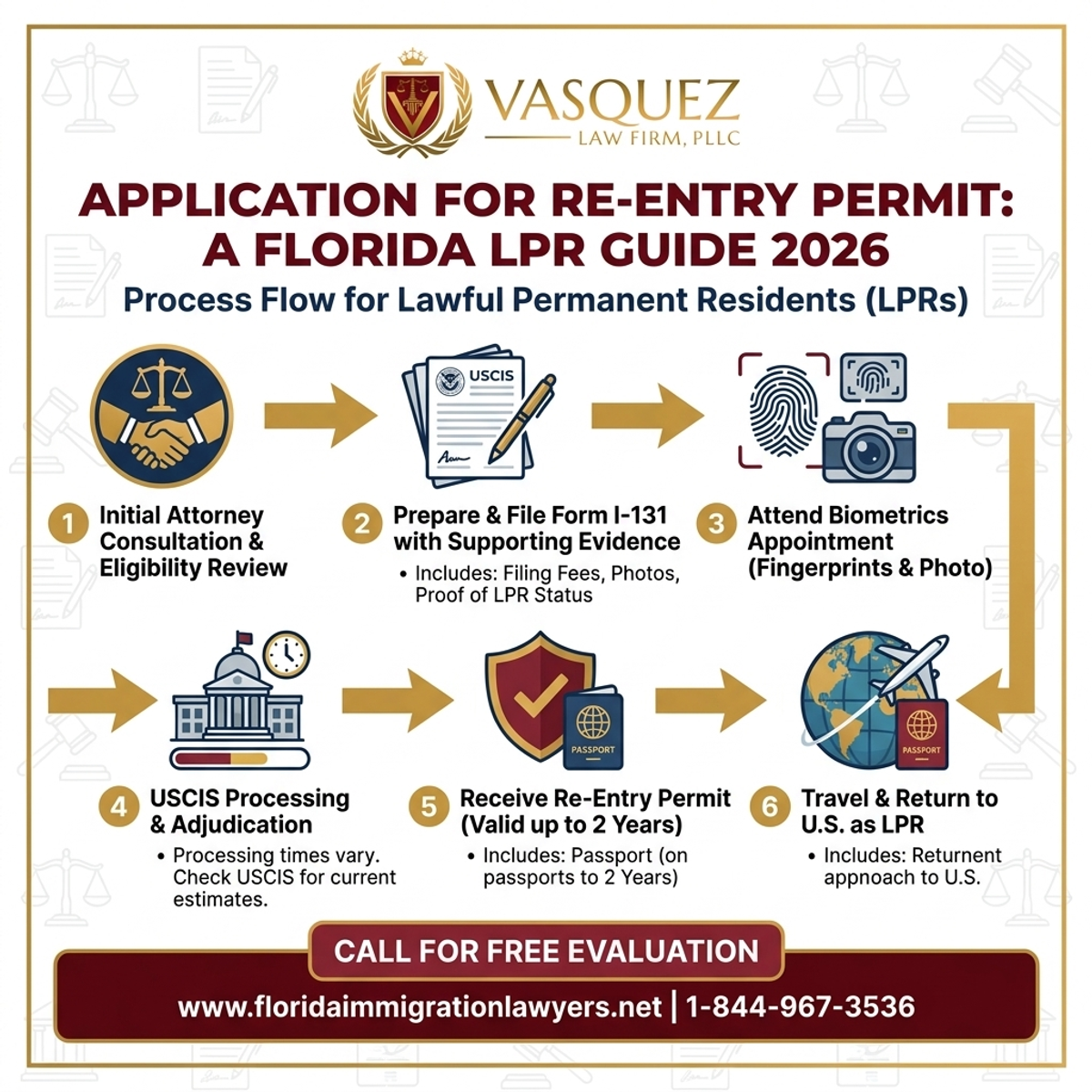
Step-by-Step Process — Application for Re-Entry Permit: A Florida LPR Guide 2026
These timeframes are estimates and can fluctuate. Factors such as the completeness of your application, any requests for additional evidence (RFEs), and general USCIS processing backlogs can impact your individual case. For LPRs in Florida needing to travel soon, understanding these timelines is crucial for planning. If your travel plans are urgent, an attorney can help ensure your application is submitted without errors to minimize delays. It is always wise to apply as early as possible.
What Factors Can Lead to Green Card Abandonment?
Understanding the factors that can lead to green card abandonment is vital for any Lawful Permanent Resident in Florida planning extended international travel. While an application for re-entry permit significantly mitigates this risk, it's not a foolproof guarantee if other indicators suggest you no longer intend to reside permanently in the United States. Immigration law is clear: LPR status is contingent upon maintaining your intention to make the U.S. your permanent home. Absences that suggest otherwise can lead to serious consequences, including the loss of your green card.
The primary factor for green card abandonment is prolonged absence from the U.S. Generally, an absence of more than six months can raise questions, and an absence of one year or more creates a legal presumption of abandonment. However, it's not just the length of absence that matters; it's also the "intent." If a CBP officer at a Florida port of entry, such as Fort Lauderdale-Hollywood International Airport, determines that you have taken up residence abroad, regardless of your re-entry permit, you could be found to have abandoned your status. This determination often involves looking at a combination of factors that demonstrate your primary ties.
Other significant factors include severing ties to the U.S. while establishing new ones abroad. For example, if you sell your home in Orlando, terminate your employment in Florida, close your U.S. bank accounts, and move your entire family overseas, these actions could be viewed as an intent to abandon. Conversely, maintaining strong ties to the U.S. such as owning property, paying U.S. taxes, maintaining a U.S. mailing address, having a Florida driver's license, and keeping family in the U.S. can help demonstrate your intent to return. Even with a re-entry permit, CBP officers have the discretion to question your intent, as outlined in the Immigration and Nationality Act (INA). Therefore, always be prepared to articulate your reasons for travel and demonstrate your continuing ties to the United States upon your return.
Do not navigate this process alone. Contact Florida Immigration Lawyers today to discuss your situation and protect your permanent residency.
What Are the Costs Associated with an I-131 Application in 2026?
As of 2026, the primary cost associated with filing an I-131 application for re-entry permit is the USCIS filing fee. It's important to remember that these fees are subject to change, and applicants should always verify the most current amounts directly on the USCIS website before submitting their application. The filing fee is non-refundable, regardless of the outcome of your application. In addition to the government filing fee, there may be other associated costs that applicants in Florida should consider, particularly if they choose to seek professional legal assistance.
The table below provides a breakdown of the typical fees and potential additional costs an LPR in Florida might encounter when applying for a re-entry permit. These costs can add up, so budgeting and understanding each component is crucial for a smooth application process. It is generally not advisable to cut corners on fees, as inaccuracies or omissions can lead to delays or rejection.
I-131 Re-Entry Permit Cost Breakdown (As of 2026):
| Item | Typical Fee | Notes |
|---|---|---|
| USCIS Form I-131 Filing Fee | Varies (check USCIS website) | Required for all applicants. This fee is non-refundable. |
| Biometrics Services Fee | Varies (check USCIS website) | Required for all applicants. This fee covers the cost of fingerprinting and background checks. |
| Passport-Style Photos | $10-$20 | Cost for two professional passport-style photographs. |
| Postage/Shipping Fees | $5-$30 | For mailing your application packet, especially if using certified mail or courier services. |
| Legal Fees (Optional) | Variable | Cost for retaining an immigration attorney to assist with preparation and submission. Highly recommended for complex cases or to ensure accuracy. |
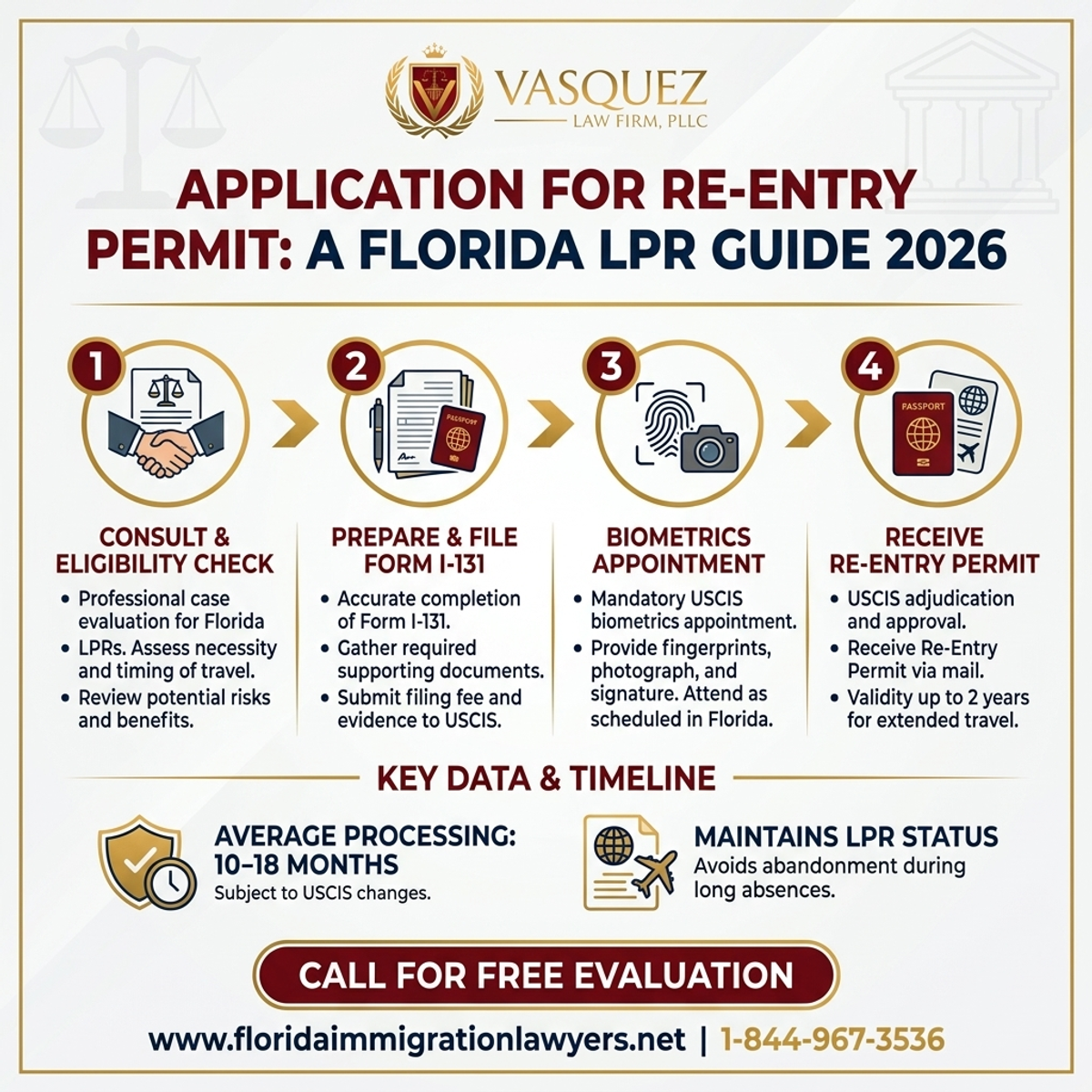
Key Statistics — Application for Re-Entry Permit: A Florida LPR Guide 2026
While the USCIS fees are mandatory, legal fees are an investment that can save you time, stress, and potential complications. An experienced Florida immigration lawyer can ensure your application for re-entry permit is prepared correctly, all supporting documents are included, and you are properly advised on maintaining your LPR status while abroad. This can be particularly beneficial for residents of Central Florida who may have intricate travel plans or unique circumstances requiring guidance. Always ensure you have sufficient funds to cover all applicable fees before beginning the application process.
Common Mistakes to Avoid When Applying for a Re-Entry Permit
Applying for a re-entry permit can be complex, and even minor errors can lead to significant delays or denial. Avoiding these common mistakes is crucial for LPRs in Florida to protect their permanent resident status:
- Filing While Abroad: You generally must be physically present in the U.S. when filing Form I-131. Filing from outside the country can lead to immediate rejection, as per 8 CFR 223.2.
- Missing Biometrics Appointment: Failing to attend your scheduled biometrics appointment in Florida (e.g., at the Orlando ASC) will almost certainly result in your application being denied, as it's a mandatory step for identity verification.
- Incorrect or Incomplete Form I-131: Leaving sections blank or providing inaccurate information can cause RFEs (Requests for Evidence) or outright denial. Double-check every field for accuracy and completeness.
- Insufficient Supporting Documentation: Not including all required documents, such as copies of your green card or passport photos, will delay processing or lead to denial. Always use the official USCIS checklist.
- Incorrect Filing Fee: Submitting the wrong fee amount or an expired payment method will result in rejection of your entire application package. Verify the current fees on the USCIS website.
- Departing Before Biometrics: While you can depart after your biometrics, leaving before the appointment makes it impossible to complete a mandatory step, leading to denial.
- Not Demonstrating Intent to Return: Even with a re-entry permit, prolonged absence without maintaining ties to the U.S. (e.g., U.S. address, bank accounts, tax filings) can still lead to a presumption of green card abandonment upon re-entry.
- Assuming Automatic Approval: A re-entry permit is not guaranteed. USCIS reviews each case, and certain factors (e.g., criminal history, previous immigration violations) could lead to denial.
- Waiting Too Long to Apply: Processing times can be lengthy. Filing close to your departure date risks not having the permit in hand, potentially forcing you to either delay travel or travel without it.
- Sending to the Wrong Address: USCIS has specific lockbox addresses for different forms and mailing methods. Sending your I-131 to the wrong address will cause significant delays.
- Failing to Update Address with USCIS: If your mailing address changes while your application is pending, and you don't inform USCIS, you may miss important notices or even your re-entry permit.
When to Call a Florida Immigration Lawyer for Your Re-Entry Permit
While the application for re-entry permit process may seem straightforward for some, there are many situations where the expertise of a Florida immigration lawyer becomes invaluable. Immigration law is constantly evolving, and even a slight misstep can have severe consequences for your LPR status. If you find yourself in any of the following scenarios, it is highly advisable to seek professional legal guidance from Florida Immigration Lawyers:
- Complex Travel History: If you have a history of frequent or unusually long absences from the U.S., a lawyer can help you prepare a stronger case to demonstrate your intent to maintain permanent residency.
- Previous Immigration Issues: Any past immigration violations, denials, or encounters with CBP can complicate your application. An attorney can assess these issues and advise on how to proceed.
- Criminal Record: Even minor criminal offenses can impact your eligibility for immigration benefits. A lawyer can evaluate your record and advise on potential inadmissibility grounds.
- Uncertainty About Documentation: If you are unsure which documents to submit, how to answer specific questions on Form I-131, or how to explain your reasons for extended travel, an attorney can provide clarity and ensure accuracy.
- Expedited Processing Needs: While rare, an attorney might be able to help with requests for expedited processing in truly emergent situations, though this is not guaranteed.
- Risk of Green Card Abandonment: If you are concerned about the presumption of green card abandonment due to extensive ties abroad or previous long absences, a lawyer can help you strategize and present compelling evidence of your continued intent to reside in the U.S.
- Need for Timely Filing: To ensure your application is filed correctly and promptly, especially with impending travel plans, a lawyer can streamline the process and prevent costly errors.
Florida Immigration Lawyers has extensive experience assisting LPRs throughout Central Florida and beyond with their travel document needs. We understand the specific concerns of residents in areas like Orlando and can provide tailored advice to protect your immigration status. Don't risk your green card; let our experienced team guide you.
About Florida Immigration Lawyers
Florida Immigration Lawyers is an immigration law firm dedicated to serving individuals and families across the entire state of Florida. With a deep understanding of U.S. immigration laws and a commitment to our clients, we provide comprehensive legal services tailored to meet your unique needs. From our base in Central Florida, we assist clients with a wide range of immigration matters, including family immigration, business immigration, naturalization, deportation defense, and securing essential travel documents like the re-entry permit.
Our team of experienced attorneys is passionate about protecting the rights and futures of immigrants. We pride ourselves on offering compassionate, client-focused representation, ensuring that you understand every step of your legal journey. We are available 24/7 to answer your questions and offer free case reviews, making quality legal assistance accessible when you need it most. Whether you are seeking an application for re-entry permit to prevent green card abandonment or need assistance with other complex immigration challenges, Florida Immigration Lawyers is here to help. Schedule a free consultation today to discuss your case.
Sources and References
- U.S. Citizenship and Immigration Services (USCIS)
- USCIS Form I-131, Application for Travel Document
- Executive Office for Immigration Review (EOIR)
- Immigration and Nationality Act (INA) Section 223 - Re-entry Permits (8 U.S.C. § 1203)
- Code of Federal Regulations (CFR) 8 CFR Part 223 - Reentry Permits, Refugee Travel Documents, and Advance Parole Documents
Related services: immigration practice areas, family immigration services, citizenship and naturalization.
This article provides general legal information and is not intended as legal advice. Every case is unique, and outcomes depend on specific facts and circumstances. Contact an attorney for advice about your particular situation.
Protecting your green card status and ensuring your right to return to the U.S. is a serious matter. Don't risk the presumption of green card abandonment. Take the proactive step to secure your future by filing an application for re-entry permit with the guidance of experienced legal professionals. Contact Florida Immigration Lawyers today at 1-844-YO-PELEO for a free, confidential case review. Se Habla Espanol - Estamos aqui para ayudarle.
If you need legal assistance, learn more about experienced immigration attorneys in Orlando, or call us at 1-844-YO-PELEO for a free case review.
Do Not Navigate This Process Alone
Our experienced immigration attorneys are ready to fight for you. Get a free, confidential case review today.
Se Habla Español
Or leave your details and we’ll call you:
Free Evaluation in 24 Hours
Or talk to us right now

AI voice assistant — available 24/7
FreeFrequently Asked Questions

William J. Vásquez
Founding Attorney · Vasquez Law Firm
U.S. Air Force veteran and immigration attorney with years of hands-on U.S. immigration experience. J.D., NCCU School of Law. AILA member. Admitted to the 4th, 5th, and 11th Circuit Courts.
Available 24/7 - Free Evaluations
Reviewed for legal accuracy by William J. Vásquez
Licensed in North Carolina; U.S. immigration is federal practice.
Related Legal Services
Our Florida immigration attorneys can help you with immigration practice areas, free immigration consultation and business immigration. Call today at 1-844-YO-PELEO for a free case review.
Related Links
Related Topics
Free Legal Case Review
Discuss your case with our experienced attorneys. We're available 24/7.
Se Habla Español - Estamos aquí para ayudarle.
Related Articles
EAD Advance Parole Combo Card in Florida: What You Need
An EAD advance parole combo card allows individuals with pending adjustment applications to both work and travel abroad without jeopardizing their green card application. Learn how to apply in Florida, what documents you need, and common mistakes to avoid.
PERM Labor Certification in Florida: A 2026 Guide
Learn all about the PERM labor certification process in Florida, essential for employers sponsoring green card applicants. Understand the steps, document requirements, and common mistakes to avoid in this 2026 guide.
Dual Citizenship Lawyer in Florida: What You Need to Know
For Florida residents, the concept of dual citizenship, or holding two passports, offers a compelling blend of opportunities and challenges. While the U.S. generally permits dual nationality, the path to achieving this status requires a meticulous understanding of both U.S. immigration laws and the citizenship policies of your country of origin. This guide explores the definition of dual citizenship, the detailed step-by-step process for U.S. naturalization, and the significant benefits and potential pitfalls involved. We cover essential documentation, typical timelines, and cost considerations for 2026, providing crucial insights for anyone in Orlando, Miami, or across Florida considering this important legal step. Learn about common mistakes to avoid and understand when to seek professional legal counsel to navigate this complex process successfully. Florida Immigration Lawyers is here to provide expert, bilingual support for your dual citizenship journey.
Immigration Lawyer Orlando Free Consultation in Florida
For individuals and families in Orlando, Florida, navigating the complexities of U.S. immigration law requires expert guidance. An immigration lawyer in Orlando offers crucial support for everything from visa applications and green card processes to naturalization and deportation defense. This comprehensive guide details what a free consultation covers, providing a step-by-step overview of immigration pathways, essential document checklists, and expected timelines in 2026. We also highlight common mistakes to avoid, discuss the critical role of legal counsel in deportation and asylum cases, and explain why choosing a local Orlando immigration attorney is beneficial. Florida Immigration Lawyers is dedicated to serving the diverse community of Orlando with compassionate, effective legal solutions, ensuring you receive personalized advice and robust representation for a successful immigration journey.