F-1 Student Visa for Florida Universities in 2026
Embarking on an academic journey at a Florida university as an international student requires a thorough understanding of the F-1 student visa process. This comprehensive guide, updated for 2026, details everything from initial eligibility and securing your Form I-20 to navigating the DS-160 application, paying the SEVIS fee, and successfully completing your visa interview. We cover essential documents, financial requirements, and provide a clear timeline for processing, helping you plan your studies effectively. Additionally, we explore authorized work options like CPT and OPT, along with common pitfalls to avoid that could jeopardize your F-1 status. With Florida's vibrant educational landscape attracting students globally, understanding these regulations is more crucial than ever. For personalized guidance and to ensure a smooth application, Florida Immigration Lawyers offers legal support for all international students aiming to study in Florida.
An F-1 student visa allows international students to pursue a full course of study at a U.S. academic institution, including many prestigious Florida universities. To qualify, you must be accepted by a Student and Exchange Visitor Program (SEVP)-approved school, demonstrate sufficient funds to cover your education and living expenses, and intend to return to your home country after completing your studies. The process involves obtaining an I-20 form from your chosen university, paying the SEVIS I-901 fee, completing the DS-160 application, and attending a visa interview at a U.S. Embassy or Consulate. Navigating these steps effectively is crucial for a successful application.
- Secure acceptance from an SEVP-approved Florida university.
- Obtain Form I-20, Certificate of Eligibility for Nonimmigrant Student Status.
- Pay the SEVIS I-901 fee and complete the DS-160 online application.
- Attend a mandatory F-1 visa interview at a U.S. Embassy or Consulate.
- Demonstrate strong ties to your home country and sufficient financial resources.
Florida, with its vibrant culture, diverse economy, and world-class educational institutions, is a top destination for international students seeking higher education. Pursuing your academic dreams in the Sunshine State requires a clear understanding of the F-1 student visa process. From the initial application to maintaining your status, each step is critical. Whether you aspire to study at the University of Central Florida in Orlando, the University of Florida, or any other esteemed Florida university, securing your F-1 visa is the foundational requirement for your journey.
The F-1 visa program is designed to facilitate academic and vocational studies in the United States, providing a pathway for thousands of international students to enrich their lives and contribute to academic communities across the country. However, the application process can be complex, involving strict deadlines, detailed documentation, and specific legal requirements set by U.S. Citizenship and Immigration Services (USCIS) and the Department of State. Understanding these nuances is essential to avoid delays or denials, especially as immigration policies evolve. This comprehensive guide will walk you through everything you need to know about obtaining and maintaining an F-1 student visa for your studies in Florida in 2026, offering practical advice and crucial insights.
Do not attempt to navigate this intricate process alone. An experienced immigration attorney can provide invaluable guidance, ensuring all requirements are met accurately and efficiently. For personalized assistance and a smooth application process, call Florida Immigration Lawyers at 1-844-YO-PELEO for a free case review.
Navigating the F-1 Student Visa Process for Florida Universities in 2026
The F-1 student visa is a nonimmigrant visa specifically for individuals who wish to pursue a full-time academic or language training program in the United States. As of 2026, the fundamental eligibility criteria remain consistent: you must be enrolled in an academic program, be proficient in English or enrolled in courses to become proficient, and possess sufficient funds to cover your tuition, fees, and living expenses. Furthermore, you must maintain a residence abroad that you do not intend to abandon, demonstrating your intent to return to your home country upon completion of your studies. This is a critical aspect of the F-1 visa, as it is a nonimmigrant visa, meaning it is not intended for permanent residency. Florida's diverse range of institutions, from large public universities like Florida State University to specialized private colleges, all require strict adherence to these federal guidelines.
The initial step for any aspiring international student is to gain admission to a Student and Exchange Visitor Program (SEVP)-approved school. Most accredited Florida universities and colleges are SEVP-certified, allowing them to enroll international students. Once accepted, the university will issue you a Form I-20, Certificate of Eligibility for Nonimmigrant Student Status. This document is paramount; it serves as proof of your acceptance and outlines your program details, estimated costs, and the duration of your study. Without a valid I-20, you cannot proceed with the F-1 visa application. It's crucial to review all information on your I-20 carefully for accuracy, as any discrepancies could lead to significant delays or issues during your visa interview or upon entry to the U.S. Understanding the specific requirements of USCIS for nonimmigrant visas is the first step toward a successful application.
How to Apply for an F-1 Student Visa: A Step-by-Step Guide for Florida Applicants
Applying for an F-1 student visa involves several distinct stages that require careful attention to detail. As of 2026, the general process for students seeking to study at a Florida university begins with securing admission and obtaining the Form I-20. Once you have your I-20, you must pay the SEVIS I-901 fee. This fee supports the Student and Exchange Visitor Information System (SEVIS), which tracks F-1 students throughout their stay in the U.S. After paying the SEVIS fee, you will complete the DS-160, Online Nonimmigrant Visa Application, which is submitted to the U.S. Department of State. The final step is scheduling and attending your visa interview at a U.S. Embassy or Consulate in your home country. It is vital to prepare thoroughly for this interview, as it is a crucial determinant of your visa approval.
- Gain Admission to an SEVP-Approved Florida University: Research and apply to accredited schools in Florida. Once accepted, the Designated School Official (DSO) at your university will issue you a Form I-20. Ensure all personal and program details on the I-20 are correct.
- Pay the SEVIS I-901 Fee: This mandatory fee must be paid before your visa interview. You can pay it online via the FMJFee website. Keep the receipt, as you will need it for your interview.
- Complete the DS-160 Online Nonimmigrant Visa Application: Fill out this comprehensive form truthfully and completely. This application collects personal, educational, and security information. You can access it through the U.S. Department of State's Consular Electronic Application Center. Print the confirmation page.
- Schedule Your Visa Interview: Once the DS-160 is submitted and the SEVIS fee paid, you can schedule an interview at the nearest U.S. Embassy or Consulate in your country of residence. Interview wait times can vary significantly, so plan accordingly.
- Gather Required Documents: Compile all necessary documents, including your passport, I-20, DS-160 confirmation, SEVIS fee receipt, financial evidence, academic transcripts, and a visa photo.
- Attend Your Visa Interview: During the interview, a consular officer will assess your eligibility, your intent to study, your financial capacity, and your intent to return home after your studies. Be prepared to answer questions clearly and concisely.
- Receive Your Visa: If approved, your passport will be stamped with the F-1 visa. Verify all details on the visa are accurate before traveling.
Essential Documents and Financial Requirements for Your F-1 Visa in Florida
To successfully obtain an F-1 student visa for a Florida university, you must present a comprehensive set of documents and demonstrate robust financial stability. The U.S. government requires evidence that you can cover your tuition, fees, and living expenses for the duration of your program without resorting to unauthorized employment. This financial proof is critical for your I-20 issuance and your visa interview. The Designated School Official (DSO) at your chosen Florida institution will specify the exact amount required, which typically includes tuition, housing, books, health insurance, and personal expenses. Providing clear, verifiable financial documentation is paramount to showing your capacity to support yourself throughout your academic journey in Florida.
Document Checklist for Your F-1 Visa Application:
- Valid Passport: Must be valid for at least six months beyond your intended period of stay in the United States.
- Form I-20: Original Certificate of Eligibility for Nonimmigrant Student Status, issued by your SEVP-approved Florida university.
- DS-160 Confirmation Page: Printed confirmation of your submitted Online Nonimmigrant Visa Application.
- SEVIS I-901 Fee Payment Receipt: Proof that you have paid the Student and Exchange Visitor Information System fee.
- Visa Interview Appointment Confirmation: Documentation of your scheduled interview date and time.
- One (1) 2x2 Inch Photograph: Meeting specific U.S. visa photo requirements (recent, color, against a white background, no glasses).
- Academic Transcripts and Diplomas: Official records from all previously attended educational institutions.
- Standardized Test Scores: Such as TOEFL, IELTS, SAT, or GRE, as required by your Florida university.
- Evidence of Financial Support: Bank statements, scholarship letters, sponsorship affidavits, or other verifiable documents demonstrating sufficient funds for at least one year of study. This may include letters from sponsors, proof of their financial capability, and an affidavit of support (Form I-134).
- Ties to Home Country: Documents proving your intent to return home, such as property deeds, family ties, job offers, or bank accounts in your home country.
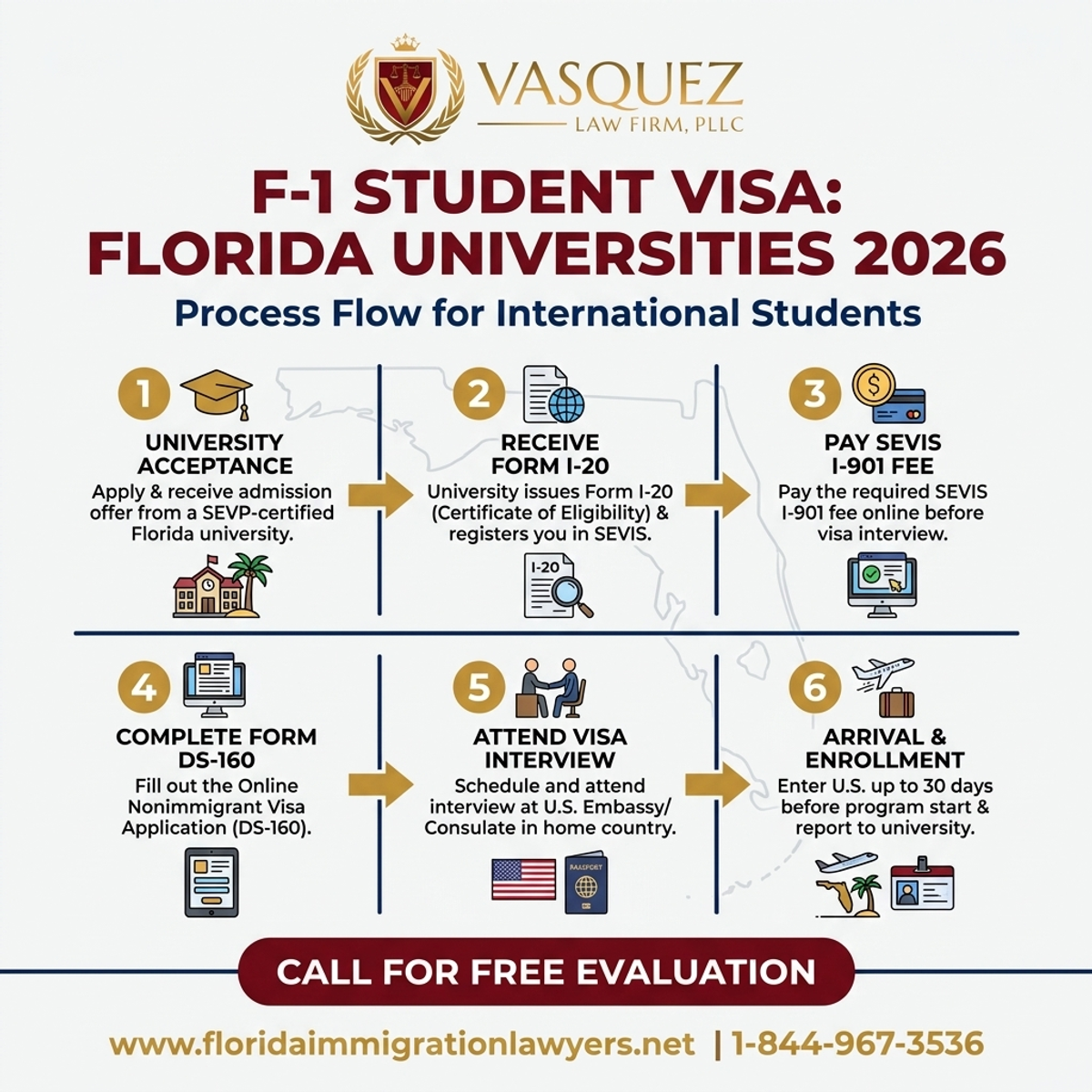
Step-by-Step Process — F-1 Student Visa for Florida Universities in 2026
F-1 Visa Processing Times and What to Expect in Florida as of 2026
As of 2026, F-1 student visa processing times can vary significantly based on the U.S. Embassy or Consulate where you apply, the time of year, and individual case complexities. While there isn't a single universal timeline, applicants for Florida universities should generally plan for several weeks, or even months, from the moment they receive their I-20 to the visa stamping. It is highly advisable to apply well in advance of your program start date, ideally three to five months prior. Consular offices in high-demand regions, particularly in Asia and Latin America, may experience longer wait times for interview appointments. After the interview, if approved, the visa typically takes a few days to a week for administrative processing and passport return. Remember that you cannot enter the U.S. on an F-1 visa more than 30 days before your program start date on your I-20.
Typical F-1 Visa Processing Timeline (as of 2026):
| Stage | Typical Timeframe | Notes |
|---|---|---|
| University Admission & I-20 Issuance | 2-6 weeks | Depends on university application deadlines and review processes. |
| SEVIS I-901 Fee Payment | Immediate | Online payment, receipt generated instantly. |
| DS-160 Application Submission | 1-3 days | Online form, requires careful completion. |
| Visa Interview Scheduling | 1-8 weeks | Varies greatly by country and embassy workload; check embassy website for current wait times. |
| Visa Interview & Approval | Immediate decision | Decision typically given at the end of the interview. |
| Administrative Processing / Passport Return | 3-10 business days | After approval, passport with visa is returned. Some cases may require further administrative processing. |
For any changes of status within the U.S., such as an f-1 to h-4 change of status i-539 processing time texas service center 2026, processing times would be handled by USCIS service centers, not embassies, and would follow separate timelines.
Understanding F-1 Visa Costs and Work Options (CPT/OPT) for Florida International Students
The financial commitment for an F-1 student visa and subsequent studies at a Florida university extends beyond just tuition. Prospective students must budget for various fees, living expenses, and potential travel costs. While tuition rates vary widely among institutions, from community colleges to flagship universities, other standardized fees apply to all F-1 applicants. These include the mandatory SEVIS I-901 fee and the DS-160 visa application fee. Beyond these, you must consider the cost of living in Florida, which, while generally more affordable than some other U.S. states, can still be substantial, especially in major cities like Orlando, Miami, or Tampa. Demonstrating access to these funds is a prerequisite for your visa.
Typical F-1 Visa Related Costs (as of 2026):
| Item | Typical Fee (USD) | Notes |
|---|---|---|
| SEVIS I-901 Fee | $350 | Mandatory fee for Student and Exchange Visitor Information System. |
| DS-160 Visa Application Fee | $185 | Non-refundable fee for the nonimmigrant visa application. |
| University Application Fees | $50-$100 | Varies by institution. |
| Tuition & Fees (Annual) | $15,000 - $50,000+ | Highly variable based on institution, program, and in-state/out-of-state status (international students pay out-of-state). |
| Living Expenses (Annual) | $10,000 - $20,000+ | Includes housing, food, transportation, personal expenses. Varies by city (e.g., Orlando vs. smaller towns). |
| Health Insurance (Annual) | $1,000 - $3,000+ | Often required by universities. |
While on an F-1 visa, your primary purpose is academic study. However, certain work opportunities are available, subject to strict regulations outlined in 8 CFR 214.2(f)(9). These include:
- On-Campus Employment: Students may work on campus for up to 20 hours per week while school is in session and full-time during breaks, without special authorization, as long as it does not displace a U.S. worker.
- Curricular Practical Training (CPT): This allows F-1 students to gain practical experience directly related to their major area of study through employment, internships, or cooperative education. CPT must be an integral part of an established curriculum and requires authorization from the DSO.
- Optional Practical Training (OPT): This provides F-1 students with an opportunity for temporary employment directly related to their major field of study. OPT can be pre-completion (during studies) or post-completion (after graduation). Most students utilize post-completion OPT for up to 12 months. STEM (Science, Technology, Engineering, and Mathematics) degree holders may be eligible for a 24-month extension of OPT. Both CPT and OPT require explicit authorization from USCIS and a new I-20 with the recommendation.
Any unauthorized employment is a serious violation of F-1 status and can lead to severe consequences, including deportation. Understanding these rules is crucial for all international students in Florida.
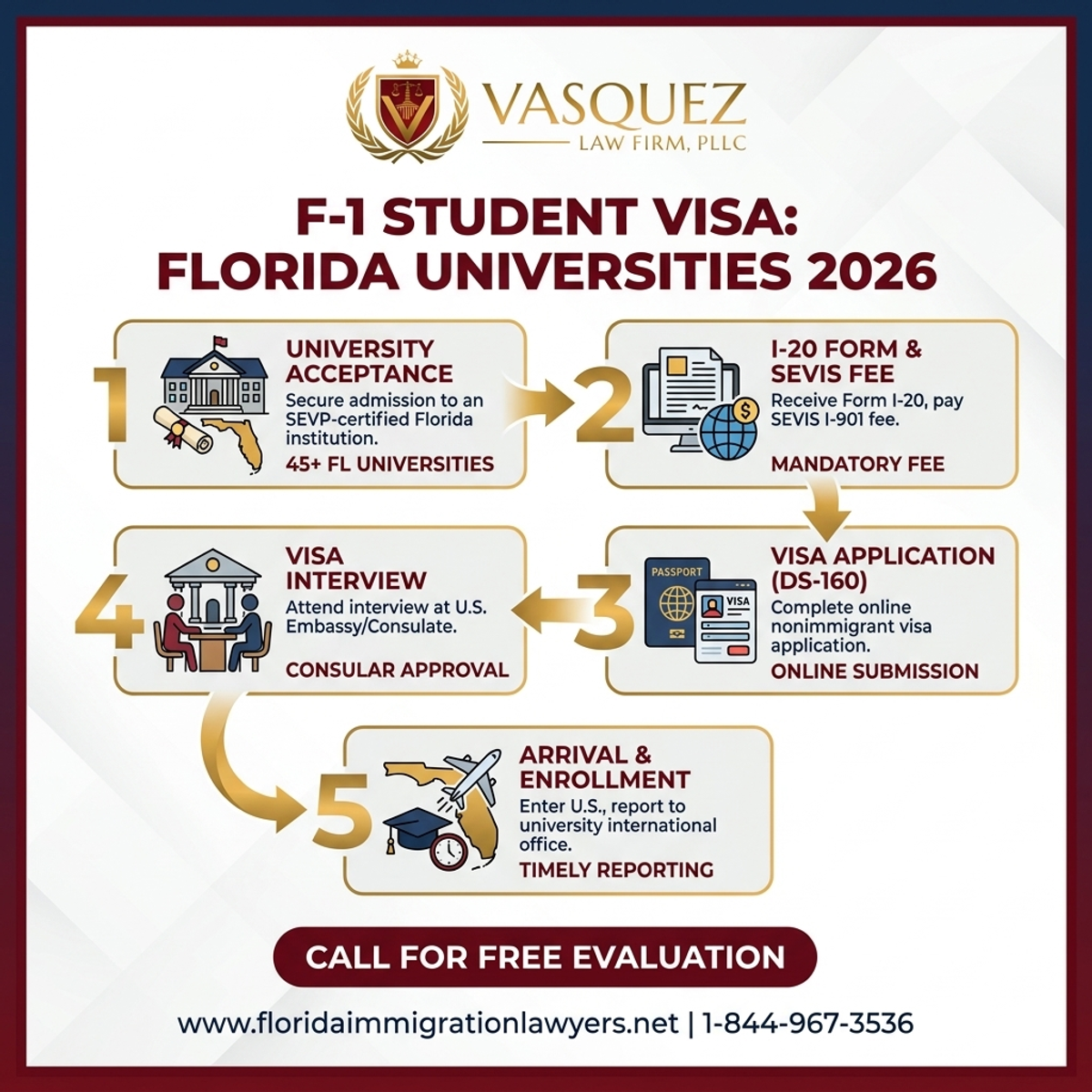
Key Statistics — F-1 Student Visa for Florida Universities in 2026
Do not navigate this process alone. The complexities of F-1 visa applications, especially regarding financial proof, work authorizations, and maintaining status, require legal insight. Contact Florida Immigration Lawyers today at 1-844-YO-PELEO for a free case review and ensure your academic journey in Florida starts on solid legal ground.
Common Mistakes to Avoid When Applying for an F-1 Student Visa
The F-1 student visa application process is fraught with potential pitfalls that can lead to delays, denials, or even future immigration complications. Avoiding these common mistakes is crucial for a successful outcome:
- Submitting an Incomplete or Inaccurate DS-160 Form: Any missing information or inconsistencies can trigger additional scrutiny or outright denial. Ensure all sections are filled out truthfully and completely.
- Lack of Sufficient Financial Proof: Failing to demonstrate adequate funds for your entire program duration is a primary reason for F-1 visa denials. Bank statements must be current, verifiable, and clearly show the required amount.
- Inability to Prove Nonimmigrant Intent: Consular officers need to be convinced you intend to return to your home country after your studies. Lack of strong ties (family, property, job prospects) abroad can lead to denial.
- Applying Too Late: Waiting until the last minute to apply can lead to missing your program start date due to long interview wait times or administrative processing delays.
- Misunderstanding F-1 Visa Regulations: Not knowing the rules for maintaining full-time enrollment, reporting changes of address, or limitations on employment can result in status violations.
- Incorrectly Answering Interview Questions: Providing vague, inconsistent, or dishonest answers during your visa interview can lead to immediate denial. Practice clear and concise responses.
- Traveling to the U.S. Too Early: You cannot enter the U.S. more than 30 days before the start date on your I-20. Arriving earlier can result in denial of entry.
- Unauthorized Employment: Working off-campus without CPT or OPT authorization is a serious violation of your F-1 status and can lead to deportation.
- Failing to Notify DSO of Changes: Not informing your Designated School Official (DSO) about changes in address, major, or funding sources can put your F-1 status at risk.
- Ignoring SEVIS Records: The SEVIS system tracks your compliance. Ignoring updates or issues related to your SEVIS record can lead to termination of your F-1 status.
When to Call a Lawyer for Your F-1 Student Visa in Florida
While many F-1 student visa applications proceed smoothly, certain circumstances warrant the expertise of an experienced immigration lawyer. If you encounter any complexities, red flags, or simply wish to ensure the highest chance of success, consulting with Florida Immigration Lawyers can make a significant difference. Our team can help you navigate challenging situations with confidence, whether you are applying from abroad or already in Florida. Here are specific scenarios where legal assistance is highly recommended:
- Previous Visa Denials: If you've been denied an F-1 visa or any other U.S. visa in the past, an attorney can help analyze the reasons for denial and strategize a stronger reapplication.
- Complex Financial Situations: If your financial support comes from multiple sources, international sponsors, or non-traditional assets, a lawyer can help organize and present this evidence effectively.
- Concerns about Nonimmigrant Intent: If you have a strong desire to remain in the U.S. long-term after your studies, or if your ties to your home country are not immediately obvious, an attorney can help you articulate your nonimmigrant intent truthfully and persuasively.
- Issues with I-20 or SEVIS: Discrepancies on your I-20, issues with your SEVIS record, or problems transferring schools require immediate legal attention.
- Previous Immigration Violations: Any past overstays, unauthorized employment, or other immigration infractions can severely complicate your F-1 application. An attorney can assess the impact and advise on potential waivers or strategies.
- Special Circumstances: If you have a criminal record, health issues, or other unique personal situations that might affect your eligibility, legal counsel is essential.
- Need for Status Change: If you are already in the U.S. on a different visa and wish to change to F-1 status, or if you are an F-1 student considering a change to another visa category (e.g., H-1B, family-based green card), a lawyer can guide you through the process, such as filing Form I-539.
- Deportation Concerns: If you have violated your F-1 status and are facing potential deportation defense proceedings, urgent legal intervention is necessary.
Florida Immigration Lawyers has extensive experience with F-1 visas and other immigration matters. We understand the specific requirements for students in Florida, including those attending universities in Orlando and across Central Florida. We can help you prepare your application, review your documents, prepare you for your interview, and represent you in complex cases.
About Florida Immigration Lawyers
Florida Immigration Lawyers is a leading law firm dedicated to providing exceptional legal representation to individuals and families navigating the complexities of U.S. immigration law throughout Florida. With a deep understanding of federal immigration statutes and a commitment to our clients, we offer comprehensive legal services tailored to your unique needs. Our experienced attorneys focus on a wide array of immigration matters, including F-1 student visas, family-based immigration, business immigration, asylum claims, deportation defense, and citizenship applications. We pride ourselves on our empathetic approach, clear communication, and unwavering advocacy for our clients.
Serving all of Florida, including the vibrant international community in Orlando and Central Florida, we are available 24/7 to address your concerns. We offer free case reviews to help you understand your options and develop a strategic plan. Our bilingual team is ready to assist you in English and Spanish, ensuring that language is never a barrier to accessing high-quality legal advice. When your future in the U.S. depends on a successful immigration outcome, trust the dedicated professionals at Florida Immigration Lawyers. Schedule a free consultation today and let us put our experience to work for you.
Sources and References
- U.S. Citizenship and Immigration Services (USCIS)
- U.S. Department of State
- Executive Office for Immigration Review (EOIR)
- 8 U.S.C. Chapter 12 - Immigration and Nationality Act (INA)
- INA § 101(a)(15)(F)(i) - Definition of F-1 Nonimmigrant
- 8 CFR 214.2(f) - Regulations pertaining to F-1 students
- SEVIS I-901 Fee website: FMJ Fee payment website
Related services: immigration practice areas, asylum protection, experienced immigration attorneys, immigration lawyer cost in Florida.
This article provides general legal information and is not intended as legal advice. Every case is unique, and outcomes depend on specific facts and circumstances. Contact an attorney for advice about your particular situation.
Your educational journey in Florida is a significant investment in your future. Ensure it's built on a foundation of sound legal advice. Contact Florida Immigration Lawyers today at 1-844-YO-PELEO for a free, no-obligation case review. Se Habla Espanol - Estamos aqui para ayudarle.
If you need legal assistance, learn more about speak with an immigration lawyer, or call us at 1-844-YO-PELEO for a free case review.
Do Not Navigate This Process Alone
Our experienced immigration attorneys are ready to fight for you. Get a free, confidential case review today.
Se Habla Español
Or leave your details and we’ll call you:
Free Evaluation in 24 Hours
Or talk to us right now
AI voice assistant — available 24/7
FreeFrequently Asked Questions

William J. Vásquez
Founding Attorney · Vasquez Law Firm
U.S. Air Force veteran and immigration attorney with years of hands-on U.S. immigration experience. J.D., NCCU School of Law. AILA member. Admitted to the 4th, 5th, and 11th Circuit Courts.
Available 24/7 - Free Evaluations
Reviewed for legal accuracy by William J. Vásquez
Licensed in North Carolina; U.S. immigration is federal practice.
Related Legal Services
Our Florida immigration attorneys can help you with immigration lawyer cost in Florida, experienced immigration attorneys and asylum protection. Call today at 1-844-YO-PELEO for a free case review.
Related Links
Related Topics
Free Legal Case Review
Discuss your case with our experienced attorneys. We're available 24/7.
Se Habla Español - Estamos aquí para ayudarle.
Related Articles
EAD Advance Parole Combo Card in Florida: What You Need
An EAD advance parole combo card allows individuals with pending adjustment applications to both work and travel abroad without jeopardizing their green card application. Learn how to apply in Florida, what documents you need, and common mistakes to avoid.
PERM Labor Certification in Florida: A 2026 Guide
Learn all about the PERM labor certification process in Florida, essential for employers sponsoring green card applicants. Understand the steps, document requirements, and common mistakes to avoid in this 2026 guide.
Dual Citizenship Lawyer in Florida: What You Need to Know
For Florida residents, the concept of dual citizenship, or holding two passports, offers a compelling blend of opportunities and challenges. While the U.S. generally permits dual nationality, the path to achieving this status requires a meticulous understanding of both U.S. immigration laws and the citizenship policies of your country of origin. This guide explores the definition of dual citizenship, the detailed step-by-step process for U.S. naturalization, and the significant benefits and potential pitfalls involved. We cover essential documentation, typical timelines, and cost considerations for 2026, providing crucial insights for anyone in Orlando, Miami, or across Florida considering this important legal step. Learn about common mistakes to avoid and understand when to seek professional legal counsel to navigate this complex process successfully. Florida Immigration Lawyers is here to provide expert, bilingual support for your dual citizenship journey.
Immigration Lawyer Orlando Free Consultation in Florida
For individuals and families in Orlando, Florida, navigating the complexities of U.S. immigration law requires expert guidance. An immigration lawyer in Orlando offers crucial support for everything from visa applications and green card processes to naturalization and deportation defense. This comprehensive guide details what a free consultation covers, providing a step-by-step overview of immigration pathways, essential document checklists, and expected timelines in 2026. We also highlight common mistakes to avoid, discuss the critical role of legal counsel in deportation and asylum cases, and explain why choosing a local Orlando immigration attorney is beneficial. Florida Immigration Lawyers is dedicated to serving the diverse community of Orlando with compassionate, effective legal solutions, ensuring you receive personalized advice and robust representation for a successful immigration journey.