K3 Visa Processing Time 2026: Your Florida Guide
For U.S. citizens in Florida hoping to reunite with their foreign spouses, understanding the K3 visa processing time in 2026 is essential. This non-immigrant visa allows spouses to enter the U.S. while their immigrant visa petition (Form I-130) is pending, bridging the gap to permanent residency. While processing times for the K-3 visa can range from 12 to 24 months, various factors, including USCIS caseloads and the completeness of your application, play a significant role. This comprehensive guide details K-3 visa eligibility, the step-by-step application process, required documentation, and associated costs. We also address how the Visa Bulletin and priority dates factor into the subsequent adjustment of status. Navigating this intricate legal journey requires precision and expertise. Florida Immigration Lawyers is here to provide the support and guidance you need, ensuring your application is meticulously prepared and strategically managed. Don't hesitate to reach out for a free case review to discuss your specific circumstances and plan your path forward.
The K3 visa processing time in 2026 can vary significantly, typically ranging from 12 to 24 months, though some cases may take longer. This non-immigrant visa allows spouses of U.S. citizens to enter the United States while their Form I-130 immigrant petition is pending approval. Factors influencing the timeline include the specific USCIS service center, the U.S. embassy or consulate processing the case, and the completeness of the application. While the K-3 visa was designed to reduce separation, faster I-130 processing times for immediate relatives have made it less common, but it remains an option for eligible couples seeking to unite sooner in Florida.
- Eligibility: Must be married to a U.S. citizen with an approved or pending I-130.
- Purpose: Allows foreign spouse to enter the U.S. while I-130 for green card is processed.
- Timeline: Generally 12-24 months, but highly variable based on caseloads.
- Key Forms: I-130, I-129F (for K-3), DS-160, I-485 (for adjustment of status).
- Florida Relevance: USCIS field offices in Florida handle subsequent adjustment of status.
Navigating the complex world of immigration can be daunting, especially when you're eager to reunite with your spouse. If you are a U.S. citizen married to a foreign national, understanding the K3 visa processing time in 2026 is crucial for planning your future together in Florida. The K-3 non-immigrant visa was created to shorten the physical separation between U.S. citizens and their foreign spouses by allowing the spouse to enter the U.S. and await the approval of their Form I-130, Petition for Alien Relative, and subsequent adjustment of status to lawful permanent resident. While less common today due to improved I-130 processing for immediate relatives, the K-3 visa remains a viable option for many.
This comprehensive guide from Florida Immigration Lawyers will walk you through the intricacies of the K-3 visa, covering eligibility, the application process, expected timelines, and associated costs. We will also address how the broader immigration landscape, including the visa bulletin and priority dates, might indirectly affect your journey, particularly as you transition from a K-3 visa holder to a permanent resident. Our goal is to provide you with clear, actionable information to help you and your loved one navigate this path with confidence. Don't face this journey alone; call Florida Immigration Lawyers at 1-844-YO-PELEO for a free case review and let our experienced team assist you every step of the way.
What is a K-3 Visa and Who is Eligible in 2026?
The K-3 non-immigrant visa is specifically designed for the foreign spouse of a U.S. citizen. Its primary purpose is to allow the spouse to enter the United States and reside with their U.S. citizen partner while their Form I-130, Petition for Alien Relative, is pending with U.S. Citizenship and Immigration Services (USCIS). This visa was established by the Legal Immigration Family Equity (LIFE) Act of 2000 to mitigate the long separation times that families often faced during the traditional immigrant visa process. As of 2026, the K-3 visa remains available, although its utility has somewhat diminished due to faster I-130 processing for immediate relatives.
To be eligible for a K-3 visa in 2026, several strict criteria must be met. First and foremost, you must be legally married to a U.S. citizen. This marriage must be valid in the place where it occurred. Second, the U.S. citizen spouse must have already filed Form I-130, Petition for Alien Relative, on behalf of their foreign spouse with USCIS, and this petition must still be pending. Third, the U.S. citizen must then file Form I-129F, Petition for Alien Fiancé(e), for the K-3 visa itself. It is critical to understand that the K-3 visa is a non-immigrant visa, meaning it is a temporary visa that allows entry, but it does not grant permanent residency directly. Its main benefit is to allow the spouse to be in the U.S. while waiting for their immigrant visa to become available or for their adjustment of status application to be processed. For those living in Orlando or anywhere in Central Florida, understanding these foundational requirements is the first step toward a successful application. Our firm focuses on helping couples in Florida determine their eligibility and strategize the most efficient path forward.
How Long Does K-3 Visa Processing Time Take in 2026?
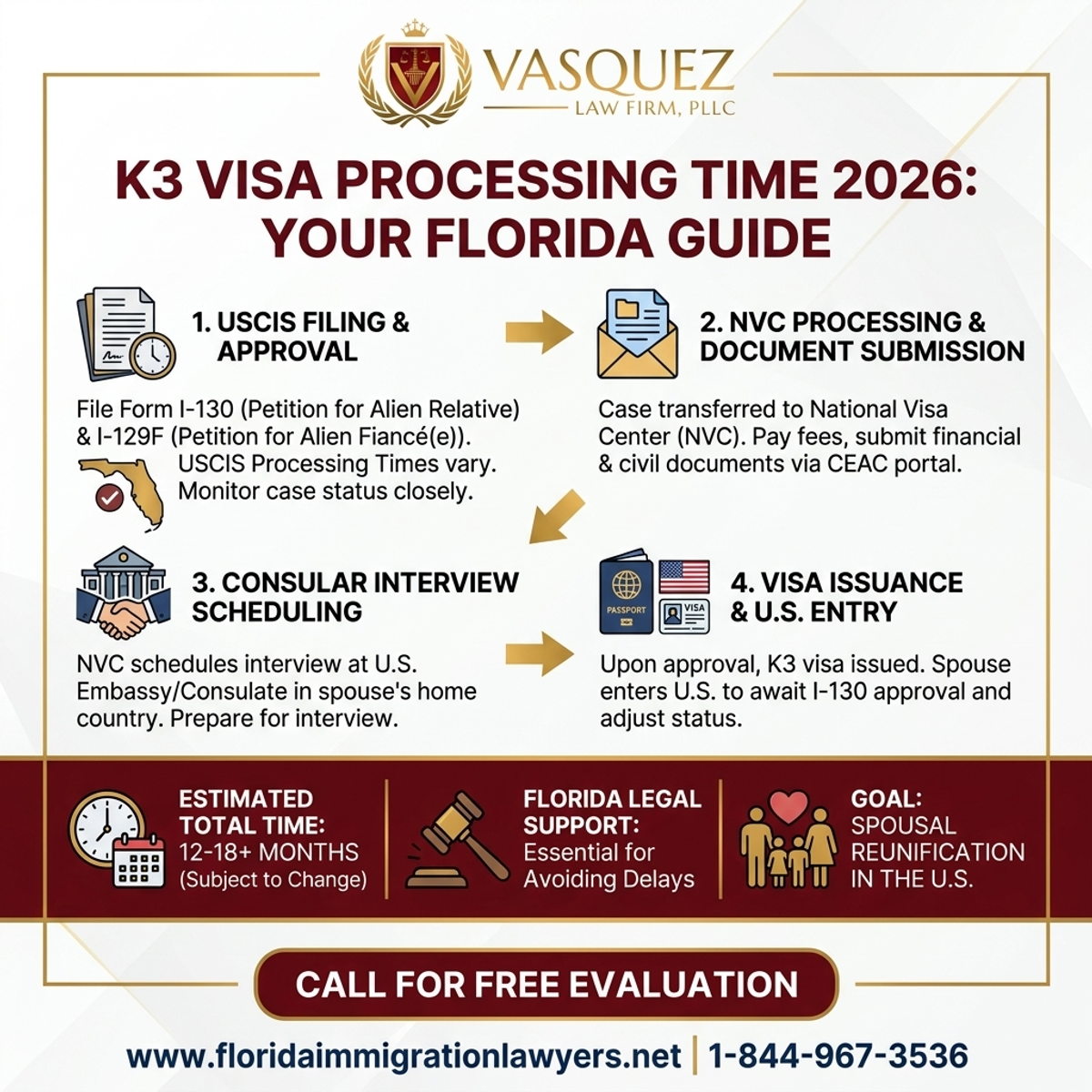
As of 2026, the K-3 visa processing time generally ranges from 12 to 24 months from the initial filing of the I-130 petition to the final visa issuance. However, this is an estimate, and actual times can vary based on numerous factors, including the workload at USCIS service centers, the specific U.S. embassy or consulate processing the visa, and the completeness of the applicant's documentation. The K-3 visa process involves multiple stages, each with its own processing times, making the overall timeline difficult to predict with absolute certainty. It is important to note that if your I-130 petition for an immediate relative is processed exceptionally quickly, the K-3 visa might not offer a significant time advantage, as its primary purpose is to bridge longer I-130 wait times. For a more precise understanding of current USCIS processing times, applicants should always consult the official USCIS website.
Several factors can influence the K-3 visa timeline for applicants in Florida. These include the volume of applications at the particular USCIS service center handling the I-130 and I-129F petitions, the efficiency of the National Visa Center (NVC), and the scheduling capacity of the U.S. embassy or consulate in the foreign spouse's home country. Additionally, any requests for evidence (RFEs) or issues during background checks can cause significant delays. For instance, if the U.S. citizen spouse resides in Central Florida, their petitions might be handled by service centers that have different processing backlogs than those serving other regions. Thorough preparation and submission of a complete, accurate application package are paramount to avoiding unnecessary delays. While the K-3 visa was designed to expedite reunification, its practical benefit now often depends on individual case circumstances and the fluctuating efficiency of government agencies. Consulting with an immigration attorney can help manage expectations and identify potential bottlenecks.
K-3 Visa Processing Timeline Expectations (2026)
Understanding each stage of the K-3 visa process is key to estimating the overall timeline:
| Stage | Typical Timeframe (As of 2026) | Notes |
|---|---|---|
| Form I-130 Filing & Approval | 7-15 months | Filed by U.S. citizen spouse. Processing times vary by USCIS service center. Must be pending or approved for K-3. |
| Form I-129F Filing & Approval | 5-9 months | Filed by U.S. citizen spouse after I-130 receipt. Also varies by USCIS service center. |
| NVC Processing | 1-3 months | After I-129F approval, NVC forwards case to embassy/consulate. Collects forms & fees. |
| Embassy/Consulate Interview | 2-6 months | Scheduling depends on embassy workload. Foreign spouse attends interview. Medical exam required. |
| Visa Issuance & Entry to U.S. | 1-2 months | After successful interview, visa issued. Spouse can travel to U.S. |
| Adjustment of Status (I-485) | 8-20 months (after entry) | Filed by K-3 holder in U.S. to become permanent resident. Processing varies by local USCIS field office (e.g., Orlando, Miami). |
Step-by-Step Guide to the K-3 Visa Application Process
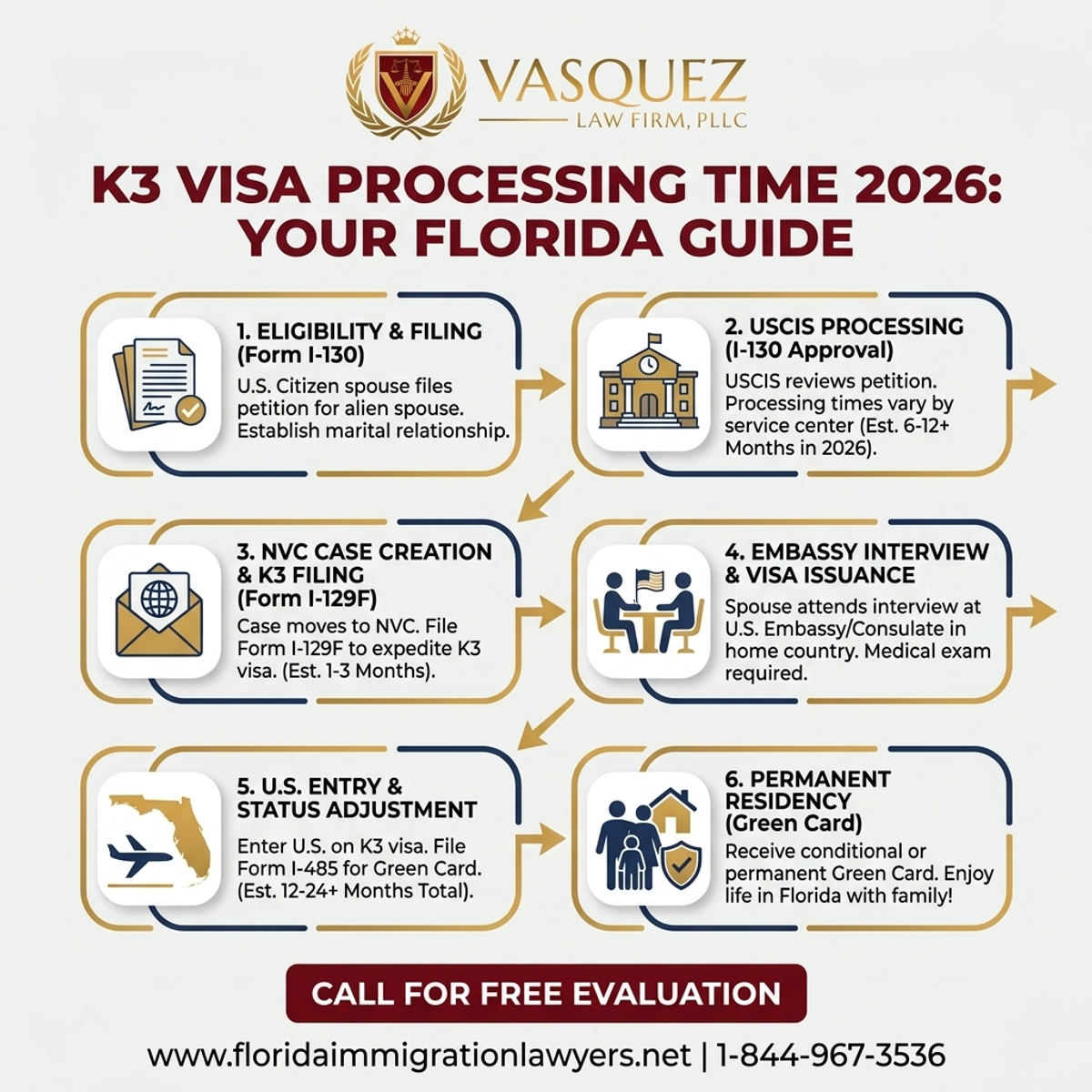
The K-3 visa application process, while seemingly straightforward, involves several critical steps that must be followed precisely to avoid delays. This guide outlines the typical progression for couples seeking to utilize the K-3 visa pathway in 2026:
-
File Form I-130, Petition for Alien Relative: The U.S. citizen spouse initiates the process by filing Form I-130 with USCIS. This petition establishes the bona fide nature of the marital relationship. For immediate relatives (spouses of U.S. citizens), there is no visa quota, but processing times still apply. This is the foundational step for both the immigrant visa and the K-3 visa. Ensure all supporting documents, such as marriage certificates, proof of joint finances, and photos, are included to demonstrate a legitimate marriage.
-
Receive I-130 Receipt Notice: After USCIS accepts your I-130 petition, you will receive Form I-797C, Notice of Action, acknowledging receipt. This receipt number is crucial for tracking your case and is required for the next step.
-
File Form I-129F, Petition for Alien Fiancé(e): Once you have the I-130 receipt notice, the U.S. citizen spouse can then file Form I-129F with USCIS. Although titled for fiancés, this form is also used for K-3 spouses. This petition specifically requests the K-3 non-immigrant visa for your spouse. You must include a copy of the I-130 receipt notice with your I-129F filing. This step is what officially starts the K-3 visa process, as per INA 214(r) (8 U.S.C. 1184(r)).
-
I-129F Approval and NVC Processing: Upon approval of the I-129F petition, USCIS forwards the case to the National Visa Center (NVC). The NVC will then assign a case number and send instructions to the foreign spouse regarding the collection of necessary documents and payment of fees. This phase primarily involves administrative processing and ensuring all prerequisites for the consular interview are met. Be diligent in responding to NVC requests promptly.
Step-by-Step Process — K3 Visa Processing Time 2026: Your Florida Guide
-
Consular Interview Scheduling and Preparation: The NVC forwards the approved petition to the U.S. embassy or consulate in the foreign spouse's country of residence. The consulate will then schedule an interview. The foreign spouse must undergo a medical examination by an authorized physician and gather all required documents, including civil documents, financial evidence, and results of the medical exam. The interview assesses eligibility and verifies the authenticity of the marriage.
-
K-3 Visa Interview and Issuance: The foreign spouse attends the interview at the U.S. embassy or consulate. If the interview is successful and all requirements are met, the K-3 visa will be stamped in their passport. They can then travel to the United States to join their U.S. citizen spouse. Upon entry, the K-3 visa holder will typically be granted a two-year period of admission.
-
Adjustment of Status (Form I-485): Once in the U.S. on a K-3 visa, the foreign spouse can file Form I-485, Application to Register Permanent Residence or Adjust Status, with USCIS. This application, along with supporting documentation, allows them to apply for a green card without leaving the U.S. This is the final step to becoming a lawful permanent resident. Applicants in Florida will typically file with the USCIS Chicago Lockbox, and their interview, if required, may be scheduled at a local field office such as the one in Orlando or Miami. This process also involves filing for employment authorization (I-765) and advance parole (I-131) concurrently.
Essential Documents for Your K-3 Visa Application
A meticulously prepared application package is critical for minimizing delays in the K3 visa processing time in 2026. Missing or incorrect documents can lead to Requests for Evidence (RFEs) or outright denials. Here is a comprehensive checklist of documents typically required for both the U.S. citizen petitioner and the foreign national beneficiary throughout the K-3 visa process:
- Form I-130, Petition for Alien Relative: The initial petition filed by the U.S. citizen, proving the marital relationship.
- Proof of U.S. Citizenship: U.S. passport, birth certificate, naturalization certificate, or Consular Report of Birth Abroad for the petitioner.
- Marriage Certificate: Original or certified copy of the legal marriage certificate.
- Proof of Bona Fide Marriage: Evidence demonstrating a real and ongoing marital relationship. This can include joint bank accounts, joint leases or property deeds, utility bills in both names, shared health insurance, photos together, affidavits from friends/family, and correspondence.
- Divorce Decrees or Death Certificates: If either spouse was previously married, proof of termination of all prior marriages is required.
- Form I-129F, Petition for Alien Fiancé(e): The petition for the K-3 visa itself, filed by the U.S. citizen.
- Copy of I-130 Receipt Notice: Essential to prove the I-130 is pending.
- Passport Copies: Valid passports for both the U.S. citizen and the foreign spouse. The foreign spouse's passport must be valid for at least six months beyond the intended period of stay.
- Birth Certificates: Original or certified copies for both spouses.
- Police Certificates: From all countries where the foreign spouse has lived for more than six months since age 16.
- Medical Examination: Completed by an authorized panel physician in the foreign spouse's country.
- Photographs: Passport-style photographs for both spouses, meeting specific USCIS and Department of State requirements.
- Form DS-160, Online Nonimmigrant Visa Application: Completed by the foreign spouse for the consular interview.
- Form I-864, Affidavit of Support: Filed by the U.S. citizen to demonstrate they can financially support the foreign spouse, meeting specific poverty guidelines to ensure the spouse will not become a public charge. This form is crucial for the immigrant visa stage and adjustment of status.
- Financial Documents: Tax returns, W-2s, employment letters, and bank statements of the U.S. citizen to support the Affidavit of Support.
Understanding K-3 Visa Costs and Fees in 2026
The total cost for a K-3 visa in 2026 involves several government filing fees, which are subject to change by USCIS and the Department of State. These fees are non-refundable and must be paid at various stages of the application process. It's important to budget not only for these mandatory government fees but also for other potential expenses, such as legal fees, medical examinations, and travel costs. While specific fee amounts can fluctuate, understanding the categories of expenses will help you prepare financially. Always verify the most current fees directly on the Department of State and USCIS websites.
For individuals and families in Florida, these costs are consistent across the nation, but local expenses for medical exams or legal assistance may vary. Beyond the government fees, consider the cost of obtaining certified translations for any foreign-language documents, postage for mailing applications, and potentially travel expenses for the consular interview abroad. If you choose to work with an immigration attorney, their fees will also be a significant part of your overall budget, though the value of guidance in avoiding costly mistakes often outweighs this expense. Remember, the K-3 visa is a stepping stone to a green card, so you will incur additional fees later for the adjustment of status application (Form I-485).
Typical K-3 Visa Related Fees (As of 2026)
| Item | Typical Fee (As of 2026) | Notes |
|---|---|---|
| Form I-130, Petition for Alien Relative | $535 - $560 | Filed by U.S. citizen spouse. Fee varies slightly based on filing method (online vs. paper). |
| Form I-129F, Petition for Alien Fiancé(e) | $535 - $560 | Filed by U.S. citizen spouse for K-3 visa. |
| DS-160, Nonimmigrant Visa Application Fee | $205 - $265 | Paid by foreign spouse at the embassy/consulate. |
| Medical Examination Fee | Varies ($150 - $500+) | Paid to authorized panel physician. Not a government fee. |
| Form I-485, Application to Adjust Status | $1,225 - $1,440 | Filed after entry on K-3. Includes biometric services fee. (For green card). |
| USCIS Immigrant Fee | $235 - $250 | Paid after I-485 approval, before green card production. |
| Attorney Fees | Varies ($3,000 - $8,000+) | Highly dependent on case complexity and firm. Essential for guidance. |
Key Statistics — K3 Visa Processing Time 2026: Your Florida Guide
Do not navigate this complex process alone. The stakes are too high when your family's future is on the line. Contact Florida Immigration Lawyers today for dedicated support and personalized legal strategies. We are here to help you understand your options and achieve your immigration goals.
Impact of the Visa Bulletin and Priority Dates on K-3 Spouses in Florida
While the K-3 visa itself is a non-immigrant visa, its ultimate goal is to facilitate the foreign spouse's adjustment to lawful permanent resident status (green card) in the U.S. This subsequent step, the adjustment of status, is where the Visa Bulletin and its associated priority dates become highly relevant. The K-3 visa is specifically for immediate relatives of U.S. citizens, a category that is not subject to annual quotas or per-country limits for the immigrant visa itself (Form I-130). This means that for immediate relatives, an immigrant visa number is always considered 'immediately available,' and thus, they do not typically have to wait for a priority date to become current for the I-130 to be approved. However, understanding the nuances of how the Visa Bulletin works is still important for K-3 visa holders, especially if there are any unforeseen delays or changes in policy.
The Visa Bulletin, published monthly by the U.S. Department of State, details the availability of immigrant visas for various preference categories and countries. While immediate relatives (IR-1/CR-1) are exempt from these quotas, other family-sponsored categories (F1, F2A, F2B, F3, F4) are heavily impacted by priority dates. A priority date is essentially your place in line, determined by the date your I-130 petition was properly filed. For K-3 visa holders, the priority date from their initial I-130 filing will be used when they apply for adjustment of status (I-485). Although an immigrant visa number is generally immediately available for immediate relatives, processing times for the I-130 and I-485 can still be lengthy. For example, if the K-3 spouse transitions to adjustment of status in Florida, the processing time for their I-485 at a local USCIS field office (like the one in Orlando or Miami) will dictate their final wait for the green card. The news context regarding potential changes like the public charge rule or H-1B fees, while not directly impacting K-3, highlights the dynamic nature of immigration law, underscoring the need for continuous legal counsel. Staying informed about Executive Office for Immigration Review (EOIR) decisions and general immigration policy is always prudent.
Navigating K-3 Visa Challenges: Florida-Specific Considerations
While the K-3 visa process is federally governed, practical aspects and local resources in Florida can significantly impact an applicant's experience. Florida is home to a large and diverse immigrant population, leading to specific considerations for K-3 visa holders and their U.S. citizen spouses. Understanding these local dynamics, from USCIS field office operations to community support, is crucial for a smoother journey. Our firm, based in Central Florida, is intimately familiar with the unique challenges and opportunities that arise in this vibrant state.
One key factor is the presence of USCIS field offices in Florida, notably in Orlando, Miami, and Tampa. These offices are responsible for conducting interviews for adjustment of status applications (Form I-485) once a K-3 visa holder is in the U.S. The caseloads and processing times at these specific offices can fluctuate, directly affecting how long a K-3 spouse might wait for their green card interview after filing their I-485. For instance, the Miami Field Office, serving a densely populated area, might experience different wait times compared to the Orlando office. Additionally, Florida's diverse demographics mean that applicants may come from a wide range of countries, each with its own U.S. embassy or consulate processing procedures, which can add layers of complexity to the initial visa issuance abroad. Florida's robust immigration legal community is a valuable resource, offering specialized assistance in navigating these challenges. Seeking local legal counsel ensures that your application is not only compliant with federal law but also optimized for the Florida context, addressing any regional specificities or local policy interpretations. Our immigration practice areas cover all aspects of family-based immigration, including K-3 visas and adjustment of status.
Common Mistakes to Avoid in the K-3 Visa Process
The K-3 visa application is a detailed and unforgiving process where even minor errors can lead to significant delays or even denial. Avoiding these common pitfalls is crucial for a smooth and efficient journey toward reuniting with your spouse in Florida.
-
Failing to File Form I-130 First: The K-3 visa requires an I-130 petition to be filed (and preferably pending) before the I-129F for the K-3 visa can be submitted. Filing the I-129F prematurely will result in rejection. Always ensure the I-130 receipt notice is obtained first.
-
Incomplete or Inaccurate Documentation: Submitting an application with missing forms, incorrect information, or insufficient supporting evidence is a primary cause of delays. USCIS will issue a Request for Evidence (RFE), which adds months to the processing time. Double-check every form and document.
-
Lack of Bona Fide Marriage Proof: Immigration officials scrutinize marriage petitions to prevent fraud. Insufficient evidence of a legitimate, ongoing marital relationship (e.g., joint bank accounts, shared leases, photos over time) can lead to intense questioning or denial.
-
Ignoring Changing Processing Times: Relying on outdated processing times can lead to frustration. USCIS processing times fluctuate constantly. Always check the official USCIS website for the most current estimates for both I-130 and I-129F petitions. If I-130 processing is very fast, the K-3 might not be beneficial.
-
Not Meeting Financial Requirements (I-864): The U.S. citizen petitioner must demonstrate sufficient income to support their spouse (Form I-864, Affidavit of Support). Failing to meet the poverty guidelines or provide adequate financial documentation can lead to denial of the green card application, even if the K-3 visa was granted.
-
Criminal or Immigration Violations: Undisclosed criminal history or prior immigration violations (e.g., overstaying a previous visa) by the foreign spouse can trigger severe issues, including inadmissibility. Be transparent and seek legal advice on how to address these issues.
-
Misunderstanding the K-3's Purpose: Some applicants mistake the K-3 as a direct path to a green card. It is a non-immigrant visa, a temporary solution. The K-3 holder must still file Form I-485 for adjustment of status to obtain permanent residency after entering the U.S.
-
Neglecting Updates to Contact Information: Moving without notifying USCIS and the NVC can result in missed notices, RFEs, or interview appointments, severely delaying the process or even leading to case abandonment.
When to Call a Lawyer for Your K-3 Visa Process
While some individuals attempt to navigate the K-3 visa process independently, the complexities of immigration law often necessitate professional legal guidance. Given the significant investment of time, money, and emotional energy, knowing when to consult an experienced immigration attorney can be the difference between success and costly delays or denials. Florida Immigration Lawyers are here to provide the assistance you need, whether you are in Orlando, Tampa, or anywhere across Florida.
You should strongly consider contacting an attorney if your situation involves any of the following scenarios: a prior denial of an immigration petition, a criminal record for either spouse, previous immigration violations, a history of divorce or multiple marriages, or if you simply feel overwhelmed by the extensive documentation and legal requirements. An attorney can help you gather and organize all necessary documents, prepare compelling evidence of a bona fide marriage, and ensure all forms are completed accurately. They can also represent you during interviews, respond to Requests for Evidence (RFEs), and provide critical advice on how to address potential inadmissibility issues. Furthermore, an attorney can help you understand the most current policies, including any relevant changes to the public charge rule, and strategize the most efficient path for your specific circumstances. Don't risk your family's future; let our team at Florida Immigration Lawyers guide you through every step of your K-3 visa and adjustment of status journey.
Florida Immigration Lawyers is an immigration law firm dedicated to serving individuals and families across the entire state of Florida. With a deep understanding of U.S. immigration laws and a compassionate approach, we strive to make the complex immigration process as smooth and stress-free as possible for our clients. Our team of experienced attorneys focuses on a wide range of immigration services, including family-based visas like the K-3, adjustment of status, deportation defense, asylum claims, citizenship, and business immigration. We pride ourselves on providing personalized attention, strategic legal advice, and unwavering advocacy for every case we handle. Located in Central Florida, we are available 24/7 for support and offer free case reviews to help you understand your options without obligation. Choose Florida Immigration Lawyers for peace of mind and dedicated representation in your immigration journey. Call us at 1-844-YO-PELEO to schedule your consultation today.
Sources and References
- U.S. Citizenship and Immigration Services (USCIS)
- U.S. Department of State
- Executive Office for Immigration Review (EOIR)
- 8 U.S.C. § 1184(r) - Immigration and Nationality Act (INA) Section 214(r) - K-3 Visas
- 8 U.S.C. § 1151(b)(2)(A)(i) - Immigration and Nationality Act (INA) Section 201(b)(2)(A)(i) - Immediate Relatives
- 8 Code of Federal Regulations (CFR) Part 214 - Nonimmigrant Classes
- USCIS Policy Manual
Related services: experienced immigration attorneys, immigration lawyer cost in Florida.
This article provides general legal information and is not intended as legal advice. Every case is unique, and outcomes depend on specific facts and circumstances. Contact an attorney for advice about your particular situation.
Understanding the K3 visa processing time in 2026 is just one piece of the puzzle. With complex regulations and ever-changing policies, having a knowledgeable legal partner is invaluable. Let Florida Immigration Lawyers be your trusted guide. We offer dedicated, bilingual support and are committed to helping you achieve your American dream. Contact us today for a free case review at 1-844-YO-PELEO. Se Habla Espanol - Estamos aqui para ayudarle.
Do Not Navigate This Process Alone
Our experienced immigration attorneys are ready to fight for you. Get a free, confidential case review today.
Se Habla Español
Or leave your details and we’ll call you:
Free Evaluation in 24 Hours
Or talk to us right now
AI voice assistant — available 24/7
FreeFrequently Asked Questions

William J. Vásquez
Founding Attorney · Vasquez Law Firm
U.S. Air Force veteran and immigration attorney with years of hands-on U.S. immigration experience. J.D., NCCU School of Law. AILA member. Admitted to the 4th, 5th, and 11th Circuit Courts.
Available 24/7 - Free Evaluations
Reviewed for legal accuracy by William J. Vásquez
Licensed in North Carolina; U.S. immigration is federal practice.
Related Legal Services
Our Florida immigration attorneys can help you with business immigration, deportation defense and family immigration services. Call today at 1-844-YO-PELEO for a free case review.
Related Links
Related Topics
Free Legal Case Review
Discuss your case with our experienced attorneys. We're available 24/7.
Se Habla Español - Estamos aquí para ayudarle.
Related Articles
EAD Advance Parole Combo Card in Florida: What You Need
An EAD advance parole combo card allows individuals with pending adjustment applications to both work and travel abroad without jeopardizing their green card application. Learn how to apply in Florida, what documents you need, and common mistakes to avoid.
PERM Labor Certification in Florida: A 2026 Guide
Learn all about the PERM labor certification process in Florida, essential for employers sponsoring green card applicants. Understand the steps, document requirements, and common mistakes to avoid in this 2026 guide.
Dual Citizenship Lawyer in Florida: What You Need to Know
For Florida residents, the concept of dual citizenship, or holding two passports, offers a compelling blend of opportunities and challenges. While the U.S. generally permits dual nationality, the path to achieving this status requires a meticulous understanding of both U.S. immigration laws and the citizenship policies of your country of origin. This guide explores the definition of dual citizenship, the detailed step-by-step process for U.S. naturalization, and the significant benefits and potential pitfalls involved. We cover essential documentation, typical timelines, and cost considerations for 2026, providing crucial insights for anyone in Orlando, Miami, or across Florida considering this important legal step. Learn about common mistakes to avoid and understand when to seek professional legal counsel to navigate this complex process successfully. Florida Immigration Lawyers is here to provide expert, bilingual support for your dual citizenship journey.
Immigration Lawyer Orlando Free Consultation in Florida
For individuals and families in Orlando, Florida, navigating the complexities of U.S. immigration law requires expert guidance. An immigration lawyer in Orlando offers crucial support for everything from visa applications and green card processes to naturalization and deportation defense. This comprehensive guide details what a free consultation covers, providing a step-by-step overview of immigration pathways, essential document checklists, and expected timelines in 2026. We also highlight common mistakes to avoid, discuss the critical role of legal counsel in deportation and asylum cases, and explain why choosing a local Orlando immigration attorney is beneficial. Florida Immigration Lawyers is dedicated to serving the diverse community of Orlando with compassionate, effective legal solutions, ensuring you receive personalized advice and robust representation for a successful immigration journey.