TPS to Green Card Florida: Pathways to Permanent Residency
For many TPS holders in Florida, transitioning to a green card is a crucial step towards permanent residency. This comprehensive guide from Florida Immigration Lawyers outlines the complex process, including eligibility requirements, the step-by-step application, essential documentation, and typical processing timelines as of 2026. We address critical aspects like lawful entry, family-based petitions, and common pitfalls to avoid. Understanding the costs involved and knowing when to seek legal counsel are vital for a successful outcome. Our firm provides dedicated support for individuals seeking to adjust status from TPS in Florida, offering free consultations to assess your unique situation and guide you through every stage.
Transitioning from Temporary Protected Status (TPS) to a green card in Florida is a complex but achievable pathway for many eligible individuals. As of 2026, the primary method involves meeting specific criteria for adjustment of status, often through a qualifying family petition or an employment-based visa, combined with a lawful entry into the U.S. This process requires careful documentation and adherence to USCIS regulations. Consulting an experienced immigration lawyer is crucial to navigate the legal complexities and ensure a smooth transition to permanent residency.
- TPS holders may adjust status if they meet green card eligibility.
- Lawful entry into the U.S. is a critical requirement for most adjustments.
- Family-based petitions are common avenues for TPS to green card.
- The process involves filing Form I-485, Application to Register Permanent Residence.
- Legal guidance from a Florida immigration lawyer is highly recommended.
For many individuals living in Florida under Temporary Protected Status (TPS), the dream of achieving permanent residency, a green card, is a significant goal. The journey from TPS to a green card can seem daunting, filled with intricate legal requirements and evolving immigration policies. However, with the right guidance and understanding, this pathway is often within reach. As of 2026, understanding the specific eligibility criteria, application processes, and potential challenges is more important than ever for TPS holders across the state, from Orlando to Miami.
This comprehensive guide from Florida Immigration Lawyers will demystify the process, providing clear, actionable information for those seeking to transition from TPS to a green card in Florida. We will explore the legal frameworks, step-by-step procedures, required documentation, and common pitfalls to avoid. Our aim is to empower you with the knowledge needed to pursue your permanent residency with confidence. Do not navigate this complex immigration landscape alone. Call Florida Immigration Lawyers at 1-844-YO-PELEO for a free consultation to discuss your specific situation.
Can a TPS Holder Get a Green Card in Florida in 2026?
Yes, a Temporary Protected Status (TPS) holder can generally get a green card in Florida in 2026, provided they meet the specific eligibility requirements for adjustment of status. The most critical factor for many TPS holders is having a lawful admission or parole into the United States, which, combined with a qualifying immigrant visa petition, can pave the way for permanent residency. This pathway is not automatic but is available to those who satisfy the necessary criteria under U.S. immigration law.
The ability for a TPS holder to adjust their status to that of a lawful permanent resident (green card holder) largely depends on their eligibility for an underlying immigrant visa. This typically means having a qualifying family relationship with a U.S. citizen or lawful permanent resident, or an approved employment-based petition. Historically, a crucial aspect for TPS holders has been demonstrating lawful entry into the U.S. A landmark Supreme Court decision in 2021 (Sanchez v. Mayorkas) clarified that TPS itself does not constitute an 'admission' for adjustment of status purposes under INA Section 245(a). However, subsequent guidance and legislative efforts have provided alternative interpretations or pathways, making it essential to consult with an attorney.
Many TPS holders in Florida, particularly those from countries like Honduras, El Salvador, and Haiti, have long-standing ties to the community. They often have U.S. citizen children, spouses, or employers who can sponsor them for a green card. The key is to carefully assess your individual immigration history, including your method of entry, any prior immigration applications, and any potential bars to admissibility. The USCIS Orlando Field Office, along with other offices across Florida, processes these applications, and understanding their specific procedures is vital. An experienced immigration lawyer in Florida can help you determine your eligibility and strategize the best approach for your unique circumstances.
It is important to remember that immigration laws are dynamic. While the general principles for adjustment of status for TPS holders remain consistent, policy interpretations and processing times can shift. Staying informed and seeking professional legal advice is the best way to navigate these changes. Florida Immigration Lawyers are dedicated to helping TPS holders understand their options and pursue permanent residency effectively. We serve clients throughout Florida, including Orlando, offering guidance tailored to your needs.
What is the Step-by-Step Process for TPS to Green Card Adjustment of Status?
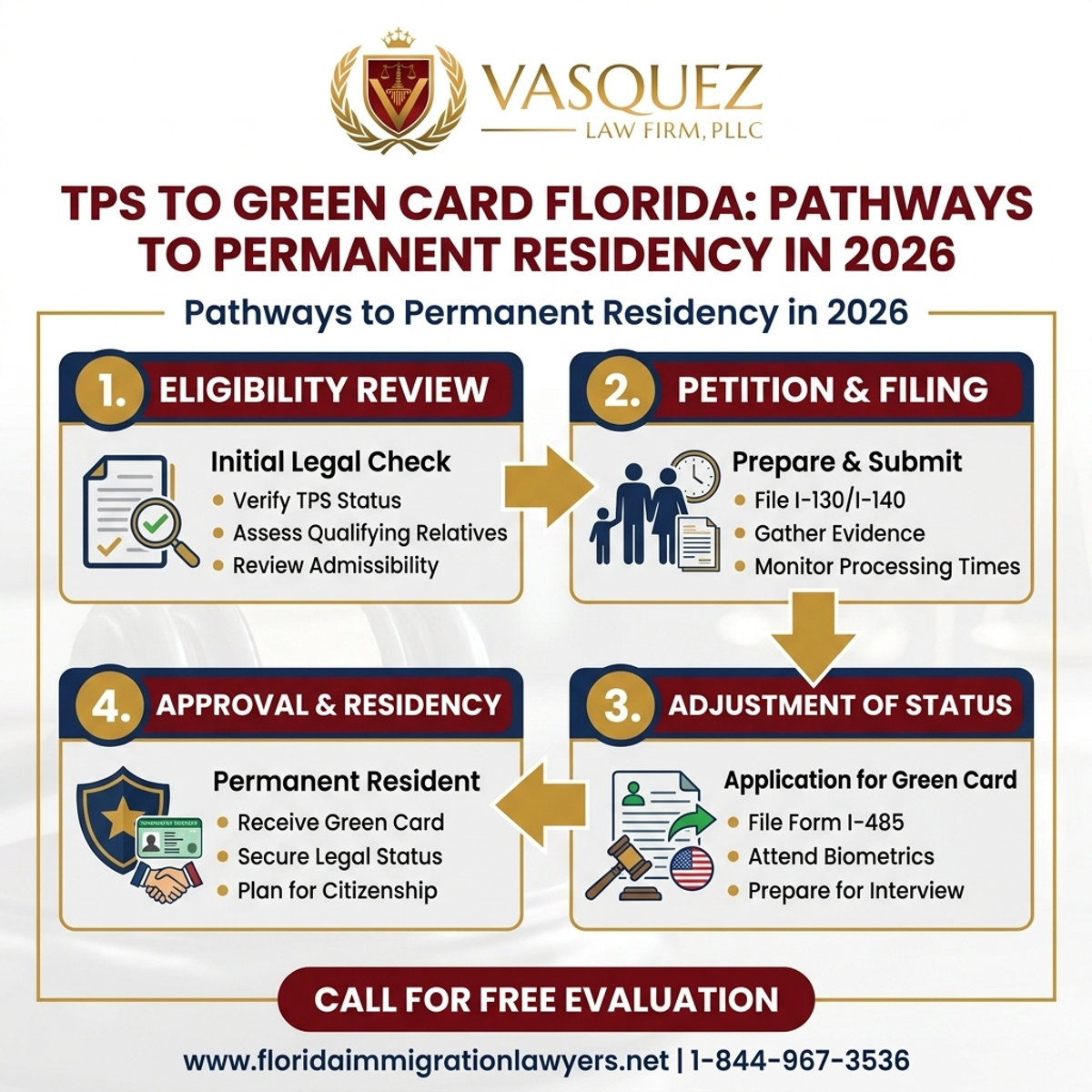
The process of adjusting status from TPS to a green card in Florida involves several key steps, beginning with establishing eligibility for an immigrant visa. This guide outlines the typical progression for TPS holders seeking permanent residency. Each step requires meticulous attention to detail and accurate documentation to avoid delays or denials, especially within the jurisdiction of Florida's immigration courts and USCIS field offices.
-
Establish Eligibility for an Immigrant Visa: Before applying for a green card, a TPS holder must be eligible for an immigrant visa category. This usually means a U.S. citizen or lawful permanent resident relative (spouse, parent, adult child) files Form I-130, Petition for Alien Relative, or an employer files Form I-140, Immigrant Petition for Alien Worker. This foundational step confirms there is a 'visa number' available for you.
What to Expect: Filing Form I-130 or I-140 is the first hurdle. Approval times vary based on the relationship and country of origin, but can range from several months to several years. For immediate relatives of U.S. citizens (spouses, minor children, parents), a visa is immediately available upon I-130 approval.
-
Confirm Lawful Admission or Parole: This is a critical step for TPS holders. While TPS itself does not grant admission, many TPS holders initially entered the U.S. lawfully (e.g., with a visa) or were granted parole. If you did not have a lawful entry, you may need to explore options like USCIS humanitarian parole or seek an alternative pathway, such as consular processing abroad, which carries its own risks and complexities. A recent development for some TPS holders is the possibility of obtaining 'advance parole' to travel internationally and re-enter, potentially creating a lawful admission record.
What to Expect: Your immigration lawyer will review your entry documents and history to determine if you meet the lawful admission requirement or if other strategies are necessary. This is a crucial point of analysis.
-
File Form I-485, Application to Register Permanent Residence or Adjust Status: Once an immigrant visa petition is approved and a visa is available (if applicable, for preference categories), and you have a lawful admission, you can file Form I-485. This form is the core application for your green card. It must be filed with supporting documents, including your birth certificate, marriage certificate (if applicable), medical exam results (Form I-693), and proof of your TPS status.
What to Expect: Upon filing, you will receive a receipt notice. USCIS will then schedule a biometrics appointment at a local Application Support Center (ASC) in Florida, such as the one serving the Orlando area. You may also be eligible to apply for an Employment Authorization Document (EAD) and Advance Parole concurrently.
-
Attend the Interview (if required): Most adjustment of status applicants are required to attend an interview at a USCIS field office, such as the one in Orlando, Tampa, or Miami. During the interview, an immigration officer will review your application, verify your information, and ask questions about your eligibility, your relationship (for family-based petitions), and your immigration history.
What to Expect: Your attorney from Florida Immigration Lawyers can prepare you thoroughly for this interview, ensuring you understand the types of questions to expect and have all necessary documents. The interview is a critical juncture in the process.
-
Receive Decision: After the interview, USCIS will make a decision on your application. If approved, you will receive your green card by mail. If denied, the decision will state the reasons, and you may have options to appeal or reapply, depending on the specifics of the denial.
What to Expect: The wait for a decision after the interview can vary, typically from a few weeks to several months. An approval means you are now a lawful permanent resident of the United States.
Essential Document Checklist for TPS to Green Card Applicants
Preparing a complete and accurate set of documents is paramount for a successful TPS to green card application in Florida. Missing or incorrect documentation is a leading cause of delays and denials. This checklist covers the essential documents typically required, but always consult with your immigration lawyer for a personalized list based on your unique case.
- Proof of Identity and Nationality: Passport, birth certificate.
- Proof of TPS Status: Form I-797 approval notices for TPS, EADs issued under TPS.
- Proof of Lawful Entry/Admission: Form I-94 Arrival/Departure Record, visa stamps, parole documents.
- Immigrant Visa Petition Documents: Approved Form I-130 or I-140 (if applicable), and all supporting evidence from that initial petition (e.g., marriage certificates, birth certificates, photos, affidavits).
- Form I-485, Application to Register Permanent Residence or Adjust Status: Completed and signed.
- Form I-693, Report of Medical Examination and Vaccination Record: Completed by a USCIS-approved civil surgeon.
- Form I-864, Affidavit of Support: From the petitioning relative, with supporting financial documents (tax returns, employment letters, bank statements).
- Form I-765, Application for Employment Authorization: (Optional, can be filed concurrently with I-485).
- Form I-131, Application for Travel Document: (Optional, can be filed concurrently for Advance Parole).
- Photographs: Passport-style photos as specified by USCIS.
- Police Clearances/Certificates: From countries where you have lived for six months or more since age 16 (if required, typically for consular processing).
- Court and Criminal Records: If applicable, certified copies of all arrest records, court dispositions, and police reports.
- Proof of Financial Solvency: Bank statements, pay stubs, employment verification.
Step-by-Step Process — TPS to Green Card Florida: Pathways to Permanent Residency in 2026
How Long Does TPS to Green Card Processing Take in 2026?
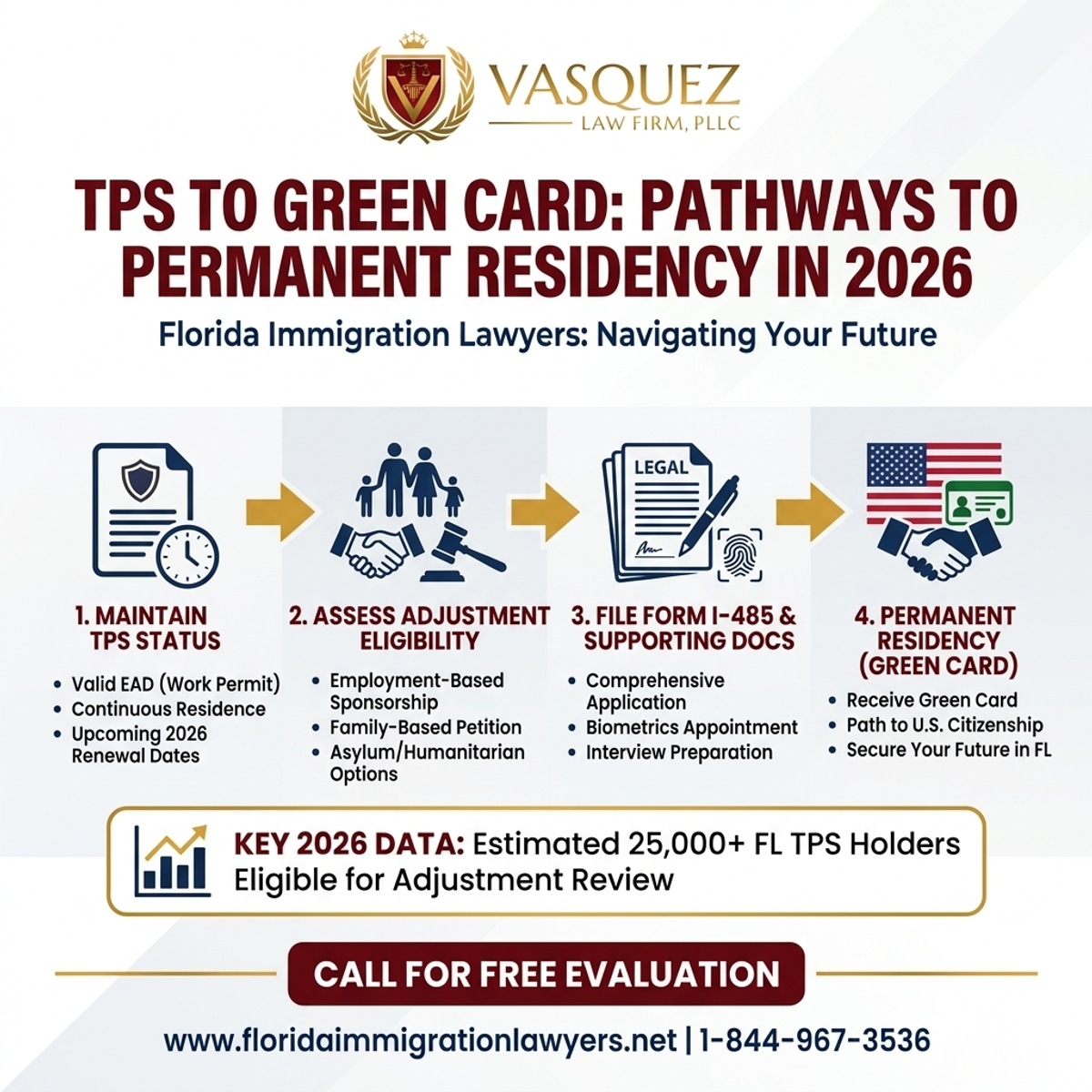
The processing time for transitioning from TPS to a green card in Florida can vary significantly based on several factors, including the specific USCIS field office (e.g., Orlando, Miami), the service center handling your initial petition, the type of underlying immigrant visa, and the complexity of your case. As of 2026, applicants should anticipate a multi-stage process that can extend from one to several years.
The timeline begins with the processing of the underlying immigrant petition (Form I-130 or I-140). Family-based petitions for immediate relatives of U.S. citizens generally have shorter waits for visa availability, but the processing of the petition itself can take 6-18 months. For preference categories (e.g., adult children of U.S. citizens, siblings of U.S. citizens), visa availability can add years to the wait, depending on the visa bulletin. Once the immigrant petition is approved and a visa is available, the Form I-485 adjustment of status application itself typically takes 12-24 months for processing, including biometrics, potential requests for evidence (RFEs), and an interview. These are general estimates, and individual cases may differ based on the specific circumstances and any unforeseen issues. Florida Immigration Lawyers constantly monitor USCIS processing times to provide the most current information to our clients.
| Stage | Typical Timeframe (As of 2026) | Notes |
|---|---|---|
| Immigrant Petition (I-130/I-140) | 6 months - 5+ years | Varies significantly by visa category and country of origin. Immediate relatives (spouse, minor child, parent of USC) typically have shorter waits for visa availability. |
| Visa Availability (Visa Bulletin) | Immediate to 15+ years | Applicable for preference categories (not immediate relatives). Depends on demand and per-country limits. |
| I-485 Filing to Biometrics | 1-3 months | Appointment at a local Application Support Center (ASC) in Florida (e.g., Orlando, Tampa, Miami). |
| Biometrics to Interview Scheduling | 6-18 months | Can vary based on USCIS field office workload and case complexity. |
| Interview to Decision | 1 week - 6 months | Some cases are approved on the spot; others require further review or RFEs. |
| Total Processing Time (Estimate) | 1.5 years - 10+ years | Highly dependent on underlying visa category, lawful entry status, and individual case specifics. |
What are the Costs Involved in a TPS to Green Card Application?
The financial aspect of transitioning from TPS to a green card in Florida is a significant consideration for many applicants. The total cost encompasses various government filing fees, medical examination fees, and potential legal fees. It is crucial to understand that government fees are subject to change, and specific amounts should always be verified on the official USCIS website. As of 2026, these costs can accumulate, making financial planning an important part of the process.
Government filing fees include separate charges for the immigrant petition (Form I-130 or I-140), the adjustment of status application (Form I-485), and potentially fees for an Employment Authorization Document (EAD) and Advance Parole. Additionally, all applicants must undergo a medical examination by a USCIS-approved civil surgeon, which incurs a separate fee directly to the doctor's office. Legal fees for an experienced immigration attorney, such as those at Florida Immigration Lawyers, cover professional guidance, document preparation, representation at interviews, and handling any complex issues that may arise. While legal fees are an investment, they often save applicants from costly mistakes and delays. It is important to note that specific filing fees can fluctuate, so always check current USCIS fee schedules. The combined costs can be substantial, emphasizing the need for careful financial preparation.
Key Statistics — TPS to Green Card Florida: Pathways to Permanent Residency in 2026
| Item | Typical Fee Range (As of 2026) | Notes |
|---|---|---|
| Form I-130 (Immigrant Petition) | Variable, check USCIS site | Paid by the U.S. citizen or LPR petitioner. |
| Form I-485 (Adjustment of Status) | Variable, check USCIS site | Includes biometrics fee. May be combined with EAD/Advance Parole for no additional fee. |
| Form I-693 (Medical Exam) | $200 - $500 | Paid directly to the civil surgeon. Price varies by provider and required vaccinations. |
| Legal Fees | Varies significantly by case complexity and attorney. | Covers consultation, document preparation, strategy, and representation. Essential for complex cases. |
| Miscellaneous Costs | $50 - $200+ | Includes translation services, postage, photocopying, travel for appointments. |
Common Mistakes to Avoid When Adjusting Status from TPS to Green Card
Navigating the complex path from TPS to a green card in Florida requires precision and careful attention to detail. Even minor errors can lead to significant delays or even denial of your application. Avoiding these common mistakes is crucial for a successful outcome.
-
Failing to Establish Lawful Entry: Many TPS holders do not realize that TPS status itself does not grant 'lawful admission' for adjustment of status purposes. If you entered without inspection, you might not be eligible to adjust status in the U.S. This is a critical point that requires thorough legal analysis, potentially necessitating a waiver or another pathway like consular processing.
-
Submitting Incomplete or Incorrect Forms: USCIS forms are highly specific. Missing signatures, unanswered questions, or incorrect information can lead to a Request for Evidence (RFE) or outright denial. Each form must be meticulously completed according to the latest instructions.
-
Not Disclosing All Immigration History: Attempting to hide any part of your immigration history, including prior arrests, deportations, or visa overstays, can be considered misrepresentation and lead to severe penalties, including permanent bars from the U.S. Transparency is always the best policy, even for potentially negative information, as an attorney may be able to address it.
-
Missing Deadlines: Immigration processes are time-sensitive. Missing deadlines for RFE responses, interview attendance, or filing updates can result in the abandonment or denial of your application. Keep meticulous records of all communications and deadlines.
-
Traveling Without Advance Parole: If you have a pending adjustment of status application and leave the U.S. without an approved Advance Parole document (Form I-131), your I-485 application will likely be considered abandoned. This is a common and costly error for many applicants.
-
Failing to Maintain TPS Status: While your green card application is pending, it is generally advisable to maintain your TPS status by re-registering during the designated periods. If your TPS expires and your I-485 is denied, you could fall out of status.
-
Inadequate Financial Support (I-864): The Affidavit of Support (Form I-864) from your petitioner must demonstrate sufficient financial means to support you. Errors in calculating income, missing tax documents, or insufficient co-sponsors can lead to RFEs or denial based on public charge grounds, especially with recent policy shifts.
-
Ignoring Criminal History: Even minor arrests or convictions can impact green card eligibility. Failing to provide certified court documents or assuming an old charge is irrelevant can be detrimental. Always consult with an attorney to assess any criminal history.
-
Poor Interview Preparation: The USCIS interview is a crucial step. Being unprepared, providing inconsistent answers, or failing to present required documents can jeopardize your application. Practice and thorough document review with your attorney are essential.
-
Not Seeking Legal Counsel: Attempting to navigate the complex immigration system alone is a significant risk. An experienced immigration lawyer can identify potential issues, ensure proper documentation, and represent your best interests, significantly increasing your chances of success.
When Should You Call a Florida Immigration Lawyer?
The journey from TPS to a green card in Florida is rarely straightforward, and certain situations make legal counsel absolutely essential. You should contact a Florida immigration lawyer from Florida Immigration Lawyers immediately if you encounter any of the following scenarios or have particular concerns about your case.
If you have any doubts about your lawful entry into the U.S., a prior deportation order, or a criminal history, legal advice is critical. These factors can create significant bars to adjustment of status that only an experienced attorney can help you navigate, potentially identifying waivers or alternative pathways. Similarly, if your sponsoring relative has financial difficulties or if you have received a Request for Evidence (RFE) from USCIS, a lawyer can help craft a robust response. Any change in your marital status, employment, or country conditions that might affect your TPS or green card eligibility also warrants immediate consultation. Do not wait for a problem to escalate; proactive legal intervention can prevent costly mistakes and delays.
Florida Immigration Lawyers focus on complex immigration cases, including those involving TPS to green card transitions. We understand the specific nuances of Florida's immigration landscape, from the Orlando Immigration Court to the USCIS Field Offices. Our team is equipped to handle issues such as waivers of inadmissibility, consular processing strategies, and appeals of denied applications. We offer comprehensive support, from initial eligibility assessment to preparing you for your interview and representing your interests throughout the entire process. Protecting your future in Florida is our priority.
About Florida Immigration Lawyers: TPS to Green Card Florida
Florida Immigration Lawyers is a leading law firm dedicated to providing comprehensive and compassionate immigration legal services throughout the state of Florida. With a deep understanding of U.S. immigration law and its specific application in Florida, our experienced attorneys are committed to helping individuals and families achieve their immigration goals. We pride ourselves on offering personalized attention, strategic advice, and vigorous representation for every client, from Orlando to every corner of the Sunshine State.
Our firm focuses on a wide range of immigration matters, including family-based immigration, employment visas, asylum, deportation defense, and naturalization. We are particularly adept at guiding clients through complex pathways such as the transition from TPS to a green card in Florida, ensuring compliance with all legal requirements and navigating any challenges that may arise. Our commitment extends to providing accessible legal support, with free consultations available 24/7. We understand the unique needs of Florida's diverse immigrant communities and are proud to offer bilingual services, with a dedicated team ready to assist in both English and Spanish.
When you choose Florida Immigration Lawyers, you gain a trusted partner committed to your success. Our attorneys are not just legal professionals; they are advocates who genuinely care about your future. We leverage our experience to simplify complex legal processes, offering clarity and peace of mind. For reliable, effective, and empathetic immigration legal assistance, contact us today at 1-844-YO-PELEO or visit our website at floridaimmigrationlawyers.net. Let us help you achieve your American dream.
Sources and References: TPS to Green Card Florida
- U.S. Citizenship and Immigration Services (USCIS)
- Executive Office for Immigration Review (EOIR)
- U.S. Department of State - Visa Bulletin
- 8 U.S.C. § 1254a - Temporary Protected Status (INA Section 244)
- 8 U.S.C. § 1255 - Adjustment of Status of Nonimmigrant to That of Person Admitted for Permanent Residence (INA Section 245)
- 8 CFR Part 244 - Temporary Protected Status
- 8 CFR Part 245 - Adjustment of Status to That of Person Admitted for Permanent Residence
- Sanchez v. Mayorkas, 141 S. Ct. 1809 (2021)
Related services: immigration practice areas, family immigration services.
This article provides general legal information and is not intended as legal advice. Every case is unique, and outcomes depend on specific facts and circumstances. Contact an attorney for advice about your particular situation.
Your journey to a green card from Temporary Protected Status (TPS) in Florida is a significant step towards securing your future. With the right legal support, you can navigate the complexities and pursue your dream of permanent residency. Do not hesitate to seek professional guidance. Contact Florida Immigration Lawyers today at 1-844-YO-PELEO for a free, confidential consultation. Se Habla Español - Estamos aquí para ayudarle.
If you need legal assistance, learn more about experienced immigration attorneys in Orlando, or call us at 1-844-YO-PELEO for a free consultation.
Do Not Navigate This Process Alone
Our experienced immigration attorneys are ready to fight for you. Get a free, confidential case review today.
Se Habla Español
Or leave your details and we’ll call you:
Free Evaluation in 24 Hours
Or talk to us right now

AI voice assistant — available 24/7
FreeFrequently Asked Questions

William J. Vásquez
Founding Attorney · Vasquez Law Firm
U.S. Air Force veteran and immigration attorney with years of hands-on U.S. immigration experience. J.D., NCCU School of Law. AILA member. Admitted to the 4th, 5th, and 11th Circuit Courts.
Available 24/7 - Free Evaluations
Reviewed for legal accuracy by William J. Vásquez
Licensed in North Carolina; U.S. immigration is federal practice.
Related Legal Services
Our Florida immigration attorneys can help you with business immigration, deportation defense and family immigration services. Call today at 1-844-YO-PELEO for a free case review.
Related Links
Related Topics
Free Legal Case Review
Discuss your case with our experienced attorneys. We're available 24/7.
Se Habla Español - Estamos aquí para ayudarle.
Related Articles
Certificate of Eligibility for Expungement in Florida 2026
For non-U.S. citizens in Florida, understanding how a state expungement impacts immigration status is critical. A certificate of eligibility for expungement in Florida allows a criminal record to be sealed or expunged under state law. However, federal immigration agencies often disregard such state-level relief, still considering the original criminal offense as a conviction for immigration purposes. This can have severe implications for visa applications, green card eligibility, naturalization, and even lead to deportation. This guide clarifies the Florida expungement process, its limited effect on federal immigration law, and key steps to protect your status in 2026. Learn about common mistakes, required documents, timelines, and when to seek expert legal counsel from Florida Immigration Lawyers to navigate these complex issues effectively.
Immigration Lawyer Orlando Free Consultation in Florida
For individuals and families in Orlando, Florida, navigating the complexities of U.S. immigration law requires expert guidance. An immigration lawyer in Orlando offers crucial support for everything from visa applications and green card processes to naturalization and deportation defense. This comprehensive guide details what a free consultation covers, providing a step-by-step overview of immigration pathways, essential document checklists, and expected timelines in 2026. We also highlight common mistakes to avoid, discuss the critical role of legal counsel in deportation and asylum cases, and explain why choosing a local Orlando immigration attorney is beneficial. Florida Immigration Lawyers is dedicated to serving the diverse community of Orlando with compassionate, effective legal solutions, ensuring you receive personalized advice and robust representation for a successful immigration journey.
Green Card Renewal Process in Florida 2026
Renewing your 10-year green card in Florida is essential to maintain your status as a permanent resident. Learn how to file Form I-90, gather the necessary documents, and avoid common mistakes. Florida Immigration Lawyers can help guide you through the process.
Immigration Services Treasure Coast Florida: 2026 Guide
Navigating immigration services in Florida's Treasure Coast, including Martin County, requires expert legal guidance. This 2026 guide from Florida Immigration Lawyers provides comprehensive insights into visa applications, green card processes, naturalization, asylum claims, and deportation defense. We cover eligibility, step-by-step procedures, required documents, estimated timelines, and potential costs. Learn about common mistakes to avoid and when it's crucial to consult an experienced immigration attorney. Our firm offers dedicated support across all of Florida, ensuring you have the resources needed for a successful immigration journey. Get personalized advice and understand your options today.