TPS to Green Card Pathway in Florida
Discover the pathway from TPS to a green card in Florida. Our guide covers eligibility, steps, and common pitfalls. Contact Florida Immigration Lawyers for expert advice.

For many individuals granted Temporary Protected Status (TPS) in the United States, the dream of permanent residency, or a Green Card, can seem distant. However, for TPS holders in Florida, a clear pathway often exists to adjust their status and secure a more stable future. This comprehensive guide will explore the intricacies of transitioning from TPS to a Green Card, focusing on the specific requirements, processes, and considerations for those residing in the Sunshine State.
Understanding Temporary Protected Status (TPS)
Temporary Protected Status (TPS) is a humanitarian immigration benefit granted by the U.S. government to eligible nationals of designated countries who are unable to return safely to their home country due to conditions such as armed conflict, environmental disaster, or other extraordinary and temporary circumstances. While TPS provides temporary relief from deportation and allows beneficiaries to obtain work authorization, it does not automatically lead to permanent residency. However, it can serve as a crucial stepping stone for many individuals seeking a Green Card.
Designations for TPS are country-specific and time-limited, though they are often extended. Beneficiaries must register during specific periods and meet ongoing eligibility criteria. It's vital for TPS holders to understand that TPS itself is not a path to citizenship, but rather a temporary status that protects them from removal from the U.S. and grants them the ability to live and work legally. The ability to adjust status from TPS to a Green Card depends on meeting separate and distinct eligibility requirements under U.S. immigration law, often involving a qualifying family relationship or employment opportunity.
Eligibility Requirements for TPS Holders to Adjust Status
While TPS offers temporary protection, transitioning to a Green Card requires meeting specific criteria for adjustment of status. The most critical factor for many TPS holders seeking a Green Card is demonstrating "lawful admission" or "parole" into the United States. Historically, TPS recipients were often considered to have been "inspected and admitted" for the purpose of adjustment of status, even if their initial entry was without inspection. However, recent court decisions and policy changes have complicated this interpretation, especially for those who entered without inspection and later received TPS.
For TPS holders in Florida, the primary pathways to a Green Card typically involve:
- Family-Based Petitions: If you are an immediate relative (spouse, unmarried child under 21, or parent) of a U.S. citizen, or have a qualifying relationship with a U.S. lawful permanent resident, you may be eligible. The U.S. citizen or LPR must file Form I-130, Petition for Alien Relative, on your behalf.
- Employment-Based Petitions: In some cases, an employer may sponsor a TPS holder for a Green Card if they meet the qualifications for a specific employment-based visa category. This often requires a labor certification process and the filing of Form I-140, Immigrant Petition for Alien Worker.
- Special Immigrant Juvenile Status (SIJS): For certain TPS holders under 21 who have been abused, neglected, or abandoned by one or both parents, SIJS could be an option.
- Asylum or Refugee Status: If you have an independent basis for asylum, you may pursue that path, which can lead to a Green Card after one year of asylum status. Learn more about asylum law.
Crucially, regardless of the pathway, TPS holders must also be "admissible" to the United States. This means they must not have any grounds of inadmissibility, such as certain criminal convictions, immigration violations, or health-related issues. Some grounds of inadmissibility can be waived, but this adds complexity to the process. It is highly recommended to consult with an immigration attorney to assess your specific eligibility and potential challenges.
The Adjustment of Status Process for TPS Holders in Florida
The journey from TPS to a Green Card involves several key steps. While the general process is similar across the U.S., having an attorney familiar with local USCIS field offices in Florida can be beneficial.
- Establish an Underlying Eligibility Basis: As mentioned, this is usually a family-based or employment-based petition. The U.S. citizen or LPR petitioner (for family cases) or employer (for employment cases) must first file the appropriate petition (Form I-130 or I-140) with USCIS.
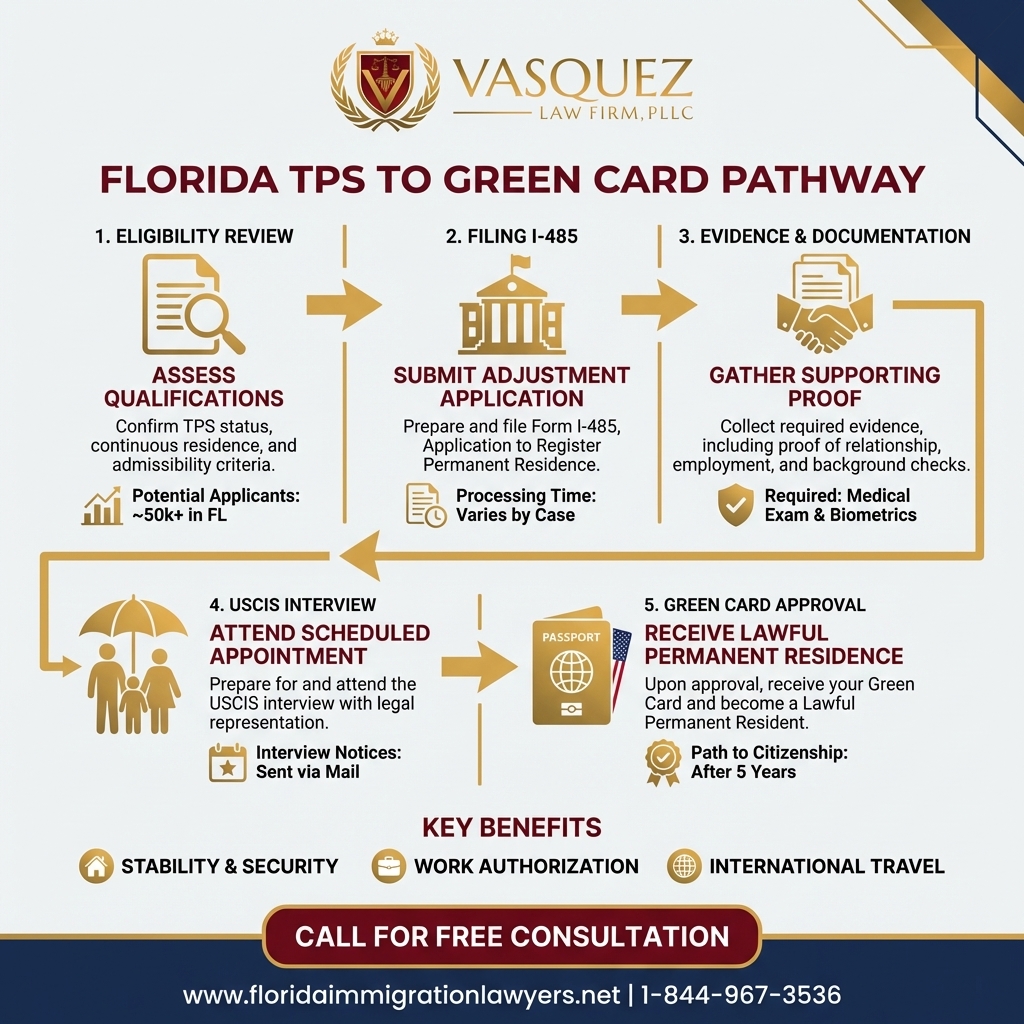
- File Form I-485, Application to Register Permanent Residence or Adjust Status: Once the underlying petition is approved and a visa number is available (if applicable), the TPS holder can file Form I-485. This form is the core application for adjustment of status. It must be filed with supporting documents, including proof of TPS status, birth certificate, medical examination results (Form I-693), and affidavits of support (Form I-864) for family-based cases.
- Biometrics Appointment: After filing Form I-485, applicants will receive a notice for a biometrics appointment at a local Application Support Center (ASC). Here, fingerprints, photographs, and signatures are collected for background checks.
- Interview with USCIS: Most adjustment of status applicants will be scheduled for an interview at a USCIS field office. For Florida residents, this might be in Miami, Orlando, Tampa, or Jacksonville. During the interview, an immigration officer will review your application, ask questions about your eligibility, the underlying petition, and your background.
- Decision: Following the interview, USCIS will make a decision on your application. If approved, you will receive your Green Card by mail. If denied, it is crucial to understand the reasons for denial and explore potential options, which may include appealing the decision or seeking deportation defense if removal proceedings are initiated.
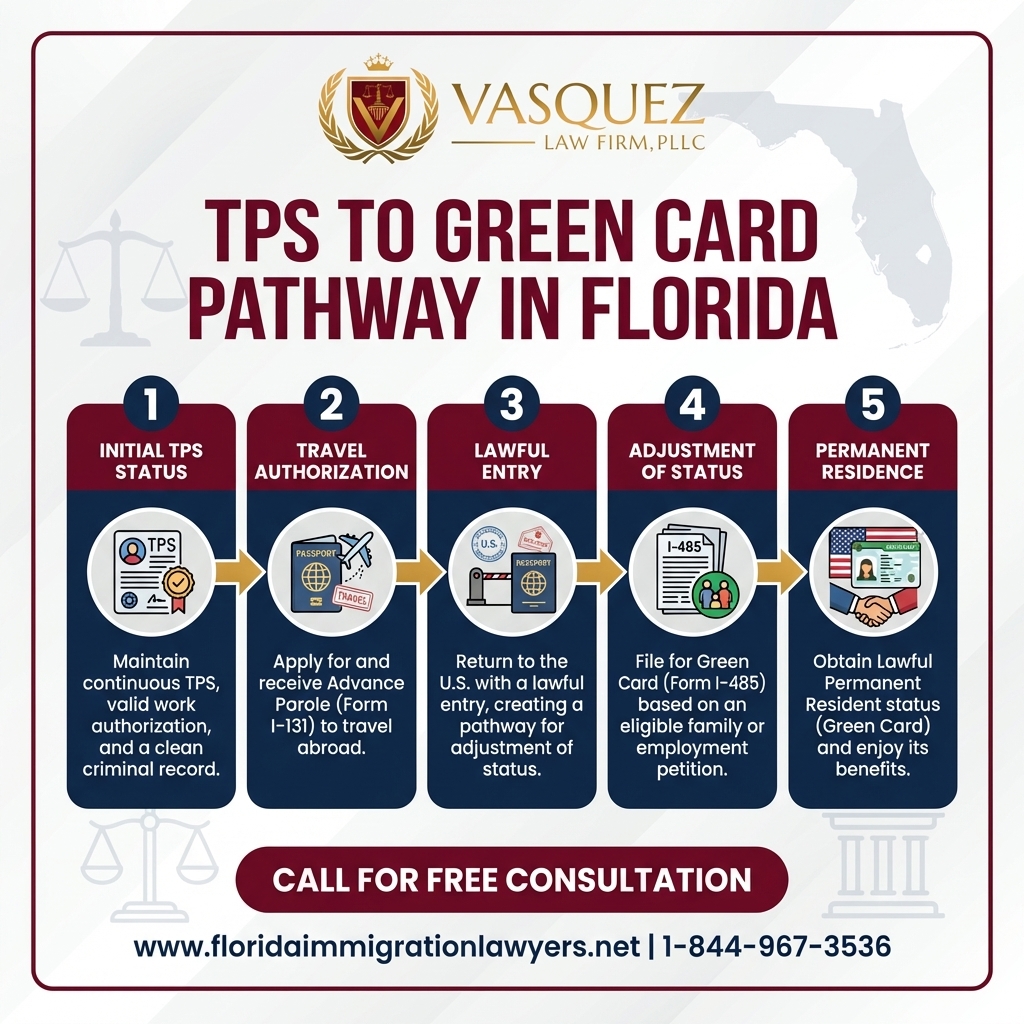
Throughout this process, maintaining your TPS status is crucial until your Green Card is approved. Letting your TPS expire before your adjustment of status is finalized can have serious negative consequences.
Common Challenges and Pitfalls in the TPS to Green Card Process
Navigating the transition from Temporary Protected Status to a Green Card is often complex and fraught with potential challenges. Many TPS holders encounter hurdles that can delay or even jeopardize their application. Understanding these common pitfalls is essential for a successful outcome.
One significant challenge revolves around the concept of "lawful admission." While TPS itself provides a lawful presence, the crucial question for adjustment of status is whether an individual was "inspected and admitted" or "paroled" into the U.S. If a TPS holder initially entered the country without inspection, they historically relied on specific court rulings (like the Matter of Z-Z-R- and later, the Matter of H-G-G-) that allowed TPS to serve as a lawful admission for adjustment purposes. However, recent legal developments, particularly the Supreme Court's decision in Sanchez v. Mayorkas, have clarified that merely having TPS does not cure an initial unlawful entry for the purpose of adjustment of status under INA §245(a). This means that many TPS holders who entered without inspection may need to seek an alternative pathway, such as consular processing, which requires leaving the U.S. and attending an interview abroad, potentially triggering a 3-year or 10-year bar to re-entry if they accrued significant unlawful presence before TPS was granted.
Another common pitfall is the issue of inadmissibility. Even if an applicant meets the "lawful admission" requirement, certain actions or conditions can make them inadmissible to the U.S. These include, but are not limited to, specific criminal convictions, past immigration fraud or misrepresentation, certain health-related issues, or prior periods of unlawful presence. While some grounds of inadmissibility can be waived, the waiver process itself is complex and requires compelling evidence. Failing to disclose relevant information or misrepresenting facts on an application can lead to severe consequences, including a permanent bar from the U.S.
Maintaining continuous eligibility throughout the process is also critical. This includes ensuring that the underlying visa petition (e.g., Form I-130) remains valid, that the TPS status is consistently re-registered, and that no new grounds of inadmissibility arise. Any lapse in TPS status or a change in circumstances (e.g., divorce from a petitioning spouse) can derail the Green Card application. Furthermore, the lengthy processing times for USCIS applications mean that applicants must be prepared for a prolonged period of uncertainty, during which their circumstances or immigration laws could change. This underscores the importance of having experienced legal counsel who can monitor developments and advise on the best course of action. Our team of experienced attorneys is dedicated to guiding clients through these intricate processes.
Finally, the complexity of immigration law itself, coupled with frequent policy changes and varying interpretations by different USCIS officers, presents a significant challenge. What might be permissible in one case could be problematic in another, depending on the specific facts and the prevailing legal landscape. Attempting to navigate this process without professional legal guidance can lead to costly errors, delays, and even denial of the Green Card. Seeking timely and qualified legal advice from an immigration lawyer is not just beneficial; it's often essential for a successful outcome.
Specific Considerations for Florida Residents
Florida is home to a diverse immigrant population, including a significant number of TPS beneficiaries. While federal law governs the adjustment of status process, local USCIS field offices and their particular procedures can sometimes influence the experience. For instance, the Miami Field Office, being one of the busiest in the country, may have different processing times or interview backlogs compared to smaller offices. An attorney familiar with the specific nuances of Florida's USCIS offices can provide invaluable insights and preparation for interviews.
Moreover, Florida's legal landscape, while not directly impacting federal immigration law, can indirectly affect TPS holders. Access to legal aid organizations, community resources, and culturally competent support services varies by region within Florida. Understanding these local resources can be beneficial. It's also important for TPS holders in Florida to be aware of state-specific policies that might affect their daily lives, such as driver's license eligibility or access to certain state benefits, even though these do not directly impact their federal Green Card application.
Benefits of a Green Card
Obtaining a Green Card, or lawful permanent residency, offers numerous significant benefits that provide stability and opportunity far beyond the temporary nature of TPS. With a Green Card, you gain the right to live permanently in the United States, removing the uncertainty associated with TPS re-designations and extensions. This permanent status allows for greater freedom to travel internationally without fear of being denied re-entry, provided you adhere to residency requirements.
Green Card holders can work for any employer in the U.S. without needing specific work authorizations, opening up broader employment opportunities and career advancement. They can also sponsor certain family members for Green Cards, facilitating family reunification. Furthermore, permanent residents are eligible for various federal benefits, including Social Security and Medicare, after meeting specific eligibility periods. Perhaps most importantly, a Green Card is the direct pathway to U.S. citizenship, typically after five years of permanent residency (or three years if married to a U.S. citizen), offering the ultimate security and full civic participation in American society.
Seeking Legal Assistance
Given the complexities and potential pitfalls of navigating the TPS to Green Card pathway, securing experienced legal counsel is not just advisable, but often essential. An immigration attorney specializing in adjustment of status cases can provide comprehensive guidance, from assessing your initial eligibility and identifying potential grounds of inadmissibility to preparing a robust application package and representing you during USCIS interviews. They can help you understand the nuances of "lawful admission," navigate complex waivers, and respond effectively to Requests for Evidence (RFEs) from USCIS.
Our firm has a proven track record of assisting TPS holders in Florida with their adjustment of status applications. We understand the unique challenges faced by immigrants and are dedicated to providing compassionate and effective legal representation. Don't risk your future by attempting to navigate this intricate process alone. Contact us today for a free consultation to discuss your specific situation and learn how our attorneys can help you achieve your dream of permanent residency. We are here to help you understand your options and protect your rights, whether it's through adjustment of status, asylum, or deportation defense.
Conclusion
The pathway from Temporary Protected Status to a Green Card in Florida is a journey that requires careful planning, a thorough understanding of immigration law, and meticulous attention to detail. While challenges exist, particularly regarding lawful admission and inadmissibility, a successful outcome is achievable for many TPS holders. By understanding the eligibility requirements, diligently following the application process, and most importantly, seeking expert legal guidance, you can significantly increase your chances of securing permanent residency. Take the first step towards a more secure future by reaching out to our experienced immigration team. Contact us today for a personalized assessment of your case and let us help you navigate this life-changing process.
Do Not Navigate This Process Alone
Our experienced immigration attorneys are ready to fight for you. Get a free, confidential consultation today.
Se Habla Español
Frequently Asked Questions

William J. Vásquez
Founding Attorney · Vasquez Law Firm
U.S. Air Force veteran and immigration attorney with thousands of cases resolved. J.D., NCCU School of Law. AILA member. Admitted to the 4th, 5th, and 11th Circuit Courts.
Available 24/7 - Free Evaluations
Related Legal Services
Our Florida immigration attorneys can help you with deportation defense, citizenship and naturalization and family immigration services. Call today at 1-844-967-3536 for a free consultation.
Related Links
Related Topics
Free Legal Consultation
Discuss your case with our experienced attorneys. We're available 24/7.
Se Habla Español - Estamos aquí para ayudarle.
Related Articles
Immigration Lawyer Hialeah Florida: Your Trusted Legal Guide
For those in Hialeah, Florida, navigating the complexities of U.S. immigration law requires expert legal guidance. Our comprehensive guide explains why retaining an experienced immigration lawyer in Hialeah, Florida, is crucial for family-based petitions, employment visas, deportation defense, and naturalization. We cover essential services, common pitfalls, and offer a step-by-step overview of the immigration process, including timelines and cost factors. With a focus on Florida-specific challenges and local resources, this article empowers you with the knowledge to make informed decisions. Learn how Florida Immigration Lawyers can provide the dedicated support you need for a successful immigration journey.
TPS Florida Eligible Countries 2026 | FL Immigration Lawyers
Explore Temporary Protected Status (TPS) eligibility for Florida in 2026, focusing on countries facing turmoil and how to apply. Contact Florida Immigration Lawyers for personalized assistance.
Understanding the Asylum One-Year Deadline in Florida
The asylum one-year filing deadline is critical for those seeking refuge in the U.S. Understanding exceptions and preparing your application carefully can influence the outcome of your asylum case. Contact Florida Immigration Lawyers for expert guidance.
Citizenship Application Delay in Florida: What to Know
Facing citizenship application delays in Florida? Discover the key reasons behind N-400 processing backlogs in 2026 and learn how to navigate them effectively. Whether you're in Homestead or elsewhere in Florida, our guide provides actionable insights and tips to help manage your citizenship journey. Contact Florida Immigration Lawyers for personalized support.